Noi nanomateriale fluorescente se inspiră din sistemele de antenă ale instalațiilor(New fluorescent nanomaterials take inspiration from plant antenna systems)

a proiectat un set de nanomateriale fluorescente care s-au inspirat din sistemele de antenă ale plantelor.
Aceste noi materiale multifuncționale urmăresc să imite organismele fotosintetice ale plantelor. Aceste microorganisme constau din mii de molecule de clorofilă încorporate într-o matrice de proteine, care le furnizează o orientare / aranjament specific și o distanță eculară. Una dintre caracteristicile principale ale acestor sisteme este funcția antenei, care le permite să recolteze energia solară într-o gamă spectrală largă și să o transporte prin multiple procese eficiente de transfer de energie către un centru de reacție specific, energie.

Posted: Jan 26, 2016

New fluorescent nanomaterials take inspiration from plant antenna systems

(Nanowerk News) One of the biggest temptations facing a scientist is to try and reproduce natural phenomena which are so fascinating given their effectiveness and perfection. This is the aim being pursued by the UPV/EHU’s Molecular Spectroscopy Group which, coinciding with the International Year of Light, has designed a set of fluorescent nanomaterials which have taken their inspiration from the antenna systems of plants.

These new multifunctional materials aim to imitate the photosynthetic organisms of plants. These microorganisms consist of thousands of chlorophyll molecules embedded in a protein matrix, which provides them with a specific orientation/arrangement and intermolecular distance. One of the main characteristics of these systems is their antenna function, which enables them to harvest solar energy in a broad spectral range and transport it by means of multiple, efficient energy transfer processes to a specific reaction centre, where it is finally turned into chemical energy.
Jorge Bañuelos, Iñigo López Arbeloa, and Leire Gartzia
Jorge Bañuelos, Iñigo López Arbeloa, and Leire Gartzia.
It is a well-known fact that solar radiation is made up of many colours (blue, green, yellow, red, etc.), as borne out by the broad range of colours present in the rainbow. The aim of artificial antenna systems is to capture the greatest light range possible so that it can then be efficiently turned into electrical energy (activating of photovoltaic cells)or the emitting of red light, so useful in photonic applications, such as those of biomedical interest. In this respect, and with the aim of coming up with artificial antenna systems, the Molecular Spectroscopy Group has been developing new dyes and photoactive nanomaterials capable of absorbing a broad interval of chromatic radiation which can then be transformed into a red-only emission.
Energy donor and acceptor molecules coexist in these photoactive dyes and nanomaterials developed by the Molecular Spectroscopy Group. The former are highly photostable fluorescent molecules and are responsible for absorbing the light which they then transfer to the acceptor species, which will emit light. This strategy allows the limitations inherent in the red dyes to be reduced; these red dyes are characterised by their reduced light absorption and their low photostability and offer a great advantage in photonic and biophotonic applications as they allow the photostability of the system and detection sensitivity to be improved.
Three different alternatives have been chosen to develop these antenna systems: two of them are based on the encapsulation of fluorescent dyes in either inorganic or organic hosts, and the other one in the assembly of different dyes into a single molecular structure. “We have replaced the protein matrix of the natural systems by synthetic hosts of nanometric dimensions which protect the dyes and provide a significant arrangement that will help to make the energy transfer processes viable and efficient.
Furthermore, with respect to the photoactive part, which is responsible for interacting with the light, the chlorophyll molecules have been replaced by fluorescent molecules many of which have been tuned à la carte,” explained Leire Gartzia, author of the thesis the most salient results of which have been included in the paper published in International Reviews in Physical Chemistry(„Excitation energy transfer in artificial antennas: from photoactive materials to molecular assemblies”).
In the first of the alternatives, the solid matrix chosen to encapsulate the fluorescent dyes is of crystalline aluminosilicate known as Zeolite L., characterised by the fact that it has unidimensional channels and a suitable pore size (7Å) in which the molecules fit like a glove. “This produces a highly ordered nanomaterial that allows the light emission to be modulated to produce a red or white light depending on the control we exert on the efficiency of the energy transfer process,” added the researcher. This chameleon-like property turns them into materials capable of generating new light emitting diodes (LEDs), featuring white-light emitting diodes (WLED), which are so useful in lighting technologies such as liquid crystal displays (LCD).
The other matrix chosen to host dyes consists of polymer nanoparticles capable of hosting inside them extremely high dye concentrations without it becoming aggregated. “Confining the dyes reduces the photodegradation processes, considerably increases their useful service life and encourages the transfer of energy, which has enabled us not only to obtain an antenna system but also tunable red laser radiation that is efficient and long-lasting in stable aqueous suspensions,” pointed out Leire Gartzia.
Finally, they have developed antenna systems made up solely of organic molecules in which the energy donor and acceptor species are linked by a spacer ensuring short intermolecular distances, thus achieving efficiencies in the energy transfer processes of practically 100%. This has meant a great improvement in the harvesting of light across the visible spectrum, leading to exclusively stable bright red which means they are highly recommended as active hosts for tunable lasers in the zone close to the infrared. The main interest in this wavelength is its great tissue penetration capacity, a key in photodynamic therapy with uses in ophthalmology and dermatology and in cancer treatment, for example.
Source: University of the Basque Country

Sinteza microundelor „înscrie” grafenul spre perfecțiune(Microwave synthesis ‘zaps’ graphene to perfection)

Surprinzator, cercetatorii au descoperit ca lichidul lor ionic oligomeric ar putea dizolva suficiente foi exfoliate pentru a se transforma intr-un gel fizic – primul pentru grafenul curat. Acest material tridimensional are o structură intrinsecă, dependentă de câmpul magnetic, care poate duce la aplicații ale dispozitivelor.

Posted: Jan 22, 2016

Microwave synthesis ‘zaps’ graphene to perfection

(Nanowerk News) By employing microwave radiation and a special ionic liquid solvent, RIKEN researchers have developed a quick, efficient and potentially scalable way to produce large quantities of single-layer graphene (Nature Chemistry, „Ultrahigh-throughput exfoliation of graphite into pristine ‘single-layer’ graphene using microwaves and molecularly engineered ionic liquids”).

Graphene can move electrons at extraordinary speeds because of its unique, ultrathin arrangement of carbon atoms. But isolating this two-dimensional material has proved challenging. While early experiments famously used adhesive tape to separate graphite crystals into single-layer graphene, recent efforts have focused on techniques involving liquid-phase exfoliation that mechanically agitate graphite particles dispersed in a solvent. However, this kind of physical shaking makes it difficult to produce structurally intact graphene sheets in high yields.
graphene
A quick and efficient way to produce single-layer graphene using microwaves and ionic liquids has been found by RIKEN researchers.
Takuzo Aida from the RIKEN Center for Emergent Matter Science and colleagues from across Japan theorized that using everyday microwave ovens might improve graphene synthesis. “We envisioned that a perturbation that activates graphite without mechanical force would give highly efficient exfoliation,” explains Michio Matsumoto, a co-author of the study. “We chose to irradiate graphite with microwaves because graphite is a good absorber of microwaves and releases heat after irradiation.”
Successful exfoliation requires a way to keep the freshly peeled materials separated; otherwise, the graphene layers will recoalesce into larger particles. Ionic liquids—salts that remain in a liquefied state—are promising for this role because their charged nature generates strong attractions to graphitic surfaces. Previously, the RIKEN team used ionic liquids based on imidazolium, a positively charged, nitrogen-bearing ring, to exfoliate carbon nanotubes. But, preliminary studies revealed the need for a different chemical approach.
“The face-to-face stacking that binds graphene layers in graphite was too strong for conventional imidazolium compounds to prevent aggregation of graphite,” explains Matsumoto. “To overcome that stacking force, we designed new ionic liquids inspired by the biological concept of multivalent interactions.”
To make ionic ligands that can stick to multiple sites on a graphene layer, the researchers polymerized imidazolium and ethylene oxide atoms into short chains known as oligomers. When they mixed the oligomeric ionic liquid with graphite powder and heated the solution for 30 minutes in a microwave oven, the results were impressive—exfoliation occurred with a yield of 93 per cent and practically all of the graphene produced was in the form of single layers.
“This work brings large-scale synthesis of high-quality graphene one step closer,” says Matsumoto.
Surprisingly, the researchers found their oligomeric ionic liquid could dissolve enough of the exfoliated sheets to turn into a physical gel—a first for pristine graphene. This three-dimensional material has an intriguing, magnetic-field-dependent structure that may lead to device applications.
Source: RIKEN

Betonul de dezghețare ar putea îmbunătăți siguranța pe carosabil, ar putea proteja împotriva spionajului corporativ(De-icing concrete could improve roadway safety , guard against corporate espionage)

Am o terasă în curtea mea, care este făcută din beton conductiv;Echipa de cercetare a lui Tuan demonstrează performanța de dezghețare a betonului la aviația federală în timpul unei faze de testare

77 sept

Producția de nanotehnologii ar putea beneficia de o tehnică nouă de creștere nanosheet(

echivalentul microscopic al unei singure coli de hârtie, o foaie de date 2D este un material care este limitat la doar câteva straturi atomice într-o direcție. Nanomaterialele – materiale care sunt constrânse în cel puțin o dimensiune la maximum un număr de straturi atomice – au proprietăți fizice unice care modifică proprietățile lor electronice și chimice în raport cu materialele lor identice compozite dar convenționale și mai mari. „Ce este frumos cu un nanomaterial 2D este faptul că pentru că este o foaie, este mult mai ușor pentru noi să manipulăm în comparație cu alte tipuri de nanomateriale

Posted: Jan 21, 2016

Nanotechnology manufacturing could benefit from novel nanosheet growth technique

(Nanowerk News) After six years of painstaking effort, a group of University of Wisconsin-Madison materials scientists believe their breakthrough in growing tiny sheets of zinc oxide could have huge implications for the future of nanomaterial manufacturing—and in turn, on a host of electronic and biomedical devices.

The group, led by Xudong Wang, an associate professor of materials science and engineering at UW-Madison, and postdoctoral researcher Fei Wang, has developed a novel technique for synthesizing two-dimensional nanosheets from compounds that do not naturally form the atomic-layer-thick materials. It is the first time such a technique has been successful, and the researchers described their findings 20, January, 2016, in the journal Nature Communications(„Nanometre-thick single-crystalline nanosheets grown at the water–air interface”).
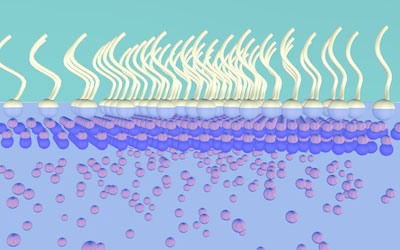
Schematic illustration of the formation of ZnO nanosheets directed by surfactant monolayer
Schematic illustration of the formation of ZnO nanosheets directed by surfactant monolayer.
Essentially the microscopic equivalent of a single sheet of paper, a 2D nanosheet is a material that is constrained to up to only a few atomic layers in one direction. Nanomaterials—materials that are constrained in at least one dimension to a maximum of a handful of atomic layers—have unique physical properties that alter their electronic and chemical properties in relation to their compositionally identical but conventional, and larger, material counterparts. “What’s nice with a 2D nanomaterial is that because it’s a sheet, it’s much easier for us to manipulate compared to other types of nanomaterials,” says Xudong Wang.
Until now, materials scientists were limited to working with naturally occurring 2D nanosheets. These natural 2D structures include graphene, a single layer of graphite, and a limited number of other compounds. Developing a reliable method to synthesize and manufacture 2D nanosheets from other materials has been a goal of materials researchers and the nanotechnology industry for years.
In their technique, the UW-Madison team applied a specially formulated surfactant—a detergent-like substance—onto the surface of a liquid containing zinc ions. Due to its chemical properties, the surfactant assembles itself into a single layer at the surface of liquid, with negatively charged sulfate ions pointed in the direction of the liquid. Those sulfate ions draw the positively charged zinc ions from within the liquid to the surface, and within a couple hours enough zinc ions are drawn up to form continuous zinc oxide nanosheets only a few atomic layers thick.
Xudong Wang first had the idea for using a surfactant to grow nanosheets during a lecture he was giving in a course on nanotechnology in 2009.
“The course includes a lecture about self-assembly of monolayers,” says Xudong Wang. “Under the correct conditions, a surfactant will self-assemble to form a monolayer. This is a well-known process that I teach in class. So while teaching this I wondered why we wouldn’t be able to reverse this method and use the surfactant monolayer first to grow the crystalline face.”
After five years of trial and error with different surfactant solutions, the idea finally paid off about a year ago.
“We are very excited about this,” says Xudong Wang. “This is definitely a new way to fabricate 2D nanosheets, and it has great potential for different materials and for many different applications.”
Already the researchers have has found that the 2D zinc oxide nanosheets they’ve grown are able to function as p-type semiconductor transistors, which is the opposite electronic behavior of naturally occurring zinc oxide. Researchers have for some time attempted to produce zinc oxide with reliable p-type semiconductor properties.
Zinc oxide is a very useful component of electronic materials, and the new nanosheets have potential for use in sensors, transducers and opto-electronics.
But the zinc oxide nanosheets are only the first of what could be a revolution in 2D nanomaterials. Already, the UW-Madison team is applying its surfactant method to growing 2D nanosheets of gold and palladium, and the technique holds promise for growing nanosheets from all sorts of metals that wouldn’t form them naturally.
“It brings a lot of new functional material to this 2D material category,” Xudong Wang says.
Source: University of Wisconsin-Madison


Primul material care urmează să fie țesut la nano nivel(First material to be woven at nano level)

Țesutul este un mod bine-cunoscut de fabricare a țesăturii, dar până acum nu a fost niciodată folosit la nivel molecular. Oamenii de știință au reușit acum să tese firele organice într-un material tridimensional, folosind cuprul ca șablon. Noul material este un cadru organic COF, covalent, și se numește COF-505. Ionii de cupru pot fi îndepărtați și adăugați fără a schimba structura de bază și, în același timp, elasticitatea poate fi schimbată în mod reversibil.

Posted: Jan 21, 2016

First material to be woven at nano level

(Nanowerk News) For the first time, scientists have been able to weave a material at molecular level. The research is led by University of California Berkeley, in cooperation with Stockholm University. The new material is presented in the scientific journal Science („Weaving of organic threads into a crystalline covalent organic framework”).

Weaving is a well-known way of making fabric, but has until now never been used at the molecular level. Scientists have now been able to weave organic threads into a three-dimensional material, using copper as a template. The new material is a COF, covalent organic framework, and is named COF-505. The copper ions can be removed and added without changing the underlying structure, and at the same time the elasticity can be reversibly changed.
„It almost looks like a molecular version of the Vikings chain-armour. The material is very flexible,” says Peter Oleynikov, researcher at the Department of Materials and Environmental Chemistry at Stockholm University.
COF’s are like MOF’s porous three-dimensional crystals with a very large internal surface that can adsorb and store enormous quantities of molecules. A potential application is capture and storage of carbon dioxide, or using COF’s as a catalyst to make useful molecules from carbon dioxide.
The research is led by Professor Omar Yaghi at University of California Berkeley. At Stockholm University Professor Osamu Terasaki, PhD Student Yanhang Ma and Researcher Peter Oleynikov have contributed to determine the structure of COF-505 at atomic level from a nano-crystal, using electron crystallography methods.
„It is a difficult, complicated structure and it was very demanding to resolve. We’ve spent lot of time and efforts on the structure solution. Now we know exactly where the copper is and we can also replace the metal. This opens up many possibilities to make other materials,” says Yanhang Ma, PhD Student at the Department of Materials and Environmental Chemistry at Stockholm University.
Source: Stockholm University

Un simplu material artificial poate influența proprietățile luminii vizibile(A simple artificial material can influence the properties of visible light)

Materiale fabricate artificial, numite metamateriale, pot fi utilizate pentru manipularea luminii pentru o serie de aplicații, dar necesită deseori structuri tridimensionale complicate cu caracteristici de câteva zeci de nanometri. Acum, cercetătorii A * STAR au construit o „metasurface” mai simplă, bidimensională, pentru manipularea luminii de transmisie de ultimă generație ( metaforele dielectrice de înaltă transmisie cu 2 controlul fazei la lungimi de undă vizibile „).Principalul dezavantaj al abordărilor anterioare la astfel de componente optice a fost fracțiunea redusă a luminii transmise. Structura creată de echipă a atins o transmisie de vârf de aproape 90%. „Cele mai multe abordări anterioare se bazează pe nanoparticule plasmonice, care au pierderi puternice în spectrul vizibil și de obicei au doar un răspuns rezonant electric”, explică Yu. „Particulele de siliciu pe care le folosim pot avea rezonante atât electrice, cât și magnetice.” Cercetătorii au eliminat aproape atât pierderile, cât și reflexia optică din metastru.

Posted: Jan 20, 2016

A simple artificial material can influence the properties of visible light

(Nanowerk News) Artificially engineered materials called metamaterials can be used to manipulate light for a range of applications, but often require complicated three-dimensional structures with features as small as a few tens of nanometers. Now, A*STAR researchers have constructed a simpler, two-dimensional ‘metasurface’ for state-of-the-art high-transmission light manipulation („High-transmission dielectric metasurface with 2 phase control at visible wavelengths”).

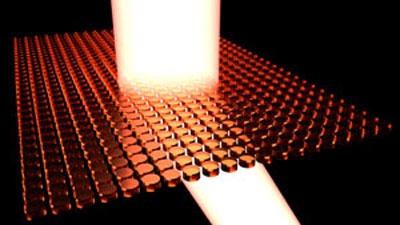
Visualization of the metasurface — a square array of silicon cylinders — manipulating the phase of visible light
Visualization of the metasurface — a square array of silicon cylinders — manipulating the phase of visible light. (Image: A*STAR Data Storage Institute)
A metamaterial is a periodic array of subwavelength-sized elements that interact with an electromagnetic wave’s electric or magnetic component, or both. Each element can be engineered to create a material with optical properties beyond those found in naturally occurring substances. Metasurfaces harness the same idea but are only two-dimensional, and so easier to create.
Yefeng Yu and his co-workers from A*STAR’s Data Storage Institute have created a metasurface that can alter a property of light known as phase (see image). Light can be thought of as a wave with successive peaks and troughs. Moving this wave, to delay or hasten the peaks and troughs, is known as a phase shift. The metasurface designed and created by Yu and the team is capable of complete control over the phase of visible light. By creating certain phase shift distributions it is possible to focus light or even create on-demand holographic images.
The team’s metasurface comprised a square array of silicon disks. Each was 130 nanometers tall with a center-to-center separation of 360 nanometers. Light striking the surface of the structure passed through to the other side, but was deflected by approximately ten degrees. The phase change imparted to the transmitted light by the metasurface was dependent on the radius of the silicon disks. The team showed that varying the radii between 120 and 155 nanometers could produce any desired phase shift.
The main drawback of previous approaches to such optical components has been the low fraction of light transmitted. The structure created by the team reached a peak transmission of almost 90 per cent. “Most previous approaches are based on plasmonic nanoparticles, which have strong losses in the visible spectrum and typically have only an electric resonant response,” explains Yu. “The silicon particles we use can have both electric and magnetic resonances.” The researchers have nearly eliminated both losses and optical reflection from their metasurface.
“To make metasurfaces interesting for practical applications it is important to tune them and dynamically control the phase of incoming light,” says Yu. “This is something our group is now working on.”
Source: A*STAR

Cristalele care pot fi transformate pot permite noi cipuri de memorie(Switchable crystals could enable new memory chips)

au dezvoltat un material subțire, a cărui fază și proprietăți electrice pot fi schimbate între metale și semiconductoare pur și simplu prin aplicarea unei mici tensiuni. Materialul rămâne apoi în noul său configurație, până când este deconectat de o altă tensiune. el deschide calea pentru aplicarea acestor materiale atat in dispozitive electrochimice in stare solida pentru conversia eficienta a stocarii de energie sau oxigen, cat si in aplicatii posibile intr-un nou tip de dispozitive de memorie „.

Posted: Jan 20, 2016

Switchable crystals could enable new memory chips

(Nanowerk News) Two MIT researchers have developed a thin-film material whose phase and electrical properties can be switched between metallic and semiconducting simply by applying a small voltage. The material then stays in its new configuration until switched back by another voltage. The discovery could pave the way for a new kind of “nonvolatile” computer memory chip that retains information when the power is switched off, and for energy conversion and catalytic applications.

The findings, reported in the journal Nano Letters in a paper („Voltage-Controlled Topotactic Phase Transition in Thin-Film SrCoOx Monitored by In Situ X-ray Diffraction”) by MIT materials science graduate student Qiyang Lu and associate professor Bilge Yildiz, involve a thin-film material called a strontium cobaltite, or SrCoOx.
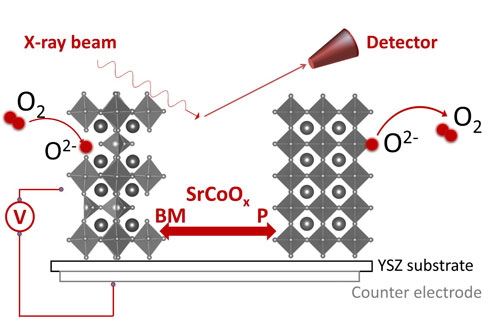
This diagram shows how an electrical voltage can be used to modify the oxygen concentration, and therefore the phase and structure, of strontium cobaltites
This diagram shows how an electrical voltage can be used to modify the oxygen concentration, and therefore the phase and structure, of strontium cobaltites. Pumping oxygen in and out transforms the material from the brownmillerite form (left) to the perovskite form (right). (Courtesy of the researchers)
Usually, Yildiz says, the structural phase of a material is controlled by its composition, temperature, and pressure. “Here for the first time,” she says, “we demonstrate that electrical bias can induce a phase transition in the material. And in fact we achieved this by changing the oxygen content in SrCoOx.”
“It has two different structures that depend on how many oxygen atoms per unit cell it contains, and these two structures have quite different properties,” Lu explains.
One of these configurations of the molecular structure is called perovskite, and the other is called brownmillerite. When more oxygen is present, it forms the tightly-enclosed, cage-like crystal structure of perovskite, whereas a lower concentration of oxygen produces the more open structure of brownmillerite.
The two forms have very different chemical, electrical, magnetic, and physical properties, and Lu and Yildiz found that the material can be flipped between the two forms with the application of a very tiny amount of voltage — just 30 millivolts (0.03 volts). And, once changed, the new configuration remains stable until it is flipped back by a second application of voltage.
Strontium cobaltites are just one example of a class of materials known as transition metal oxides, which is considered promising for a variety of applications including electrodes in fuel cells, membranes that allow oxygen to pass through for gas separation, and electronic devices such as memristors — a form of nonvolatile, ultrafast, and energy-efficient memory device. The ability to trigger such a phase change through the use of just a tiny voltage could open up many uses for these materials, the researchers say.
Previous work with strontium cobaltites relied on changes in the oxygen concentration in the surrounding gas atmosphere to control which of the two forms the material would take, but that is inherently a much slower and more difficult process to control, Lu says. “So our idea was, don’t change the atmosphere, just apply a voltage.”
“Voltage modifies the effective oxygen pressure that the material faces,” Yildiz adds. To make that possible, the researchers deposited a very thin film of the material (the brownmillerite phase) onto a substrate, for which they used yttrium-stabilized zirconia.
In that setup, applying a voltage drives oxygen atoms into the material. Applying the opposite voltage has the reverse effect. To observe and demonstrate that the material did indeed go through this phase transition when the voltage was applied, the team used a technique called in-situ X-ray diffraction at MIT’s Center for Materials Science and Engineering.
The basic principle of switching this material between the two phases by altering the gas pressure and temperature in the environment was developed within the last year by scientists at Oak Ridge National Laboratory. “While interesting, this is not a practical means for controlling device properties in use,” says Yildiz. With their current work, the MIT researchers have enabled the control of the phase and electrical properties of this class of materials in a practical way, by applying an electrical charge.
In addition to memory devices, the material could ultimately find applications in fuel cells and electrodes for lithium ion batteries, Lu says.
“Our work has fundamental contributions by introducing electrical bias as a way to control the phase of an active material, and by laying the basic scientific groundwork for such novel energy and information processing devices,” Yildiz adds.
In ongoing research, the team is working to better understand the electronic properties of the material in its different structures, and to extend this approach to other oxides of interest for memory and energy applications, in collaboration with MIT professor Harry Tuller.
José Santiso, the nanomaterials growth division leader at the Catalan Institute of Nanoscience and Nanotechnology in Barcelona, Spain, who was not involved in this research, calls it “a very significant contribution” to the study of this interesting class of materials, and says “it paves the way for the application of these materials both in solid state electrochemical devices for the efficient conversion of energy or oxygen storage, as well as in possible applications in a new kind of memory devices.”
Source: By David L. Chandler, MIT

Amortizoarele de ultraviolete pe bază de sticlă acționează ca „scuturi biologice”(Glass-based ultraviolet absorbers act as ‘biological shields’)

un grup de cercetători din China a dezvoltat o nouă metodă de a crea materiale transparente, pe bază de sticlă, cu putere de absorbție UV și durate lungi de viață. Echipa a demonstrat că noul sticlă protejează efectiv celulele vii și coloranții organici și crede că ar putea fi dezvoltat și ca un scut transparent pentru protejarea electronicii în spațiu. Ele descriu rezultatele lor în Materialul optic Express ( „Compozit de sticlă ca absorbant UV robust pentru protecție biologică” ).Cercetatorii au folosit un oxid de metal – oxid de ceriu (IV) (CeO 2 ) – bine cunoscut pentru abilitatea sa de a absorbi fotonii UV pentru a ambarca absorbantul UV compozit pe baza de sticla.
Alte caracteristici cheie ale materialului compozit final sunt transparența optică a sticlei și capacitatea materialului de a suprima separarea electronilor generați fotografic și a găurilor. Caracteristica ulterioară încetinește o reacție indusă de lumină care ar conduce la defalcarea ulterioară a materialului sub expunere prelungită la radiațiile UV.

Posted: Jan 20, 2016

Glass-based ultraviolet absorbers act as ‘biological shields’

(Nanowerk News) If you’ve ever experienced a bad sunburn, you know the damage that ultraviolet (UV) light can cause to living cells (like your skin). Out in space, where the level of radiation from the sun can be even higher, it can damage sensitive electronics aboard in-flight spacecraft.

The dangers of UV light have prompted scientists to search for versatile materials that block UV and can withstand long radiation exposure times without falling apart. Now a group of researchers in China has developed a new method to create transparent, glass-based materials with UV-absorbing power and long lifetimes. The team demonstrated that the new glass effectively protects living cells and organic dyes, and believe it could also be developed as a transparent shield to protect electronics in space. They describe their results in Optical Materials Express („Glass composite as robust UV absorber for biological protection”).
UV-Induced Changes to Giant Cells
These images show UV-induced morphological changes of multinucleated giant cells, unprotected and protected by the group’s UV absorber. (Image: Shifeng Zhou/ South China University of Technology)
The researchers used a metal oxide –cerium (IV) oxide (CeO2) – well-known for its ability to absorb UV photons to craft the composite glass-based UV absorber.
Other key features of the final composite material are the optical transparency of the glass and the material’s ability to suppress the separation of photo-generated electrons and holes. The later feature slows down a light-induced reaction that would lead to the ultimate breakdown of the material under prolonged exposure to UV radiation.
The method the team developed is based on the self-limited nanocrystallization of glass.
„Self-limited nanocrystallization of glass can be achieved by taking advantage of the rigid environment of the solid-state matrix, rather than the conventional solution and vapor conditions to modulate the ionic migration kinetics,” explained Shifeng Zhou, School of Materials Science and Engineering, South China University of Technology, Guangzhou, China. „It allows us to create glass-ceramics embedded with a CeO2:fluorine (F) nanostructure.”
The viscous glass matrix involved poses a considerable constraint for oxide (O2-) and F– ion diffusion, so the group gradually etches trifluorocerium (CeF3) by O2- ions within an oxide matrix until F–doped CeO2 is generated in a controllable manner. It’s important to note that this technology is also routinely used to prepare other UV absorbers such as zinc oxide (ZnO) and titanium oxide (TiO2).
„This work establishes an effective approach for the functionalization of glass,” said Zhou. „And it allowed us to demonstrate the construction of a novel glass-based UV absorber.”
The group’s innovative approach for fabricating the UV absorber has important implications „for the construction of novel glass materials with new functions via microstructure engineering,” he added.
Among the group’s key discoveries was finding that the self-limited nanocrystallinization of glass is indeed an effective way to functionalize it. The special glass they created suppresses photocatalytic and catalytic activity, while boasting an extremely high UV-absorbing capacity.
„Our glass shows excellent optical quality, and it can be easily fabricated either in bulk form or as a film,” said Zhou. „It effectively protects organic dye and living cells from UV radiation damage.”
Potential applications for the group’s work include radiation hardening of electronic devices, serving as a biological shield, and preserving cultural artifacts and relics.
„In space, the high-energy radiation environment encountered by electronic equipment aboard spacecraft can be quite damaging,” noted Zhou. „Fortunately, in the future, if you add a radiation-blocking coating onto the surface of the package – a transparent glass/polymer material – the device would be well protected, and its service lifetime may be prolonged.”
In terms of applications as biological shields and to preserve cultural artifacts and relics, the special glass can „protect cells from UV-induced damage,” he added.
Going forward, the group plans to focus their efforts on developing other novel and effective glass-based UV absorbers, using the self-limited nanocrystallization method.
„We’ll explore ways for large-scale fabrication of this type of film, which is extremely important for practical applications,” said Zhou. „Our group will also further study the functionalization of glass based on its microstructure engineering, because we believe this fundamental research may have great significance for the glass industry.”
Source: The Optical Society

Electrolitul celulelor de combustie dezvoltat pentru a oferi o energie mai curată și mai eficientă(Fuel cell electrolyte developed to offer cleaner, more efficient energy)

Un nou material electrolit subțire, care ajută celulele de combustie cu oxizi solizi să funcționeze mai eficient și mai ieftin decât cele compuse din materiale convenționale și care are aplicații potențiale pentru sursele de energie portabile, a fost dezvoltat la Universitatea din Cambridge.
Aceste materiale noi oferă posibilitatea fie de a îmbunătăți în mod semnificativ eficiența sistemelor actuale de celule de combustibil la temperaturi ridicate, fie de a atinge aceleași niveluri de performanță la temperaturi mult mai scăzute. Oricare dintre aceste abordări ar putea permite consumul de combustibil și consumul de deșeuri mult mai redus.

Posted: Jan 20, 2016

Fuel cell electrolyte developed to offer cleaner, more efficient energy

(Nanowerk News) A new thin-film electrolyte material that helps solid oxide fuel cells operate more efficiently and cheaply than those composed of conventional materials, and has potential applications for portable power sources, has been developed at the University of Cambridge.

These new materials offer the possibility of either significantly improving the efficiency of current high-temperature fuel cell systems, or achieving the same performance levels at much lower temperatures. Either of these approaches could enable much lower fuel consumption and waste energy. The material was co-invented by Professor Judith Driscoll of the Department of Materials Science and Metallurgy and her colleague Dr Shinbuhm Lee, with support from collaborators at Imperial College and at three different labs in the US.
Solid oxide fuel cells are comprised of a negative electrode (cathode) and positive electrode (anode), with an electrolyte material sandwiched between them. The electrolyte transports oxygen ions from the cathode to the anode, generating an electric charge. Compared to conventional batteries, fuel cells have the potential to run indefinitely, if supplied by a source of fuel such as hydrogen or a hydrocarbon, and a source of oxygen.
By using thin-film electrolyte layers, micro solid oxide fuel cells offer a concentrated energy source, with potential applications in portable power sources for electronic consumer or medical devices, or those that need uninterruptable power supplies such as those used by the military or in recreational vehicles.
“With low power requirements and low levels of polluting emissions, these fuel cells offer an environmentally attractive solution for many power source applications,” said Dr Charlanne Ward of Cambridge Enterprise, the University’s commercialisation arm, which is managing the patent that was filed in the US. “This opportunity has the potential to revolutionise the power supply problem of portable electronics, by improving both the energy available from the power source and safety, compared with today’s battery solutions.”
In addition to providing significantly improved conductivity, the new electrolyte material offers:
  • minimal heat loss and short circuiting due to low electronic conductivity
  • minimal cracking under heat cycling stress due to small feature size in the construction
  • high density, reducing the risk of fuel leaks
  • simple fabrication using standard epitaxial growth and self-assembly techniques
“The ability to precisely engineer and tune highly crystalline materials at the nanoscale is absolutely key for next-generation power generation and storage of many different kinds,” said Driscoll. “Our new methods and understanding have allowed us to exploit the very special properties of nanomaterials in a practical and stable thin-film configuration, resulting in a much improved oxygen ion conducting material.”
In October, a paper on the enhancement of oxygen ion conductivity in oxides was published in Nature Communications („Strongly enhanced oxygen ion transport through samarium-doped CeO2 nanopillars in nanocomposite films”). It is this enhancement that improves efficiency and enables low-temperature operation of fuel cells. As a result of the reported advantages, the novel electrolyte material can also potentially be used in the fabrication of improved electrochemical gas sensors and oxygen separation membranes (to extract oxygen molecules from the air). The inventors have also published two other papers showing the enhanced ionic conduction in different materials systems, one in Nano Letters („Ionic Conductivity Increased by Two Orders of Magnitude in Micrometer-Thick Vertical Yttria-Stabilized ZrO2 Nanocomposite Films”) and one in Advanced Functional Materials („Strain Tuning and Strong Enhancement of Ionic Conductivity in SrZrO3–RE2O3 (RE = Sm, Eu, Gd, Dy, and Er) Nanocomposite Films”).
Source: University of Cambridge