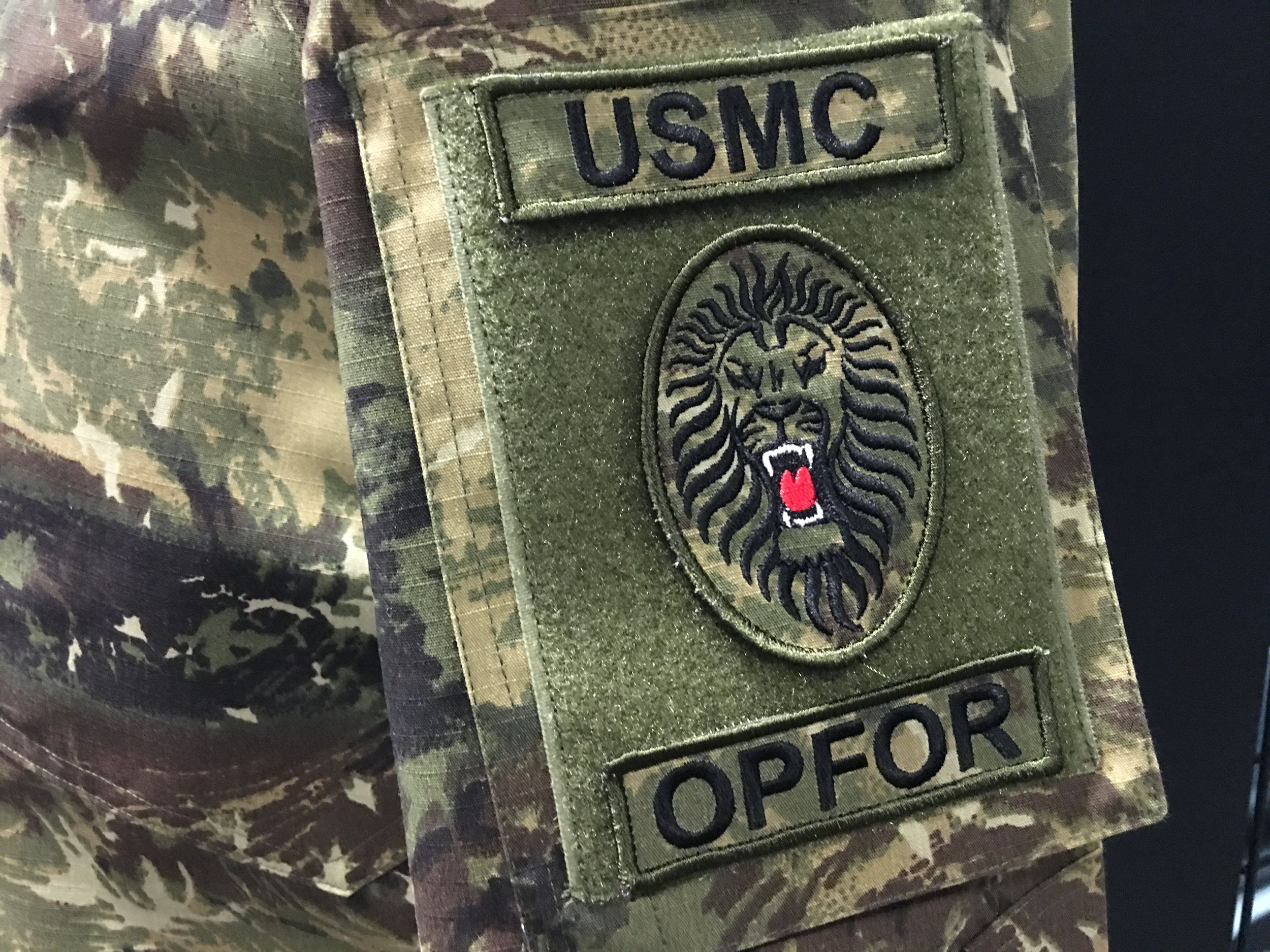
Woodland Combat Camo (Camouflage) Model de luptă uniformă (BDU) pentru spectrul de lumină vizibil și aproape IR!(HyperStealth Biotechnology USMC OPFOR ‘Swirly’ Jungle/Woodland Combat Camo (Camouflage) Pattern Battle Dress Uniform (BDU) for Visible and Near-IR Light Spectrums!)

modelul a fost dezvoltat special pentru a satisface cerințele de colorare ale OPFOR pentru a replica terenurile în care operează și „depășesc nivelurile de reflexie în infraroșu (IR) apropiate de ceea ce văd în prezent în inventarul american de acolo și acest lucru unul a întâmpinat nevoile lor cu colorarea și cu spectrul luminos aproape de infraroșu

HyperStealth Biotechnology USMC OPFOR ‘Swirly’ Jungle/Woodland Combat Camo (Camouflage) Pattern Battle Dress Uniform (BDU) for Visible and Near-IR Light Spectrums! (Video!)

HyperStealth Biotechnology Corp. President/CEO Guy Cramer was kind enough to show DefenseReview (DR) the new USMC OPFOR (United States Marine Corps Opposing Force) “swirly” (or “swirling”) jungle/woodland combat camo (camouflage) pattern BDU (Battle Dress Uniform) at NDIA SOFIC (Special Operations Forces Industry Conference) 2017, and the pattern looked pretty good. According to Cramer, the pattern was specifically developed to meet the OPFOR’s coloration requirements to replicate the terrains in which they operate and “surpass the near-infrared (IR) reflectance levels of what they were currently seeing in the US inventory out there, and this one met their needs with the coloration, and with the near-infrared [light spectrum]. So, very much an advance [in uniform technology] compared to what they’re typically using in the scenarios that they do.”

Now, you may be asking why a non-digital “swirly” pattern. Well, Cramer answered that one for us. “So, for Special Forces, you’re gonna’ want something that is not digital, because quite often, they’ll be within engagement ranges that are 10-5 yards. Digital is so artificial looking that close up, it’s actually give it away. At 30 yards, digital looks better. It actually blends in with the background much better than a design that’s not digital,” says Cramer. Cramer told DR that the new Hyperstealth USMC OPFOR combat camouflage pattern BDU actually started out as a digital pattern, that HyperStealth modified into a non-digital (analog?) swirly pattern. In other words, the non-digital/analog swirly jungle/woodland USMC OPFOR combat camo pattern is designed to optimize concealment at close-in dynamic CQB/CQC (Close Quarters Battle/Close Quarters Combat) distances.

Anyway, Cramer told DR that as of our interview with him at SOFIC, the USMC OPFOR unit had already adopted the new HyperStealth Biotechnology OPFOR BDU, and had been using it for about 6 weeks, which means that they’ve been using it for about 3 months, now.

Defense Review likes the HyperStealth USMC OPFOR pattern, and looks forward to talking with some of the units’ operators at some point, to get their direct feedback on it. In the meantime, enjoy the embedded photos and video.


Company Contact Info:

Guy Cramer, President/Owner
HyperStealth Biotechnology Corp.
P.O. Box 21134
Maple Ridge Sq.
Maple Ridge, B.C., V2X 1P7
Office Phone: 604-961-7046
Email: [email protected]
Website: http://www.hyperstealth.com

Evaluarea performanței unui material compozit bazat pe hârtie Kraft și o rășină formată cu deșeuri polistiren expandate

reciclarea deșeurilor din polistiren expandat (EPS), pentru a contribui la reducerea acumulării excesive a acestui material în depozitele de deșeuri sanitare din Mexic.

Evaluarea performanței unui material compozit bazat pe hârtie Kraft și o rășină formată cu deșeuri polistiren expandate: Un studiu de caz din Mexic

  • M. Jimenez-Francisco
  • J. A. Caamal-Canche
  • J. G. Carrillo 
  • Ricardo H. Cruz-Estrada

Abstract

Lucrarea de față propune reciclarea deșeurilor din polistiren expandat (EPS), pentru a contribui la reducerea acumulării excesive a acestui material în depozitele de deșeuri sanitare din Mexic. Procesul de recuperare a EPS este propus folosind un biosolvent (Lemon limonene-LL) pentru a prepara o soluție polimerică (EPS-LL), iar evaluarea sa ulterioară ca o acoperire pe o hârtie Kraft lignocelulozică de 200 g / m 2și o porozitate Gurley de 15-30 seg / 100 ml. Sa testat efectul diferitelor concentrații de rășină și straturile de acoperire cu rășină asupra rezistenței la compresiune și a rezistenței la tracțiune, precum și rezistența hârtiei tratate la absorbția apei. Rezultatele au arătat că straturile de acoperire au crescut treptat rezistența mecanică a hârtiei Kraft, atât la întindere, cât și la compresiune, dar numai până la o anumită greutate de rășină aplicată. Referitor la absorptiveness apei, hârtia tratată a arătat o reducere semnificativă a absorbției de apă, de la 230 g / m 2 , cu un strat de rășină până la 23 g / m 2cu trei straturi de rășină. Rezultatele demonstrează potențialul reciclării EPS pentru obținerea unui material compozit cu caracteristici hidrofobe bune și rezistență mecanică. Acest studiu are, de asemenea, intenția de a oferi o valoare adăugată a acestui polimer reciclat, mai degrabă decât de a continua obiceiul actual de ao elimina în depozitele de deșeuri sanitare.

/link.springer.com/article/10.1007/s10924-017-1073-7

Lockheed Martin 60 KW Fibră optică cu laser de arme laser testate în termen de 18 luni pentru aplicații viitoare de război(Lockheed Martin 60 LW Fiber-Optic airborne Laser Weapon being Tested within 18 Months for Future Warfare Applications )

Fibră optică cu laser de arme laser testate în termen de 18 luni pentru aplicații viitoare de război;Aici, la DR, suntem fani mari ai armelor cu laser care pot fi folosite pentru a trage din aer in vehicule și soldați inamici

Lockheed

Cel mai eficient lasere nanowire din lume(World’s most efficient nanowire lasers)

Cunoscuți pentru costul redus, prelucrarea simplă și eficiența ridicată, perovskiții sunt materiale populare în cercetarea panoului solar. Acum, cercetatorii au demonstrat ca nanofirele fabricate din perovskitul cu halogenuri de plumb sunt cele mai eficiente lasere nanowire cunoscute ( Materialele Naturale , „Lasere cu perovskite cu nanoparticule de plumb cu praguri de lasere joase si factori de inalta calitate” ).Aceste nanofire pot avansa în aplicații nanofotonice și dispozitive optoelectronice. În special, laserele care funcționează în regiunea apropiată cu infraroșu ar putea beneficia de comunicații cu fibră optică și de avansarea caracterizării poluării din spațiu.

Posted: Jun 17, 2016

World’s most efficient nanowire lasers

(Nanowerk News) Known for their low cost, simple processing and high efficiency, perovskites are popular materials in solar panel research. Now, researchers demonstrated that nanowires made from lead halide perovskite are the most efficient nanowire lasers known (Nature Materials, „Lead halide perovskite nanowire lasers with low lasing thresholds and high quality factors”).

Perovskite-based nanowire lasers
Perovskite-based nanowire lasers are the most efficient known. A topological image of a nanowire is shown (left insert). Room temperature emission images above the lasing threshold for two nanowires composed of different halides, iodide (red in center) and bromide (green on the right), are shown in top inserts. (Image: Xiaoyang Zhu, Columbia University)
Efficient nanowire lasers could benefit fiber optic communications, pollution characterization, and other applications. The challenge is getting the right material. These ultra-compact wires have a superior ability to emit light, can be tuned to emit different colors, and are relatively easy to synthesize. The development of these perovskite wires parallels the rapid development of the same materials for efficient solar cells.
Semiconductor nanowire lasers, due to their ultra-compact physical sizes, highly localized coherent output, and efficiency, are promising components for use in fully integrated nanoscale photonic and optoelectronic devices. Lasing requires a minimum (threshold) excitation density, below which little light is emitted. A high “lasing threshold” not only makes critical technical advances difficult, but also imposes fundamental limits on laser performance due to the onset of other losses.
In searching for an ideal material for nanowire lasing, researchers at Columbia University and the University of Wisconsin-Madison investigated a new class of hybrid organic-inorganic semiconductors, methyl ammonium lead halide perovskites (CH3NH3PbX3), which is emerging as a leading material for high-efficiency photovoltaic solar cells due to low cost, simple processing and high efficiencies.
The exceptional solar cell performance in these materials can be attributed to the long lifetimes of the carriers that move energy through the systems (electrons and holes) and carrier diffusion lengths. These properties, along with other attributes such as high fluorescence yield and wavelength tunability, also make them ideal for lasing applications. Room temperature lasing in these nanowires was demonstrated with:
  • The lowest lasing thresholds and the highest quality factors reported to date
  • Near 100% quantum yield (ratio of the number of photons emitted to those absorbed)
  • Broad tunability of emissions covering the near infrared to visible wavelength region.
Specifically, the laser emission shifts from near infrared to blue with decreasing atomic number of the halides (X=I, Br, Cl) in the nanowires. These nanowires could advance applications in nanophotonics and optoelectronic devices. In particular, lasers that operate in the near infrared region could benefit fiber optic communications and advance pollution characterization from space.
Source: Department of Energy, Office of Science

Noua metodă chimică ar putea revoluționa grafenul( New chemical method could revolutionize graphene)

au descoperit o noua metoda chimica care permite incorporarea grafenului intr-o gama larga de aplicatii, mentinand in acelasi timp electronica ultra-rapida;Graphene, un material ușor, subțire și flexibil, poate fi folosit pentru a spori rezistența și viteza ecranelor de afișare a computerului, a circuitelor electrice / fotonice, a celulelor solare și a diferitelor procese medicale, chimice și industriale, printre alte lucruri.

New Chemical