Tehnica de tricotat cu baterii de fire(Knitting electronics with yarn batteries)

La testare, bateria cu zinc-ion de fire a fost stabilă, a avut o capacitate mare de încărcare și a fost reîncărcabilă și impermeabilă. În plus, materialul ar putea fi tricotat și întins. De asemenea, ar putea fi tăiate în mai multe bucăți, fiecare dintre ele putând servi un ceas. Într-o demonstrație demonstrativă, opt bucăți din bateria de fire tăiate au fost țesute într-o piesă lungă care ar putea alimenta o centură care conține 100 de diode emițătoare de lumină (cunoscute ca LED-uri) și un panou electroluminiscent.

Posted: Mar 28, 2018

Knitting electronics with yarn batteries

(Nanowerk News) When someone thinks about knitting, they usually don’t conjure up an image of sweaters and scarves made of yarn that can power watches and lights. But that’s just what one group is reporting in ACS Nano („Waterproof and Tailorable Elastic Rechargeable Yarn Zinc Ion Batteries by a Cross-Linked Polyacrylamide Electrolyte”). They have developed a rechargeable yarn battery that is waterproof and flexible. It also can be cut into pieces and still work.

Knitting Electronics with Yarn Batteries
Pieces of flexible, rechargeable yarn batteries can be connected in series to power electroluminescent panel displays. (© ACS)
Most people are familiar with smartwatches, but for wearable electronics to progress, scientists will need to overcome the challenge of creating a device that is deformable, durable, versatile and wearable while still holding and maintaining a charge. One dimensional fiber or yarn has shown promise, since it is tiny, flexible and lightweight.
Previous studies have had some success combining one-dimensional fibers with flexible Zn-MnO2 batteries, but many of these lose charge capacity and are not rechargeable. So, Chunyi Zhi and colleagues wanted to develop a rechargeable yarn zinc-ion battery that would maintain its charge capacity, while being waterproof and flexible.
The group twisted carbon nanotube fibers into a yarn, then coated one piece of yarn with zinc to form an anode, and another with magnesium oxide to form a cathode. These two pieces were then twisted like a double helix and coated with a polyacrylamide electrolyte and encased in silicone.
Upon testing, the yarn zinc-ion battery was stable, had a high charge capacity and was rechargeable and waterproof. In addition, the material could be knitted and stretched. It also could be cut into several pieces, each of which could power a watch. In a proof-of-concept demonstration, eight pieces of the cut yarn battery were woven into a long piece that could power a belt containing 100 light emitting diodes (known as LEDs) and an electroluminescent panel.
Source: American Chemical Society

Nanoplatelets ar putea face televizoarele mai eficiente din punct de vedere energetic(Nanoplatelets could make TVs more energy efficient)

Cunoscute ca nanoplateste semiconductoare (NPL), materialele au doar câteva atomi grosime și sunt fabricate din telură de cadmiu. Creat cu metode standard de chimie, NPL-urile sunt destinate în cele din urmă să funcționeze ca elemente de conversie a luminii în dispozitivele de consum.

Posted: Mar 28, 2018

Nanoplatelets could make TVs more energy efficient

(Nanowerk News) Researchers at NIST and Sharp Laboratories of America, Inc. have discovered new optical properties in sheet-like materials that could eventually make flat-screen televisions, laptops and other light-emitting appliances more energy-efficient (Journal of Physical Chemistry, „High-Temperature Photoluminescence in Colloidal ‘Quasi’ 2D Materials”).

Known as semiconductor nanoplatelets (NPLs), the materials are just a few atoms thick and made of cadmium telluride. Created with standard chemistry methods, NPLs are eventually intended to work as light-converting elements in consumer devices.
Nanoplatelets could make TVs more energy efficient
LED lights are shown at top emitting heat. The blue light goes down to a TV screen. The green and red light goes through nanoplatelets before going to the TV screen. (Image: K. Irvine/NIST)
Nanoplatelets could replace the phosphor coatings that are currently used to create full-color light in TV screens and other display and lighting technologies. In such displays, light emitting diodes (LEDs) are used to shine light through the phosphors to create a full-color spectrum.
Although phosphors create fantastic, true-to-life colors that are easy to turn into dynamic pictures on screens, the light-conversion process needs to become more energy-efficient. In addition, replacing phosphors could further increase a display’s dynamic range, making possible even blacker blacks and brighter colors than is possible today.
Recently, researchers and engineers have developed tiny spherical structures called quantum dots (QD) to replace phosphor coating for the light conversion. However, the color quality of light produced by QDs, which are placed directly on a blue LED source, is hard to control due to a phenomenon known as thermal quenching. The light from QDs dramatically dims due to inevitable heating in excess of 212°F (100 °C) from the LED source commonly used in today’s televisions and monitors.
Like QDs, NPLs are designed to emit multicolored light. Both QDs and NPLs are only a few nanometers thick—about ten thousand times narrower than a strand of human hair. But it’s much easier to tailor NPLs’ color-converting properties because it is determined only by the nanoplatelets’ thickness, a much easier property to control than the size of a three-dimensional QD. In addition, the NIST and Sharp Laboratories research has demonstrated that the light from NPLs does not get quenched at elevated temperatures, which is critical for next-generation lighting technology.
More work is needed before the NPLs will be ready for wide-scale market use. But eventually, these optically active nanoplatelets may be as associated with reducing energy waste in lighting and display technologies, as blood platelets are with reducing bleeding in hospital patients. Since about 15 percent of the world’s electricity consumption is currently used for lighting, these tiny sheets of cadmium telluride material may make a big difference in energy efficiency. Developing cadmium-free NPLs is one of the next problems that scientists aim to solve.
Source: By Alison Gillespie, NIST

Compozitul de metal-oxid / grafină prezintă nanoparticule fără precedent proprietăți de stocare(Modulating superconductivity of 2D atomic layers of indium with charge transfer from self-assembled organic molecules)

Modularea supraconductivității straturilor atomice 2D ale indiului cu transfer de sarcină din moleculele organice autoasamblate
cercetătorii au fabricat heterostructuri 2D constând dintr-un strat atomic de indiu (In) epitaxial crescut pe un substrat de siliciu și un metal-ftalocianină foarte comandat (MPc, M = Mn, Cu) auto-asamblat pe stratul In.

Posted: Mar 27, 2018
Modulating superconductivity of 2D atomic layers of indium with charge transfer from self-assembled organic molecules
(Nanowerk News) There have been tremendous advances in the self-assembly of organic molecules on solid surfaces via non-covalent bonds. Furthermore, research on self-assembly of two dimensional (2D) materials has yielded deep insights into the properties of superconducting 2D materials with atomic-scale thickness that could potentially lead to the creation of new hybrid materials and electronic devices through the so-called ‘bottom-up’ approach based on self-assembly as opposed to nanofabrication using etching and lithography.
Notably, the unique physical proprieties of organic molecules offer advantages in terms of flexible and rational design and are an appealing approach with the possibility of opening up new fields of research.
With a view to controlling superconductivity in 2D atomic layers, Takashi Uchihashi and colleagues at International Center for Materials Nanoarchitectonics (WPI-MANA), National Institute for Materials Science,Tsukuba, Japan and collaborators at the Institute for Molecular Science, Okazaki, Japan, and Graduate School of Advanced Integration Science, Chiba University, Chiba, Japan, report the first observation of self-assembled organic molecules modulating the superconducting transport properties of an underlying 2D atomic-layer metallic material (Nano Letters, „Controlled Modification of Superconductivity in Epitaxial Atomic Layer-Organic Molecule Heterostructures”).
Modulation of Tc of indium by self-assembled layers of organic molecules
Modulation of Tc of indium by self-assembled layers of organic molecules. (Image: NIMS)
Specifically, the researchers fabricated 2D heterostructures consisting of an atomic layer of indium (In) epitaxially grown on a silicon substrate and a highly ordered metal-phthalocyanine (MPc, M = Mn, Cu) self-assembled onto the In layer.
In this heterostructure, “charge transfer and local spins due to the presence of organic molecules modified the superconducting properties of the atomic layer”.
Examination of the 2D heterostructures led the researchers unexpectedly find that that substitution of the atom of metal-phthalocyanine from Mn to Cu changed the superconducting transition temperature (Tc) from 3.05 K to 3.20 K, that is, from a negative to positive direction. Further analysis combined with scanning tunneling microscopy (STM), X-ray magnetic circular dichroism (XMCD), and ab initio calculations revealed that this distinct phenomenon was due to competition between charge and spin effects.
“Particularly important is the directionality of the relevant d-orbitals that play a decisive role in magnetic interactions,” says Uchihashi. “It strongly suggests the feasibility of controlling macroscopic superconducting properties through manipulation of molecular states.”
Source: NIMS

Compozitul de metal-oxid / grafină prezintă nanoparticule fără precedent proprietăți de stocare a energiei(Metal-oxide/graphene nanosheet composite exhibits unprecedented energy storage properties)

„Materialul compozit superlatlat descris în această lucrare se bazează pe conceptul MANA de” Materiale Nanoarhitectonice „, spune Sasaki. „Am luat două tipuri de materiale 2D cu proprietăți diferite și am format un material compozit avansat cu caracteristici sinergice care nu sunt expuse de un singur materia

Posted: Mar 27, 2018
Metal-oxide/graphene nanosheet composite exhibits unprecedented energy storage properties
(Nanowerk News) The unique physical properties of nanomaterials are important for the realization of high performance energy storage devices. For example, the ultra-narrow spaces between multilayered two-dimensional (2D) nanosheets are suitable for high efficiency ion intercalation, namely, reversible insertion of ions into the spaces between layers.
Importantly, nanomaterial structures with nearly ideal nano interlayer spaces for ion intercalation exhibit short diffusion distances and large numbers of active sites —properties that are essential for fabricating electrode materials of high performing energy storage devices.
However, despite extensive research on 2D materials such as graphene and transition metal dichalcogenides the energy storage capacity has not met expectations.
More recently, research has also turned to explore 2D metal oxides—materials with many more active sites, and even shorter diffusion lengths. The main issues to resolve include synthesis of genuine single layered metal oxides, prevention of ‘restacking’ during chemical processes to fabricate electrodes, and improving their electrical conductivity.
Here, a group led by Takayoshi Sasaki at the International Center for Materials Nanoarchitectonics (WPI-MANA), National Institute for Materials Science (NIMS), Tsukuba, Japan, describe the synthesis of superlattice-like MnO2/graphene 2D nanostructures that exhibited the best figures of merit for energy storage reported to-date (ACS Nano, „Genuine Unilamellar Metal Oxide Nanosheets Confined in a Superlattice-like Structure for Superior Energy Storage”).
text
Structure of MnO2/graphene superlattice-like structure and electrochemical characteristics of Li and Na batteries fabricated using this material. (Image: NIMS)
The researchers synthesized the MnO2/graphene superlattice structures by ‘electrostatic assembly’ of MnO2 and graphene in a solution, exploiting the differences in the charged states of the respective materials: The MnO2 nanosheets are negatively charged and reduced graphene oxide (rGO) nanosheets are positive. The two important points about this fabrication process and the resulting nanosheet structures are that the MnO2 nanosheets were ‘genuine unilamellar’ structures and each of the MnO2 nanosheets was ‘stabilized’ between the atomic layers of graphene.
The MnO2/graphene nanostructures were used as anodes for Li and Na ion batteries. Electrochemical measurements showed specific capacities of 1325 and 795 mA h g-1 at 0.1 A g-1 and 370 and 245 mA h g-1 at 12.8 A g-1 for Li and Na storage, respectively. “More importantly, an ultralong cyclability with 0.004% and 0.0078% capacity decay per cycle up to 5000 cycles was achieved for Li and Na storage, respectively, outperforming previously reported metal oxide-based anodes to date,” state the authors.
“The superlattice composite material described in this paper is based on MANA’s concept of ‘Materials Nanoarchitectonics’, says Sasaki. “We have taken two types of 2D materials with differing properties and formed an advanced composite material with synergistic characteristics that are not exhibited by a single material.”
Source: NIMS

Minuscule, senzori montați pe dinți care pot urmări ce mănânci(Tiny, tooth-mounted sensors that can track what you eat)

Cu toate acestea, senzorul își poate schimba culoarea. De exemplu, în cazul în care stratul central primește sare sau etanol, proprietățile sale electrice se vor schimba, determinând senzorul să absoarbă și să transmită un spectru diferit de unde de radiofrecvență, cu o intensitate variabilă. Astfel pot fi detectate și măsurate substanțele nutritive și alți analit.
„Teoretic, putem modifica stratul bioresponsiv în acești senzori pentru a viza alte substanțe chimice

Posted: Mar 27, 2018
Tiny, tooth-mounted sensors that can track what you eat
(Nanowerk News) Monitoring in real time what happens in and around our bodies can be invaluable in the context of health care or clinical studies, but not so easy to do. That could soon change thanks to new, miniaturized sensors developed by researchers at the Tufts University School of Engineering that, when mounted directly on a tooth and communicating wirelessly with a mobile device, can transmit information on glucose, salt and alcohol intake.
In research to be published soon in the journal Advanced Materials („Functional, RF-trilayer sensors for tooth-mounted, wireless monitoring of the oral cavity and food consumption”), researchers note that future adaptations of these sensors could enable the detection and recording of a wide range of nutrients, chemicals and physiological states.
A miniaturized sensor mounted on a tooth
A miniaturized sensor mounted on a tooth. (Image: SilkLab, Tufts University)
Previous wearable devices for monitoring dietary intake suffered from limitations such as requiring the use of a mouth guard, bulky wiring, or necessitating frequent replacement as the sensors rapidly degraded. Tufts engineers sought a more adoptable technology and developed a sensor with a mere 2mm x 2mm footprint that can flexibly conform and bond to the irregular surface of a tooth. In a similar fashion to the way a toll is collected on a highway, the sensors transmit their data wirelessly in response to an incoming radiofrequency signal.
The sensors are made up of three sandwiched layers: a central “bioresponsive” layer that absorbs the nutrient or other chemicals to be detected, and outer layers consisting of two square-shaped gold rings. Together, the three layers act like a tiny antenna, collecting and transmitting waves in the radiofrequency spectrum. As an incoming wave hits the sensor, some of it is cancelled out and the rest transmitted back, just like a patch of blue paint absorbs redder wavelengths and reflects the blue back to our eyes.
The sensor, however, can change its “color.” For example, if the central layer takes on salt, or ethanol, its electrical properties will shift, causing the sensor to absorb and transmit a different spectrum of radiofrequency waves, with varying intensity. That is how nutrients and other analytes can be detected and measured.
“In theory we can modify the bioresponsive layer in these sensors to target other chemicals – we are really limited only by our creativity,” said Fiorenzo Omenetto, Ph.D., corresponding author and the Frank C. Doble Professor of Engineering at Tufts. “We have extended common RFID [radiofrequency ID] technology to a sensor package that can dynamically read and transmit information on its environment, whether it is affixed to a tooth, to skin, or any other surface.”
Source: Tufts University

Filmul subțire poate ajuta la gestionarea fluxului de căldură în dispozitivele viitoare(Thin-film could help manage heat flow in future devices)

Acest material subțire este un izolator topologic, care susține fluxul de electroni pe suprafața sa, dar nu și în interior. Nici un studiu nu a testat încă dacă aceleași lucruri erau valabile și pentru căldură,Cercetătorii au descoperit că, cu cât este mai subțire filmul, cu atât este mai mare conductivitatea termică. De asemenea, au descoperit că raportul dintre conductivitatea termică și conductivitatea electrică la suprafața materialelor izolatoare topologice poate fi de peste 10 ori mai mare decât valoarea lui Sommerfeld, valoare care este cunoscută pentru majoritatea metalelor și semiconductorilor determinată de legea Weidemann-Franz.

Posted: Mar 27, 2018

Thin-film could help manage heat flow in future devices

(Nanowerk News) Purdue University researchers have demonstrated the ability of a thin film to conduct heat on just its surfaces, identifying a potential solution to overheating in electronic devices such as phones and computers.

“When you try to make an electronic device, the heat dissipation is always a problem,” said Xianfan Xu, Purdue’s James J. and Carol L. Shuttleworth Professor of Mechanical Engineering. “So we are trying to provide an understanding of how heat can be dissipated in these future devices.”
This thin film material is a topological insulator, which supports the flow of electrons on its surface but not in its interior. No study had yet tested whether the same were true for heat, until confirmed by research published in ACS Nano („Large Enhancement of Thermal Conductivity and Lorenz Number in Topological Insulator Thin Films”).
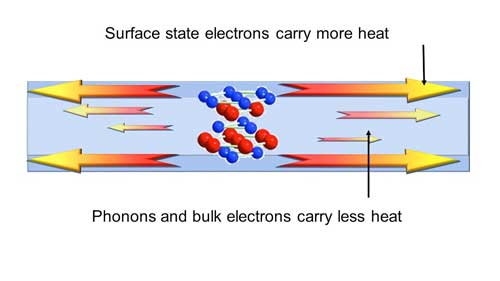
A very thin film has the ability to carry more heat on its surface than in the interior
A very thin film has the ability to carry more heat on its surface than in the interior. (Image: Xianfan Xu, Purdue University)
Past research has speculated that topological insulators could be useful for the development of spintronic devices, which encode information through the spins of electrons as opposed to electrical charge in today’s electronics.
The researchers found that the thinner the film is, the higher the heat conductivity. They also discovered that the ratio of thermal conductivity to electrical conductivity at the surface of the topological insulator materials can be more than 10 times higher than the Sommerfeld value, which is the value known for most metals and semiconductors determined by the Weidemann-Franz law. By conducting heat on just its surfaces rather than across the entire film, this material could prevent parts of a device from heating up or redirect heat.
Xu heat Purdue researchers have discovered a characteristic of this film that could help control heat flow in electronics. (Purdue University image/Jared Pike) Download image
Now, having identified this characteristic of heat transfer in topological insulators, the next step is to figure out how to use them for manipulating heat flow.
“There are not many ways to control heat. It’s not electricity, where you can turn it on and off,” Xu said. “But now there might be a chance to do that.”
The work is a collaborative effort among the research groups led by Xu, Yong Chen, a professor in Purdue’s Department of Physics and Astronomy, and Jesse Maassen, a physics professor at Dalhousie University in Canada.
Source: Purdue University

Explorarea proprietăților termoelectrice ale nanostructurilor de selenide din staniu(Exploring the thermoelectric properties of tin selenide nanostructures)

filmele subtiri SnSe nanostructurate pe care le-am fabricat au avut un factor de putere de doar ~ 5 la suta din cel de SnSe singur cristal la temperatura camerei”, a spus Shuhao Liu, un autor pe hartie. Dar, dupa ce au incercat o varietate de dopanti pentru a imbunatati factorul de putere al materialului, au stabilit ca „argintul a fost cel mai eficient – rezultand o imbunatatire a factorului de putere de 300 la suta fata de probele nedepuse”, a spus Liu. „Pelicula subțire nanostructurată dopată cu argint SnSe promite o valoare ridicată a meritelor.”Acest lucru face ca nanoflacile SnSe să se formeze pe suprafața plăcii. Adăugarea unui element dopant precum argintul la filmele subțiri SnSe în timpul sintezei materialelor poate optimiza în continuare proprietățile termoelectrice.

Posted: Mar 27, 2018

Exploring the thermoelectric properties of tin selenide nanostructures

(Nanowerk News) Single crystal tin selenide (SnSe) is a semiconductor and an ideal thermoelectric material; it can directly convert waste heat to electrical energy or be used for cooling. When a group of researchers from Case Western Reserve University in Cleveland, Ohio, saw the graphenelike layered crystal structure of SnSe, they had one of those magical “aha!” moments.

The group reports in the Journal of Applied Physics („Nanostructured SnSe: Synthesis, doping and thermoelectric properties”), that they immediately recognized this material’s potential to be fabricated in nanostructure forms. “Our lab has been working on two-dimensional semiconductors with layered structures similar to graphene,” said Xuan Gao, an associate professor at Case Western.
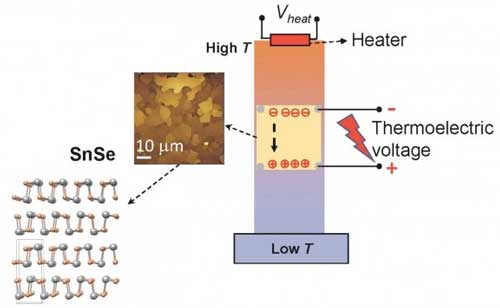
Electric charges in a nanostructured tin selenide (SnSe) thin film flow from the hot end to the cold end of the material and generate a voltage
Electric charges in a nanostructured tin selenide (SnSe) thin film flow from the hot end to the cold end of the material and generate a voltage. (Image: Xuan Gao)
Nanomaterials with nanometer-scale dimensions – such as thickness and grain size – have favorable thermoelectric properties. This inspired the researchers to grow nanometer-thick nanoflakes and thin films of SnSe to further study its thermoelectric properties.
The group’s work centers on the thermoelectric effect. They study how the temperature difference in a material can cause charge carriers – electrons or holes – to redistribute and generate a voltage across the material, converting thermal energy into electricity.
“Applying a voltage on a thermoelectric material can also lead to a temperature gradient, which means you can use thermoelectric materials for cooling,” said Gao. “Generally, materials with a high figure of merit have high electrical conductivity, a high Seebeck coefficient – generated voltage per Kelvin of temperature difference within a material – and low thermal conductivity,” he said.
A thermoelectric figure of merit, ZT, indicates how efficiently a material converts thermal energy to electrical energy. The group’s work focuses on the power factor, which is proportional to ZT and indicates a material’s ability to convert energy, so they measured the power factor of the materials they made.
To grow SnSe nanostructures, they used a chemical vapor deposition (CVD) process. They thermally evaporated a tin selenide powder source inside an evacuated quartz tube. Tin and selenium atoms react on a silicon or mica growth wafer placed at the low-temperature zone of the quartz tube. This causes SnSe nanoflakes to form on the surface of the wafer. Adding a dopant element like silver to SnSe thin films during material synthesis can further optimize its thermoelectric properties.
At the start, “the nanostructure SnSe thin films we fabricated had a power factor of only ~5 percent of that of single crystal SnSe at room temperature,” said Shuhao Liu, an author on the paper. But, after trying a variety of dopants to improve the material’s power factor, they determined that “silver was the most effective – resulting in a 300 percent power factor improvement compared to undoped samples,” Liu said. “The silver-doped SnSe nanostructured thin film holds promise for a high figure of merit.”
In the future, the researcher hope that SnSe nanostructures and thin films may be useful for miniaturized, environmentally friendly, low-cost thermoelectric and cooling devices.
Source: American Institute of Physics

Un nou polimer de tip sticlă ar putea conduce electricitate pentru electronice transparente(New glass-like polymer could conduct electricity for transparent electronics)

au creat un film polimer transparent care conduce de asemenea electricitate, introducând un material organic ieftin pentru aplicații precum ecrane de dispozitive electronice.Filmul polimeric, care are aspectul și simțul sticlei, poate fi produs mai ieftin la scară largă decât oxidul de staniu de indiu, deoarece provine din materiale abundente în pământ. Eficacitatea costurilor sale are și avantaje față de polimerii deja utilizați pentru electronică, care se bazează pe chimie scumpe și doping chimic pentru a obține o conductivitate ridicată. Polimerii conductori existenți, de asemenea, absorg în mod obișnuit lumina datorită structurii lor electronice conjugate sau delocalizate.

Posted: Mar 27, 2018

New glass-like polymer could conduct electricity for transparent electronics

(Nanowerk News) Purdue researchers have created a transparent polymer film that also conducts electricity, introducing an inexpensive organic material for applications such as the screens of electronic devices.

While some polymers can already conduct electricity with the help of a process called chemical doping, none have yet been made that conduct just as well in a transparent form. This combination could find use in TV, phone and computer screens that currently use a relatively expensive inorganic material, indium tin oxide, to serve as a transparent conductor. The researchers detail their discovery in a paper published in Science („A nonconjugated radical polymer glass with high electrical conductivity”).
“The precursors of this new polymer are made on the ton scale,” said Bryan Boudouris, the Robert and Sally Weist Associate Professor of Chemical Engineering. “Having a conducting transparent material from carbon-based materials would be significant.”
The polymer film, which has the look and feel of glass, can be more cheaply produced on a large scale than indium tin oxide because it originates from earth-abundant materials. Its cost effectiveness also has advantages over polymers already used for electronics that rely on expensive chemistry and chemical doping to achieve high conductivity. Existing conducting polymers also typically absorb light due to their conjugated, or delocalized, electron network structure.
“It’s tough to engineer something that is conjugated to be transparent,” said Brett Savoie, an assistant professor of Chemical Engineering. “So, we started with a completely new non-conjugated polymer and modified it to conduct.”
Modifications involved adding radical groups that are already transparent but typically wouldn’t conduct electricity within a polymer. “Our idea was, could we use polymers easier to make on a large scale but also get them to be electronically active?” Boudouris said.
Savoie simulated how the radical groups electronically communicate with each other across the polymeric material, a property known as electrical percolation, to figure out how to make the polymer a good conductor. The simulations showed that it was critical to incorporate more radicals than previous studies had been able to achieve, and also make the polymer soft enough that the radical groups could associate within the material. Boudouris accomplished this by synthesizing a material that had both a high density of radical sites and could flow at low temperatures, resulting in a transparent film processed near room temperature.
high density of transparent radical groups (light regions) enable a polymer to conduct electricity despite non-conducting areas (dark regions)
An artistic rendering shows how a high density of transparent radical groups (light regions) enable a polymer to conduct electricity despite non-conducting areas (dark regions). (Image: Brett Savoie, Purdue University)
This polymer is not only transparent, but could conduct electricity competitively with commercially available conjugated polymers. “The simulations gave us the design principles that will allow us to make even better conductors in the future,” Boudouris said.
The new polymer also provides insights for future research to be conducted by Boudouris, Savoie and other faculty at the Purdue-based Materials Innovation for Bioelectronics from Intrinsically-stretchable Organics (Mi-Bio) center, which aims to produce tailor-made polymers for biomedical applications.
“Conducting polymers are different from other conductors in that they can reversibly exchange ions and analytes with liquid media—kind of like a sponge—and this creates all kinds of interesting sensing and device applications.” Savoie said.
Source: Purdue University

Recoltarea energiei din fluctuațiile de lumină au dezvoltat o metodă și un material care generează un impuls electric atunci când lumina fluctuează de la soare la umbră și invers.

antenele, atunci când sunt încorporate în geamurile din sticlă, ar putea reduce zgomotele reci și ar economisi energie. Antenele, cu dimensiuni de ordinul zecilor de nanometri, reacționează la lumina apropiată de infraroșu și generează căldură.
Antenele sunt formate din discuri metalice mici, în acest caz nanodiscuri de aur, cu un diametru de 160 nm (0,16 micrometri). Ele sunt plasate pe un substrat și acoperite cu un film polimeric pentru a crea proprietățile piroelectrice.
„Nanoantenele pot fi fabricate pe suprafete mari, cu miliarde de discuri mici distribuite uniform pe suprafata
Aplicațiile care sunt mai aproape de mână pot fi găsite în cercetarea optică, cum ar fi detectarea luminii la scară nanometrică

Posted: Mar 26, 2018
Harvesting energy from light fluctuations
(Nanowerk News) It may in the future be possible to harvest energy with the aid of leaves fluttering in the wind. Researchers at the Laboratory of Organic Electronics at Linköping University have developed a method and a material that generate an electrical impulse when the light fluctuates from sunshine to shade and vice versa.
„Plants and their photosynthesis systems are continuously subjected to fluctuations between sunshine and shade. We have drawn inspiration from this and developed a combination of materials in which changes in heating between sunshine and shade generate electricity,” says Magnus Jonsson, docent and principal investigator for the research group in organic photonics and nano-optics at the Laboratory of Organic Electronics, Linköping University.
The results, which have been verified in both experiments and computer simulations, have been published in Advanced Optical Materials („Hybrid Plasmonic and Pyroelectric Harvesting of Light Fluctuations”).
Magnus Jonsson and Mina Shiran Chaharsoughi, Linköping University
This is Magnus Jonsson and Mina Shiran Chaharsoughi at the Laboratory of Organic Electronics, Linköping University. (Image: Thor Balkhed)
Together with researchers from the University of Gothenburg, Magnus Jonsson and his team have previously developed small nanoantennas that absorb sunlight and generate heat. They published an article together in Nano Letters in 2017, describing how the antennas when incorporated into window glass could reduce cold downdraughts and save energy. The antennas, with dimensions in the order of tens of nanometers, react to near infrared light and generate heat.
Mina Shiran Chaharsoughi, PhD student in Magnus Jonsson’s group, has now developed the technology further and created a tiny optical generator by combining the small antennas with a pyroelectric film.
„Pyroelectric” means that an electrical voltage develops across the material when it is heated or cooled. The change of temperature causes charges to move and the generation of an electric current in the circuit.
The antennas consist of small metal discs, in this case gold nanodiscs, with a diameter of 160 nm (0.16 micrometres). They are placed on a substrate and coated with a polymeric film to create the pyroelectric properties.
„The nanoantennas can be manufactured across large areas, with billions of the small discs uniformly distributed over the surface. The spacing between discs in our case is approximately 0.3 micrometres. We have used gold and silver, but they can also be manufactured from aluminium or copper,” says Magnus Jonsson.
The antennas generate heat that is then converted to electricity with the aid of the polymer. It is first necessary to polarize the polymer film in order to create a dipole across it, with a clear difference between positive and negative charge. The degree of polarisation affects the magnitude of the generated power, while the thickness of the polymer film seems not to have any effect at all.
„We force the polarisation into the material, and it remains polarised for a long time,” says Mina Shiran Chaharsoughi.
Mina Shiran Chaharsoughi carried out an experiment in order to demonstrate the effect clearly, holding a twig with leaves in the air flow from a fan. The motion of the leaves created sunshine and shade on the optical generator, which in turn produced small electrical pulses and powered an external circuit.
„The research is at an early stage, but we may in the future be able to use the natural fluctuations between sunshine and shade in trees to harvest energy,” says Magnus Jonsson.
Applications that are closer to hand can be found in optics research, such as the detection of light at the nanometre scale. Other applications may be found in optical computing.
Source: Linköping University