Pielea electronică ar putea fi utilizată pentru multe aplicații, inclusiv dispozitive protetice, monitori de sănătate purtători, robotică și realitate virtuală. O provocare majoră este transferarea circuitelor electrice ultrathin pe suprafețe 3D complexe, iar atunci când electronicele sunt flexibile și suficient de stretchabile pentru a permite mișcarea.
Nov 28, 2018
Flexible electronic skin aids human-machine interactions
(Nanowerk News) Human skin contains sensitive nerve cells that detect pressure, temperature and other sensations that allow tactile interactions with the environment. To help robots and prosthetic devices attain these abilities, scientists are trying to develop electronic skins.
Electronic skin could be used for many applications, including prosthetic devices, wearable health monitors, robotics and virtual reality. A major challenge is transferring ultrathin electrical circuits onto complex 3D surfaces and then having the electronics be bendable and stretchable enough to allow movement.
Some scientists have developed flexible „electronic tattoos” for this purpose, but their production is typically slow, expensive and requires clean-room fabrication methods such as photolithography. Mahmoud Tavakoli, Carmel Majidi and colleagues wanted to develop a fast, simple and inexpensive method for producing thin-film circuits with integrated microelectronics.
In the new approach, the researchers patterned a circuit template onto a sheet of transfer tattoo paper with an ordinary desktop laser printer. They then coated the template with silver paste, which adhered only to the printed toner ink. On top of the silver paste, the team deposited a gallium-indium liquid metal alloy that increased the electrical conductivity and flexibility of the circuit.
Finally, they added external electronics, such as microchips, with a conductive „glue” made of vertically aligned magnetic particles embedded in a polyvinyl alcohol gel.
The researchers transferred the electronic tattoo to various objects and demonstrated several applications of the new method, such as controlling a robot prosthetic arm, monitoring human skeletal muscle activity and incorporating proximity sensors into a 3D model of a hand.
Roboții mici nu mai mari decât o celulă ar putea fi produși în masă utilizând o nouă metodă dezvoltată de cercetători de la MIT. Dispozitivele microscopice, pe care echipa le numește „sincelule” (scurte pentru celulele sintetice), ar putea fi utilizate în cele din urmă pentru a monitoriza condițiile în interiorul unei conducte de petrol sau gaze sau pentru a căuta boala în timp ce plutește prin sânge.
Cheia pentru a face astfel de dispozitive minuscule în cantități mari constă într-o metodă pe care echipa a dezvoltat-o pentru a controla procesul natural de fracturare a materialelor fragile atomice subțiri, direcționând liniile de fractură astfel încât să producă buzunare miniscule de dimensiuni și forme previzibile. Embedded în interiorul acestor buzunare sunt circuite electronice și materiale care pot colecta, înregistra și transmite date.
Oct 23, 2018
How to mass produce cell-sized robots
(Nanowerk News) Tiny robots no bigger than a cell could be mass-produced using a new method developed by researchers at MIT. The microscopic devices, which the team calls “syncells” (short for synthetic cells), might eventually be used to monitor conditions inside an oil or gas pipeline, or to search out disease while floating through the bloodstream.
The key to making such tiny devices in large quantities lies in a method the team developed for controlling the natural fracturing process of atomically-thin, brittle materials, directing the fracture lines so that they produce miniscule pockets of a predictable size and shape. Embedded inside these pockets are electronic circuits and materials that can collect, record, and output data.
The system uses a two-dimensional form of carbon called graphene, which forms the outer structure of the tiny syncells. One layer of the material is laid down on a surface, then tiny dots of a polymer material, containing the electronics for the devices, are deposited by a sophisticated laboratory version of an inkjet printer. Then, a second layer of graphene is laid on top.
Controlled fracturing
People think of graphene, an ultrathin but extremely strong material, as being “floppy,” but it is actually brittle, Strano explains. But rather than considering that brittleness a problem, the team figured out that it could be used to their advantage.
“We discovered that you can use the brittleness,” says Strano, who is the Carbon P. Dubbs Professor of Chemical Engineering at MIT. “It’s counterintuitive. Before this work, if you told me you could fracture a material to control its shape at the nanoscale, I would have been incredulous.”
But the new system does just that. It controls the fracturing process so that rather than generating random shards of material, like the remains of a broken window, it produces pieces of uniform shape and size. “What we discovered is that you can impose a strain field to cause the fracture to be guided, and you can use that for controlled fabrication,” Strano says.
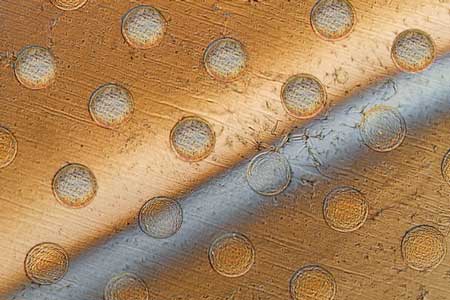
When the top layer of graphene is placed over the array of polymer dots, which form round pillar shapes, the places where the graphene drapes over the round edges of the pillars form lines of high strain in the material. As Albert Liu describes it, “imagine a tablecloth falling slowly down onto the surface of a circular table. One can very easily visualize the developing circular strain toward the table edges, and that’s very much analogous to what happens when a flat sheet of graphene folds around these printed polymer pillars.”
As a result, the fractures are concentrated right along those boundaries, Strano says. “And then something pretty amazing happens: The graphene will completely fracture, but the fracture will be guided around the periphery of the pillar.” The result is a neat, round piece of graphene that looks as if it had been cleanly cut out by a microscopic hole punch.
This photo shows circles on a graphene sheet where the sheet is draped over an array of round posts, creating stresses that will cause these discs to separate from the sheet. The gray bar across the sheet is liquid being used to lift the discs from the surface. (Image: Felice Frankel)
Because there are two layers of graphene, above and below the polymer pillars, the two resulting disks adhere at their edges to form something like a tiny pita bread pocket, with the polymer sealed inside. “And the advantage here is that this is essentially a single step,” in contrast to many complex clean-room steps needed by other processes to try to make microscopic robotic devices, Strano says.
The researchers have also shown that other two-dimensional materials in addition to graphene, such as molybdenum disulfide and hexagonal boronitride, work just as well.
Cell-like robots
Ranging in size from that of a human red blood cell, about 10 micrometers across, up to about 10 times that size, these tiny objects “start to look and behave like a living biological cell. In fact, under a microscope, you could probably convince most people that it is a cell,” Strano says.
This work follows up on earlier research by Strano and his students on developing syncells that could gather information about the chemistry or other properties of their surroundings using sensors on their surface, and store the information for later retrieval, for example injecting a swarm of such particles in one end of a pipeline and retrieving them at the other to gain data about conditions inside it. While the new syncells do not yet have as many capabilities as the earlier ones, those were assembled individually, whereas this work demonstrates a way of easily mass-producing such devices.
Apart from the syncells’ potential uses for industrial or biomedical monitoring, the way the tiny devices are made is itself an innovation with great potential, according to Albert Liu. “This general procedure of using controlled fracture as a production method can be extended across many length scales,” he says. “[It could potentially be used with] essentially any 2-D materials of choice, in principle allowing future researchers to tailor these atomically thin surfaces into any desired shape or form for applications in other disciplines.”
This is, Albert Liu says, “one of the only ways available right now to produce stand-alone integrated microelectronics on a large scale” that can function as independent, free-floating devices. Depending on the nature of the electronics inside, the devices could be provided with capabilities for movement, detection of various chemicals or other parameters, and memory storage.
There are a wide range of potential new applications for such cell-sized robotic devices, says Strano, who details many such possible uses in a book he co-authored with Shawn Walsh, an expert at Army Research Laboratories, on the subject, called “Robotic Systems and Autonomous Platforms,” which is being published this month by Elsevier Press.
As a demonstration, the team “wrote” the letters M, I, and T into a memory array within a syncell, which stores the information as varying levels of electrical conductivity. This information can then be “read” using an electrical probe, showing that the material can function as a form of electronic memory into which data can be written, read, and erased at will. It can also retain the data without the need for power, allowing information to be collected at a later time. The researchers have demonstrated that the particles are stable over a period of months even when floating around in water, which is a harsh solvent for electronics, according to Strano.
“I think it opens up a whole new toolkit for micro- and nanofabrication,” he says.
Daniel Goldman, a professor of physics at Georgia Tech, who was not involved with this work, says, “The techniques developed by Professor Strano’s group have the potential to create microscale intelligent devices that can accomplish tasks together that no single particle can accomplish alone.”
Efectuarea de piele electronică pentru a imita proprietățile tactile de detectare a pielii umane este o zonă activă de cercetare pentru diverse aplicații, cum ar fi electronica portabilă, robotică și proteză. Una dintre provocările majore în cercetarea electronică a pielii este diferențierea diverselor stimuli externi, în special între tulpină și presiune. O altă problemă este depozitarea uniformă a pielii electrice pe obiecte tridimensionale în formă neregulată.
Posted: Sep 24, 2018
Robotic electronic skin made from spray-coated tactile sensor
(Nanowerk News) Robots will be able to conduct a wide variety of tasks as well as humans if they can be given tactile sensing capabilities.
The solution-based process is easily scalable to accommodate for large areas and can be coated as a thin-film on 3-dimensional irregularly shaped objects via spray coating.
These conditions make their processing technique unique and highly suitable for robotic electronic skin or wearable electronic applications.
Spray Coated Tactile Sensor on a 3-D Surface for Robotic Skin. (Video: KAIST)
The making of electronic skin to mimic the tactile sensing properties of human skin is an active area of research for various applications such as wearable electronics, robotics, and prosthetics. One of the major challenges in electronic skin research is differentiating various external stimuli, particularly between strain and pressure. Another issue is uniformly depositing electrical skin on 3-dimensional irregularly shaped objects.
To overcome these issues, the research team led by Professor Steve Park from the Department of Materials Science and Engineering and Professor Jung Kim from the Department of Mechanical Engineering developed electronic skin that can be uniformly coated on 3-dimensional surfaces and distinguish mechanical stimuli.
The new electronic skin can also distinguish mechanical stimuli analogous to human skin. The structure of the electronic skin was designed to respond differently under applied pressure and strain. Under applied strain, conducting pathways undergo significant conformational changes, considerably changing the resistance.
On the other hand, under applied pressure, negligible conformational change in the conducting pathway occurs; e-skin is therefore non-responsive to pressure. The research team is currently working on strain insensitive pressure sensors to use with the developed strain sensors.
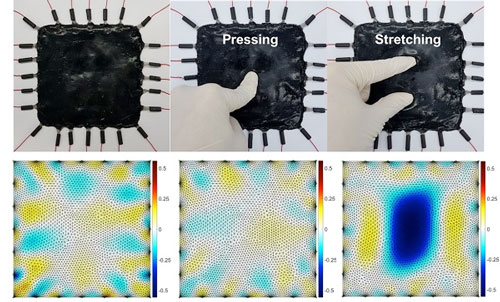
Detecting mechanical stimuli using electrical impedance tomography. (Image: KAIST)
The research team also spatially mapped the local strain without the use of patterned electrode arrays utilizing electrical impedance tomography (EIT). By using EIT, it is possible to minimize the number of electrodes, increase durability, and enable facile fabrication onto 3-dimensional surfaces.
Professor Park said, “Our electronic skin can be mass produced at a low cost and can easily be coated onto complex 3-dimensional surfaces. It is a key technology that can bring us closer to the commercialization of electronic skin for various applications in the near future.”
Universitatea din Texas de la Arlington a brevetat o piele inteligenta, creata de un cercetator UTA, care va da robotilor senzatii tactile mai sensibile decat oameni.Pielea inteligenta este de fapt alcatuita din milioane de senzori de nanofire flexibile care au mult mai multe informatii decat pielea oamenilor. Pe măsură ce senzorii perie o suprafață, robotul colectează toate informațiile pe care senzorii le trimit înapoi.Alte aplicații posibile viitoare includ aderarea pielii inteligente la proteze pentru a le dota cu un sentiment, aplicarea tehnologiei pe alte dispozitive medicale, țeserea pielii în uniforma unui soldat de luptă, astfel încât să poată fi detectată orice substanță chimică toxică sau identificarea amprentelor digitale.
Posted: Aug 09, 2018
Flexible nanowire sensors give robots ultra-sensitive skin
(Nanowerk News) The University of Texas at Arlington has patented a smart skin, created by a UTA researcher, that will give robots more sensitive tactile feeling than humans.
“The idea is to have robots work better alongside people,” said Zeynep Çelik-Butler, a UTA electrical engineering professor. “The smart skin is actually made up of millions of flexible nanowire sensors that take in so much more information than people’s skin. As the sensors brush against a surface, the robot collects all the information those sensors send back.”
Çelik-Butler said the sensors, which are flexible and made of zinc oxide nanorods, are self-powered and do not need any external voltage for operation. Each is about 0.2 microns in diameter, while a human hair is about 40 to 50 microns.
In addition, the developed sensors were fully packaged in a chemical and moisture resistant polyimide that greatly enhances usability in harsh environments. The result is a thin, flexible, self-powered tactile sensing layer, suitable as a robotic or prosthetic skin.
Smart skin technology. (Image: UTA)
The smart skin technology allows the robots to sense temperature changes and surface variations, which would allow a person alongside the robot to be safer or react accordingly.
Other possible future applications include adhering the smart skin to prosthetics to equip them with some feeling, applying the technology to other medical devices, weaving the skin into the uniform of a combat soldier so that any toxic chemicals could be detected or fingerprint identification.
“These sensors are highly sensitive and if they were brushed over a partial fingerprint, the technology could help identify who that person is,” Çelik-Butler said. “Imagine people being able to ascertain a person’s identity with this hairy robot, as my students call it.”
Teri Schultz, director of technology management in the UTA Office of Research, said the technology shows promise in a number of commercial sectors.
“Robots are the here and now,” Schultz said. “We could see this technology develop with the next generation of robots to allow them to be more productive in helping people.”
La nivel național, un metaplan pentru a determina amenințările naționale generale este activ în permanență în direcția efectuării unei evaluări de risc în timp util și, prin urmare, determină mobilizarea capacităților naționale de pregătire și supraveghere.
Cercetările conduse de oamenii de știință de la Universitatea din Luxemburg au arătat potențialul cojilor de cristal lichid ca materiale care permit o gamă largă de aplicații viitoare, de la tehnologia autoturismului până la tehnologia anti-contrafacere și o nouă clasă de senzori.Învelișurile de cristal lichid, numai fracții de un milimetru, astfel încât acestea să poată fi aplicate cu ușurință pe suprafețe, au câteva proprietăți unice care ar putea fi utilizate în inginerie: întrucât reflectă foarte selectiv lumina, ele pot fi aranjate în modele care pot fi citite pentru mașini, asemănător unui cod QR, adăugând informații codate obiectelor. „Aceste modele ar putea fi utilizate pentru a ghida vehicule autonome sau pentru a instrui roboții atunci când manipulează piesele dintr-o fabrică. Acest lucru ar putea deveni important mai ales în cazul aplicațiilor în interior unde dispozitivele GPS nu funcționează”, explică Prof. Lagerwall.
Posted: May 29, 2018
‘Smart’ material enables novel applications in autonomous driving and robotics
(Nanowerk News) Research led by scientists from the University of Luxembourg has shown the potential of liquid crystal shells as enabling material for a vast array of future applications, ranging from autonomous driving to anti-counterfeiting technology and a new class of sensors.
Liquid Crystals, already widely used in flat-screen TVs, are materials that are in a state between solid and liquid. Prof Jan Lagerwall and his team at the Physics and Materials Science Research Unit (PHYMS) at the University of Luxembourg have been investigating the unique mechanical and optical properties of microscopic shells that are produced of liquid crystal for several years.
Now, in a multidisciplinary collaboration with IT scientists Dr. Gabriele Lenzini and Prof Peter Ryan of the University’s Interdisciplinary Center for Security and Trust (SnT) as well as Mathew Schwartz, Assistant Professor at the New Jersey Institute of Technology, they published a report in the scientific journal Advanced Materials („Cholesteric Liquid Crystal Shells as Enabling Material for Information-Rich Design and Architecture”) describing potentially groundbreaking future applications for the material.
Liquid Crystal shells, only fractions of a millimeter in size so they can easily be applied to surfaces, have several unique properties that could be utilized in engineering: As they reflect light highly selectively, they can be arranged into patterns that are readable for machines, akin to a QR code, adding coded information to objects. „These patterns could be used to guide autonomous vehicles or to instruct robots when handling workpieces in a factory. This could become important especially in indoors applications where GPS devices don’t work,” Prof Lagerwall explains.
The shells can be manufactured to reflect only certain wavelengths of light, such as infrared, that would be invisible to the human eye. As the Liquid Crystal shells reflect light „omnidirectionally” meaning that beholders see the same pattern regardless of their position and viewing angle, the patterns can even be read by moving objects.
Additionally, the shells can be manufactured in a way that they change their structure when they are exposed to certain external impacts, such as pressure, heat or specific chemicals.
Together with computers to interpret these changes, the shells could be used as sensors, for example as pressure sensors in the fingertips of robots enabling tactile feeling which is currently hard to achieve in robotic engineering. Another application could be fire exit signage on walls inside buildings that only becomes visible when the temperature exceeds a certain threshold. The big advantage of these sensors is that they passively react to external impacts and don’t need electricity and batteries.
Finally, liquid crystal shells could be used to prevent counterfeiting. The micropatterns that emerge when the shells are brought together are unique and impossible to copy. These unclonable patterns could be used to create uncopiable identifiers that can be attached to valuable objects, such as art works or expensive pharmaceuticals. In combination with cryptographic tools they could be used to create a system that ensures that a buyer or user has the original and not a counterfeited product.
Prof Lagerwall makes clear that the ideas outlined in the report require further research. „Our hope is that the article can stimulate future research on liquid crystalline materials into new directions that are in line with the current societal developments,” he said.
Este un mod cu totul nou de a gândi despre senzori. Fibrele mici dezvoltate la EPFL sunt fabricate din elastomer și pot încorpora materiale cum ar fi electrozi și polimeri nanocompoziți. Fibrele pot detecta chiar și cea mai mică presiune și tensiune și pot rezista la deformări de aproape 500% înainte de a-și recupera forma inițială. Tot ceea ce le face perfecte pentru aplicații în îmbrăcăminte și proteze inteligente și pentru crearea de nervi artificiali pentru roboți.deformate, dar întotdeauna se întorc la forma lor originală.
Materiale rigide precum polimerii nanocompozite, metalele și termoplastele pot fi introduse în fibre, precum și metalele lichide care pot fi ușor deformate. „De exemplu, putem adăuga trei șiruri de electrozi în partea superioară a fibrelor și una în partea inferioară.Electrodii diferiți vor intra în contact în funcție de modul în care se aplică presiunea asupra fibrelor.Aceasta va face ca electrozii să transmită un semnal, care poate fi apoi citită pentru a determina exact ce tip de stres este expus fibrei – cum ar fi stresul de compresiune sau forfecare,oamenii de stiinta si-au integrat fibrele in degetele robotice ca nervi artificiali. Ori de câte ori degetele atinge ceva, electrozii din fibre transmit informații despre interacțiunea tactilă a robotului cu mediul său
Posted: May 25, 2018
An elastic fiber filled with electrodes set to revolutionize smart clothes
(Nanowerk News) It’s a whole new way of thinking about sensors. The tiny fibers developed at EPFL are made of elastomer and can incorporate materials like electrodes and nanocomposite polymers. The fibers can detect even the slightest pressure and strain and can withstand deformation of close to 500% before recovering their initial shape. All that makes them perfect for applications in smart clothing and prostheses, and for creating artificial nerves for robots.
The fibers were developed at EPFL’s Laboratory of Photonic Materials and Fiber Devices (FIMAP), headed by Fabien Sorin at the School of Engineering. The scientists came up with a fast and easy method for embedding different kinds of microstructures in super-elastic fibers. For instance, by adding electrodes at strategic locations, they turned the fibers into ultra-sensitive sensors. What’s more, their method can be used to produce hundreds of meters of fiber in a short amount of time. Their research has just been published in Advanced Materials („Superelastic Multimaterial Electronic and Photonic Fibers and Devices via Thermal Drawing”).
Heat, then stretch
To make their fibers, the scientists used a thermal drawing process, which is the standard process for optical-fiber manufacturing. They started by creating a macroscopic preform with the various fiber components arranged in a carefully designed 3D pattern. They then heated the preform and stretched it out, like melted plastic, to make fibers of a few hundreds microns in diameter. And while this process stretched out the pattern of components lengthwise, it also contracted it crosswise, meaning the components’ relative positions stayed the same. The end result was a set of fibers with an extremely complicated microarchitecture and advanced properties.
Until now, thermal drawing could be used to make only rigid fibers. But Sorin and his team used it to make elastic fibers. With the help of a new criterion for selecting materials, they were able to identify some thermoplastic elastomers that have a high viscosity when heated. After the fibers are drawn, they can be stretched and deformed but they always return to their original shape.
Rigid materials like nanocomposite polymers, metals and thermoplastics can be introduced into the fibers, as well as liquid metals that can be easily deformed. „For instance, we can add three strings of electrodes at the top of the fibers and one at the bottom. Different electrodes will come into contact depending on how the pressure is applied to the fibers. This will cause the electrodes to transmit a signal, which can then be read to determine exactly what type of stress the fiber is exposed to – such as compression or shear stress, for example,” says Sorin.
Artificial nerves for robots
Working in association with Professor Dr. Oliver Brock (Robotics and Biology Laboratory, Technical University of Berlin), the scientists integrated their fibers into robotic fingers as artificial nerves. Whenever the fingers touch something, electrodes in the fibers transmit information about the robot’s tactile interaction with its environment. The research team also tested adding their fibers to large-mesh clothing to detect compression and stretching. „Our technology could be used to develop a touch keyboard that’s integrated directly into clothing, for instance” says Sorin.
The researchers see many other potential applications. Especially since the thermal drawing process can be easily tweaked for large-scale production. This is a real plus for the manufacturing sector. The textile sector has already expressed interest in the new technology, and patents have been filed.
Source: By Laure-Anne Pessina, Ecole Polytechnique Fédérale de Lausanne
Cercetătorii de la trei departamente Technion-Israel Institute of Technology au finalizat un studiu interdisciplinar care dezvăluie configurația optimă pentru roboții nanometrici care pot călători în corpul uman pentru a efectua o varietate de sarcini. Modelul îmbunătățește modelele anterioare de inspirație naturală.
(Nanowerk News) Researchers from three Technion-Israel Institute of Technology departments have completed an interdisciplinary study revealing the optimal configuration for nanoscale robots that can travel within the human body to perform a variety of tasks. The model improves previous nature-inspired models.
Led by Professor Alex Leshansky of the Technion’s Wolfson Department of Chemical Engineering, the research team comprised of members of three different Technion faculties (the others were the Department of Mathematics and the Department of Physics) analyzed the optimal configuration for nanoscale robots that are designed to “swim” through the human body. Their findings were recently published in Science Robotics („Geometric constraints and optimization in externally driven propulsion”).
For the last decade, research groups around the world have been working to develop nanometer- or micrometer-scale robots that can move in a liquid environment. These robots provide diverse opportunities in important biomedical applications, including drug delivery.
The original inspiration for the design of these miniature robots comes from bacteria, which move using slender helical tails called flagella. As the flagellum rotates in the liquid, it creates friction that propels the bacterium. Inspired by this natural mechanism, research groups have developed tiny spirals that are driven by a rotating magnetic field.
Although this method offers a number of advantages (including low power requirements of magnetic field), creating these spirals is complicated. As a result, researchers have suggested using random clusters of magnetic nanoparticles as tiny “swimmers.” Such clusters can be easily fabricated using a simple aggregation process. But in the article published in Science Robotics, the Technion researchers demonstrate that this approach does not yield optimal results.
As part of their study, the Technion researchers developed a theory for calculating the optimal speed of these magnetic swimmers based on their shape and magnetization. As a result, they can now calculate the maximum possible speed of random clusters, and the optimal shape for these tiny swimmers. Contrary to expectations, they found that the thin spiral inspired by nature is not the optimal shape, but rather a thick arc with twisted ends. This optimal propeller was shown to move much faster than the previously developed random clusters.
According to Professor Leshansky, the study’s findings will lead to the development of more efficient microrobots: “Most researchers in the field assume that the biomimetic helical shape for tiny swimming devices is the optimal one. To our surprise, we discovered that the optimal shape is rather different than helix and were able to demonstrate more efficient structure.”
au făcut un pas important spre fabricarea rapidă a unor ecrane electronice flexibile și a altor dispozitive electronice extensibile, inclusiv roboți moi.
Progresul realizat de o echipă din colectivul Robotic Collaborative și Intelligent Systems Institute deschide calea către imprimarea 3D a unor structuri înalte, complicate, cu un aliaj de galiu foarte conductiv.
Cercetătorii au pus nanoparticulele de nichel în metalul lichid, galinstan, pentru a-l îngroșa într-o pastă cu o consistență potrivită pentru fabricarea aditivilor.
Imprimarea de metale lichide este o parte integrantă a câmpului electronic flexibil”, a declarat co-autorul Dogan Yirmibesoglu, doctor în robotică. student la OSU. „Producția de aditivi permite fabricarea rapidă a unor modele și circuite complicate.”
Câmpul oferă o gamă largă de produse, inclusiv produse textile cu conductivitate electrică; afișaje flexibile; senzori pentru cuplu, presiune și alte tipuri de tensiune; costume senzoriale de uzură, cum ar fi cele utilizate în dezvoltarea jocurilor video; antene; și senzori biomedicali.
Posted: Mar 05, 2018
Modified, 3D-printable alloy shows promise for flexible electronics, soft robots
(Nanowerk News) Researchers in Oregon State University’s College of Engineering have taken a key step toward the rapid manufacture of flexible computer screens and other stretchable electronic devices, including soft robots.
The advance by a team within the college’s Collaborative Robotics and Intelligent Systems Institute paves the way toward the 3D printing of tall, complicated structures with a highly conductive gallium alloy.
Researchers put nickel nanoparticles into the liquid metal, galinstan, to thicken it into a paste with a consistency suitable for additive manufacturing.
“The runny alloy was impossible to layer into tall structures,” said Yigit Mengüc, assistant professor of mechanical engineering and co-corresponding author on the study. “With the paste-like texture, it can be layered while maintaining its capacity to flow, and to stretch inside of rubber tubes. We demonstrated the potential of our discovery by 3D printing a very stretchy two-layered circuit whose layers weave in and out of each other without touching.”
Sample 3D prints. (Image: Oregon State University)
Gallium alloys are already being used as the conductive material in flexible electronics; the alloys have low toxicity and good conductivity, plus they’re inexpensive and “self-healing” – able to attach back together at break points.
But prior to the modification developed at OSU, which used sonication – the energy of sound – to mix the nickel particles and the oxidized gallium into the liquid metal, the alloys’ printability was restricted to 2-dimensional.
For this study, researchers printed structures up to 10 millimeters high and 20 millimeters wide.
“Liquid metal printing is integral to the flexible electronics field,” said co-author Dogan Yirmibesoglu, a robotics Ph.D. student at OSU. “Additive manufacturing enables fast fabrication of intricate designs and circuitry.”
The field features a range of products including electrically conductive textiles; bendable displays; sensors for torque, pressure and other types of strain; wearable sensor suits, such as those used in the development of video games; antennae; and biomedical sensors.
“The future is very bright,” Yirmibesoglu said. “It’s easy to imagine making soft robots that are ready for operation, that will just walk out of the printer.”
The gallium alloy paste demonstrates several features new to the field of flexible electronics, added co-corresponding author Uranbileg Daalkhaijav, Ph.D. candidate in chemical engineering.
“It can be made easily and quickly,” Daalkhaijav said. “The structural change is permanent, the electrical properties of the paste are comparable to pure liquid metal, and the paste retains self-healing characteristics.”
Future work will explore the exact structure of the paste, how the nickel particles are stabilized, and how the structure changes as the paste ages.
Source: By Steve Lundeberg, Oregon State University
Exoskeletonele mobile sunt mașini portabile care sunt mobile și alimentate cu ajutorul unui sistem de hidraulică, motoare electrice, pneumatice, pârghii sau o combinație de tehnologii care permit mișcarea membrelor cu rezistență și rezistență