Exoskeletonurile de intensificare a mișcării pot afecta luarea deciziilor(Movement-enhancing exoskeletons may impair decision making)

Poate reduce numărul de baterii pe care un soldat trebuie să le transporte, eventual luminând încărcarea, eliberând spațiul în rucsaci pentru alte consumabile, inclusiv alimente și apă;În experimentele de laborator, soldații care purtau exoskeletoni concepuți pentru a îmbunătăți performanțele fizice au reacționat mai lent la indiciile vizuale

Movement - enhancing exoskeletons

Tehnologia Rostec Active și Passive Exoskeleton în cadrul lucrărilor pentru programul militar rus Ratnik-3 Future Soldier(Rostec Active and Passive Exoskeleton Technology in the Works for Russian Military Ratnik-3 Future Soldier Program)

Fabricat din fibră de carbon ușoară, materialul pasiv al exoscheletului îmbunătățește capacitățile fizice ale soldatului (forță, viteză etc.), protejând în același timp coloanei vertebrale și articulațiilor – și este reglabil în înălțime. Aceasta permite soldatului să transporte o greutate suplimentară de până la 50 kg (110,231 lbs) în timpul „marșurilor și atacurilor lungi”.Exoskeletonele pasive sunt complet autonome și nu necesită surse de alimentare, servomotoare, electronice și senzori”.

Rostec Active and Passive Exoskeleton Technology in the Works for Russian Military Ratnik-3 Future Soldier Program

As if “stealth camouflage” adaptive camouflage/visual cloaking tech isn’t enough, Russian military defense contractor Rostec just demonstrated “operative passive exoskeletons” for Russian Ratnik-3-type future soldiers/warfighters. Oh, and they’re not done. Rostec is also reportedly developing an active exoskeleton, and they’ve already designed a prototype that’ll be shown at an exhibition, soon. So, it would appear that US military infantry warfighters are going to have their hands full, if World War III (WWIII) ever breaks out, and the Russians are on the opposition.

According to Army Technology, the Rostec passive exoskeleton tech was co-developed by the Central Research Institute for Precision Machine Building (TSNIITOCHMASH), which is part of Russia’s Rostec State, and GB Engineering. Made from lightweight carbon fiber, the passive exoskeleton hardware enhances the soldier’s physical capabilities (strength, speed, etc.), while also protecting his/her spine and joints–and it’s height-adjustable. It enables the soldier to carry up to 50kg (110.231 lbs) extra weight during “long marches and assaults”.

This is the part that intrigues DefenseReview (DR), though:

“The passive exoskeletons are completely autonomous and require no power sources, servomotors, electronics and sensors.”

We’re interested to see how that actually works, and how its capabilities differ from the active exoskeleton tech, which we assume is even more capable in terms of strengh, speed and load-bearing enhancement.

Defense Review will try to glean as much information as possible on Rostec’s active exoskeleton technology, and do a follow-up piece on it. If it weren’t already being used for yogurt, a good name for the technology would be “Activia”–has a nice Russian ring to it.


Company Contact Info:

Rostec
24, Usacheva str.
Moscow, 119048
Russian Federation
Phone: +7 (495) 287-25-25
Email: [email protected]
Website: https://rostec.ru

Descoperirea lui Valleytronics ar putea extinde limitele legii lui Moore(Valleytronics discovery could extend limits of Moore’s Law)

Cu această constatare, cercetătorii vor putea dezvolta dispozitive operaționale valleytronic, care într-o bună zi vor putea fi integrate în circuite electronice. Cuplarea unică dintre lumină și văi din acest nou material poate deschide calea spre viitoarele chips-uri hibride electronice / fotonice.” sulfură de staniu (SnS), un candidat ” valleytronics „

Posted: May 01, 2018

Valleytronics discovery could extend limits of Moore’s Law

(Nanowerk News) Research appearing in Nature Communications („Accessing valley degree of freedom in bulk Tin(II) sulfide at room temperature”) finds useful new information-handling potential in samples of tin(II) sulfide (SnS), a candidate „valleytronics” transistor material that might one day enable chipmakers to pack more computing power onto microchips.

The research was led by Jie Yao of the Department of Energy’s Lawrence Berkeley National Laboratory (Berkeley Lab) and Shuren Lin of UC Berkeley’s Department of Materials Science and Engineering and included scientists from Singapore and China. Berkeley Lab’s Molecular Foundry, a DOE Office of Science user facility, contributed to the work.
Local Energy Extrema
Valleytronics utilizes different local energy extrema (valleys) with selection rules to store 0s and 1s. In SnS, these extrema have different shapes and responses to different polarizations of light, allowing the 0s and 1s to be directly recognized. This schematic illustrates the variation of electron energy in different states, represented by curved surfaces in space. The two valleys of the curved surface are shown. (Image: Berkeley Lab)
For several decades, improvements in conventional transistor materials have been sufficient to sustain Moore’s Law – the historical pattern of microchip manufacturers packing more transistors (and thus more information storage and handling capacity) into a given volume of silicon. Today, however, chipmakers are concerned that they might soon reach the fundamental limits of conventional materials. If they can’t continue to pack more transistors into smaller spaces, they worry that Moore’s Law would break down, preventing future circuits from becoming smaller and more powerful than their predecessors.
That’s why researchers worldwide are on the hunt for new materials that can compute in smaller spaces, primarily by taking advantage of the additional degrees of freedom that the materials offer – in other words, using a material’s unique properties to compute more 0s and 1s in the same space. Spintronics, for example, is a concept for transistors that harnesses the up and down spins of electrons in materials as the on/off transistor states.
Valleytronics, another emerging approach, utilizes the highly selective response of candidate crystalline materials under specific illumination conditions to denote their on/off states – that is, using the materials’ band structures so that the information of 0s and 1s is stored in separate energy valleys of electrons, which are dependent on the crystal structures of the materials.
In this new study, the research team has shown that tin(II) sulfide (SnS) is able to absorb different polarizations of light and then selectively reemit light of different colors at different polarizations. This is useful for concurrently accessing both the usual electronic – and the material’s valleytronic – degrees of freedom, which would substantially increase the computing power and data storage density of circuits made with the material.
„We show a new material with distinctive energy valleys that can be directly identified and separately controlled,” said Yao. „This is important because it provides us a platform to understand how valley signatures are carried by electrons and how information can be easily stored and processed between the valleys, which are of both scientific and engineering significance.”
Lin, the first author of the paper, said the material is different from previously investigated candidate valleytronics materials because it possesses such selectivity at room temperature without additional biases apart from the excitation light source, which alleviates the previously stringent requirements in controlling the valleys. Compared to its predecessor materials, SnS is also much easier to process.
With this finding, researchers will be able to develop operational valleytronic devices, which may one day be integrated into electronic circuits. The unique coupling between light and valleys in this new material may also pave the way toward future hybrid electronic/photonic chips.
Berkeley Lab’s „Beyond Moore’s Law” initiative leverages the basic science capabilities and unique user facilities of Berkeley Lab and UC Berkeley to evaluate promising candidates for next-generation electronics and computing technologies. Its objective is to build close partnerships with industry to accelerate the time it typically takes to move from the discovery of a technology to its scale-up and commercialization.
Source: Lawrence Berkeley National Laboratory

Suprafețele rezistente la apă pot fi eficiente în apă, menținând răcirea electronică(Water-repellent surfaces can efficiently boil water, keep electronics cool)

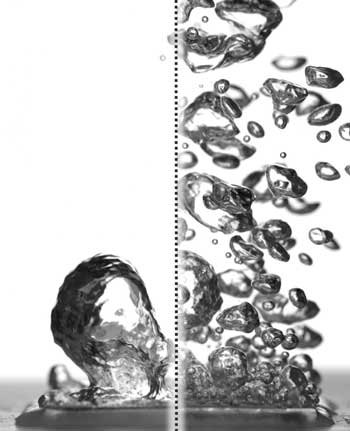
Pre-udarea texturii unei suprafețe superhidrofobe duce la „fixarea” bulelor mici în timpul fierbei, ceea ce înseamnă că ele nu se întind pe suprafață în timp ce se extind. În schimb, ei se îndepărtează fără a coaliza într-o pătură de vapori și ajută la menținerea suprafeței umezite cu apă lichidă. Materialele hidrofobe pot, de asemenea, să formeze mult mai multe bule mici decât suprafețele hidrofile, permițând astfel răcirea mai eficientă a suprafeței.Suprafetele care resping apa pot sustine un punct de fierbere eficient daca tot aerul si vaporii sunt scosi dintr-un sistem

Posted: Apr 30, 2018

Water-repellent surfaces can efficiently boil water, keep electronics cool

(Nanowerk News) Surfaces that repel water can support efficient boiling if all air and vapor is removed from a system first, according to research featured on the cover of the most recent issue of Physical Review Letters („Enabling Highly Effective Boiling from Superhydrophobic Surfaces”).

Water is typically boiled off hydrophilic surfaces to cool nuclear reactors and high-power electronics, preventing them from overheating. Purdue University research has shown that the most water-repellent surfaces possible, superhydrophobic materials, not only can boil water efficiently under the right conditions, but also stay cooler than hydrophilic surfaces.
„One of the ways to take heat out of a surface is to boil from it,” said Justin Weibel, associate research professor of mechanical engineering. „But no one typically considers using superhydrophobic surfaces to improve boiling.”
Boiling from a Water-Proof Surface
Superhydrophobic surfaces are normally insulated by vapor when brought to a boil (left), but getting water to stick makes them boil very efficiently (right), better than hydrophilic surfaces. (Image: Taylor Allred, Purdue University)
Consumer electronics – including laptops and even some smartphones – have water within metal „heat pipes” that dissipate the heat generated when these devices are in use, cooling them off. High-power electronics used in electric vehicles, supercomputers and aircraft particularly call for more efficient means to prevent overheating.
„Superhydrophobic surfaces were previously thought to be bad for boiling because they can’t stay wet,” said Taylor Allred, a Purdue doctoral student in mechanical engineering and first author on the paper. „You get a blanket of vapor on the surface, and because vapor is a very good insulator of heat, you are insulating the surface instead of cooling it.”
Past research has led scientists to believe that without this layer of insulating vapor, superhydrophobic surfaces could potentially boil at lower temperatures than hydrophilic ones. Several studies have attempted making patterned surfaces to get the benefits of both hydrophilic and hydrophobic materials, but researchers hadn’t yet achieved an entirely vapor-free surface with patterning due to the hydrophobic regions.
„We realized that if we could perform one key step prior to boiling from the superhydrophobic surface, we could get the best of both hydrophobic and hydrophilic surface behaviors all in one,” said Suresh Garimella, Purdue’s Goodson Distinguished Professor of Mechanical Engineering and director of the Cooling Technologies Research Center.
Allred first submerged the surface and then heated the surrounding water, being careful to not boil directly from the surface itself. Doing so removed the layer of air that is normally trapped within the texture of the superhydrophobic surface, allowing water to instead penetrate the texture and fully wet it as it would for a hydrophilic surface.
Pre-wetting the texture of a superhydrophobic surface results in the „pinning” of small bubbles during boiling, meaning that they don’t spread out over the surface as they expand. They instead depart without coalescing into a vapor blanket and help keep the surface wet with liquid water. Hydrophobic materials are also able to form many more small bubbles than hydrophilic surfaces, allowing the surface to be cooled more efficiently.
„There are numerous papers on making superhydrophobic surfaces and using them for a variety of applications. With this research, we’ve opened up a whole new area where they can be deployed,” Garimella said.
Source: Purdue University

Monitorizarea stării fizice și a contra-terorismului(Physical Status Monitoring and Counter-terrorism)

CST sau echipele de asistență civilă sunt unități complet echipate și echipate, al căror rol este de a sprijini autoritățile de stat și locale în caz de incidente chimice / biologice / nucleare.Stofa sensibilă a fost o cămașă de întârziere cu întârziere la flacără, cu senzori de țesătură încorporați

0 (13)

Designul de circuit nou promovează generatoarele termoelectrice care pot fi purtate(Novel circuit design boosts wearable thermoelectric generators)

cercetatorii au demonstrat ca generatoarele termoelectrice care pot recupera energia din caldura corporala pot fi folosite pentru a alimenta biosenzori simpli pentru masurarea frecventei cardiace, a respiratiei sau a altor factori.”Comunitatea electronică a făcut progrese extraordinare în înțelegerea proprietăților electronice și optice ale materialelor pe bază de polimeri. Construim aceste cunoștințe pentru a înțelege transportul termic și termoelectric în aceste polimeri pentru a permite noi funcționalități ale dispozitivului. ”
Printre celelalte perspective ale materialelor dezvoltate se numără dispozitive de răcire localizate care inversează procesul, folosind electricitatea pentru a transfera energia termică dintr-o parte a unui dispozitiv în altul. Răcirea doar a unor părți ale corpului ar putea oferi percepția confortului fără costul aerului condiționat mare.

Posted: Oct 09, 2017

Novel circuit design boosts wearable thermoelectric generators

(Nanowerk News) Using flexible conducting polymers and novel circuitry patterns printed on paper, researchers have demonstrated proof-of-concept wearable thermoelectric generators that can harvest energy from body heat to power simple biosensors for measuring heart rate, respiration or other factors.

Because of their symmetrical fractal wiring patterns, the devices can be cut to the size needed to provide the voltage and power requirements for specific applications. The modular generators could be inkjet printed on flexible substrates, including fabric, and manufactured using inexpensive roll-to-roll techniques.
“The attraction of thermoelectric generators is that there is heat all around us,” said Akanksha Menon, a Ph.D. student in the Woodruff School of Mechanical Engineering at the Georgia Institute of Technology. “If we can harness a little bit of that heat and turn it into electricity inexpensively, there is great value. We are working on how to produce electricity with heat from the body.”
The research was reported in the Journal of Applied Physics („Interconnect patterns for printed organic thermoelectric devices with large fill factors”)
Electrical conductivity is measured for a thermoelectric polymer film
Electrical conductivity is measured for a thermoelectric polymer film in the laboratory of Shannon Yee at the Georgia Institute of Technology. (Image: Georgia Tech)
Thermoelectric generators, which convert thermal energy directly into electricity, have been available for decades, but standard designs use inflexible inorganic materials that are too toxic for use in wearable devices. Power output depends on the temperature differential that can be created between two sides of the generators, which makes depending on body heat challenging. Getting enough thermal energy from a small contact area on the skin increases the challenge, and internal resistance in the device ultimately limits the power output.
To overcome that, Menon and collaborators in the laboratory of Assistant Professor Shannon Yee designed a device with thousands of dots composed of alternating p-type and n-type polymers in a closely-packed layout. Their pattern converts more heat per unit area due to large packing densities enabled by inkjet printers. By placing the polymer dots closer together, the interconnect length decreases, which in turn lowers the total resistance and results in a higher power output from the device.
“Instead of connecting the polymer dots with a traditional serpentine wiring pattern, we are using wiring patterns based on space filling curves, such as the Hilbert pattern – a continuous space-filling curve,” said Kiarash Gordiz, a co-author who worked on the project while he was a Ph.D. student at Georgia Tech. “The advantage here is that Hilbert patterns allow for surface conformation and self-localization, which provides a more uniform temperature across the device.”
The new circuit design also has another benefit: its fractally symmetric design allows the modules to be cut along boundaries between symmetric areas to provide exactly the voltage and power needed for a specific application. That eliminates the need for power converters that add complexity and take power away from the system.
“This is valuable in the context of wearables, where you want as few components as possible,” said Menon. “We think this could be a really interesting way to expand the use of thermoelectrics for wearable devices.”
So far, the devices have been printed on ordinary paper, but the researchers have begun exploring the use of fabrics. Both paper and fabric are flexible, but the fabric could be easily integrated into clothing.
“We want to integrate our device into the commercial textiles that people wear every day,” said Menon. “People would feel comfortable wearing these fabrics, but they would be able to power something with just the heat from their bodies.”
With the novel design, the researchers expect to get enough electricity to power small sensors, in the range of microwatts to milliwatts. That would be enough for simple heart rate sensors, but not more complex devices like fitness trackers or smartphones. The generators might also be useful to supplement batteries, allowing devices to operate for longer periods of time.
Among the challenges ahead are protecting the generators from moisture and determining just how close they should be to the skin to transfer thermal energy – while remaining comfortable for wearers.
The researchers use commercially-available p-type materials, and are working with chemists at Georgia Tech to develop better n-type polymers for future generations of devices that can operate with small temperature differentials at room temperatures. Body heat produces differentials as small as five degrees, compared to a hundred degrees for generators used as part of piping and steam lines.
“One future benefit of this class of polymer material is the potential for a low-cost and abundant thermoelectric material that would have an inherently low thermal conductivity,” said Yee, who directs the lab as part of the Woodruff School of Mechanical Engineering. “The organic electronics community has made tremendous advances in understanding electronic and optical properties of polymer-based materials. We are building upon that knowledge to understand thermal and thermoelectric transport in these polymers to enable new device functionality.”
Among the other prospects for the materials being developed are localized cooling devices that reverse the process, using electricity to move thermal energy from one side of a device to another. Cooling just parts of the body could provide the perception of comfort without the cost of large-space air conditioning, Yee said.
Source: Georgia Institute of Technology

Tehnologie de suport tehnic sprijină performanța infanteriei(Wearable Technology Supports Infantry Performance )

Tehnologia performanta este angajato serios pentru a ajuta la îmbunătățirea capacităților sale de infanterie; Dezvoltatorii din spatele adoptării aplicațiilor de tehnologie de uzură sunt variate, însă o aplicație cheie este folosirea acestei tehnologii pentru a monitoriza starea fizică a unui soldat

wearable Technology