O nouă generație de retine artificiale bazată pe materiale 2D(A new generation of artificial retinas based on 2D materials)

Oamenii de stiinta sustin ca au dezvoltat si testat cu succes prima retina artificiala ultrathina din lume, care ar putea imbunatatii considerabil tehnologia vizuala implantabila existenta pentru orb. Dispozitivul flexibil, bazat pe materiale foarte subțiri 2D, ar putea reveni într-o zi la milioane de oameni cu boli retiniene. Și cu câteva modificări, dispozitivul ar putea fi folosit pentru a urmări activitatea inimii și a creierului.
Cercetatorii isi prezinta lucrarile astazi la cea de-a 256-a reuniune nationala si expozitie a Societatii Americane de Chimie (ACS).
Aceasta este prima demonstratie pe care o puteti folosi grafenul cu cateva straturi si disulfura de molibden pentru fabricarea cu succes a unei retini artificiale „, spune Nanshu Lu, Ph.D. Desi aceasta cercetare este inca in faza incipienta, este un punct de plecare foarte interesant pentru utilizarea acestor materiale pentru a restabili viziunea, spune ea, adaugand ca acest dispozitiv ar putea fi, de asemenea, implantat in alta parte a corpului pentru a monitoriza activitatile inimii si creierului.

Posted: Aug 20, 2018

A new generation of artificial retinas based on 2D materials

(Nanowerk News) Scientists report they have successfully developed and tested the world’s first ultrathin artificial retina that could vastly improve on existing implantable visualization technology for the blind. The flexible device, based on very thin 2D materials, could someday restore sight to the millions of people with retinal diseases. And with a few modifications, the device could be used to track heart and brain activity.

The researchers are presenting their work today at the 256th National Meeting & Exposition of the American Chemical Society (ACS).
“This is the first demonstration that you can use few-layer graphene and molybdenum disulfide to successfully fabricate an artificial retina,” Nanshu Lu, Ph.D., says. “Although this research is still in its infancy, it is a very exciting starting point for the use of these materials to restore vision,” she says, adding that this device could also be implanted elsewhere in the body to monitor heart and brain activities.
The retina, located at the back of the eye, contains specialized photoreceptor cells called rods and cones that convert incoming light into nerve signals. These impulses travel into the brain via the optic nerve where they are decoded into visual images.
Diseases such as macular degeneration, diabetic retinopathy and retinitis pigmentosa can damage or destroy retinal tissue, leading to vision loss or complete blindness. There is no cure for many of these diseases, but silicon-based retinal implants have restored a modicum of vision to some individuals.
However, Lu says these devices are rigid, flat and fragile, making it hard for them to replicate the natural curvature of the retina. As a result, silicon-based retinal implants often produce blurry or distorted images and can cause long-term strain or damage to surrounding eye tissue, including the optic nerve.
Lu, who is at the University of Texas at Austin, and her collaborator Dae-Hyeong Kim, Ph.D., who is at Seoul National University, sought to develop a thinner, more flexible alternative that would better mimic the shape and function of a natural retina.
The researchers used 2D materials, including graphene and molybdenum disulfide, as well as thin layers of gold, alumina and silicon nitrate to create a flexible, high-density and curved sensor array. The device, which resembles the surface of a flattened soccer ball or icosahedron, conforms to the size and shape of a natural retina without mechanically disturbing it.
In laboratory and animal studies, photodetectors on the device readily absorbed light and passed it through a soft external circuit board. The circuit board housed all of the electronics needed to digitally process light, stimulate the retina and acquire signals from the visual cortex.
Based on these studies, the researchers determined that this prototype artificial retina is biocompatible and successfully mimics the structural features of the human eye. They say it could be an important step in the quest to develop the next generation of soft bio-electronic retinal prostheses.
Moving ahead, Lu is exploring ways to integrate this technology into mechanically and optically imperceptible electronic tattoos that are laminated on the skin surface to gather real-time health information. Lu says that the team plans to add transistors to these transparent e-tattoos to help amplify signals from the brain or the heart so they can be more easily monitored and treated.
These ultrathin sensors and electrodes can also be implanted on the surface of the heart to detect arrhythmias. Lu says doctors could potentially program them to act like tiny pacemakers, sending electrical impulses through the heart to correct the problem.

Title: 2D Materials based on Epidermal and Implantable Conformal Electronics

Abstract :Bio-tissues are soft, curvilinear and dynamic whereas wafer-based electronics are hard, planar, and fragile. Such mismatch fundamentally impedes their integration with each other. As atomically thin, optically transparent, mechanically robust, and highly functional electronic materials, 2D materials are ideal for conformable bioelectronics. We have invented a cost- and time-effective “wet transfer, dry patterning” process for the freeform manufacture of graphene e-tattoos (GETs). Our GET has a total thickness of less than 500 nm, an optical transparency of ~85%, and a stretchability of more than 40%. Tensile fracture of PMMA-supported graphene has been experimentally investigated and different stages of fracture have been identified. GET can be directly laminated on human skin exactly like a temporary transfer tattoo and can fully conform to the microscopic morphology of the skin surface via just van der Waals forces. Analytical models are developed to guide the GET design for full skin conformability even under skin deformation [4]. As a dry electrode, GET-skin interface impedance is found to be as low as medically used Ag/AgCl gel electrodes. GET has been successfully applied to measure electrocardiogram (ECG), electromyogram (EMG), electroencephalogram (EEG), skin temperature, and skin hydration. When applied around human eyes, imperceptible GET electrooculogram (EOG) sensors can capture eye movement with an angular resolution of 4 degrees, which can be used to wirelessly control a quadcopter in real-time. In addition to noninvasive e-tattoos, we have engineered human eye-inspired soft implantable optoelectronic device using atomically thin MoS2-graphene heterostructure and strain-releasing, retina conformable designs. The hemispherically curved image sensor array exhibits infrared blindness and successfully acquires pixelated optical signals. We propose the ultrathin hemispherically curved image sensor array as a promising imaging element in the soft retinal implant with minimum mechanical loading to the retina. Optical signals obtained by this curved image array can be converted to electrical stimulations applied to optic nerves to restore visualization.
Source: American Chemical Society

Nano-urile de imprimare ecologice pot restabili vederea orbilor(

Retina artificială constă într-o peliculă subțire circulară de material fotoactiv și este similară cu un pixel individual într-un senzor de cameră digitală. Fiecare pixel este cu adevărat microscopic – este de aproximativ 100 de ori mai subțire decât o singură celulă și are un diametru mai mic decât diametrul părului uman. Se compune dintr-un pigment de nanocristale semiconductoare. Astfel de pigmenți sunt ieftini și non-toxici și sunt utilizați în mod obișnuit în cosmeticele comerciale și în cerneala tatuajelor.

Posted: May 02, 2018

Organic printing nanoinks may restore sight to blind people

(Nanowerk News) A simple retinal prosthesis is being developed in collaboration between Tel Aviv University in Israel and Linköping University in Sweden. Fabricated using cheap and widely-available organic pigments used in printing inks and cosmetics, it consists of tiny pixels like a digital camera sensor on a nanometric scale. Researchers hope that it can restore sight to blind people.

Researchers led by Eric Glowacki, principal investigator of the organic nanocrystals subgroup in the Laboratory of Organic Electronics, Linköping University, have developed a tiny, simple photoactive film that converts light impulses into electrical signals. These signals in turn stimulate neurons (nerve cells). The research group has chosen to focus on a particularly pressing application, artificial retinas that may in the future restore sight to blind people.
The Swedish team, specializing in nanomaterials and electronic devices, worked together with researchers in Israel, Italy and Austria to optimise the technology. Experiments in vision restoration were carried out by the group of Yael Hanein at Tel Aviv University in Israel. Yael Hanein’s group is a world-leader in the interface between electronics and the nervous system.
The results have recently been published in Advanced Materials („Direct electrical neurostimulation with organic pigment photocapacitors”).
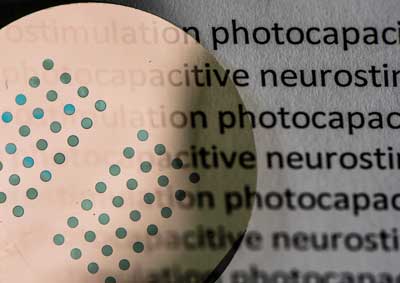
An array of semitransparent organic pixels on top of a ultrathin sheet of gold
An array of semitransparent organic pixels on top of a ultrathin sheet of gold. The thickness of both the organic islands and the underlying gold is more than one-hundred times thinner than a single neuron. (Image: Thor Balkhed)
The retina consists of several thin layers of cells. Light-sensitive neurons in the back of the eye convert incident light to electric signals, while other cells process the nerve impulses and transmit them onwards along the optic nerve to an area of the brain known as the “visual cortex”. An artificial retina may be surgically implanted into the eye if a person’s sight has been lost as a consequence of the light-sensitive cells becoming degraded, thus failing to convert light into electric pulses.
The artificial retina consists of a thin circular film of photoactive material, and is similar to an individual pixel in a digital camera sensor. Each pixel is truly microscopic – it is about 100 times thinner than a single cell and has a diameter smaller than the diameter of a human hair. It consists of a pigment of semi-conducting nanocrystals. Such pigments are cheap and non-toxic, and are commonly used in commercial cosmetics and tattooing ink.
“We have optimised the photoactive film for near-infrared light, since biological tissues, such as bone, blood and skin, are most transparent at these wavelengths. This raises the possibility of other applications in humans in the future,” says Eric Glowacki.
He describes the artificial retina as a microscopic doughnut, with the crystal-containing pigment in the middle and a tiny metal ring around it. It acts without any external connectors, and the nerve cells are activated without a delay.
“The response time must be short if we are to gain control of the stimulation of nerve cells,” says David Rand, postdoctoral researcher at Tel Aviv University. “Here, the nerve cells are activated directly. We have shown that our device can be used to stimulate not only neurons in the brain but also neurons in non-functioning retinas.”
Eric Glowacki and his research group work at the Laboratory of Organic Electronics in Norrkoping, Sweden. The research group is part of a larger research initiative called the Wallenberg Center for Molecular Medicine, WCMM, at Linköping University. This initiative has created the unique environment necessary to develop this technology in a collaboration between nanomaterials scientists, biomedical engineers, and biologists.
Source: Linköping Universitet

Senzorii de hârtie din țesuturi arată promisiunea pentru îngrijirea sănătății, pentru divertisment, pentru robotică(Tissue paper sensors show promise for health care, entertainment , robotics)

demonstrează modul în care senzorii purtați pot să urmărească mișcarea ochilor;inginerii au transformat hârtia de țesut, asemănătoare cu cea a toaletei, într-un nou tip de senzor care poate detecta un impuls, o clipire a ochiului și alte mișcări umane

Tissue

Senzorii de hârtie din țesuturi arată promisiunea pentru îngrijirea sănătății, pentru divertisment, pentru robotică(Tissue paper sensors show promise for health care, entertainment, robotics)

au transformat hârtia de țesut – similar cu cea a toaletei – într-un nou tip de senzor care poate detecta un puls, o clipire a ochiului și alte mișcări umane. Senzorul este ușor, flexibil și ieftin, cu aplicații potențiale în domeniul sănătății, al divertismentului și al roboticii.rată că, prin ruperea hârtiei absorbante cu nanocompozite și prin ruperea fibrelor de hârtie, hârtia acționează ca un senzor . Acesta poate detecta o batai inimii, forta degetului, miscare a degetului, miscare a ochilor si multe altele, a spus Jae-Hyun Chung, profesor asociat UW de inginerie mecanica si autor principal al cercetarii.

Posted: Feb 13, 2018

Tissue paper sensors show promise for health care, entertainment, robotics

(Nanowerk News) University of Washington engineers have turned tissue paper – similar to toilet tissue – into a new kind of wearable sensor that can detect a pulse, a blink of an eye and other human movement. The sensor is light, flexible and inexpensive, with potential applications in health care, entertainment and robotics.

The technology, described in a paper in the journal Advanced Materials Technologies („Fracture-Induced Mechanoelectrical Sensitivities of Paper-Based Nanocomposites”), shows that by tearing tissue paper that’s loaded with nanocomposites and breaking the paper’s fibers, the paper acts as a sensor. It can detect a heartbeat, finger force, finger movement, eyeball movement and more, said Jae-Hyun Chung, a UW associate professor of mechanical engineering and senior author of the research.
paper sensor to track eye movement
University of Washington graduate student, Jinyuan Zhang, demonstrates how eye movement is tracked with a tissue paper sensor.
“The major innovation is a disposable wearable sensor made with cheap tissue paper,” said Chung. “When we break the specimen, it will work as a sensor.”
These small, Band Aid-sized sensors could have a variety of applications in various fields. For example, monitoring a person’s gait or the movement of their eyes can be used to inspect brain function or a game player’s actions. The sensor could track how a special-needs child walks in a home test, sparing the child the need for hospital visits. Or the sensors could be used in occupational therapy for seniors.
“They can use these sensors and after one-time use, they can be thrown away,” said Chung.
In their research, the scientists used paper similar to toilet tissue. The paper – nothing more than conventional paper towels – is then doused with carbon nanotube-laced water. Carbon nanotubes are tiny materials that create electrical conductivity. Each piece of tissue paper has both horizontal and vertical fibers, so when the paper is torn, the direction of the tear informs the sensor of what’s happened. To trace eye movement, they’re attached to a person’s reading glasses.
For now, the work has been contained to a laboratory, and researchers are hoping to find a suitable commercial use. A provisional patent was filed in December 2017.
Source: University of Washington

Cercetatorii dezvolta micro-verticale flexibile verticale (w / video)(Researchers develop flexible vertical micro LED (w/video))

„Microelementele verticale flexibile verticale pot fi utilizate în ceasuri inteligente cu consum redus de energie, afișaje mobile și iluminat ușor de purtat. În plus, aceste dispozitive optoelectrice flexibile sunt potrivite pentru aplicații biomedicale, cum ar fi știința creierului, tratamentul fototerapeutic și lentilele de contact biosenzori.“

Posted: Jan 29, 2018

Researchers develop flexible vertical micro LED (w/video)

(Nanowerk News) A Korea Advanced Institute of Science and Technology (KAIST) research team led by Professor Keon Jae Lee from the Department of Materials Science and Engineering and Professor Daesoo Kim from the Department of Biological Sciences has developed flexible vertical micro LEDs (f-VLEDs) using anisotropic conductive film (ACF)-based transfer and interconnection technology. The team also succeeded in controlling animal behavior via optogenetic stimulation of the f-VLEDs.

Flexible micro LEDs have become a strong candidate for the next-generation display due to their ultra-low power consumption, fast response speed, and excellent flexibility. However, the previous micro LED technology had critical issues such as poor device efficiency, low thermal reliability, and the lack of interconnection technology for high-resolution micro LED displays.
The research team has designed new transfer equipment and fabricated a f-VLED array (50×50) using simultaneous transfer and interconnection through the precise alignment of ACF bonding process. These f-VLEDs achieved optical power density (30 mW/mm2) three times higher than that of lateral micro LEDs, improving thermal reliability and lifetime by reducing heat generation within the thin film LEDs.
These f-VLEDs (thickness: 5 micrometre, size: below 80 micrometre) can be applied to optogenetics for controlling the behavior of neuron cells and brains. In contrast to the electrical stimulation that activates all of the neurons in brain, optogenetics can stimulate specific excitatory or inhibitory neurons within the localized cortical areas of the brain, which facilitates precise analysis, high-resolution mapping, and neuron modulation of animal brains. (Refer to the author’s previous ACS Nano paper „Optogenetic Mapping of Functional Connectivity in Freely Moving Mice via Insertable Wrapping Electrode Array Beneath the Skull”)
In this work, they inserted the innovative f-VLEDs into the narrow space between the skull and the brain surface and succeeded in controlling mouse behavior by illuminating motor neurons on two-dimensional cortical areas located deep below the brain surface.
Comparison of micro-LEDs Technology
Comparison of micro-LEDs Technology. (IMage: KAIST)
Professor Lee said, „The flexible vertical micro LED can be used in low-power smart watches, mobile displays, and wearable lighting. In addition, these flexible optoelectronic devices are suitable for biomedical applications such as brain science, phototherapeutic treatment, and contact lens biosensors.”
He recently established a startup company (FRONICS Inc.) based on micro LED technology and is looking for global partnerships for commercialization. This result was published in the February 2018 issue of Nano Energy („Optogenetic Control of Body Movements via Flexible Vertical Light-Emitting Diodes on Brain Surface”).
Source: The Korea Advanced Institute of Science and Technology