Construirea unei amenințări eficiente împotriva amenințărilor biologice: avantajul tehnologic(Building an effective defense against biological threats:the technology advantage)

Statele Unite se confruntă cu amenințări semnificative și în creștere la adresa securității naționale din cauza epidemiilor naturale din ce în ce mai frecvente și distrugătoare ale bolilor infecțioase și, eventual, de atacurile de arme biologice sub acoperire asupra populațiilor civile

Building

Proiecte de cercetare avansate de apărare AgencyNews And Events(Defence Advanced Research Projects AgencyNews And Events)

Un program DARPA care dezvoltă un sistem de implementare pe teren pentru neutralizarea la fața locului a depozitelor vrac de agenți chimici de război a demonstrat cu succes o nouă metodă de epurare fără apă a solului care neutraliza în siguranță substanțele chimice toxice care simulează sarin, soman și agenți de muștar

Defense Advanced1Defense Advanced 2

Sistemele de aerospațiale UTC Senzorul MS-177 completează primul test de zbor pe Global Hawk(UTC Aerospace Systems MS-177 sensor completes first flight test on Global Hawk)

va începe acum o fază de integrare, testare și calificare de șase luni înaintea lansării oficiale la sfârșitul anului 2017;capabilități la un nou nivel în ceea ce privește aria de acoperire, calitatea și precizia

UTS Aerospace

Sunt sintetizate pentru prima dată sinteze lanțuri unidimensionale foarte lungi(Ultra-long, one-dimensional carbon chains are synthesised for the first time)

a fost dezvoltată o nouă cale de producere a carbinei (lanțuri de carbon infinit de lungi ale căror proprietăți mecanice depășesc cele ale diamantului și grafen) prin utilizarea nanotuburilor de carbon cu pereți dubli pentru a proteja lanțul de carbon datorită instabilității sale extreme în condiții ambientale.Conform modelelor teoretice, Carbyne are proprietăți mecanice care nu sunt comparabile cu niciun material cunoscut, deoarece depășesc chiar și rezistența mecanică și proprietățile de flexibilitate ale grafenului și diamantului.

Posted: Apr 13, 2016

Ultra-long, one-dimensional carbon chains are synthesised for the first time

(Nanowerk News) In a study, in which researchers in the UPV/EHU’s Nano-Bio Spectroscopy Group led by Ángel Rubio have participated, a new route has been developed to produce carbyne (infinitely long carbon chains whose mechanical properties surpass those of diamond and graphene) by using double-walled carbon nanotubes to protect the carbon chain due to its extreme instability in ambient conditions. The results of the study have been published in the journal Nature Materials („Confined linear carbon chains as a route to bulk carbyne”).

Elemental carbon appears in many different forms, some of which are very well-known and have been thoroughly studied: diamond, graphite, graphene, fullerenes, nanotubes and carbyne. Within this “carbon family”, carbyne (a truly one-dimensional carbon structure) is the only one that has not been synthesised until now, despite having been studied for more than 50 years. Organic chemists across the world had been trying to synthesise increasingly longer carbyne chains by using stabilizing agents; the longest chain obtained so far (achieved in 2010) was 44 carbon atoms.
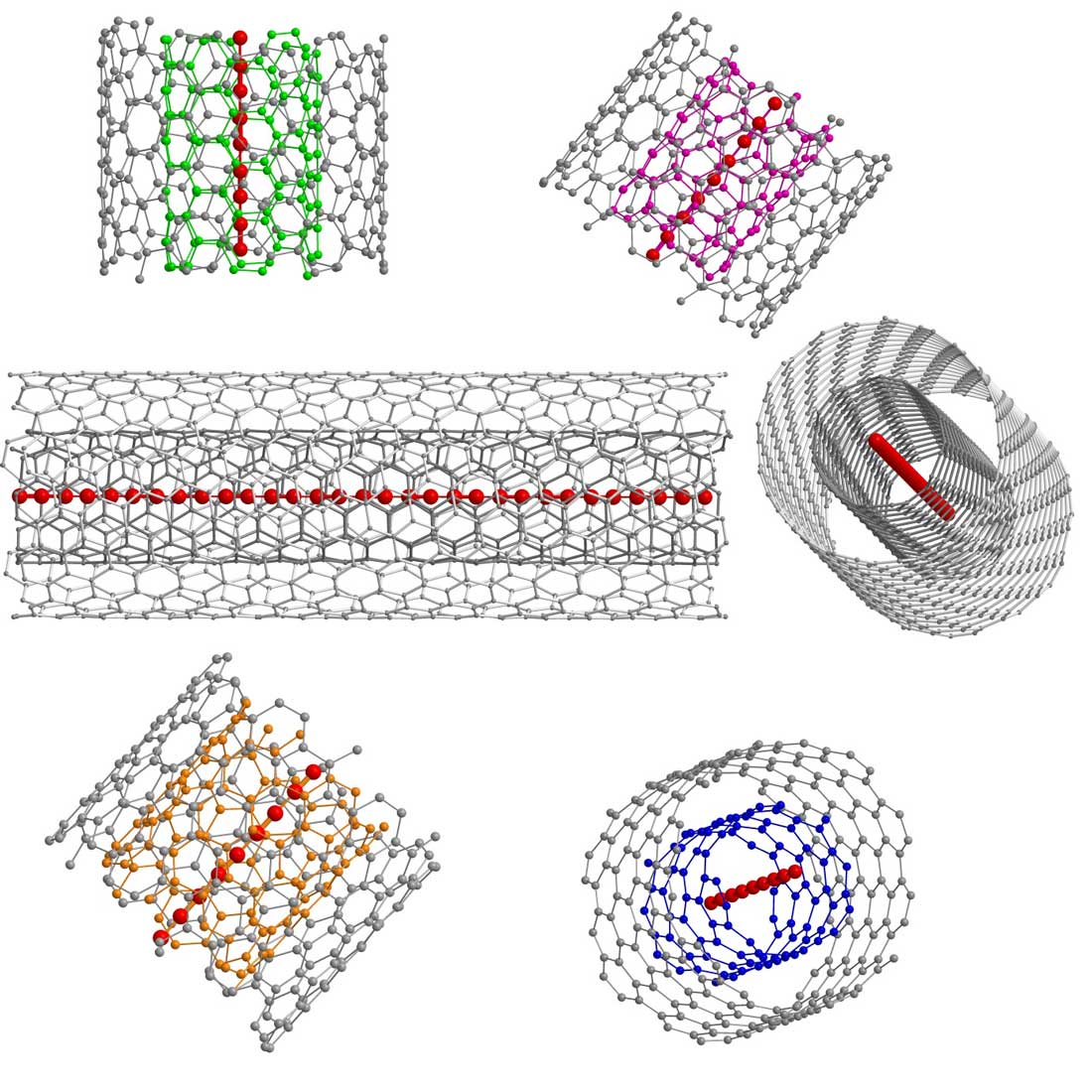
Schematic representation of confined ultra-long, linear carbon chains inside different double-walled carbon nanotubes
Schematic representation of confined ultra-long, linear carbon chains inside different double-walled carbon nanotubes (Image: Lei Shi / Faculty of Physics, University of Vienna) (click on image to enlarge)
A research group at the University of Vienna, led by Prof Thomas Pichler, has presented a new, simple means for stabilising carbon chains with a record-breaking length of over 6,400 carbon atoms. They have thus broken the previous record by more than two orders of magnitude. To do this, they used the confined space inside a double-walled carbon nanotube as a nano-reactor to make the ultra-long carbon chains grow and also to provide the chains with great stability. This stability is tremendously important for future applications.
The work carried out in collaboration with various highly prominent research groups worldwide, including the UPV/EHU’s Nano-Bio Spectroscopy research Group led by Prof Ángel Rubio, has unambiguously confirmed the existence of these chains by means of structural and optical probes.
According to the researchers, the direct experimental proof of the confined, ultra-long carbon chains, which are two orders of magnitude longer than the previously proven ones, can be seen as a promising step towards the final objective to obtain perfectly linear carbon chains.
Theoretical studies have shown that after having made these linear chains grow inside the carbon nanotube, the hybrid system could have a metallic nature due to the load transfer from the carbon nanotubes towards the chain, although both the nanotube and the chain are vacuum semi-conductors. So it is possible to control the electronic properties of this hybrid system. Therefore, this new system is not only interesting from the chemical point of view, it could also be very important in the field of nano devices.
According to theoretical models, carbyne has mechanical properties that are unmatched by any known material, as it even outperforms the mechanical resistance and flexibility properties of graphene and diamond. Furthermore, its electronic properties are pointing towards new nano-electronic applications, such as in the development of new magnetic semiconductors, high power density batteries, or in quantum spin transport electronics (spintronics). However, the researchers point out that to do this it would be necessary to extract these ultra-long, linear carbon chains from the double-walled nanotube containing them and stabilise them in some liquid environment.
Source: University of the Basque Country

Nanoparticulele asemănătoare nanoparticulelor oferă o protecție fiabilă împotriva ruginii(Flake-like nanoparticles offer reliable rust protection)

Cercetătorii de la INM au dezvoltat un tip special de nanoparticule de zinc-fosfat sub formă de fulgi. Aceste nanoparticule sunt de zece ori mai lungi decât ele sunt groase. Ca rezultat al acestei anizotropii, penetrarea moleculelor de gaze în metal este încetinită.În alte serii de teste, oamenii de știință au reușit să valideze eficiența noilor nanoparticule. Pentru a face acest lucru, ei au scufundat plăcile de oțel atât în ​​soluțiile de electroliți cu nanoparticule zinc-fosfat sferoidale, cât și cu nanoparticule de zinc-fosfat tip fulgi în fiecare caz. După doar o jumătate de zi, plăcile de oțel din electroliți cu nanoparticule sferoidale au prezentat semne de coroziune, în timp ce plăcile de oțel din electroliții cu nanoparticule de tip flaky erau încă în stare perfectă și străluceseră, chiar și după trei zile. Cercetătorii și-au creat particulele utilizând săruri de zinc disponibile în comerț, acid fosforic și acid organic ca agent de complexare. Cu cât agenți mai complexați au adăugat, cu atât nanoparticulele au devenit mai anizotrope.

Posted: Apr 13, 2016

Flake-like nanoparticles offer reliable rust protection

(Nanowerk News) Research scientists at INM developed a special type of flake-like zinc-phosphate nanoparticles. These nanoparticles are ten times as long as they are thick. As a result of this anisotropy, the penetration of gas molecules into the metal is slowed down.

Large quantities of steel are used in architecture, bridge construction and ship-building. Structures of this type are intended to be long-lasting. Furthermore, even in the course of many years, they must not lose any of their qualities regarding strength and safety. For this reason, the steel plates and girders used must have extensive and durable protection against corrosion. In particular, the steel is attacked by oxygen in the air, water vapor and salts. Nowadays, various techniques are used to prevent the corrosive substances from penetrating into the material. One common method is to create an anti-corrosion coating by applying layers of zinc-phosphate.
Now, research scientists at INM – Leibniz Institute for New Materials developed a special type of zinc-phosphate nanoparticles. In contrast to conventional, spheroidal zinc-phosphate nanoparticles, the new nanoparticles are flake-like. They are ten times as long as they are thick. As a result of this anisotropy, the penetration of gas molecules into the metal is slowed down.
The developers will be demonstrating their results and the possibilities they offer at stand B46 in hall 2 at this year’s Hanover Trade Fair as part of the leading trade show Research & Technology which takes place from 25th to 29th April.
“In first test coatings, we were able to demonstrate that the flake-type nanoparticles are deposited in layers on top of each other thus creating a wall-like structure,” explained Carsten Becker-Willinger, Head of Nanomers® at INM. “This means that the penetration of gas molecules through the protective coating is longer because they have to find their way through the ´cracks in the wall´”. The result, he said, was that the corrosion process was much slower than with coatings with spheroidal nanoparticles where the gas molecules can find their way through the protective coating to the metal much more quickly.
In further series of tests, the scientists were able to validate the effectiveness of the new nanoparticles. To do so, they immersed steel plates both in electrolyte solutions with spheroidal zinc-phosphate nanoparticles and with flake-type zinc-phosphate nanoparticles in each case. After just half a day, the steel plates in the electrolytes with spheroidal nanoparticles were showing signs of corrosion whereas the steel plates in the electrolytes with flake-type nanoparticles were still in perfect condition and shining, even after three days. The researchers created their particles using standard, commercially available zinc salts, phosphoric acid and an organic acid as a complexing agent. The more complexing agent they added, the more anisotropic the nanoparticles became.
Source: INM – Leibniz-Institut für Neue Materialien