Nanocoatingul face posibilă fabricarea de materiale textile încălzite electric(Nanocoating makes electrically heated textiles possible)

oamenii de știință descriu modul în care utilizează o metodă de depunere a vaporilor pentru tesatura nano-strat pentru a crea sewable, materialul weavable, încălzit electric. Mânușa demonstrativă pe care au făcut-o poate menține degetele în picioare timp de până la opt ore. Mănușa cu trei straturi, cu un strat acoperit de polimerul conductor poli (3,4-etilendioxitiofen), cunoscut și ca PEDOT, este alimentat de o baterie cu buton de greutate de 1,8 grame. Un ban cântărește puțin sub 2,27 grame.Într-un test al capacității țesăturii de a rezista la crăpare, înfundare sau alte schimbări atunci când au fost încălzite, au generat o temperatură de 28 grade C (82,4 F), cu o conexiune la o baterie de 4,5 V și o temperatură de 45 grade C (113 F) -V pentru o oră și nu a găsit „modificări dramatice ale morfologiei”, ceea ce indică faptul că materialul de bumbac acoperit cu PEDOT a fost robust și suficient de stabil pentru a-și menține performanța „când este folosit ca element de încălzire.

Posted: Sep 29, 2017

Nanocoating makes electrically heated textiles possible

(Nanowerk News) Commuters, skiers, crossing guards and others who endure frozen fingers in cold weather may look forward to future relief as manufacturers are poised to take advantage of a new technique for creating electrically heated cloth developed by materials scientist Trisha Andrew and colleagues at the University of Massachusetts Amherst. They have made gloves that keep fingers as warm as the palm of the hand.

In a new paper in Applied Materials & Interfaces („Transforming Commercial Textiles and Threads into Sewable and Weavable Electric Heaters”), the scientists describe how they use a vapor deposition method for nano-coating fabric to create sewable, weavable, electrically heated material. The demonstration glove they made can keep fingers toasty for up to eight hours. The three-layered glove, with one layer coated by the conducting polymer poly(3,4-ethylenedioxytiophene), also known as PEDOT, are powered by a button battery weighing 1.8 grams. A dime weighs just under 2.27 grams.
Nano-coated, Battery Powered Warm Gloves
A three-layered glove developed by materials chemist Trisha Andrew has one layer coated by the conducting polymer PEDOT and is powered by a button battery weighing 1.8 grams. (Image: UMass Amherst)
The authors point out, „Lightweight, breathable and body-conformable electrical heaters have the potential to change traditional approaches to personal thermal management, medical heat therapy, joint pain relief and athletic rehabilitation.”
Andrew says, „We took a pair of cotton gloves and coated the fingers to allow a small amount of current to pass through, so they heat up. It’s regular old-fashioned cotton cloth. We chose to make a pair of gloves because the fingers require a high curvature that allows us to show that our material is really flexible. The glove is powered by a small coin battery and they run on nano-amps of current, not enough to pass current through your skin or to hurt you. Our coating works even when it’s completely dunked in water, it will not shock you, and our layered construction means the conductive cloth does not come into contact with your skin.”
She adds, „We hope to have this reach consumers as a real product in the next few years. Maybe it will be two years to a prototype, and five years to the consumer. I think this is the most consumer-ready device we have. It’s ready to take to the next phase.”
Until recently, textile scientists have not used vapor deposition because of technical difficulties and high cost of scaling up from the laboratory. But recently, manufacturers are finding that the technology can be scaled up while remaining cost-effective, the researchers say. Using the vapor deposition method described in their paper, Andrew and colleagues also coated threads of a thick cotton yarn commonly used for sweaters. It performed well and offers another avenue for creating heated clothing, the authors state.
Andrew says, „One thing that motivated us to make this product is that we could get the flexibility, the nice soft feel, while at the same time it’s heated but not making you sweaty. A common thing we hear from commuters is that in the winter, they would love to have warmer fingers.” In their laboratory tests, her research team reports, four fingers of the test glove warmed to the same temperature as the palm, and „the wearer could feel the heat transferred from the fabric heaters to her fingers a few seconds after the voltage was applied.”
Andrew and chemistry postdoctoral researcher Lushuai Zhang, with chemical engineering graduate student Morgan Baima, conducted several tests to assure that their gloves could stand up to hours of use, laundering, rips, repairs and overnight charging. Andrew notes, „Right now we use an off-the-shelf battery that lasts for eight hours, but you would need a rechargeable to make these more practical.”
Further, „If you are skiing and rip your glove, you can repair it just by sewing it back together with plain thread.”
They arranged for biocompatibility testing at an independent lab where mouse connective tissue cells were exposed to PEDOT-coated samples and responses compared to positive and negative controls. They report that their PEDOT-coated materials are safe for contact with human skin without causing adverse reactions to the chemicals used.
They also addressed questions of heat, moisture and skin contact stability to prevent the wearer from experiencing any electric shock from a wet conducting element. Andrew says, „Chemically, what we use to surround the conductive cloth looks like polystyrene, the stuff used to make packing peanuts. It completely surrounds the conducting material so the electrical conductor is never exposed.”
Experimenting with different variables in the vapor nano-coating process, they found that adjusting temperature and chamber pressure were important in achieving optimal surface coverage of the cloth. In a test of the fabric’s ability to resist cracking, creasing or other changes when heated, they generated a temperature of 28 degrees C (82.4 F) with connection to a 4.5-V battery and 45 degrees C (113 F) connected to a 6-V battery for an hour, and found „no dramatic morphology changes,” indicating that the PEDOT-coated cotton textile was rugged and stable enough to maintain its performance” when used as a heating element.
Source: University of Massachusetts at Amherst

Senzor de hidrogen ultra-rapid și ultra-sensibil pentru nanofire(Ultra-fast and ultra-sensitive nanowire hydrogen sensor)

O echipă KAIST a realizat un senzor de hidrogen ultra rapid care poate detecta nivelurile de gaze de hidrogen sub 1% în mai puțin de șapte secunde. De asemenea, senzorul poate detecta sute de părți la un milion de niveluri de hidrogen gazos în 60 de secunde la temperatura camerei ( materiale și interfețe aplicate ACS , „Nanowires compozit Pd-Ag compozit pentru răspuns rapid și senzori de hidrogen transparent” ).Profesorul Kim se așteaptă ca senzorul ultra-rapid de hidrogen să poată fi util pentru prevenirea accidentelor de explozie provocate de scurgeri de hidrogen gazos. În plus, se așteaptă ca alte gaze nocive din aer să poată fi detectate cu precizie prin nano-filtrare eficientă prin utilizarea unei varietăți de straturi MOF.

Posted: Sep 29, 2017

Ultra-fast and ultra-sensitive nanowire hydrogen sensor

(Nanowerk News) A KAIST team made an ultra-fast hydrogen sensor that can detect hydrogen gas levels under 1% in less than seven seconds. The sensor also can detect hundreds of parts per million levels of hydrogen gas within 60 seconds at room temperature (ACS Applied Materials and Interfaces, „Hollow Pd-Ag Composite Nanowires for Fast Responding and Transparent Hydrogen Sensors „).

A research group under Professor Il-Doo Kim in the Department of Materials Science and Engineering at KAIST, in collaboration with Professor Reginald M. Penner of the University of California-Irvine, has developed an ultra-fast hydrogen gas detection system based on a palladium (Pd) nanowire array coated with a metal-organic framework (MOF).
text
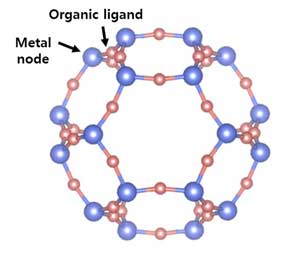
Schematic illustration of a metal-organic framework (MOF). The MOF, consisting of metal ions and organic ligands, is a highly porous material with a ultrahigh surface area. The various structures of MOFs can be synthesized depending on the kinds of metal ions and organic ligands. (Image: KAIST)
Hydrogen has been regarded as an eco-friendly next-generation energy source. However, it is a flammable gas that can explode even with a small spark. For safety, the lower explosion limit for hydrogen gas is 4 vol% so sensors should be able to detect the colorless and odorless hydrogen molecule quickly.
The importance of sensors capable of rapidly detecting colorless and odorless hydrogen gas has been emphasized in recent guidelines issued by the U.S. Department of Energy. According to the guidelines, hydrogen sensors should detect 1 vol% of hydrogen in air in less than 60 seconds for adequate response and recovery times.
Ultra-fast and ultra-sensitive nanowire hydrogen sensor
Representative image of this paper published in ACS Nano on Sept. 26.
To overcome the limitations of Pd-based hydrogen sensors, the research team introduced a MOF layer on top of a Pd nanowire array. Lithographically patterned Pd nanowires were simply overcoated with a Zn-based zeolite imidazole framework (ZIF-8) layer composed of Zn ions and organic ligands. ZIF-8 film is easily coated on Pd nanowires by simple dipping (for 2-6 hours) in a methanol solution including Zn (NO3)2·6H2O and 2-methylimidazole.
As synthesized ZIF-8 is a highly porous material composed of a number of micro-pores of 0.34 nm and 1.16 nm, hydrogen gas with a kinetic diameter of 0.289 nm can easily penetrate inside the ZIF-8 membrane, while large molecules (>0.34 nm) are effectively screened by the MOF filter.
Thus, the ZIF-8 filter on the Pd nanowires allows the predominant penetration of hydrogen molecules, leading to the acceleration of Pd-based H2 sensors with a 20-fold faster recovery and response speed compared to pristine Pd nanowires at room temperature.
Images of Pd nanowire array-based hydrogen sensors, scanning electron microscopy image of a Pd nanowire covered by a metal-organic framework layer, and the hydrogen sensing properties of the sensors
Images of Pd nanowire array-based hydrogen sensors, scanning electron microscopy image of a Pd nanowire covered by a metal-organic framework layer, and the hydrogen sensing properties of the sensors. (Image: KAIST)
Professor Kim expects that the ultra-fast hydrogen sensor can be useful for the prevention of explosion accidents caused by the leakage of hydrogen gas. In addition, he expects that other harmful gases in the air can be accurately detected through effective nano-filtration by using of a variety of MOF layers.
Source: The Korea Advanced Institute of Science and Technology (KAIST)

Progresele înregistrate în procesul de obținere a foilor de nanotuburi de carbon în masă(Progress achieved towards mass producing carbon nanotube sheets)

CNT-urile sunt foi de carbon care au fost laminate în tuburi, măsurând 100.000 de ori mai mici decât diametrul părului uman. Proprietățile lor electrice, chimice, termice și mecanice excepționale le fac un material ideal pentru nenumărate aplicații, inclusiv pentru stocarea energiei, cipuri de calculator și senzori. Potențialul revoluționar al CNT-urilor în ingineria materialelor se reflectă în creșterea prognozată a valorii de piață, care se așteaptă să ajungă la 8,7 miliarde de dolari până în 2022, potrivit analistilor de piață Markets and Markets. Buckypaper este o foaie subțire din nanotuburi de carbon agregate.

Posted: Sep 27, 2017

Progress achieved towards mass producing carbon nanotube sheets

(Nanowerk News) Researchers at the Masdar Institute have recently announced a breakthrough approach to producing carbon nanotube (CNT) sheets, known as ‘buckypaper,’ through a scalable, low-cost and simple technique. The novel fabrication method could help bring game-changing buckypaper applications a step closer towards cost-effective commercialization.

“Being able to produce buckypaper in a scalable way like this has not been demonstrated before. This new technique could boost the development of market-ready applications, including high-power lithium-ion batteries and low-cost vanadium-redox-flow batteries,” said Dr. Rahmat Susantyoko, postdoctoral researcher from the Mechanical Engineering Department.
Dr. Susantyoko was first author of a paper that describes the new technique, called Surface-Engineered Tape-Cast (SETC), which was published last month in the Journal of Materials Chemistry A („A surface-engineered tape-casting fabrication technique toward the commercialisation of freestanding carbon nanotube sheets”).
Buckypaper
Buckypaper
CNTs are sheets of carbon that have been rolled into tubes, measuring 100,000 times smaller than the diameter of human hair. Their exceptional electrical, chemical, thermal and mechanical properties make them an ideal material for countless applications, including in energy storage, computer chips, and sensors. The revolutionary potential of CNTs in materials engineering is reflected by the projected growth of its market value, which is expected to reach US$8.7 billion by 2022, according to market analysts Markets and Markets. Buckypaper is a thin sheet made of aggregated carbon nanotubes.
Despite the technical potential of buckypaper, a critical problem continues to hinder its development for CNT applications. The difficulty of converting CNTs from their original fine, dust-like powdery state, to a solid, thin film of grouped CNTs remains a key challenge.
CNTs in buckypaper form are much easier for engineers to manipulate. In their macroscopic manifestation, CNTs can be processed and developed into useful materials for a broader range of applications. While many innovative buckypaper-based applications have been developed in recent years, they failed to achieve broad commercialization because they lacked a scalable and cost-effective buckypaper fabrication process.
“Common buckypaper fabrication methods used today are membrane filtration and chemical vapor deposition. However both methods have severe limitations, with membrane filtration restricting the size of the produced buckypaper to the size of the membrane and apparatus used, and chemical vapor deposition being exceedingly expensive,” Dr. Susantyoko explained.
Addressing the need for a low-cost, scalable fabrication method, Masdar Institute’s SETC technique offers a novel solution that leverages tape-casting – a method traditionally used to coat a CNT film over a substrate – that overcomes the current technological limitations that have prevented low-cost, scalable buckypaper fabrication till now.
“Our technique utilizes tape-casting with a special type of substrate, which we engineered in the lab, that allows us to easily peel off the buckypaper from the supporting substrate, resulting in a free-standing buckypaper film,” Dr. Susantyoko said.
Identifying the ideal substrate that would allow the buckypaper to easily peel off was the biggest challenge. Through investigation, the team discovered that buckypaper sticks to smooth and randomly-patterned rough surfaces, but separates from a special kind of surface that has a rough structure composed of micro-sized pyramids.
“We realized that the surface morphology of substrate and dissimilarity in surface energy of CNT–substrate play important roles in affecting the ability to easily peel off the CNT film,” Dr. Susantyoko added. He explained that the unique morphology and high surface area created by the micro-pyramids enabled the easy separation of the CNT sheet.
To demonstrate the effectiveness of their SETC buckypaper fabrication technique, the team used it to produce a buckypaper-based cathode for a high-power lithium-ion battery. Now, the team is enhancing their SETC method to produce an even higher-powered cathode, which is intended to be used for space applications.
By providing materials scientists with a scalable, low-cost and simple method to fabricate CNT sheets, Masdar Institute researchers are helping to bring the game-changing CNT innovations being developed in labs across the world to the market.

Grafenul forjat în forme tridimensionale(Graphene forged into three-dimensional shapes)

Noul grafen 3D este stabil și are proprietăți electronice și optice care diferă de grafenul 2D normal. Grafenul optic forjat poate ajuta la fabricarea de arhitecturi 3D pentru dispozitive bazate pe grafen.

Posted: Sep 26, 2017

Graphene forged into three-dimensional shapes

(Nanowerk News) Researchers from Finland and Taiwan have discovered how graphene, a single-atom-thin layer of carbon, can be forged into three-dimensional objects by using laser light. A striking illustration was provided when the researchers fabricated a pyramid with a height of 60 nm, which is about 200 times larger than the thickness of a graphene sheet. The pyramid was so small that it would easily fit on a single strand of hair (Nano Letters, „Optical Forging of Graphene into Three-Dimensional Shapes”).

forging a graphene sheet into controlled 3D shapes
Jst as a blacksmith uses a hammer to forge a metal sheet into 3D shapes, a pulsed laser beam can forge a graphene sheet into controlled 3D shapes in the nanoscale. The forging mechanism is based on laser-induced local expansion of graphene, as confirmed by computer simulations using thin sheet elasticity theory. (Image: Academy of Finland)
Graphene is a close relative to graphite, which consists of millions of layers of graphene and can be found in common pencil tips. After graphene was first isolated in 2004, researchers have learned to routinely produce and handle it. Graphene can be used to make electronic and optoelectronic devices, such as transistors, photodetectors and sensors. In future, we will probably see an increasing number of products containing graphene.
“We call this technique optical forging, since the process resembles forging metals into 3D shapes with a hammer. In our case, a laser beam is the hammer that forges graphene into 3D shapes,” explains Professor Mika Pettersson, who led the experimental team at the Nanoscience Center of the University of Jyväskylä, Finland. “The beauty of the technique is that it’s fast and easy to use; it doesn’t require any additional chemicals or processing. Despite the simplicity of the technique, we were very surprised initially when we observed that the laser beam induced such substantial changes on graphene. It took a while to understand what was happening.”
“At first, we were flabbergasted. The experimental data simply made no sense,” says Dr Pekka Koskinen, who was responsible for the theory. “But gradually, by close interplay between experiments and computer simulations, the actuality of 3D shapes and their formation mechanism started to become clear.”
“When we first examined the irradiated graphene, we were expecting to find traces of chemical species incorporated into the graphene, but we couldn’t find any. After some more careful inspections, we concluded that it must be purely structural defects, rather than chemical doping, that are responsible for such dramatic changes on graphene,” explains Associate Professor Wei Yen Woon from Taiwan, who led the experimental group that carried out X-ray photoelectron spectroscopy at the synchrotron facility.
The novel 3D graphene is stable and it has electronic and optical properties that differ from normal 2D graphene. Optically forged graphene can help in fabricating 3D architectures for graphene-based devices.
Source: Suomen Akatemia

Catedralele Europei primesc o nouă viață datorită nanoparticulelor(Europe’s cathedrals get new life thanks to nanoparticles)

un material nou fabricat din nanoparticule inovatoare. Scopul este de a consolida structura interioară a pietrelor. Se aplică în principal pe marmură.Materialul dezvoltat de echipa de cercetare europeană ( proiectul Nano-Cathedral include carbonatul de calciu, care este un amestec de oxid de calciu, apă și dioxid de carbon.

Posted: Sep 26, 2017

Europe’s cathedrals get new life thanks to nanoparticles

(Nanowerk News) Just a few meters from Pisa’s famous Leaning Tower, restorers are defying scorching temperatures to bring back shine to the city’s Cathedral.

Ordinary restoration techniques like laser are being used on much of the stonework that dates back to the 11th century. But a brand new technique is also being used: a new material made of innovative nanoparticles. The aim is to consolidate the inner structure of the stones. It’s being applied mainly on marble.
Pisa cathedral
Pisa cathedral
“Marble has very low porosity, which means we have to use nanoparticles in order to go deep inside the stone, to ensure that the treatment is both efficient while still allowing the stone to breathe,” explains Roberto Cela, civil engineer at Opera Della Primaziale Pisana.
The material developed by the European research team (Nano-Cathedral project includes calcium carbonate, which is a mix of calcium oxide, water and carbon dioxide.
The nanoparticles penetrate the stone cementing its decaying structure.
“It is important that these particles have the same chemical nature as the stones that are being treated, so that the physical and mechanical processes that occur over time don’t lead to the break-up of the stones,” says Dario Paolucci, chemist at the University of Pisa.
Vienna’s St Stephen’s is another of the five cathedrals where the new restoration materials are being tested.
The first challenge for researchers is to determine the mechanical characteristics of the cathedral’s stones. Since there are few original samples to work on, they had to figure out a way of “ageing” samples of stones of similar nature to those originally used.
“We tried different things: we tried freeze storage, we tried salts and acids, and we decided to go for thermal ageing,” explains Matea Ban, material scientist at the University of Technology in Vienna. “So what happens is that we heat the stone at certain temperatures. Minerals inside then expand in certain directions, and when they expand they build up stresses to neighbouring minerals and then they crack, and we need those cracks in order to consolidate them.”
Consolidating materials were then applied on a variety of limestones, sandstones and marble – a selection of the different types of stones that were used to build cathedrals around Europe.
What researchers are looking for are very specific properties.
“First of all, the consolidating material has to be well absorbed by the stone,” says petrologist Johannes Weber of the University of Applied Arts in Vienna. “Then, as it evaporates, it has to settle properly within the stone structure. It should not shrink too much. All materials shrink when drying, including consolidating materials. They should adhere to the particles of the stone but shouldn’t completely obstruct its pores.”
Further tests are underway in cathedrals across Europe in the hope of better protecting our invaluable cultural heritage.
Source: European Commission

Cercetătorii dezvoltă un generator solar termoelectric purtător(Researchers develop wearable solar thermoelectric generator)

a introdus un nou sistem avansat de recoltare a energiei, capabil să genereze electricitate pur și simplu atașat la haine, ferestre și pereți exteriori o clădire ( Nano Energy , „Generator termoelectric purtător solar, condus de o diferență de temperatură fără precedent” ).
Acest nou dispozitiv se bazează pe o diferență de temperatură între părțile calde și cele reci. Diferența de temperatură poate fi mărită cu până la 20,9 ° C, care este mult mai mare decât diferențele de temperatură tipice de 1,5 până la 4,1 ° C ale generatoarelor termoelectrice purtate de căldură. Echipa de cercetare se așteaptă ca generatorul lor termoelectric purtător solar să propună o modalitate promițătoare de a îmbunătăți în continuare eficiența prin creșterea diferenței de temperatură.

Posted: Sep 26, 2017

Researchers develop wearable solar thermoelectric generator

(Nanowerk News) A recent study, led by Professor Kyoung Jin Choi in the School of Materials Science and Engineering at UNIST has introduced a new advanced energy harvesting system, capable of generating electricity by simply being attached to clothes, windows, and outer walls of a building (Nano Energy, „Wearable solar thermoelectric generator driven by unprecedentedly high temperature difference”).

This new device is based on a temperature difference between the hot and cold sides. The temperature difference can be increased as high as 20.9°C, which is much higher than the typical temperature differences of 1.5 to 4.1°C of wearable thermoelectric generators driven by body heat. The research team expects that their wearable solar thermoelectric generator proposes a promising way to further improve the efficiency by raising the temperature difference.
thermoelectric ink printed in lines and shapes
This is a photograph of the TE ink printed in various shapes with curves and straight lines. (Image: UNIST)
Energy harvesting is a diverse field encompassing many technologies, which involve a process that captures small amounts of energy that would otherwise be lost as heat, light, sound, vibration, or movement. A thermoelectric generator (TEGs) refers to a device that converts waste heat energy, such as solar energy, geothermal energy, and body heat into additional electrical power.
There has been a great increase in the study of wearable thermoelectric (TE) generators using the temperature difference between the body heat and surrounding environment. However, one of the main drawbacks of wearable TEG techniques driven by body heat was that such temperature difference is only 1-4 °C and this has hindered further commercialization.
The research team solved this low temperature difference faced by conventional wearable TEGs by introducing a local solar absorber on a PI substrate. The solar absorber is a five-period Ti/MgF2 superlattice, in which the structure and thickness of each layer was designed for optimal absorption of sunlight. This has increased the temperature difference as high as 20.9°C, which is the highest value of all wearable TEGs reported to date.
„Through this study, we have secured a temperature difference with the ten-fold increase from the conventional wearable solar thermoelectric generators,” says Yeon Soo Jung in the Graduate School of Materials Science and Engineering at UNIST. „Since the output of a TE generator is proportional to the square root of the temperature difference, one can significantly increase the output with the help of this technology.”
In this study, Professor Choi and his team designed a noble wearable solar thermoelectric generator (W-STEG) by integrating flexible BiTe-based TE legs and sub-micron thick solar absorbers on a polymide (PI) substrate. The TE legs were prepared by dispenser printing with an ink consisting of mechanically alloyed BiTe-based powders and an Sb2Te3-based sintering additive dispersed in glycerol. They report that a W-STEG comprising 10 pairs of p-n legs has an open-circuit voltage of 55.15 mV and an output power of 4.44 µW when exposed to sunlight.
„Our new werable STEG is expected to be useful in various applications, such as in self-powered wearable electronic devices,” says Professor Choi. „It will also serve as a catalyst to further improve the future wearable electronic technology market.”
Source: Ulsan National Institute of Science and Technology