
Adezivul solid se asamblează pe o cale către baterii mai sigure(Self-assembling solid crystals a path to safer, solid batteries )

Cercetatorii au identificat noi materiale solide care ar putea conduce la fabricarea de baterii litiu-ion netoxice,

Posted: Sep 04, 2017

Self-assembling solid crystals a path to safer, solid batteries

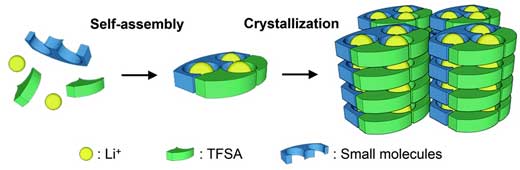
(Nanowerk News) Researchers have identified new solid materials that could lead to the manufacture of non-toxic lithium-ion batteries, according to a study recently published in the journal Science and Technology of Advanced Materials („Construction of nanostructures for selective lithium ion conduction using self-assembled molecular arrays in supramolecular solids”).When a specific organic compound is added to lithium salt, the molecules self-assemble to form channels through which lithium ions can move, creating an electric currentWhen a specific organic compound is added to lithium salt, the molecules self-assemble to form channels through which lithium ions can move, creating an electric current.Batteries are made of two oppositely charged electrodes separated by a liquid, gel-like, or solid ‘electrolyte’ medium through which electrically charged atoms, or ions, move. In many cases, these electrolytes are toxic and flammable, so researchers have been looking for non-toxic alternatives.Makoto Moriya of Shizuoka University in Japan investigated molecular crystals for this purpose. To obtain the crystals he added an organic compound to lithium salt. The molecules self-assembled to form channels through which lithium ions moved, creating an electric current. Changing the crystals’ structures affected their ion-conducting functions.Ion conductivity in these materials was not as high as in organic liquids, inorganic ceramics or glass electrolytes. But it was comparable to polymer electrolytes, which have been targeted as potential solid electrolytes.Also, the amount of flammable organic substances in the molecular crystalline electrolytes was lower than in polymer electrolytes and in conventional liquid electrolytes, making them a potentially safer alternative.Moriya found it easy to control the crystal structure of these solid materials by making alterations to their molecules. This structural versatility could prove to be a powerful tool for dramatically improving ion conductivity in these materials.“These observations … could open the door to the design of new solid electrolytes and thus the development of new molecular devices,” Moriya concludes.
Read more: Self-assembling solid crystals a path to safer, solid batteries

Source: National Institute for Materials Science

Grapefină pentru aplicații de detectare (Graphene woven fabrics for sensing application )

Grafenul a atras atenția extinsă datorită proprietăților sale excelente electrice, conductivității termice remarcabile, transparenței înalte, grosimii superioare și zonei mari specifice și, firește, a fost folosit ca material de detectare.
In ACS Applied Materials & Interfaces ( „simultană de înaltă sensibilitate de detectare a temperaturii și umidității cu Grafenul Țesături“ ), cercetatorii raport acum o temperatură și umiditate senzor flexibil (FTHS) din grafen țesături (GWFs) preparate prin depunere chimică din vapori (CVD) .
Senzorul a fost preparat printr-un proces de asamblare strat-cu-strat prietenos cu mediul. În comparație cu filmele de grafeni comune produse de CVD, GWF a fost compus din panglici de micrometru de intercalare cu cristale intercalate și au găuri dreptunghiulare, demonstrând o ultrasensibilitate cu un factor de gabarit de 500 până la deformare cu 2%.Rezultatele simulării și unele dispozitive raportate efectuate de GWF au demonstrat macrostructura și microstructura specială a GWF, care îi promite proprietăți unice și aplicații potențiale diversificate”, concluzioneaza autorii raportului. „Cu un design special, am folosit GWF-uri pentru a produce un senzor flexibil și bifuncțional. FTHS a arătat o sensibilitate ridicată la senzorii de temperatură, o performanță bună de detectare a umidității și o mică interferență reciprocă”.

Posted: Sep 04, 2017

Graphene woven fabrics for sensing application

(Nanowerk News) Graphene has attracted extensive attention because of its excellent electrical properties, outstanding thermal conductivity, high transparency, ultrathin thickness, and large specific area, and naturally, it has been used as a sensing material.

In ACS Applied Materials & Interfaces („Simultaneous High Sensitivity Sensing of Temperature and Humidity with Graphene Woven Fabrics”), researchers now report a flexible temperature and humidity sensor (FTHS) from graphene woven fabrics (GWFs) prepared by chemical vapor deposition (CVD).
The sensor was prepared through an environmentally friendly layer-by-layer assembly process. Compared with the common graphene films produced by CVD, the GWF was composed of criss-crossed interlacing graphene micrometer ribbons and had rectangular holes, demonstrating ultra-sensitivity with a gauge factor of 500 to deformation within 2%.
fabricating a flexible temperature and humidity sensor with graphen woven fabrics
(a) Schematic diagram of assembly steps of the FTHS. Inset: photograph of as-prepared FTHS. (b) Mechanism for temperature sensing. (c) Mechanism for humidity sensing. (© ACS) (click on image to enlarge)
The researchers found that the substrate, the length-width ratio of GWF, and the time of the oxygen plasma treatment greatly influenced the sensitivity of the temperature-sensing part.
„Simulation results and some reported devices made by GWF have proved the special macrostructure and microstructure of GWF, which promise it unique properties and diversified potential applications,” the authors conclude their report. „With a special design, we used GWFs to produce a flexible and bifunctional sensor. The FTHS showed high sensitivity in temperature sensing, good humidity sensing performance, and little mutual interference.”
By Michael is author of two books by the Royal Society of Chemistry: N

Read more: Graphene woven fabrics for sensing application