Cercetătorii realizează un senzor ultra-sensibil de temperatură(Researchers engineer ultra-sensitive temperature sensor)

Poate un „termometru” să fie format dintr-o peliculă subțire sau mic (particule micrometrice sau nanometrice), să funcționeze în timp real și într-o regiune foarte bine definită, cu o rezoluție spațială variind de la un centimetru până la un micrometru capabil să măsoare temperaturi cu sensibilitate excepțională într-o bandă largă între 80 kelvin (minus 193 ° C) și 750 kelvin (476 ° C)? Raspunsul este da.Ca o peliculă subțire, materialul poate fi la fel de mic ca centimetri pătrați sau poate ajunge la câțiva metri pătrați pentru a fi utilizat ca strat de acoperire pe componentele vehiculelor terestre, al aeronavelor sau al transformatoarelor de rețea. Ca particule micrometrice sau nanometrice, acestea pot fi dispersate într-un mediu lichid, în timp ce rămân solide.

Posted: Jan 11, 2018

Researchers engineer ultra-sensitive temperature sensor

(Nanowerk News) Can a „thermometer” consist of a thin film or tiny (micrometer or even nanometer scale) particles, operate in real time and in very well-defined regions with a spatial resolution ranging from a centimeter to a micrometer, and be capable of measuring temperatures with exceptional sensitivity in a wide band between 80 kelvin (minus 193°C) and 750 kelvin (476°C)? The answer is yes.

The device, created in the laboratory by researchers at the University of São Paulo (USP) and the University of Campinas (UNICAMP) in São Paulo State, Brazil, is described in an article in Scientific Reports („A suitable (wide-range + linear) temperature sensor based on Tm3+ ions”). Basically, it is a temperature sensor with practically no effect at all on the temperature of the object.
ultra-sensitive temperature sensor
Material developed in Brazil measures temperatures in the range of 80-750 kelvin and could be used in manufacturing and biological processes. (click on image to enlarge)
„Because the device is optical, information on the temperature of the object of interest can be obtained without direct physical contact between them,” Zanatta said. „It suffices to project a laser beam onto the sensor and observe how it responds. By measuring the wavelength of the light emitted by the sensor using a detector, the temperature of the object can be determined with great precision,” said Antonio Ricardo Zanatta, an investigator at the USP’s São Carlos Physics Institute and one of project’s researchers.
When excited by a laser pulse, the sensor – which consists of a system made of titanium dioxide (TiO2) doped with thulium ions (Tm3+) – emits light at wavelengths that vary depending on the temperature of the environment. A very precise measurement of the wavelength is used to determine this temperature.
The wavelength varies approximately 2 picometers (2×10-12 m) per degree of temperature. Spectroscopy can be used to detect this tiny wavelength variation.
„Variation in the wavelength of the emitted light is absolutely linear between 80 and 750 kelvin, and the device remains integral and stable throughout this temperature range,” Zanatta said.
Besides from Zanatta, the project also had contributions from UNICAMP’s Gleb Wataghin Physics Institute investigators Fernando Alvarez and Diego Scoca. The research is supported by the Sao Paulo Research Foundation – FAPESP through the Thematic Project „Research and development of nanostructured materials for electronic and surface physics applications”, with Alvarez as principal investigator.
A patent application form commercial production has been filed with support from UNICAMP’s incubator, the Inova UNICAMP.

Technologic application

Applications of the sensor range from the identification of hotspots in electronic equipment to the detection of viral or bacterial infection in specific regions of an organism. „Because it’s capable of measuring a very broad spectrum of temperatures, it can be used in manufacturing – where temperatures sometimes reach very high levels – as well as biological processes, which are highly sensitive to the slightest temperature variations,” said Alvarez.
„At this stage,” Zanatta points, „we’ve arranged the material in the form of a thin film. Theoretically, this can be used as a coating for any surface, be it flat or curved, smooth or rough.” He says that the material can also be presented as microparticles or nanoparticles.
Although this technological development does not yet exist, in principle, it would be possible to encapsulate the laser emitter, temperature sensor and wavelength detector with a radio communicator inside a small pill.
Swallowed with a little water, the pill would send back temperature data while moving along the digestive tract until its ejection from the organism at the opposite extremity: a futuristic scenario, but not too distant from the science available now.
„A very simple application, which could rapidly be made feasible, would entail coating a plastic substrate with the sensor and fixing it to a patient’s skin. It’s important to note that titanium dioxide is abundant, easy to obtain, and biocompatible, i.e., non-toxic. It’s already used in many medical prosthetic devices,” Alvarez said.
As a thin film, the material can be as small as a few square centimeters or reach several square meters for use as a surface coating on components of land vehicles, aircraft or power grid transformers. As micrometric or nanometric particles, it can be dispersed in a liquid medium while remaining solid.

Challenges and the next steps

The need for a dedicated detector is a limiting factor at the present stage, in terms of both the cost and portability of the device.
„The associated instrumentation is costly today, given the need for a laser and a detector,” Zanatta said. „We believe, however, that as technology advances, it will be possible to fabricate an integrated device with a semiconductor laser, temperature sensor and detector. And the cost can be considerably reduced when we go from laboratory to industrial scale.”
Source: By José Tadeu Arantes, Fundação de Amparo à Pesquisa do Estado de São Paulo

In-q-Tel trimestrial: Ce sunt consumabilele?(In-q-Tel Quarterly: What Are Wearables?)

Articolele de îmbrăcăminte sunt dispozitive de senzor care pur și simplu sunt purtate pe corpul fizic.Poziția senzorului pe corp este vitală pentru a înregistra o reprezentare precisă a mișcărilor corpului, în timp ce abordarea celor mai importante semne vitale, incluzând moartea fizică reală

0 (16)

Promițătoare nanosenzori pentru submarine, mine și nave spațiale(Promising nanosensors for submarines, mines and spacecraft)

au descoperit un mecanism care permite senzorilor de gaz, bazați pe oxizi de metale nanocristaline, să lucreze la temperatura camerei. Această invenție va spori eficiența monitorizării mediului la centralele nucleare, submarine și nave spațiale.Cercetătorii au descoperit că compozitele bazate pe oxizi de zinc și indiu pot crește semnificativ sensibilitatea senzorului la hidrogen

Posted: Nov 10, 2017

Promising nanosensors for submarines, mines and spacecraft

(Nanowerk News) Researchers from the Physics Department of Moscow State University and their colleagues have discovered a mechanism that allows gas sensors, based on nanocrystalline metal oxides, to work at room temperature. This invention will raise the efficiency of environmental monitoring at nuclear power plants, on submarines and spacecrafts. The discovery was reported in Scientific Reports („Green light activated hydrogen sensing of nanocrystalline composite ZnO-In2O3 films at room temperature”).

Hydrogen Sensor Scheme
This is a hydrogen sensor scheme. (Image: Alexander Ilyin)
Scientists have proposed a new fundamental principle of operation of hydrogen sensors. Unlike most resistive gas detectors, it does not need to be heated and only requires visible light. This discovery will significantly reduce the energy consumption of the sensor and expand its scope.
„Such sensors can be used in explosive environments or be built into mobile devices without constructing additional heat sink systems,” said Alexander Ilyin, a co-author of the study, a PhD student at the Physics Department of Moscow State University.
Researchers have found out that composites based on zinc and indium oxides can significantly increase the sensitivity of the sensor to hydrogen. Physicists have also proposed an explanation for the hypersensitivity of the designed composite. In their opinion, the sensor response mechanism consists in a change in the processes of generation and recombination of nonequilibrium electrons when the composite is interacting with hydrogen. Composites with a certain structure provide a more significant change in these processes.
Samples for the sensor were made from nanocrystalline indium and zinc oxide powders. The structure and particle size were studied by the means of transmission electron microscopy and x-ray diffraction. The electrical and sensor characteristics of the structureswere studied in the new designed setup, in which the required temperature of the composite and the concentration of hydrogen were well controlled.
The obtained results would allow the scientists to develop a new type of resistive hydrogen sensor that works under additional illumination without heating. Such sensors are promising not only for effective monitoring of environmental pollution in industrial plants, but also for constant monitoring of air in closed facilities (submarines, mines, spacecraft) where the slightest change in the chemical composition can lead to human casualties.
Source: Lomonosov Moscow State University

Tehnica de transfer produce senzori de gaz de nitrură de galiu care pot fi purtați(Transfer technique produces wearable gallium nitride gas sensors)

Senzorii produse prin noul proces pot detecta amoniacul la nivelele pe miliarde de hectare și pot diferenția între gazele care conțin azot.Transferul senzorilor de nitrură de galiu la foliile metalice și polimerii flexibili își dublează sensibilitatea la gazul de dioxid de azot și crește timpul de răspuns cu un factor de șase. Etapele simple de producție, bazate pe epitaxia cu fază metalică cu vapori organici (MOVPE), ar putea, de asemenea, să reducă costul producerii senzorilor și a altor dispozitive optoelectronice.

Posted: Nov 09, 2017

Transfer technique produces wearable gallium nitride gas sensors

(Nanowerk News) A transfer technique based on thin sacrificial layers of boron nitride could allow high-performance gallium nitride gas sensors to be grown on sapphire substrates and then transferred to metallic or flexible polymer support materials. The technique could facilitate the production of low-cost wearable, mobile and disposable sensing devices for a wide range of environmental applications.

Transferring the gallium nitride sensors to metallic foils and flexible polymers doubles their sensitivity to nitrogen dioxide gas, and boosts response time by a factor of six. The simple production steps, based on metal organic vapor phase epitaxy (MOVPE), could also lower the cost of producing the sensors and other optoelectronic devices.
Sensors produced with the new process can detect ammonia at parts-per-billion levels and differentiate between nitrogen-containing gases. The gas sensor fabrication technique was reported November 9 in the journal Scientific Reports („Gas sensors boosted by two-dimensional h-BN enabled transfer on thin substrate foils: towards wearable and portable applications”).
Image shows wafer-scale processed AlGaN/GaN sensors being tested
Image shows wafer-scale processed AlGaN/GaN sensors being tested. (Image: Georgia Tech Lorraine)
„Mechanically, we just peel the devices off the substrate, like peeling the layers of an onion,” explained Abdallah Ougazzaden, director of Georgia Tech Lorraine in Metz, France and a professor in Georgia Tech’s School of Electrical and Computer Engineering (ECE). „We can put the layer on another support that could be flexible, metallic or plastic. This technique really opens up a lot of opportunity for new functionality, new devices – and commercializing them.”
The researchers begin the process by growing monolayers of boron nitride on two-inch sapphire wafers using an MOVPE process at approximately 1,300 degrees Celsius. The boron nitride surface coating is only a few nanometers thick, and produces crystalline structures that have strong planar surface connections, but weak vertical connections.
Aluminum gallium nitride (AlGaN/GaN) devices are then grown atop the monolayers at a temperature of about 1,100 degrees Celsius, also using an MOVPE process. Because of the boron nitride crystalline properties, the devices are attached to the substrate only by weak Van der Waals forces, which can be overcome mechanically. The devices can be transferred to other substrates without inducing cracks or other defects. The sapphire wafers can be reused for additional device growth.
„This approach for engineering GaN-based sensors is a key step in the pathway towards economically viable, flexible sensors with improved performances that could be integrated into wearable applications,” the authors wrote in their paper.
So far, the researchers have transferred the sensors to copper foil, aluminum foil and polymeric materials. In operation, the devices can differentiate between nitrogen oxide, nitrogen dioxide, and ammonia. Because the devices are approximately 100 by 100 microns, sensors for multiple gases can be produced on a single integrated device.
„Not only can we differentiate between these gases, but because the sensor is very small, we can detect them all at the same time with an array of sensors,” said Ougazzaden, who expects that the devices could be modified to also detect ozone, carbon dioxide and other gases.
The gallium nitride sensors could have a wide range of applications from industry to vehicle engines – and for wearable sensing devices. The devices are attractive because of their advantageous materials properties, which include high thermal and chemical stability.
„The devices are small and flexible, which will allow us to put them onto many different types of support,” said Ougazzaden, who also directs the International Joint Research Lab at Georgia Tech CNRS.
To assess the effects of transferring the devices to a different substrate, the researchers measured device performance on the original sapphire wafer and compared that to performance on the new metallic and polymer substrates. They were surprised to see a doubling of the sensor sensitivity and a six-fold increase in response time, changes beyond what could be expected by a simple thermal change in the devices.
„Not only can we have flexibility in the substrate, but we can also improve the performance of the devices just by moving them to a different support with appropriate properties,” he said. „Properties of the substrate alone makes the different in the performance.”
In future work, the researchers hope to boost the quality of the devices and demonstrate other sensing applications. „One of the challenges ahead is to improve the quality of the materials so we can extend this to other applications that are very sensitive to the substrates, such as high-performance electronics.”
The Georgia Tech researchers have previously used a similar technique to produce light-emitting diodes and ultraviolet detectors that were transferred to different substrates, and they believe the process could also be used to produce high-power electronics. For those applications, transferring the devices from sapphire to substrates with better thermal conductivity could provide a significant advantage in device operation.
Ougazzaden and his research team have been working on boron-based semiconductors since 2005. Their work has attracted visits from several industrial companies interested in exploring the technology, he said.
„I am very excited and lucky to work on such hot topic and top-notch technology at GT-Lorraine,” said Taha Ayari, a Ph.D. student in the Georgia Tech School of ECE and the paper’s first author.
Source: Georgia Institute of Technology

Materialul sintetic acționează ca un dispozitiv de mascare a insectelor(Synthetic material acts like an insect cloaking device)

Microsferele sintetice cu găuri la scară nanometrică pot absorbi lumina din toate direcțiile într-o gamă largă de frecvențe, făcându-i un candidat pentru acoperiri antireflective, Ca o acoperire antireflexivă, acest material ar putea avea aplicații în senzori și camere, unde captarea reflexiei nedorite a luminii ar putea crește raportul semnal-zgomot. Acest lucru ar putea fi deosebit de util în telescoape. Pentru aplicațiile cu celule solare, o acoperire cu brocozomi sintetici ar putea crește capturarea luminii la lungimi de undă multiple și din orice unghi datorită structurii 3D a mingii de fotbal a sferelor, ceea ce face necesar să se construiască dispozitive pentru urmărirea soarelui.

Posted: Nov 03, 2017

Synthetic material acts like an insect cloaking device

(Nanowerk News) Synthetic microspheres with nanoscale holes can absorb light from all directions across a wide range of frequencies, making it a candidate for antireflective coatings, according to a team of Penn State engineers. The synthetic spheres also explain how the leaf hopper insect uses similar particles to hide from predators in its environment.

Scientists have long been aware that leaf hoppers extrude microparticles, called brochosomes, and wipe them on their wings. Because the particles are superhydrophobic, the leaf hopper’s wings stay dry in wet conditions. What was not understood before the current work is that the brochosomes also allow leaf hoppers and their eggs to blend in with their background at the wavelengths of light visible to their main predators, such as the ladybird beetle.
Synthetic brochosomes (false colored)
Synthetic brochosomes (false colored). (Image: Shikuan Yang, Birgitt Boschitsch/Penn State)
“We knew our synthetic particles might be interesting optically because of their structure,” said Tak-Sing Wong, assistant professor of mechanical engineering and the Wormely Family Early Career Professor in Engineering. “We didn’t know, until my former postdoc and lead author of the study Shikuan Yang brought it up in a group meeting, that the leaf hopper made these non-sticky coatings with a natural structure very similar to our synthetic ones. That led us to wonder how the leaf hopper used these particles in nature.”
Doing a search of the scientific literature turned up nothing about the leaf hopper brochosomes’ use as camouflage. But the pits’ sizes in the synthetic microspheres are very close to the wavelength of light, and can capture up to 99 percent of light ranging from ultraviolet through visible and into the near infrared. The particle surface acts like a metamaterial, the type of material used in cloaking devices.
“The problem is that in the field, these leaf hoppers produce very little of this product, and it is very hard to collect,” Wong said. “But we had already produced large quantities of these structures in the lab, enough to put inside a machine to look at their optical properties.”
In a paper published online in Nature Communications („Ultra-antireflective synthetic brochosomes”), the researchers simulated insect vision and found that the brochosomes are very likely camouflage coatings against leaf hopper predators. Camouflage is common in nature, but there are very few examples of natural antireflective coatings, moth eyes being a prominent exception. Moth eyes are covered in anti-reflective nanostructures that prevent light from reflecting off them at night when predators might see them.
The synthetic microspheres are produced via a rather complex five-step process using electrochemical deposition. However, the process can be scaled up and many different materials can be used to make the synthetic brochosomes, such as gold, silver, manganese oxide or even a conductive polymer.
“Different materials will have their own applications,” Wong said. “For example, manganese oxide is a very popular material used in supercapacitors and batteries. Because of its high surface area, this particle could make a good battery electrode and allow a higher rate of chemical reaction to take place.”
As an antireflective coating, this material could have applications in sensors and cameras, where capturing unwanted light reflection could increase the signal-to-noise ratio. This could be particularly useful in telescopes. For solar cell applications, a coating of synthetic brochosomes could increase light capture at multiple wavelengths and from every angle due to the 3D soccer ball-shape structure of the spheres, making it unnecessary to build devices to track the sun.
“This paper is more of a fundamental study,” Wong said. “In the future, we may try to extend the structure to longer wavelengths. If we made the structure a little larger, could it absorb longer electromagnetic waves such as mid-infrared and open up further applications in sensing and energy harvesting?” That remains to be studied.
Source: Penn State Materials Research Institute

Senzori bazați pe chip cu incredibilă sensibilitate(Chip-based sensors with incredible sensitivity)

Acest tip de senzor este format din sfere solide și nu este compatibil cu metodele de microfabricare, dar recent, Tadigadapa și echipa sa au dezvoltat o modalitate inovatoare de a dezvolta coji microsferice din sticlă cu chip cu senzitivități incredibile care pot fi utilizate pentru mișcare, temperatură, presiune sau biochimie detectare. Puteți face un senzor de umiditate cu adevărat sensibil.Poti face senzatia chimica, senzatia de vapori, senzatia biofizica, senzatia de presiune si senzatia de temperatura deosebita

Posted: Nov 02, 2017

Chip-based sensors with incredible sensitivity

(Nanowerk News) In London’s St. Paul’s Cathedral, a whisper can be heard far across the circular whispering gallery as the sound curves around the walls. Now, an optical whispering gallery mode resonator developed by Penn State electrical engineers can spin light around the circumference of a tiny sphere millions of times, creating an ultrasensitive microchip-based sensor for multiple applications.

“Whispering gallery mode resonators, which are basically optical resonators, have been intensely studied for at least 20 years,” said Penn State electrical engineering professor Srinivas Tadigadapa. “What people have done is to take an optical fiber and touch the end with a blow torch. When the melted fiber re-condenses, it forms a sphere at the tip. This can be coupled to a light source to make a sensor.”
That type of sensor consists of solid spheres and is not compatible with microfabrication methods, but recently Tadigadapa and his team developed an innovative way to grow on-chip glass microspherical shells with incredible sensitivities that potentially can be used for motion, temperature, pressure or biochemical sensing.
Chip-scale glass microspherical shell sensor array blown on a silicon substrate. Insert is a near-perfect spherical shell
Chip-scale glass microspherical shell sensor array blown on a silicon substrate. Insert is a near-perfect spherical shell. (Image: Tadigadapa Lab/Penn State)
The hollow borosilicate glass spheres are blown from sealed and pressurized cylindrical cavities etched into a silicon substrate. Using a glassblowing technique, the thin glass wafer, under high heat and external vacuum pressure, forms an almost perfect bubble. The researchers grew arrays of spheres from 230 microns to 1.2 millimeters in diameter with wall thicknesses between 300 nanometers and 10 micrometers.
“The bottom of the sphere is thinned until it is basically a hole,” Tadigadapa said. “You can put the light on the outside of the sphere but do all the chemistry on the inner face of the shell. You can bring in any analyte that you want to identify, but it goes on the inner surface. That brings in a lot of possibilities. You can do chemical sensing, vapor sensing, biophysical sensing, pressure sensing and really outstanding temperature sensing.”
After many failed attempts, the team discovered that the key to making a high- quality sensor lay in making sure that the equatorial plane of the sphere, its center, is above the surface of the chip.
To get an understanding of the quality of their spheres, Tadigadapa’s Ph.D. student Chenchen Zhang and recent Ph.D. graduate Eugene Freeman worked with Alexander Cocking, a Ph.D. student in the lab of Penn State laser expert Zhiwen Liu, professor of electrical engineering.
“We make the bubbles and then take them to Dr. Liu’s lab to get the resonance levels and make the measurements,” said Zhang, lead author on a paper describing their work in Scientific Reports(„On-Chip Glass Microspherical Shell Whispering Gallery Mode Resonators”).
This result will have particular significance for lab-on-a-chip biophysical sensing for disease sensing, Zhang said. “Or by adding a polymer coating on the inside of the bubble, you could make a really sensitive humidity sensor.”
Tadigadapa added, “There are some really exciting possibilities. I think it will spawn a large follow-up work.”
Source: Penn State Materials Research Institute

De cleiuri și gaze: senzori de aderență la bară și senzori nanomecanici(Of glues and gases: Barnacle adhesion and nanomechanical sensors)

Yoshikawa va vorbi și despre cercetarea și dezvoltarea unui al doilea sistem nanomecanic care utilizează „analiza aero-termo-dinamică a masei” (AMA), pentru a caracteriza gazele prin măsurarea directă a greutății lor moleculare în condiții ambiante fără vacuum, ionizare sau instrumente voluminoase cerută de analiza spectrală în masă. Similar metodei de deformare prin care MSS detectează moleculele de gaze, AMA calculează greutatea moleculară a unei specii de gaz prin măsurarea modificării mecanice a unui obiect elastic simplu plasat sub un flux constant al gazului. Procesul poate fi realizat atât la scară nanometrică, cât și la macroscala, permițând senzorilor AMA să fie extrem de mici, portabili și capabili să fie integrați în alte dispozitive, cum ar fi telefoanele mobile.

Posted: Oct 30, 2017

Of glues and gases: Barnacle adhesion and nanomechanical sensors

(Nanowerk News) Among the diverse research studies being presented at this year’s 64th AVS International Symposium and Exhibition, being held Oct. 29-Nov. 2, 2017, in Tampa, Florida, are two biomaterial interfaces sessions that feature some highly unusual applications of engineering. The first describes the use of stress forces – more commonly employed to evaluate the failure mechanisms of materials and devices made from them – to discover how barnacles stick to surfaces. The second explores the development of two novel mechanical systems, both smaller than the eye can see, for use with gas molecules: one to detect them with ultra-high sensitivity and the other to precisely measure their molecular weights.

In the first presentation, biomedical engineer Manuel Figueroa of the College of New Jersey will discuss his research examining the effect of hydrophobicity (resistance to bonding with water) on the adhesive ability of the acorn barnacle, Amphibalanus amphitrite. This species is an abundant and widespread biofouler that is particularly troublesome for the marine shipping industry since a barnacle-encrusted ship hull creates drag on the vessel, reducing its performance and increasing fuel consumption.
To analyze barnacle adhesion in the laboratory, Figueroa allowed the arthropods to attach for two weeks to untreated glass slides representing hydrophilic surfaces as well as glass slides coated with hydrophobic self-assembled monolayers. He then removed the barnacles using a force gauge and calculated the critical shear stress needed to do the job for both sets. Finally, the quantity of glue remaining on the substrates was measured. What Figueroa discovered was that the critical shear stress was significantly higher for the hydrophobic surfaces as was the density of residual glue. The strong correlation, he said, suggests that hydrophobic surfaces may provide a protected environment for the barnacles to release their adhesive and that barnacle release only occurs when this cohesion fails. With further research, these findings may help shipbuilders and others design surfaces that exploit the nonadhesive characteristics.
In the second presentation, nanotechnology researcher Genki Yoshikawa of the National Institute for Materials Science in Japan will discuss the ongoing development and application of two nanometer-scale (billionth of a meter) mechanical devices for the detection and characterization of gas molecules. The first is the membrane-type surface stress sensor (MSS), that utilizes a circular membrane connected by cantileverlike “bridge spans” to a frame with embedded electrical resistors. Gas molecules are detected when they adsorb to the receptor layer coated on the membrane and deform it slightly, thereby perturbing the current flowing through the resistors. The MSS has great potential as a gas sensor, Yoshikawa said, because it is highly sensitive, can be designed to detect specific gases, and offers portability, ease of use and low cost. However, Yoshikawa said that adapting the MSS into a practical consumer mobile/”internet of things” sensor system requires “further optimization and integration of lots of components including receptor layers, hardware including electronics and sample handling, multidimensional data analysis, and precise calibration for high reproducibility.” This, Yoshikawa said, is the mission of an industry-academia-government consortium known as the MSS Alliance.
Yoshikawa also will talk about his group’s research and development of a second nanomechanical system that uses “aero-thermo-dynamic mass analysis” (AMA), to characterize gases by directly measuring their molecular weight in ambient conditions without the vacuum, ionization or bulky instrumentation required by mass spectral analysis. Similar to the deformation method by which MSS detects gas molecules, AMA calculates the molecular weight of a gas species by measuring the mechanical alteration of a simple elastic object placed under a constant flow of the gas. The process can be carried out at the nanoscale as well as the macroscale, allowing AMA sensors to be extremely tiny, portable and capable of being integrated into other devices such as cell phones.

References

Presentation BI-MoM1, “Characterization of Adult Barnacle Adhesion Upon Reattachment to Hydrophobic Surfaces” by Manuel Figueroa, is at 8:20 a.m. EDT Oct. 30, 2017, in Room 12 in the Tampa Convention Center, Tampa, Florida.
Presentation MN+BI_NS-MoM-3, “Nanomechanical Sensors (MSS, AMA) Toward IoT Olfactory Sensor System” by Genki Yoshikawa, is at 9:00 a.m. EDT Oct. 30, 2017, in Room 24 in the Tampa Convention Center, Tampa, Florida.
Source: AVS

Controalele din plastic și metal-organice pentru detectarea și stocarea(Plastic and metal-organic frameworks partner for sensing and storage)

O casatorie intre plasticul imprimantei 3D si un material versatil pentru detectia si stocarea gazelor ar putea conduce la senzori ieftini si baterii de celule de combustie la fel, deoarece ar putea fi, de asemenea, bune ca bază pentru tehnologia de detectare ieftină. De exemplu, anumite MOF sunt bune la filtrarea metanului sau a dioxidului de carbon, ambele fiind gaze cu efect de seră. Marea problemă este că noile MOF-uri sunt particule mici, care în vrac au consistența de praf. Și este greu să construiți un senzor utilizabil dintr-un material care să alunece prin degete.

Posted: Oct 25, 2017

Plastic and metal-organic frameworks partner for sensing and storage

(Nanowerk News) A marriage between 3-D printer plastic and a versatile material for detecting and storing gases could lead to inexpensive sensors and fuel cell batteries alike, suggests new research from the National Institute of Standards and Technology (NIST).

The material is called a metal-organic framework, or MOF–perhaps not as familiar a substance as plastic, but one that may prove as broadly useful. They are easy to make, cost little, and some of them are good at picking out a particular gas from the air.
Seen on a microscopic level, MOFs look like buildings under construction–think of steel girders with space between them. A particular MOF talent is to allow fluids to flow through their spaces while their girders attract some specific part of the fluid and hold onto it as the rest of the fluid flows past. MOFs are already promising candidates for refining petroleum and other hydrocarbons.
MOFs have caught the attention of a team of scientists from NIST and American University because they also might be good as the basis for inexpensive sensing technology. For example, certain MOFs are good at filtering out methane or carbon dioxide, both of which are greenhouse gases. The big problem is that newly made MOFs are tiny particles that in bulk have the consistency of dust. And it’s hard to build a usable sensor from a material that slips through your fingers.
To address this problem, the team decided to try mixing MOFs into the plastic that is used in 3-D printers. Not only would the printer mold the plastic into any shape the team desired, but the plastic itself is permeable enough to allow gases to pass right through it, where the MOFs could snag the specific gas molecules the team wants to detect. The question was, would the MOFs work in the mix?
The team’s new research paper shows (Polymers for Advanced Technologies, „Toward 3D printed hydrogen storage materials made with ABS-MOF composites”) the idea has promise not only for sensing but for other applications as well. It demonstrates that the MOFs and the plastic get along well; for example, the MOFs don’t settle to the bottom of the plastic when it’s melted, but stay evenly distributed in the mixture. The team then moved on to mix in a specific MOF that’s good at capturing hydrogen gas and conducted testing to see how well the solidified mixture could store hydrogen.
„The auto industry is still looking for an inexpensive, lightweight way to store fuel in hydrogen-powered cars,” said NIST sensor scientist Zeeshan Ahmed. „We’re hoping that MOFs in plastic might form the basis of the fuel tank.”
The paper also shows that when exposed to hydrogen gas, the solid mix retains more than 50 times more hydrogen than plastic alone, indicating the MOFs are still functioning effectively while inside the plastic. These are promising results, but not yet good enough for a fuel cell.
Ahmed said his team members are optimistic the idea can be improved enough to be practical. They have already built on their initial research in a second, forthcoming paper, which explores how well two other MOFs can absorb nitrogen gas as well as hydrogen, and also shows how to make the MOF-plastic mixtures immune to the degrading effects of humidity. The team is now pursuing collaborations with other NIST research groups to develop MOF-based sensors.
„The goal is to find a storage method that can hold 4.5 percent hydrogen by weight, and we’ve got a bit less than one percent now,” he said. „But from a materials perspective, we don’t need to make that dramatic an improvement to reach the goal. So we see the glass–or the plastic–as half full already.”
Source: NIST

Senzor de hidrogen ultra-rapid și ultra-sensibil pentru nanofire(Ultra-fast and ultra-sensitive nanowire hydrogen sensor)

O echipă KAIST a realizat un senzor de hidrogen ultra rapid care poate detecta nivelurile de gaze de hidrogen sub 1% în mai puțin de șapte secunde. De asemenea, senzorul poate detecta sute de părți la un milion de niveluri de hidrogen gazos în 60 de secunde la temperatura camerei ( materiale și interfețe aplicate ACS , „Nanowires compozit Pd-Ag compozit pentru răspuns rapid și senzori de hidrogen transparent” ).Profesorul Kim se așteaptă ca senzorul ultra-rapid de hidrogen să poată fi util pentru prevenirea accidentelor de explozie provocate de scurgeri de hidrogen gazos. În plus, se așteaptă ca alte gaze nocive din aer să poată fi detectate cu precizie prin nano-filtrare eficientă prin utilizarea unei varietăți de straturi MOF.

Posted: Sep 29, 2017

Ultra-fast and ultra-sensitive nanowire hydrogen sensor

(Nanowerk News) A KAIST team made an ultra-fast hydrogen sensor that can detect hydrogen gas levels under 1% in less than seven seconds. The sensor also can detect hundreds of parts per million levels of hydrogen gas within 60 seconds at room temperature (ACS Applied Materials and Interfaces, „Hollow Pd-Ag Composite Nanowires for Fast Responding and Transparent Hydrogen Sensors „).

A research group under Professor Il-Doo Kim in the Department of Materials Science and Engineering at KAIST, in collaboration with Professor Reginald M. Penner of the University of California-Irvine, has developed an ultra-fast hydrogen gas detection system based on a palladium (Pd) nanowire array coated with a metal-organic framework (MOF).
text
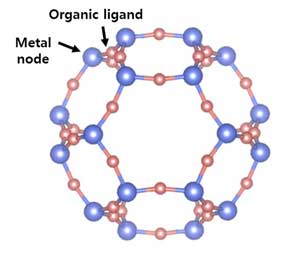
Schematic illustration of a metal-organic framework (MOF). The MOF, consisting of metal ions and organic ligands, is a highly porous material with a ultrahigh surface area. The various structures of MOFs can be synthesized depending on the kinds of metal ions and organic ligands. (Image: KAIST)
Hydrogen has been regarded as an eco-friendly next-generation energy source. However, it is a flammable gas that can explode even with a small spark. For safety, the lower explosion limit for hydrogen gas is 4 vol% so sensors should be able to detect the colorless and odorless hydrogen molecule quickly.
The importance of sensors capable of rapidly detecting colorless and odorless hydrogen gas has been emphasized in recent guidelines issued by the U.S. Department of Energy. According to the guidelines, hydrogen sensors should detect 1 vol% of hydrogen in air in less than 60 seconds for adequate response and recovery times.
Ultra-fast and ultra-sensitive nanowire hydrogen sensor
Representative image of this paper published in ACS Nano on Sept. 26.
To overcome the limitations of Pd-based hydrogen sensors, the research team introduced a MOF layer on top of a Pd nanowire array. Lithographically patterned Pd nanowires were simply overcoated with a Zn-based zeolite imidazole framework (ZIF-8) layer composed of Zn ions and organic ligands. ZIF-8 film is easily coated on Pd nanowires by simple dipping (for 2-6 hours) in a methanol solution including Zn (NO3)2·6H2O and 2-methylimidazole.
As synthesized ZIF-8 is a highly porous material composed of a number of micro-pores of 0.34 nm and 1.16 nm, hydrogen gas with a kinetic diameter of 0.289 nm can easily penetrate inside the ZIF-8 membrane, while large molecules (>0.34 nm) are effectively screened by the MOF filter.
Thus, the ZIF-8 filter on the Pd nanowires allows the predominant penetration of hydrogen molecules, leading to the acceleration of Pd-based H2 sensors with a 20-fold faster recovery and response speed compared to pristine Pd nanowires at room temperature.
Images of Pd nanowire array-based hydrogen sensors, scanning electron microscopy image of a Pd nanowire covered by a metal-organic framework layer, and the hydrogen sensing properties of the sensors
Images of Pd nanowire array-based hydrogen sensors, scanning electron microscopy image of a Pd nanowire covered by a metal-organic framework layer, and the hydrogen sensing properties of the sensors. (Image: KAIST)
Professor Kim expects that the ultra-fast hydrogen sensor can be useful for the prevention of explosion accidents caused by the leakage of hydrogen gas. In addition, he expects that other harmful gases in the air can be accurately detected through effective nano-filtration by using of a variety of MOF layers.
Source: The Korea Advanced Institute of Science and Technology (KAIST)

O celulă solară pe care o poți pune în spălare(A solar cell you can put in the wash)

au dezvoltat un nou tip de dispozitiv fotovoltaic ultra-subțire, acoperit pe ambele părți cu folii stretchable și impermeabile, care pot continua să furnizeze energie electrică din lumina soarelui chiar și după ce sunt înmuiate în apă sau întinse și comprimate. Ar putea deschide calea către celulele solare care să poată fi alimentate de dispozitive precum monitoarele de sănătate încorporate în îmbrăcăminte.sperăm că aceste fotovoltaice organice lavabile, ușor și elastice va deschide o nouă cale pentru utilizarea ca sistem de sursă de alimentare pe termen lung pentru senzori care pot fi purtați și alte dispozitive

Posted: Sep 18, 2017

A solar cell you can put in the wash

(Nanowerk News) Scientists from RIKEN and the University of Tokyo have developed a new type of ultra-thin photovoltaic device, coated on both sides with stretchable and waterproof films, which can continue to provide electricity from sunlight even after being soaked in water or being stretched and compressed.

The work, published in Nature Energy („Stretchable and waterproof elastomer-coated organic photovoltaics for washable electronic textile applications”), could open the way to wearable solar cells, which will provide power to devices such as health monitors incorporated into clothing. One of the requirements of the Internet of Things–referring to a world where devices of all sorts are connected to the Internet–is the development of power sources for a host of devices, including devices that can be worn on the body.
According to Takao Someya, the leader of the research group, these could include sensors that record heartbeats and body temperature, for example, providing early warning of medical problems. In the past, attempts have been made to create photovoltaics that could be incorporated into textiles, but typically they lacked at least one of the important properties–long-term stability in both air and water, energy efficiency, and robustness including resistance to deformation–that are key to successful devices.
For the present work, the members of the research group developed extremely thin and flexible organic photovoltaic cells, based on a material called PNTz4T, which they had developed in earlier work. They deposited the device in an inverse architecture, which they had previously developed, onto a 1-um-thick parylene film. The ultra-thin device was then placed onto acrylic-based elastomer and the top side of the device was coated with an identical elastomer, giving it a coating on both sides to prevent water infiltration.. The elastomer, while allowing light to enter, prevented water and air from leaking into the cells, making them more long-lasting than previous experiments.
The researchers then subjected the device to a variety of tests, finding first that it had a strong energy efficiency of 7.9 percent, producing a current of 7.86 milliwatts per square centimeter, as the current density was 13.8 milliamperes per square centimeter at 0.57 volts, based on a simulated sunlight of 100 milliwatts per square centimeter. To test its resistance to water, they soaked it in water for two hours, and found that the efficiency decreased by just 5.4 percent. And to test the durability, they subjected it to compression, and found that after compressing by nearly half for twenty cycles while placing drops of water on it, it still had 80 percent of the original efficiency.
According to Kenjiro Fukuda of the RIKEN Center for Emergent Matter Science, „We were very gratified to find that our device has great environmental stability while simultaneously having a good efficiency and mechanical robustness. We very much hope that these washable, lightweight and stretchable organic photovoltaics will open a new avenue for use as a long-term power source system for wearable sensors and other devices.”
Source: RIKEN

Extinderea limitelor conductorilor elastici(Stretching the limits of elastic conductors)

Noul material, produs sub formă de cerneală ca o pastă, pot fi imprimate în diferite modele pe textile și suprafețe de cauciuc ca cabluri alungibil pentru dispozitivele purtabile care încorporează senzori, precum și a da funcții ale pielii cum ar fi umane exterioare robotului ( Nature Materials , „Printable conductori elastici prin formarea in situ a nanoparticulelor de argint din fulgi de argint ” ).

Posted: Sep 12, 2017

Stretching the limits of elastic conductors

(Nanowerk News) A newly developed printable elastic conductor retains high conductivity even when stretched to as much as five times its original length, says a Japanese team of scientists. The new material, produced in paste-like ink form, can be printed in various patterns on textiles and rubber surfaces as stretchable wiring for wearable devices incorporating sensors, as well as give human skin-like functions to robot exteriors (Nature Materials, „Printable elastic conductors by in situ formation of silver nanoparticles from silver flakes”).

LED-integrated pressure-sensing glove
LED-integrated pressure-sensing glove. Each fingertip pressure sensor mounted on this glove is connected to an LED. The intensity of the LEDs varies according to the pressure applied by the fingertips. The glove makes it possible to ascertain degrees of pressure that are difficult to obtain just by examining images. (Image: Someya Group, The University of Tokyo)
The development of wearable devices such as those monitoring a person’s health or physical performance, like heart rate or muscle activity, is currently underway with some products already on the market. Moreover, with the advent of robots in areas such as health care and retail, in addition to manufacturing, future applications for sensitive elastic conductive material that can withstand high strain from stretching are likely to increase at a fever pitch.
„We saw the growing demand for wearable devices and robots,” says Professor Takao Someya at the University of Tokyo’s Graduate School of Engineering, who supervised the current study. „We felt it was very important to create printable elastic conductors to help meet the need and realize the development of the products,” he adds.
To achieve a high degree of stretchability and conductivity, the researchers mixed four components to create their elastic conductor. They found that their conductive paste consisting of micrometer-sized silver (Ag) flakes, fluorine rubber, fluorine surfactant—commonly known as a substance that reduces surface tension in liquid—and organic solvent to dissolve the fluorine rubber markedly outperformed the elastic conductor they had previously developed in 2015.
Without stretching, printed traces of the new conductor recorded 4,972 siemens per centimeter (S/cm), high conductivity using the common measure for assessing electrical conductance. When stretched by 200 percent, or to three times its original length, conductivity measured 1,070 S/cm, which is nearly six times the value of the previous conductor (192 S/cm). Even when stretched by 400 percent, or to five times its original length, the new conductor retained high conductivity of 935 S/cm, the highest level recorded for this amount of stretching.
Magnification by a scanning electron microscope (SEM) and transmission electron microscope (TEM) showed that the high performance of the conductor was due to the self-formation of silver (Ag) nanoparticles—one-thousandth the size of the Ag flakes and dispersed uniformly between the flakes in the fluorine rubber—after the conductive composite paste was printed and heated. „We did not expect the formation of Ag nanoparticles,” comments Someya on their surprising discovery.
Furthermore, the scientists found that by adjusting variables like the molecular weight of the fluorine rubber, they could control the distribution and population of nanoparticles, while the presence of surfactant and heating accelerated their formation and influenced their size.
To demonstrate the feasibility of the conductors, the scientists fabricated fully printed stretchable pressure and temperature sensors – that can sense weak force and measure heat close to body and room temperatures – wired with the printable elastic conductors on textiles. The sensors, which can be installed easily by laminating onto surfaces by hot pressing with heat and pressure, took precise measurements even when stretched by 250 percent. This is enough to accommodate high-stress flexible areas such as elbows and knees on conformable, form-fitting sportswear or joints on robotic arms often designed to surpass human capabilities and thus undergo higher strain.
The new material, which is durable and suitable for high-capacity printing methods like stencil or screen printing that can cover large surface areas, points to easy installation, and its properties of forming Ag nanoparticles (which are a fraction of the cost of Ag flakes) when printed provide an economical alternative for realizing a wide range of applications for wearables, robotics, and deformable electronic devices. The team is now exploring substitutes for Ag flakes to further reduce costs, while they are also looking at other polymers, like nonfluorine rubbers, and various combinations of materials and processes to fabricate elastic conductors with similar high performance.
Source: University of Tokyo

Read more: Stretching the limits of elastic conductors