
Curatarea metroului după atacul biologic(Cleaning Up Subway After Biological Attack)
Un nou proiect se concentrează pe curățarea unui sistem de metrou după eliberarea unui agent biologic de război, cum ar fi antraxul
Un nou proiect se concentrează pe curățarea unui sistem de metrou după eliberarea unui agent biologic de război, cum ar fi antraxul
Un nou filtru superhidrofil sa dovedit a fi capabil sa indeparteze mai mult de 90% din hidrocarburi, precum si toate bacteriile si particulele din apa contaminata produsa prin operatiuni de fracturare hidraulica (fracking) la sisturi de petrol si gaze,
| Posted: Sep 25, 2017 | |
Nanopore filter may be a match for fracking water(Nanowerk News) A new superhydrophilic filter has proven able to remove greater than 90 per cent of hydrocarbons, as well as all bacteria and particulates from contaminated water produced by hydraulic fracturing (fracking) operations at shale oil and gas wells, according to researchers at the Energy Safety Research Institute at Swansea University in collaboration with researchers at Rice University. |
|
| The work by Prof Andrew R Barron and his colleagues turns a ceramic membrane with microscale pores into a superhydrophilic filter that „essentially eliminates” the common problem of fouling. | |
| The researchers determined one pass through the membrane should clean contaminated water enough for reuse at a well, significantly cutting the amount that has to be stored or transported. | |
| The work is reported in Nature’s open-access Scientific Reports („Superhydrophilic Functionalization of Microfiltration Ceramic Membranes Enables Separation of Hydrocarbons from Frac and Produced Water”). | |
| The filters keep emulsified hydrocarbons from passing through the material’s ionically charged pores, which are about one-fifth of a micron wide, small enough that other contaminants cannot pass through. The charge attracts a thin layer of water that adheres to the entire surface of the filter to repel globules of oil and other hydrocarbons and keep it from clogging. | |
| A hydraulically fractured well uses more than 5 million gallons of water on average, of which only 10 to 15 per cent is recovered during the flow back stage, Barron said. | |
| „This makes it very important to be able to re-use this water” | |
| Not every type of filter reliably removes every type of contaminant, he said. | |
| Solubilized hydrocarbon molecules slip right through micro filters designed to remove bacteria. Natural organic matter, like sugars from guar gum used to make fracking fluids more viscous, require ultra- or nanofiltration, but those foul easily, especially from hydrocarbons that emulsify into globules. A multistage filter that could remove all the contaminants isn’t practical due to cost and the energy it would consume. | |
| Frac water and produced waters represent a significant challenge on a technical level. If you use a membrane with pores small enough to separate they foul, and this renders the membrane useless. In our case, the superhydrophilic treatment results in an increased flux (flow) of water through the membrane as well as inhibiting any hydrophobic material – such as oil – from passing through. The difference in solubility of the contaminants thus works to allow for separation of molecules that should in theory pass through the membrane. | |
| Barron and his colleagues used cysteic acid to modify the surface of an alumina-based ceramic membrane, making it superhydrophilic, or extremely attracted to water. The superhydrophilic surface has a contact angle of 5 degrees. | |
| The acid covered not only the surface but also the inside of the pores, and that kept particulates from sticking to them and fouling the filter. | |
| In tests with fracking flow back or produced water that contained guar gum, the alumna membrane showed a slow initial decrease in flux – a measure of the flow of mass through a material – but it stabilized for the duration of lab tests. Untreated membranes showed a dramatic decrease within 18 hours. | |
| The researchers theorized the initial decrease in flow through the ceramics was due to purging of air from the pores, after which the superhydrophilic pores trapped the thin layer of water that prevented fouling. | |
| „This membrane doesn’t foul, so it lasts,” Barron said. „It requires lower operating pressures, so you need a smaller pump that consumes less electricity. And that’s all better for the environment.” | |
| „Fracking has proved highly controversial in the UK in part as a result of the pollution generated from produced waters”, co-author Darren Oatley-Radcliffe, an associate professor, at Swansea University, said, „However, with this new super-hydrophilic membrane we can clean up this waste produced water to a very high standard and recycle all of the materials, significantly improving the environmental performance of the fracking process.” |
| Source: Swansea University |
Urmărirea soldaților într-o situație de urgență durează uneori prea mult, un factor critic care ar putea costa viețile soldaților răniți;O nouă tehnologie de stil negru personalizat, concepută pentru a fi purtată de soldați pe câmpul de luptă, va fi dezvoltată pentru armata australiană
Un nou dispozitiv portabil dorește să livreze provizii pentru marinarii și soldații americani la cerere, în loc să lase membrii forțelor armate să transporte sacii pe spatele lor
DOD a emis instrucțiuni care să permită instalațiilor militare să distrugă dronele necinstite,
Confuzat despre ce plăci de armură a corpului trebuie să ajungă;
Înțelegerea acestor efecte este importantă și pentru alte aplicații, cum ar fi împărțirea moleculelor de apă pentru a produce hidrogen la interfețele solid-lichide, dispozitive electronice care se bazează pe interfațe de oxid de oxid sau alte procedee electrochimice care utilizează aceste materiale ca catalizatori, permiteți interacțiunile.
Materialele pe care echipa le-a studiat fac parte dintr-o clasa cunoscuta sub denumirea de oxizi binari alcalino-pamant, ale caror componente sunt „printre cele mai abundente clase de materiale de pe Pamant”, spune Yildiz. „[Această clasă este] ieftină, abundentă și are proprietăți reglabile”, făcându-l promițătoare pentru multe aplicații. Dar ea adaugă că abordarea teoretică pe care au luat-o vor fi aplicate în prezent mult mai larg, la multe alte tipuri de materiale oxidice și la alte tipuri de defecte în interiorul lor, pe lângă vacanțele neutre pentru oxigen.
| Posted: Sep 22, 2017 | |
New analysis explains role of defects in metal oxides(Nanowerk News) Sometimes things that are technically defects, such as imperfections in a material’s crystal lattice, can actually produce changes in properties that open up new kinds of useful applications. New research from a team at MIT shows that such imperfections in a family of materials known as insulating metal oxides may be key to their performance for a variety of high-tech applications, such as nonvolatile memory chips and energy conversion technologies. |
|
| The findings are reported this week in the journal Physical Review Letters („Polarizing Oxygen Vacancies in Insulating Metal Oxides under a High Electric Field”), in a paper by MIT Associate Professor Bilge Yildiz, Professor and Associate Provost Krystyn Van Vliet, and former postdoc Mostafa Youssef. | |
 |
|
| In this diagram, the atomic lattice of a crystal of barium oxide is depicted, with atoms of oxygen and barium represented by red and gray spheres. A neutral oxygen vacancy, a place where an oxygen atom should appear in the lattice but is instead replaced by two electrons, is represented by the yellow shape, which depicts the charge density of those electrons. At left, the crystal is seen with no electric field applied, and at right, with an applied field of 21.8 megavolts per centimeter. The distortions of the lattice reveal the effects of that applied electric field. (Image: Felice Frankel) | |
| These metal oxide materials have been investigated by many researchers, Yildiz says, and „their properties are highly governed by the number and the kind of defects that are present.” When subjected to strong driving forces, such as strong electric fields, „the behavior of such defects had not been well-understood,” she says. | |
| Researchers do have a well-established theoretical understanding of how perfectly structured versions of these insulating metal oxides function under a variety of conditions, such as in strong electric fields, but there was no such theory to describe the materials when they contain common types of defects, according to Yildiz. Understanding these effects quantitatively is important in order to develop this promising family of materials for potential applications including new types of low-energy computer memory and processing devices, electrically based refrigeration, and electro-catalytic energy-conversion devices such as fuel cells. | |
| The team demonstrated a theoretical framework and showed how the stability and structure of a point defect is altered under strong electric fields. They took a common defect called a neutral oxygen vacancy – a place where an oxygen atom should appear in the lattice but instead two electrons are trapped. Their results have quantified the polarization behavior of the material with this defect, in an electric field. | |
| „The oxygen vacancies in particular are very important in electronic and electrochemical applications,” says Yildiz, who holds joint appointments in the departments of Nuclear Science and Engineering and Materials Science and Engineering. | |
| In many of these applications, she says, there can be an internal voltage gradient created within the thin-film material, and this „electric potential” gradient causes strong electric fields. Understanding the effects of those fields is essential for the design of certain new devices. | |
| „Most of the work in this area is experimental,” Yildiz says. „You take a thin film, you put it in an electric field, and you do measurements.” But in such experiments, the effects of the local electric potential and the electric field are convoluted, making it very hard to understand the results. „It’s impossible to resolve them from each other, so you need to have a theory” to account for the effects, she adds. | |
| The researchers have now devised a new theoretical framework that allows them to isolate the electric field effect from the electric potential effect, and quantify both independently. This allowed them to make very specific predictions that are different from those produced by classical theory and should make it possible to validate the new model experimentally within a year, Yildiz says. | |
| The findings should help enable the development of some important potential applications, she says. One is in a new type of computer memory device known as resistive switching memory, which provides fast switching speeds using very little energy. These memory devices rely on the presence of defects. | |
| „The way they switch their resistance state [to record data] depends on the defect type, content, and distribution,” she says. „In order to model the device behavior, you should be able to model how the applied strong electric fields alter the defect structure, concentration, and distribution.” That’s what this new work enables: „If you know quantitatively the effects of both the potential and the field, then you can design your operating conditions to benefit from these effects.” | |
| Understanding these effects is also important for other applications such as splitting water molecules to produce hydrogen at solid-liquid interfaces, electronic devices that rely on oxide-oxide interfaces, or other electrochemical processes using these materials as catalysts, where defects serve as the sites that enable the interactions. | |
| The materials the team studied belong to a class known as alkaline-earth-metal binary oxides, whose constituents are „among the most abundant class of materials on Earth,” Yildiz says. „[This class is] cheap, abundant, and has tunable properties,” making it promising for many applications. But she adds that the theoretical approach they took will now be applied much more broadly, to many other kinds of oxide materials and to other kinds of defects within them besides the neutral oxygen vacancies. |
| Source: By David L. Chandler, MIT |
Parcul de pornire Nest Secure vine de asemenea cu ceva numit Nest Detect;Este un senzor alimentat de baterii care detectează atât mișcarea, cât și mișcarea deschisă sau apropiată
Războiul a dus întotdeauna la cele mai mari salturi în tehnologie, pe care fiecare țară încearcă în mod constant să aibă cele mai avansate și capabile armamente pentru a-și proteja interesele acasă și în străinătate
au descoperit un aliaj bidimensional cu o bandgap optica care poate fi reglat de temperatura folosita pentru ao creste.A dezvoltat aliajul de patru componente din metale tranziționale, molibden și tungsten, cu sulfuri de calciu și seleniu într-un cuptor de depunere chimică de vapori. Ei au descoperit că schimbările de temperatură au făcut modificări subtile în modul în care atomii au asamblat și, de asemenea, au modificat proprietățile care determină modul în care absorb și emit lumină.
| Posted: Sep 21, 2017 | |
Four elements make 2-D optical platform(Nanowerk News) Rice University scientists have discovered a two-dimensional alloy with an optical bandgap that can be tuned by the temperature used to grow it. |
|
| The Rice lab of materials scientist Pulickel Ajayan grew the four-component alloy of transition metals molybdenum and tungsten with chalcogens sulfur and selenium in a chemical vapor deposition furnace. They found changes in temperature made subtle changes in the way atoms assembled and also altered the properties that determine how they absorb and emit light. | |
 |
|
| Subtle changes in growth temperature alters the form of a four-component alloy created at Rice University. The alloy can be tuned to alter its optical bandgap, which may be of use in the design of solar cells and light-emitting diodes. (Illustration by Alex Kutana) | |
| Their experiments were built upon work by the lab of Rice theoretical physicist Boris Yakobson, which created scores of models to predict how various combinations of the four elements should work. | |
| The process should be of interest to engineers looking to make smaller, more-efficient devices. Because the bandgap falls in the optical range of the electromagnetic spectrum, the researchers said solar cells and light-emitting diodes might be the first beneficiaries. | |
| The paper appears as a cover story in the current issue of Advanced Materials („Quaternary 2D Transition Metal Dichalcogenides (TMDs) with Tunable Bandgap”). | |
| The team led by co-lead author and Rice research scientist Alex Kutana generated 152 random models of the material that showed the bandgap could be tuned from 1.62 to 1.84 electron volts by varying the growth temperature from 650 and 800 degrees Celsius (1,202 to 1,472 degrees Fahrenheit). | |
| The experimental team led by Sandhya Susarla then made and tested the thermodynamically stable materials in a furnace at 50-degree increments. Scientists at Oak Ridge National Laboratory led by postdoctoral researcher Jordan Hachtel produced microscope images that identified and detailed the position of each atom in the materials. | |
| “Labs have made 2-D materials with two or three components, but we don’t believe anyone has tried four,” said co-author and Rice postdoctoral researcher Chandra Sekhar Tiwary. “Having four components gives us an additional degree of freedom. With fewer materials, every adjustment you make to change the bandgap turns it into a different material. That’s not the case here.” | |
| “What we’ve made should be very useful,” added Susarla, a Rice graduate student. “For applications like solar cells and LEDs, you need a material that has a broad bandgap.” | |
| Tiwary said the material can be tuned to cover the entire spectrum of visible light, from 400- to 700-nanometer wavelengths. “That’s a huge range we can cover by just changing this composition,” he said. “If we choose the composition correctly, we can hit the correct bandgap or correct emission point.” | |
| “These materials are arguably the most important 2-D semiconductors because of their excellent optoelectronic properties and low cost,” Kutana said. “Our high-throughput calculations permitted us to avoid prior assumptions about how the alloy bandgap behaved. The surprising outcome was how regular the bandgap changes were, resulting in optical properties that are both useful and predictable.” |
| Source: By Mike Williams, Rice University |
Una dintre domeniile promițătoare ale științei materialelor moderne este studiul materialelor bidimensionale (2D), adică filme subțiri constând din unul sau mai multe straturi atomice. Materialele 2D datorate supraconductivității și rezistenței lor electrice ar putea constitui o bază pentru nanoelectronica modernă. Aplicațiile optice în nanoelectronică necesită materiale avansate capabile să „genereze” mari fluxuri de electroni prin iradiere ușoară. Gallium selenidă (GaSe) este unul dintre semiconductorii 2D care poate face față acestei probleme cel mai eficient.De exemplu, poate fi aplicat în dispozitive încapsulate care sunt fabricate în vid și apoi acoperite cu un strat de protecție care elimină penetrarea aerului.
| Posted: Sep 21, 2017 | |
Application of air-sensitive semiconductors in nanoelectronics(Nanowerk News) A research group consisting of scientists from Tomsk Polytechnic University, Germany and Venezuela proved vulnerability of a two-dimensional semiconductor gallium selenide in air. This discovery will allow manufacturing superconducting nanoelectronics based on gallium selenide, which has never been previously achieved by any research team in the world. |
|
| The study was published in Semiconductor Science and Technology („GaSe oxidation in air: from bulk to monolayers”). | |
 |
|
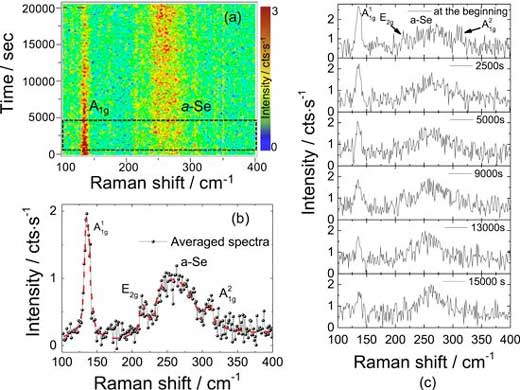
| Raman spectrum of 8 L GaSe taken at two different times during time evolution map. (a) Red dashed line is drawn as the guide for the eye. The constant intensity ratio peaks indicates that oxidation stops approximately after 16 500 s. Thickness dependent Raman spectrum of GaSe for oxidation investigation. (b) Each spectrum was taken with 700 s × 3 of accumulation time. (Image: Tomsk Polytechnic University) | |
| One of the promising areas of modern materials science is the study of two-dimensional (2D) materials, i.e. thin films consisting of one or several atomic layers. 2D materials due to their electrical superconductivity and strength could be a basis for modern nanoelectronics. Optic applications in nanoelectronics require advanced materials capable of ‘generating’ great electron fluxes upon light irradiation. Gallium selenide (GaSe) is one of the 2D semiconductors that can cope with this problem most efficiently. | |
| ‘Some research teams abroad tried to create electronic devices based on GaSe. However, despite extensive theoretical studies of this material, which were published in major scientific journals, the stability of the material in real devices remained unclear,’ says Prof. Raul Rodriguez, the Department of Lasers and Lighting Engineering. | |
| The research team revealed the reasons behind this. They studied GaSe by means of Raman spectroscopy and x-ray photoelectron spectroscopy that allowed proving the existence of chemical bonds between gallium and oxygen. Photoluminescence in oxidized substance is absent that also proves the formation of oxides. It means that the scientists revealed that GaSe oxidizes quickly in air and loses its electrical conductivity necessary for creating nanoeletronic devices. | |
| ‘GaSe monolayers become oxidized almost immediately after being exposed to air. Further research of GASe stability in air will allow making proposals how to protect it and maintain its optoelectronic properties,’ emphasize the authors. | |
| According to Prof. Rodriguez, for GaSe not to lose its unique properties it should be placed in a vacuum or inert environment. For example, it can be applied in encapsulated devices that are vacuum-manufactured and then covered with a protective layer eliminating air penetration. | |
| This method can be used to produce next generation optoelectronics, detectors, light sources and solar batteries. Such devices of ultra-small sizes will have very high quantum efficiency, i.e. they will be able to generate large electron fluxes under small external exposure. |
| Source: Tomsk University |