
Crearea unui burete molecular superior, de la început(Creating a molecular super sponge, from the ground up)

oamenii de stiinta au creat un material complex din punct de vedere structural folosind doar doua tipuri de blocuri. Cunoscută ca o structură metalică organică (MOF), noua suprastructură poroasă sau cușcă, numită NU-1301, este destul de mare, cu cea mai mare celulă unică din orice material nebiologic.MF este un material foarte poros, ca un burete super, care este excelent pentru aplicații de stocare incluzând, dar fără a se limita la, depozitarea deșeurilor nucleare.

Posted: Aug 22, 2017

Creating a molecular super sponge, from the ground up
(Nanowerk News) Mother Nature does it every day, but building complex materials from the bottom-up using only simple building blocks is incredibly difficult in the lab.

Now, scientists created a structurally complex material using just two types of building blocks. Known as a metal-organic framework (MOF), the new porous, or cage-filled, superstructure called NU-1301 is quite large, with the largest unit cell of any non-biological material.
In addition, it is the lowest density MOF reported to date. The low density means the MOF is a highly porous material, like a super sponge, which is great for storage applications including, but not limited to, storage of nuclear waste.
This work (Science, „Bottom-up construction of a superstructure in a porous uranium–organic crystal”) demonstrates a set of design rules. These rules can now be used for the self-assembly of highly intricate, open structures using simple starting materials. For example, scientists can use the rules to design new materials that better filter pollutants and other toxic chemicals. In addition, this work highlights the potential role of uranium and other actinides for complex materials synthesis.
NU-1301 is composed of cuboctahedral building blocks
NU-1301 is composed of cuboctahedral building blocks (blue) that organize into pentagonal and hexagonal (yellow and red) prismatic secondary structures resulting in the formation of colossal icosidodecahedral (grey) and rectified hexakaidecahedral (green) cavities with internal diameters of 5.0 nm and 6.2 nm, respectively. The cages are measured in Angstroms. (Image: N.A. Vermeulen)
The structure of NU-1301 represents a new three-dimensional net, named Northwestern University Net (nun), which has been added to the reticular chemistry structure resource database. The net is highly complex with 17 topologically distinct nodal vertices and 18 discrete edges.
Given the structural complexity of NU-1301, the single crystal x-ray structure of the resulting MOF could not be solved using traditional methods because only the position of the uranium atoms could be determined experimentally.
As a result, the scientists simulated the organic components based on the uranium atom positions; then, they confirmed the final simulated structure using other techniques. NU-1301 has a high Brunauer-Emmett-Teller (BET) area (4750 m2/g) and pore volume (3.9 cm3/g) and is thermally stable to temperatures greater than 500°C (~900 F) under both nitrogen and air.
The pores of NU-1301 are also accessible and anionic in nature, as shown by the encapsulation of positively charged small organic molecules and large biological molecules that can be separated from negatively charged molecules of similar sizes.
Source: U.S. Department of Energy, Office of Science

Read more: Creating a molecular super sponge, from the ground up

Ambalajul antimicrobian bazat pe argint menține alimentele proaspete ( Clay-based antimicrobial packaging keeps food fresh )

Cercetătorii au încărcat aceste nanotuburi cu un ulei esențial antibacterian natural găsit în cimbru și oregano numit carvacrol și au acoperit suprafața interioară a filmului de ambalaj cu nanotuburile încărcate pentru a ucide microbii.
Echipa a înfășurat roșiile, bananele și puiul în film pentru a-și testa eficacitatea în diferite perioade de timp în comparație cu alimentele învelite în polietilenă simplă. După 10 zile, roșiile învelite cu noul film erau mai bine conservate decât legumele de control. În plus, noul film a ajutat bananele să rămână mai ferme și să păstreze culoarea galbenă vibrantă după șase zile, comparativ cu fructul de control. Și puiul învelit cu filmul experimental și refrigerat timp de 24 de ore a prezentat o creștere semnificativ mai mică a bacteriilor decât puiul din polietilenă simplă.

Posted: Aug 22, 2017

Clay-based antimicrobial packaging keeps food fresh

(Nanowerk News) Sometimes it seems as if fresh fruits, vegetables and meats go bad in the blink of an eye. Consumers are left feeling frustrated, often turning to less expensive processed foods that last longer but are less nutritious. Now scientists report that they have developed a packaging film coated with clay nanotubes packed with an antibacterial essential oil. The film provides a one-two punch, preventing over-ripening and microbial growth, which could help improve the shelf life of perishables.

The researchers are presenting their results at the 254th National Meeting & Exposition of the American Chemical Society (ACS).
Clay-Based Antimicrobial Packaging Keeps Food Fresh
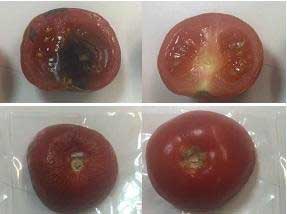
Control tomatoes (left) rotted after six days while those wrapped in a new clay-based film (right) stayed fresh. (Image: Hayriye Ünal)
„Food packaging that is capable of interacting with food can contribute to safety and prevent economic losses from spoilage,” Hayriye Ünal, Ph.D., says. „Specialized films that can preserve a wide array of foods are highly sought after.”
People around the world have been trying to preserve fruits, vegetables and meats since ancient times. From the traditional methods of salting or fermenting to the more modern methods of canning, freezing or wrapping in plastic films, food preservation has always been important. According to the U.S. Department of Agriculture, about 30 to 40 percent of the food that farmers produce in the country goes to waste. Sometimes, busy people just don’t have enough time to eat all of the fresh food they buy, but other times food spoils at the grocery store because consumers avoid purchasing imperfect fruits, vegetables and meats.
Over the past two decades, scientists have been developing alternative ways to preserve food, with an extensive focus on packaging. Numerous issues, primarily the versatility of the materials, have hindered progress. „While companies can already make many films that prevent fruit and vegetables from drying out, incorporating additional properties in the same film is a challenge,” says Ünal, who is at Sabanci University in Turkey.
Bacterial contamination and permeability to both oxygen and water vapor are major issues that scientists are addressing. Another challenge is to prevent too much ethylene from building up around foods. Ethylene is a compound naturally released by fruits and vegetables that aids in the ripening process. But an excess of ethylene trapped underneath the packaging film can cause food to over ripen and rot.
To meet the demand for multi-functional packaging, Ünal’s team started with a polyethylene film. To scavenge for ethylene and provide a gas barrier the group incorporated clay „halloysite nanotubes,” which are small, hollow cylinders. The nanotubes prevent oxygen from entering the film, and prevent water vapor and other gases from escaping. In addition they keep ethylene from building up by absorbing it. The researchers loaded these nanotubes with a natural antibacterial essential oil found in thyme and oregano called carvacrol and coated the inner surface of the packaging film with the loaded nanotubes to kill microbes.
The team wrapped tomatoes, bananas and chicken in the film to test its effectiveness over varying amounts of time compared to foods wrapped in plain polyethylene. After 10 days, tomatoes wrapped with the new film were better preserved than the control vegetables. In addition, the new film helped bananas stay more firm and keep their vibrant yellow color after six days compared to the control fruit. And chicken enveloped with the experimental film and refrigerated for 24 hours showed significantly less bacterial growth than chicken in plain polyethylene.
But moving this technology to industry will require some additional work, Ünal says. As a next step toward that, her team will test the new film to make sure it is safe and nontoxic.
Source: American Chemical Society

Read more: Clay-based antimicrobial packaging keeps food fresh

München Re & In-Q-Tel a selectat Metabiota pentru a obține o perspectivă mai profundă asupra riscului epidemiei și pregătirii globale pentru bolile infecțioase(Munich Re& In-Q-Tel Select Metabiota to Gain Deeper Insights into Epidemic Risk and Global Preparedness for Infectious Diseases)

Cu o platformă intuitivă, bazată pe cloud, Metabiota furnizează administratorilor de risc și subscriptorilor cu o perspectivă fără precedent asupra modului în care se propagă bolile și le ajută să cuantifice riscul reprezentat de epidemii

Stimp20

Silk ar putea îmbunătăți sensibilitatea, flexibilitatea senzorilor de corp care pot fi purtați ( Silk could improve sensitivity, flexibility of wearable body sensors )

Pe baza rezultatelor preliminare, Zhang dorește să exploreze modalități de a crea un set integrat de senzori auto-susținători care să fie alimentați de nano-generatori. Ea sugerează, de asemenea, că senzorii de mătase ai echipei sale ar putea fi folosiți pentru a construi roboți mai reali care să poată simți atingerea, temperatura sau umiditatea și pot chiar distinge între vocile diferitelor persoane.

Posted: Aug 21, 2017

Silk could improve sensitivity, flexibility of wearable body sensors

(Nanowerk News) From smart socks to workout clothes that measure exertion, wearable body sensors are becoming the latest „must-have” technology. Now scientists report they are on the cusp of using silk, one of the world’s most coveted fabrics, to develop a more sensitive and flexible generation of these multi-purpose devices that monitor a slew of body functions in real time.

The researchers are presenting their work today at the 254th National Meeting & Exposition of the American Chemical Society (ACS).
„There is a whole world of possibilities for silk sensors at the moment. Silk is the ideal material for fabricating sensors that are worn on the body,” Yingying Zhang, Ph.D., says. „One possibility we foresee is for them to be used as an integrated wireless system that would allow doctors to more easily monitor patients remotely so that they can respond to their medical needs more rapidly than ever before.”
flexible body sensor made from silk
Silk could soon be used to produce more sensitive and flexible body sensors like this one. (Image: Yingying Zhang)
Body sensors, which are usually made with semiconductors, have shown great potential for monitoring human health. But they have limitations. For instance, strain sensors, which measure changes in force, cannot be highly sensitive and highly stretchable at the same time. Silk, a natural material that is stronger than steel and more flexible than nylon, could overcome these problems. The fiber is also lightweight and biocompatible. However, silk doesn’t conduct electricity very well. To address this challenge, Zhang and colleagues at Tsinghua University in China sought to find a way to boost the conductivity of silk so it could be successfully used in body-sensing devices.
The researchers decided to try two different strategies. In one approach, they treated the silk in an inert gas environment with temperatures ranging from 1,112 degrees to 5,432 degrees Fahrenheit. As a result, the silk became infused with N-doped carbon with some graphitized particles, which is electrically conductive. Using this technique, the scientists have developed strain sensors, pressure sensors and a dual-mode sensor capable of measuring temperature and pressure simultaneously.
In the other approach, the team fed either graphene or carbon nanotubes to silkworms. Some of these nanoparticles were naturally incorporated into the silk produced by the worms. So far, this method hasn’t produced electrically conductive fibers, but the researchers are still experimenting with this technique and are hopeful they can make it work.
Based on the preliminary results, Zhang wants to explore ways to create an integrated set of silk-based, self-sustaining sensors that would be powered by nano-generators. She also suggests that her team’s silk sensors might be used to build more realistic robots that can sense touch, temperature or humidity and can even distinguish between different people’s voices.
Source: American Chemical Society

Read more: Silk could improve sensitivity, flexibility of wearable body sensors

Tehnologie de suport tehnic sprijină performanța infanteriei(Wearable Technology Supports Infantry Performance )

Tehnologia performanta este angajato serios pentru a ajuta la îmbunătățirea capacităților sale de infanterie; Dezvoltatorii din spatele adoptării aplicațiilor de tehnologie de uzură sunt variate, însă o aplicație cheie este folosirea acestei tehnologii pentru a monitoriza starea fizică a unui soldat

wearable Technology

Echipament flexibil pentru războinici(Flexible Material Equipment for Warfighters )

a fost în curs de dezvoltare echipamente de material flexibil pentru războinici;Exploatând avantajele tehnologiei aditivilor, nanomaterialelor și platformelor de cercetare autonome, în timp ce valorifică parteneriatele cu industria și mediul academic, echipa conduce un portofoliu dedicat cercetării materialelor destinate viitorului, dedicat asigurării faptului că Forțele Aeriene dispun de cea mai avansată tehnologie pentru lupta

flexible material

Materiale ceramice cu greutate redusă un model pentru armura mai ușoară(Light-weight ceramic materials a model for lighter armor)

În timp ce diferite materiale ceramice posedă o duritate ridicată, acestea nu reușesc cu ușurință atunci când sunt separate;când este supus forțelor de tracțiune;cantitatea de tensiune pe care aceste materiale le poate rezista înainte de eșec, este o mică parte din compresia pe care o pot suporta

Stimp4