Grafenul, o foaie de atomi de carbon aranjat într-o latură rigidă, fagure de miere, asemănătoare firului de pui, are proprietăți electronice interesante. Dar când oamenii de știință taie o bandă mai mică de 5 nanometri în lățime – mai puțin de o lățime de zece mii pe lățimea părului uman – nanoparticulele grafene dobândesc noi proprietăți cuantice, făcându-le o alternativă potențială la semiconductorii de siliciu.
Posted: Aug 08, 2018
Tying electrons down with nanoribbons
(Nanowerk News) Scientists are experimenting with narrow strips of graphene, called nanoribbons, in hopes of making cool new electronic devices, but University of California, Berkeley scientists have discovered another possible role for them: as nanoscale electron traps with potential applications in quantum computers.
Scanning tunneling microscope image of a topological nanoribbon superlattice. Electrons are trapped at the interfaces between wide ribbon segments (which are topologically non-trivial) and narrow ribbon segments (which are topologically trivial). The wide segments are 9 carbon atoms across (1.65 nanometers) while the narrow segments are only 7 carbon atoms across (1.40 nanometers).
Graphene, a sheet of carbon atoms arranged in a rigid, honeycomb lattice resembling chicken wire, has interesting electronic properties of its own. But when scientists cut off a strip less than about 5 nanometers in width – less than one ten-thousandth the width of a human hair – the graphene nanoribbon takes on new quantum properties, making it a potential alternative to silicon semiconductors.
UC Berkeley theoretician Steven Louie, a professor of physics, predicted last year that joining two different types of nanoribbons could yield a unique material, one that immobilizes single electrons at the junction between ribbon segments.
In order to accomplish this, however, the electron “topology” of the two nanoribbon pieces must be different. Topology here refers to the shape that propagating electron states adopt as they move quantum mechanically through a nanoribbon, a subtle property that had been ignored in graphene nanoribbons until Louie’s prediction.
Two of Louie’s colleagues, chemist Felix Fischer and physicist Michael Crommie, became excited by his idea and the potential applications of trapping electrons in nanoribbons and teamed up to test the prediction. Together they were able to experimentally demonstrate that junctions of nanoribbons having the proper topology are occupied by individual localized electrons.
A nanoribbon made according to Louie’s recipe with alternating ribbon strips of different widths, forming a nanoribbon superlattice, produces a conga line of electrons that interact quantum mechanically. Depending on the strips’ distance apart, the new hybrid nanoribbon is either a metal, a semiconductor or a chain of qubits, the basic elements of a quantum computer.
“This gives us a new way to control the electronic and magnetic properties of graphene nanoribbons,” said Crommie, a UC Berkeley professor of physics. “We spent years changing the properties of nanoribbons using more conventional methods, but playing with their topology gives us a powerful new way to modify the fundamental properties of nanoribbons that we never suspected existed until now.”
Using the mathematics of topology
Louie’s theory implies that nanoribbons are topological insulators: unusual materials that are insulators, that is, non-conducting in the interior, but metallic conductors along their surface. The 2016 Nobel Prize in Physics was awarded to three scientists who first used the mathematical principles of topology to explain strange, quantum states of matter, now classified as topological materials.
This scanning tunneling microscope image shows a hybrid graphene nanoribbon composed of a topologically non-trivial nanoribbon (9 carbon atoms across) joined to a topologically trivial nanoribbon (7 carbon atoms across). Electrons are trapped at each junction.
Three-dimensional topological insulators conduct electricity along their sides, sheets of 2D topological insulators conduct electricity along their edges, and these new 1D nanoribbon topological insulators have the equivalent of zero-dimensional (0D) metals at their edges, with the caveat that a single 0D electron at a ribbon junction is confined in all directions and can’t move anywhere. If another electron is similarly trapped nearby, however, the two can tunnel along the nanoribbon and meet up via the rules of quantum mechanics. And the spins of adjacent electrons, if spaced just right, should become entangled so that tweaking one affects the others, a feature that is essential for a quantum computer.
The synthesis of the hybrid nanoribbons was a difficult feat, said Fischer, a UC Berkeley professor of chemistry. While theoreticians can predict the structure of many topological insulators, that doesn’t mean that they can be synthesized in the real world.
“Here you have a very simple recipe for how to create topological states in a material that is very accessible,” Fischer said. “It is just organic chemistry. The synthesis is not trivial, granted, but we can do it. This is a breakthrough in that we can now start thinking about how to use this to achieve new, unprecedented electronic structures.”
The researchers report their synthesis, theory and analysis in the Aug. 9 issue of the journal Nature („Topological band engineering of graphene nanoribbons”). Louie, Fischer and Crommie are also faculty scientists at Lawrence Berkeley National Laboratory.
Knitting nanoribbons together
Louie, who specializes in the quantum theory of unusual forms of matter, from superconductors to nanostructures, authored a 2017 paper that described how to make graphene nanoribbon junctions that take advantage of the theoretical discovery that nanoribbons are 1D topological insulators. His recipe required taking so-called topologically trivial nanoribbons and pairing them with topologically non-trivial nanoribbons, where Louie explained how to tell the difference between the two by looking at the shape of the quantum mechanical states that are adopted by electrons in the ribbons.
Fischer, who specializes in synthesizing and characterizing unusual nanomolecules, discovered a new way to make atomically precise nanoribbon structures that would exhibit these properties from complex carbon compounds based on anthracene.
Berkeley chemist Felix Fischer created the complex molecules at the top so that when heated on a gold catalyst they would join together to form the graphene nanoribbon on the bottom, a topological insulator.
Working side by side, Fischer’s and Crommie’s research teams then built the nanoribbons on top of a gold catalyst heated inside a vacuum chamber, and Crommie’s team used a scanning tunneling microscope to confirm the electronic structure of the nanoribbon. It perfectly matched Louie’s theory and calculations. The hybrid nanoribbons they made had between 50 and 100 junctions, each occupied by an individual electron able to quantum mechanically interact with its neighbors.
“When you heat the building blocks, you get a patchwork quilt of molecules knitted together into this beautiful nanoribbon,” Crommie said. “But because the different molecules can have different structures, the nanoribbon can be designed to have interesting new properties.”
Fischer said that the length of each segment of nanoribbon can be varied to change the distance between trapped electrons, thus changing how they interact quantum mechanically. When close together the electrons interact strongly and split into two quantum states (bonding and anti-bonding) whose properties can be controlled, allowing the fabrication of new 1D metals and insulators. When the trapped electrons are slightly more separated, however, they act like small, quantum magnets (spins) that can be entangled and are ideal for quantum computing.
“This provides us with a completely new system that alleviates some of the problems expected for future quantum computers, such as how to easily mass-produce highly precise quantum dots with engineered entanglement that can be incorporated into electronic devices in a straightforward way,” Fischer said.
Source: By Robert Sanders, University of California, Berkeley
Instalarea unei plăci cu titan acoperită, cum ar fi pistonul Titanium cu pistoane rotunjite, oferă o suprafață mai netedă pentru ca bara de declanșare să alunece. În plus, plonjorul de tip LSPI Titanium are un profil puțin mai mic și vine cu un resort mai ușor, ceea ce face mai ușor de împins.
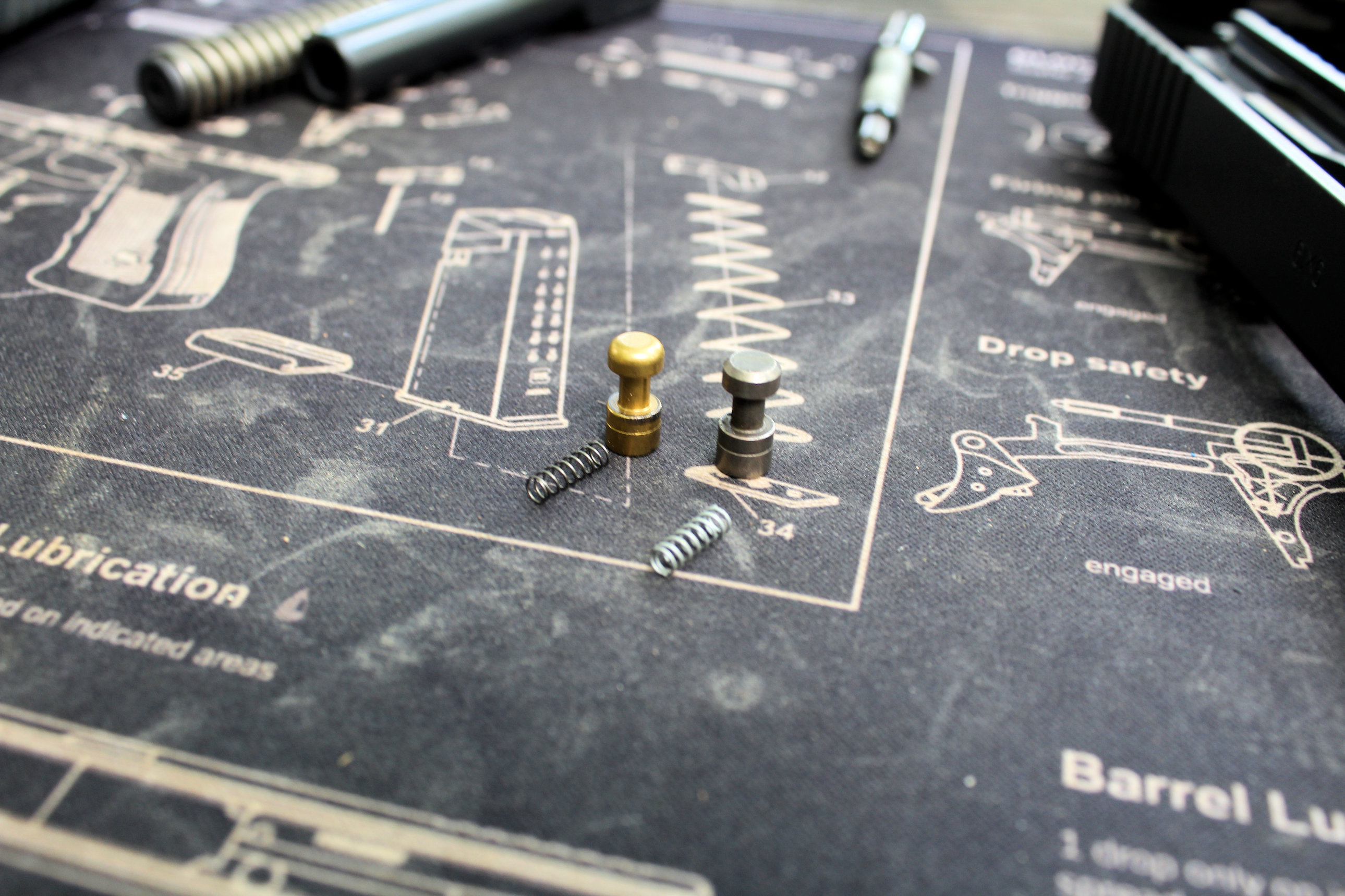
Lightning Strike Plonjorul cu titan, în stânga, față de pistonul de stocare din dreapta. Rețineți că nu există nicio margine pe titan. Între aceasta și netezirea stratului de titan și a primăverii cu brichetă, se poate îmbunătăți simțul preluării pe declanșator.
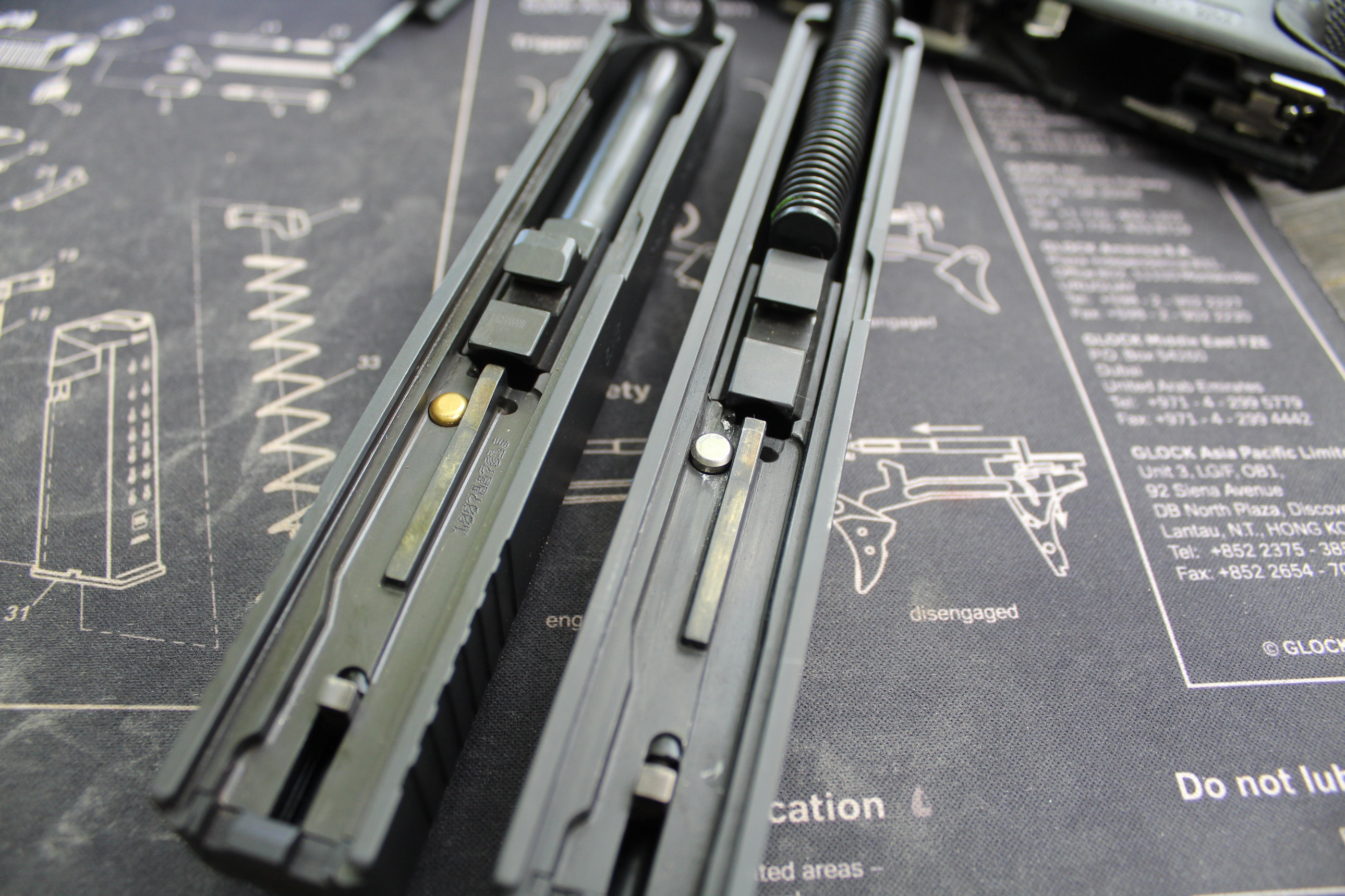
Lightning Strike Pistonul titanic (din stânga) are, de asemenea, un profil mai mic, permițând o cuplare mai ușoară a barei de declanșare, ceea ce ajută la o simțire mai slabă atunci când apăsați declanșatorul.
Improving your Glock for under $100, Part I: Plunger and Trigger Bar Mods!
Posted by: August 7, 2018
If one is looking to accessorize and upgrade their Glock, basically, the sky’s the limit! Or, I should say, cost is the only limiting factor. From custom slides to complete transformations like building a Roland Special with mini-red dot sight, extended mag well, and a compensator equipped barrel, how much you want to spend is the only barrier to how far one can go modifying a Glock.
Of course, fully customized Glocks can easily cost well over a $1,000 USD. Depending on the situation, there are advantages to having a fully decked out Glock. Certain types of competitive shooting sports, modifications and upgrades are needed if you want to be able to shoot your best. However, for most of us mere mortals, we’re not necessarily looking to make a race-ready, competitive pistol, but rather just improving the pistol enough to where it’ll perform better than a stock Glock in any shooting situation.
Now what you may (or may not) find surprising is that you can, with minimum parts swap outs and some novice level gunsmithing, vastly improve a stock Glock for a little as $100 USD, all in. This includes sights, trigger and extended magazine well.
My goal with this article is to highlight the best accessories for the money, and, more importantly, cover the best sources of information that will allow you to do your own polishing and tuning, resulting in a lighter and better trigger pull, while still maintaining 100% reliability.
This a is a beautiful pistol, and I bet a super sweet shooter! The drawback is the cost. Transformed Glocks like this can cost two to three times the amount of a normal Glock, way more than what the average pistol shooter is looking to spend for increased performance.
Improving the Trigger
Want a 3.5lbs trigger? It’s very feasible to do, but it will cost you. Many of the kits required to get the trigger pull that light are well over $150.00, and require a major parts swap out and tuning. If not done correctly, you could end up with reliability issues. Fortunately, you can vastly improve a stock Glock trigger for a fraction of the cost of a complete trigger swap.
By simply replacing one or two parts, along with some polishing of certain parts, this can be done at the novice level. You can lessen the trigger pull weight and smooth out the take-up. Now, it won’t get you a super-light 3.5lbs trigger, but the following suggestions can easily take a pound or more off.
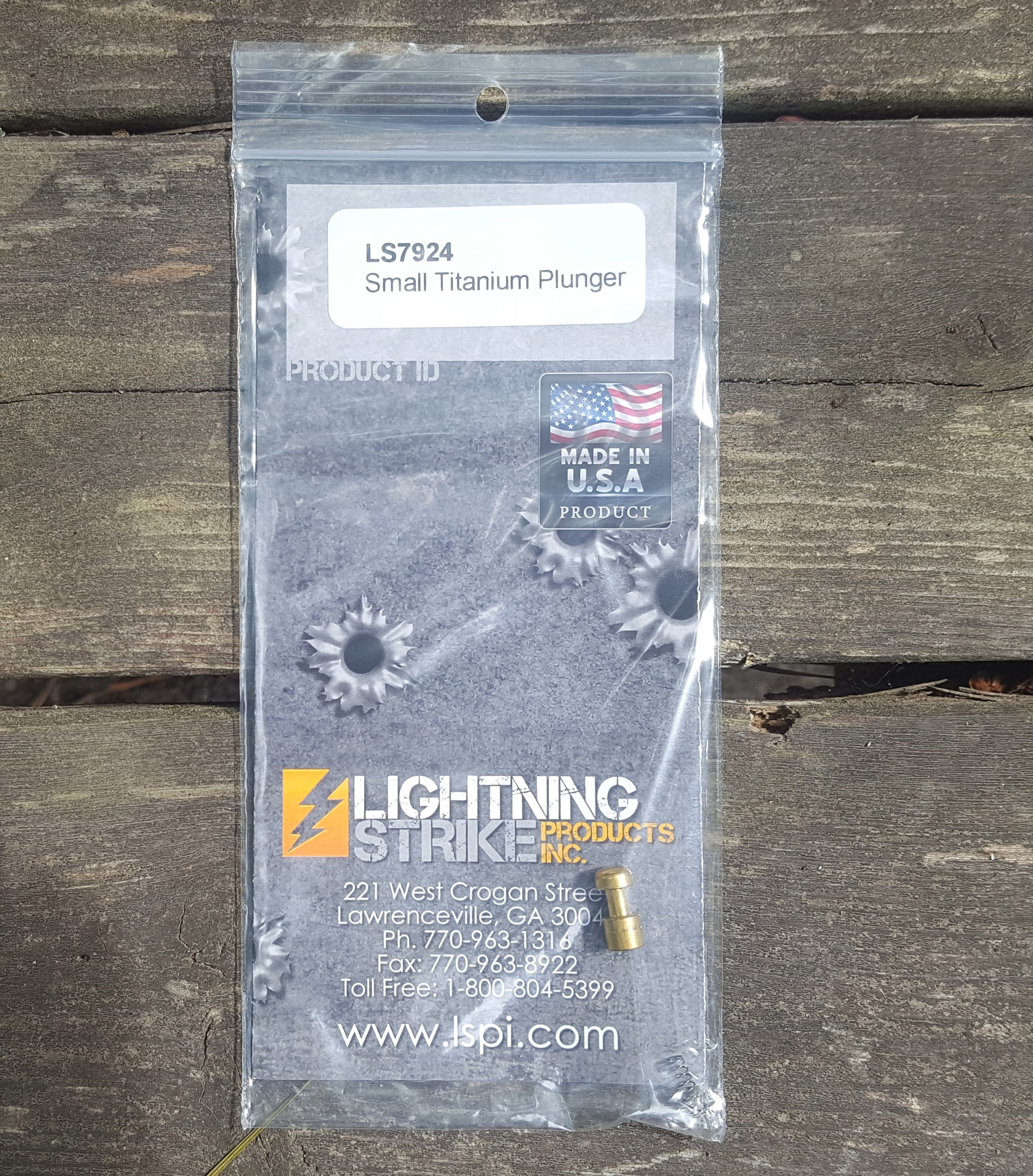
Lightning Strike Products Inc. (LSPI) Titanium Plunger
One of the easiest parts to swap out (and cheapest) that will improve your Glock trigger is replacing the stock plunger (firing pin safety) with a titanium coated one. A lot of the feel of the trigger pull comes from the trigger bar having to press in the plunger. The stock plunger has a flat base with beveled edges. As you pull the trigger, the part of the trigger bar that engages the plunger drags across it, pushing it in to free up the firing pin. This drag and push action is the majority of what you feel on the initial take-up of the trigger.
Installing a titanium coated one like the Lightning Strike Products Inc. (LSPI) Titanium Plunger with rounded edges offers a smoother surface for the trigger bar to slide across. Additionally, the LSPI Titanium Plunger has a slightly smaller profile, and comes with a lighter spring, making it easier to be pushed in.
Lightning Strike Titanium coated plunger on the left compared to stock plunger on the right. Note no edges whatsoever on the titanium one. Between that and the smoothness of the titanium coating and lighter spring, using one can improve the feel of the take-up on the trigger.
Lightning Strike Titanium plunger (on the left) also has a smaller profile, allowing for a smoother engagement of the trigger bar, which helps with a less-gritty feel when pressing the trigger.
What’s even better is that you can get the LSPI Titanium Plunger with spring, super cheap, from NDZ Performance’s eBay store for $17.08.(includes shipping). That’s a heck of a deal, and I’ve been using one these plungers for over a year in my G34 with no issues. I should also mention that I’ve put about 4,000rds thru the pistol to date.
One thing I should point out, though, is that this plunger will not work on a Gen5 Glock pistol, as Glock has completely redesigned and changed the shape of the new plunger. But, for the older models, Gen1 thru Gen4, it’ll fit. And, I think upgrading to a titanium coated plunger one of the first things I’d recommend doing to improve trigger pull.
Lightning Strike Products Inc. Titanium Coated plunger is not only super cheap, but also works well.
25 Cent Glock Trigger Job
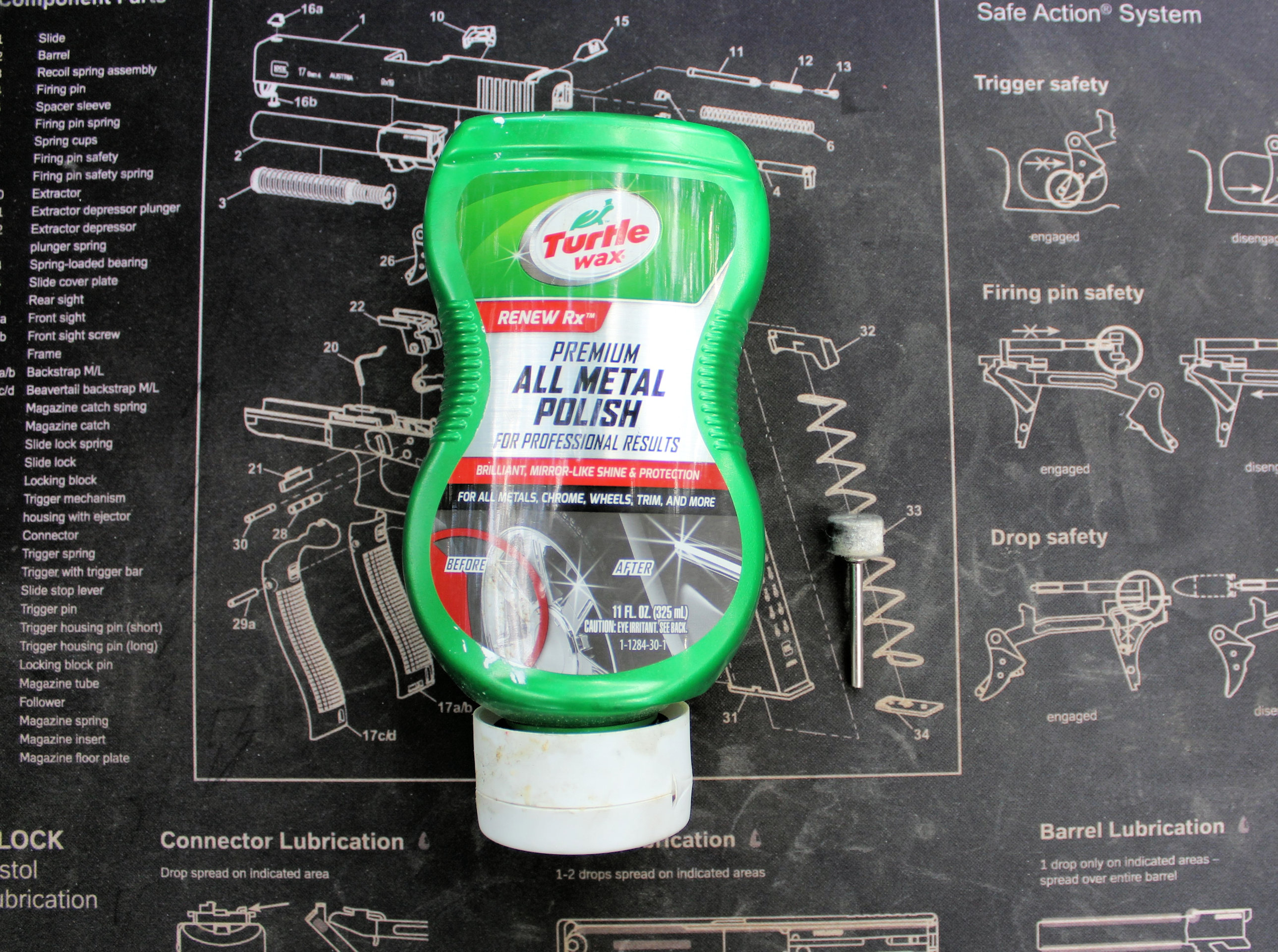
There’s a video on YouTube called “Glock 25 Cent Trigger Job” that shows how to polish the trigger bar, plunger, firing pin, and connector. It’s really a $3.85 trigger job (that’s how much I spent on a bottle of metal polish). I tried it on all three of my Glocks (just polishing the trigger bar and plunger). With a light polish on the areas covered in the video, it did reduce the trigger pull weight on all my triggers.
Want to take off some trigger pull weight? Before you spend money on aftermarket parts, try using some metal polish on the trigger bar. Doing so may take a pound or more off your trigger pull.
By Polishing the trigger bar, you’re filling in the impurities in the metal and smoothing out the tiny ruff areas, basically replicating breaking the gun in by firing a few thousand rounds. If you follow the instructions and stick to using a rag or a felt buffing wheel, with metal polish, there’s no real way to mess up your trigger bar or plunger. You’re not going to take off too much metal, or change any angles.
I won’t go over exactly what to do. Instead, I think it’s best to just provide the link here, so you can watch the video by DefenderOfFreedom. Check it out, and decide for yourself if it’s something you can handle. I’ve done it to Gen3, Gen4, and Gen5 Glocks. It only requires about a minute’s worth of polishing, and it’ll result in a slightly lighter and smoother trigger pull.
Now, there’s also another video called ‘Improving upon the 25 cent Glock trigger job‘, by John Horvath.
Here is the link: https://www.youtube.com/watch?v=zr3aT8JDvFA. In it, he uses a fine file to smooth it out even more where the trigger bar protrudes to touch the plunger. I also did this procedure, but I instead used fine sand paper wrapped around a Dremel wheel. Like the video states, just be careful not to take off too much metal, or change any angles. If you follow his instructions, though, I feel this is also well within the realm of novice-level gunsmithing that’ll result in an even better trigger pull.
Before and after pic of polishing the trigger bar. It only took about 30 seconds of buffing with a felt Dremel wheel and metal polish to get the trigger bar looking this shiny and smooth.
Swapping Trigger Bars
A buddy of mine who just attended a Glock armorers course was told by the instructor that it’s highly recommended for Gen4 Glock users to swap out the trigger bar with a Gen3 one. Doing so will result in a better trigger pull. The reason for this is that Gen4 trigger bars have a small protrusion on the part that engages the plunger to help keep it in place at the correct angle as you pull the trigger back. This small protrusion creates extra drag, leading to a heavier trigger pull. Now, I think it is true that Gen4 Glocks have the worst stock trigger pulls, around 7 lbs compared to Gen3 and Gen5 Glocks, which are around 5.5 to just over 6lbs.
As to why Gen4’s have heavier stock pulls, I won’t go into all of it here, but it has to do with more than just that protrusion. As to whether swapping out trigger bars will improve the trigger pull on a Gen4? I did try it, and after measuring it with a trigger pull gauge, I found no improvement. I should mention, though, that I had already polished the Gen4 trigger bar, to include the small protrusion some. However, the Gen3 trigger bar had also been polished).
Perhaps if one is just swapping an unpolished Gen4 trigger bar for a Gen3 trigger bar, it helps. But, if that’s true, then why swap in the first place? If just polishing the Gen4 trigger bar yields the same results as swapping to a Gen3 trigger bar, then why spend the extra 20 bucks for another trigger bar?
Top, Gen3 Trigger bar compared to Gen4 trigger bar in pistol. If you look closely on the Gen4 trigger bar, where it sticks up to engage the plunger, there is a small raised bump. Polishing the trigger bar to include this bump results in a trigger pull that’s almost as good as the Gen3’s.
The following are my before and after results, detailing the trigger pull weights on my Gen3 and Gen4 Glocks, starting with stock weight, then after polishing the trigger bars and replacing stock plungers with titanium coated ones. Here:
Model Stock Pull Weight After Modifications
Gen3 Glock 17 5.94lbs 5lbs
Gen4 Glock 19 7.05 5.4 (with tuned connector)
* Trigger pull weight average after 10 measurements
I should also note that the pull gauge I used was a mechanical one that I don’t think is that great. The sticker that shows the poundage appears to be placed a little off. So, I do not know how accurate it actually is regarding exact weight measurements. I think it displays on the heavy side. However, I’m confident in the fact that it did constantly show lighter trigger pulls after I put in the improved plunger and polished parts in.
As you can see from this pic, the sticker displaying the weight on this mechanical gauge seems to have been placed off. The pen mark on the sliding marker is where I think it shows the correct weight. Despite this, it might not show the correct exact weight. It did however show consistantly lighter trigger pulls after modifications.
You will also notice that with the Glock 19, it says with tuned connector. That will be covered in Part II of this article. With a factory untuned connector, the pull with polish job and plunger was just a tad under 6lbs. Also I did compare the trigger pull weight on my Gen3 Glock 17 with and without Titanium plunger. Even though I had polished my factory plunger, the pull weight averaged 5.2lbs. So, swapping it out with the titanium one knocked off an additional 2 ounces.
I’ve also polished the trigger bar on a Gen5 Glock 17. I did however fail to measure the stock pull weight prior to polishing. After just polishing the trigger bar, and no other modifications, the pull weight averaged 6.2lbs. I was actually surprised it was that high (or it could just be my gauge). It feels a lot lighter than that. If it’s accurate, I think the lighter feel is due to the new plunger design and other changes Glock made to the Gen5’s. The owner did say, however, that after polishing it, it did feel better than it was before.
The Wrap Up
Can you do more to improve the trigger pull on your Glock? Certainly. You can replace and tune the connector (which I will cover in part II), and replace the firing pin (striker), firing pin spring, and trigger spring. All these things can be done. I have a Gen4 Glock 34 with a 4-lbs trigger pull. But to get there, I did have some trial and error with correct spring weights to get it 100% reliable.
Again, my intent with both part I and II is to stick to recommending modifications that can not only be done by the average person with no gunsmithing experience, but more importantly, will not sacrifice reliability at all. So, if you’re looking to enhance your stock Glock pistol without spending tons of money to do so, I urge you to check out the videos and see if it’ll work for you.
Stayed tuned for Part II: Replacing and tuning connectors, upgrading the sights, and adding an oversized magwell adaptor.
About the Author:
Jeff Gurwitch is retired U.S Army Special Forces (SF).
26 years active duty, 19 years with SF.
15 years’ competitive shooting experience; USPSA, IDPA and 3 Gun.
a creat materiale polimerice unice pentru scopuri medicale care repară organe umane traumatizate ( Cell and Tissue Biology , Bioresorption of Porous 3D Matrice pe bază de colagen în ficat și țesut muscular ” ).
Specialiștii de laborator au dezvoltat un material poros tridimensional din colagen și chitosan, un analog al țesutului osos. Folosind acest material, cercetatorii pot restaura parti ale oaselor pierdute ca urmare a unor traume sau boli.
Posted: Aug 06, 2018
Scientists develop unique materials to repair damaged organs and tissue
(Nanowerk News) Tissue engineering is the future of medicine. Under Project 5-100, the Polymer Materials for Tissue Engineering and Transplantology Laboratory of Peter the Great St. Petersburg Polytechnic University (SPbPU) created unique polymeric materials for medical purposes that repair traumatized human organs (Cell and Tissue Biology, „Bioresorption of Porous 3D Matrices Based on Collagen in Liver and Muscular Tissue”).
The laboratory specialists developed a three-dimensional porous material made of collagen and chitosan, an analog of bone tissue. Using this material, the researchers can restore parts of bone lost as a result of trauma or illness.
According to the scientists, this is a completely new medical area not only in Russia but in the whole world. The terminology has not yet been defined. They are currently called „mimicking” materials, as they trick the body. The polymer matrix is implanted into damaged liver tissue, bones or vessels, saturated with the cells of these organs. Since the materials are made from biocompatible components (chitosan and collagen), the body is tricked and does not reject the foreign object. Over time, the matrix decomposes and the artificial tissue is replaced by natural tissue.
Scientists created biocompatible and bioresorbable polymer materials. (Image: Peter the Great St. Petersburg Polytechnic University)
„We are not deceiving nature, we are just helping it to cope with a medical problem. Experts are currently debating whether it is better to use an implant or restore an organ. A person with an artificial organ must take medication for the rest of their lifetime to prevent the body from rejecting it. This is not the case for tissue grown from human cells,” explains Vladimir Yudin, Head of the Laboratory.
The development of artificial organs for transplantology is an urgent priority of modern medicine. The successful development of this area largely depends on the creation of biocompatible and bioresorbable polymer materials.
The scientists of St. Petersburg Polytechnic University have not only developed the technology to create biocompatible materials that stimulate the restoration of natural tissues, but also managed to regulate the resorption time of the materials. It is very important for the implanted materials not to disintegrate before the new fabric is formed.
The results of preclinical studies showed that after a certain period of time, a three-dimensional sponge embedded in a bone starts to become covered with natural bone tissue, while the material itself decomposes. In addition, the developed collagen sponge was studied both in liver tissues and in muscle tissue – the material also stimulated the restoration of the natural tissue of the organs.
The researchers also developed wound covers, prostheses of blood vessels, and suture threads. In vivo preclinical trials were conducted with these materials, and the results proved that they are effective. The materials are recommended for use in tissue engineering and cellular transplantation.
Source: Peter the Great Saint-Petersburg Polytechnic University
Cercetătorii de la Universitatea Rice au descoperit că „grafenul din bare” rezistent la fractură este mai mult de două ori mai dur decât grafenul curat.
Grafenul este o foaie de carbon cu un atom de grosime. Pe scara bidimensională, materialul este mai puternic decât oțelul, dar deoarece grafenul este atât de subțire, acesta este încă supus ruperii și ruperii.
Posted: Aug 03, 2018
Carbon nanotube ‘rebar’ makes graphene twice as tough
(Nanowerk News) Rice University researchers have found that fracture-resistant “rebar graphene” is more than twice as tough as pristine graphene.
Graphene is a one-atom-thick sheet of carbon. On the two-dimensional scale, the material is stronger than steel, but because graphene is so thin, it is still subject to ripping and tearing.
Rebar graphene is the nanoscale analog of rebar (reinforcement bars) in concrete, in which embedded steel bars enhance the material’s strength and durability. Rebar graphene, developed by the Rice lab of chemist James Tour in 2014, uses carbon nanotubes for reinforcement.
In a new study in the American Chemical Society journal ACS Nano („Toughening Graphene by Integrating Carbon Nanotubes”), Rice materials scientist Jun Lou, graduate student and lead author Emily Hacopian and collaborators, including Tour, stress-tested rebar graphene and found that nanotube rebar diverted and bridged cracks that would otherwise propagate in unreinforced graphene.
Simulations show how carbon nanotubes can make graphene twice as tough by acting as reinforcement bars, like steel in concrete. Researchers at Brown University worked with experimentalists at Rice University to show how rebar helps bridge or redirect cracks in graphene under strain.
The experiments showed that nanotubes help graphene stay stretchy and also reduce the effects of cracks. That could be useful not only for flexible electronics but also electrically active wearables or other devices where stress tolerance, flexibility, transparency and mechanical stability are desired, Lou said.
Both the lab’s mechanical tests and molecular dynamics simulations by collaborators at Brown University revealed the material’s toughness.
Graphene’s excellent conductivity makes it a strong candidate for devices, but its brittle nature is a downside, Lou said. His lab reported two years ago that graphene is only as strong as its weakest link. Those tests showed the strength of pristine graphene to be “substantially lower” than its reported intrinsic strength. In a later study, the lab found molybdenum diselenide, another two-dimensional material of interest to researchers, is also brittle.
An image depicts a sample of rebar graphene after testing under an electron microscope by materials scientists at Rice University. It shows how cracks propagate in a zigzag way, rather than straight, as would be seen in plain graphene. The rebar graphene is attached by molecular forces on both sides to a platform that slowly pulls the material apart. (Image: Emily Hacopian/Lou Group)
Tour approached Lou and his group to carry out similar tests on rebar graphene, made by spin-coating single-walled nanotubes onto a copper substrate and growing graphene atop them via chemical vapor deposition.
To stress-test rebar graphene, Hacopian, Yang and colleagues had to pull it to pieces and measure the force that was applied. Through trial and error, the lab developed a way to cut microscopic pieces of the material and mount it on a testbed for use with scanning electron and transmission electron microscopes.
“We couldn’t use glue, so we had to understand the intermolecular forces between the material and our testing devices,” Hacopian said. “With materials this fragile, it’s really difficult.”
Rebar didn’t keep graphene from ultimate failure, but the nanotubes slowed the process by forcing cracks to zig and zag as they propagated. When the force was too weak to completely break the graphene, nanotubes effectively bridged cracks and in some cases preserved the material’s conductivity.
In earlier tests, Lou’s lab showed graphene has a native fracture toughness of 4 megapascals. In contrast, rebar graphene has an average toughness of 10.7 megapascals, he said.
Simulations by study co-author Huajian Gao and his team at Brown confirmed results from the physical experiments. Gao’s team found the same effects in simulations with orderly rows of rebar in graphene as those measured in the physical samples with rebar pointing every which way.
“The simulations are important because they let us see the process on a time scale that isn’t available to us with microscopy techniques, which only give us snapshots,” Lou said. “The Brown team really helped us understand what’s happening behind the numbers.”
He said the rebar graphene results are a first step toward the characterization of many new materials. “We hope this opens a direction people can pursue to engineer 2D material features for applications,” Lou said.
Echipa de cercetare a elaborat o metodă care îndepărtează culoarea din apă folosind un material asemănător cu buretele pe care l-au creat din pulpa de lemn și bucăți mici de metal. Celuloza, structura principală în pereții celulelor vegetale și cel mai abundent material natural de pe Pământ, furnizează coloana vertebrală a materialului, care este decorat cu mici bucăți de paladiu. Acest metal servește drept catalizator pentru a elimina rapid culoarea.La fel ca un burete adevărat, materialul poate fi stropit de apă și reutilizat de mai multe ori, fără a pierde capacitatea de a îndepărta culoarea din apă. Cercetătorii spun că este dificil să se facă un astfel de material ușor, care este perfect după multe runde de stoarcere și filtrare, mai ales atunci când buretele trebuie să-și mențină structura elvețiană asemănătoare brânzeturilor topite cu particule de reducere a culorii.
Posted: Aug 01, 2018
Harmful dyes in lakes, rivers can become colorless with new, sponge-like material
(Nanowerk News) Dyes are widely used in industries such as textiles, cosmetics, food processing, papermaking and plastics. Globally, we produce about 700,000 metric tons — the weight of two Empire State Buildings — of dye each year to color our clothing, eye shadow, toys and vending machine candy.
During manufacturing, about a tenth of all dye products are discharged into the waste stream. Most of these dyes escape conventional wastewater-treatment processes and remain in the environment, often reaching lakes, rivers and holding ponds, and contaminating the water for the aquatic plants and animals that live there. Even just a little added color can block sunlight and prevent plant photosynthesis, which disrupts the entire aquatic ecosystem.
Researchers hold a small piece of the sponge-like material in water containing blue dye. After about 10 seconds, the water in the beaker turns clear. (Images: Mark Stone/University of Washington)
„A small amount of dye can pollute a large volume of water, so we needed to find a way to very quickly and efficiently remove the color,” said senior author Anthony Dichiara, an assistant professor of bioresource science and engineering in the UW School of Environmental and Forest Sciences. „We were pretty impressed with what we were able to achieve.”
The research team developed a method that removes color from water using a sponge-like material they created from wood pulp and small bits of metal. Cellulose, the main structure in plant cell walls and the most abundant natural material on Earth, provides the backbone of the material, which is decorated with tiny pieces of palladium. This metal serves as a catalyst to help remove color quickly.
Instead of removing dye from water, the research team sought to change the color of the dyes to something that falls outside of what we can see in the visible spectrum. A chemical reaction can, for example, disrupt the color red and make it appear clear, or colorless. In the case of dye waste products that artificially color the water in lakes and prevent photosynthesis, changing the dye from red to clear should allow plants to grow normally again.
The chemical reduction of dyes using molecules called „reducing agents” can alter the dye structure and change its color from red or blue to clear. However, the reaction is not very efficient and can take weeks to occur. The UW’s material contains a catalyst that works with the reducing agent to speed this process up to almost instantaneous.
UW scientist Anthony Dichiara and visiting scholar Jin Gu show us the ‘sponge’ they’ve developed that clears the color from dye in water. The plant-based sponge speeds up a chemical process that would otherwise happen very slowly – in this case clearing water in about 10 seconds.
In the new paper, the researchers describe the simple and sustainable process they developed to make the color-removing material. The researchers combined cellulose molecules with palladium metal, heated the solution and mixed it in a blender. Then they purified and freeze-dried the material so it became a porous, reusable substance. The resulting sponge is more than 99 percent air — its large pores allow water to flow in and out, while the metal catalyst particles within the material work to remove any color present.
Just like a real sponge, the material can be squeezed of its water and reused multiple times without losing the ability to remove color from water. The researchers say it is difficult to make such a lightweight material that is flawless after many rounds of squeezing and filtering, especially when the sponge must maintain its Swiss cheese-like structure fused with color-reducing particles.
The researchers tested their sponge in the lab using blue and red dyes commonly found in the textile industry. They poured the colored water — already mixed with the existing molecule that helps reduce color — over the sponge. As the liquid passed through the material, the resulting water was clear. In another test, they swirled the sponge material inside a jar containing blue-dyed water, and after about 10 seconds the color disappeared.
Outside of lab tests, the researchers say that many small sponge-like materials could be released into a lake polluted with dye, along with the molecule to help reduce the color. Similar to swirling a tea bag round a mug, the sponges could be dragged around the lake until all of the color disappears.
„Just a little amount of dye can change the color of a lake dramatically,” Dichiara said. „This method could work well when you have low concentrations of dye in water that you need to take care of really quickly.”