
Dispozitivele 5G urmează să vă schimbe viața(5G Devices Are about to Chage Your Life)
5G este un salt mult mai mare decât ceea ce sa întâmplat înainte. Site-ul Qualcomm, de fapt, îl numește „transformator ca și automobilele și energia electrică”
5G este un salt mult mai mare decât ceea ce sa întâmplat înainte. Site-ul Qualcomm, de fapt, îl numește „transformator ca și automobilele și energia electrică”
Aceste implanturi sunt foarte personalizabile, astfel încât acestea pot fi modificate pentru a se potrivi nevoilor specifice ale fiecărui pacient
Viitorul performanței umane este o cursă de cercetare, iar S.U.A. nu trebuie să-și asume rolul de conducător auto, spune directorul DIA
Un material proiectat de inginerii chimici ai MIT poate reacționa cu dioxidul de carbon din aer, să crească, să se consolideze și chiar să se repare
Vestele balistice nu opresc orice tip de glont.Atât șeful primăriei, cât și șeful poliției din Selma au bănuit că ofițerii lor nu dispun de echipamentul potrivit
IAI a finalizat dezvoltarea unui sistem autonom de detectare a dispozitivelor explozive, care va elimina riscurile pentru echipele umane
Programul de chimie Al își propune să accelereze crearea de noi molecule de înaltă performanță pentru nevoile de apărare
Acum, Chaobin He, Beng Hoon Tan și colegii de la Institutul de Materiale de Cercetare și Inginerie A Singapore, Singapore, raportează intensitatea crescută a PLA, menținând în același timp rezistența și modulul materialului prin adăugarea nanoparticulelor core-shell ca o umplutură. Nanoparticulele au miezuri de silice cu lanțuri de cauciuc legate covalent la silice și acid poli (acid D-lactic) (PDLA) grefat pe cochilia exterioară. Acești pași secvențiali s-au realizat prin utilizarea unei tehnici numite „polimerizare cu deschiderea inelului”.
| Posted: Oct 04, 2018 | |
Toughening up polymers with nanoparticles(Nanowerk News) A*STAR researchers have toughened up polylactic acid while maintaining its elasticity by adding core-shell nanoparticles as a filler (Composites Science and Technology, „Biodegradable silica rubber core-shell nanoparticles and their stereocomplex for efficient PLA toughening”). |
|
| Polylactic acid (PLA) is a biodegradable and highly biocompatible polymer with good thermal processibility, which has found widespread use in biomedical applications and as a packaging material. However, it is brittle and has poor mechanical stability, so it is often modified by adding reinforcing polymers and by incorporating different polymerization methods. Unfortunately, these modifications also reduce the material’s strength and elastic modulus, which limits its applications. | |
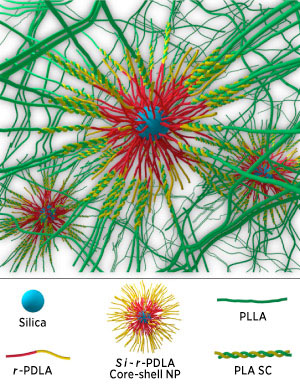
| Now, Chaobin He, Beng Hoon Tan and colleagues at the A*STAR Institute of Materials Research and Engineering, Singapore, report the increased toughness of PLA, while maintaining the strength and modulus of the material, by the addition of core-shell nanoparticles as a filler. The nanoparticles have silica cores with rubber chains covalently linked to the silica, and poly(D-lactic acid) (PDLA) grafted onto the outer shell. These sequential steps were realized by using a technique called ‘ring opening polymerization’. | |
 |
|
| Polymeric nanocomposites comprising poly(lactic acid) with nanoparticles of silica-rubber-poly(D-lactic acid). | |
| On addition of the nanoparticles to a poly(L-lactic acid) (PLLA) matrix using a solution blending process, a complex forms between the pendant PDLA chains and the PLLA matrix. Interestingly, thermal analysis of the polymer nanocomposite indicates that the material reassembles perfectly after recrystallization from the melt. This melt memory effect is considerably enhanced by the incorporation of rubber chains in the nanoparticles. | |
| „The presence of silica-rubber-PDLA nanoparticles in the PLA matrix and its complex formation with PLLA provide stress relief and bridging effects during deformation, thus improving toughness without sacrificing strength and modulus,” says He. | |
| The increased facile stress relief is probably due to the ability of rubber to act as a stress concentrator during plastic deformation. From microscopic analysis of the polymer nanocomposite, the deformation mechanisms of the material were identified as ‘crazing’, which involves the formation of microvoids in the material, and fibrillation at sites of local plastic deformation. | |
| “The large scale production of PLA from renewable resources makes our environmentally-friendly material a promising candidate to replace petroleum-based thermoplastics,” says He. “While our approach has significantly overcome the shortcomings of pure PLA, such as brittleness and poor mechanical stability, further optimization of materials and process as well as enhancement in the nanoparticles-polymer matrix compatibility needs to be carried out.” | |
| “The ability to toughen PLA with the addition of these silica-rubber-PLA nanoparticles will pave the way for further development of sustainable polymers for wider applications, example, consumer electronics, automotive and packaging,” concludes He. | |
| The A*STAR-affiliated researchers contributing to this research are from the Institute of Materials Research and Engineering. |
| Source: A*STAR |
Porozitatea este cheia materialelor de înaltă performanță pentru sistemele de stocare a energiei, tehnologii de mediu sau catalizatori: cu cât materialul este mai poros, cu atât mai multe lichide și gaze poate fi stocat. Cu toate acestea, o multitudine de pori destabilizează materialul.În cadrul Unității de Cercetare DFG FOR2433, prof. Kaskel și partenerii lucrează intens pe producerea de noi materiale poroase care își pot schimba structurile dinamic și ajustând adaptiv dimensiunile porilor.
| Posted: Oct 01, 2018 | |
Chemists develop highly porous material, more precious than diamonds(Nanowerk News) Porosity is the key to high-performance materials for energy storage systems, environmental technologies or catalysts: The more porous a solid state material is, the more liquids and gases it is able to store. However, a multitude of pores destabilizes the material. |
|
| In search of the stability limits of such frameworks, researchers of the TU Dresden’s Faculty of Chemistry broke a world record: DUT-60 is a new crystalline framework with the world’s highest specific surface and the highest specific pore volume (5.02 cm3g-1) measured so far among all known crystalline framework materials (Angewandte Chemie, „Balancing Mechanical Stability and Ultrahigh Porosity in Crystalline Framework Materials”). | |
 |
|
| The framework of DUT-60 holds a pore volume of 5.02 cm3g-1 – the highest specific pore volume one has ever measured among all crystalline framework materials so far. (Image: I. Senkovska, TU Dresden) | |
| The specific surface area describes the sum of all surface boundaries a material has: the outer visible ones as well as the inner pores. 90.3% of DUT-60 is free volume. The metal-organic framework (MOF) can adsorb huge amounts of gas – and in that way it is able to store colossal quantities of gases or filter toxic gases from the air. | |
| “Materials with specific surfaces as high as these could show new and unexpected phenomena,” explains Stefan Kaskel, Professor of Inorganic Chemistry at TU Dresden, the new material’s importance for science. “If you imagine the inner surface of one gram of zeolite as an even, plane area, it would cover about 800 square metres, graphene would make it up to almost 3000 square metres. One gram of DUT-60 would attain an area of 7800 square metres.” | |
| The material was developed by computational methods and synthesized subsequently. There are only few compounds of low density that are mechanically stable enough to be accessible for gases without their surfaces being destroyed. | |
| “It took us five years from the computational development to the pure product DUT-60,” resumes Prof. Kaskel. “Due to its very complicated production, the material is more expensive than gold and diamonds and so far can be only synthesized in small quantities of maximum 50 milligram per batch.” | |
| The former world record was held by the material NU-110 published by Omar Farha, Northwestern University, in 2012: Its pore volume of 4.40 cm3g-1 is significantly lower than the new record holder. DUT-60 marks an important step in the investigation of the upper limits of porosity in crystalline porous materials, and stimulates the development of new methods to determine inner surfaces. | |
| Within the DFG Research Unit FOR2433, Prof. Kaskel and partners are working intensively on the production of new porous materials that can change their structures dynamically and adaptively adjust their pore sizes. | |
| “Moreover, we are working on applications of porous materials within the fields of gas storage, environmental research, catalysis, batteries and air filtration. Here in Dresden, we are also producing metal organic frameworks on a scale of several kilograms. They can be ordered at the Materials Center Dresden.” |
| Source: Technical University of Dresden |