
| Posted: Mar 27, 2018 | |
Thin-film could help manage heat flow in future devices(Nanowerk News) Purdue University researchers have demonstrated the ability of a thin film to conduct heat on just its surfaces, identifying a potential solution to overheating in electronic devices such as phones and computers. |
|
| “When you try to make an electronic device, the heat dissipation is always a problem,” said Xianfan Xu, Purdue’s James J. and Carol L. Shuttleworth Professor of Mechanical Engineering. “So we are trying to provide an understanding of how heat can be dissipated in these future devices.” | |
| This thin film material is a topological insulator, which supports the flow of electrons on its surface but not in its interior. No study had yet tested whether the same were true for heat, until confirmed by research published in ACS Nano („Large Enhancement of Thermal Conductivity and Lorenz Number in Topological Insulator Thin Films”). | |
 |
|
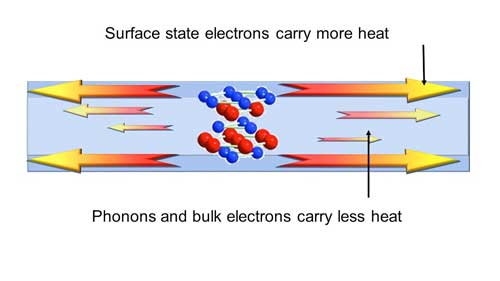
| A very thin film has the ability to carry more heat on its surface than in the interior. (Image: Xianfan Xu, Purdue University) | |
| Past research has speculated that topological insulators could be useful for the development of spintronic devices, which encode information through the spins of electrons as opposed to electrical charge in today’s electronics. | |
| The researchers found that the thinner the film is, the higher the heat conductivity. They also discovered that the ratio of thermal conductivity to electrical conductivity at the surface of the topological insulator materials can be more than 10 times higher than the Sommerfeld value, which is the value known for most metals and semiconductors determined by the Weidemann-Franz law. By conducting heat on just its surfaces rather than across the entire film, this material could prevent parts of a device from heating up or redirect heat. | |
| Xu heat Purdue researchers have discovered a characteristic of this film that could help control heat flow in electronics. (Purdue University image/Jared Pike) Download image | |
| Now, having identified this characteristic of heat transfer in topological insulators, the next step is to figure out how to use them for manipulating heat flow. | |
| “There are not many ways to control heat. It’s not electricity, where you can turn it on and off,” Xu said. “But now there might be a chance to do that.” | |
| The work is a collaborative effort among the research groups led by Xu, Yong Chen, a professor in Purdue’s Department of Physics and Astronomy, and Jesse Maassen, a physics professor at Dalhousie University in Canada. |
| Source: Purdue University |