
| Posted: May 23, 2018 | |
A chip-scale broadband optical system that can sense molecules in the mid-infrared(Nanowerk News) Researchers at Columbia Engineering have demonstrated, for the first time, a chip-based dual-comb spectrometer in the mid-infrared range, that requires no moving parts and can acquire spectra in less than 2 microseconds. The system, which consists of two mutually coherent, low-noise, microresonator-based frequency combs spanning 2600 nm to 4100 nm, could lead to the development of a spectroscopy lab-on-a-chip for real-time sensing on the nanosecond time scale. |
|
| “Our results show the broadest optical bandwidth demonstrated for dual-comb spectroscopy on an integrated platform,” said Alexander Gaeta, David M. Rickey Professor of Applied Physics and of Materials Science and senior author of the study, published in Nature Communications(„Silicon-chip-based mid-infrared dual-comb spectroscopy”). | |
 |
|
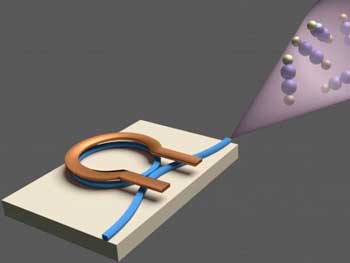
| Schematic of silicon microresonator generating a frequency comb that samples molecules for chemical identification. (Image: Alexander Gaeta/Columbia Engineering) | |
| Creating a spectroscopic sensing device on a chip that can realize real-time, high-throughput detection of trace molecules has been challenging. A few months ago, teams led by Gaeta and Michal Lipson, Higgins Professor of Electrical Engineering, were the first to miniaturize dual-frequency combs by putting two frequency comb generators on a single millimeter-sized chip. They have been working on broadening the frequency span of the dual combs, and on increasing the resolution of the spectrometer by tuning the lines of the comb. | |
| In this current study, the researchers focused on the mid-infrared (mid-IR) range, which, because its strong molecular absorption is typically 10 to 1,000 times greater than those in the visible or near-infrared, is ideal for detecting trace molecules. The mid-IR range effectively covers the “fingerprint” of many molecules. | |
| The team performed mid-IR dual-comb spectroscopy using two silicon nanophotonic devices as microresonators. Their integrated devices enabled the direct generation of broadband mid-infrared light and fast acquisition speeds for characterizing molecular absorption. | |
| “Our work is a critical advance for chip-based dual-comb spectroscopy for liquid/solid phase studies,” said Mengjie Yu, lead author of the paper and a PhD student in Gaeta’s lab. “Our chip-scale broadband optical system, essentially a photonic lab-on-a-chip, is well-suited for identification of chemical species and could find a wide range of applications in chemistry, biomedicine, material science, and industrial process control.” |
| Source: Columbia University School of Engineering and Applied Science |