
Dispozitivele 5G urmează să vă schimbe viața(5G Devices Are about to Chage Your Life)
5G este un salt mult mai mare decât ceea ce sa întâmplat înainte. Site-ul Qualcomm, de fapt, îl numește „transformator ca și automobilele și energia electrică”
5G este un salt mult mai mare decât ceea ce sa întâmplat înainte. Site-ul Qualcomm, de fapt, îl numește „transformator ca și automobilele și energia electrică”
Aceste implanturi sunt foarte personalizabile, astfel încât acestea pot fi modificate pentru a se potrivi nevoilor specifice ale fiecărui pacient
Viitorul performanței umane este o cursă de cercetare, iar S.U.A. nu trebuie să-și asume rolul de conducător auto, spune directorul DIA
Un material proiectat de inginerii chimici ai MIT poate reacționa cu dioxidul de carbon din aer, să crească, să se consolideze și chiar să se repare
Vestele balistice nu opresc orice tip de glont.Atât șeful primăriei, cât și șeful poliției din Selma au bănuit că ofițerii lor nu dispun de echipamentul potrivit
IAI a finalizat dezvoltarea unui sistem autonom de detectare a dispozitivelor explozive, care va elimina riscurile pentru echipele umane
Programul de chimie Al își propune să accelereze crearea de noi molecule de înaltă performanță pentru nevoile de apărare
Acum, Chaobin He, Beng Hoon Tan și colegii de la Institutul de Materiale de Cercetare și Inginerie A Singapore, Singapore, raportează intensitatea crescută a PLA, menținând în același timp rezistența și modulul materialului prin adăugarea nanoparticulelor core-shell ca o umplutură. Nanoparticulele au miezuri de silice cu lanțuri de cauciuc legate covalent la silice și acid poli (acid D-lactic) (PDLA) grefat pe cochilia exterioară. Acești pași secvențiali s-au realizat prin utilizarea unei tehnici numite „polimerizare cu deschiderea inelului”.
| Posted: Oct 04, 2018 | |
Toughening up polymers with nanoparticles(Nanowerk News) A*STAR researchers have toughened up polylactic acid while maintaining its elasticity by adding core-shell nanoparticles as a filler (Composites Science and Technology, „Biodegradable silica rubber core-shell nanoparticles and their stereocomplex for efficient PLA toughening”). |
|
| Polylactic acid (PLA) is a biodegradable and highly biocompatible polymer with good thermal processibility, which has found widespread use in biomedical applications and as a packaging material. However, it is brittle and has poor mechanical stability, so it is often modified by adding reinforcing polymers and by incorporating different polymerization methods. Unfortunately, these modifications also reduce the material’s strength and elastic modulus, which limits its applications. | |
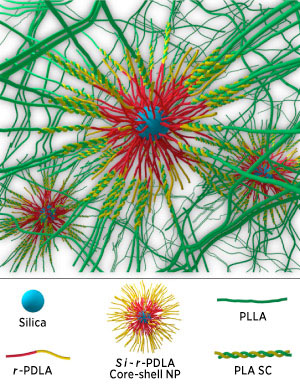
| Now, Chaobin He, Beng Hoon Tan and colleagues at the A*STAR Institute of Materials Research and Engineering, Singapore, report the increased toughness of PLA, while maintaining the strength and modulus of the material, by the addition of core-shell nanoparticles as a filler. The nanoparticles have silica cores with rubber chains covalently linked to the silica, and poly(D-lactic acid) (PDLA) grafted onto the outer shell. These sequential steps were realized by using a technique called ‘ring opening polymerization’. | |
 |
|
| Polymeric nanocomposites comprising poly(lactic acid) with nanoparticles of silica-rubber-poly(D-lactic acid). | |
| On addition of the nanoparticles to a poly(L-lactic acid) (PLLA) matrix using a solution blending process, a complex forms between the pendant PDLA chains and the PLLA matrix. Interestingly, thermal analysis of the polymer nanocomposite indicates that the material reassembles perfectly after recrystallization from the melt. This melt memory effect is considerably enhanced by the incorporation of rubber chains in the nanoparticles. | |
| „The presence of silica-rubber-PDLA nanoparticles in the PLA matrix and its complex formation with PLLA provide stress relief and bridging effects during deformation, thus improving toughness without sacrificing strength and modulus,” says He. | |
| The increased facile stress relief is probably due to the ability of rubber to act as a stress concentrator during plastic deformation. From microscopic analysis of the polymer nanocomposite, the deformation mechanisms of the material were identified as ‘crazing’, which involves the formation of microvoids in the material, and fibrillation at sites of local plastic deformation. | |
| “The large scale production of PLA from renewable resources makes our environmentally-friendly material a promising candidate to replace petroleum-based thermoplastics,” says He. “While our approach has significantly overcome the shortcomings of pure PLA, such as brittleness and poor mechanical stability, further optimization of materials and process as well as enhancement in the nanoparticles-polymer matrix compatibility needs to be carried out.” | |
| “The ability to toughen PLA with the addition of these silica-rubber-PLA nanoparticles will pave the way for further development of sustainable polymers for wider applications, example, consumer electronics, automotive and packaging,” concludes He. | |
| The A*STAR-affiliated researchers contributing to this research are from the Institute of Materials Research and Engineering. |
| Source: A*STAR |
Porozitatea este cheia materialelor de înaltă performanță pentru sistemele de stocare a energiei, tehnologii de mediu sau catalizatori: cu cât materialul este mai poros, cu atât mai multe lichide și gaze poate fi stocat. Cu toate acestea, o multitudine de pori destabilizează materialul.În cadrul Unității de Cercetare DFG FOR2433, prof. Kaskel și partenerii lucrează intens pe producerea de noi materiale poroase care își pot schimba structurile dinamic și ajustând adaptiv dimensiunile porilor.
| Posted: Oct 01, 2018 | |
Chemists develop highly porous material, more precious than diamonds(Nanowerk News) Porosity is the key to high-performance materials for energy storage systems, environmental technologies or catalysts: The more porous a solid state material is, the more liquids and gases it is able to store. However, a multitude of pores destabilizes the material. |
|
| In search of the stability limits of such frameworks, researchers of the TU Dresden’s Faculty of Chemistry broke a world record: DUT-60 is a new crystalline framework with the world’s highest specific surface and the highest specific pore volume (5.02 cm3g-1) measured so far among all known crystalline framework materials (Angewandte Chemie, „Balancing Mechanical Stability and Ultrahigh Porosity in Crystalline Framework Materials”). | |
 |
|
| The framework of DUT-60 holds a pore volume of 5.02 cm3g-1 – the highest specific pore volume one has ever measured among all crystalline framework materials so far. (Image: I. Senkovska, TU Dresden) | |
| The specific surface area describes the sum of all surface boundaries a material has: the outer visible ones as well as the inner pores. 90.3% of DUT-60 is free volume. The metal-organic framework (MOF) can adsorb huge amounts of gas – and in that way it is able to store colossal quantities of gases or filter toxic gases from the air. | |
| “Materials with specific surfaces as high as these could show new and unexpected phenomena,” explains Stefan Kaskel, Professor of Inorganic Chemistry at TU Dresden, the new material’s importance for science. “If you imagine the inner surface of one gram of zeolite as an even, plane area, it would cover about 800 square metres, graphene would make it up to almost 3000 square metres. One gram of DUT-60 would attain an area of 7800 square metres.” | |
| The material was developed by computational methods and synthesized subsequently. There are only few compounds of low density that are mechanically stable enough to be accessible for gases without their surfaces being destroyed. | |
| “It took us five years from the computational development to the pure product DUT-60,” resumes Prof. Kaskel. “Due to its very complicated production, the material is more expensive than gold and diamonds and so far can be only synthesized in small quantities of maximum 50 milligram per batch.” | |
| The former world record was held by the material NU-110 published by Omar Farha, Northwestern University, in 2012: Its pore volume of 4.40 cm3g-1 is significantly lower than the new record holder. DUT-60 marks an important step in the investigation of the upper limits of porosity in crystalline porous materials, and stimulates the development of new methods to determine inner surfaces. | |
| Within the DFG Research Unit FOR2433, Prof. Kaskel and partners are working intensively on the production of new porous materials that can change their structures dynamically and adaptively adjust their pore sizes. | |
| “Moreover, we are working on applications of porous materials within the fields of gas storage, environmental research, catalysis, batteries and air filtration. Here in Dresden, we are also producing metal organic frameworks on a scale of several kilograms. They can be ordered at the Materials Center Dresden.” |
| Source: Technical University of Dresden |
un grup de cercetători de la Universitatea de Științe și Tehnologie din Anhui au sintetizat compozite de ferită PANI / Zn care au demonstrat o absorbție excelentă în microunde performanţă.
Cum de a reduce poluarea electromagnetică? Cum aceste materiale atenuează undele electromagnetice? Un grup de cercetători de la Școala de Inginerie Chimică de la Universitatea de Știință și Tehnologie din Anhui au sintetizat compozite Fe ferite / PANI ca absorbanți eficienți în microunde pentru a reduce sau elimina poluarea cu microunde.
| Posted: Sep 28, 2018 | |
Composite significantly reduces electromagnetic pollution(Nanowerk News) In a paper published in NANO („Structure and Microwave Absorption Properties of Polyaniline/Zn Ferrite Composites”), a group of researchers from Anhui University of Science and Technology have synthesized PANI/Zn ferrite composites which have shown excellent microwave absorption performance. |
|
| How to reduce electromagnetic pollution? How do these materials attenuate electromagnetic waves? A group of researchers from the School of Chemical Engineering at Anhui University of Science and Technology have synthesized Fe ferrite/PANI composites as efficient microwave absorbers to reduce or eliminate microwave pollution. | |
 |
|
| A schematic diagram of phase cancellation and microwave attenuation process. The fluffy structure of PANI/Fe ferrite composite can highly increase the transmission path of microwave, and the multiple reflections can enhance the microwave attenuation efficiency of the absorber. Thus, the microwave attenuation capability of PANI/Zn ferrite composites mainly comes from the enhanced effect of fluffy structure, multiple reflections, interfacial polarization, magnetic loss and dielectric loss. Moreover, if the relationship between the coating thickness and the frequency of incident microwaves matched well with the quarter-wave thickness criteria, the incident microwaves would vertically enter the absorber inside, as shown in this figure. (Image: Honglong Xing) | |
| PANI/Zn ferrite composites were synthesized by a two-step hydrothermal and in-situ polymerization method. Zn ferrite was used to adjust the impedance matching and improve PANI magnetic loss capability. The synergy of fluffy structure, dielectric loss, magnetic loss, interfacial polarization and phase cancellation effect lead to the attenuation of microwave energy. | |
| Furthermore, the fluffy structure enhanced the microwave transmission path and attenuation efficiency. These factors make this composite a good microwave absorber and an ideal material in the electromagnetic wave absorption field. | |
| Microwave absorption materials with reflection loss (RL) values less than -10 dB represent that 90% of microwave was absorbed. The minimum RL values of this composite can reach -54.4 dB with coating thickness of 1.4 mm. The bandwidth about RL below -10 dB was 4.8 GHz at 1.6 mm. The excellent microwave absorption performance of PANI/Zn ferrite composites suggested that it can be used as an excellent absorber with thin coating thickness, strong absorption and broad bandwidth. | |
| Microwave absorption materials have been studied by many workers to reduce or eliminate microwave pollution. Because of rapid popularity and development of electronic devices, especially mobile phones, computers and wireless routers, microwave pollution has been intensified in recent years. These materials have great potential applications in information security, healthcare, electronic countermeasures and so on. | |
| The functional materials of PANI/Fe ferrite with lightweight, thin coating thickness, high efficiency and broadband absorption properties are also easy to synthesize, which is beneficial to industrial mass production. |
| Source: World Scientific | |
Sistemul ATS pentru îmbrăcăminte la un nivel scăzut este un sistem modular scalabil pentru operațiile de vizibilitate redusă. Se compune din trei părți care pot fi utilizate independent unul de celălalt sau combinate în orice configurație are nevoie de utilizator. Sistemul este alcătuit dintr-un suport de placă dimensionat în jurul dimensiunilor plăcii ESAPI și plăcile dure 10X12. Harnașul pentru vizibilitate la joasă vizibilitate poate fi folosit ca produs autonom sau în combinație cu dispozitivul de transport cu plăci, utilizând umerii de curea inclusi.
ATS Tactical Gear Low Level Clothing System: Scalable, Modular Ultra Lo-Pro/Lo-Vis Tactical Armor Shirt Plate Carrier System for Dynamic CQB and PSD Ops!
Posted by: David Crane September 27, 2018
Print Friendly, PDF & Email
By David Crane
September 27, 2018
Last updated on 9/27/18.
This one comes to us from DefenseReview (DR) writer/contributor and chief new-product tester Jeff Gurwitch. ATS Tactical Gear recently released their Low Level Clothing System shirt plate carrier for commercial sales. Gurwitch received one last year to try out, so he could make suggestions for improvements. Here’s what Gurwitch said about it to DR (minimally modified):
“It’s a good low-level setup. See the link below. It’s designed for low level CQB work and PSD (Personal Security Detail/Detachment). I’ve attached pics of my kit. I took it on one contractor deployment, and just thought it’s worth a quick heads-up piece on DR.
ATS NEW LOW LEVEL CLOTHING SYSTEM!“
The following information on the rig comes directly from the ATS company website:
“The ATS Low level Clothing System is a scalable, modular system for low visibility operations. It consists of three parts that can be used independently of each other or combined in what ever configuration the user needs. The System consists of a Plate carrier sized around ESAPI plate sizes and the 10X12 hard plates. The Low Visibility Chest Harness can be used as a stand alone product or in conjunction with the Plate Carrier by using the included strap hangers.
The shirt can used in combination with either of the other parts of the System, and is modified to accept the Low Visibility chest Harness to its front, whether using the plate carrier or not. The System is available in several color options and both long sleeve and short sleeve variants. Plate pockets sizes are available from ESAPI small through extra large and shirt sizes are available from small through XXl. plates are not included with this package.”
Looks pretty slick. DR digs it.
Company Contact Info:
ATS
Phone: 270-885-2890
Email Contact Page: https://atstacticalgear.com/contact-us/
Website: https://atstacticalgear.com