Acoperirea suprafeței textile și îmbrăcăminte cu nanoparticule este o abordare a producției de suprafețe extrem de active pentru a avea UV-blocare, antimicrobiene, antistatic retardant, flacără, apă și ulei hidrofug, rezistent la rid, și auto-curățare properties.One obstacol încăpățânat făcut previne textile îmbunătățită nanomaterial de a deveni mai mult o realitate comercială este insuficientă durabilitatea acoperirilor nano pe fibre textile sau stabilitatea diferitelor proprietăți înzestrate de nanoparticule. Pur și simplu pune, „inteligent“ vine de pe timpul proprietăților antimicrobiene washing.While sunt exercitate de nano-argint, blocarea UV, auto-curățare și proprietăți ignifuge sunt conferite de acoperiri de oxid de nano-metal. nanoparticule de oxid de zinc încorporate în matrici polimerice, cum ar fi amidon solubil sunt un exemplu bun de nanostructuri funcționale cu potențial de aplicații, cum ar fi: capacitatea de protectie UV in industria textila si de protectie solara si finisaje antibacteriene in textile medicale si interioara Wears
Posted: Feb 29, 2016
Nanotechnology in textiles – the new black
(Nanowerk Spotlight) Nanoengineered functional textiles are going to revolutionize the clothing that you’ll wear. The potential of nanotechnology in the development of new materials in the textile industry is considerable. On the one hand, existing functionality can be improved using nanotechnology and on the other, it could make possible the manufacture of textiles with entirely new properties or the combination of different functions in one textile material (read our previous Nanowerk Spotlight on this topic: „Nanotechnology textiles„).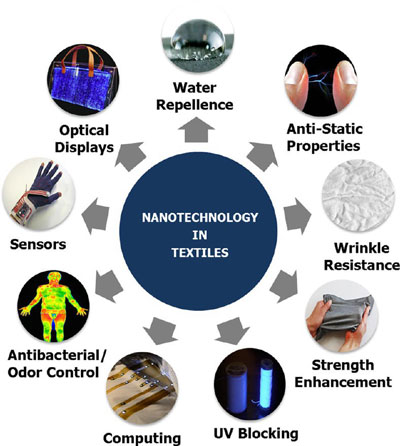 Applications of nanotechnology in textiles. (Reprinted with permission by American Chemical Society)A first generation of nano-enhanced textiles benefitted from nano finishing: Coating the surface of textiles and clothing with nanoparticles is an approach to the production of highly active surfaces to have UV-blocking, antimicrobial, antistatic, flame retardant, water and oil repellent, wrinkle resistant, and self-cleaning properties.One stubborn hurdle that prevents nanomaterial-enhanced textiles from becoming more of a commercial reality is the insufficient durability of nanocoatings on textile fibers or the stability of various properties endowed by nanoparticles. Quite simply put, the ‘smart’ comes off during washing.While antimicrobial properties are exerted by nano-silver, UV blocking, self-cleaning and flame-retardant properties are imparted by nano-metal oxide coatings. Zinc oxide nanoparticles embedded in polymer matrices like soluble starch are a good example of functional nanostructures with potential for applications such as UV-protection ability in textiles and sunscreens, and antibacterial finishes in medical textiles and inner wears (read more about nanofinishing in textile technology).
 Sandy Mattei models a design by Matilda Ceesay with a Permethrin-releasing textile net. (Image: Cornell University)A just published review paper in the February 26, 2016 online edition of ACS Nano („Nanotechnology in Textiles”) discusses electronic and photonic nanotechnologies that are integrated with textiles and shows their applications in displays, sensing, and drug release within the context of performance, durability, and connectivity.In these smart clothes the textile structures themselves perform electronic or electric functions. Ideally, the nanoelectronic components will be completely fused with the textile material, resulting in that textile and non-textile components cannot be differentiated and ‘foreign particles’ can no longer be seen or felt.
Electronics in textiles
We have written extensively about smart textiles, for instance
In their review, the authors discuss the electrical conductivity of conducting polymers and graphene, both of which are attractive for creating textiles that enable the incorporation of sensors and actuators.Another section of the review is dedicated to power sources suitable for e-textiles. This covers lightweight fabric carbon nanotube supercapacitor electrodes; stretchable graphene and PPy-based supercapacitors; triboelectric nanogenerators; flexible fiber and stripe batteries; and stretchable PPy-based supercapacitors for energy transfer.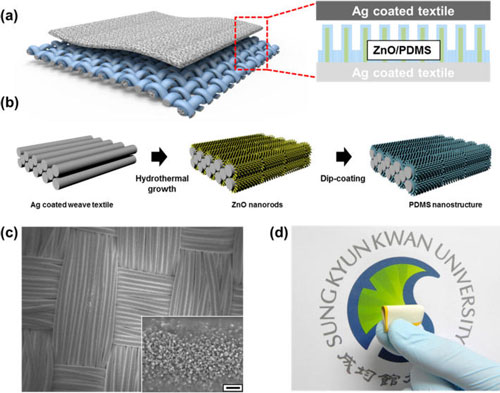 (a) Schematic illustration of a wearable triboelectric nanogenerator. (b) Fabrication process of the nanopatterned PDMS structure. (c) FE-SEM images of the bottom textile with nanopatterned PDMS. Inset is a high-resolution image clearly showing the ZnO NR-templated PDMS nanopatterns. (d) Photographic image of the flexible, foldable WTNG. (Reproduced with permission by American Chemical Society) (click on image to enlarge)Adding digital components to these e-textiles would open up an entirely new area of functional clothing. OLEDs in fiber form could lead to revolutionary applications by integrating optical and optoelectronic devices into textile. Combined with nanoelectronic devices, we might one day see flexible optical sensors and display screens woven into shirts and other garments. You could literally wear your next-generation smart phone or iPad on your sleeves; including the solar panels to power them (read more: „Light-emitting nanofibers shine the way for optoelectronic textiles„).
Photonic technologies for textiles
Want your clothes to change color at the push of a button, in response to ambient heat or illumination, warning you about airborne pollutants or pollen, or glow in the dark? The integration of optical technologies into garments will make this possible.As the authors write, „photonic materials and devices including films, nanoadditives, or optical fibers have been adopted in the fabrication of textiles and garments to not only enhance the aesthetic performance but also endow the garments with additional functionalities. The most distinctive and basic application of optical technologies on fabrics or garments is perhaps tuning their appearance by controlling the intensity, color, and pattern of light.”For example, optical films made of periodical dielectric multilayers could be directly coated on fabrics, thus offering a highly reflective colorful appearance and enabling different color perceptions depending on the angle of observation. Holographic films may also achieve similar functions and even provide a more complex 3D visual effect.”
Sensing and drug release in textiles
Lab-on-fiber technology will allow the implementation of sophisticated, autonomous multifunction sensing and actuating systems – all integrated in individual optical fibers. Such multifunctional labs integrated into a single optical fiber, exchanging information and combining sensorial data, could provide effective auto-diagnostic features as well as new photonic and electro-optic functionalities (read more: „Move over chips – here come multifunctional labs on a single fiber„).The general sensing principle of a plasmonic fiber sensor is described in detail in the review paper: „In a plasmonic fiber sensor, a lossy surface plasmon mode propagating along a metal/dielectric interface can be excited at its resonance by an optical fiber core-guided mode via evanescent wave coupling when the phase-matching condition between the two modes is satisfied at a certain frequency. The presence of such a plasmonic mode manifests itself as a spectral dip in the fiber transmission spectrum, with its spectral location corresponding to the phase-matching frequency. Variations in the refractive index of an analyte adjacent to the metal layer could significantly modify the phase-matching condition, thus displacing the spectral dip in the optical fiber transmission spectrum.”Already, temperature, humidity, and pressure sensors have been incorporated in textiles. In future, microfluidics can be incorporated in thread-based channels for application in point-of-care diagnostics. Combined with LEDs, these textiles can give visual sensing information. Combined with drug-loaded nanoparticles, textile fibers could provide programmable release of therapeutic drugs.For example, the designer Matilda Ceesay created a hooded body suit embedded at the molecular level with insecticides to ward off mosquitoes infected with malaria. The cotton mesh used for this anti-malaria garment was coated with a material where an insect repellent and fabric are bound at the nano level using metal organic framework molecules (MOFs).Concluding their review, after an extensive discussion of fabrication methods and functionalities, the authors also address the issues of toxicity of nanomaterials in textiles as well as commercial trends in the global nanotechnology-enhanced textile market.By Michael Berger – Michael is author of two books by the Royal Society of Chemistry: Nano-Society: Pushing the Boundaries of Technology and Nanotechnology: The Future is Tiny.
Read more: Nanotechnology in textiles – the new black

