Sticla are acum potențialul inteligent(Glass now has smart potential)

au dezvoltat o metodă de încorporare a nanoparticulelor cu emisie de lumină în sticlă, fără a-și pierde nici una dintre proprietățile lor unice – un pas major către aplicațiile de „sticlă inteligentă”, cum ar fi ecrane 3D sau senzori de radiație de la distanță

Glass

Datorită nanoparticulelor, sticla are acum potențialul inteligent(Thanks to nanoparticles, glass now has smart potential )

Aceste nanoparticule luminescente noi, denumite upconversion nanoparticles, au devenit candidati promitatori pentru o intreaga varietate de aplicatii ultra-inalte tehnologice, cum ar fi senzori biologici, imagistica biomedicala si afisaje volumetrice 3D”

Posted: Jun 07, 2016

Thanks to nanoparticles, glass now has smart potential

(Nanowerk News) Australian researchers at the University of Adelaide have developed a method for embedding light-emitting nanoparticles into glass without losing any of their unique properties – a major step towards ‘smart glass’ applications such as 3D display screens or remote radiation sensors.

This new “hybrid glass” successfully combines the properties of these special luminescent (or light-emitting) nanoparticles with the well-known aspects of glass, such as transparency and the ability to be processed into various shapes including very fine optical fibres.
The research, in collaboration with Macquarie University and University of Melbourne, has been published online in the journal Advanced Optical Materials („Upconversion Nanocrystal-Doped Glass: A New Paradigm for Photonic Materials”).
text
Schematic diagram of Ln3+ distribution in various glasses. a) glass containing Ln3+ ions (Ln3+-doped glass), b) glass containing in situ grown NCs (glass ceramics), c) glass with directly doped NCs (NCs-doped glass). The small gray dots represent the Ln3+ ions in NCs-doped glass that were formed by dissolution of NCs, which could be prevented by using NCs with a robust shell. d) Schematic of Ln3+ ion densities available in glasses, NCs in glass ceramics, and as-synthesized individual NCs. (© Wiley)
“These novel luminescent nanoparticles, called upconversion nanoparticles, have become promising candidates for a whole variety of ultra-high tech applications such as biological sensing, biomedical imaging and 3D volumetric displays,” says lead author Dr Tim Zhao, from the University of Adelaide’s School of Physical Sciences and Institute for Photonics and Advanced Sensing (IPAS).
“Integrating these nanoparticles into glass, which is usually inert, opens up exciting possibilities for new hybrid materials and devices that can take advantage of the properties of nanoparticles in ways we haven’t been able to do before. For example, neuroscientists currently use dye injected into the brain and lasers to be able to guide a glass pipette to the site they are interested in. If fluorescent nanoparticles were embedded in the glass pipettes, the unique luminescence of the hybrid glass could act like a torch to guide the pipette directly to the individual neurons of interest.”
Although this method was developed with upconversion nanoparticles, the researchers believe their new ‘direct-doping’ approach can be generalised to other nanoparticles with interesting photonic, electronic and magnetic properties. There will be many applications – depending on the properties of the nanoparticle.
“If we infuse glass with a nanoparticle that is sensitive to radiation and then draw that hybrid glass into a fibre, we could have a remote sensor suitable for nuclear facilities,” says Dr Zhao.
To date, the method used to integrate upconversion nanoparticles into glass has relied on the in-situ growth of the nanoparticles within the glass.
“We’ve seen remarkable progress in this area but the control over the nanoparticles and the glass compositions has been limited, restricting the development of many proposed applications,” says project leader Professor Heike Ebendorff-Heideprem, Deputy Director of IPAS.
“With our new direct doping method, which involves synthesizing the nanoparticles and glass separately and then combining them using the right conditions, we’ve been able to keep the nanoparticles intact and well dispersed throughout the glass. The nanoparticles remain functional and the glass transparency is still very close to its original quality. We are heading towards a whole new world of hybrid glass and devices for light-based technologies.”
Source: University of Adelaide

Read more: Thanks to nanoparticles, glass now has smart potential

Înțelegerea și prezicerea autoasamblării(Understanding and predicting self-assembly)

Materialul este o nanopapetă peptoidă. Este o structură plană de numai două molecule groase și este compusă din peptoide, care sunt polimeri sintetici strâns legați de peptidele care formează proteine.
Asamblarea automată a nanoparticulelor pentru a realiza structuri complexe de foi și altele, cum ar fi nanotuburi și solide cristaline, care pot fi personalizate în detectoare chimice incredibil de sensibile sau catalizatori de durată, pentru a numi câteva posibilități .

Posted: Jun 07, 2016

Understanding and predicting self-assembly

(Nanowerk News) To mimic complex natural proteins’ capabilities as sensors, catalysts, and more using synthetic materials that can withstand industrial conditions, scientists must first know how to finesse the building blocks they’ll use. Molecular Foundry staff worked with scientists to discover a new design rule that controls the way in which polymer building blocks adjoin to form the backbones that run the length of tiny biomimetic sheets.

Understanding the rules that govern how the nanosheets self-assemble could be used to piece together complex sheet structures and others, such as nanotubes and crystalline solids, that could be customized into incredibly sensitive chemical detectors or long-lasting catalysts, to name a few possibilities.
Scientists aspire to build nanostructures that mimic the complexity and function of nature’s proteins, but are made of durable and synthetic materials. These microscopic widgets could be customized into incredibly sensitive chemical detectors or long-lasting catalysts, to name a few possible applications.
But as with any craft that requires extreme precision, researchers must first learn how to finesse the materials they’ll use to build these structures.
A recent discovery by scientists at the Molecular Foundry is a big step in this direction (Nature, „Peptoid nanosheets exhibit a new secondary-structure motif”).
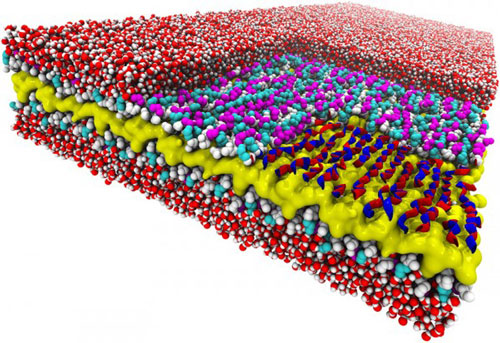
atomic-resolution simulation of a peptoid nanosheet
Snakes on a plane: This atomic-resolution simulation of a peptoid nanosheet reveals a snake-like structure never seen before. The nanosheet’s layers include a water-repelling core (yellow), peptoid backbones (white), and charged sidechains (magenta and cyan). The right corner of the nanosheet’s top layer has been “removed” to show how the backbone’s alternating rotational states give the backbones a snake-like appearance (red and blue ribbons). Surrounding water molecules are red and white.
The researchers discovered a design rule that enables a recently created material to exist. The material is a peptoid nanosheet. It’s a flat structure only two molecules thick, and it’s composed of peptoids, which are synthetic polymers closely related to protein-forming peptides.
The design rule controls the way in which polymers adjoin to form the backbones that run the length of nanosheets.
Surprisingly, these molecules link together in a counter-rotating pattern not seen in nature. This pattern allows the backbones to remain linear and untwisted, a trait that makes peptoid nanosheets larger and flatter than any biological structure.
The Molecular Foundry scientists say this never-before-seen design rule could be used to piece together complex nanosheet structures and other peptoid assemblies such as nanotubes and crystalline solids.
What’s more, they discovered it by combining computer simulations at National Energy Research Scientific Computing Center, another DOE user facility located at Berkeley Lab, with x-ray scattering and imaging methods to determine, for the first time, the atomic-resolution structure of peptoid nanosheets.
Source: Department of Energy, Office of Science

Read more: Understanding and predicting self-assembly

Origami stele Ninja inspiră design nou baterie(Origami Ninja star inspires new battery design )

O baterie de unică folosință care se îndoaie ca o stea ninja de origami ar putea alimenta biosenzori și alte dispozitive mici pentru utilizare în condiții de teren dificile.Baterie de origami pe suport de hârtie.

Posted: Jun 07, 2016

Origami Ninja star inspires new battery design

(Nanowerk News) A new disposable battery that folds like an origami ninja star could power biosensors and other small devices for use in challenging field conditions, says an engineer at Binghamton University, State University of New York.

Seokheun “Sean” Choi, assistant professor of computer and electrical engineering at Binghamton University, along with two of his students, developed the device, a microbial fuel cell that runs on the bacteria available in a few drops of dirty water. They report on their invention in a new paper published online in the journal Biosensors and Bioelectronics („A disposable power source in resource-limited environments: A paper-based biobattery generating electricity from wastewater”).
disposable battery that folds like an origami ninja star
A new disposable battery that folds like an origami ninja star could power biosensors and other small devices for use in challenging field conditions.
Choi previously developed a paper-based origami battery. The first design, shaped like a matchbook, stacked four modules together. The ninja star version, which measures about 2.5 inches wide, boasts increased power and voltage, with eight small batteries connected in series.
“Last time, it was a proof of concept. The power density was in the nanowatt range,” said Choi. “This time, we increased it to the microwatt range. We can light an LED for about 20 minutes or power other types of biosensors.”
Paper-based biosensors include pregnancy tests and HIV tests. The sensitivity of such tests is limited, Choi said, and a battery like his could allow the use of more sophisticated fluorescent or electrochemical biosensors in developing countries. “Commercially available batteries are too wasteful and expensive for the field,” he said. “Ultimately, I’d like to develop instant, disposable, accessible bio-batteries for use in resource-limited regions.”
The new design folds into a star with one inlet at its center and the electrical contacts at the points of each side. After a few drops of dirty water are placed into the inlet, the device can be opened into a Frisbee-like ring to allow each of the eight fuel cells to work. Each module is a sandwich of five functional layers with its own anode, proton exchange membrane and air-cathode.
Choi’s original matchbook-sized battery could be produced for about 5 cents. The new ninja star device is more expensive — roughly 70 cents — in part because it uses not only filter paper but also carbon cloth for the anode as well as copper tape. The team’s next goal is to produce a fully paper-based device that has the power density of the new design and a lower price tag.
Choi prides himself on involving students in his research, and this paper represents a special triumph for co-author Landen Kwan, who worked on the project during a National Science Foundation Research Experiences for Undergraduates program at Binghamton in the summer of 2015. Kwan, then a student at Queensborough Community College, is now enrolled at Stony Brook University. Binghamton doctoral student Arwa Fraiwan also contributed to the study, which was funded by the National Science Foundation.
Source: Binghamton University

Read more: Origami Ninja star inspires new battery design

1.3 milioane dolari DARPA subvenție pentru a fondului de cercetare grafene detector de infraroșu ( $1.3 million DARPA grant to fund graphene infrared detector research )

Camerele portabile cu infraroșu care pot vedea lungimi de undă invizibile de lumină au fost utilizate de mult timp de către organele de drept, soldați, pompieri și alții pentru a vedea în întuneric sau pentru a localiza oamenii prin căldura corporală pe care o emită. Dar imaginile neclare pe care aceste dispozitive le produc nu sunt câteodată mai mult decât bloburi colorate indistincte.
Detectoarele cu infraroșu mai puternice care produc imagini mai detaliate – cele utilizate în mod obișnuit de către NASA și agențiile de apărare – sunt mari, costisitoare și pot funcționa doar la temperaturi extrem de scăzute.

Posted: Jun 07, 2016

$1.3 million DARPA grant to fund graphene infrared detector research

(Nanowerk News) The Defense Advanced Research Projects Agency has awarded a $1.3 million grant to a team led by University of Central Florida researcher Debashis Chanda to fund the development of a next-generation infrared detector that could be used in fields as varied as night vision, meteorology and space exploration.

„We are working on a novel infrared detection and imaging technology. The detection mechanism is very different than what is being used now,” said Chanda, an assistant professor with joint appointments to UCF’s NanoScience Technology Center and College of Optics & Photonics.
Dr. Debashis Chanda, University of Central Florida
The work caught the attention of DARPA, which made news recently with fanciful technology like a crewless Navy drone ship, workhorse robots to lug soldiers’ heavy gear, and the XS-1 space plane. DARPA is funding the UCF team’s research for the 3½ years.
Portable infrared cameras that can see invisible wavelengths of light have long been used by law enforcement, soldiers, firefighters and others to see in the dark or locate people by the body heat they emit. But the blurry images those devices produce are sometimes nothing more than indistinct colored blobs.
More powerful infrared detectors that produce more detailed images – ones typically used by NASA and defense agencies – are large, expensive and can only function at ultra-low temperatures.
„The biggest problem is that most infrared detectors need cryogenic cooling, and in most cases you can’t carry a big cooling tank with you,” Chanda said. „That is a big barrier.”
Chanda and associate professor Michael Leuenberger of the NTC and UCF’s Department of Physics, are working on an entirely new type of detector that relies on a seemingly magic material. The team plans to use a substance known as graphene, that is so thin – just one atomic layer thick – it is a two-dimensional material.
Chanda envisions an infrared detector that is small, portable, doesn’t need to be cooled and produces high-resolution images. Unlike current technologies, which can detect only one band of light, the next-gen detector would be tunable and able to see a range of bands.
„We came up with the idea that one can make graphene to strongly absorb light in the infrared domain and we showed that we can also tune the response electronically,” Chanda said. „If you can take an infrared image in different spectral bands, you can extract much more information.”
The team intends to collaborate with defense majors such as Northrop Grumman, Lockheed Martin and St. Johns Optical Systems for integration and packaging.
Source: University of Central Florida

Read more: $1.3 million DARPA grant to fund graphene infrared detector research

Acesta este diprosiul – dacă nu reușim, spuneți la revedere telefoanelor inteligente, scanărilor IRM și automobilelor hibride(This is dyprosium – if we run out of it, say goodbye to smartphones, MRI scans and hybrid cars)

Acestea sunt pământuri rare, un grup de 17 elemente chimice cu nume care leagă limba, cum ar fi ytriu și tuliu, care sunt folosite în televizoare, telefoane mobile, laptopuri
Cautati pentru proprietățile lor magnetice și conductive, ele fac tehnologiile mai rapide, mai puternice, mai ușoare și mai eficiente

This is

Superfiltrul nanomask protejează împotriva ucigașelor invizibile(Superfilter nanomask protects from invisible killers )

Masca roman, dezvoltata de profesorul Wallace Leung de la Universitatea Politehnica din Hong Kong, este realizata din mai multe straturi de diferite tipuri de nanofibre, care filtreaza particule nanosized.
Stratarea nanofibrelor asigură o suprafață mare, îmbunătățind mișcarea naturală a particulelor și interceptarea acestora de către fibre. De asemenea, permite utilizatorilor să respire confortabil, deoarece aerul curge liber prin straturile multiple, fără o rezistență foarte mare.
De exemplu, încorporarea unui strat de dioxid de titan și a altor nanofibre compozite semiconductoare în mască transformă gazele poluante, cum ar fi oxidul de azot, la substanțe inofensive atunci când fibrele sunt expuse la lumină vizibilă chiar și în condiții de lumină în încăpere. De asemenea, încorporarea nanofibrelor de chitosan în mască poate oferi funcții antibacteriene atunci când fibrele devin umede de la transpirație

Posted: Jun 06, 2016

Superfilter nanomask protects from invisible killers

(Nanowerk News) The novel mask, developed by Professor Wallace Leung of The Hong Kong Polytechnic University, is made out of multiple layers of different types of nanofibres, which filter nanosized particles.

Layering the nanofibres provides a large surface area, enhancing the natural movement of particles and their interception by the fibres. It also allows users to breathe comfortably since air flows freely through the multiple layers without much resistance.
viruses
Conventional masks cannot effectively filter nanosized particles such as the influenza A, MERS and SARS viruses, which can cause serious infections, illness and even death. (Image : Abhijith Ar)
Conventional masks made from microfibres cannot effectively filter nanosized particles such as the influenza A virus, or the more seriously damaging MERS and SARS viruses, which can cause serious infections, illness and even death. Many Asian countries also deal with serious airborne particles from pollution and forest fires, which are too small to be filtered by conventional microfibre masks.
Different types of nanofibres can be used in some layers of the mask to provide additional functions. For example, incorporating a layer of titanium dioxide and other semiconductor composite nanofibres in the mask converts pollutant gases, such as nitrous oxide, to harmless substances when the fibres are exposed to visible light, even under room light conditions. Also, incorporating chitosan nanofibres in the mask can provide antibacterial functions when the fibres become wet from sweat, for example.
Dr Leung has also adapted the nanofibre filter for use in airplane and vehicle cabin ventilation systems. Both the nanomask and cabin ventilation filter have been internationally recognized, receiving a Gold Medal in 2014 from the 42nd International Exhibition of Inventions in Geneva and a Special Merit Award from the Romanian National Ministry of Education. Both technologies have been licensed to Avalon Nanofibre Ltd., which has immediate plans to develop and commercialize products based on these technologies to meet market needs.
Did you know?
The influenza A, SARS and MERS viruses range in size from about 80 to 140 nanometres in diameter. Ultrafine particulate matter suspended in the air originates from combustion and ranges from 10 to 100 nm in size. When these particles gather, they form larger particles several hundreds of nanometres in size and reflect visible light. This is what we know as “smog”. In comparison, the diameter of a human hair is about 100 microns or 100,000 nanometres.
Source: The Hong Kong Polytechnic University

Read more: Superfilter nanomask protects from invisible killers

Superfiltrul nanomask protejează împotriva ucigașelor invizibile(Superfilter nanomask protects from invisibile killers)

este realizată din mai multe straturi de diferite tipuri de nanofibre, care filtrează particule nanosizate.Măștile convenționale fabricate din microfibre nu pot filtra în mod eficient particule nanosimice, cum ar fi virusul gripal A sau virusurile MERS și SARS mai dăunătoare, care pot provoca infecții grave, boli și chiar moarte.

Superfiltru

Cercetătorii determină limitele fundamentale ale mantalelor de invizibilitate ( Researchers determine fundamental limits of invisibility cloaks)

o tehnologie care permite obiectelor să devină invizibile sau nedetectabile undelor electromagnetice, inclusiv undele radio, Microunde, infraroșu și lumină vizibilă.Mantalele sunt fabricate din materiale artificiale, numite metamateriale, care au proprietăți speciale care permit un control mai bun al undelor de intrare și pot face un obiect invizibil sau transparent. Limitele nou stabilite se aplică pe mantalele fabricate din metamateriale pasive – cele care nu atrag energia de la o sursă de energie externă.

Posted: Jul 06, 2016

Researchers determine fundamental limits of invisibility cloaks

(Nanowerk News) Researchers in the Cockrell School of Engineering at The University of Texas at Austin have been able to quantify fundamental physical limitations on the performance of cloaking devices, a technology that allows objects to become invisible or undetectable to electromagnetic waves including radio waves, microwaves, infrared and visible light.

The researchers’ theory confirms that it is possible to use cloaks to perfectly hide an object for a specific wavelength, but hiding an object from an illumination containing different wavelengths becomes more challenging as the size of the object increases.
Andrea Alù, an electrical and computer engineering professor and a leading researcher in the area of cloaking technology, along with graduate student Francesco Monticone, created a quantitative framework that now establishes boundaries on the bandwidth capabilities of electromagnetic cloaks for objects of different sizes and composition. As a result, researchers can calculate the expected optimal performance of invisibility devices before designing and developing a specific cloak for an object of interest. Alù and Monticone describe their work in the journal Optica („Invisibility exposed: physical bounds on passive cloaking”).
Physical Limits on the Performance of Passive Cloaking Devices
The graph shows the trade-off between how much an object can be made transparent (scattering reduction; vertical axis) and the color span (bandwidth; horizontal axis) over which this phenomenon can be achieved. The red line represents the optimal performance achievable by a passive cloak, dividing the graph in realizable and forbidden regions. No passive invisibility device can attain performance values belonging to the forbidden region. Achieving invisibility becomes more and more challenging for bigger objects (the red line representing the bound moves upward and to the left, as indicated by the arrow). (Image: Cockrell School of Engineering)
Cloaks are made from artificial materials, called metamaterials, that have special properties enabling a better control of the incoming wave, and can make an object invisible or transparent. The newly established boundaries apply to cloaks made of passive metamaterials – those that do not draw energy from an external power source.
Understanding the bandwidth and size limitations of cloaking is important to assess the potential of cloaking devices for real-world applications such as communication antennas, biomedical devices and military radars, Alù said. The researchers’ framework shows that the performance of a passive cloak is largely determined by the size of the object to be hidden compared with the wavelength of the incoming wave, and it quantifies how, for shorter wavelengths, cloaking gets drastically more difficult.
For example, it is possible to cloak a medium-size antenna from radio waves over relatively broad bandwidths for clearer communications, but it is essentially impossible to cloak large objects, such as a human body or a military tank, from visible light waves, which are much shorter than radio waves.
„We have shown that it will not be possible to drastically suppress the light scattering of a tank or an airplane for visible frequencies with currently available techniques based on passive materials,” Monticone said. „But for objects comparable in size to the wavelength that excites them (a typical radio-wave antenna, for example, or the tip of some optical microscopy tools), the derived bounds show that you can do something useful, the restrictions become looser, and we can quantify them.”
In addition to providing a practical guide for research on cloaking devices, the researchers believe that the proposed framework can help dispel some of the myths that have been developed around cloaking and its potential to make large objects invisible.
„The question is, ‘Can we make a passive cloak that makes human-scale objects invisible?’ ” Alù said. „It turns out that there are stringent constraints in coating an object with a passive material and making it look as if the object were not there, for an arbitrary incoming wave and observation point.”
Now that bandwidth limits on cloaking are available, researchers can focus on developing practical applications with this technology that get close to these limits.
„If we want to go beyond the performance of passive cloaks, there are other options,” Monticone said. „Our group and others have been exploring active and nonlinear cloaking techniques, for which these limits do not apply. Alternatively, we can aim for looser forms of invisibility, as in cloaking devices that introduce phase delays as light is transmitted through, camouflaging techniques, or other optical tricks that give the impression of transparency, without actually reducing the overall scattering of light.”
Alù’s lab is working on the design of active cloaks that use metamaterials plugged to an external energy source to achieve broader transparency bandwidths.
„Even with active cloaks, Einstein’s theory of relativity fundamentally limits the ultimate performance for invisibility,” Alù said. „Yet, with new concepts and designs, such as active and nonlinear metamaterials, it is possible to move forward in the quest for transparency and invisibility.”
Source: University of Texas at Austin

Read more: Researchers determine fundamental limits of invisibility cloaks