Acoperirea metasuprafecțională concretă elimină interferențele și contracția ghidurilor de undă ( Conformal metasurface coating eliminates crosstalk and shrinks waveguides )

Cercetătorii au dezvoltat un material care este atât de subțire încât este aproape 2-dimensional, cu caracteristici care manipulează și sporesc proprietățile ghidului de undă.Ei au dezvoltat și testat două acoperiri conformale, unul pentru ghidarea semnalului și unul pentru a acoperi ghidul de undă. Ei au creat acoperirile prin inginerie judiciară a modelării pe suprafețe pentru a permite noi și transformative de ghidare a undelor. Acoperirile sunt aplicate pe un ghid de undă Teflon în formă de tijă, stratul de ghidare atingând teflonul și stratul de cloaking din exterior.
„În ceea ce privește aplicațiile, acestea ar include sistemele cu milimetru / terahertz / infraroșu pentru detectarea, comunicațiile și imaginile care trebuie să manipuleze polarizarea, să stoarcă semnale prin ghiduri de undă cu o secțiune transversală mai mică și / sau să necesite o distribuire densă a componentelor interconectate,

Posted: Aug 27, 2017

Conformal metasurface coating eliminates crosstalk and shrinks waveguides
(Nanowerk News) The properties of materials can behave in funny ways. Tweak one aspect to make a device smaller or less leaky, for example, and something else might change in an undesirable way, so that engineers play a game of balancing one characteristic against another. Now a team of Penn State electrical engineers have a way to simultaneously control diverse optical properties of dielectric waveguides by using a two-layer coating, each layer with a near zero thickness and weight.

„Imagine the water faucet in your home, which is an essential every-day device,” said Douglas H. Werner, John L. and Genevieve H. McCain Chair Professor of Electrical Engineering. „Without pipes to carry the water from its source to the faucet, the device is worthless. It is the same with ‘waveguides.’ They carry electromagnetic or optical signals from the source to the device – an antenna or other microwave, millimeter-wave or terahertz device. Waveguides are an essential component in any electromagnetic or optical system, but they are often overlooked because much of the focus has been on the devices themselves and not the waveguides.”
According to Zhi Hao Jiang, former postdoctoral fellow at Penn State and now a professor at Southeast University, Nanjing, China, metasurface coatings allow researchers to shrink the diameter of waveguides and control the waveguiding characteristics with unprecedented flexibility.
The researchers developed a material that is so thin it is almost 2-dimensional, with characteristics that manipulate and enhance properties of the waveguide.
text
Rod shaped waveguide with two quasi-two dimensional conformal coatings that sheild the waveguide from crosstalk and blocking and allow the waveguide to be smaller. (Image: Werner Lab, Penn State)
They developed and tested two conformal coatings, one for guiding the signal and one to cloak the waveguide. They created the coatings by judiciously engineering the patterning on the surfaces to enable new and transformative waveguide functionality. The coatings are applied to a rod-shaped, Teflon waveguide with the guiding layer touching the Teflon and the cloaking layer on the outside.
This quasi 2-dimensional conformal coating that is configured as a cloaking material can solve the crosstalk and blockage problem. Dielectric waveguides are not usually used singly, but in bundles. Unfortunately, conventional waveguides leak, allowing the signal from one waveguide to interfere with those located nearby.
The researchers also note in their paper in Nature Communications („Conformal metasurface-coated dielectric waveguides for highly confined broadband optical activity with simultaneous low-visibility and reduced crosstalk”) that „the effectiveness of the artificial coating can be well maintained for waveguide bends by properly matching the dispersion properties of the metasurface unit cells.” Although the coating can be applied to a bend in the waveguide, the waveguide cannot be bent after the coating is applied.
Improving the properties of the waveguide to carefully control polarization and other attributes allows the waveguides to be smaller, and alleviating crosstalk allows these smaller waveguides to be more closely bundled. Smaller waveguides more closely bundled could lead to increased miniaturization.
„In terms of applications these would include millimeter-wave/terahertz/infrared systems for sensing, communications, and imaging that need to manipulate polarization, squeeze signals through waveguides with a smaller cross-section, and/or require dense deployment of interconnected components,” said Jiang.
Source: By A’ndrea Elyse Messer, Penn State

Read more: Conformal metasurface coating eliminates crosstalk and shrinks waveguides

Nu sunt necesare baterii: firele de nanotehnologie cu recoltare de energie generează energie electrică (No batteries required: Energy-harvesting nanotechnology yarns generate electricity )

recoltarea energiei din mișcarea undelor oceanice sau Fluctuațiile de temperatură. Când ați cusut într-o cămașă, aceste fire au servit ca un monitor de respirație auto-alimentat.Firele de nanotuburi cu colaci de carbon, create la Universitatea din Texas, la Dallas, și care sunt înregistrate aici cu un microscop electronic de scanare, generează energie electrică atunci când sunt întinse sau răsucite.

Posted: Aug 25, 2017

No batteries required: Energy-harvesting nanotechnology yarns generate electricity

(Nanowerk News) An international research team led by scientists at The University of Texas at Dallas and Hanyang University in South Korea has developed high-tech yarns that generate electricity when they are stretched or twisted.

In a study published in the Aug. 25 issue of the journal Science („Harvesting electrical energy from carbon nanotube yarn twist”), researchers describe „twistron” yarns and their possible applications, such as harvesting energy from the motion of ocean waves or from temperature fluctuations. When sewn into a shirt, these yarns served as a self-powered breathing monitor.
Coiled carbon nanotube yarn
Coiled carbon nanotube yarns, created at the University of Texas at Dallas and imaged here with a scanning electron microscope, generate electrical energy when stretched or twisted. (Image: University of Texas at Dallas)
„The easiest way to think of twistron harvesters is, you have a piece of yarn, you stretch it, and out comes electricity,” said Dr. Carter Haines, associate research professor in the Alan G. MacDiarmid NanoTech Institute at UT Dallas and co-lead author of the article. The article also includes researchers from South Korea, Virginia Tech, Wright-Patterson Air Force Base and China.

Yarns Based on Nanotechnology

The yarns are constructed from carbon nanotubes, which are hollow cylinders of carbon 10,000 times smaller in diameter than a human hair. The researchers first twist-spun the nanotubes into high-strength, lightweight yarns. To make the yarns highly elastic, they introduced so much twist that the yarns coiled like an over-twisted rubber band.
In order to generate electricity, the yarns must be either submerged in or coated with an ionically conducting material, or electrolyte, which can be as simple as a mixture of ordinary table salt and water.
„Fundamentally, these yarns are supercapacitors,” said Dr. Na Li, a research scientist at the NanoTech Institute and co-lead author of the study. „In a normal capacitor, you use energy – like from a battery – to add charges to the capacitor. But in our case, when you insert the carbon nanotube yarn into an electrolyte bath, the yarns are charged by the electrolyte itself. No external battery, or voltage, is needed.”
When a harvester yarn is twisted or stretched, the volume of the carbon nanotube yarn decreases, bringing the electric charges on the yarn closer together and increasing their energy, Haines said. This increases the voltage associated with the charge stored in the yarn, enabling the harvesting of electricity.
Stretching the coiled twistron yarns 30 times a second generated 250 watts per kilogram of peak electrical power when normalized to the harvester’s weight, said Dr. Ray Baughman, director of the NanoTech Institute and a corresponding author of the study.
„Although numerous alternative harvesters have been investigated for many decades, no other reported harvester provides such high electrical power or energy output per cycle as ours for stretching rates between a few cycles per second and 600 cycles per second.”

Lab Tests Show Potential Applications

In the lab, the researchers showed that a twistron yarn weighing less than a housefly could power a small LED, which lit up each time the yarn was stretched.
To show that twistrons can harvest waste thermal energy from the environment, Li connected a twistron yarn to a polymer artificial muscle that contracts and expands when heated and cooled. The twistron harvester converted the mechanical energy generated by the polymer muscle to electrical energy.
„There is a lot of interest in using waste energy to power the Internet of Things, such as arrays of distributed sensors,” Li said. „Twistron technology might be exploited for such applications where changing batteries is impractical.”
The researchers also sewed twistron harvesters into a shirt. Normal breathing stretched the yarn and generated an electrical signal, demonstrating its potential as a self-powered respiration sensor.
„Electronic textiles are of major commercial interest, but how are you going to power them?” Baughman said. „Harvesting electrical energy from human motion is one strategy for eliminating the need for batteries. Our yarns produced over a hundred times higher electrical power per weight when stretched compared to other weavable fibers reported in the literature.”

Electricity from Ocean Waves

„In the lab we showed that our energy harvesters worked using a solution of table salt as the electrolyte,” said Baughman, who holds the Robert A. Welch Distinguished Chair in Chemistry in the School of Natural Sciences and Mathematics. „But we wanted to show that they would also work in ocean water, which is chemically more complex.”
In a proof-of-concept demonstration, co-lead author Dr. Shi Hyeong Kim, a postdoctoral researcher at the NanoTech Institute, waded into the frigid surf off the east coast of South Korea to deploy a coiled twistron in the sea. He attached a 10 centimeter-long yarn, weighing only 1 milligram (about the weight of a mosquito), between a balloon and a sinker that rested on the seabed.
Every time an ocean wave arrived, the balloon would rise, stretching the yarn up to 25 percent, thereby generating measured electricity.
Even though the investigators used very small amounts of twistron yarn in the current study, they have shown that harvester performance is scalable, both by increasing twistron diameter and by operating many yarns in parallel.
„If our twistron harvesters could be made less expensively, they might ultimately be able to harvest the enormous amount of energy available from ocean waves,” Baughman said. „However, at present these harvesters are most suitable for powering sensors and sensor communications. Based on demonstrated average power output, just 31 milligrams of carbon nanotube yarn harvester could provide the electrical energy needed to transmit a 2-kilobyte packet of data over a 100-meter radius every 10 seconds for the Internet of Things.”
Source: University of Texas at Dallas

Read more: No batteries required: Energy-harvesting nanotechnology yarns generate electricity

2D van der Waals heterostructuri cu cuplaj optic-electronice-magnetic (2D van der Waals heterostructures with tunable optical-electronic-magnetic coupling )

Deoarece vdWH-urile noastre au răspuns multifuncțional extern dependent de stimulente (cum ar fi piezoresistance, electroresistiv și magnetoconductanță), ele pot fi aplicate pentru senzori multifuncționali”, spune Ren. „De exemplu, vdWHs prezintă o sensibilitate excelentă pe presiune, cu un coeficient de piezoresistance ridicat de -4,4 × 10 -6 Pa -1 „.
„Heterostructurile organice vdW formate prin combinarea a două perechi de complexe CT organice cu cuplaj interfacial de reglabil arată avantaje copleșitoare față de o singură componentă”, adaugă el. „Ele prezintă proprietăți fizico-chimice unice care acoperă o mare parte a subiectelor opto-electrice-magnetice-mecanice.”

Posted: Aug 23, 2017

2D van der Waals heterostructures with tunable optical-electronic-magnetic coupling

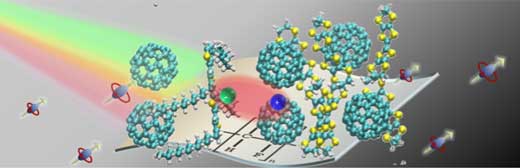
(Nanowerk Spotlight) Ever since the first demonstration of graphene in 2004, the scientific community has pursued the possibility of building man-made materials by artificial stacking of different ultrathin materials one on top of the other. These materials are called van der Waals heterostructures.Due to their unique interlayer coupling and optoelectronic properties, these materials are of considerable interest for the next generation nanoelectronics.Conventional 2D heterostructures usually are composed of two layers of opposite charge carrier type using inorganic materials. One of the challenges when creating 2D heterostructures is the painstaking stacking of the individual components on top of each other.Researchers have now found, for the first time, that there can also be charge transfer (CT) induced interfacial coupling between two different pairs of organic CT layers.Moreover, external stimuli can be harnessed to tune the interfacial coupling to control the physical properties of organic van der Waals heterostructures (vdWHs).”The interface of heterostructures can provide many possibilities to generate new phenomena,” Shenqiang Ren, an Associate Professor in the Mechanical Engineering at Temple University, tells Nanowerk. „Our group has years of investigation on organic CT complexes. As the interface between two layers of organic CT complex is different from single phase, such as intra-layer and inter-layer CT interactions, it is exciting to investigate the interfacial coupling within organic van der Waals heterostructures.”The most significant finding in this work, just published in Nature Communications („Tunable two-dimensional interfacial coupling in molecular heterostructures”), is that the researchers found strong and anisotropic interfacial charge transfer coupling in two-dimensional organic van der Waals heterostructures.Organic van der Waals heterostructures exhibit multi-stimuli controlled physical propertiesOrganic van der Waals heterostructures exhibit multi-stimuli controlled physical properties. (Image: Dr. B Xu)As the team (a collaboration between Ren’s group and Prof. Michael L Klein’s High-Performance Computing group at Temple University) points out, such interfacial CT coupling enables external stimuli controlled physical properties in organic vdWHs.To prepare 2D vdWH, researchers widely use a conventional chemical vapor deposition approach. However, the weak interlayer interaction between the monolayer 2D film and the substrate leads to island growth rather than continuous monolayers.The approach demonstrated by the Temple University team allows for large-scale (mm2 range) assembly of free-standing 2D CT heterostructures with controlled orientation and unique physicochemical properties. As they note, the interfacial coupling can be tuned in over a large range by external fields (ferroelectric and magnetic) with strong enhancement of current and capacitance, due to the coupling across two CT pairs along the vertical and horizontal orientations.”As our vdWHs show multifunctional external stimuli dependent response (such as piezoresistance, electroresistive and magnetoconductance), they can be applied for multifunctional sensors,” says Ren. „For example, the vdWHs exhibit excellent pressure dependent sensitivity with a high piezoresistance coefficient of -4.4×10⁻⁶ Pa-1.””The organic vdW heterostructures formed by the combination of two pairs of organic CT complex with tunable interfacial coupling show overwhelming advantages over single component,” he adds. „They exhibit unique physicochemical properties covering vast majority of opto-electrical-magnetic-mechanical topics.”The researchers’ next steps will be focused on the synthesis of wafer-scale two-dimensional vdWHs towards artificial intelligence applications.Since the organic vdWHs demonstrate a fast response to external stimuli with the change of conductivity, this opens up the practical applications for multi-stimuli sensors.By Michael is author of two books by the Royal Society of Chemistry: Nano-Society: Pushing the Boundaries of Technology and Nanotechnology: The Future is Tiny. Copyright © Nanowerk

Read more: 2D van der Waals heterostructures with tunable optical-electronic-magnetic coupling

Celulele de biocombustibili extensibile extrag energia de la transpirație la dispozitive portabile de putere (Stretchable biofuel cells extract energy from sweat to power wearable devices)

Celulele de biocombustibili sunt echipate cu o enzimă care oxidează acidul lactic prezent în transpirația umană pentru a genera curent. Acest lucru transformă transpirația într-o sursă de energie.

Read more: Stretchable biofuel cells extract energy from sweat to power wearable devices

Posted: Aug 22, 2017

Stretchable biofuel cells extract energy from sweat to power wearable devices

(Nanowerk News) A team of engineers has developed stretchable fuel cells that extract energy from sweat and are capable of powering electronics, such as LEDs and Bluetooth radios. The biofuel cells generate 10 times more power per surface area than any existing wearable biofuel cells. The devices could be used to power a range of wearable devices.

The epidermal biofuel cells are a major breakthrough in the field, which has been struggling with making the devices that are stretchable enough and powerful enough. Engineers from the University of California San Diego were able to achieve this breakthrough thanks to a combination of clever chemistry, advanced materials and electronic interfaces. This allowed them to build a stretchable electronic foundation by using lithography and by using screen-printing to make 3D carbon nanotube-based cathode and anode arrays.
The biofuel cells are equipped with an enzyme that oxidizes the lactic acid present in human sweat to generate current. This turns the sweat into a source of power.
Flexible, Stretchable Biofuel Cell
The biofuel cell can stretch and flex, conforming to the human body. (Image: University of California San Diego)
Engineers report their results in the June issue of Energy & Environmental Science („Soft, stretchable, high power density electronic skin-based biofuel cells for scavenging energy from human sweat „). In the paper, they describe how they connected the biofuel cells to a custom-made circuit board and demonstrated the device was able to power an LED while a person wearing it exercised on a stationary bike. Professor Joseph Wang, who directs the Center for Wearable Sensors at UC San Diego, led the research, in collaboration with electrical engineering professor and center co-director Patrick Mercier and nanoegnineering professor Sheng Xu, both also at the Jacobs School of Engineering UC San Diego.

Islands and bridges

To be compatible with wearable devices, the biofuel cell needs to be flexible and stretchable. So engineers decided to use what they call a „bridge and island” structure developed in Xu’s research group. Essentially, the cell is made up of rows of dots that are each connected by spring-shaped structures. Half of the dots make up the cell’s anode; the other half are the cathode. The spring-like structures can stretch and bend, making the cell flexible without deforming the anode and cathode.
The basis for the islands and bridges structure was manufactured via lithography and is made of gold. As a second step, researchers used screen printing to deposit layers of biofuel materials on top of the anode and cathode dots.

Increasing energy density

The researchers’ biggest challenge was increasing the biofuel cell’s energy density, meaning the amount of energy it can generate per surface area. Increasing energy density is key to increasing performance for the biofuel cells. The more energy the cells can generate, the more powerful they can be.
„We needed to figure out the best combination of materials to use and in what ratio to use them,” said Amay Bandodkar, one of the paper’s first authors, who was then a Ph.D. student in Wang’s research group. He is now a postdoctoral researcher at Northwestern University.
To increase power density, engineers screen printed a 3D carbon nanotube structure on top the anodes and cathodes. The structure allows engineers to load each anodic dot with more of the enzyme that reacts to lactic acid and silver oxide at the cathode dots. In addition, the tubes allow easier electron transfer, which improves biofuel cell performance.

Testing applications

The biofuel cell was connected to a custom-made circuit board manufactured in Mercier’s research group. The board is a DC/DC converter that evens out the power generated by the fuel cells, which fluctuates with the amount of sweat produced by a user, and turns it into constant power with a constant voltage.
Researchers equipped four subjects with the biofuel cell-board combination and had them exercise on a stationary bike. The subjects were able to power a blue LED for about four minutes.

Next steps

Future work is needed in two areas. First, the silver oxide used at the cathode is light sensitive and degrades over time. In the long run, researchers will need to find a more stable material.
Also, the concentration of lactic acid in a person’s sweat gets diluted over time. That is why subjects were able to light up an LED for only four minutes while biking. The team is exploring a way to store the energy produced while the concentration of lactate is high enough and then release it gradually.
Source: University of California – San Diego

Read more: Stretchable biofuel cells extract energy from sweat to power wearable devices

Un polițist de trafic pentru molecule(A traffic cop for molecule)

Oamenii de stiinta au creat un material rigid cu pori ultra-mici, cu diametrul mai mic de 7Å, (mai putin de un milion pe diametrul parului uman) care sunt ultra selectivi pe baza dimensiunilor. Porii permit oamenilor de stiinta sa proiecteze filme care pot diferentia molecule de dimensiuni asemanatoare bazate pe diferente mici in forma unei molecule.

Posted: Aug 22, 2017

A traffic cop for molecules

(Nanowerk News) Whether making a plastic coating or fuel, saving energy reduces costs. A vital target for cost savings is separating chemicals that are slightly different from each other. Nearly every processing industry must separate chemicals.

Scientists created a rigid material with ultra-small pores with diameter less than 7Å, (less than one-millionth the diameter of a human hair) that are ultra selective based on size. The pores enable scientists to design films that can differentiate between similarly sized molecules based on small differences in a molecule’s shape.
Membranes are separation agents. Scalable, efficient membranes reduce the cost and the environmental impact of producing vital commodities. How? The best membranes use a fraction of the energy of traditional approaches.
This study (Nature Materials, „Materials for next-generation molecularly selective synthetic membranes”) shows how a material with ultra small pores can be scaled to separate large quantities of molecules effectively by allowing an efficient sorting process based on size.
Carbon molecular sieves (CMS) with rigid ultra small pores
Carbon molecular sieves (CMS) with rigid ultra small pores (pores with diameter less than 7Å) and tailorable size and shape selectivity can enable the membrane-based separation of gas and liquid organic molecules.
Materials with rigid ultra small micropores provide selectivity that controls the motion of individual molecules to improve separation between similarly sized molecules by making it difficult for the “chubby ones” to get through.
Next-generation membranes based on these advanced materials overcome the deficiencies of conventional polymers to separate alkanes and alkenes, natural gases, and isomers. Additionally, these next-generation membranes will achieve solute-solute discrimination in organic solvents, which was also a problem for conventional methods.
Mass-producing molecular-scale separators must be economical. The key is to use hollow fibers with selective thin layers using an advanced version of the process to make textile fibers like those used to make inexpensive clothes.
The advanced version of this technology relies upon hundreds of “spinnerets” to produce the fibers in parallel and then collect them into a holder. When the fibers are extruded and contact air, a skin forms—like it does when glue is in contact with air. Because these advanced materials are scalable, scientists can create molecularly selective membranes that could provide large payoffs in reducing carbon dioxide emissions and energy consumption for a more sustainable future.
Source: U.S. Department of Energy, Office of Science
Subscribe to a free copy of one of our daily
Nanowerk Newsletter Email Digests
with a compilation of all of the day’s news.

Read more: A traffic cop for molecules

Eticheta inteligentă vă poate informa când să aruncați alimente și produse cosmetice (Smart label could let you know when to toss food and cosmetics )

Detectarea degradării produselor alimentare și cosmetice și a contaminării.Oamenii de știință au dezvoltat un senzor cu cost redus, portabil, pe suport de hârtie, care poate realiza toate aceste funcții cu rezultate ușor de citit.dezvoltând dispozitive pe bază de hârtie care își schimbă culoarea, în timp ce produsele cosmetice și produsele alimentare sunt proaste. Acești senzori se leagă de speciile reactive de oxigen pe care produsele se acumulează în timp ce îmbătrânesc și, eventual, strică.

Posted: Aug 22, 2017

Smart label could let you know when to toss food and cosmetics

(Nanowerk News) Detecting food and cosmetic spoilage and contamination. Identifying new medicinal plants in a remote jungle. Authenticating tea and wine. Scientists have developed a low-cost, portable, paper-based sensor that can potentially carry out all of these functions with easy-to-read results.

The researchers are presenting their results at the 254th National Meeting & Exposition of the American Chemical Society (ACS).
“I’ve always been interested in developing technologies that are accessible to both industry and the general population,” Silvana Andreescu, Ph.D., says. “My lab has built a versatile sensing platform that incorporates all the needed reagents for detection in a piece of paper. At the same time, it is adaptable to different targets, including food contaminants, antioxidants and free radicals that indicate spoilage.”
What sets Andreescu’s sensors apart from others, she says, are the nanostructures they use to catch and bind to compounds they’re looking for.
“Most people working on similar sensors use solutions that migrate on channels,” Andreescu says. “We use stable, inorganic particles that are redox active. When they interact with the substances we want to detect, they change color, and the intensity of the change tells us how concentrated the analyte is.”
Additionally, because all of the reagents needed to operate the device are incorporated in the paper, users don’t need to add anything other than the sample being tested.
The potential applications are wide-ranging. For example, much of her sensor work thus far has focused on detecting antioxidants in tea and wine. Andreescu, who’s at Clarkson University, and her colleagues have found that these products have unique antioxidant “fingerprints” that could be used for authentication purposes. The portable sensor could also be used by researchers exploring remote locations, such as the Amazon rainforest, in search of natural sources of antioxidants, she notes.
More recently, Andreescu extended her work to root out food contamination and environmental pollutants. One sensor prototype can spot ochratoxin A, a fungal toxin commonly found in a range of products, including cereals and coffee. She says this direction could be expanded further to look for salmonella and E. coli.
Now, her team is taking the work in yet another direction, developing paper-based devices that change color as cosmetics and food go bad. These sensors bind to the reactive oxygen species that products accumulate as they age and eventually spoil. Although testing for this application is still ongoing, Andreescu says this technology could one day be incorporated into smart labels that would tell consumers when to throw a product out.
Source: American Chemical Society

Read more: Smart label could let you know when to toss food and cosmetics

Crearea unui burete molecular superior, de la început(Creating a molecular super sponge, from the ground up)

oamenii de stiinta au creat un material complex din punct de vedere structural folosind doar doua tipuri de blocuri. Cunoscută ca o structură metalică organică (MOF), noua suprastructură poroasă sau cușcă, numită NU-1301, este destul de mare, cu cea mai mare celulă unică din orice material nebiologic.MF este un material foarte poros, ca un burete super, care este excelent pentru aplicații de stocare incluzând, dar fără a se limita la, depozitarea deșeurilor nucleare.

Posted: Aug 22, 2017

Creating a molecular super sponge, from the ground up

(Nanowerk News) Mother Nature does it every day, but building complex materials from the bottom-up using only simple building blocks is incredibly difficult in the lab.

Now, scientists created a structurally complex material using just two types of building blocks. Known as a metal-organic framework (MOF), the new porous, or cage-filled, superstructure called NU-1301 is quite large, with the largest unit cell of any non-biological material.
In addition, it is the lowest density MOF reported to date. The low density means the MOF is a highly porous material, like a super sponge, which is great for storage applications including, but not limited to, storage of nuclear waste.
This work (Science, „Bottom-up construction of a superstructure in a porous uranium–organic crystal”) demonstrates a set of design rules. These rules can now be used for the self-assembly of highly intricate, open structures using simple starting materials. For example, scientists can use the rules to design new materials that better filter pollutants and other toxic chemicals. In addition, this work highlights the potential role of uranium and other actinides for complex materials synthesis.
NU-1301 is composed of cuboctahedral building blocks
NU-1301 is composed of cuboctahedral building blocks (blue) that organize into pentagonal and hexagonal (yellow and red) prismatic secondary structures resulting in the formation of colossal icosidodecahedral (grey) and rectified hexakaidecahedral (green) cavities with internal diameters of 5.0 nm and 6.2 nm, respectively. The cages are measured in Angstroms. (Image: N.A. Vermeulen)
The structure of NU-1301 represents a new three-dimensional net, named Northwestern University Net (nun), which has been added to the reticular chemistry structure resource database. The net is highly complex with 17 topologically distinct nodal vertices and 18 discrete edges.
Given the structural complexity of NU-1301, the single crystal x-ray structure of the resulting MOF could not be solved using traditional methods because only the position of the uranium atoms could be determined experimentally.
As a result, the scientists simulated the organic components based on the uranium atom positions; then, they confirmed the final simulated structure using other techniques. NU-1301 has a high Brunauer-Emmett-Teller (BET) area (4750 m2/g) and pore volume (3.9 cm3/g) and is thermally stable to temperatures greater than 500°C (~900 F) under both nitrogen and air.
The pores of NU-1301 are also accessible and anionic in nature, as shown by the encapsulation of positively charged small organic molecules and large biological molecules that can be separated from negatively charged molecules of similar sizes.
Source: U.S. Department of Energy, Office of Science

Read more: Creating a molecular super sponge, from the ground up

Ambalajul antimicrobian bazat pe argint menține alimentele proaspete ( Clay-based antimicrobial packaging keeps food fresh )

Cercetătorii au încărcat aceste nanotuburi cu un ulei esențial antibacterian natural găsit în cimbru și oregano numit carvacrol și au acoperit suprafața interioară a filmului de ambalaj cu nanotuburile încărcate pentru a ucide microbii.
Echipa a înfășurat roșiile, bananele și puiul în film pentru a-și testa eficacitatea în diferite perioade de timp în comparație cu alimentele învelite în polietilenă simplă. După 10 zile, roșiile învelite cu noul film erau mai bine conservate decât legumele de control. În plus, noul film a ajutat bananele să rămână mai ferme și să păstreze culoarea galbenă vibrantă după șase zile, comparativ cu fructul de control. Și puiul învelit cu filmul experimental și refrigerat timp de 24 de ore a prezentat o creștere semnificativ mai mică a bacteriilor decât puiul din polietilenă simplă.

Posted: Aug 22, 2017

Clay-based antimicrobial packaging keeps food fresh

(Nanowerk News) Sometimes it seems as if fresh fruits, vegetables and meats go bad in the blink of an eye. Consumers are left feeling frustrated, often turning to less expensive processed foods that last longer but are less nutritious. Now scientists report that they have developed a packaging film coated with clay nanotubes packed with an antibacterial essential oil. The film provides a one-two punch, preventing over-ripening and microbial growth, which could help improve the shelf life of perishables.

The researchers are presenting their results at the 254th National Meeting & Exposition of the American Chemical Society (ACS).
Clay-Based Antimicrobial Packaging Keeps Food Fresh
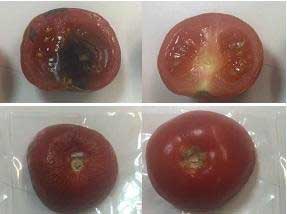
Control tomatoes (left) rotted after six days while those wrapped in a new clay-based film (right) stayed fresh. (Image: Hayriye Ünal)
„Food packaging that is capable of interacting with food can contribute to safety and prevent economic losses from spoilage,” Hayriye Ünal, Ph.D., says. „Specialized films that can preserve a wide array of foods are highly sought after.”
People around the world have been trying to preserve fruits, vegetables and meats since ancient times. From the traditional methods of salting or fermenting to the more modern methods of canning, freezing or wrapping in plastic films, food preservation has always been important. According to the U.S. Department of Agriculture, about 30 to 40 percent of the food that farmers produce in the country goes to waste. Sometimes, busy people just don’t have enough time to eat all of the fresh food they buy, but other times food spoils at the grocery store because consumers avoid purchasing imperfect fruits, vegetables and meats.
Over the past two decades, scientists have been developing alternative ways to preserve food, with an extensive focus on packaging. Numerous issues, primarily the versatility of the materials, have hindered progress. „While companies can already make many films that prevent fruit and vegetables from drying out, incorporating additional properties in the same film is a challenge,” says Ünal, who is at Sabanci University in Turkey.
Bacterial contamination and permeability to both oxygen and water vapor are major issues that scientists are addressing. Another challenge is to prevent too much ethylene from building up around foods. Ethylene is a compound naturally released by fruits and vegetables that aids in the ripening process. But an excess of ethylene trapped underneath the packaging film can cause food to over ripen and rot.
To meet the demand for multi-functional packaging, Ünal’s team started with a polyethylene film. To scavenge for ethylene and provide a gas barrier the group incorporated clay „halloysite nanotubes,” which are small, hollow cylinders. The nanotubes prevent oxygen from entering the film, and prevent water vapor and other gases from escaping. In addition they keep ethylene from building up by absorbing it. The researchers loaded these nanotubes with a natural antibacterial essential oil found in thyme and oregano called carvacrol and coated the inner surface of the packaging film with the loaded nanotubes to kill microbes.
The team wrapped tomatoes, bananas and chicken in the film to test its effectiveness over varying amounts of time compared to foods wrapped in plain polyethylene. After 10 days, tomatoes wrapped with the new film were better preserved than the control vegetables. In addition, the new film helped bananas stay more firm and keep their vibrant yellow color after six days compared to the control fruit. And chicken enveloped with the experimental film and refrigerated for 24 hours showed significantly less bacterial growth than chicken in plain polyethylene.
But moving this technology to industry will require some additional work, Ünal says. As a next step toward that, her team will test the new film to make sure it is safe and nontoxic.
Source: American Chemical Society

Read more: Clay-based antimicrobial packaging keeps food fresh

München Re & In-Q-Tel a selectat Metabiota pentru a obține o perspectivă mai profundă asupra riscului epidemiei și pregătirii globale pentru bolile infecțioase(Munich Re& In-Q-Tel Select Metabiota to Gain Deeper Insights into Epidemic Risk and Global Preparedness for Infectious Diseases)

Cu o platformă intuitivă, bazată pe cloud, Metabiota furnizează administratorilor de risc și subscriptorilor cu o perspectivă fără precedent asupra modului în care se propagă bolile și le ajută să cuantifice riscul reprezentat de epidemii

Stimp20