
U.S.military subliniază importanța nanotehnologiei(U.S.military stresses importance of nanotechnology)
nanotehnologia este studiul manipulării materiei pe o scară atomică, moleculară sau supermoleculară
nanotehnologia este studiul manipulării materiei pe o scară atomică, moleculară sau supermoleculară
disulfidul de molibden (MoS 2 ), este un material cu un singur strat, cu proprietăți interesante dincolo de cele ale grafenului. MoS 2 poate absorbi de cinci ori mai multă lumină vizibilă ca grafenul, făcându-l util în detectoarele de lumină și celulele solare. În plus, se propun și se sintetizează zilnic și materiale mai noi, cum ar fi borofenul (un material cu un singur strat format din atomi de bor proiectat a fi mecanic mai puternic decât grafenul).
| Posted: Jun 15, 2016 | |
Graphene isn’t the only Lego in the nanoelectronics materials-science toy box(Nanowerk News) You may have heard of graphene, a sheet of pure carbon, one atom thick, that’s all the rage in materials-science circles, and getting plenty of media hype as well. Reports have trumpeted graphene as an ultra-thin, super-strong, super-conductive, super-flexible material. You could be excused for thinking it might even save all of humanity from certain doom. |
|
| Not exactly. In the current world of nano-electronics, there is a lot more going on than just graphene. One of the materials I work with, molybdenum disulphide (MoS2), is a one-layer material with interesting properties beyond those of graphene. MoS2 can absorb five times as much visible light as graphene, making it useful in light detectors and solar cells. In addition, even newer materials like borophene (a one-layer material made of boron atoms projected to be mechanically stronger than graphene) are being proposed and synthesized every day. | |
 |
|
| Layering two-dimensional materials. (Image: Peter Byrley) | |
| These and other materials yet to be discovered will be used like Lego pieces to build the electronics of the future (the paper is titled van der Waals heterostructures). By stacking multiple materials in different ways, we can take advantage of different properties in each of them. The new electronics built with these combined structures will be faster, smaller, more environmentally resistant and cheaper than what we have now. | |
| Looking for an energy gap | |
| There is a key reason that graphene will not be the versatile cure-all material that the hype might suggest. You can’t just stack graphene repeatedly to get what you want. The electronic property preventing this is the lack of what is called an “energy gap.” (The more technical term is “band gap.”) | |
| Metals will conduct electricity through them regardless of the environment. However, any other material that is not a metal needs a little boost of energy from the outside to get electrons to move through the band gap and into the conducting state. How much of a boost the material needs is called the energy gap. The energy gap is one of the factors that determines how much total energy needs to be put into your entire electrical device, from either heat or applied electrical voltage, to get it to conduct electricity („Physics of Semiconductor Devices”). You essentially have to put in enough starting energy if you want your device to work. | |
| Some materials have a gap so large that almost no amount of energy can get electrons flowing through them. These materials are called insulators (think glass). Other materials have either an extremely small gap or no gap at all. These materials are called metals (think copper). This is why we use copper (a metal with instant conductivity) for wiring, while we use plastics (an insulator that blocks electricity) as the protective outer coating. | |
| Everything else, with gaps in between these two extremes, is called a semiconductor (think silicon). Semiconductors, at the theoretical temperature of absolute zero, behave as insulators because they have no heat energy to get their electrons into the conducting state. At room temperature, however, heat from the surrounding environment provides just enough energy to get some electrons (hence the term, “semi”-conducting) over the small band gap and into the conducting state ready to conduct electricity. | |
 |
|
| Comparing the band gap in metals (left), semiconductors (center) and insulators (right). (Image: Peter Byrley) | |
| Graphene’s energy gap | |
| Graphene is in fact a semi-metal. It has no energy gap, which means it will always conduct electricity – you can’t turn off its conductivity. | |
| This is a problem because electronic devices use electrical current to communicate. At their most fundamental level, computers communicate by sending 1’s and 0’s – on and off signals. If a computer’s components were made from graphene, the system would always be on, everywhere. It would be unable to perform tasks because its lack of energy gap prevents graphene from ever becoming a zero; the computer would keep reading 1’s all the time. Semiconductors, by contrast, have an energy gap that is small enough to let some electrons conduct electricity but is large enough to have a clear distinction between on and off states. | |
| Finding the right materials | |
| Not all hope is lost, however. Researchers are looking at three main ways to tackle this: | |
|
|
| There are many one-layer materials currently being looked at that actually have a sufficient energy gap. One such material, MoS2, has been studied in recent years as a potential replacement for traditional silicon and also as a light detector and gas sensor. | |
| The only drawback with these other materials is that so far, we have not found one that matches the excellent though always-on conductivity of graphene. The other materials can be turned off, but when on, they are not as good as graphene. MoS2 itself is estimated to have 1/15th to 1/10th the conductivity of graphene in small devices. Researchers, including me, are now looking at ways to alter these materials to increase their conductivity. | |
| Using graphene as an ingredient | |
| Strangely, an energy gap in graphene can actually be induced through modifications like bending it, turning it into a nanoribbon, inserting foreign chemicals into it or using two layers of graphene. But each of these modifications can reduce the graphene’s conductivity or limit how it can be used. | |
| To avoid specialized setups, we could just combine graphene with other materials. By doing this, we are also combining the properties of the materials in order to reap the best benefits. We could, for example, invent new electronic components that have a material allowing them to be shut off or on (like MoS2) but have graphene’s great conductivity when turned on. New solar cells will work on this concept. | |
| A combined structure could, for example, be a solar panel made for harsh environments: We could layer a thin, transparent protective material over the top of a very efficient solar-collecting material, which in turn could be on top of a material that is excellent at conducting electricity to a nearby battery („Extraordinary Sunlight Absorption and One Nanometer Thick Photovoltaics Using Two-Dimensional Monolayer Materials”). Other middle layers could include materials that are good at selectively detecting gases such as methane or carbon dioxide. | |
| Researchers are now racing to figure out what the best combination is for different applications. Whoever finds the best combination will eventually win numerous rights to patents for improved electronic products. | |
| The truth is, though, we don’t know what our future electronics will look like. New Lego pieces are being invented all the time; the ways we stack or rearrange them are changing constantly, too. All that’s certain is that the insides of electronic devices will look drastically different in the future than they do today. |
| Source: By Peter Byrley, Ph.D. Candidate in Chemical Engineering, University of California, Riverside |
Structura este unul dintre primele exemple din lume ale unui absorber de metasurface cu trei straturi, folosind un strat intermediar de carbon.folosește carbonul amorf drept interstrat între filmele de aur subțiri și pelicula superioară, modelată cu o matrice periodică 2D, folosind o gravare cu fascicul de ioni concentrat.Celula va fi utilizată pentru aplicații de energie termică solară și are potențialul de a atinge temperaturi mult mai ridicate decât suprafețele negre simple, deoarece poate minimiza emisia de radiație termică.
| Posted: Jun 15, 2016 | |
New generation of high-efficiency solar thermal absorbers developed(Nanowerk News) Researchers from the Universities of Bristol and Exeter are one step closer to developing a new generation of low-cost, high-efficiency solar cells („A selective metasurface absorber with an amorphous carbon interlayer for solar thermal applications”). The structure is one of the world’s first examples of a tri-layer metasurface absorber using a carbon interlayer. |
|
 |
|
| SEM view of MDM structure D at lower magnification. Inset image at higher magnification showing rounded nature of the upper patterned layer. | |
| The system, developed by Chenglong Wang a PhD student in Professor Martin Cryan’s research group, uses amorphous carbon as an inter-layer between thin gold films with the upper film patterned with a 2D periodic array using focused ion beam etching. | |
| The trilayer gold-carbon-gold metasurface strongly absorbs light across the solar spectrum but minimises emission of thermal radiation from the structure. The use of gold in the research is a first step towards a high temperature metasurface where gold can be replaced by other refractory metals such as tungsten or chrome. | |
| The cell will be used for solar thermal energy applications and has the potential to reach much higher temperatures than simple black surfaces because it can minimise the emission of thermal radiation. | |
| The metasurface has been developed as part of a joint project, led by Dr Neil Fox, between Bristol’s Department of Electrical and Electronic Engineering and Schools of Physics and Chemistry. The aim of this project is to develop diamond-based solar thermionic devices, which use sunlight to get surfaces sufficiently hot that they emit electrons directly into a vacuum. If these electrons are collected at a cooled anode, electrical energy can be produced with maximum efficiencies predicted to be much higher than is achievable using conventional silicon solar cells. | |
| Martin Cryan, Professor of Applied Electromagnetics and Photonics in the Department of Electrical and Electronic Engineering, said: “Integrating diamond within metasurfaces is very challenging, and this paper is a first step in that direction using amorphous carbon. The next stage is to carry out high temperature testing on the structures and to attempt to reach the ~700 degrees celsius required to obtain efficient thermionic emission.” |
| Source: University of Bristol |
Carbonul de burete din loofah ar putea fi un progres necesar pentru a muta aceste baterii înainte într-un mod ieftin și sustenabil, spun cercetătorii.
| Posted: Jun 15, 2016 | |
Loofah-based material could give lithium batteries a boost(Nanowerk News) Today’s mobile lifestyle depends on rechargeable lithium batteries. But to take these storage devices to the next level — to shore up the electric grid or for widespread use in vehicles, for example — they need a big boost in capacity. To get lithium batteries up to snuff for more ambitious applications, researchers report in the journal ACS Applied Materials & Interfaces(„Multifunctional Nitrogen-Doped Loofah Sponge Carbon Blocking Layer for High-Performance Rechargeable Lithium Batteries”) a new solution that involves low-cost, renewable loofah sponges. |
|
 |
|
| A carbon material derived from loofah sponges could be used in the next generation of lithium batteries. | |
| The lithium-ion batteries that power most of our devices still have some room for improvement. But some experts predict that even when these batteries are fully optimized, they still will not be able to meet the power needs for larger-scale applications, such as taking a car 500 miles on one charge. Scientists looking to go beyond lithium-ion have turned to lithium-sulfur and other options. But a major challenge to commercializing these technologies remains: The cathodes crumble over time, leading to progressively lower capacity. Shanqing Zhang, Yanglong Hou, Li-Min Liu and colleagues wanted to find a way to stabilize these alternatives. | |
| The researchers developed a “blocking” layer of highly conductive, porous carbon derived from a loofah sponge. The loofah-derived membrane helped prevent the cathode from dissolving in lithium-sulfur, lithium-selenium and lithium-iodine batteries — and all three types performed well consistently over 500 to 5,000 cycles. The loofah sponge carbon could be the advance needed to move these batteries forward in a low-cost, sustainable way, the researchers say. |
| Source: American Chemical Society | |
cercetări și prototipuri scenarii viitoare, sisteme, produse și procese pentru alegerea propriilor setări de confidențialitate microbiologică.scopul a fost să vedem dacă bacteriile pe care le ridicăm și le lăsăm în urmă pot fi urmărite și urmărite în timp
Contul ficțional imaginat aici se bazează pe zeci de conversații cu experți în domeniul securității informatice, hackeri, oficialități guvernamentale și multe altele.
Oamenii de stiinta au descoperit ca celulele bioluminiscente gasite in unele calmaruri de sticla sunt din punct de vedere biologic ineficiente.Sculele de sticlă au proprietăți remarcabile pentru evitarea detectării
Servicii de inginerie Gryphon
a creat un nou laser revoluționar, cu bandă largă, reglabilă, care are implicații majore pentru detectarea drogurilor și a explozivilor.Robustul, tot laserul solid, poate fi reglat rapid pentru a emite în intervalul lungimii de undă care cuprinde regiunea critică a „amprentelor digitale” în care cele mai multe caracteristici moleculare sunt absorbite și identificate prin detectarea în infraroșu. În experimente, laserul și-a demonstrat capacitatea de a capta amprenta spectrală unică a gazelor.
| Posted: Jun 09, 2016 | |
Tunable lasers to improve infrared spectroscopy(Nanowerk News) A new development from Northwestern Engineering’s Manijeh Razeghi could be another tool for protecting our borders. |
|
| Supported by the Department of Homeland Security, Razeghi’s lab has created a new, revolutionary, broad-band tunable infrared laser that has major implications for the detection of drugs and explosives. | |
| The robust, all solid-state laser can be rapidly tuned to emit in the wavelength range that encompasses the critical “fingerprint” region where most molecular features are absorbed and identified through infrared sensing. In experiments, the laser has demonstrated its ability to capture the unique spectral fingerprint of gases. | |
| “The only moving part in the entire system is the fan used to keep the laser cool,” said Manijeh Razeghi, Walter P. Murphy Professor of Electrical Engineering and Computer Science. “This is a major advantage over existing systems that require mechanical parts to achieve tuning, and we expect to demonstrate remarkable stability.” | |
| The initial, patent-pending results have been published in the June 8 issue of Nature Scientific Reports („Monolithically, widely tunable quantum cascade lasers based on a heterogeneous active region design”). The research and development of the laser system is the culmination of more than 18 years of quantum cascade laser development work at Northwestern’s Center for Quantum Devices. | |
| The laser has been integrated into a system that contains all of the laser driver electronics and tuning software necessary for integration into a spectroscopy system. It produces a stable, single-aperture spot less than 3 millimeters in diameter that is suitable for standoff detection and is capable of linear or random access scanning with stabilization times of less than 1 millisecond per wavelength. |
| Source: Northwestern University | |
Fluidul și sticla din prototip au fost alese deoarece au indicatori de refracție foarte asemănăți, ceea ce înseamnă că lumina trece prin ele cu viteze similare. Atunci când lumina se mișcă dintr-un material cu un indice de refracție ridicat la unul cu un indice de refracție mai mic, acesta schimbă direcția; acesta este fenomenul din spatele iluziei familiare a apariției unei paie care se îndoaie când este introdusă într-un pahar de apă.
Prototipul cercetătorilor exploatează faptul că schimbările de temperatură modifică indicii de refracție ai materialelor.În experimentele lor, cercetătorii au descoperit că o schimbare de temperatură de 10 grade ar crește de zece ori difuzia dispozitivului și o schimbare de 42 de grade a schimbat-o de o mie de ori.
Heshmat crede că o versiune modulate în funcție de temperatură a filtrului echipei sale ar putea fi utilizată pentru calibrarea senzorilor utilizați în studiul fluxurilor materiale, studiul celulelor și imagistica medicală.
| Posted: Jun 09, 2016 | |
Mixing solids and liquids enhances optical properties of both(Nanowerk News) By immersing glass particles in a fluid, researchers at MIT’s Media Lab and Harvard University are exploring a new mechanism for modifying an optical device’s diffusivity, or the extent to which it scatters light. |
|
| In its current form, the new diffuser could be used to calibrate a wide range of imaging systems, but the researchers believe that their mechanism could ultimately lead to holographic video screens or to tunable optical devices with applications in imaging, sensing, and photography. | |
 |
|
| A mild temperature change radically alters the degree to which a solid-fluid mixture bends light. (Image: Courtesy of the researchers) | |
| In experiments, the solid-liquid mixture demonstrated much more dramatic changes in diffusivity than existing theory would have predicted, so the researchers also developed a new computer model to describe it. That model could help them devise more complex applications for the basic technology. | |
| The researchers describe their new work in the latest issue of the American Chemical Society’s ACS Photonics journal („Tyndall Windows: Tunable Scattering of Disordered Solid–Liquid Matching Mixtures”). | |
| The fluid and the glass in the prototype were chosen because they have very similar refractive indices, meaning light travels through them at similar speeds. When light moves from a material with a high refractive index to one with a lower refractive index, it changes direction; this is the phenomenon behind the familiar illusion of a straw’s appearing to bend when it’s inserted into a glass of water. | |
| The researchers’ prototype exploits the fact that changes in temperature alter materials’ refractive indices. | |
| “It’s hard to find a solid and liquid that have exactly the same refractive index at room temperature,” says Barmak Heshmat, a postdoc in the Media Lab’s Camera Culture group and corresponding author on the paper. “But if the speed at which the refractive index changes for solid and liquid is different — which is the case for most solids and liquids — then at a certain temperature they will exactly match, to the last digit. That’s why you see this giant jump in transparency.” | |
 |
|
| Changing the diffusivity of a solid-fluid mixture renders the letters „MIT” legible or illegible. Inset: the glass particles suspended in the mixture. (Image: Courtesy of the researchers) | |
| Heshmat is joined on the paper by Ramesh Raskar, the NEC Career Development Associate Professor of Media Arts and Sciences and head of the Camera Culture group, and Benedikt Groever, a graduate student in engineering and applied science at Harvard. | |
| Study in contrast | |
| In their experiments, the researchers found that a temperature change of 10 degrees would increase the diffusivity of their device tenfold, and a change of 42 degrees changed it a thousandfold. | |
| Heshmat believes that a temperature-modulated version of his team’s filter could be used to calibrate sensors used in the study of material flows, the study of cells, and medical imaging. | |
| For instance, medical-imaging systems are typically calibrated using devices called “tissue phantoms,” which duplicate the optical properties of different types of biological tissues. Tissue phantoms can be expensive, and many of them may be required to calibrate a single imaging device. Heshmat believes that a low-cost version of his team’s filter could mimic a wide range of tissues. | |
| But the fundamental principle illustrated by the researchers’ prototype could have broader ramifications. The effect of heat on the refractive index of either the solid or the fluid, taken in isolation, is very subtle. But when the two are mixed together, the effect on diffusivity is dramatic. | |
 |
|
| At a certain temperature (b), the refractive indices of an optical fluid and glass particles suspended in it match, rendering the solid-fluid mixture transparent. At lightly lower (a) and higher (b) temperatures, the mismatch of refractive indices causes light to scatter. (Image: Courtesy of the researchers) | |
| The same would be true, Heshmat argues, of other types experimental materials whose refractive indices change in response to either light or an electric field. And optical or electrical activation would broaden the range of applications for tunable optical devices. | |
| “If you have photorefractive changes in a solid material in a solid phase, the amount of change you can get between the solid and itself is very small,” he explains. “You need a very strong field to see that change in your refractive index. But if you have two types of media, the refractive index of the solid is going to change much faster compared to the liquid. So you get this deep contrast that can help a lot.” | |
| Application | |
| In holographic displays, cells filled with a mixture of electrically responsive solid materials and a fluid could change their diffusivity when charged by an electrode, in much the way that cells filled with ionized gas change their color in plasma TVs. Adjacent cells could thus steer light in slightly different directions, mimicking the reflection of light off of a contoured surface and producing the illusion of three-dimensionality. | |
| Liquid-solid mixtures could also be used to produce tunable diffraction gratings, which are used in some sensing applications to filter out light or other electromagnetic radiation of particular frequencies, or in tunable light diffusers of the sort photographers use to make the strongly directional light of a flash feel more like ambient light. | |
| The computer model that the researchers describe in their paper predicts the diffusivity of a liquid-solid mixture on the basis of the physical characteristics of the solid particles — how jagged or spiky they are — and on their concentration in the liquid. That model, Heshmat says, could be used to develop solid particles tailored to specific applications. | |
| The appeal of this method may even reach beyond science and engineering. “I understand the obvious potential scientific applications listed in the abstract,” says Aydogan Ozcan, a professor of electrical engineering at the University of California at Los Angeles. “But I think this kind of approach could potentially be useful for designing new artwork — for interior design, for example. You can design furniture parts or artwork that will change the light-matter interaction and visual perception on demand or through a programmed interface, which would bring dynamic light effects indoors. Similarly, it can be used in architectural designs to replace curtains by structured interfaces.” |
| Source: By Larry Hardesty, MIT |
Read more: Mixing solids and liquids enhances optical properties of both
ambele întrebări.
Holografia holografică vă permite să reconstruiți imaginile tridimensionale ale obiectelor. Baza fizică a metodei este de a înregistra un model de interferență a undelor provenite de la o sursă (unde de referință) și a reflectat un obiect (val de obiect). Caracteristicile structurale ale obiectului modifică faza undei obiectului, iar modelul de interferență stochează această informație – volumul și „structura” obiectului înregistrat pe hologramă.
În holografia fotoelectronică, în locul unui val de referință, există electroni care zboară direct spre un detector după procesul de ionizare a tunelului. Valul obiectului corespunde cu electronii care, pe drum spre detector, sunt mai întâi împrăștiați pe ionul părinte. Sa constatat că holograma codifică informații despre faza amplitudinii împrăștierii elastice a electronului pe ion. Această fază poate fi utilizată pentru a restabili structura ionului.
| Posted: Jun 09, 2016 | |
Tunneling ionization helps scientists to track ultrafast changes in molecules(Nanowerk News) Using tunneling ionization and ultrashort laser pulses, scientists have been able to observe the structure of a molecule and the changes that take place within billionths of a billionth of a second when it is excited by an electron impact. |
|
| Oleg Tolstikhin, a Russian physicist from MIPT, and his colleagues from Japan and China have discovered a method of “looking” into molecules and obtaining information about their structure using electron interference patterns. They also conducted an experiment demonstrating the ability to track changes in a molecule during the transition of an electron to an excited state. The findings were presented in two papers published in Physical Review Letters („Imaging Electronic Excitation of NO by Ultrafast Laser Tunneling Ionization” and „Near-Forward Rescattering Photoelectron Holography in Strong-Field Ionization: Extraction of the Phase of the Scattering Amplitude”). | |
| Tolstikhin and his colleagues are working in the field of attophysics – a science which looks at very fast processes (1 attosecond, as = 10-18s) such as the restructuring of electron shells or the displacement of atomic nuclei in molecules during chemical reactions. Their main objective is to learn to recognise how the structure of molecules changes with attosecond time resolution. i.e. billionths of a billionth of a second. | |
| One method is to use tunneling ionization. A strong laser pulse is directed at a molecule, which causes electrons to break away due to the quantum tunneling effect. As we can say with certainty that ionization took place within a small fraction of a laser cycle (the duration of one complete oscillation of the electromagnetic field in the laser irradiation used at a wavelength of 800 nm is approximately 2.5 femtoseconds), the proposed method allows scientists to observe rapidly occurring processes within the molecule. | |
| “Attophysics is currently a “fundamental science”, but we are still able to suggest a range of applications: by knowing the way in which a shell configuration changes, or the way nuclei move during a chemical reaction, we can “shoot” a laser in the right place at the right time to produce a controlled outcome in a chemical reaction,” says Oleg Tolstikhin, Chief Researcher and Associate Professor of MIPT’s Theoretical Physics Devision and Head of the Attosecond Physics Group. | |
| Tunneling ionization from the excited state of a molecule | |
| The first paper describes an experiment in which and his colleagues from Nagoya University and The University of Electro-Communications in Tokyo used few-cycle laser pulses of different wavelengths to irradiate molecules of nitric oxide (NO). A weak UV pulse excited an outer electron to a higher state, followed by a strong infrared pulse creating a field in which the electron escaped from the molecule due to the tunneling effect. After breaking away from the molecule in the strong laser field, the electron returned and was scattered on a molecular ion, which resulted in the molecule dissociation into a positive nitrogen ion and an oxygen atom. The scientists then measured the momentum distribution of nitrogen ions for the ground and excited initial initial states. | |
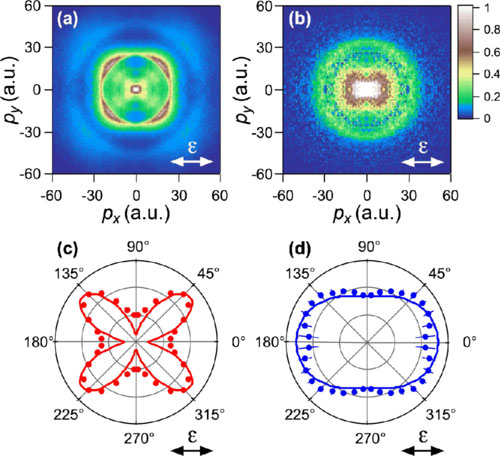 |
|
| Fig.1. Momentum distribution of N+ ions for an initial NO molecule in the ground (a and c) and excited (b and d) electronic states. The points denote the experimental results. The solid lines are the results of theoretical calculations. (Image courtesy of the author of the paper) | |
| From this image, the scientists were able to track the dependence of the rate of tunneling ionization on the orientation of the molecule with respect to the laser polarization direction. It was found that in the ground state of the molecule, tunneling ionization is most likely to occur when the axis of the molecule is at an angle of 45° to the direction of the oscillation of the electric field, and in the excited state the distribution is almost isotropic, i.e. the same in all directions (Fig.1). The results of the experiment are consistent with the predictions of the weak-field asymptotic theory of tunneling ionization. | |
| The good agreement between the experimental results and the theoretical calculations, and the high time resolution suggest that the method could potentially be used to visualize molecular configurations in real time, which means they could be observed dynamically and controlled effectively. | |
| Photoelectron holography | |
| The second paper is purely theoretical. It examines the development of a new method that enables scientists to “extract” structural information from spectra of photoelectron scattering in tunneling ionization of an atom or molecule. The numerical experiment is similar to the real experiment conducted with nitric oxide: the atom is irradiated with a strong femtosecond laser pulse. But instead of a momentum distribution of N+ ions, the scientists studied an interference pattern of photoelectrons that had tunneled from the outer shell of the atom. | |
| Certain ionized electrons ultimately have the same momentum and this means that they are able to interfere. The time in which the photoelectrons are able to fly “back and forth” in a laser field and return for rescattering on the parent ion is comparable with the length of the optical cycle of the laser (a few femtoseconds). However, the observed interference pattern has a much narrower “time” structure – it encodes processes that last for attoseconds. This means that it is possible to observe what happened with an atom or a molecule in the time between the tunneling of an electron and its return to the ion with attosecond resolution. | |
| Previously, scientists demonstrated that the momentum distribution in an experiment with tunneling ionization contains a stable interference structure that must store information about the composition of the parent ion (Science, „Time-Resolved Holography with Photoelectrons”). This structure was called a photoelectron hologram, similar to an optical hologram. However, precisely what structural information is encoded in the hologram and how to decode it from there was still a puzzle. Oleg Tolstikhin and his colleagues from China and Japan provided an answer to both of these questions. | |
| Optical holography allows you to reconstruct three-dimensional images of objects. The physical basis of the method is to record an interference pattern of waves coming from a source (reference wave) and reflected off an object (object wave). The structural features of the object alter the phase of the object wave, and the interference pattern stores this information – the volume and “structure” of the object recorded on the hologram. | |
| In photoelectron holography, instead of a reference wave there are electrons that fly directly to a detector after the process of tunneling ionization. And the object wave corresponds to electrons that, on their way to the detector, are first scattered on the parent ion. It was found that the hologram encodes information on the phase of the elastic scattering amplitude of the electron on the ion. This phase can be used to restore the structure of the ion. The results of the numerical calculations very well agree with the predictions of the adiabatic theory, which confirms the validity of the theoretical conclusions made. | |
| “In our study, we consider a model atom with one electron – but this is only to simplify the calculations. We demonstrate the principle of extracting the phase of the complex scattering amplitude from the photoelectron momentum distributions and this procedure should apply to all atoms and molecules,” says Oleg Tolstikhin commenting on the study. |
| Source: Moscow Institute of Physics and Technology | |
| Subscribe to a free copy of one of our daily Nanowerk Newsletter Email Digests with a compilation of all of the day’s news. |
Read more: Tunneling ionization helps scientists to track ultrafast changes in molecules