
Will TALOS (Tactical Assault Light Operator Suit)-Outfitted Future Soldiers Get Lightweight Abalone Shell-Based Flexible Scalar Biomimetic Metal Foam, Carbyne (Linear Acetylenic Carbon) and/or Multilayer Graphene Ballistic Armor Composites?
October 11, 2016
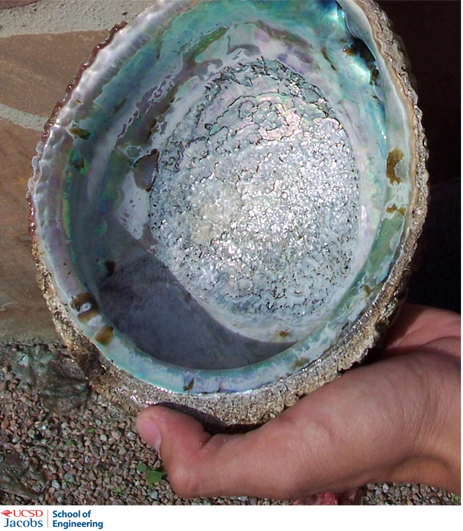 DefenseReview (DR) has been writing about TALOS (Tactical Assault Light Operator Suit)-related technologies lately, but we haven’t yet addressed the combat body armor component, yet. It would seem possible that abalone shell-based lightweight metal foam, flexible scalar biomimetic carbyne (linear acetylenic carbon) and/or multilayer graphenecomposites (perhaps combined with ballistic fiber and/or ceramic composites) may eventually prove to be a viable solution for future body armor and vehicle armor, which would be good new for TALOS. TALOS’ ballistic armor is obviously going to be an important component of the overall system.
DR found the UC San Diego Jacobs school of Engineering piece Uncovering the Secrets of Abalone Body Armor to be some pretty interesting reading to go along with NewAtlas’ metal foam piece, and we wonder if those two technologies can be integrated with carbyne and/or graphene. According to ExtremTech, carbyne’s essentially an “indefinitely long chain of carbon atoms that are joined together by sequential double bonds or alternating single and triple bonds (a polyyne)”. Carbyne’s about two times stronger than graphene and carbon nanotubes.
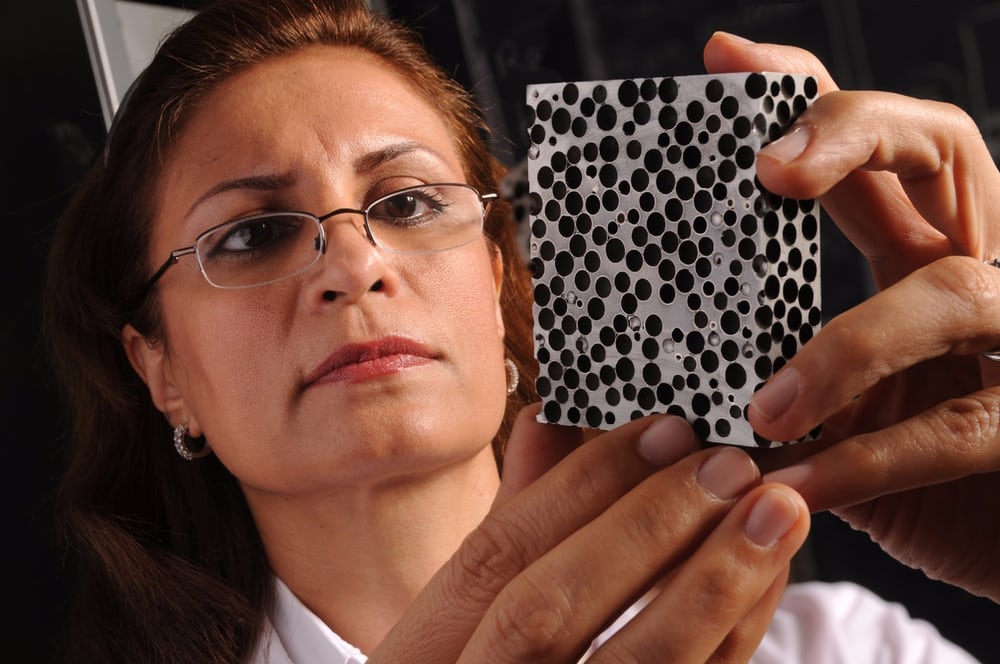
DR is fairly familiar with multilayer graphene, which is mechanically drawn from bulk graphite sheets. A group of scientists out of Rice University and the University of Massachussetts (Jae-Hwang Lee, Phillip E. Loya, Jun Lou, and Edwin L. Thomas) published a paper on the theoretical/devvelopmental multilayer graphen ballistic armor tech in late 2014, and it’s definitely intriguing. Apparently, graphene absorbes kinetic energy ten (10) times better than steel, although we haven’t seen any mention yet of how graphene stacks up against aramid fibers (like DuPont Kevlar), ceramic hard armor, etc. Regardless carbyne is even better, significantly better. Metal Foam may eventually prove to be the best future ballistic armor technology yet, as it can reportedly obliterate/vaporize bullets.
 It should be noted that to our knowledge, graphene of up to 300 layers and 100 nanometers thick has only taken microbullet hits. Microbullets are microscopic spheres travelling at very high speed. The bad news is that the 3.7 micron spheres punctured the graphene barrier every time. The good news, however, is that the spheres “left a fractured pattern of ‘petals’ around the point of impact, indicating the graphene stretched before breaking, which is supposed to be promising, since it shows that the microbullet’s energy is distributed over a wide area of the graphene material, despite the puncture. So, DR’s very interesting in seeing what carbyne can handle with regard to ballistic projectiles.
Obviously, the lighter TALOS’ ballistic armor can be made the better, despite TALOS’ electric/hydraulic-powered exoskeleton component. Lighter’s ALWAYS better, when it comes to military mobile infantry and Special Operations Forces (SOF) hardware. The question is, will TALOS’-viable carbyne and/or multilayer graphene composite ballistic armor eventually offer anti-rifle protection, specifically against various 7.62x39mm Russian and 7.62x54R Russian rounds? DR doesn’t know, but we DO know that we’re excited to find out. We’re also curious if the proposed graphene-infused spider-silk composite tech has ballistic armor application.
Defense Review is really intrigued by the prospect of TALOS-outfitted future soldiers getting abalone shell-based flexible scalar biomimetic ballistic/body armor, similar in concept to the fish-scale-format ballistic armor DR discussed back in 2008. That would be pretty awesome. Oh, and if the armor can float, even better. Perhaps metal-foam ballistic armor composites can help with that. Then again, perhaps not. We’ll have to ask professor of mechanical and aerospace engineering Afsaneh Rabiei at NC State about that.
Organization Contact Info:
Rex Graham
Jacobs School of Engineering
UC San Diego
Phone: 858-822-3075
Email: [email protected]
Website: http://jacobsschool.ucsd.edu