Noul aerogel de argint nanofire de argint este un avantaj pentru industria energetică și electronică(New ultralight silver nanowire aerogel is boon for energy and electronics industries)

Spumele metalice (sau metalele poroase) reprezintă o nouă clasă de materiale cu proprietăți unice, inclusiv o suprafață ușoară, suprafață mare, conductivitate electrică ridicată și conductivitate termică scăzută. Cercetătorii Laboratorului Național Lawrence Livermore (LLNL) au creat un nou aerogel de ultrasunete de nanoparticule de argint, care ar putea duce la avansarea celulelor de combustie, a stocării energiei, a dispozitivelor medicale și a electronicii.

Posted: Oct 06, 2017

New ultralight silver nanowire aerogel is boon for energy and electronics industries

(Nanowerk News) Metal foams (or porous metals) represent a new class of materials with unique properties including lightweight, high surface area, high electrical conductivity and low thermal conductivity. Lawrence Livermore National Laboratory (LLNL) researchers have created a new ultralight silver nanowire aerogel that could lead to advances in fuel cells, energy storage, medical devices and electronics.

It is so light that it could lay on a fragile rosebud without the flower wilting.
ultralight silver nanowire aerogel on rosebud
A new ultralight silver nanowire aerogel developed by Lawrence Livermore National Laboratory scientist is so light that it could lay on a fragile rosebud without the flower wilting. (Image: LLNL)
But conventional methods of creating these foams require demanding manufacturing conditions including high temperature, high pressure and/or strict oxygen exclusion. In some cases, they are not scalable for mass production. Using nanowires as building blocks, the fabrication of silver aerogels doesn’t have these limitations. In addition, the new silver aerogels have tunable densities, controlled pore structures, improved electrical conductivity and mechanical properties, making it attractive for practical applications.
„The high porosity and excellent mechanical/electrical properties of these silver nanowire aerogels may lead to enhanced device performance and open up new possibilities in fuel cells, energy storage, medical devices, catalysis and sensors,” said Fang Qian, lead author of the paper in the most recent online edition of Nano Letters („Ultralight Conductive Silver Nanowire Aerogels”), which also will be featured as the journal cover in the December issue.
A scanning electron microscope image of a typical silver aerogel
A scanning electron microscope image of a typical silver aerogel. (Image: LLNL)
The new method for fabricating these ultralight, conductive silver aerogels utilizes assemblies of LLNL-made silver nanowires, which can result in low-density monoliths (4.8 mg/cc) that can conform to various geometries. Silver nanowire building blocks were prepared by polyol synthesis and purified by selective precipitation. Silver aerogels were produced by freeze-casting nanowire aqueous suspensions followed by thermal sintering to weld the nanowire junctions.
„We are able to make these ultra-lightweight silver aerogels because the quality of our silver nanowires is extremely high,” said Yong Han, principal investigator of the project. „The custom feedstock synthesis capabilities we have at the Lab allow us to create such materials with demanding specifications for diverse application.”
Source: Lawrence Livermore National Laboratory

Nanomaterialul nou poate extrage combustibil hidrogen din apa de mare(New nanomaterial can extract hydrogen fuel from seawater)

nou nanomaterial hibrid care utilizează energia solară și îl folosește pentru a genera hidrogen din apa de mare mai ieftin și mai eficient decât materialele curente.
Descoperirea ar putea duce într-o zi la o nouă sursă de carburant curat, ar ușura cererea de combustibili fosili și va stimula economia din Florida, unde soarele și apa de mare sunt abundente.producerea unui combustibil chimic din energia solară este o soluție mai bună decât producerea energiei electrice din panourile solare, a spus el. Această energie electrică trebuie utilizată sau stocată în baterii care se degradează, în timp ce gazul hidrogen este ușor de depozitat și transportat.

Posted: Oct 04, 2017

New nanomaterial can extract hydrogen fuel from seawater

(Nanowerk News) It’s possible to produce hydrogen to power fuel cells by extracting the gas from seawater, but the electricity required to do it makes the process costly. UCF researcher Yang Yang has come up with a new hybrid nanomaterial that harnesses solar energy and uses it to generate hydrogen from seawater more cheaply and efficiently than current materials.

The breakthrough could someday lead to a new source of the clean-burning fuel, ease demand for fossil fuels and boost the economy of Florida, where sunshine and seawater are abundant.
Yang, an assistant professor with joint appointments in the University of Central Florida’s NanoScience Technology Center and the Department of Materials Science and Engineering, has been working on solar hydrogen splitting for nearly 10 years.
It’s done using a photocatalyst – a material that spurs a chemical reaction using energy from light. When he began his research, Yang focused on using solar energy to extract hydrogen from purified water. It’s a much more difficulty task with seawater; the photocatalysts needed aren’t durable enough to handle its biomass and corrosive salt.
hybrid nanomaterial photocatalyst that's able to generate solar energy and extract hydrogen gas from seawater
Artist’s conceptualization of the hybrid nanomaterial photocatalyst that’s able to generate solar energy and extract hydrogen gas from seawater. (Image: University of Central Florida)
As reported in the journal Energy & Environmental Science („MoS2/TiO2 Heterostructures as Nonmetal Plasmonic Photocatalysts for Highly Efficient Hydrogen Evolution”), Yang and his research team have developed a new catalyst that’s able to not only harvest a much broader spectrum of light than other materials, but also stand up to the harsh conditions found in seawater.
„We’ve opened a new window to splitting real water, not just purified water in a lab,” Yang said. „This really works well in seawater.”
Yang developed a method of fabricating a photocatalyst composed of a hybrid material. Tiny nanocavities were chemically etched onto the surface of an ultrathin film of titanium dioxide, the most common photocatalyst. Those nanocavity indentations were coated with nanoflakes of molybdenum disulfide, a two-dimensional material with the thickness of a single atom.
Typical catalysts are able to convert only a limited bandwidth of light to energy. With its new material, Yang’s team is able to significantly boost the bandwidth of light that can be harvested. By controlling the density of sulfur vacancy within the nanoflakes, they can produce energy from ultraviolet-visible to near-infrared light wavelengths, making it at least twice as efficient as current photocatalysts.
„We can absorb much more solar energy from the light than the conventional material,” Yang said. „Eventually, if it is commercialized, it would be good for Florida’s economy. We have a lot of seawater around Florida and a lot of really good sunshine.”
In many situations, producing a chemical fuel from solar energy is a better solution than producing electricity from solar panels, he said. That electricity must be used or stored in batteries, which degrade, while hydrogen gas is easily stored and transported.
Fabricating the catalyst is relatively easy and inexpensive. Yang’s team is continuing its research by focusing on the best way to scale up the fabrication, and further improve its performance so it’s possible to split hydrogen from wastewater.
Source: University of Central Florida

Metoda nouă pentru regenerarea țesuturilor, inspirată de natură(New method for tissue regeneration, inspired by nature)

au gasit o modalitate de imitare a procesului nostru natural de vindecare a organismului, folosind particule nanometrice derivate din celule numite vezicule, pentru a repara tesutul deteriorat.Această soluție nouă oferă toate avantajele terapiilor bazate pe celule, dar fără a utiliza celule viabile, prin valorificarea capacității regenerative a particulelor de dimensiuni nanofilice numite vezicule extracelulare care sunt generate în mod natural în timpul formării osoase.

Posted: Oct 03, 2017

New method for tissue regeneration, inspired by nature

(Nanowerk News) Scientists have found a way of mimicking our body’s natural healing process, using cell derived nano-sized particles called vesicles, to repair damaged tissue.

The paper, published in Scientific Reports („Annexin-enriched osteoblast-derived vesicles act as an extracellular site of mineral nucleation within developing stem cell cultures”), describes a new approach to bone regeneration; stimulating cells to produce vesicles which can then be delivered to facilitate tissue regeneration.
The research team, led by the University of Birmingham, believe that the findings mark the first step in a new direction for tissue regeneration with the potential to help repair bone, teeth and cartilage.
Fracture numbers are expected to double by 2020, putting tremendous strain on healthcare-systems worldwide. Osteoporosis-fragility fractures alone represent a cost of £1.5 billion to the NHS, and for individuals it can have a detrimental impact on quality of life.
Current approaches have significant limitations; autologous grafts cannot meet demand and cause patient morbidity, allogeneic bone lacks bioactive factors, and growth factor-based approaches (e.g. BMP-2) may have serious side-effects and high costs.
Consequently, there is a considerable need to devise new methods for the generation of large volumes of bone without associated patient morbidity.
In recent years, attention has been focused on cell-based approaches. However, translation is frequently prevented by insurmountable regulatory, ethical and economic issues.
This novel solution delivers all the advantages of cell-based therapies but without using viable cells, by harnessing the regenerative capacity of nano-sized particles called extracellular vesicles that are naturally generated during bone formation.
Excitingly, the team have shown in-vitro that if extracellular vesicles are applied in combination with a simple phosphate the therapy outperforms the current gold standard, BMP-2.
Dr Sophie Cox, from the School of Chemical Engineering at the University of Birmingham, explained, „Though we can never fully mimic the complexity of vesicles produced by cells in nature, this work describes a new pathway harnessing natural developmental processes to facilitate hard tissue repair.”
Dr Owen Davies, EPSRC E-TERM Landscape Fellow at the University of Birmingham and Loughborough University, added, „It is early days, but the potential is there for this to transform the way we approach tissue repair. We’re now looking to produce these therapeutically valuable particles at scale and also examine their capacity to regenerate other tissues.”

Stratul de electrozi preparat din carbon activ (din frunze de ceai) îmbunătățește performanța celulelor de combustibil cu 33%(Electrode layer prepared from activated carbon (from tea leaves) enhances fuel cell performance by 33%)

Celulele de combustibil sunt considerate tehnologii energetice promițătoare ale viitorului, deoarece ele ajută la producerea de energie durabilă prin utilizarea de hidrocarburi ca și combustibili, cum ar fi metanolul, etanolul, acetona etc. prin mecanismul simplu de reacție de reducere a oxidării. Prin urmare, găsesc utilizarea lor în încărcătoare laptop, aplicații militare, în cazul în care accesul la energie electrică este dificil.Acest cadru utilizat în combinație cu negrul de fum convențional din stratul de difuzie a gazului catodic, a demonstrat că îmbunătățește performanța celulelor de combustibil cu 33% în condițiile de funcționare a celulelor de combustie cu metanol.

Posted: Oct 03, 2017

Electrode layer prepared from activated carbon (from tea leaves) enhances fuel cell performance by 33%

(Nanowerk Spotlight) Fuel cells are considered as promising energy technology of the future, as they aid in production of sustainable energy using hydrocarbons as fuels, such as methanol, ethanol, acetone etc by simple oxidation-reduction reaction mechanism. Hence find their use in laptop chargers, military applications, where the access to electricity is difficult.
However the wider spectrum of commercial perspective of methanol systems is greatly hindered by the mass transport phenomenon occurring in the electrode area of a fuel cell.
In a fuel cell, methanol undergoes oxidation on anode side, liberating protons and electrons. Electrons travel through external circuit and protons travel through membrane and reach the cathode side. On the cathode side, air undergoes reduction on cathode side, utilizing electrons and protons from anode reaction to form water.
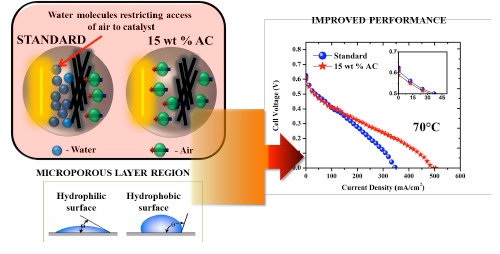
This water, where the rate of formation is high at high current density regions covers the catalyst sites and prevents the incoming the air stream from further accession. This phenomenon – called ‘flooding’ – limits the operation of fuel cells at high current density regions. This is mitigated by optimising pore characteristics of carbon materials used in the gas diffusion layer of membrane electrode assembly (MEA) of a fuel cell.
MEA of a fuel cell consists of gas diffusion layer, catalyst layer and the membrane, all sandwiched together, with each layer playing a prominent role. The gas diffusion layer aids in effective reactant transport, catalyst layer in oxidation/reduction reaction and the membrane layer in transport of protons from anode to the cathode.
Schematic illustration of impact of using activated carbon (AC) in the gas diffusion layer comparable to standard (STD) MEA
Figure 1: Schematic illustration of impact of using activated carbon (AC) in the gas diffusion layer comparable to standard (STD) MEA. (Image: University of Manchester)
The mass transport limitation is addressed by working on the pore structure of carbon materials. Several carbon blacks: Vulcan XC-72, Ketjen Black, Acetylene Black Asbury 850, Denka Black and Mogul L are used widely. In addition to the performance limitation, the precursor for these carbon materials comes from the treatment of hydrocarbons at high temperature and pressure conditions.
In this work, reported in Electrochimica Acta („Enhanced performance based on a hybrid cathode backing layer using a biomass derived activated carbon framework for methanol fuel cells”), Manchester University chemical engineering researchers Prabhuraj Balakrishnan and Stuart M. Holmes prepared an activated carbon framework from tea leaves, obtained from the Black sea region of Tukey (from Ankara University) collaborators.
This framework used in combination with conventional carbon black in the cathode gas diffusion layer, has shown to improve the fuel cell performance by 33% in methanol fuel cell operating conditions.
More specifically, the cell performance underwent drastic changes in the mass transport region of the fuel cell polarization curve (Figure 1), comparable to the standard MEA. This is attributed to the pore structure (75.69% of mesopores and 24.31% of micropores) of this framework aiding in enhanced water removal, as a result more air molecules react with the platinum catalyst sites finally improving the fuel cell performance.
On increasing the composition of this activated carbon framework in the gas diffusion layer, the performance declined due to the poor electrical conductivity of the carbon. This shows that if the electrical conductivity of this activated carbon framework could be improved, this would decrease the reliance on conventional carbon blacks which currently suffers from source material (hydrocarbon) availability in addition to improving performance.
Provided by The University of Manchester as a Nanowerk exclusive