
| Posted: Jan 31, 2018 | |
Skin-inspired graphene oxide based coating that’s as hard as teeth and can heal itself(Nanowerk News) Self-healing smart coatings could someday make scratches on cell phones a thing of the past. But researchers often have to compromise between strength and the ability to self-repair when developing these materials. |
|
| Now, one group reports in ACS Nano („An Epidermis-like Hierarchical Smart Coating with a Hardness of Tooth Enamel”) the development of a smart coating that is as hard as tooth enamel on the outside but can heal itself like skin can. | |
 |
|
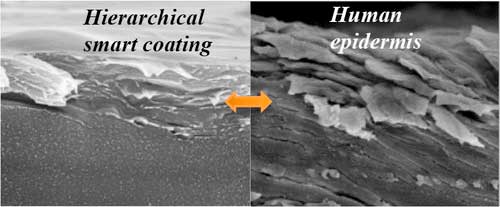
| A quasi-linear layer-by-layer (LBL) film with constituent graphene oxide is deposited on top of an exponential LBL counterpart as a protective hard layer, forming a hierarchical stratified assembly mimicking the structure of epidermis. (© ACS) | |
| The smart coating market is a booming industry and is only expected to grow in upcoming years. The most common smart coatings that can heal themselves are based on soft polymers that can wear out quickly. But hard coatings can be too rigid to come back together to fix a tear or scratch. | |
| In previous research, Ming Yang and colleagues produced a stiffer, more healable coating, but its performance still needs to be optimized. In the current paper, the researchers developed a different way to make a soft, yet hard, self-healing material. | |
| Mimicking the structure of human skin, the researchers used a layer-by-layer technique to form a soft, dynamic under layer containing polyvinyl alcohol and tannic acid. The hard outer layer contained these compounds plus a layer of graphene oxide. When fabricated at a certain thickness, the material successfully healed itself when cut, and it also could kill bacteria. | |
| The material could someday serve as an electronic skin or even as a scratch-proof coating on buildings or phones. |
| Source: American Chemical Society |