Chimistii folosesc elemente abundente, ieftine si non-toxice pentru a sintetiza semiconductori(Chemists use abundant, low-cost and non-toxic elements to synthesize semiconductors)

Ei au venit cu un compus care conține sodiu, care este ieftin și abundent; bismut, care este relativ redus, dar este supraprodus în timpul mineritului altor metale și este ieftin; și sulf, cel de-al cincilea element cel mai comun pe Pământ. Cercetatorii raporteaza descoperirea lor intr-un document publicat recent de catre Journal of the American Chemical Society ( „Solutia crescuta de sodiu Bismuth Dichalcogenides: spre pamant-abundente, Biocompatible Semiconductors” ).
„Sinteza noastră declanșează o nouă clasă de semiconductori ternari (cu trei părți) cu costuri scăzute și ecologice, care arată proprietățile de interes pentru aplicațiile în conversia energiei”, scrie chimistul în lucrare.

Posted: Mar 14, 2018

Chemists use abundant, low-cost and non-toxic elements to synthesize semiconductors

(Nanowerk News) One of the problems for Javier Vela and the chemists in his Iowa State University research group was that a toxic material worked so well in solar cells.

And so any substitute for the lead-containing perovskites used in some solar cells would have to really perform. But what could they find to replace the perovskite semiconductors that have been so promising and so efficient at converting sunlight into electricity?
What materials could produce semiconductors that worked just as well, but were safe and abundant and inexpensive to manufacture?
“Semiconductors are everywhere, right?” Vela said. “They’re in our computers and our cell phones. They’re usually in high-end, high-value products. While semiconductors may not contain rare materials, many are toxic or very expensive.”
Vela, an Iowa State associate professor of chemistry and an associate of the U.S. Department of Energy’s Ames Laboratory, directs a lab that specializes in developing new, nanostructured materials. While thinking about the problem of lead in solar cells, he found a conference presentation by Massachusetts Institute of Technology researchers that suggested possible substitutes for perovskites in semiconductors.
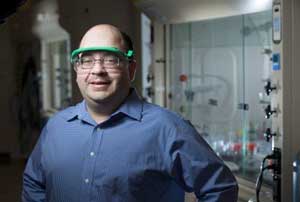
Javier Vela
Javier Vela and the chemists in his research group have been working to produce semiconductors from materials that are safe, abundant and inexpensive to manufacture. (Image: Iowa State University)
Vela and Iowa State graduate students Bryan Rosales and Miles White decided to focus on sodium-based alternatives and started an 18-month search for a new kind of semiconductor. The work was supported by Vela’s five-year, $786,017 CAREER grant from the National Science Foundation. CAREER grants are the foundation’s most prestigious awards for early career faculty.
They came up with a compound that features sodium, which is cheap and abundant; bismuth, which is relatively scarce but is overproduced during the mining of other metals and is cheap; and sulfur, the fifth most common element on Earth. The researchers report their discovery in a paper recently published online by the Journal of the American Chemical Society („Solution-Grown Sodium Bismuth Dichalcogenides: Toward Earth-Abundant, Biocompatible Semiconductors”).
“Our synthesis unlocks a new class of low-cost and environmentally friendly ternary (three-part) semiconductors that show properties of interest for applications in energy conversion,” the chemists wrote in their paper.
In fact, Rosales is working to create solar cells that use the new semiconducting material.
Vela said variations in synthesis – changing reaction temperature and time, choice of metal ion precursors, adding certain ligands – allows the chemists to control the material’s structure and the size of its nanocrystals. And that allows researchers to change and fine tune the material’s properties.
Several of the material’s properties are already ideal for solar cells: The material’s band gap – the amount of energy required for a light particle to knock an electron loose – is ideal for solar cells. The material, unlike other materials used in solar cells, is also stable when exposed to air and water.
So, the chemists think they have a material that will work well in solar cells, but without the toxicity, scarcity or costs.
“We believe the experimental and computational results reported here,” they wrote in their paper, “will help advance the fundamental study and exploration of these and similar materials for energy conversion devices.”
Source: Iowa State University

Turbocompresoare cu un catalizator multifuncțional de nanotehnologie(Turbocharging fuel cells with a multifunctional nanotechnology catalyst)

Catalizator de 8 ori mai repede
Catalizatorul obține eficiența prin ruperea oxigenului printr-un sistem cu celule de combustibil. „Este de peste opt ori mai rapid decât materialele de ultimă oră care fac același lucru acum”, a declarat Yu Chen, un asociat de cercetare postdoctorală în laboratorul lui Liu și primul autor al studiului.
Există câteva tipuri de celule de combustie, dar cercetătorii au lucrat pentru a îmbunătăți celulele de combustie cu oxizi solizi, care se găsesc în unele automobile prototipice cu celule de combustibil. Perspectivele cercetării ar putea, de asemenea, ajuta la honuirea supercapacitorilor și a tehnologiei asociate panourilor solare, avansând astfel energia durabilă dincolo de potențialul imediat al catalizatorului de a îmbunătăți celulele de combustie.

Posted: Mar 14, 2018

Turbocharging fuel cells with a multifunctional nanotechnology catalyst

(Nanowerk News) Powering clean, efficient cars is just one way fuel cell technology could accelerate humanity into a sustainable energy future, but unfortunately, the technology has been a bit sluggish. Now, engineers may be able to essentially turbocharge fuel cells with a new catalyst.

The sluggishness comes from a chemical bottleneck, the rate of processing oxygen, a key ingredient that helps fuel cells, which are related to batteries, produce electricity. The new catalyst, a nanotechnology material developed by engineers at the Georgia Institute of Technology, markedly speeds up oxygen processing and is the subject of a new study (Joule, „A Highly Efficient Multi-phase Catalyst Dramatically Enhances the Rate of Oxygen Reduction”).
Partly to accommodate oxygen’s limitations, fuel cells usually require pure hydrogen fuel, which reacts with the oxygen taken in from the air, but the costs of producing the hydrogen have been prohibitive. The new catalyst is a potential game-changer.
fuel cell catalyst, a coating only about two dozen nanometers thic
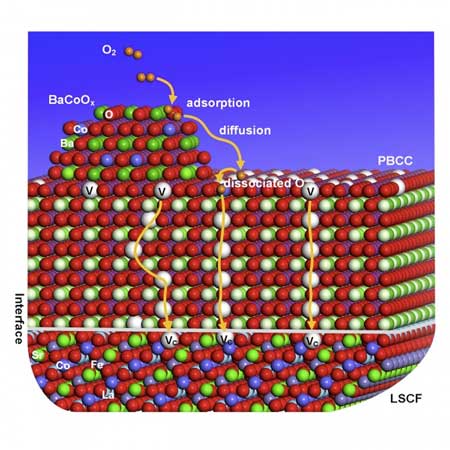
The new Georgia Tech fuel cell catalyst, a coating only about two dozen nanometers thick, works in two phases. First, the nanoparticles on top grab molecular oxygen from the air and make it very easy and tear apart into single oxygen ions. Then oxygen vacancies in the nanoparticle rapidly pass the oxygen ions to the second phase, a layer full of oxygen vacancies which shuttle the ions to their meeting with ionic hydrogen to complete the chemical process that powers fuel cells. (Image: Georgia Tech / Liu / Chen)
“It can easily convert chemical fuel into electricity with high efficiency,” said Meilin Liu, who led the study and is a Regents’ Professor in Georgia Tech’s School of Material Science and Engineering. “It can let you use readily available fuels like methane or natural gas or just use hydrogen fuel much more efficiently,” Liu said.

Catalyst 8 times as fast

The catalyst achieves the efficiency by rushing oxygen through a fuel cell’s system. “It’s more than eight times as fast as state-of-the-art materials doing the same thing now,” said Yu Chen, a postdoctoral research associate in Liu’s lab and the study’s first author.
There are a few types of fuel cells, but the researchers worked to improve solid oxide fuel cells, which are found in some prototypical fuel cell cars. The research insights could also aid in honing supercapacitors and technology paired with solar panels, thus advancing sustainable energy beyond the new catalyst’s immediate potential to improve upon fuel cells.

Naturally sluggish oxygen

Though they work differently from fuel cells and are much less efficient and clean, combustion engines make a useful metaphor to aid in understanding how fuel cells and the new catalyst work.
In a combustion engine, fuel from a tank and oxygen from the air come together to react in an explosion, producing energy that turns a crankshaft. Adding a turbocharger speeds the process up by mixing fuel and oxygen together more quickly and rushing them to combustion.
Currently, in fuel cells, hydrogen fuel from a tank and oxygen from the air also drive a process that produces energy, in this case, electricity. The two ingredients do come together in a reaction, but one very different from combustion, and much cleaner.
One end of the fuel cell, the anode, removes electrons from the hydrogen atoms in what’s called oxidation and sends the electrons through an external circuit as electric current to the cathode on the other side. There, oxygen, which is notoriously electron hungry, sucks the electrons up in what’s called reduction, and that keeps the electricity flowing.
The hydrogen, now positively charged, and the oxygen, now negatively charged, meet up to form water, which is the fuel cell’s exhaust.
In that reaction chain, oxygen is the slow link in two ways: Oxygen’s reduction takes longer than hydrogen’s oxidation, and the reduced oxygen moves more slowly through the system to meet with hydrogen. Analogous to the turbocharger, the new catalyst pushes the oxygen forward.
A simple diagram depicts the basic functioning of a solid oxide fuel cell
A simple diagram depicts the basic functioning of a solid oxide fuel cell. (Image: The National Museum of American History)

Oxygen rush nanotechnology

The catalyst is applied as a sheer coating only about two dozen nanometers thick and is comprised of two connected nanotechnology solutions that break both oxygen bottlenecks.
First, nanoparticles highly attractive to oxygen grab the O2 molecule and let inflowing electrons quickly jump onto it, easily reducing it and tearing it into two separate oxygen ions (each one an O2-). Then a series of chemical gaps called oxygen vacancies that are built into the nanoparticles’ structures suck up the oxygen ions like chains of vacuum cleaners passing the ions hand to hand to the second phase of the catalyst.
The second phase is a coating that is full of oxygen vacancies that can pass the O2- even more rapidly toward its final destination.
“The oxygen goes down quickly through the channels and enters the fuel cell, where it meets with the ionized hydrogen or another electron donor like methane or natural gas.”
The ions meet to make water, which exits the fuel cell. In the case of methane fuel, pure CO2 is also emitted, which can be captured and recycled back into fuel.

Interesting rare metals

In the first stage, there are two different flavors of nanoparticle at work. Both have cobalt, but one contains barium and the other praseodymium, a rare-earth metal that can be pricey in high quantities.
“Praseodymium is in such very small amounts that it doesn’t impact costs,” Liu said. “And the catalyst saves lots of money on fuel and on other things.”
High operating temperatures in existing fuel cells require expensive protective casings and cooling materials. The researchers believe the catalyst could help lower the temperatures by reducing electrical resistance inherent in current fuel cell chemistry. That could, in turn, reduce overall material costs.

Protective cathode coating

The second stage of the catalyst is a lattice that contains praseodymium and barium, as well as calcium and cobalt (PBCC). In addition to its catalytic function, the PBCC coating protects the cathode from degradation that can limit the lifetime of fuel cells and similar devices.
The underlying original cathode material, which contains the metals lanthanum, strontium, cobalt, and iron (LSCF), has become an industry standard but comes with a caveat.
“It’s very conductive, very good, but the problem is that strontium undergoes a diminishment called segregation in the material,” Liu said. “One component of our catalyst, PBCC, acts as a coating and keeps the LSCF a lot more stable.”
LSCF manufacturing is already well-established, and adding the catalyst coating to production could be likely reasonably achieved. Liu also is considering replacing the LSCF cathode completely with the new catalyst material, and his lab is developing a yet another catalyst to boost fuel oxidation reactions at the fuel cell’s anode.
Source: Georgia Tech

În căutarea unui fotocatalizator pentru a obține hidrogen din apă cu lumină vizibilă(In search of a photocatalyst to get hydrogen from water with visible light)

TiO 2 este un material cu proprietăți fotocatalizate unice și este aplicat în prezent în multe domenii ale tehnologiei. Una dintre principalele proprietăți pe care le are este capacitatea de a fotocataliza ruperea moleculei de apă pentru a obține o moleculă de hidrogen și oxigen molecular. Obiectivul principal al COMPHOCAT a fost de a studia proprietățile de TiO 2 la scară nanometrică și de a construi modele computaționale pentru a simula comportamentul nanoparticulelor care urmează să fie utilizate.

Posted: Mar 13, 2018

In search of a photocatalyst to get hydrogen from water with visible light

(Nanowerk News) Hydrogen is the cleanest potential fuel we have; the challenge is to get a clean process to stop using fossil fuels. The COMPHOCAT project, led by Professor Francesc Illas, director of the Institute of Theoretical and Computational Chemistry of the University of Barcelona (IQTCUB), has worked on the computational model of titanium dioxide nanoparticles (TiO2) to search for a catalyst which, with visible light, favours the division of water to generate hydrogen.

TiO2 is a material with unique photocatalysis properties and is now being applied to many areas of technology. One of the main properties it has is the ability to photocatalyse the breaking of the water molecule to obtain a hydrogen molecule and molecular oxygen. The main objective in COMPHOCAT was to study TiO2 properties at the nanoscale and build computational models to simulate the behaviour of the nanoparticles to be used.
titanium dioxide nanoparticles
Titanium dioxide nanoparticles.
“So far, it has not been possible to identify photocatalysts with activity in the area of visible light, which restricts our practical applications”, says Francesc Illas. “To get a photocatalyst to be practical –he continues- we need to get light in the ultraviolet range, where the TiO2 works better, or we should change the compound so that it has the same properties as visible light”. Illas believes the first option is ruled out “because we cannot get enough ultraviolet light from solar light, since the atmosphere absorbs this range’s light”. The second option –changing TiO2’s nanoparticles- is being studied at the IQTCUB.
The research team led by Illas is formed by the IQTCUB researchers Stefan Bromley (ICREA), Francesc Viñes, Kyoung Chul Co, Ángel Morales, Rosendo Valero, and the researchers in training Antoni Macià and Oriol Lamiel. These researchers created realists models of TiO2 nanoparticles in which they could study the electronic properties using models based on the density functional theory, and conducted precise calculations considering all electrons and adding relativist effects.
“Each particle’s geometry has been determined by the minimization of energy, a technique which is used to get the most stable atom distribution for a molecule”, says Illas. Electronic properties were studied as the function of the shape and size of the nanoparticle. “These TiO2 structure models allowed researchers build a database with nanoparticles which, if suitably modified, can lead to candidates with an absorption spectrum that works well with the window of visible light”, says the UB researcher.
The COMPHOCAT project was carried out thanks to the 52 million hours of calculation with the MareNostrum supercomputer from the Barcelona Supercomputingn Center (BSCN-CNS) given by the Partnership for Advanced Computing in Europe (PRACE). In order to continue with this study, PRACE platform gave the team led by Illas 40 million additional calculation hours for the new project EXCIPHOCAT, which will enable researcher characterize the compounds that were designed in this first stage.

Full bibliographic information

A. Morales-García, O. Lamiel-Garcia, R. Valero and F. Illas. “Properties of single oxygen vacancies on a realistic (TiO2)84 nanoparticle: a challenge for density functionals”. The Journal of Physical Chemistry C, January 2018. DOI: 10.1021/acs.jpcc.7b11269
F. Viñes, O. Lamiel-Garcia, F. Illas and S. T. Bromley. “Size dependent structural and polymorphic transitions in ZnO: from nanocluster to bulk”. Nanoscale, 2017. Doi: 10.1039/C7NR02818K
O. Lamiel-Garcia, K. C. Ko, J. Y. Lee, S. T. Bromley and F. Illas. “When anatase nanoparticles become bulk-like: properties of realistic TiO2 nanoparticles in the 1-6 nm size range from all electron relativistic density functional theory based calculations”. Journal of Chemical Theory and Computation, 2017. Doi: 10.1021/acs.jctc.7b00085
Source: Universidad de Barcelona

Cel mai bun pistol anti-război ACP / 45 (Walther PPQ 45 SD with Threaded Suppressor Barrel: Best Suppressed .45 ACP Combat/Tactical Pistol Out of the Box?)

Spre deosebire de pistoalele Walther PPQ și PPQ M2 de 9 mm, care necesită un arc diferit pentru utilizare suprimată și nefolosită, pistolul PPQ 45 SD poate utiliza același arc de recul pentru ambele, conform testelor lui Walther. Directorul de marketing Walther USA, Luke Thorkildsen, spune că PPQ 45 este „unul dintre cei mai puțini dintre cei 45 de ani care au fost acolo” și îl credem pentru că l-am împușcat.

Walther PPQ 45 SD with Threaded Suppressor Barrel: Best Suppressed .45 ACP Combat/Tactical Pistol Out of the Box? (Video!)

Last, but certainly not least among the latest Walther Arms pistols shown at SHOT Show 2018 (like the Walther PPQ M2 SC Sub-Compact and Walther PPS M2 SC with Shield RMSc) , DefenseReview (DR) got to view and handle the Walther PPQ 45 SD suppressed .45 ACP combat/tactical pistol with a .578×28 threaded suppressor barrel (4.875″). Unlike the Walther PPQ and PPQ M2 9mm pistols, which require different spring for suppressed and unsuppressed use, the PPQ 45 SD pistol can use the same recoil spring for both, according to Walther’s testing. Walther USA’s marketing director Luke Thorkildsen says the PPQ 45 is “one of the smoothest-shooting .45’s out there”, and we believe him, ’cause we’ve shot it.

While DR actually currently carries a Glock 19 (G19) 9mm, and is seriously considering acquiring the two new Walther 9mm pistols we’ve just covered (see article links above and below) for their out-of-the-box design and quality excellence, we’re also still big fans of the .45 ACP caliber, and the Walther PPQ 45 SDlooks like a winner, at least on paper. Ideally, however, we’d like to see a “SC” sub-compact variant of it (we believe the PPQ 45 is essentially already a compact .45, since it has a 4.25″ barrel) for concealed carry (CCW) and clandestine/covert military Special Operations Forces (SOF) applications, as the PPQ 45 SD isn’t exactly a small pistol.

Glock, of course, did something similar to this many years ago with the introduction of the Glock 30 (G30) and Glock 30S (G30S) .45 ACP compact pistols, which trimmed some size and weight off the original Glock 21 (G21).

DR assumes that Walther could use extended magazine base pads to lengthen the PPQ 45 SD’s grip, if necessary, just like they’ve done with the Walther PPQ M2 SC.

Regardless, the Walther PPQ 45 SD is a hell of a package as it stands, and Defense Review can’t wait to shoot it at the range. In the meantime, enjoy our video from Walther’s booth, below.


Company Contact Info:

Walther Arms (Walther USA)
7700 Chad Colley Blvd
Fort Smith, AR 72916
Phone: 479-242-8500 EXT. 507
Email: [email protected]
Website: http://www.waltherarms.com

SHIELD
PO Box 7633
Bridport, Dorset DT6 9DW,
United Kingdom
Phone: +44 (0)1297 678233
Email Contact Page: http://www.shieldpsd.com/pages/contact-us-2
Website: http://www.shieldpsd.com

O idee luminată pentru nanopatrerele la cerere(A bright idea for on-demand nanopatterns)

Proprietățile fotoluminiscente ale acestor modele ar putea deveni componente utile în aplicații precum biosenzori și celule solare.au exploatat proprietățile butilxanthatului de zinc rezistent pentru a produce linii de nanocristale ZnS cu diametre de sub 6 nanometri. Apoi, după ce au caracterizat structurile cu microscopie electronică, au făcut o altă descoperire serendipită – nanopatrele au emis lumină luminoasă fotoluminiscentă atunci când au fost expuse radiațiilor ultraviolete. Stările de degradare pe suprafețele nanocristale au fost identificate ca fiind cauza comportamentului optic nou.

Posted: Mar 09, 2018

A bright idea for on-demand nanopatterns

(Nanowerk News) An A*STAR team has assembled zinc sulfide (ZnS) quantum dots into nanoscale grids and arrays of lens-like disks by performing electron-beam lithography on a multipurpose thin film (ACS Nano, „Direct patterning of zinc sulfide on a sub-10 nanometer scale via electron beam lithography”). The photoluminescent properties of these patterns could make them useful components in applications such as biosensors and solar cells.

While individual ZnS nanoparticles have intriguing optical properties, due to the effects of quantum coupling, their light-emitting capabilities become more potent when positioned into ordered assemblies. Instead of conventional bottom-up approaches that use wet chemicals to generate nanoparticle ensembles on silicon chips, many researchers now approach this problem from the top down, using nanoscale lithography to strip away unwanted material and write quantum dots directly on to surfaces.
Light-emitting ZnS nanostructures
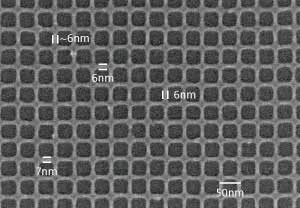
Light-emitting ZnS nanostructures can be patterned into nearly any shape, including grids as above, using a multipurpose photoresist. (© ACS)
Carving shapes into semiconductor surfaces smaller than 10 nanometers is a particular expertise of M. S. M. Saifullah from the A*STAR Institute of Materials Research and Engineering, and colleagues. They direct high-powered electron beams on to special thin films called ‘resists’. Areas of the resist exposed to the focused beams undergo chemical changes that enable tiny features to stay in place while the surrounding film is washed away by solvents.
In most electron-beam lithography techniques, the patterned resist is transferred to another substrate and a chemical etching step generates the final nanoscale shapes. Saifullah and the team, however, had a different strategy. “We developed a resist that can decompose and form a metal sulfide right under the electron beam,” he notes. “This was a challenge because most resists don’t have such functionalities.”
The team found a compound called zinc butylxanthate that could meet their needs. In this molecule, zinc and sulfur atoms are connected to long-chain organic groups that potentially can be detached using the energy from an electron beam. Experiments with the new resist proved the efficiency of this conversion process: by gradually increasing the electron beam exposure, the starting film was transformed into ZnS nanocrystals with a conversion rate of almost 100 per cent
The A*STAR-led researchers exploited the properties of the zinc butylxanthate resist to produce lines of ZnS nanocrystals with diameters as thin as 6 nanometers. Then, after characterizing the structures with electron microscopy, they made another serendipitous discovery — the nanopatterns emitted bright photoluminescent light when exposed to ultraviolet radiation. Defect states on the nanocrystal surfaces were pinpointed as the cause of the new optical behavior.
“The nice thing about photoluminescent ZnS nanocrystals is they can be arranged into practically any shape,” says Saifullah. “In the future, we would like to combine these nanostructures with plasmonics.”
Source: A*STAR