Graphene găsește o nouă aplicație ca colorant anti-static non-toxic(Graphene finds new application as non-toxic, anti-static hair dye)

Oamenii ar putea aplica acest colorant pentru a face părul conductiv la suprafață”, a spus Huang. „Acesta ar putea fi apoi integrat cu electronice portabile sau să devină o sondă conductivă. Suntem limitați doar de imaginația noastră „Echipa a utilizat grafenul super-material pentru a dezvolta un nou colorant pentru păr, care este non-toxic, nu dăunează și durează prin multe spălări fără să se estompeze. Grafenul conduce, de asemenea, natura deschiderii de noi oportunități pentru păr, cum ar fi transformarea acestuia în electrozi in situ sau integrarea acestuia cu dispozitive electronice portabile.

Posted: Mar 15, 2018

Graphene finds new application as non-toxic, anti-static hair dye

(Nanowerk News) It’s an issue that has plagued the beauty industry for more than a century: Dying hair too often can irreparably damage your silky strands.

Now a Northwestern University team has used materials science to solve this age-old problem. The team has leveraged super material graphene to develop a new hair dye that is non-toxic, non-damaging and lasts through many washes without fading. Graphene’s conductive nature also opens up new opportunities for hair, such as turning it into in situ electrodes or integrating it with wearable electronic devices.
The study was published by the journal Chem („Multifunctional Graphene Hair Dye”). Jiaxing Huang, professor of materials science and engineering in Northwestern’s McCormick School of Engineering, led the research.
Dying hair might seem simple and ordinary, but it’s actually a sophisticated chemical process. Called the cuticle, the outermost layer of a hair is made of cells that overlap in a scale-like pattern. Commercial dyes work by using harsh chemicals, such as ammonia and bleach, to first pry open the cuticle scales to allow colorant molecules inside and then trigger a reaction inside the hair to produce more color. Not only does this process cause hair to become more fragile, some of the small molecules are also quite toxic.
Huang and his team bypassed harmful chemicals altogether by leveraging the natural geometry of graphene sheets. While current hair dyes use a cocktail of small molecules that work by chemically altering the hair, graphene sheets are soft and flexible, so they wrap around each hair for an even coat. Huang’s formula also incorporates edible, non-toxic polymer binders to ensure that the graphene sticks – and lasts through at least 30 washes, which is the commercial requirement for permanent hair dye. An added bonus: graphene is anti-static, so it keeps winter-weather flyaways to a minimum.
“It’s similar to the difference between a wet paper towel and a tennis ball,” Huang explained, comparing the geometry of graphene to that of other black pigment particles, such as carbon black or iron oxide, which can only be used in temporary hair dyes. “The paper towel is going to wrap and stick much better. The ball-like particles are much more easily removed with shampoo.”
This geometry also contributes to why graphene is a safer alternative. Whereas small molecules can easily be inhaled or pass through the skin barrier, graphene is too big to enter the body. “Compared to those small molecules used in current hair dyes, graphene flakes are humongous,” said Huang, who is a member of Northwestern’s International Institute of Nanotechnology.
Ever since graphene – the two-dimensional network of carbon atoms – burst onto the science scene in 2004, the possibilities for the promising material have seemed nearly endless. With its ultra-strong and lightweight structure, graphene has potential for many applications in high-performance electronics, high-strength materials and energy devices. But development of those applications often require graphene materials to be as structurally perfect as possible in order to achieve extraordinary electrical, mechanical or thermal properties.
The most important graphene property for Huang’s hair dye, however, is simply its color: black. So Huang’s team used graphene oxide, an imperfect version of graphene that is a cheaper, more available oxidized derivative.
“Our hair dye solves a real-world problem without relying on very high-quality graphene, which is not easy to make,” Huang said. “I feel optimistic about this application.”
Still, future versions of the dye could someday potentially leverage graphene’s notable properties, including its highly conductive nature.
“People could apply this dye to make hair conductive on the surface,” Huang said. “It could then be integrated with wearable electronics or become a conductive probe. We are only limited by our imagination.”
So far, Huang has developed graphene-based hair dyes in multiple shades of brown and black. Next, he plans to experiment with more colors.
Source: By Amanda Morris, Northwestern University

Graphene oxide nanopheets ar putea ajuta aduce litiu-metal baterii la piață(Graphene oxide nanosheets could help bring lithium-metal batteries to market)

sub forma unei nanoplocuri acoperite cu oxid de grafena care, atunci cand sunt plasate intre cei doi electrozi ai unei baterii metal-litiu, previne placarea neuniforma a litiului și permite funcționarea în siguranță a bateriei pentru sute de cicluri de încărcare / descărcare;Arătăm că materialele bidimensionale de oxid de grafen sunt capabile să împiedice formarea dendritelor prin schimbarea vitezei de difuzie a litiu-ionului pe măsură ce trec prin straturile de oxid de grafen

Posted: Mar 15, 2018

Graphene oxide nanosheets could help bring lithium-metal batteries to market

(Nanowerk News) Lithium-metal batteries – which can hold up to 10 times more charge than the lithium-ion batteries that currently power our phones, laptops and cars – haven’t been commercialized because of a fatal flaw: as these batteries charge and discharge, lithium is deposited unevenly on the electrodes. This buildup cuts the lives of these batteries too short to make them viable, and more importantly, can cause the batteries to short-circuit and catch fire.

Now, researchers at the University of Illinois at Chicago have developed a solution to this problem in the form of a graphene-oxide coated ‘nanosheet’ that, when placed in between the two electrodes of a lithium-metal battery, prevents uneven plating of lithium and allows the battery to safely function for hundreds of charge/discharge cycles. They report their findings in the journal Advanced Functional Materials („Synergistic Effect of Graphene Oxide for Impeding the Dendritic Plating of Li”).
lithium electrode in a battery with a graphene oxide nanosheet separator
Left: Dendrites forming on a lithium electrode. Right: Lithium plates uniformly on a lithium electrode in a battery with a graphene oxide nanosheet separator. (Image: Reza Shahbazian-Yassar) (click on image to enlarge)
„Our findings demonstrate that two-dimensional materials – in this case, graphene oxide – can help regulate lithium deposition in such a way that extends the life of lithium-metal batteries,” said Reza Shahbazian-Yassar, associate professor of mechanical and industrial engineering in the UIC College of Engineering and corresponding author of the paper.
Lithium-metal batteries are so useful because of their high-energy density and relatively light weights compared with conventional batteries. However, over the course of many charge-discharge cycles, lithium builds up unevenly on the battery’s lithium metal electrode in a branching or ‘dendritic’ pattern and ultimately causes the battery to go dead. If the dendrites grow through the electrolyte solution and make contact with the other electrode, then the battery may experience a catastrophic event – in other words, an explosion or fire.
In lithium-ion batteries, a separator is placed in the electrolyte. Usually made of a porous polymer or glass ceramic fibers, the separator allows lithium ions to flow through while keeping the other components blocked to prevent electrical shorts, which can lead to fires.
Reza and colleagues used a modified separator in a lithium-metal battery to modulate the flow of lithium ions to control the rate of lithium deposition and see if they could prevent dendrites from forming. They spray-coated a fiberglass separator with graphene oxide, producing what they called a nanosheet.
Using scanning electron microscopy and other imaging techniques, the researchers showed that when the nanosheet was used in a lithium-metal battery, a uniform film of lithium formed on the lithium electrode’s surface, which actually improves battery function and makes the battery much safer, said Tara Foroozan, a graduate student in the UIC College of Engineering and first author on this study.
Molecular simulations, led by a team of researchers from Texas A & M University, suggested that the lithium ions become temporarily bonded to the graphene oxide, and then diffuse through areas of nanoscopic defects in the sheet. This delays the passage of lithium ions enough to prevent the formation of dendritic deposition of lithium on the electrode.
„The nanosheet slows the passage of lithium ions enough to allow for more uniform plating on lithium ions across the surface of the electrode, which helps preserve battery life,” said Reza.
Results of phase-field modeling computations led by Farzad Mashayek, professor and head of mechanical and industrial engineering in the UIC College of Engineering and an author on the paper, indicated that graphene oxide can also mechanically suppress the growth of lithium dendrites.
„We show that two-dimensional graphene oxide materials are able to impede the formation of dendrites by changing the rate of lithium-ion diffusion as they pass through the graphene oxide layers,” said Shahbazian-Yassar. „This method has very high potential for industrial application and scalability.”
Source: University of Illinois at Chicago

Frecvența pieptenează substanțele chimice de identificare în regiunea spectrală infraroșie mijlocie(Frequency combs ID chemicals within the mid-infrared spectral region)

Aceste lasere, numite piepteni de frecvență, „acționează ca” conducători „de lumină și au numeroase aplicații – de la transferarea standardelor de timp și îmbunătățirea semnalelor GPS la spectroscopia de precizie”Spectrele noastre multi-banda, controlate de utilizator si ingineri, sunt ideale pentru aplicatii in care se doreste operarea paralela cu multicomb, cum ar fi senzorii de punct pentru monitorizarea in timp real a sintezei chimice in situ, microscopia in apropierea campului si teledetectie „, a spus Nader. „Acești senzori pot crește semnificativ sensibilitatea detectării instrumentelor și tehnicilor, cum ar fi analizoarele de respirație, detectarea cancerului, urmărirea și detectarea explozivilor și monitorizarea sintezei drogurilor”.

Posted: Mar 15, 2018

Frequency combs ID chemicals within the mid-infrared spectral region

(Nanowerk News) Chemical compounds all carry distinctive absorption „fingerprints” within the mid-infrared spectral region of 2 to 12 microns. This offers an opportunity to measure and study chemicals at extremely sensitive levels but researchers lack the tools, like lasers and detectors, needed to operate within the mid-infrared. Recently, there’s been a push to develop new tools to help see and measure these chemical compounds in greater detail.

In a breakthrough, a group of researchers at the National Institute of Standards and Technology developed an on-silicon-chip laser source with outputs that consist of precisely defined and equally spaced optical lines within the mid-infrared spectral region. They report their findings in APL Photonics („Versatile silicon-waveguide supercontinuum for coherent mid-infrared spectroscopy”).
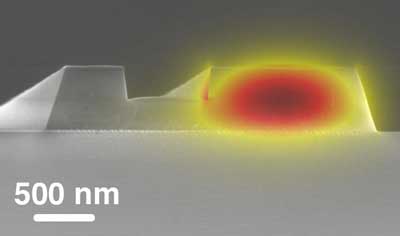
scanning electron micrograph of a fabricated photonic waveguide used in on-chip mid-infrared frequency comb lasers
The scanning electron micrograph of a fabricated photonic waveguide used in on-chip mid-infrared frequency comb lasers. (Image: National Institute of Standards and Technology, Applied Physics Division, Quantum Nanophotonics group)
These lasers, called frequency combs, „act as ‘rulers’ of light and have numerous applications – from transferring time standards and improving GPS signals to precision spectroscopy,” said Nima Nader, a postdoctoral researcher for NIST.
For spectroscopic applications, this type of coherent light source can pass through a sample cell containing unknown gases. These gases absorb some of the light and leave behind fingerprints on very specific comb lines. Researchers can check these lines against a database of gases to identify the specific chemicals present.
Beyond this, the coherent nature of the laser source „enables long-distance propagation of light so chemical samples can be studied remotely, without direct contact,” Nader said. „And since frequency combs are stabilized laser sources, they can detect very low levels of chemicals and enhance the sensitivity of our measurements.”
These sources are fabricated on a compact, silicon-based integrated photonics platform, which enables hundreds of devices – in this case, frequency combs – to be fabricated on a single small-area die.
„Each device is engineered to generate a mid-infrared spectrum of comblike optical lines with tailored spectral shape, bandwidth, and optical power distribution,” Nader said.
These laser sources are „as coherent and low-noise as conventional frequency combs developed prior to our work,” Nader said. „We also reported, for the first time, dual-comb spectroscopy of a gas sample with a mid-infrared frequency comb source that exploits a silicon-photonic platform.”
These developments improve conventional techniques such as Fourier-transform-infrared spectroscopy. A practical, broadband, low-noise mid-infrared frequency comb with moderate power and engineered spectrum may improve the frequency precision, sensitivity, and data acquisition rates of mid-infrared spectroscopy.
„Our user-controlled and engineered multiband spectra are ideal for applications in which parallel multicomb operation is desired – such as point sensors for real-time in situ chemical synthesis monitoring, near-field microscopy, and remote sensing,” Nader said. „These sensors can significantly increase the detection sensitivity of tools and techniques such as breath analyzers, cancer detection, explosives tracking and detection, and drug synthesis monitoring.”
The next step is to push the optical bandwidth of NIST’s frequency combs to longer infrared wavelengths and higher optical powers. „We’re also working to reduce their footprint and power consumption to create compact systems with improved efficiency,” Nader said.
Source: American Institute of Physics

Cadrele metalice-organice reduc consumul de energie al produselor petrochimice(Metal-organic frameworks cut energy consumption of petrochemicals)

) În industria chimică și petrochimică, separarea moleculelor într-un mod eficient din punct de vedere energetic este una dintre cele mai importante provocări. În ansamblu, procesele de separare reprezintă aproximativ 40% din energia consumată în industria petrochimică, iar reducerea acestora poate contribui la soluționarea emisiilor de carbon antropice.
Unul dintre cele mai importante produse din industria petrochimică este propilena, care este utilizată pe scară largă în fibre, spumă, materiale plastice etc. Propilena purificatoare necesită aproape întotdeauna separarea acesteia de propan. În prezent, acest lucru se face prin distilare criogenică, unde cele două gaze sunt lichefiate prin răcire la temperaturi sub zero. Acest lucru conferă procesului de separare propilen-propan o amprentă foarte mare de energie.
O soluție este utilizarea „cadrelor metalice-organice” (MOF). Acestea sunt polimeri cristalini porosi, realizați din noduri metalice care sunt legate între ele prin liganzi organici. Porii din structura lor moleculară permit MF să capteze moleculele atât de eficient încât sunt acum candidați primari în cercetarea privind captarea carbonului.

Posted: Mar 15, 2018

Metal-organic frameworks cut energy consumption of petrochemicals

(Nanowerk News) In the chemical and the petrochemical industries, separating molecules in an energy-efficient way is one of the most important challenges. Overall, the separation processes account for around 40% of the energy consumed in the petrochemical industry, and reducing this can help addressing anthropogenic carbon emissions.

One of the most important products in the petrochemical industry is propylene, which is widely used in fibers, foams, plastics etc. Purifying propylene almost always requires separating it from propane. Currently this is done by cryogenic distillation, where the two gases are liquefied by being cooled to sub-zero temperatures. This gives the propylene-propane separation process a very large energy footprint.
A solution is to use „metal-organic frameworks” (MOF’s). These are porous, crystalline polymers made of metal nodes that are linked together by organic ligands. The pores in their molecular structure allow MOFs to capture molecules so efficiently that they are now prime candidates in carbon-capture research.
Ultrathin MOF Membrane on Commercial Polymer Support
This is an ultrathin MOF membrane on commercial polymer support. (Image: K.V. Agrawal/EPFL)
In terms of separating molecules, MOF-based membranes are among the highest performers, and can carry out the propylene-propane separation at ambient temperature. One MOF called ZIF-8 (zeolitic imidazolium frameworks-8), allows propylene to diffuse through its pores 125 times more efficiently than propane at 30oC, offering high selectivity without the need for sub-zero temperatures.
„The main challenge with this approach is to synthesize high-quality, ultrathin, MOF films on commercial porous substrates without complicated substrate modifications,” says Professor Kumar Varoon Agrawal at EPFL. „Such high-quality films have fewer defects and are necessary for obtaining the highest possible separation selectivity.”
His lab at EPFL Sion has now developed a straightforward MOF crystallization approach called „electrophoretic nuclei assembly for crystallization of highly-intergrown thin-films” (ENACT) (Advanced Functional Materials, „Electrophoretic Nuclei Assembly for Crystallization of High-Performance Membranes on Unmodified Supports”).
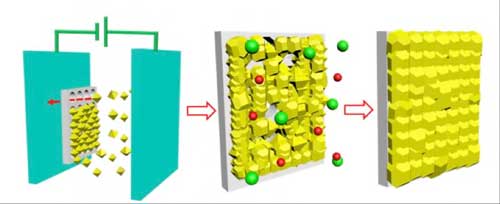
Electrophoretic Nuclei Assembly for Energy-efficient Separation Membrane
This is an electrophoretic nuclei assembly for energy-efficient separation membrane. (Image: K.V. Agrawal/EPFL)
The ENACT method allows simple regulation of the heterogeneous nucleation on unmodified (as-obtained) porous and nonporous substrates. This in turn facilitates the synthesis of ultrathin, highly intergrown polycrystalline MOF films.
The lab used the ENACT method to synthesize 500-nm-thick MOF membranes. When they tested them, the membranes yielded one of the best separation performances in propylene/propane separation recorded to date. The ultrathin film yielded large propylene permeance (flux normalized with pressure difference), which will help reduce the membrane area needed for industrial applications.
The group concludes that the versatile, straightforward ENACT method can be extended to a wide-range of nanoporous crystals.
Source: Ecole Polytechnique Fédérale de Lausanne

Filtrul de apă pe bază de grafen elimină mai mult de 99% din materia organică naturală(Graphene-based water filter removes more than 99% of natural organic matter)

au dezvoltat un filtru de laborator pe scara larga, bazat pe grafen, care poate elimina mai mult de 99% din materia organica omniprezenta naturala ramasa in urma tratarii conventionale a apei potabile.Noul sistem de tratare se face prin transformarea grafitului natural in membranele de oxid de grafena care permit un debit mare de apa la presiunea atmosferica, in timp ce se elimina practic toata materia organica

Posted: Mar 14, 2018

Graphene-based water filter removes more than 99% of natural organic matter

(Nanowerk News) University of New South Wales (UNSW) scientists have developed a world-first, graphene-based, laboratory-scale filter that can remove more than 99% of the ubiquitous natural organic matter left behind during conventional treatment of drinking water.

In a research collaboration with Sydney Water, the team has demonstrated the success of the approach in laboratory tests on filtered water from the Nepean Water Filtration Plant in western Sydney, and is working to scale up the new technology.
The results of some of the ground-breaking research are published in the journal Carbon(„Application of graphene oxide membranes for removal of natural organic matter from water”). The project is led by Dr Rakesh Joshi of the UNSW School of Materials Science and Engineering, in collaboration with Professor Veena Sahajwalla and Professor Vicki Chen of UNSW, and Dr Heriberto Bustamante of Sydney Water.
“Our advance is to use filters based on graphene – an extremely thin form of carbon. No other filtration method has come close to removing 99% of natural organic matter from water at low pressure,” Dr Joshi said.
“Our results indicate that graphene-based membranes could be converted into an alternative new option that could in the future be retrofitted in conventional water treatment plants.”
Sydney Water supplies clean water to about 4.8 million people in Sydney, the Illawarra and the Blue Mountains. These natural organic matter contaminants can affect the performance of direct filtration plants, reducing their capacity after heavy rain.
“The most common methods used at present to remove organic matter from water supplies include the application of chemical coagulants,” said Dr Bustamante.
“However, these existing treatments are only partly effective, particularly as the concentration of natural organic matter is increasing.”
Dr Joshi said: “The new treatment system is made by converting naturally occurring graphite into graphene oxide membranes that allow high water flow at atmospheric pressure, while removing virtually all of the organic matter.”
Dr Joshi has an international reputation in this area, having published many highly cited articles including one in the journal Science on graphene oxide-based filtration in 2014 while working at the University of Manchester with Nobel Laureate Sir Andre Geim.
The UNSW team is upgrading the experimental rig to construct a small pilot plant that could be tested in the field.
Source: By Deborah Smith, University of New South Wales

Scoaterea metalelor grele din apă cu MOF(Removing heavy metals from water with MOFs)

cadre organice metalice (MOF), materiale care sunt realizate din noduri metalice interconectate cu substanțe chimice organice ” struts’. Suprafața lor internă fără precedent și o ușurință chimică ușoară permite MF să „tragă” vaporii de apă și alte gaze din aer. Aceleași caracteristici le fac materiale promițătoare, de asemenea, pentru eliminarea selectivă a metalelor grele din apă ( ACS Central Science , „Rapidă, selectivă de eliminare a metalelor grele din apă printr-un cadru metalo-organic / polidopamină compozit” ).Compozitul final, denumit Fe-BTC / PDA, poate elimina rapid și selectiv cantități mari de metale grele cum ar fi plumbul și mercurul din probele de apă din lumea reală. De fapt, el poate elimina de peste 1,6 ori greutatea proprie a mercurului și de 0,4 ori greutatea sa de plumb.

Posted: Mar 14, 2018

Removing heavy metals from water with MOFs

(Nanowerk News) According to the World Health Organization almost 1 billion people do not have access to clean drinking water, and that number is expected to increase with climate change. Meanwhile, our endlessly rising energy needs and use of heavy metals in industrial processes have maximized our exposure to toxic materials in water.

Current commercial methods to remove heavy metals including lead from municipal drinking water tend to be costly and energy-consuming, without being sufficiently efficient. Less conventional approaches might be more efficient, but are single-use, difficult to regenerate, or produce significant toxic waste as a side-product.
Now, the lab of Professor Wendy Lee Queen at EPFL, with colleagues at the University of California Berkeley and Lawrence Berkeley National Laboratory have found a solution using metal organic frameworks (MOFs), which are materials made up of metal nodes interlinked by organic chemical ‘struts’. Their unprecedented internal surface areas and easy chemical tunability allow MOFs to „pull” water vapor and other gases from air. These same features make them promising materials also for selectively removing heavy metals from water (ACS Central Science, „Rapid, Selective Heavy Metal Removal from Water by a Metal–Organic Framework/Polydopamine Composite”).
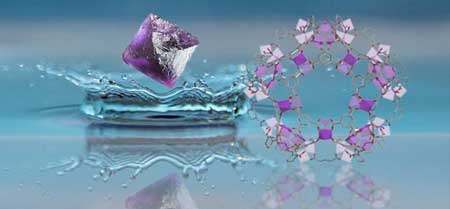
A drop of water injected on an octahedral crystal
A drop of water injected on an octahedral crystal. (Image: Wendy Lee Queen/EPFL)
A PhD student at EPFL-Valais, Daniel T. Sun, has designed a water-stable MOF/polymer composite using cheap, environmentally and biologically friendly materials. The scientists treated a MOF, known as Fe-BTC, with dopamine, which polymerized to polydopamine (PDA) pinning the polymer inside the MOF. The final composite, named Fe-BTC/PDA, can quickly and selectively remove high amounts of heavy metals like lead and mercury from real-world water samples. In fact, it can remove over 1.6 times its own weight of mercury and 0.4 times of its weight of lead.
Fe-BTC/PDA was then tested in solutions as toxic as some of the worst water samples found in Flint, Michigan. The tests showed that the MOF can, in a matter of seconds, reduce lead concentrations to 2 parts per billion, a level that the U.S. Environmental Protection Agency and World Health Organization deem drinkable.
The scientists also removed lead from various real-world water samples obtained from the Rhone River, the Mediterranean Sea, and a wastewater treatment plant in Switzerland. They also showed how the material could be regenerated easily.
There are multiple sources of exposure to toxic heavy metals. For example, lead is used in paint, ceramic glazes, jewelry, toys, and pipes. Considering this, the approach with the new MOF shows much promise for solving current limitations of water-cleaning systems. The authors of the study are now testing other new specially designed MOFs to remove other types of trace contaminants in water and air.
Source: Ecole Polytechnique Fédérale de Lausanne

Nanospearii livrează celulelor genetice cu precizie precisă(Nanospears deliver genetic material to cells with pinpoint accuracy)

u încercat să creeze nanopreluri biocompatibile care pot fi configurate pentru a transporta ADN-ul în celule cu ajutorul unui câmp magnetic extern, fără să deterioreze celulele sau să utilizeze propulsoare chimice .
Cercetatorii au fabricat nanospears folosind margele de polistiren ca un model. Au pus margelele pe siliciu și le-au gravat într-o formă mică și ascuțită a sulițelor. Margelele au fost îndepărtate, iar sulitele de siliciu rezultate au fost acoperite cu straturi subțiri de nichel și aur. Aurul a fost funcționalizat astfel încât biomoleculele, cum ar fi ADN-ul, să se poată atașa.

Posted: Mar 14, 2018

Nanospears deliver genetic material to cells with pinpoint accuracy

(Nanowerk News) In a step toward accelerating the production of new gene therapies, scientists report in ACS Nano („Precision-Guided Nanospears for Targeted and High-Throughput Intracellular Gene Delivery”) that they have developed remote-controlled, needle-like nanospears capable of piercing membrane walls and delivering DNA into selected cells. They say the new technique, which can ferry biological materials to cells with pinpoint accuracy, overcomes many of the existing barriers to effective gene modification.

Precision-Guided Nanospears for Targeted and High-Throughput Intracellular Gene Delivery
Medical interventions based on the use of genetically modified cells are an emerging area of stem cell and cancer immunology research. Existing approaches to delivering DNA into cells for producing these gene therapies include viruses, external electrical fields or harsh chemical reagents. But these methods are often costly, inefficient and harmful to the cells.
Researchers have experimented with sharp-tipped nanoparticles stuck on surfaces to deliver biomolecules to cells, but it is difficult to remove the modified cells from the nanoparticle-coated surface for further study. Self-propelled nanoparticles also can deliver molecules to cells in the body. However, these devices are difficult to precisely control and can generate toxic byproducts.
To overcome these issues, Steven J. Jonas, Paul S. Weiss, Xiaobin Xu and colleagues sought to create biocompatible nanospears that can be configured to transport DNA into cells precisely using an external magnetic field without either damaging the cells or having to use chemical propellants.
The researchers fabricated nanospears using polystyrene beads as a template. They placed the beads onto silicon and etched them down into a tiny, sharp spear shape. The beads were removed, and the resulting silicon spears were coated with thin layers of nickel and gold. The gold was functionalized so that biomolecules, such as DNA, could attach.
Then, the researchers removed the nanospears from the silicon by mechanical scraping. Because the nickel layer is magnetic, the particles’ movement and orientation could be precisely controlled with a magnet. This capability allowed the researchers to maneuver the nanospears in a lab dish to modify brain cancer cells so that they expressed a green fluorescent protein. After making contact and penetrating the cells, the nanospears released their DNA cargo.
After the experiment, more than 90 percent of the cells remained viable and more than 80 percent exhibited green fluorescence, showing that the method is less harmful and more effective than other non-viral approaches. The researchers conclude this technique could eventually lead to new ways to prepare vast numbers of cells for the coordinated manufacture of gene therapies.
Source: American Chemical Society

Fulgi de grafen pentru viitoarele tranzistoare(Graphene flakes for future transistors)

Tiny și foarte promițătoare pentru posibile aplicații în domeniul nanoelectronicii: ele sunt nanoflakele de grafenă studiate de o echipă a SISSA și protagoniști ai unui studiu publicat recent în revista Nano Letters ( „Filtrarea prin rotire asistată cu ajutorul interferențelor cuantice în Nanoflakes Grafen” ).
Aceste nanostructuri în formă hexagonală ar permite exploatarea efectelor cuantice pentru a modula debitul curent. Datorită proprietăților lor magnetice intrinseci, ele ar putea reprezenta, de asemenea, un pas important în domeniul spintronicii, care se bazează pe spinul electronilor.Pentru a îmbunătăți eficiența dispozitivului posibil și procentul de polarizare actuală, cercetătorii au elaborat, de asemenea, un protocol care prevede interacțiunea fulgilor de grafen cu o suprafață din azot și bor.

Posted: Mar 14, 2018

Graphene flakes for future transistors

(Nanowerk News) Tiny and very promising for possible applications in the field of nanoelectronics: they are the graphene nanoflakes studied by a SISSA’s team and protagonists of a study recently published in the Nano Letters journal („Quantum Interference Assisted Spin Filtering in Graphene Nanoflakes”).

These hexagonal shaped nanostructures would allow to exploit quantum effects to modulate the current flow. Thanks to their intrinsic magnetic properties, they could also represent a significant step forward in the field of spintronics, which is based on the electron spin. The study, conducted by a theoretical analysis and simulations at the computer, was led by Massimo Capone.
Graphene Flakes for Future Transistors
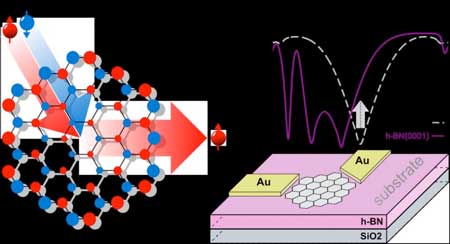
On the left: This is a spin filter made out of a magnetic nanoflake: a current of electrons with spin ‘up’ and ‘down’ in equal proportions flows through the device. Due to destructive interference in a spin channel (for example: down) the outgoing current is prevalently made of spin-up electrons. On the right: Schematic illustration of the device and plot of the spin-filtering efficiency. (Image: Angelo Valli)
„We have been able to observe two key phenomena by analysing the properties of graphene nanoflakes. Both are of great interest for possible future applications” explain Angelo Valli and Massimo Capone, authors of the study together with Adriano Amaricci and Valentina Brosco.
The first phenomenon deals with the so-called interference between electrons and is a quantum phenomenon: In nanoflakes, the electrons interfere with each other in a „destructive” manner if we measure the current in a certain configuration. This means that there is no transmission of current. This is a typically quantum phenomenon, which only occurs at very reduced sizes. By studying the graphene flakes we have understood that it is possible to bring this phenomenon to larger systems, therefore into the nano world and on a scale in which it is observable and can be exploited for possible uses in nanoelectronics.
The two researchers explain that in what are called „Quantum interference transistors” destructive interference would be the „OFF” status. For the „ON” status, they say it is sufficient to remove the conditions for interference, thereby enabling the current to flow.

Magnetism and spintronics

But there’s more. In the study, the researchers demonstrated that the nanoflakes present new magnetic properties which are absent, for example, in an entire sheet of graphene: The magnetism emerges spontaneously at their edges, without any external intervention. This enables the creation of a spin current.
The union between the phenomena of quantum interference and of magnetism would allow to obtain almost complete spin polarization, with a huge potential in the field of spintronics, explain the researchers. These properties could be used, for example, in the memorising and processing information technologies, interpreting the spin as binary code. The electron spin, being quantised and having only two possible configurations (which we could call „up” and „down”), is very well suited for this kind of implementation.

Next step: the experimental test

To improve the efficiency of the possible device and the percentage of current polarization the researchers have also developed a protocol that envisages the interaction of the graphene flakes with a surface made of nitrogen and boron.
„The results obtained are really interesting. This evidence now awaits the experimental test, to confirm what we have theoretically predicted,” concludes Massimo Capone, head of the research and recently awarded the title of Outstanding Referee by the American Physical Society journal; in this way, each year, the journal indicates the male and female scientists who have distinguished themselves for their expertise in collaborating with the journal.
Source: Scuola Internazionale Superiore di Studi Avanzati (SISSA)

Borul poate forma o structură 2-D pură, de tip fagure, de tip grafen(Boron can form a purely honeycomb, graphene-like 2-D structure)

În plus, o latură de bor 2D de tip fagure poate permite comportamentul de superconductivitate. Deoarece în binecunoscutul supraconductor înalt Tc, MgB 2 , structura cristalină formată din avioane cu bor cu straturi intercalate Mg, unde planul bor are o structură de tip fagure curată ca grafen.Scanarea imaginilor de microscopie prin tuneluri (STM) dezvăluie o borofenă monolayer perfectă cu o latură plană, fără buclă fagure, similară cu grafenul. Calculele teoretice arată că borofenul de fagure pe Al (111) este stabil din punct de vedere energetic.

Posted: Mar 14, 2018

Boron can form a purely honeycomb, graphene-like 2-D structure

(Nanowerk News) Seeking for low-dimensional boron allotropes has attracted considerable interest in the past decades and tremendous theoretical works predict the existence of monolayer boron. As boron has only three valence electrons, the electron deficiency makes a honeycomb lattice of boron energetically unstable. Instead, a triangular lattice with periodic holes was predicted to be more stable.

In 2015, Prof. Wu has led a research team at Institute of Physics, Chinese Academy of Sciences, and successfully synthesized 2D borophene sheet on silver surface, which is exhibiting the predicted triangular lattice with different arrangements of hexagonal holes.
An intriguing question is whether it is possible to prepare a borophene monolayer with a pure honeycomb lattice. Honeycomb borophene will naturally host Dirac fermions and thus intriguing electronic properties resembling other group IV elemental 2D materials.
Additionally, a honeycomb 2D boron lattice may enable the superconductivity behavior. Since in the well-known high Tc superconductor, MgB2, the crystal structure consists of boron planes with intercalated Mg layers, where the boron plane has a pure honeycomb structure like graphene.
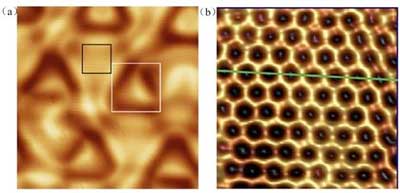
STM images of borophene monolayer with honeycomb lattice
High resolution STM images of borophene monolayer with honeycomb lattice on Al(111). (© Science China Press)
It is remarkable that in MgB2, superconductivity occurs in the boron planes, while the Mg atoms serves as electron donors.
Recently, the research team led by Prof. Wu reported the successful preparation of a purely honeycomb, graphene-like borophene, by using an Al(111) surface as the substrate and molecular beam epitaxy (MBE) growth in ultrahigh vacuum (Science Bulletin, „xperimental Realization of Honeycomb Borophene”).
Scanning tunneling microscopy (STM) images reveal perfect monolayer borophene with planar, non-buckled honeycomb lattice similar as graphene. Theoretical calculations show that the honeycomb borophene on Al(111) is energetically stable.
Remarkably, nearly one electron charge is transferred to each boron atom from the Al(111) substrate and stabilizes the honeycomb borophene structure. This work vividly demonstrated that one can manipulate the borophene lattice by controlling the charge transfer between the substrate and the borophene. And the honeycomb borophene provides attractive possibility to construct boron-based atomic layers with unique electronic properties such as Dirac states, as well as to control superconductivity in boron-based compounds.
Source: Science China Press

Cercetătorii demonstrează existența unei noi forme de materie electronică

produs o demonstrație „la scară umană” a unei noi faze a materiei numite izolatoare topologice quadrupole, care a fost recent prevăzută cu ajutorul fizicii teoretice. Acestea sunt primele rezultate experimentale care au validat această teorie.am putut prezice existența acestei noi forme de materie, însă niciun material nu a fost găsit să aibă aceste proprietăți până acum”

Posted: Mar 14, 2018

Researchers demonstrate existence of new form of electronic matter

(Nanowerk News) Researchers have produced a „human scale” demonstration of a new phase of matter called quadrupole topological insulators that was recently predicted using theoretical physics. These are the first experimental findings to validate this theory.

The researchers report their findings in the journal Nature („A quantized microwave quadrupole insulator with topologically protected corner states”).
circuit board
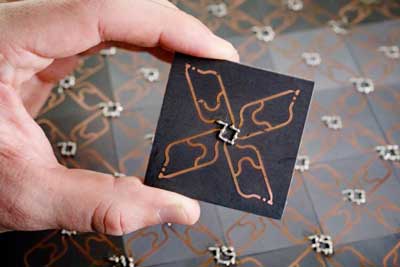
A single circuit board, foreground, that when joined with others forms the experimental array of the quadrupole topological insulator. (Image: L. Brian Stauffer)
The team’s work with QTIs was born out of the decade-old understanding of the properties of a class of materials called topological insulators. „TIs are electrical insulators on the inside and conductors along their boundaries, and may hold great potential for helping build low-power, robust computers and devices, all defined at the atomic scale,” said mechanical science and engineering professor and senior investigator Gaurav Bahl.
The uncommon properties of TIs make them a special form of electronic matter. „Collections of electrons can form their own phases within materials. These can be familiar solid, liquid and gas phases like water, but they can also sometimes form more unusual phases like a TI,” said co-author and physics professor Taylor Hughes .
TIs typically exist in crystalline materials and other studies confirm TI phases present in naturally occurring crystals, but there are still many theoretical predictions that need to be confirmed, Hughes said.
One such prediction was the existence of a new type of TI having an electrical property known as a quadrupole moment. „Electrons are single particles that carry charge in a material,” said physics graduate student Wladimir Benalcazar. „We found that electrons in crystals can collectively arrange to give rise not only to charge dipole units – that is, pairings of positive and negative charges – but also high-order multipoles in which four or eight charges are brought together into a unit. The simplest member of these higher-order classes are quadrupoles in which two positive and two negative charges are coupled.”
Multipoles
A dipole moment can be represented by two charges, one positive and one negative, separated in one dimension, a quadrupole moment can be represented by four charges separated in two dimensions, etc. (Image: Kitt Peterson)
It is not currently feasible to engineer a material atom by atom, let alone control the quadrupolar behavior of electrons. Instead, the team built a workable-scale analogue of a QTI using a material created from printed circuit boards. Each circuit board holds a square of four identical resonators – devices that absorb electromagnetic radiation at a specific frequency. The boards are arranged in a grid pattern to create the full crystal analogue.
„Each resonator behaves as an atom, and the connections between them behave as bonds between atoms,” said Kitt Peterson, the lead author and an electrical engineering graduate student. „We apply microwave radiation to the system and measure how much is absorbed by each resonator, which tells us about how electrons would behave in an analogous crystal. The more microwave radiation is absorbed by a resonator, the more likely it is to find an electron on the corresponding atom.”
The detail that makes this a QTI and not a TI is a result of the specifics of the connections between resonators, the researchers said.
„The edges of a QTI are not conductive like you would see in a typical TI,” Bahl said, „Instead only the corners are active, that is, the edges of the edges, and are analogous to the four localized point charges that would form what is known as a quadrupole moment. Exactly as Taylor and Wladimir predicted .”
„We measured how much microwave radiation each resonator within our QTI absorbed, confirming the resonant states in a precise frequency range and located precisely in the corners,” Peterson said. „This pointed to the existence of predicted protected states that would be filled by electrons to form four corner charges.”
Those corner charges of this new phase of electronic matter may be capable of storing data for communications and computing. „That may not seem realistic using our ‘human scale’ model,” Hughes said. „However, when we think of QTIs on the atomic scale, tremendous possibilities become apparent for devices that perform computation and information processing, possibly even at scales below that we can achieve today.”
The researchers said the agreement between experiment and prediction offered promise that scientists are beginning to understand the physics of QTIs well enough for practical use.
„As theoretical physicists, Wladimir and I could predict the existence of this new form of matter, but no material has been found to have these properties so far,” Hughes said. „Collaborating with engineers helped turn our prediction into reality.”
Source: University of Illinois at Urbana-Champaign