Dar suspensiile vâscoase cu proprietăți de solidificare bruscă sunt de asemenea utilizate în alte scopuri; de exemplu, un producător american utilizează suspensii vâscoase pentru a dezvolta veste de siguranță împotriva glonțului și alungirilor. „Studiul nostru poate ajuta la îmbunătățirea acestor tipuri de aplicații”, spune Isa.
Posted: May 02, 2018
It all comes down to roughness
(Nanowerk News) The internet is full of videos of people having fun running over white slime. It almost looks as if they were walking on water. But when they stand still, they slowly begin to sink. The slime in question is usually a concentrated suspension comprising cornstarch and water. Although colloquially known as „oobleck” after the children’s book by Dr Seuss, materials scientists use the term „non-Newtonian fluid”. In contrast to a „normal” (Newtonian) fluid, non-Newtonian fluids can become more viscous when acted upon by a large, rapidly changing force. For a brief moment, the material behaves like a solid. However, if the force is constant and weak, the material flows like a normal liquid.
„This phenomenon appears in all suspensions with high particle density, such as cement,” says Lucio Isa, Professor of Interfaces, Soft matter and Assembly at ETH Zurich. If cement is pumped through a pipe on a construction site too quickly, the pipe will clog.
A thin suspension behaves like water: the ball sinks on impact. A thick suspension, on the other hand, solidifies abruptly on impact (right) (Image: Isa Group, ETH Zurich)
Higher friction due to rough surfaces
This is partially due to the surface characteristics of the solid particles in the suspension. „If a force is applied suddenly,the solid particles are unable to move out of the way quickly enough. Instead, they come into contact, rubbing against and blocking each other”, Explains Isa. The rougher the particle surface, the higher the friction.
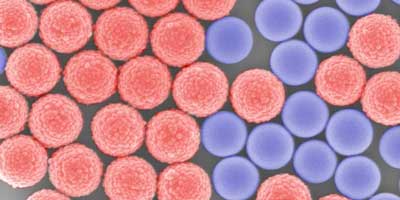
Researchers use these properties to control the sudden increase in viscosity in a dense suspension in a targeted manner. Instead of cornstarch, Isa and his colleagues „played” with uniform, micrometre-sized silicate particles with a rough surface. The particles look like tiny raspberries and had already been used by the researchers in earlier studies.
Chiao-Peng Hsu, a doctoral student working under Isa and ETH professor Nicholas Spencer, has developed a method that allows him to quickly generate a library of these raspberry-shaped particles with different surface roughnesses (PNAS, „Roughness-Dependent Tribology Effects on Discontinuous Shear Thickening”).
Higher viscosity despite fewer particles
The researchers used these particles to create suspensions that they could test for sudden increases in viscosity under stress. The results showed that the rougher the particles, the fewer had to be added to the suspension to achieve sudden solidification. In contrast, if smooth particles were used, a greater amount had to be added to the suspension before the researchers were able to observe the sudden thickening.
The researchers showed that the use of rough particles could save material: their portion of the total volume in a suspension can be substantially lower in order to generate the same effect.
When the researchers mixed rough and smooth particles in a single suspension, solidification also occurred earlier than in suspensions with exclusively smooth particles. The ETH researchers discovered that as little as 6 percent of smooth particles in a mixture was enough to reduce the increase in viscosity significantly. „It’s like mixing up ball bearings and gearwheels,” says Isa. „The gearwheels link together relatively easily to create a stable chain but the ball bearings easily break those chains and enable flow .”
Rough and smooth particles in a suspension: Their mixing ratio influences the time of the sudden increase in viscosity. (Image: Chiao-Peng Hsu, ETH Zurich)
Growing „raspberries” on cantilevers
In order to research the friction between individual particles, Hsu and his colleague Shivaprakash Ramakrishna attached a single, half-micrometre particle on a cantilever of an atomic force microscope. The researchers then moved the particle across various rough model surfaces by shifting the cantilever a few hundred nanometres while measuring the angle of tilt. The stronger the friction, the greater the angle. „Working with this kind of particle on a cantilever was extremely difficult, since the dimensions are incredibly small,” emphasises Hsu. „We were the first group to accomplish this.”
Applications in bullet-proof vests
Whether the results will be integrated into real-life applications remains to be seen. The study is primarily pure research. „Our goal was to investigate the ways in which we can change nano and microstructures in order to influence material behaviour on a macroscopic level, and we succeeded,” says Isa. The findings could be used in everyday applications such as cement. „By adjusting the surfaces of granules and mixing them into cement in a similar way to our experiment, one could optimise cement’s flow characteristics.”
But viscous suspensions with abrupt solidification properties are also used for other purposes; for example, an American manufacturer uses viscous suspensions to develop bullet and stab-proof safety vests. „Our study can help improve these kinds of applications,” says Isa.
se numeste „ShortWave IR” si este cea mai noua arma usoara cu cascada de lumina IR din arma militara americana (SOF) pentru lupta impotriva celor rai noaptea, permitand baietilor nostri sa devina invizibili asupra lor, chiar daca inamicul are noaptea viziune și / sau senzori termici / IR
Lupta în mai multe domenii încearcă să integreze operațiunile și să se coordoneze perfect în cele cinci domenii ale războiului aerian, terestru, maritim, spațial și cibernetic – spre deosebire de abordarea anticată a domeniului specific pentru rezolvarea problemelor
Conform analizei companiei Sensors Unlimited Inc. (o divizie a sistemelor UTC Aerospace Systems), „detectarea în gama de infrarosu scurt (SWIR) (lungimi de undă de la 0,9 până la 1,7 microni) a devenit recent practică prin dezvoltarea Indium Gallium Arsenide (Senzori InGaAs). „Sensors Unlimited Inc. explică tehnologia SWIR după cum urmează (mai bine decât putem):
Core Survival Hel-Star 6 SWIR (ShortWave InfraRed) Multi-Function Combat/Tactical Helmet-Mounted LED Light for Going Invisible at Night!
As if the Core Survival Hel-Star 6 Helmet Mounted, Multi-Function Light (combat/tactical helmet-mounted LED light) wasn’t already cool and interesting enough, Core Survival’s topped themselves with this little bad boy, the new Core Survival Hel-Star 6 SWIR. DefenseReview (DR) got the chance to view and handle it at SHOT Show 2018, and Core Survival’s Jamey Caldwell was kind enough to take us through it (see video below). “SWIR” stands for ShortWave IR (InfaRed), and it’s the latest IR-light-spectrum helmet-mounted light weapon in the US Military Special Operations Forces (SOF) arsenal for fighting the bad guys at night, allowing our guys to go invisible on them, even if the enemy has night vision (near IR) and/or thermal/IR sensors.
So, what is SWIR, really? According to Sensors Unlimited Inc.’s (a division of UTC Aerospace Systems) company literature, “sensing in the shortwave infrared (SWIR) range (wavelengths from 0.9 to 1.7 microns) has only recently been made practical by the development of Indium Gallium Arsenide (InGaAs) sensors.” Sensors Unlimited Inc. expounds on SWIR technology as follows (better than we can):
First, a basic fact: light in the SWIR band is not visible to the human eye. The visible spectrum extends from wavelengths of 0.4 microns (blue, nearly ultraviolet to the eye) to 0.7 microns (deep red). Wavelengths longer than visible wavelengths can only be seen by dedicated sensors, such as InGaAs. But, although light in the shortwave infrared region is not visible to the eye, this light interacts with objects in a similar manner as visible wavelengths. That is, SWIR light is reflective light; it bounces off of objects much like visible light.
As a result of its reflective nature, SWIR light has shadows and contrast in its imagery. Images from an InGaAs camera are comparable to visible images in resolution and detail; however, SWIR images are not in color. This makes objects easily recognizable and yields one of the tactical advantages of the SWIR, namely, object or individual identification.
The Core Survival Hel-Star 6 SWIR Helmet-Mounted, Multi-Function Light leverages this technology, and applies it to the Hel-Star 6 Gen III design. Pretty cool. DR doesn’t yet know whether or not the Hel-Star 6 SWIR will be as durable/rugged and waterproof as the Hel-Star 6 Gen III. According to the Core Survival website, “independent testing has confirmed that the HEL-STAR 6® Gen III exceeds the FAA’s 3 statute mile visibility requirement and is shock and vibration resistant, dustproof, and open sea waterproof to 130 fsw (laboratory 300+ feet).”
Defense Review will try to find out if the Hel-Star 6 SWIR can match or at least approach those specs. In the meantime, enjoy our video below.
Proprietățile acestui nou aliaj ar putea conduce la utilizarea acestuia ca strat de contact pentru celulele solare sau pentru memoria magnetică viitoare, tranzistori de film subțire sau termoelectrice dispozitive; au găsit o modalitate de a crea echivalentul presiunii negative prin amestecarea a două materiale împreună în doar condițiile potrivite pentru a face un aliaj cu un airier și o structură cristalină complet diferită și proprietăți unice .
Posted: May 01, 2018
Scientists find a new way to make novel materials by ‘un-squeezing’
(Nanowerk News) Some materials can morph into multiple crystal structures with very different properties. For instance, squeezing a soft form of carbon produces diamond, a harder and more brilliant form of carbon. The Kurt Vonnegut novel “Cat’s Cradle” featured ice-nine, a fictional form of water with a much higher melting point than regular ice that threatened to irreversibly freeze all the water on Earth.
These materials are called polymorphs, and they’re commonly made by applying pressure, or squeezing. Scientists looking for new materials would also like to do the opposite – apply “negative pressure” to stretch a material’s crystal structure into a new configuration. In the past, this approach seemed to require negative pressures that are difficult if not impossible to achieve in the lab, plus it risked pulling the material apart.
Now researchers at the Department of Energy’s National Renewable Energy Laboratory (NREL) have found a way to create the equivalent of negative pressure by mixing two materials together under just the right conditions to make an alloy with an airier and entirely different crystal structure and unique properties.
A team led by scientists at NREL demonstrated a way to use “negative pressure” to combine two dense materials into an alloy (right) with a much lower density, as if turning a snowball back into fluffy snow. The new alloy also has much different properties than either of its parents. The spheres represent atoms of manganese (blue), selenium (red) and tellurium (gold).
X-ray measurements at DOE’s SLAC National Accelerator Laboratory confirmed that they have succeeded. Their new alloy has more space between its atoms then either of its parent materials, as if it had been stretched out. Unlike its parents, the new material is piezoelectric – able to generate an electric charge in response to applied mechanical stress. This may be important for use in sensors and actuators.
Published in Science Advances („Negative-pressure polymorphs made by heterostructural alloying”), the paper reporting their findings contains both the theoretical understanding and experimental proof of concept that show how such novel low-density materials can be made.
“Creating the negative pressure conditions in alloys required counterintuitive thinking, and maybe that’s why this has not been pointed out before,” said Andriy Zakutayev, an NREL scientist and a lead author of the new paper.
“It’s possible to apply positive pressure to the material by squeezing it, but it’s really difficult to un-squeeze the material,” he said. “Think about it this way: you can pack a snowball out of snow, but you can’t turn a dense snowball back into fluffy snow.”
Pioneering Work on Mismatched Materials
The experiment builds on pioneering work led by NREL on mixing compounds with atomic structures that didn’t match.
As surely as water flows downhill, a chemical reaction will take the path of least resistance, proceeding in a way that consumes the least energy. Mixing two materials with high-density structures takes a lot of energy; but if you could nudge the reaction in the direction of creating a low-density end product whose atoms were farther apart, it would require a lot less energy, the researchers theorized. It would be the equivalent of making a material under negative pressure.
They tested this hypothesis by mixing high-density forms of manganese selenide and manganese telluride that have different crystal structures – one resembling rock salt, the other the mineral nickeline. To combine the two, they used a technique called sputtering in which fine sprays of atoms were freed from the surfaces of both starting materials and deposited as a thin film on a hot surface, where the new alloy crystallized and grew, said SLAC associate staff scientist Laura Schelhas. She conducted X-ray measurements of the new alloy at the lab’s Stanford Synchrotron Radiation Lightsource (SSRL) with staff scientist Kevin Stone. The alloy, it turned out, had the crystal structure of yet another mineral, wurtzite.
“You can use this alloying approach to make different, never-before-seen materials with interesting properties,” Schelhas said. “For instance, this one becomes piezoelectric: When you apply a voltage across the material it actually stretches and gets bigger. And the opposite also happens: If you push on it, it produces an electric charge. These piezoelectric materials are used in a lot of places – including some airbags, where the pressure from getting hit in a collision creates a little bit of electric charge that sets the airbag off – and the material created here was entirely new.”
Aaron Holder, an NREL researcher and assistant professor at the University of Colorado Boulder, said, “The properties of this new alloy could lead to its use as a contact layer for solar cells, or for future magnetic memory, thin film transistors, or thermoelectric devices. But how we made it is even more promising: Finding new routes to synthesize materials that nature cannot make would catalyze progress towards next-generation technologies.”
au construit primul metamaterial dinamic, tunabil dinamic, pentru controlul undelor electromagnetice. Abordarea ar putea constitui baza pentru tehnologii variind de la scanere de securitate îmbunătățite la noi tipuri de afișaje vizuale.Pentru acest studiu, cilindrii au fost dimensionați pentru a interacționa cu unde terahertz – o bandă a spectrului electromagnetic care se află între microunde și lumina infraroșie. Controlul acestei lungimi de undă de lumină ar putea îmbunătăți comunicațiile în bandă largă între sateliți sau ar putea conduce la tehnologii de securitate care să poată scana cu ușurință prin îmbrăcăminte. Abordarea ar putea fi, de asemenea, adaptată la alte benzi ale spectrului electromagnetic – cum ar fi infraroșu sau lumină vizibilă – pur și simplu prin diminuarea dimensiunii cilindrilor.
Posted: May 01, 2018
Dielectric metamaterial is dynamically tuned by light
(Nanowerk News) Researchers at Duke University have built the first metal-free, dynamically tunable metamaterial for controlling electromagnetic waves. The approach could form the basis for technologies ranging from improved security scanners to new types of visual displays.
Artistic representation of the new metasurface technology. Rays of light (red) bombard the silicon cylinders, changing their electromagnetic properties to precisely tune how they interact with electromagnetic waves. (Image: Kebin Fan, Duke University)
A metamaterial is an artificial material that manipulates waves like light and sound through properties of its structure rather than its chemistry. Researchers can design these materials to have rare or unnatural properties, like the ability to absorb specific ranges of the electromagnetic spectrum or to bend light backward.
„These materials are made up of a grid of separate units that can be individually tuned,” said Willie Padilla, professor of electrical and computer engineering at Duke. „As a wave passes through the surface, the metamaterial can control the amplitude and phase at each location in the grid, which allows us to manipulate the wave in a lot of different ways.”
In the new technology, each grid location contains a tiny silicon cylinder just 50 microns tall and 120 microns wide, with the cylinders spaced 170 microns apart from one another. While silicon is not normally a conductive material, the researchers bombard the cylinders with a specific frequency of light in a process called photodoping. This imbues the typically insulating material with metallic properties by exciting electrons on the cylinders’ surfaces.
These newly freed electrons cause the cylinders to interact with electromagnetic waves passing through them. The size of the cylinders dictates what frequencies of light they can interact with, while the angle of the photodoping affects how they manipulate the electromagnetic waves. By purposefully engineering these details, the metamaterial can control electromagnetic waves in many different ways.
For this study, the cylinders were sized to interact with terahertz waves – a band of the electromagnetic spectrum that sits between microwaves and infrared light. Controlling this wavelength of light could improve broadband communications between satellites or lead to security technology that can easily scan through clothing. The approach could also be adapted to other bands of the electromagnetic spectrum – like infrared or visible light – simply by scaling the size of the cylinders.
„We’re demonstrating a new field where we can dynamically control each point of the metasurface by adjusting how they are being photodoped,” Padilla said. „We can create any type of pattern we want to, allowing us to create lenses or beam-steering devices, for example. And because they’re controlled by light beams, they can change very fast with very little power.”
While existing metamaterials control electromagnetic waves through their electric properties, the new technology can also manipulate them through their magnetic properties.
„This allows each cylinder to not only influence the incoming wave, but the interaction between neighboring cylinders,” said Kebin Fan, a research scientist in Padilla’s laboratory and first author of the paper. „This gives the metamaterial much more versatility, such as the ability to control waves traveling across the surface of the metamaterial rather than through it.”
„We’re more interested in the basic demonstration of the physics behind this technology, but it does have a few salient features that make it attractive for devices,” Padilla said.
„Because it is not made of metal, it won’t melt, which can be a problem for some applications,” he said. „It has subwavelength control, which gives you more freedom and versatility. It is also possible to reconfigure how the metamaterial affects incoming waves extremely quickly, which has our group planning to explore using it for dynamic holography.”
Cercetătorii de la trei departamente Technion-Israel Institute of Technology au finalizat un studiu interdisciplinar care dezvăluie configurația optimă pentru roboții nanometrici care pot călători în corpul uman pentru a efectua o varietate de sarcini. Modelul îmbunătățește modelele anterioare de inspirație naturală.
(Nanowerk News) Researchers from three Technion-Israel Institute of Technology departments have completed an interdisciplinary study revealing the optimal configuration for nanoscale robots that can travel within the human body to perform a variety of tasks. The model improves previous nature-inspired models.
Led by Professor Alex Leshansky of the Technion’s Wolfson Department of Chemical Engineering, the research team comprised of members of three different Technion faculties (the others were the Department of Mathematics and the Department of Physics) analyzed the optimal configuration for nanoscale robots that are designed to “swim” through the human body. Their findings were recently published in Science Robotics („Geometric constraints and optimization in externally driven propulsion”).
For the last decade, research groups around the world have been working to develop nanometer- or micrometer-scale robots that can move in a liquid environment. These robots provide diverse opportunities in important biomedical applications, including drug delivery.
The original inspiration for the design of these miniature robots comes from bacteria, which move using slender helical tails called flagella. As the flagellum rotates in the liquid, it creates friction that propels the bacterium. Inspired by this natural mechanism, research groups have developed tiny spirals that are driven by a rotating magnetic field.
Although this method offers a number of advantages (including low power requirements of magnetic field), creating these spirals is complicated. As a result, researchers have suggested using random clusters of magnetic nanoparticles as tiny “swimmers.” Such clusters can be easily fabricated using a simple aggregation process. But in the article published in Science Robotics, the Technion researchers demonstrate that this approach does not yield optimal results.
As part of their study, the Technion researchers developed a theory for calculating the optimal speed of these magnetic swimmers based on their shape and magnetization. As a result, they can now calculate the maximum possible speed of random clusters, and the optimal shape for these tiny swimmers. Contrary to expectations, they found that the thin spiral inspired by nature is not the optimal shape, but rather a thick arc with twisted ends. This optimal propeller was shown to move much faster than the previously developed random clusters.
According to Professor Leshansky, the study’s findings will lead to the development of more efficient microrobots: “Most researchers in the field assume that the biomimetic helical shape for tiny swimming devices is the optimal one. To our surprise, we discovered that the optimal shape is rather different than helix and were able to demonstrate more efficient structure.”
Cu această constatare, cercetătorii vor putea dezvolta dispozitive operaționale valleytronic, care într-o bună zi vor putea fi integrate în circuite electronice. Cuplarea unică dintre lumină și văi din acest nou material poate deschide calea spre viitoarele chips-uri hibride electronice / fotonice.” sulfură de staniu (SnS), un candidat ” valleytronics „
Posted: May 01, 2018
Valleytronics discovery could extend limits of Moore’s Law
(Nanowerk News) Research appearing in Nature Communications („Accessing valley degree of freedom in bulk Tin(II) sulfide at room temperature”) finds useful new information-handling potential in samples of tin(II) sulfide (SnS), a candidate „valleytronics” transistor material that might one day enable chipmakers to pack more computing power onto microchips.
The research was led by Jie Yao of the Department of Energy’s Lawrence Berkeley National Laboratory (Berkeley Lab) and Shuren Lin of UC Berkeley’s Department of Materials Science and Engineering and included scientists from Singapore and China. Berkeley Lab’s Molecular Foundry, a DOE Office of Science user facility, contributed to the work.
Valleytronics utilizes different local energy extrema (valleys) with selection rules to store 0s and 1s. In SnS, these extrema have different shapes and responses to different polarizations of light, allowing the 0s and 1s to be directly recognized. This schematic illustrates the variation of electron energy in different states, represented by curved surfaces in space. The two valleys of the curved surface are shown. (Image: Berkeley Lab)
For several decades, improvements in conventional transistor materials have been sufficient to sustain Moore’s Law – the historical pattern of microchip manufacturers packing more transistors (and thus more information storage and handling capacity) into a given volume of silicon. Today, however, chipmakers are concerned that they might soon reach the fundamental limits of conventional materials. If they can’t continue to pack more transistors into smaller spaces, they worry that Moore’s Law would break down, preventing future circuits from becoming smaller and more powerful than their predecessors.
That’s why researchers worldwide are on the hunt for new materials that can compute in smaller spaces, primarily by taking advantage of the additional degrees of freedom that the materials offer – in other words, using a material’s unique properties to compute more 0s and 1s in the same space. Spintronics, for example, is a concept for transistors that harnesses the up and down spins of electrons in materials as the on/off transistor states.
Valleytronics, another emerging approach, utilizes the highly selective response of candidate crystalline materials under specific illumination conditions to denote their on/off states – that is, using the materials’ band structures so that the information of 0s and 1s is stored in separate energy valleys of electrons, which are dependent on the crystal structures of the materials.
In this new study, the research team has shown that tin(II) sulfide (SnS) is able to absorb different polarizations of light and then selectively reemit light of different colors at different polarizations. This is useful for concurrently accessing both the usual electronic – and the material’s valleytronic – degrees of freedom, which would substantially increase the computing power and data storage density of circuits made with the material.
„We show a new material with distinctive energy valleys that can be directly identified and separately controlled,” said Yao. „This is important because it provides us a platform to understand how valley signatures are carried by electrons and how information can be easily stored and processed between the valleys, which are of both scientific and engineering significance.”
Lin, the first author of the paper, said the material is different from previously investigated candidate valleytronics materials because it possesses such selectivity at room temperature without additional biases apart from the excitation light source, which alleviates the previously stringent requirements in controlling the valleys. Compared to its predecessor materials, SnS is also much easier to process.
With this finding, researchers will be able to develop operational valleytronic devices, which may one day be integrated into electronic circuits. The unique coupling between light and valleys in this new material may also pave the way toward future hybrid electronic/photonic chips.
Berkeley Lab’s „Beyond Moore’s Law” initiative leverages the basic science capabilities and unique user facilities of Berkeley Lab and UC Berkeley to evaluate promising candidates for next-generation electronics and computing technologies. Its objective is to build close partnerships with industry to accelerate the time it typically takes to move from the discovery of a technology to its scale-up and commercialization.