
Lună: august 2018
Oamenii de știință investighează mătase artificială pentru a fi folosită în armura corpului(Scientists researching Artificial Silk for Use in Body Armor)
Toți ne place să ne simțim calzi în timpul iernii și să ne răcorim în timpul verii, ceea ce este exact cum se simte când purtați mătase
O singura data , o barieră de performanță, un aspect material ar putea îmbunătăți telecomunicațiile(Once a performance barrier, material quirk could improve telecommunications)
au arătat cum poate fi proiectat un material feroelectric în așa fel încât pereții domeniului pot fi utilizați pentru a transmite microunde cu un grad mai mare de control al frecvenței decât dispozitivele mobile pe care le folosim în prezent;au simulat comportamentul dinamic la scară atomică a materialului special de film la diferite valori ale temperaturii, tensiunii și câmpului electric, comparându-l cu cel pentru o „perfect” cristal feroelectric fără pereți de domenii – ceea ce a evidențiat comportamentul excepțional al materialului.
| Posted: Aug 21, 2018 | |
Once a performance barrier, material quirk could improve telecommunications(Nanowerk News) Researchers who study and manipulate the behavior of materials at the atomic level have discovered a way to make a thin material that enhances the flow of microwave energy. The advance, which could improve telecommunications, sheds new light on structural traits, generally viewed as static and a hindrance, that, when made to be dynamic, are actually key to the material’s special ability. |
|
| The discovery, reported in the journal Nature („Resonant domain-wall-enhanced tunable microwave ferroelectrics”), shows how domain walls – the naturally occurring boundaries, separating atoms with different directions of relative displacement, that create dipoles within a material – could actually be an entryway for accessing a much wider range of electromagnetic frequencies. And this access could one day expand the range of frequencies used as communications channels. | |
 |
|
| Artist’s top-view rendering of a domain wall-variant material featuring a diffuse boundary separating aligned-dipole regions in a ferroelectric crystal film. Tunable, resonant fluctuations of these two-dimensional defects enable reduction of microwave radio frequency dielectric losses to beyond the crystal’s intrinsic limit. (Image: Drexel University) | |
| In the paper, researchers from Drexel University, Bar-Ilan University in Israel, the University of California at Berkeley, the University of California at Santa Barbara, the Carnegie Institution for Science, and the University of Pennsylvania showed how a ferroelectric material can be designed in such a way that domain walls can be used to transmit microwaves with a higher degree of frequency control than the mobile devices we currently use. | |
| „As consumer demand for mobile communications increases the available wireless spectrum is increasingly congested and new technologies are needed to create adaptive, frequency-agile antennas,” said Robert York, a professor at UC Santa Barbara and a co-author of the paper. „Tunable dielectric materials could be a potential solution.” | |
| Using the domain walls within a material to enhance its transmission quality is a particularly unexpected approach because the presence of these boundaries tends to strongly diminish a material’s ability to pass a microwave electromagnetic field. Until now, the best film materials for transmitting electromagnetic fields in radio-frequency devices were generally considered to be single-crystal materials that do not have any permanent dipole moments – let alone domain walls. | |
| But the research team turned this perception of domain walls on its head by creating a ferroelectric material with a high density of domain walls, that can outperform single crystals when it comes to tunability and transmission quality. | |
| The group found that the domain walls of a thin film of barium strontium titanate, a frequently studied ferroelectric material, function like vibrating guitar strings that resonate together. Rather than absorbing or scattering microwaves, the presence of a dense, but ordered, thicket of oscillating domain walls actually improves the quality of the transmission. | |
| „Even the best-quality bulk single crystals, without permanent, re-orientable dipoles, have higher losses at higher frequencies, due to interference caused by the vibrations of atoms in the lattice,” said Jonathan Spanier, a materials science professor at Drexel who led the research. „Film materials with permanent dipoles form domain walls, and the loss is much worse. But films that support reversible domain wall motion and their oscillating behavior surprisingly break that trend and resonate over a wide range of frequencies.” | |
| According to the researchers, „the proximity of and accessibility among thermodynamically predicted strain-induced, ferroelectric domain wall variants to achieve gigahertz microwave tunability and dielectric loss that surpass those for the current best film devices by 1-2 orders of magnitude, attaining values comparable to bulk single crystals, but in an intrinsically tunable material,” they write in the paper. | |
| The key to this exceptional tunability, according to co-author Zongquan Gu, a postdoctoral scientist in Spanier’s research group, is the abundance of different phases, „the ferroelectric phase transition temperature marks the onset of the permanent dipolar ordering. A peak in the dielectric susceptibility, a thermodynamic property related to the magnitude of capacitance, is a hallmark of the transition,” Gu said. „Engineering a film material to have many, more easily available ‘phases’ near the transition allows the material to attain much higher capacitance tuning with the same voltage.” | |
| Along with Spanier, Gu, and Geoffrey Xiao, an undergraduate student at Drexel, launched theory and simulation efforts for the prediction of domain wall-rich energy landscapes to direct the production of the domain wall-rich barium strontium titanate film. With Spanier’s colleagues at Berkeley, led by Lane Martin, professor in materials science, a leader in ferroelectric domain walls film science, Gu also made and characterized the first samples of the material, using a process called strain engineering to create a dense concentration of domain walls. | |
| From there, collaborators from Bar-Ilan University in Israel led by Ilya Grinberg, a professor of chemistry, simulated the atomic-scale dynamic behavior of the special film material at different values of temperature, strain and electric field, comparing it with that for a „perfect” ferroelectric crystal without any domain walls – which revealed the material’s exceptional behavior. | |
| This intrinsic tunability, meaning the material’s excellent transmission abilities do not require any external, electromechanical enhancement, make it promising for use in communication devices – where efficient access to spectrum is essential. | |
| At UC Santa Barbara, York, a professor of electrical and computer engineering, and his doctoral student Cedric Meyers, fabricated electrode test structures that enabled the measurement and analysis of material’s resonant microwave response, including its tunability. | |
| „Tunable dielectric materials have been a focus of investigation in my group at UCSB since the late 1990s,” York said. „But despite some progress early on, we consistently ran up against limitations of the materials that were poorly understood. This work helps to better understand these limitations and to identify potential solutions.” |
| Source: Drexel University |
Rostec Russian Ratnik-3 Soldierul viitorului „stealth camouflage” militară cu „casca camelonie” tehnologie camo adaptabilă (camuflaj) / cloaking vizibilă pentru costume și vehicule soldate în curând
DR a acoperit tehnologia adaptabilă de camuflaj / cloaking vizual pentru mulți ani acum
O nouă generație de retine artificiale bazată pe materiale 2D(A new generation of artificial retinas based on 2D materials)
Oamenii de stiinta sustin ca au dezvoltat si testat cu succes prima retina artificiala ultrathina din lume, care ar putea imbunatatii considerabil tehnologia vizuala implantabila existenta pentru orb. Dispozitivul flexibil, bazat pe materiale foarte subțiri 2D, ar putea reveni într-o zi la milioane de oameni cu boli retiniene. Și cu câteva modificări, dispozitivul ar putea fi folosit pentru a urmări activitatea inimii și a creierului.
Cercetatorii isi prezinta lucrarile astazi la cea de-a 256-a reuniune nationala si expozitie a Societatii Americane de Chimie (ACS).
Aceasta este prima demonstratie pe care o puteti folosi grafenul cu cateva straturi si disulfura de molibden pentru fabricarea cu succes a unei retini artificiale „, spune Nanshu Lu, Ph.D. Desi aceasta cercetare este inca in faza incipienta, este un punct de plecare foarte interesant pentru utilizarea acestor materiale pentru a restabili viziunea, spune ea, adaugand ca acest dispozitiv ar putea fi, de asemenea, implantat in alta parte a corpului pentru a monitoriza activitatile inimii si creierului.
| Posted: Aug 20, 2018 | |
A new generation of artificial retinas based on 2D materials(Nanowerk News) Scientists report they have successfully developed and tested the world’s first ultrathin artificial retina that could vastly improve on existing implantable visualization technology for the blind. The flexible device, based on very thin 2D materials, could someday restore sight to the millions of people with retinal diseases. And with a few modifications, the device could be used to track heart and brain activity. |
|
| The researchers are presenting their work today at the 256th National Meeting & Exposition of the American Chemical Society (ACS). | |
| “This is the first demonstration that you can use few-layer graphene and molybdenum disulfide to successfully fabricate an artificial retina,” Nanshu Lu, Ph.D., says. “Although this research is still in its infancy, it is a very exciting starting point for the use of these materials to restore vision,” she says, adding that this device could also be implanted elsewhere in the body to monitor heart and brain activities. | |
| The retina, located at the back of the eye, contains specialized photoreceptor cells called rods and cones that convert incoming light into nerve signals. These impulses travel into the brain via the optic nerve where they are decoded into visual images. | |
| Diseases such as macular degeneration, diabetic retinopathy and retinitis pigmentosa can damage or destroy retinal tissue, leading to vision loss or complete blindness. There is no cure for many of these diseases, but silicon-based retinal implants have restored a modicum of vision to some individuals. | |
| However, Lu says these devices are rigid, flat and fragile, making it hard for them to replicate the natural curvature of the retina. As a result, silicon-based retinal implants often produce blurry or distorted images and can cause long-term strain or damage to surrounding eye tissue, including the optic nerve. | |
| Lu, who is at the University of Texas at Austin, and her collaborator Dae-Hyeong Kim, Ph.D., who is at Seoul National University, sought to develop a thinner, more flexible alternative that would better mimic the shape and function of a natural retina. | |
| The researchers used 2D materials, including graphene and molybdenum disulfide, as well as thin layers of gold, alumina and silicon nitrate to create a flexible, high-density and curved sensor array. The device, which resembles the surface of a flattened soccer ball or icosahedron, conforms to the size and shape of a natural retina without mechanically disturbing it. | |
| In laboratory and animal studies, photodetectors on the device readily absorbed light and passed it through a soft external circuit board. The circuit board housed all of the electronics needed to digitally process light, stimulate the retina and acquire signals from the visual cortex. | |
| Based on these studies, the researchers determined that this prototype artificial retina is biocompatible and successfully mimics the structural features of the human eye. They say it could be an important step in the quest to develop the next generation of soft bio-electronic retinal prostheses. | |
| Moving ahead, Lu is exploring ways to integrate this technology into mechanically and optically imperceptible electronic tattoos that are laminated on the skin surface to gather real-time health information. Lu says that the team plans to add transistors to these transparent e-tattoos to help amplify signals from the brain or the heart so they can be more easily monitored and treated. | |
| These ultrathin sensors and electrodes can also be implanted on the surface of the heart to detect arrhythmias. Lu says doctors could potentially program them to act like tiny pacemakers, sending electrical impulses through the heart to correct the problem. | |
Title: 2D Materials based on Epidermal and Implantable Conformal Electronics |
|
| Abstract :Bio-tissues are soft, curvilinear and dynamic whereas wafer-based electronics are hard, planar, and fragile. Such mismatch fundamentally impedes their integration with each other. As atomically thin, optically transparent, mechanically robust, and highly functional electronic materials, 2D materials are ideal for conformable bioelectronics. We have invented a cost- and time-effective “wet transfer, dry patterning” process for the freeform manufacture of graphene e-tattoos (GETs). Our GET has a total thickness of less than 500 nm, an optical transparency of ~85%, and a stretchability of more than 40%. Tensile fracture of PMMA-supported graphene has been experimentally investigated and different stages of fracture have been identified. GET can be directly laminated on human skin exactly like a temporary transfer tattoo and can fully conform to the microscopic morphology of the skin surface via just van der Waals forces. Analytical models are developed to guide the GET design for full skin conformability even under skin deformation [4]. As a dry electrode, GET-skin interface impedance is found to be as low as medically used Ag/AgCl gel electrodes. GET has been successfully applied to measure electrocardiogram (ECG), electromyogram (EMG), electroencephalogram (EEG), skin temperature, and skin hydration. When applied around human eyes, imperceptible GET electrooculogram (EOG) sensors can capture eye movement with an angular resolution of 4 degrees, which can be used to wirelessly control a quadcopter in real-time. In addition to noninvasive e-tattoos, we have engineered human eye-inspired soft implantable optoelectronic device using atomically thin MoS2-graphene heterostructure and strain-releasing, retina conformable designs. The hemispherically curved image sensor array exhibits infrared blindness and successfully acquires pixelated optical signals. We propose the ultrathin hemispherically curved image sensor array as a promising imaging element in the soft retinal implant with minimum mechanical loading to the retina. Optical signals obtained by this curved image array can be converted to electrical stimulations applied to optic nerves to restore visualization. |
| Source: American Chemical Society |
Bateriile sunt pregătite pentru revoluția organică(Batteries poised for organic revolution)
Crucial, noul material este, de asemenea, robust, rămânând stabil peste mii de cicluri de încărcare / descărcare a bateriei.
Catodul, electrodul pozitiv în bateriile Li-ion, este o componentă critică. O moleculă organică cu deficit de electroni, numită hexazatrin-naftalină (HATN), a fost investigată anterior ca material catodic organic pentru bateriile cu litiu-ion. Cu toate acestea, performanța sa promițătoare inițială a scăzut rapid în timpul utilizării, deoarece molecula a început să se dizolve în electrolitul lichid al bateriei.
| Posted: Aug 16, 2018 | |
Batteries poised for organic revolution(Nanowerk News) Incorporating organic materials into lithium ion batteries could lower their cost and make them more environmentally friendly, A*STAR researchers have found (Journal of Materials Chemistry A, „Hexaazatriphenylene derivatives/GO composites as organic cathodes for lithium ion batteries”). |
|
| The team has developed an organic-based battery cathode that has significantly improved electrochemical performance compared to previous organic cathode materials. Crucially, the new material is also robust, remaining stable over thousands of battery charge/discharge cycles. | |
| The cathode, the positive electrode in Li-ion batteries, is a critical component. An electron-deficient, rigid organic molecule called hexaazatrinaphthalene (HATN) was previously investigated as an organic cathode material for lithium ion batteries. However, its promising initial performance declined rapidly during use, because the molecule began to dissolve into the battery’s liquid electrolyte. | |
| A new cathode material, in which HATN was combined with graphene oxide in a bid to prevent the organic material from dissolving, has now been developed by Yugen Zhang and his colleagues from the A*STAR Institute of Bioengineering and Nanotechnology. | |
 |
|
| Hydrogen bonds (blue) strongly attach the redox active organic molecule HATNTA (red) to a graphene oxide support (grey). (© The Royal Society of Chemistry) | |
| In graphene oxide, a single-atom thick sheet of carbon atoms is partly covered by a layer of oxygen atoms. “Graphene oxide has excellent electronic conductivity, and surface oxygen functionality that may form hydrogen-bonding interactions with HATN,” Zhang says. He explains that this made graphene oxide a promising candidate for forming a HATN-graphene oxide nanocomposite. | |
| The nanocomposite’s performance exceeded expectations. The materials combined to form core-shell nanorods in which the HATN was coated with graphene oxide. “Graphene oxide and HATN formed a very nice composite structure, which solved the dissolution issue of HATN in electrolyte and gave the cathode very good cycling stability,” Zhang says. A lithium ion battery using this material as its cathode retained 80 per cent of its capacity after 2000 charge/discharge cycles. | |
| The team saw even better performance when they combined graphene oxide with a HATN derivate called hexaazatrinaphthalene tricarboxylic acid (HATNTA). A battery made from this material retained 86 per cent of its capacity after 2,000 charge/discharge cycles. The improved performance is probably due to the polar carboxylic acid groups on the HATNTA molecule, which attached the molecule even more strongly to the graphene oxide. | |
| The team is continuing to develop new materials to improve the performance of organic cathodes, Zhang says. Aside from investigating alternatives to graphene oxide, the team also is working on HATN-based porous polymers for use as organic cathode materials, which should enhance the flow of ions during battery charge and discharge. |
| Source: A*STAR |
Provocări în dezvoltarea rezervoarelor Stealth(Challenges in the Development of Stealth Tanks)
Tehnologia Stealth este pregătită să intre în lumea luptei la sol
Inginerii dezvoltă cel mai rezistent aliaj de metal din lume(Engineers develop world’s most wear-resistant metal alloy)
Echipa de știință a materialelor Sandia a elaborat un aliaj de aur de platină, considerat a fi cel mai rezistent metal din lume. Este de 100 de ori mai durabil decât oțelul de înaltă rezistență, făcându-l primul aliaj sau o combinație de metale, în aceeași clasă ca diamantele și safirul, cele mai rezistente la uzură materiale ale naturii.
| Posted: Aug 16, 2018 | |
Engineers develop world’s most wear-resistant metal alloy(Nanowerk News) If you’re ever unlucky enough to have a car with metal tires, you might consider a set made from a new alloy engineered at Sandia National Laboratories. You could skid — not drive, skid — around the Earth’s equator 500 times before wearing out the tread. |
|
| Sandia’s materials science team has engineered a platinum-gold alloy believed to be the most wear-resistant metal in the world. It’s 100 times more durable than high-strength steel, making it the first alloy, or combination of metals, in the same class as diamond and sapphire, nature’s most wear-resistant materials. Sandia’s team recently reported their findings in Advanced Materials(„Achieving Ultralow Wear with Stable Nanocrystalline Metals”). “We showed there’s a fundamental change you can make to some alloys that will impart this tremendous increase in performance over a broad range of real, practical metals,” said materials scientist Nic Argibay, an author on the paper. | |
| Although metals are typically thought of as strong, when they repeatedly rub against other metals, like in an engine, they wear down, deform and corrode unless they have a protective barrier, like additives in motor oil. | |
| In electronics, moving metal-to-metal contacts receive similar protections with outer layers of gold or other precious metal alloys. But these coatings are expensive. And eventually they wear out, too, as connections press and slide across each other day after day, year after year, sometimes millions, even billions of times. These effects are exacerbated the smaller the connections are, because the less material you start with, the less wear and tear a connection can endure before it no longer works. | |
| With Sandia’s platinum-gold coating, only a single layer of atoms would be lost after a mile of skidding on the hypothetical tires. The ultradurable coating could save the electronics industry more than $100 million a year in materials alone, Argibay says, and make electronics of all sizes and across many industries more cost-effective, long-lasting and dependable — from aerospace systems and wind turbines to microelectronics for cell phones and radar systems. | |
| “These wear-resistant materials could potentially provide reliability benefits for a range of devices we have explored,” said Chris Nordquist, a Sandia engineer not involved in the study. “The opportunities for integration and improvement would be device-specific, but this material would provide another tool for addressing current reliability limitations of metal microelectronic components.” | |
New metal puts an old theory to rest |
|
| You might be wondering how metallurgists for thousands of years somehow missed this. In truth, the combination of 90 percent platinum with 10 percent gold isn’t new at all. | |
| But the engineering is new. Argibay and coauthor Michael Chandross masterminded the design and the new 21st century wisdom behind it. Conventional wisdom says a metal’s ability to withstand friction is based on how hard it is. The Sandia team proposed a new theory that says wear is related to how metals react to heat, not their hardness, and they handpicked metals, proportions and a fabrication process that could prove their theory. | |
| “Many traditional alloys were developed to increase the strength of a material by reducing grain size,” said John Curry, a postdoctoral appointee at Sandia and first author on the paper. “Even still, in the presence of extreme stresses and temperatures many alloys will coarsen or soften, especially under fatigue. We saw that with our platinum-gold alloy the mechanical and thermal stability is excellent, and we did not see much change to the microstructure over immensely long periods of cyclic stress during sliding.” | |
| Now they have proof they can hold in their hands. It looks and feels like ordinary platinum, silver-white and a little heavier than pure gold. Most important, it’s no harder than other platinum-gold alloys, but it’s much better at resisting heat and a hundred times more wear resistant. | |
| The team’s approach is a modern one that depended on computational tools. Argibay and Chandross’ theory arose from simulations that calculated how individual atoms were affecting the large-scale properties of a material, a connection that’s rarely obvious from observations alone. Researchers in many scientific fields use computational tools to take much of the guesswork out of research and development. | |
| “We’re getting down to fundamental atomic mechanisms and microstructure and tying all these things together to understand why you get good performance or why you get bad performance, and then engineering an alloy that gives you good performance,” Chandross said. | |
A slick surprise |
|
| Still, there will always be surprises in science. In a separate paper published in Carbon („In situ tribochemical formation of self-lubricating diamond-like carbon films”), the Sandia team describes the results of a remarkable accident. One day, while measuring wear on their platinum-gold, an unexpected black film started forming on top. They recognized it: diamond-like carbon, one of the world’s best man-made coatings, slick as graphite and hard as diamond. Their creation was making its own lubricant, and a good one at that. | |
| Diamond-like carbon usually requires special conditions to manufacture, and yet the alloy synthesized it spontaneously. | |
| “We believe the stability and inherent resistance to wear allows carbon-containing molecules from the environment to stick and degrade during sliding to ultimately form diamond-like carbon,” Curry said. “Industry has other methods of doing this, but they typically involve vacuum chambers with high temperature plasmas of carbon species. It can get very expensive.” | |
| The phenomenon could be harnessed to further enhance the already impressive performance of the metal, and it could also potentially lead to a simpler, more cost-effective way to mass-produce premium lubricant. |
| Source: Sandia National Laboratories |
Noi senzori de nanotehnologie ar putea permite fabricarea de textile mai inteligente(Novel nanotechnology sensors could enable smarter textiles)
O echipă de ingineri de la Universitatea din Delaware dezvoltă produse inteligente de generație următoare, prin crearea de straturi compozite de nanotuburi de carbon flexibile pe o gamă largă de fibre, inclusiv bumbac, nailon și lână.Nanotuburile de carbon conferă această capacitate impresionantă de detectare ușoară, flexibilă și respirabilă. Când materialul este stors, se măsoară cu ușurință modificări electrice mari ale materialului.
| Posted: Aug 16, 2018 | |
Novel nanotechnology sensors could enable smarter textiles(Nanowerk News) A team of engineers at the University of Delaware is developing next-generation smart textiles by creating flexible carbon nanotube composite coatings on a wide range of fibers, including cotton, nylon and wool. Their discovery is reported in the journal ACS Sensors („Thin and Flexible Carbon Nanotube-Based Pressure Sensors with Ultrawide Sensing Range”) where they demonstrate the ability to measure an exceptionally wide range of pressure – from the light touch of a fingertip to being driven over by a forklift. |
|
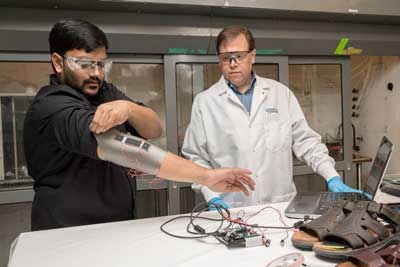
| Fabric coated with this sensing technology could be used in future “smart garments” where the sensors are slipped into the soles of shoes or stitched into clothing for detecting human motion. | |
 |
|
| Sagar Doshi (left) and Erik Thostenson test an elbow sleeve outfitted with one of their novel sensors. (Image: University of Delaware) | |
| Carbon nanotubes give this light, flexible, breathable fabric coating impressive sensing capability. When the material is squeezed, large electrical changes in the fabric are easily measured. | |
| “As a sensor, it’s very sensitive to forces ranging from touch to tons,” said Erik Thostenson, an associate professor in the Departments of Mechanical Engineering and Materials Science and Engineering. | |
| Nerve-like electrically conductive nanocomposite coatings are created on the fibers using electrophoretic deposition (EPD) of polyethyleneimine functionalized carbon nanotubes. | |
| “The films act much like a dye that adds electrical sensing functionality,” said Thostenson. “The EPD process developed in my lab creates this very uniform nanocomposite coating that is strongly bonded to the surface of the fiber. The process is industrially scalable for future applications.” | |
| Now, researchers can add these sensors to fabric in a way that is superior to current methods for making smart textiles. Existing techniques, such as plating fibers with metal or knitting fiber and metal strands together, can decrease the comfort and durability of fabrics, said Thostenson, who directs UD’s Multifunctional Composites Laboratory. | |
| The nanocomposite coating developed by Thostenson’s group is flexible and pleasant to the touch and has been tested on a range of natural and synthetic fibers, including Kevlar, wool, nylon, Spandex and polyester. The coatings are just 250 to 750 nanometers thick — about 0.25 to 0.75 percent as thick as a piece of paper — and would only add about a gram of weight to a typical shoe or garment. What’s more, the materials used to make the sensor coating are inexpensive and relatively eco-friendly, since they can be processed at room temperature with water as a solvent. | |
Exploring Future Applications |
|
| One potential application of the sensor-coated fabric is to measure forces on people’s feet as they walk. This data could help clinicians assess imbalances after injury or help to prevent injury in athletes. Specifically, Thostenson’s research group is collaborating with Jill Higginson, professor of mechanical engineering and director of the Neuromuscular Biomechanics Lab at UD, and her group as part of a pilot project funded by Delaware INBRE. Their goal is to see how these sensors, when embedded in footwear, compare to biomechanical lab techniques such as instrumented treadmills and motion capture. | |
| During lab testing, people know they are being watched, but outside the lab, behavior may be different. | |
| “One of our ideas is that we could utilize these novel textiles outside of a laboratory setting — walking down the street, at home, wherever,” said Thostenson. | |
| Sagar Doshi, a doctoral student in mechanical engineering at UD, is the lead author on the paper. He worked on making the sensors, optimizing their sensitivity, testing their mechanical properties and integrating them into sandals and shoes. He has worn the sensors in preliminary tests, and so far, the sensors collect data that compares with that collected by a force plate, a laboratory device that typically costs thousands of dollars. | |
| “Because the low-cost sensor is thin and flexible the possibility exists to create custom footwear and other garments with integrated electronics to store data during their day-to-day lives,” Doshi said. “This data could be analyzed later by researchers or therapists to assess performance and ultimately bring down the cost of healthcare.” | |
| This technology could also be promising for sports medicine applications, post-surgical recovery, and for assessing movement disorders in pediatric populations. | |
| “It can be challenging to collect movement data in children over a period of time and in a realistic context,” said Robert Akins, Director of the Center for Pediatric Clinical Research and Development at the Nemours – Alfred I. duPont Hospital for Children in Wilmington and affiliated professor of materials science and engineering, biomedical engineering and biological sciences at UD. “Thin, flexible, highly sensitive sensors like these could help physical therapists and doctors assess a child’s mobility remotely, meaning that clinicians could collect more data, and possibly better data, in a cost-effective way that requires fewer visits to the clinic than current methods do.” | |
| Interdisciplinary collaboration is essential for the development of future applications, and at UD, engineers have a unique opportunity to work with faculty and students from the College of Health Sciences on UD’s Science, Technology and Advanced Research (STAR) Campus. | |
| “As engineers, we develop new materials and sensors but we don’t always understand the key problems that doctors, physical therapists and patients are facing,” said Doshi. “We collaborate with them to work on the problems they are facing and either direct them to an existing solution or create an innovative solution to solve that problem.” | |
| Thostenson’s research group also uses nanotube-based sensors for other applications, such as structural health monitoring. | |
| “We’ve been working with carbon nanotubes and nanotube-based composite sensors for a long time,” said Thostenson, who is affiliated faculty at UD’s Center for Composite Materials (UD-CCM). Working with researchers in civil engineering his group has pioneered the development of flexible nanotube sensors to help detect cracks in bridges and other types of large-scale structures. | |
| “One of the things that has always intrigued me about composites is that we design them at varying lengths of scale, all the way from the macroscopic part geometries, an airplane or an airplane wing or part of a car, to the fabric structure or fiber level. Then, the nanoscale reinforcements like carbon nanotubes and graphene give us another level to tailor the material structural and functional properties. Although our research may be fundamental, there is always an eye towards applications. UD-CCM has a long history of translating fundamental research discoveries in the laboratory to commercial products through UD-CCM’s industrial consortium.” |
| Source: University of Delaware |
Proiectarea nanocristalelor pentru optoelectronica mai eficienta(Designing nanocrystals for more efficient optoelectronics)
Lucrările lor introduc o nouă clasă de sisteme nanocrystal-in-glass, care sporesc eficiența optoelectronicii, cum ar fi fotovoltaica și divizarea apelor induse de lumină.Această strategie va ajuta la proiectarea unor nanomateriale personalizate. Cercetătorii sugerează acum să utilizeze strategia prezentată pentru nanocompozitele semiconductoare relevante din punct de vedere tehnologic și sistemele nanoparticule în sticlă.
| Posted: Aug 15, 2018 | |
Designing nanocrystals for more efficient optoelectronics(Nanowerk News) New artificial materials for semiconductors used in solar cells or photoelectrochemical cells that are designed from scratch with totally new and tailored properties: this is the latest research topic of Stefan Wippermann, head of the group “Atomistic Modelling“ at the Max-Planck-Institut für Eisenforschung), and his team. They characterized for the first time with atomic resolution a typical material system and are able to set design principles. |
|
| Their work introduces a new class of nanocrystal-in-glass systems, which increase the efficiency of optoelectronics such as photovoltaics and light-induced water splitting. | |
| The Max Planck researchers published their latest findings in the journal Nature Nanotechnology(„Surface chemistry and buried interfaces in all-inorganic nanocrystalline solids”). | |
 |
|
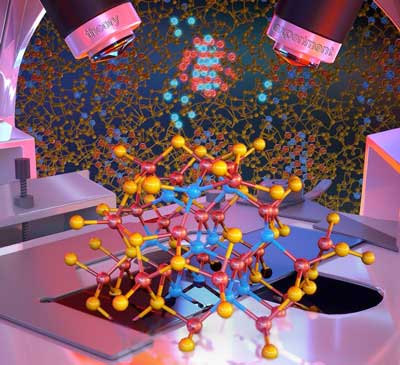
| The luminescent atoms in the image show a nanocrystal which is characterized with atomistic resolution, including its interface chemistry. (Image: Peter Allen) | |
| Nanocrystals can be used as “artificial atoms” to create designer materials for electronic applications and solar energy conversion as they are controllable, potentially non-toxic and earth-abundant. In collaboration with the groups of Dmitri Talapin and Giulia Galli, University of Chicago, wet-chemical techniques were used to synthesize those nanocrystals and assemble them into semiconducting nanocomposites. | |
| “One great advantage of designing nanocrystals is that we are able to choose their properties”, explains Wippermann. “As we develop our own “atoms”, we do not rely anymore on the chemical properties of elements but are able to design materials with target properties through nanostructuring.” | |
| That means the researchers can abstain for example from toxic or rare elements. And even though their current model system is still using toxic elements, they embed the nanocrystals into solid matrices so that the nanocrystals are not spread into air. | |
| “The current key challenge is not the production of the nanocrystals themselves but rather the understanding and controlling of their interface chemistry and defects, as their surfaces and interfaces are only a few nanometres in size and buried inside the material”, says Wippermann. | |
| He and his team produced and analysed buried interfaces in solids of indium arsenide nanoparticles capped with thiostannate (Sn2S64-) ligands as prototypical nanocomposites. The ligands are used during the synthesis of the nanocomposites. With the help of theoretical and experimental techniques they found that the ligands are not adsorbed as intact units but decompose upon contact with the nanocrystal surface, forming an amorphous matrix around the nanocrystals. | |
| Exactly this matrix influences the electronic transport of the nanocrystal solids, as the decomposed ligands form a passivation layer on the nanocrystal surface and only on top of this layer an intact ligand may adsorb. | |
 |
|
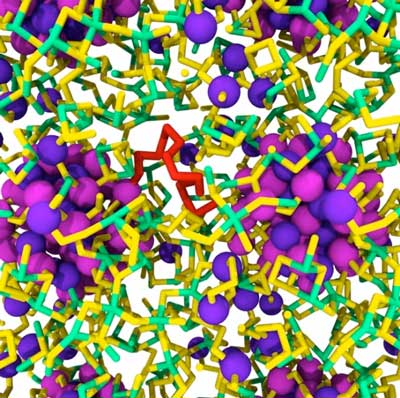
| Indium arsenide nanocrystals embedded in amorphous SnS3. Magenta and violet balls, green and yellow tubes denote indium, arsenic, tin and sulphur atoms, respectively. A sulphur chain in red. (Image: Stefan Wippermann) | |
| Another passivation mechanism is the incorporation of sulphur into the subsurface layer. Arsenic in turn diffuses into the matrix, leading to the formation of characteristic defects. These defects explain the observed switching between positive and negative photoconductivity. Simulations showed that the indium arsenide nanocrystals draw sulphur from the matrix leading to the formation of a sulphur shell around the nanocrystals. | |
| Sulphur also affects the amount and character of defects in the nanocomposite: A high sulphur content reduces the number of dangling bond defects in the nanocomposite and leads to the formation of sulphur chains acting as hole-conducting interconnects between the nanocrystals. | |
| The Max Planck scientists show that the properties of nanocrystal-based solids are influenced by the size, shape, composition, surface chemistry and mutual interactions of nanocrystals. The strong quantum confinement of charge carriers inside the nanocrystals enable efficient carrier multiplication, where a single high energy photon creates multiple electron-hole pairs, which contribute to the conductivity. | |
| This way optoelectronics can be made more efficient. Nanocrystals capped with molecular metal chalcogenide complexes have especially high electron mobilities, which allow for fast extraction of the photogenerated charges. The scientists established a strategy to characterize buried interfaces in inorganic nanocomposites and more generally nanoparticle-in-glass systems. | |
| This strategy will help in designing tailor-made nanomaterials. The researchers now suggests to employ the presented strategy to technologically relevant semiconductor nanocomposites and nanoparticle-in-glass systems. |
| Source: Max-Planck-Institut für Eisenforschung |
Nanoparticulele magnetice trag ultimele picături de ulei din apele din puț(Magnetic nanoparticles pull last drops of oil from well water)
Laboratorul Rice al inginerului chimic Sibani, Lisa Biswal, a realizat un compus cu nanoparticule magnetice care separă eficient picăturile de țiței din apa produsă, care s-au dovedit dificil de îndepărtat prin metodele actuale.Nanoparticulele magnetice trag ultimele picături de ulei din apele din puț
| Posted: Aug 15, 2018 | |
Magnetic nanoparticles pull last drops of oil from well water(Nanowerk News) Oil and water tend to separate, but they mix well enough to form stable oil-in-water emulsions in produced water from oil reservoirs to become a problem. Rice University scientists have developed a nanoparticle-based solution that reliably removes more than 99 percent of the emulsified oil that remains after other processing is done. |
|
| The Rice lab of chemical engineer Sibani Lisa Biswal made a magnetic nanoparticle compound that efficiently separates crude oil droplets from produced water that have proven difficult to remove with current methods. | |
| The research is detailed in a paper in the Royal Society of Chemistry journal Environmental Science: Water Research & Technology („Recyclable amine-functionalized magnetic nanoparticles for efficient demulsification of crude oil-in-water emulsions”). | |
 |
|
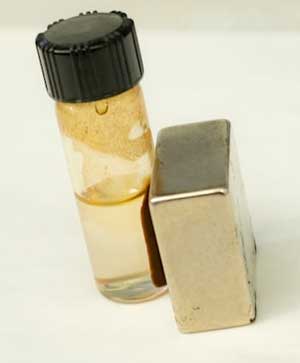
| Rice University engineers have developed magnetic nanoparticles that separate the last droplets of oil from produced water at wells. The particles draw in the bulk of the oil and are then attracted to the magnet, as demonstrated here. (Image:Jeff Fitlow) | |
| Produced water comes from production wells along with oil. It often includes chemicals and surfactants pumped into a reservoir to push oil to the surface from tiny pores or cracks, either natural or fractured, deep underground. Under pressure and the presence of soapy surfactants, some of the oil and water form stable emulsions that cling together all the way back to the surface. | |
| While methods exist to separate most of the oil from the production flow, engineers at Shell Global Solutions, which sponsored the project, told Biswal and her team that the last 5 percent of oil tends to remain stubbornly emulsified with little chance to be recovered. | |
| “Injected chemicals and natural surfactants in crude oil can oftentimes chemically stabilize the oil-water interface, leading to small droplets of oil in water which are challenging to break up,” said Biswal, an associate professor of chemical and biomolecular engineering and of materials science and nanoengineering. | |
| The Rice lab’s experience with magnetic particles and expertise in amines, courtesy of former postdoctoral researcher and lead author Qing Wang, led it to combine techniques. The researchers added amines to magnetic iron nanoparticles. Amines carry a positive charge that helps the nanoparticles find negatively charged oil droplets. Once they do, the nanoparticles bind the oil. Magnets are then able to pull the droplets and nanoparticles out of the solution. | |
| “It’s often hard to design nanoparticles that don’t simply aggregate in the high salinities that are typically found in reservoir fluids, but these are quite stable in the produced water,” Biswal said. | |
| The enhanced nanoparticles were tested on emulsions made in the lab with model oil as well as crude oil. | |
| In both cases, researchers inserted nanoparticles into the emulsions, which they simply shook by hand and machine to break the oil-water bonds and create oil-nanoparticle bonds within minutes. Some of the oil floated to the top, while placing the test tube on a magnet pulled the infused nanotubes to the bottom, leaving clear water in between. | |
| Best of all, Biswal said, the nanoparticles can be washed with a solvent and reused while the oil can be recovered. The researchers detailed six successful charge-discharge cycles of their compound and suspect it will remain effective for many more. | |
| She said her lab is designing a flow-through reactor to process produced water in bulk and automatically recycle the nanoparticles. That would be valuable for industry and for sites like offshore oil rigs, where treated water could be returned to the ocean. |
| Source: Rice University |