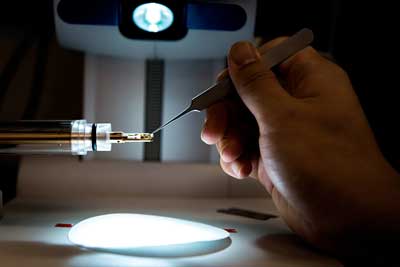
„Microelementele verticale flexibile verticale pot fi utilizate în ceasuri inteligente cu consum redus de energie, afișaje mobile și iluminat ușor de purtat. În plus, aceste dispozitive optoelectrice flexibile sunt potrivite pentru aplicații biomedicale, cum ar fi știința creierului, tratamentul fototerapeutic și lentilele de contact biosenzori.“
Posted: Jan 29, 2018
Researchers develop flexible vertical micro LED (w/video)
(Nanowerk News) A Korea Advanced Institute of Science and Technology (KAIST) research team led by Professor Keon Jae Lee from the Department of Materials Science and Engineering and Professor Daesoo Kim from the Department of Biological Sciences has developed flexible vertical micro LEDs (f-VLEDs) using anisotropic conductive film (ACF)-based transfer and interconnection technology. The team also succeeded in controlling animal behavior via optogenetic stimulation of the f-VLEDs.
Flexible micro LEDs have become a strong candidate for the next-generation display due to their ultra-low power consumption, fast response speed, and excellent flexibility. However, the previous micro LED technology had critical issues such as poor device efficiency, low thermal reliability, and the lack of interconnection technology for high-resolution micro LED displays.
The research team has designed new transfer equipment and fabricated a f-VLED array (50×50) using simultaneous transfer and interconnection through the precise alignment of ACF bonding process. These f-VLEDs achieved optical power density (30 mW/mm2) three times higher than that of lateral micro LEDs, improving thermal reliability and lifetime by reducing heat generation within the thin film LEDs.
These f-VLEDs (thickness: 5 micrometre, size: below 80 micrometre) can be applied to optogenetics for controlling the behavior of neuron cells and brains. In contrast to the electrical stimulation that activates all of the neurons in brain, optogenetics can stimulate specific excitatory or inhibitory neurons within the localized cortical areas of the brain, which facilitates precise analysis, high-resolution mapping, and neuron modulation of animal brains. (Refer to the author’s previous ACS Nano paper „Optogenetic Mapping of Functional Connectivity in Freely Moving Mice via Insertable Wrapping Electrode Array Beneath the Skull”)
In this work, they inserted the innovative f-VLEDs into the narrow space between the skull and the brain surface and succeeded in controlling mouse behavior by illuminating motor neurons on two-dimensional cortical areas located deep below the brain surface.
Comparison of micro-LEDs Technology. (IMage: KAIST)
Professor Lee said, „The flexible vertical micro LED can be used in low-power smart watches, mobile displays, and wearable lighting. In addition, these flexible optoelectronic devices are suitable for biomedical applications such as brain science, phototherapeutic treatment, and contact lens biosensors.”
au creat un tip complet nou de mușchi moleculară artificială dintr-un polimer capabil de ridicare greu;Cercetătorii se uită acum la modul în care își pot împerechea polimerul funcțional nou cu alții care sunt mai rezistenți și capabili să ridice sarcini mai grele. Ei vor, de asemenea, să dau seama cum să controleze mușchii artificiale moleculare folosind electrozi. Această acțiune ar fi similară cu modul în care semnalele electrice sunt transmise în organism și ar putea deschide calea spre viitoarele aplicații protetice.
Posted: Jan 29, 2018
New molecular muscle responds to visible light
(Nanowerk News) Picture a tiny, makeshift muscle that can curl a 20 milligram suspended weight when exposed to light. Under the right conditions, another mix packs enough power to bench-press a dime.
Researchers at Washington University in St. Louis have created a completely new kind of artificial molecular muscle from a polymer that’s capable of some heavy lifting — relatively speaking.
“The external trigger that initiates the actuation process can be something as simple as sunlight,” said Jonathan Barnes, assistant professor of chemistry in Arts & Sciences and a 2017 Packard Fellow. The novel polymer, which changes color and contracts when exposed to visible light, is described in a Jan. 24 publication of a special issue of Macromolecular Rapid Communications(„Photoredox-Based Actuation of an Artificial Molecular Muscle”).
The polymer was attached to a slip of black electrical tape. Exposed to blue light, the artificial molecular muscle moved a 20 milligram weight several centimeters from its starting position. (Image: Barnes laboratory, Washington University in St. Louis)
Barnes and his team have been working on their proof of concept for the novel redox-responsive polymer — one that contracts when electrons are added (reduction) and expands when they are taken away (oxidation) — since he started at Washington University less than two years ago.
Last fall, they demonstrated that they could successfully build their functional polymer and incorporate it into a pliant, bulk material called a hydrogel. The resulting material could be contracted to one-tenth its original volume and then expanded back to its original size, its long polymer chains delicately folding and unfolding in three dimensions.
The hydrogel contains 5 percent polymer overall, of which only 5 percent is the new, functional polymer; the rest is just water. This means that only 0.25 percent of the total hydrogel is the functional polymer, an incredibly low number in the field.
“If you look at other materials, the active polymer is usually in every link,” said Angelique Greene, a postdoctoral fellow in the Barnes laboratory. “Ours is very dilute, and yet our hydrogels still performed at a comparable and sometimes even better rate.”
Pulling their own weight
But the molecular muscle still needed to be triggered by chemical reduction in a wet solution. To address the slosh factor, the researchers then introduced visible-light-absorbing photoredox catalysts, embedded in the gel, and moved their muscles onto dry ground.
It was time for a strength test.
“We wanted to demonstrate that it could not only change shape, or bend, or turn a different color, but actually do work,” Barnes said.
The researchers affixed their best-performing gel to a piece of black electrical tape, and then attached a small, light piece of aluminum wire holding a small 20 milligram weight on the bottom. They exposed it to a blue light, and, after five hours, the polymer had moved the suspended weight several centimeters from its starting position.
“Here we have a lot fine control,” said Kevin Liles, a PhD candidate in chemistry who co-wrote the new study, along with Greene. “We can irradiate the polymer for a certain amount of time, stop it at a certain number of degrees (of bend), or irradiate a certain portion and get it to contract in certain areas.”
Five hours might seem like a long time to move a few centimeters, but Barnes isn’t worried that Mother Nature does it faster.
“If you’ve ever seen a flower or plant on the side of a mountain, it always bends toward where the light is,” Barnes said. “Nature finds a way to adapt to optimize the amount of light source that hits its petals. This material in principle does the exact same thing.”
The researchers are now looking at how to pair their novel functional polymer with others that are tougher and capable of lifting heavier loads. They also want to figure out how to control the artificial molecular muscles using electrodes. This action would be similar to the way that electrical signals are transmitted in the body, and could pave the way toward future prosthetic applications.
Cercetătorii au demonstrat cum să creeze un aliaj de aluminiu super-puternic care rivalizează rezistența oțelului inoxidabil, un avans cu potențiale aplicații industriale.Acoperirile din aliaj de aluminiu-fier rezultat „nanotwinned” s-au dovedit a fi unul dintre cele mai puternice aliaje de aluminiu create vreodată, comparabile cu oțelurile cu rezistență ridicată.
Posted: Jan 26, 2018
New research yields super-strong aluminum alloy
(Nanowerk News) Researchers have demonstrated how to create a super-strong aluminum alloy that rivals the strength of stainless steel, an advance with potential industrial applications.
“Most lightweight aluminum alloys are soft and have inherently low mechanical strength, which hinders more widespread industrial application,” said Xinghang Zhang, a professor in Purdue University’s School of Materials Engineering. “However, high-strength, lightweight aluminum alloys with strength comparable to stainless steels would revolutionize the automobile and aerospace industries.”
New research shows how to alter the microstructure of aluminum to impart greater strength and ductility. Findings were detailed in two new research papers. The work was led by a team of researchers that included Purdue postdoctoral research associate Sichuang Xue and doctoral student Qiang Li.
A sample is readied for analysis using a transmission electron microscope. (Image: Marshall Farthing)
The new high-strength aluminum is made possible by introducing “stacking faults,” or distortions in the crystal structure. While these are easy to produce in metals such as copper and silver, they are difficult to introduce in aluminum because of its high “stacking fault energy.”
A metal’s crystal lattice is made up of a repeating sequence of atomic layers. If one layer is missing, there is said to be a stacking fault. Meanwhile, so-called “twin boundaries” consisting of two layers of stacking faults can form. One type of stacking fault, called a 9R phase, is particularly promising, Zhang said.
“It has been shown that twin boundaries are difficult to be introduced into aluminum. The formation of the 9R phase in aluminum is even more difficult because of its high stacking fault energy,” Zhang said. “You want to introduce both nanotwins and 9R phase in nanograined aluminum to increase strength and ductility and improve thermal stability.”
Now, researchers have learned how to readily achieve this 9R phase and nanotwins in aluminum.
“These results show how to fabricate aluminum alloys that are comparable to, or even stronger than, stainless steels,” he said. “There is a lot of potential commercial impact in this finding.”
Xue is lead author of the Nature Communications paper, which is the first to report a “shock-induced” 9R phase in aluminum. Researchers bombarded ultrathin aluminum films with tiny micro-projectiles of silicon dioxide, yielding 9R phase.
“Here, by using a laser-induced projectile impact testing technique, we discover a deformation-induced 9R phase with tens of nanometers in width,” Xue said.
The microprojectile tests were performed by a research group at Rice University, led by professor Edwin L. Thomas, a co-author of the Nature Communications paper. A laser beam causes the particles to be ejected at a velocity of 600 meters per second. The procedure dramatically accelerates screening tests of various alloys for impact-resistance applications.
“Say I want to screen many materials within a short time,” Zhang said. “This method allows us to do that at far lower cost than otherwise possible.”
Li is lead author of the Advanced Materials paper, which describes how to induce a 9R phase in aluminum not by shock but by introducing iron atoms into aluminum’s crystal structure via a procedure called magnetron sputtering. Iron also can be introduced into aluminum using other techniques, such as casting, and the new finding could potentially be scaled up for industrial applications.
The resulting “nanotwinned” aluminum-iron alloy coatings proved to be one of the strongest aluminum alloys ever created, comparable to high-strength steels.
“Molecular-dynamics simulations, performed by professor Jian Wang’s group at the University of Nebraska, Lincoln, showed the 9R phase and nanograins result in high strength and work-hardening ability and revealed the formation mechanisms of the 9R phase in aluminum,” Zhang said. “Understand new deformation mechanisms will help us design new high strength, ductile metallic materials, such as aluminum alloys.”
One potential application might be to design wear- and corrosion-resistant aluminum alloy coatings for the electronics and automobile industries.
Se dezvăluie un proces de reciclare ecologic pentru deșeurile din polistiren expandat (EPS), utilizând procesul de dizolvare și procesul de extracție CO 2 supercritică . Procesul de reciclare poate permite condensarea unui polistiren expandat (EPS) prin dizolvarea EPS într-un solvent și unul sau mai mulți aditivi, obținându-se astfel o soluție de polistiren expandat (EPS). Procesul de reciclare poate permite în continuare purificarea soluției EPS folosind cel puțin un procedeu de filtrare și un proces de separare pentru a obține o soluție de polistiren expandat purificat (EPS). Mai mult, procesul de reciclare poate permite extragerea polistirenului din solvent în soluția de polistiren expandat purificat (EPS) folosind un CO 2 supercriticmetoda de extracție pentru obținerea unui polistiren reciclat. Procesul de reciclare permite reducerea semnificativă a volumului EPS, economisind astfel costurile logistice, precum și facilitarea creșterii cantității, calității și purității polistirenului reciclat.
Oamenii de stiinta de astazi raporteaza in ACS Applied Nano Materials ( „Nacre Mimetic cu Nanowire de argint incorporat pentru incalzire rezistiva” ) un material hibrid compus din imitatie de perle combinata cu nanofire de argint care functioneaza ca un incalzitor, cu beneficiul suplimentar de flexibilitate ridicata, sugerand un potential rol în dispozitive portabile.Nacre, altfel cunoscut sub numele de mama de perle, formează învelișul opalescent exterior al unei perle și învelișul interior al cochililor de moluscă. Oamenii de știință au fost mult timp interesați de acest material ușor, dar puternic pentru o gamă largă de aplicații, fabricând substanțe care imită pergul pentru utilizare ca agenți de întârziere a incendiilor, bariere de gaz și conductori.Materialul compozit a prezentat proprietăți excelente de încălzire, generând căldură, deoarece curentul electric a fost trecut prin nanofirele de argint, chiar și atunci când a fost îndoit în mod repetat sau când a fost laminat într-un tub. Într-un experiment de dovadă a conceptului, cercetătorii au plasat pe încălzitor un plasture cu hidrogel încărcat cu antibiotice sensibil la căldură. Întoarcerea la temperatură a declanșat o modificare a fazei în plasture, eliberând antibioticele.
Posted: Jan 24, 2018
Pearly material for bendable heating elements
(Nanowerk News) The iridescent shimmer of a string of pearls may one day be more than pretty adornment. Scientists now report in ACS Applied Nano Materials („Nacre Mimetic with Embedded Silver Nanowire for Resistive Heating”) a hybrid material consisting of imitation pearl combined with silver nanowires that works as a heater, with the added benefit of high flexibility, suggesting a potential role in wearable devices.
Nacre, otherwise known as mother of pearl, makes up the opalescent exterior coating of a pearl and the inner coating of mollusk shells. Scientists have long been interested in this lightweight, yet strong material for a range of applications, manufacturing substances that imitate nacre for use as fire retardants, gas barriers and conductors.
Flexible conductors made from silver nanowires and a flexible plastic substrate called polyethylene terephthalate (PET) are being developed in laboratories, but researchers are running into problems with adhesion between PET and the silver nanowires. So, Hongwei Duan and colleagues wanted to explore a nacre mimetic as the substrate for silver nanowires to develop a flexible resistive heater.
The researchers prepared the nacre mimetic from a synthetic nanoclay coated with a polyvinyl alcohol polymer that self-assembled upon water removal, generating a flexible transparent sheet. Then, they transferred silver nanowires from a filter membrane to the nacre mimetic sheet by hot pressing the pearly substrate against the membrane. The silver nanowires adhered to the new material better than to traditional flexible plastic substrates, resisting removal with scotch tape, a standard test of adhesion.
The composite material showed excellent heating properties, producing heat as electric current was passed through the silver nanowires, even when bent repeatedly or when rolled up into a tube. In a proof-of-concept experiment, the researchers placed a heat-sensitive antibiotic-loaded hydrogel patch onto the heater. Turning up the temperature triggered a phase change in the patch, releasing the antibiotics.
Membranele se bazează pe polimeri care se auto-asamblează, formează nanostructuri și expun funcționalități chimice care le permit să îndeplinească sarcini care nu sunt așteptate de la membrane. Ei elimină nu numai bacteriile, ci și metalele grele, reacționează la stimuli și separă moleculele mici de structura chimică. În ansamblu, obiectivul este de a dezvolta membrane care să contribuie la generarea mai eficientă a apei curate și mai sigure și la separarea substanțelor chimice cu consum redus de energie.
Posted: Jan 23, 2018
New filters could enable manufacturers to perform highly selective chemical separation
Tufts University scientists said the sophisticated membranes can separate organic compounds not only by size–as small as a molecule–but also by their electrostatic charge, meaning manufacturers could sort compounds by both size and type. The membranes use a simple, scalable process in which a specialty polymer is dissolved in a solvent and coated onto a porous support. The polymer self-assembles to create approximately 1 nanometer size channels that mimic biological systems, such as ion channels, which control the passage of compounds through cell membranes with great effectiveness.
Membrane structure; the top layer (pink) shows selective layer morphology containing packed micelles. The spaces between the micelles form membrane nanopores with size of 1-3 nanometer. (Image: Ilin Sadeghi, study co-author and Tufts University Ph.D. candidate)
Corresponding-author Ayse Asatekin, Ph.D., a chemical and biological engineering professor in the Tufts School of Engineering, said the team’s discovery responds to industry-wide calls for the development of more efficient solutions for separating chemicals, which accounts for 10 to 15 percent of global energy use, according to a report in Nature.
„Our study is promising because it is the first demonstration of a new way of making these selective membranes that are so important for chemical manufacturing,” she said. „Designing very selective membranes that can perform these complex separations could really boost energy efficiency and greatly reduce manufacturing waste.”
The newly designed membranes can:
Allow neutral compounds to pass through 250 times faster than charged compounds of similar size;
When charged and uncharged compounds are mixed, prevent the charged compound from passing through at all–its passage is averted because the neutral compound gets into the channels first and prevents the charge compound from entering; and
Provide the ability to separate charged and uncharged compounds in various filtration systems.
Asatekin noted that the charge-based separation is enhanced when the solution contains a mixture of solutes, which indicates that the membrane structure successfully mimics how biological systems such as ion channels operate. This discovery has led the researchers to believe that this approach can be used to address other separations, and bring about selectivities above and beyond what can be attained using conventional membranes.
„This means we could potentially make filters that are capable of separations that cannot be achieved currently. Filters today usually are limited to separating big from small, and we want to be able to separate compounds that are the same size but different,” Asatekin said.
Asatekin noted some potential applications for this project include the purification of antibiotics, amino acids, antioxidants and other small molecule biologic compounds, and the separation of ionic liquids from sugar in biorefinery facilities. However, she said she believes this general approach may potentially be adapted further to different separations with further research.
Asatekin serves as the principal investigator of the Smart Polymers, Membranes, and Separations Laboratory at Tufts. The lab aims to develop the next generation of membranes by designing them from molecules up. The membranes rely on polymers that self-assemble, form nanostructures, and expose chemical functionalities that enable them to perform tasks normally not expected from membranes. They remove not only bacteria but also heavy metals, react to stimuli, and separate small molecules by chemical structure. Overall, the goal is to develop membranes that will help generate clean, safe water more efficiently and separate chemicals with lower energy use.
Ei au reușit să creeze primul metamaterial cuantic al lumii, care poate fi folosit ca element de control în circuitele electrice superconductoare .Metamaterialele sunt substanțe ale căror proprietăți sunt determinate nu atât de atomii din care sunt compuși, cât și de structura structurală a atomilor. Fiecare structură are sute de nanometri și are un set propriu de proprietăți care dispar atunci când oamenii de știință încearcă să separe materialul în componentele sale. De aceea, o astfel de structură se numește meta-atom (nu trebuie confundată cu atomii obișnuiți ai Mendeleev’s Periodic Table). Orice substanță constând din meta-atomi se numește meta-material.
Posted: Jan 23, 2018
Scientists develop quantum metamaterial from complex twin qubits
(Nanowerk News) An international team consisting of Russian and German scientists has made a breakthrough in the creation of seemingly impossible materials. They have managed to create the world`s first quantum metamaterial which can be used as a control element in superconducting electrical circuits (Nature Communications, „Magnetically induced transparency of a quantum metamaterial composed of twin flux qubits”).
Superconducting quantum metamaterial consisting of an array of 15 twin qubits embedded in a coplanar wave guide. An SEM image of twin flux qubits (above) and a whole structure (below) are shown. Each qubit consists of two superconducting loops sharing one common central Josephson junction (α-junction) and four identical Josephson junctions located on the outer parts of the loops. The α-junction allows the magnetic flux to tunnel between the loops. The inset is a schematic of a single meta-atom–the twin flux qubit; the phases on nodes are shown. (Image: NUST MISIS)
Metamaterials are substances whose properties are determined not so much by the atoms they consist of, but by the atoms’ structural arrangement. Each structure is hundreds of nanometers, and has its own set of properties that disappear when scientists try to separate the material into its components. That is why such a structure is called a meta-atom (not to be confused with the common atoms of Mendeleev`s Periodic Table). Any substance consisting of meta-atoms is called a meta-material.
Until recently, another difference between atoms and meta-atoms was that the properties of conventional atoms were described by quantum mechanics equations, while meta-atoms were described by classical physics equations. However, the creation of qubits led to the emergence of a potential opportunity to construct metamaterials consisting of meta-atoms whose state could be described quantum-mechanically. However, this research required the creation of unusual qubits.
„An international team of scientists from NUST MISIS, Karlsruhe Institute of Technology (Germany), and IPHT Jena (Germany), led by Professor Alexey Ustinov, head of the NUST MISIS Laboratory of Superconducting Metamaterials, has created the world`s first so-called „twin” qubit, as well as a metamaterial on its basis. Thanks to the outstanding properties of the new material, it will be possible to create one of the key elements in superconducting electronic devices”, said Alevtina Chernikova, Rector of NUST MISIS.
Kirill Shulga, a researcher at the NUST MISIS Laboratory of Superconducting Metamaterials and the first author of the project, noted that a conventional qubit consists of a scheme that includes three Josephson junctions. The twin qubit however is composed of five junctions that are symmetric to the Central axis (see diagram).
The energy of the ground state (a) and the transition energy hf01 of the twin qubit. The minimum point of the (b) plot corresponds to the transition of the central junction phase. (Image: NUST MISIS)
„Twin qubits were supposed to serve as a more complex system than the conventional superconducting qubits. The logic here is quite simple: a more complex (artificially complex) system, with a large number of degrees of freedom, has a higher number of factors that can influence its properties. When changing some external properties of the environment where our metamaterial is located, we can turn these properties on and off by turning the twin qubit from one state with certain properties to another with other properties”, he added.
This became apparent during the experiment, as the whole metamaterial consisting of twin qubits switched over between two different modes.
„In one of the modes, the chain of qubits transmits electronic radiation in the microwave range very well while remaining a quantum element. In another mode, it turns the superconducting phase by 180 degrees and locks the transmission of electromagnetic waves through itself. Yet it still remains a quantum system. So with the help of a magnetic field, such a material can be used as a control element in systems for quantum signals (separate photons) in circuits, from which developing quantum computers consist of”, said Ilya Besedin, an engineer at the NUST MISIS Laboratory of Superconducting Metamaterials and one of the project’s researchers.
It is hard to accurately calculate the properties of one twin qubit on a standard computer compared to the properties of a standard qubit. It is possible to reach the limit of complexity, a level close to or surpassing the capabilities of modern electronic computers, if qubits become several times more complex. Such a complex system can be used as a quantum simulator, i.e. a device that can predict or simulate properties of a certain real process or material.
As the researchers note, they had to sort out lots of theories to correctly describe the processes that occurs in quantum meta-materials.
Source: National University of Science and Technology MISIS
descriu dezvoltarea unui material catalitic ieftin și eficient pentru un tip de celulă de combustibil numită celulă de combustibil cu membrană din polimer electrolitic (PEMFC), care transformă energia chimică a hidrogenului în energie electrică și se numără printre cele mai promițătoare tipuri de celule de combustibil pentru motoarele electrice și electronice.Cercetătorii UC Riverside au dezvoltat un material catalitic ieftin și eficient pentru celulele de combustie din polimer electrolitic (PEM), care se numără printre cele mai promițătoare tipuri de celule de combustibil la motoarele electrice și electronice.Materialul pe care l-am creat poate permite producătorilor de automobile să transforme componentele structurale, cum ar fi hota sau șasiul, în elemente funcționale care ajută la alimentarea autovehiculelor”
Posted: Jan 22, 2018
Making fuel cells for a fraction of the cost
(Nanowerk News) Fuel cells have the potential to be a clean and efficient way to run cars, computers, and power stations, but the cost of producing them is limiting their use. That’s because a key component of the most common fuel cells is a catalyst made from the precious metal platinum.
In a paper published today in Small („Electrocatalytic N-Doped Graphitic Nanofiber – Metal/Metal Oxide Nanoparticle Composites”), researchers at the University of California, Riverside, describe the development of an inexpensive, efficient catalyst material for a type of fuel cell called a polymer electrolyte membrane fuel cell (PEMFC), which turns the chemical energy of hydrogen into electricity and is among the most promising fuel cell types to power cars and electronics.
Engineered carbon fibers embedded with active nanoparticles (top) can be fabricated into structural materials that are lightweight and flexible (bottom). (Image: UC Riverside)
The catalyst developed at UCR is made of porous carbon nanofibers embedded with a compound made from a relatively abundant metal such as cobalt, which is more than 100 times less expensive than platinum. The research was led by David Kisailus, the Winston Chung Endowed Professor in Energy Innovation in UCR’s Marlan and Rosemary Bourns College of Engineering.
Fuel cells, which are already being used by some carmakers, offer advantages over conventional combustion technologies, including higher efficiency, quieter operation and lower emissions. Hydrogen fuel cells emit only water.
Like batteries, fuel cells are electrochemical devices that comprise a positive and negative electrode sandwiching an electrolyte. When a hydrogen fuel is injected onto the anode, a catalyst separates the hydrogen molecules into positively charged particles called protons and negatively charged particles called electrons. The electrons are directed through an external circuit, where they do useful work, such as powering an electric motor, before rejoining the positively charged hydrogen ions and oxygen to form water.
A critical barrier to fuel cell adoption is the cost of platinum, making the development of alternative catalyst materials a key driver for their mass implementation.
Using a technique called electrospinning, the UCR researchers made paper-thin sheets of carbon nanofibers that contained metal ions – either cobalt, iron or nickel. Upon heating, the ions formed ultrafine metal nanoparticles that catalyzed the transformation of carbon into a high-performance graphitic carbon. Subsequently, the metal nanoparticles and residual nongraphitic carbon were oxidized, leading to a highly porous and useful network of metal oxide nanoparticles dispersed in a porous network of graphite.
UC Riverside researchers have developed an inexpensive, efficient catalyst material for polymer electrolyte membrane (PEM) fuel cells which are among the most promising fuel cell types to power cars and electronics. (Image: BEXIM (CC BY 4.0))
Kisailus and his team, collaborating with scientists at Stanford University, determined that the new materials performed as good as the industry standard platinum-carbon systems, but at a fraction of the cost.
„The key to the high performance of the materials we created is the combination of the chemistry and fiber processing conditions,” Kisailus said. „The remarkable electrochemical properties were primarily attributed to the synergistic effects obtained from the engineering of the metal oxide with exposed active sites and the 3D hierarchical porous graphitic structure.”
Kisailus said an added benefit of the catalytic nanocomposite was that its graphitic fiber nature provided additional strength and durability, which would enable it to serve as both a fuel cell catalyst and potentially as a structural component.
„An important challenge in making high-performance vehicles is reducing weight, both from the body of the vehicle as well as extra weight from the battery or fuel cell, without affecting safety or performance,” he said. „The material we created may enable automakers to turn structural components, such as the hood or the chassis, into functional elements that help power cars.”