Dezvoltarea rapidă a sistemelor electronice flexibile și portabile dă naștere unei game incitante de aplicații, de la ceasuri inteligente și ecrane flexibile – cum ar fi telefoane inteligente, tablete și televizoare – la țesături inteligente, sticlă inteligentă, plasturi transdermali, senzori , și altele
Posted: Feb 01, 2018
Engineers develop flexible lithium battery for wearable electronics
(Nanowerk News) The rapid development of flexible and wearable electronics is giving rise to an exciting range of applications, from smart watches and flexible displays—such as smart phones, tablets, and TV—to smart fabrics, smart glass, transdermal patches, sensors, and more. With this rise, demand has increased for high-performance flexible batteries. Up to now, however, researchers have had difficulty obtaining both good flexibility and high energy density concurrently in lithium-ion batteries.
A team led by Yuan Yang, assistant professor of materials science and engineering in the department of applied physics and mathematics at Columbia Engineering, has developed a prototype that addresses this challenge: a Li-ion battery shaped like the human spine that allows remarkable flexibility, high energy density, and stable voltage no matter how it is flexed or twisted. The study is published today in Advanced Materials („Bio-inspired, spine-like flexible rechargeable lithium-ion batteries with high energy density”).
Schematic of the structure and the fabrication process of Yang’s spine-like battery. (a) Schematic illustration of bio-inspired design, the vertebrae correspond to thick stacks of electrodes and soft marrow corresponds to unwound part that interconnects all the stacks. (b) The process to fabricate the spine-like battery, multilayers of electrodes were first cut into designed shape, then strips extending out were wound around the backbone to form spine-like structure. (Image: Yuan Yang/Columbia Engineering) (click on image to enlarge)
“The energy density of our prototype is one of the highest reported so far,” says Yang. “We’ve developed a simple and scalable approach to fabricate a flexible spine-like lithium ion battery that has excellent electrochemical and mechanical properties. Our design is a very promising candidate as the first-generation, flexible, commercial lithium-ion battery. We are now optimizing the design and improving its performance.”
Yang, whose group explores the composition and structure of battery materials to realize high performance, was inspired by the suppleness of the spine while doing sit-ups in the gym. The human spine is highly flexible and distortable as well as mechanically robust, as it contains soft marrow components that interconnect hard vertebra parts. Yang used the spine model to design a battery with a similar structure. His prototype has a thick, rigid segment that stores energy by winding the electrodes (“vertebrae”) around a thin, flexible part (“marrow”) that connects the vertebra-like stacks of electrodes together. His design provides excellent flexibility for the whole battery.
“As the volume of the rigid electrode part is significantly larger than the flexible interconnection, the energy density of such a flexible battery can be greater than 85 percent of a battery in standard commercial packaging,” Yang explains. “Because of the high proportion of the active materials in the whole structure, our spine-like battery shows very high energy density¾higher than any other reports we are aware of. The battery also successfully survived a harsh dynamic mechanical load test because of our rational bio-inspired design.”
Video demonstrating flexibility of Yang’s lithium-ion battery powering a smart watch, in flat, flexed, and twisted configurations.
Yang’s team cut the conventional anode/separator/cathode /separator stacks into long strips with multiple “branches” extending out 90 degrees from the “backbone.” Then they wrapped each branch around the backbone to form thick stacks for storing energy, like vertebrae in a spine. With this integrated design, the battery’s energy density is limited only by the longitudinal percentage of vertebra-like stacks compared to the whole length of the device, which can easily reach over 90 percent.
The battery shows stable capacity upon cycling, as well as a stable voltage profile no matter how it is flexed or twisted. After cycling, the team disassembled the battery to examine the morphology change of electrode materials. They found that the positive electrode was intact with no obvious cracking or peeling from the aluminum foil, confirming the mechanical stability of their design.
To further illustrate the flexibility of their design, the researchers continuously flexed or twisted the battery during discharge, finding that neither bending nor twisting interrupted the voltage curve. Even when the cell was continuously flexed and twisted during the whole discharge, the voltage profile remained. The battery in the flexed state was also cycled at higher current densities, and the capacity retention was quite high (84 percent at 3C, the charge in 1/3 of an hour). The battery also survived a continuous dynamic mechanical load test, rarely reported in earlier studies.
“Our spine-like design is much more mechanically robust than are conventional designs,” Yang says. “We anticipate that our bio-inspired, scalable method to fabricate flexible Li-ion batteries could greatly advance the commercialization of flexible devices.”
carburile metalice de tranziție, cunoscute sub numele de MXenes, ar putea fi folosite pentru recoltarea energiei de frecare pierdute, de exemplu, din contracțiile musculare în timpul tipăririi sau mersului pe jos.MXenes, descoperit în 2011, cuprinde una dintre cele mai mari familii de materiale bidimensionale. Acestea au o conductivitate electrică ridicată și capacitatea de absorbție a electronilor în contact cu polimerii și alte materiale. Această combinație neobișnuită de proprietăți face MXenes util ca componente pentru nanogeneratoarele triboelectrice (TENG), care transformă mișcările musculare în energie electrică. Studiul sugerează că aceste materiale avansate ar putea fi încorporate în telefoane mobile, dispozitive electronice portabile, dispozitive portabile și laptop-uri, ceea ce le va face în cele din urmă să se autodeclamă.
Posted: Feb 01, 2018
New MXene materials could capture wasted frictional energy from smartphones
(Nanowerk News) Imagine that every time you tapped out a message on your smartphone, it would create electric power instead of sapping your phone’s battery. That scenario could one day be a reality, according to a researcher at Missouri University of Science and Technology.
Writing in the February 2018 issue of the journal Nano Energy („Metallic MXenes: A New Family of Materials for Flexible Triboelectric Nanogenerators”), Dr. Vadym Mochalin, associate professor of chemistry at Missouri S&T, describes how a new family of two-dimensional transition metal carbides, known as MXenes, could be used to harvest wasted frictional energy, for example, from muscle contractions during typing or walking.
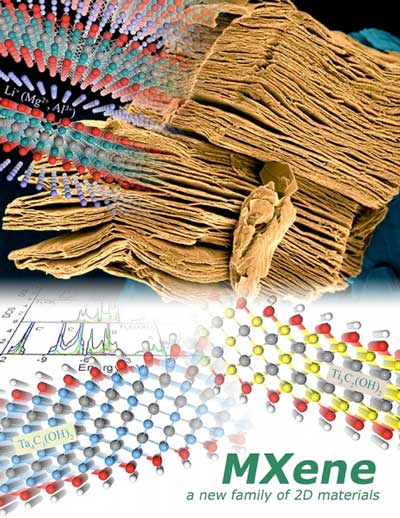
Artistic representation of scanning electron microphotograph of Ti3C2 MXene flake, superimposed with atomistic models of several MXenes and electronic density of states calculated using these models. (Image: Vadym Mochalin)
MXenes, discovered in 2011, comprise one of the largest families of two-dimensional materials. They possess high electrical conductivity and the ability to uptake electrons when in contact with polymers and other materials. This unusual combination of properties makes MXenes useful as components for triboelectric nanogenerators (TENG), which turn muscle movements into electric power. The research suggests these advanced materials could be incorporated into mobile phones, handheld electronics, wearable devices and laptops, ultimately making them self-powering.
“Exploring new chemistries and fundamental physical properties of MXenes for applications in energy storage, biology and medicine, electronics, composites, sensors and water purification is a hot area in the two-dimensional materials field,” says Mochalin.
The paper was written in collaboration with research groups from Drexel and Clemson universities.
Another study from Mochalin and his collaborators, “Saturable Absorption in 2D Ti3C2 MXene Thin Films for Passive Photonic Diodes,” was published in Advanced Materials („Saturable Absorption in 2D Ti3C2 MXene Thin Films for Passive Photonic Diodes”). This research shows how the non-linear optical properties of MXene – fullerene layered structures enable light rectification, a process similar to electrical current rectification which has been in use in electronics for decades. When compared to other two-dimensional materials, such as graphene, MXene is superior in its mechanical stability, conductivity and light radiation damage resistance, the researchers write.
A technique developed by Mochalin’s research group to deposit the nearly transparent and conductive MXene films on glass and other substrates may be used to fabricate passive saturable absorbers for generation of nanosecond pulses of high energy and peak power with solid-state bulk lasers. The high-energy ultrafast laser pulses are beneficial for processing materials where thermal influence must be minimized, for example, in drilling and cutting metals, delicate semiconductor wafers, polymeric stents, glasses, and other materials. These MXene films — only tens of nanometers in thickness — are also ideal for a wide range of applications in photonics, photovoltaics, flexible electronics, environment- and photo-sensitive sensors, and many others.
“MXenes are relatively young but already have captured a great deal of attention from scientists,” Mochalin says. “As we explore new synthetic routes to MXenes and study their fundamental physical and chemical properties, as well as their vibrational properties using Raman spectroscopy and neutron scattering, we become more and more excited about the future of MXenes. Why? Because we realize how much this family of materials has yet to offer to help us meet important societal challenges — from energy to healthcare — and to revolutionize our everyday lives.”
Working with international scholars, Mochalin’s research group at Missouri S&T leads the studies on the synthesis, characterization, computational modeling, and development of novel nanomaterials, like MXenes and nanodiamonds, for energy storage systems, composites, and biomedical applications. Mochalin involves Missouri S&T chemistry students in research — from highly-motivated undergraduates, to post-doctoral researchers. He has obtained six patents for discoveries in the fields of nanodiamonds, biodegradable composite materials, and energy storage.
Source: Missouri University of Science and Technology
MXene este unul dintre cei mai sensibili senzori de gaze raportate vreodată. Această cercetare este semnificativă, deoarece extinde gama de detectare a gazelor comune, permițându-ne să detectăm concentrații foarte scăzute pe care nu am reușit să le detectăm înainte”, a spus Yury Gogotsi, Distinsa Universitate si profesor Bach in Drexel’s College of Engineering, care a fost un autor al studiului, Drexel. Sensibilitatea ridicată a dispozitivului poate fi utilizată pentru detectarea gazelor toxice sau a poluanților găsiți în mediul nostru. „
Posted: Feb 01, 2018
A higher(er)-definition nose
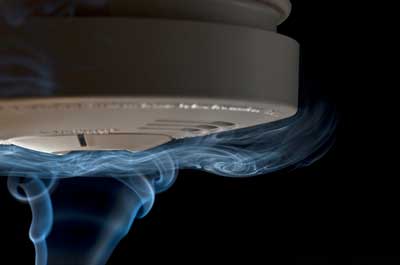
(Nanowerk News) Sensors that sniff out chemicals in the air to warn us about everything from fires to carbon monoxide to drunk drivers to explosive devices hidden in luggage have improved so much that they can even detect diseases on a person’s breath. Researchers from Drexel University and the Korea Advanced Institute of Science and Technology have made a discovery that could make our best „chemical noses” even more sensitive.
In research, recently published in the American Chemical Society journal ACS Nano („Metallic Ti3C2Tx MXene Gas Sensors with Ultrahigh Signal-to-Noise Ratio”), the team describes how a two-dimensional, metallic material called MXene can be used as a highly sensitive detector of gaseous chemicals. The paper suggests that MXene can pick up chemicals, such as ammonia and acetone, which are indicators of ulcers and diabetes, in much lower traces than sensors currently being used in medical diagnostics.
Researchers have discovered that a two-dimensional, metallic material called MXene, which was developed at Drexel, can be used to improve sensors that detect chemicals in the air. (Image: Drexel University)
„MXene is one of the most sensitive gas sensors ever reported. This research is significant because it expands the range for detection of common gases allowing us to detect very low concentrations that we were not able to detect before,” said Yury Gogotsi, PhD, Distinguished University and Bach Professor in Drexel’s College of Engineering, who was a lead Drexel author of the study. „The high sensitivity of the device may be used for detecting toxic gases or pollutants found in our environment.”
Gogotsi’s Nanomaterials Research Group, from Drexel’s Department of Materials Science and Engineering, teamed with Hee-Tae Jung, PhD, a professor at KAIST in Daejeon, South Korea to explore the gas-sensing properties of titanium carbide MXene. The key to its excellent scent-sleuthing capabilities is that MXene is both highly conductive and undergoes a measurable change of electrical conductivity in the presence of the chemical it’s designed to detect – and only when that particular chemical is present.
This discernment is called „signal-to-noise” ratio in the world of chemical sensors and it is used to rank the quality of sensors – picking up more signal and less noise is the goal. The ones in use today – mostly in medical settings to detect chemicals like acetone, ethanol and propanol, or in breathalyzers to detect alcohol – have a signal-to-noise ratio between 3-10, MXene’s is between 170 and 350, depending on the chemical.
„If the material can respond to gases by giving a strong signal, while simultaneously being conductive and achieving low electrical noise, the sensor can detect gases at very low concentrations because the signal-to-noise ratio is high – this is clearly the case with MXene,” Gogotsi said. „MXene can detect gases in the 50-100 parts per billion ranges, which is below the concentration necessary for current sensors to detect diabetes and a number of other health conditions.”
This level of sensitivity could be extremely important for detection of disease. In addition to ulcers and diabetes, breath analysis is currently being developed for early diagnosis of multiple types of cancer, cirrhosis, multiple sclerosis and kidney disease. If the chemical indicators for these diseases can be spotted in lower concentrations they are more likely to be diagnosed and treated at earlier stages.
MXene’s advantage over conventional sensor materials lies in its porous structure and chemical composition. The material is good at both allowing gas molecules to move across its surface and snagging, or adsorbing, certain ones that are chemically attracted to it, showing good selectivity.
Gogotsi’s team has been exploring MXenes since the material’s discovery at Drexel in 2011. The group has been able to create and study more than two dozen different chemical compositions for the material, which means they could be used to create sensors for a very wide variety of gasses.
In the future, Gogotsi suggests, MXene sensors could play an important role in environmental monitoring, energy harvesting and storage, as well as health care.
„The next step to advance this research will be to develop sensor sensitivity to different types of gases and improve the detection selectivity between different gases,” Gogotsi said. „We can also imagine personal sensors that will be in our smart phones or fitness trackers, monitoring body functions and the environment while we work, sleep or exercise, accessible with a tap of a finger. Improving the detection sensitivity with new materials is the first step toward making these devices a reality.”
Facilitățile americane de cercetare federală se bazează pe dispozitive conectate la internet pentru a automatiza multe funcții de bază ale clădirilor, cum ar fi ventilația, încălzirea și securitatea, precum și procese mai periculoase, cum ar fi echipamentele de decontaminare și prevenirea microbilor letale de a scăpa de laborator
Mimetizând structura pielii umane, cercetătorii au folosit o tehnică strat-cu-strat pentru a forma un strat subțire dinamic, conținând alcool polivinilic și acid tanic. Stratul exterior dur conținea acești compuși plus un strat de oxid de grafen. Când este fabricat la o anumită grosime, materialul sa vindecat cu succes atunci când a fost tăiat și, de asemenea, ar putea ucide bacteriile.
Materialul ar putea într-o bună zi să servească ca o piele electronică sau chiar ca o acoperire rezistentă la zgârieturi pe clădiri sau pe telefoane.
Posted: Jan 31, 2018
Skin-inspired graphene oxide based coating that’s as hard as teeth and can heal itself
(Nanowerk News) Self-healing smart coatings could someday make scratches on cell phones a thing of the past. But researchers often have to compromise between strength and the ability to self-repair when developing these materials.
The smart coating market is a booming industry and is only expected to grow in upcoming years. The most common smart coatings that can heal themselves are based on soft polymers that can wear out quickly. But hard coatings can be too rigid to come back together to fix a tear or scratch.
In previous research, Ming Yang and colleagues produced a stiffer, more healable coating, but its performance still needs to be optimized. In the current paper, the researchers developed a different way to make a soft, yet hard, self-healing material.
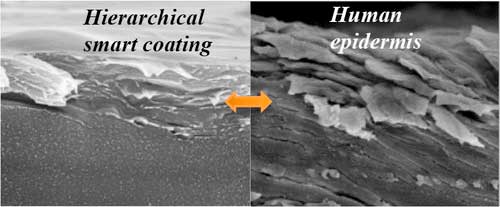
Mimicking the structure of human skin, the researchers used a layer-by-layer technique to form a soft, dynamic under layer containing polyvinyl alcohol and tannic acid. The hard outer layer contained these compounds plus a layer of graphene oxide. When fabricated at a certain thickness, the material successfully healed itself when cut, and it also could kill bacteria.
The material could someday serve as an electronic skin or even as a scratch-proof coating on buildings or phones.
O echipa de cercetatori de la Universitatea Hokkaido si Universitatea Kansai a dezvoltat roboti moleculare asistate de ADN, care se rotesc in mod autonom ca raspuns la semnalele chimice si fizice, deschizand calea pentru dezvoltarea viitoarelor nano-masini.
Cel mai mic „robot roșu” din lume măsoară 25 nanometri în diametru și 5 micrometri în lungime și prezintă un comportament roșu asemănător unor organisme motile cum ar fi peștii, furnicile și păsările.era de așteptat ca un astfel de sistem să contribuie la dezvoltarea mușchilor artificiali și a diagnosticelor genetice, precum și la construirea de nanomateriale în viitor „, a comentat Kakugo.
Posted: Jan 31, 2018
Letting molecular robots swarm like birds
(Nanowerk News) A team of researchers from Hokkaido University and Kansai University has developed DNA-assisted molecular robots that autonomously swarm in response to chemical and physical signals, paving the way for developing future nano-machines.
The world’s smallest „swarm robot” measures 25 nanometers in diameter and 5 micrometers in length, and exhibits swarming behavior resembling motile organisms such as fish, ants and birds.
„Swarm robots are one of the most elusive subjects in robotics,” says Akira Kakugo of the research team at Hokkaido University. „Fish schools, ant colonies and bird flocks show fascinating features that cannot be achieved by individuals acting alone. These include the formation of complex structures, distinct divisions of labor, robustness and flexibility, all of which emerge through local interactions among the individuals without the presence of a leader.” Inspired by these characteristics, researchers have been working to develop micro-scale swarm robots.
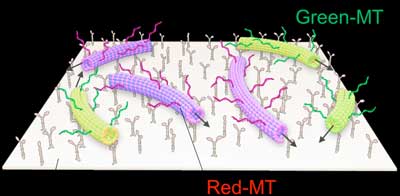
In the present study (Nature Communications, „DNA-assisted swarm control in a biomolecular motor system”), Kakugo and his collaborators have built a molecular system that is composed of the three essential components of a robot: sensors, information processors and actuators. They used cellular proteins called microtubules and kinesins as the actuator, and DNA as the information processor. Microtubules are filamentous proteins that serve as the railways in the cellular transportation system, while kinesins are motor proteins that run on the railways by consuming chemical energy obtained from hydrolysis of adenosine triphosphate (ATP). The team took a reverse strategy and built a system in which microtubules move randomly on a kinesin coated surface.
A major challenge in swarm robotics is the construction of a large number of individual robots capable of programmable self-assembly. The team addressed this issue by introducing DNA molecules into the system that are known to hybridize when they have a complementary sequence. The chemically synthesized DNA molecules with certain programs in their sequences are conjugated to the microtubules labeled with green or red fluorescence dye.
The team then monitored the motions of the DNA-conjugated microtubules gliding on a kinesin coated surface. Initially, five million microtubules moved without any interactions with each other. They then added single-strand linker DNA (l-DNA), programmed to initiate interactions among the DNA-attached microtubules. Upon introduction of the l-DNA, the microtubules began to assemble and formed swarms of a much larger size than the microtubules. When another single-strand DNA (d-DNA), programmed to dissociate the swarms was added, the microtubule swarms disappeared soon. This demonstrated that swarming of a large number of microtubules can be reversibly regulated by selectively providing the input DNA signal in the system.
Moreover, they added a photosensitive sensor to the system, azobenzene attached to the DNA molecules. They utilized isomerization of the azobenzene that occurs reversibly in response to irradiation of visible or ultraviolet light to switch on or off the interaction between DNA molecules. This enabled the photo-irradiation induced switching between the solitary and swarm state of the microtubules. The team also demonstrated that the swarms of microtubules move with a translational or rotational motion depending on the rigidity of the microtubules.
„This is the first evidence showing that swarming behavior of molecular robots can be programmed by DNA computing. The system acts as a basic computer by executing simple mathematical operations, such as AND or OR operations, leading to various structures and complex motions. It is expected that such a system contributes in developing artificial muscles and gene diagnoses, as well as building nano-machines in the future,” Kakugo commented.
Deși structurile biologice cum ar fi lumina difuză de mătase, alte materiale naturale cu microstructuri similare nu posedă modurile localizate, făcând posibilă localizarea luminii de către Anderson.
„O asemenea diferență face ca mătasea să fie deosebit de interesantă pentru transferul de căldură radiant”, a spus Kim. Mătasele au o emisivitate ridicată pentru lumina infraroșie, ceea ce înseamnă că acestea radiază ușor căldura sau radiația infraroșie, fiind în același timp un bun reflector al luminii solare. Deoarece reflexia puternică de la localizarea lui Anderson este combinată cu emisivitatea ridicată a biomoleculelor în radiația infraroșie, mătasele radiază mai multă căldură decât absorbția, făcându-l ideal pentru pasiv sau „auto-răcire”.
Posted: Jan 31, 2018
Silk fibers could be high-tech ‘natural metamaterials’ (w/video)
(Nanowerk News) New research has demonstrated how the nano-architecture of a silkworm’s fiber causes “Anderson localization of light,” a discovery that could lead to various innovations and a better understanding of light transport and heat transfer.
The discovery also could help create synthetic materials and structures that realize the phenomenon, named after Nobel laureate Philip Anderson, whose theory describes how electrons can be brought to a complete halt in materials due to their “scattering and defects.” The new findings relate not to electrons, but to light transport.
Researchers demonstrated how the nano-architecture of the silk fibers is capable of light “confinement,” a trait that could provide a range of technological applications including innovations that harness light for new types of medical therapies and biosensing. This light-confinement effect in biological and natural tissue, which was unexpected, is made possible by the Anderson localization of light, said Young Kim, an associate professor in Purdue University’s Weldon School of Biomedical Engineering.
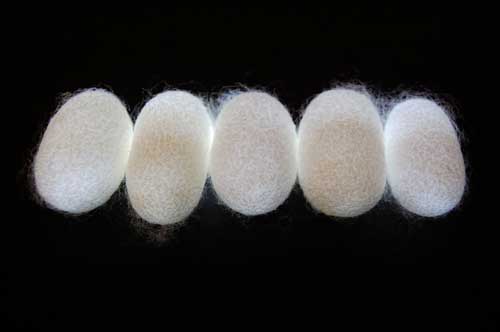
New research suggests fibers from a silkworm’s cocoon may represent “natural metamaterials,” a discovery with various technological and scientific implications. (Purdue University image/Young Kim)
The new findings suggest silk fibers may represent “natural metamaterials” and “natural metastructures,” Kim said.
Various research groups have created synthetic “metamaterials” capable of the ultra-efficient control of light. However, metamaterials have limitations because they are often difficult to scale up for commercial production and pose other challenges. Because silk’s nano-architecture is “disordered” instead of meticulously designed periodic structures, the findings suggest a strategy to produce metamaterials that are less expensive to fabricate and manufacture and easier to scale up for industry.
“This is fascinating because realizing Anderson localization of light is extremely challenging, yet we now know that it can be achieved using irregular, disordered nanostructures to create highly packed nanomaterials for strong light scattering as a silkworm produces a silk fiber and spins a cocoon shell in nature,” Kim said.
“Our findings could open up new possibilities for metamaterials and metastructures,” said Kim, who is leading research to better understand the underlying reasons for silk’s white, silvery and lustrous reflection. “I know this is an oxymoron, but we are saying silk fibers represent ‘natural metamaterials’ and ‘natural metastructures.’”
The silk fibers are 10-20 microns in diameter and contain thousands of tiny nanofibrils, each around 100 nanometers wide. For perspective, a human hair is roughly 100 microns in diameter.
A silk fiber has numerous “scattering centers” inside. Anderson localization arises from this light scattering due to disorder in the nanostructure.
“Silk has many nanofibrils, which individually scatter light,” Kim said.
New research has demonstrated how the nano-architecture of a silkworm’s fiber causes „Anderson localization of light,” a discovery that could lead to various innovations and a better understanding of light transport and heat transfer.
For the Anderson localization to occur, there must be both scattering and interference between scattered light waves. Densely packed irregular nanostructures cause light waves to interfere with each other, sometimes in destructive and sometimes in constructive ways. If constructive, the light is intensified.
“If waves are constructively interfering, this forms a very high energy inside the disordered media,” Choi said.
The small size and roughly parallel arrangement of the nanofibrils are conducive to the effect. The scattering power is maximized when there are many scattering centers and when their size is comparable to the wavelength of the light, both criteria found in the silk fibers.
Whereas commercial optical fibers must be specially engineered with a reflective coating, or cladding, to allow for the confinement of light, the silk fibers are able to achieve the feat naturally due to Anderson localization of light. The Anderson localization creates “modes” that make confinement of light possible without carefully engineered periodic structures. Instead, the same confinement is possible with disordered, more random designs.
“We found that most transmission of light disappears in most of the silk surface. However, counterintuitively, in a small area we found that the energy is confined, and this confined energy is transmitted through localized modes,” Kim said. “The localized mode is a unique pathway for energy flow.”
Although biological structures such as silk diffuse light, other natural materials with similar microstructures do not possess the localized, modes making Anderson localization of light possible.
“Such a difference makes silk particularly interesting for radiative heat transfer.” Kim said. The silk has a high emissivity for infrared light, meaning it readily radiates heat, or infrared radiation, while at the same time being a good reflector of solar light. Because the strong reflectivity from Anderson localization is combined with the high emissivity of the biomolecules in infrared radiation, silk radiates more heat than it absorbs, making it ideal for passive, or “self-cooling.”
“You may have heard that silk underwear can keep you cooler in summertime and warmer in winter,” Kim said. “We have learned the basic mechanism behind this observation.”
The work is led by researchers in Purdue’s Weldon School of Biomedical Engineering; the Department of Agricultural Biology of the National Institute of Agricultural Sciences in South Korea; and the Materials and Manufacturing Directorate of the U.S. Air Force Research Laboratory. A complete list of co-authors is available in the abstract.
“Our findings could open up largely unexplored opportunities for engineering, energy, and biomedical areas,” Kim said. “However, while direct applications could be possible, we really want to learn from silk to help develop material synthesis and design processes in the future.”
a studiat perovskitul de halogenuri de plumb cu trei compoziții diferite, inclusiv clorul, bromul și iodul. Nanocristalele fabricate din aceste compuși și aliajele lor pot fi reglate pentru a emite lumină la lungimi de undă care acoperă întreaga gamă vizibilă, păstrând în același timp emisia rapidă de lumină care le conferă performanțe superioare.
Posted: Jan 31, 2018
Materials research team lights the way for more efficient LEDs
(Nanowerk News) Researchers at the U.S. Naval Research Laboratory (NRL) Center for Computational Materials Science, working with an international team of physicists, have revealed that nanocrystals made of cesium lead halide perovskites (CsPbX3), is the first discovered material which the ground exciton state is „bright,” making it an attractive candidate for more efficient solid-state lasers and light emitting diodes (LEDs) (Nature, „Bright triplet excitons in caesium lead halide perovskites”).
„The discovery of such material, and understanding of the nature of the existence of the ground bright exciton, open the way for the discovery of other semiconductor structures with bright ground excitons,” said Dr. Alexander Efros, research physicist, NRL. „An optically active bright exciton in this material emits light much faster than in conventional light emitting materials and enables larger power, lower energy use, and faster switching for communication and sensors.”
The work, which was partially sponsored by the Office of Naval Research through a program managed by Dr. Chagaan Baatar, studied lead halide perovskites with three different compositions, including chlorine, bromine, and iodine. Nanocrystals made of these compounds and their alloys can be tuned to emit light at wavelengths that span the entire visible range, while retaining the fast light emission that gives them their superior performance.
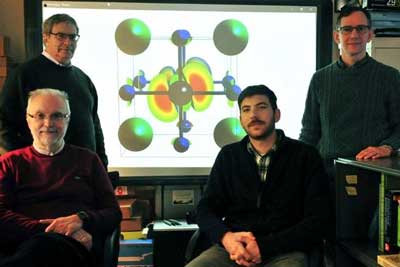
Pictured standing (l-r) are NRL researchers Dr. Alex Efros and Dr. Noam Bernstein; sitting (l-r) are Dr. John Michopoulos and Dr. John Lyons. (Image: U.S. Naval Research Laboratory)
Semiconductors emit light when bound pairs of electrons and holes, known as excitons, recombine in a process called radiative decay.
„In all known semiconductors and semiconductor nanostructures, the lowest energy state for a bound electron-hole pair is a ‘dark’ state,” said Efros. „This means the material emits light slowly and weakly.”
Because in perovskite nanocrystals the lowest energy exciton is bright, the time it takes for the electron and hole to recombine and emit light, known as their radiative lifetime, is 20 times faster than conventional materials at room temperature and 1000 times faster at cryogenic temperatures.
It is known, that quantum-dot based LEDs, or QLEDs, can suffer from „droop,” or reduced efficiency, at high pumping intensity due to processes that dissipate the energy of excitons before they have time to emit light. The decreased radiative lifetime should make it possible for LEDs based on these perovskites to use all of the energy input to create light before it is dissipated through slower processes.
„The increased rate of light emission of these materials holds great promise for various technological applications that rely on LEDs and lasers,” Efros said. „In principle, the 20 times shorter lifetime could therefore lead to 20 times more intense LEDs and lasers.” The power of a laser depends on the gain of the material it is made of, and this gain is proportional to the radiative emission rate.
Communication in free space using visible light, which makes it possible to transmit information in tight beams for long distances without fiber optic or copper cables, would also benefit from the increased light emission rates. „The maximum bandwidth of the communication system is limited by the rate at which the LEDs can turn on and off, and the shorter radiative lifetime translates directly into faster switching and therefore a higher data transmission rate,” says Efros.
Source: By Daniel Parry, Naval Research Laboratory
au creat o sursă de energie personalizabilă, care poate fi tăiată, pliată sau întinsă fără a-și pierde funcția;cum au creat sursă de alimentare portabilă, un supercapacitor, care funcționează ca o baterie rapidă de încărcare și poate fi reîncărcată de mai multe ori.Supercapacitorul editabil este fabricat din material compozit din materiale compozite cu dioxid de mangan întărit. În timp ce dioxidul de mangan este un material obișnuit pentru supercapacitorii, structura nanofire superioară, întărită cu o rețea de nanotuburi de carbon și fibre de nanoceluloză, permite ca electrozii să reziste tulpinilor asociate în timpul procesului de personalizare.
Posted: Jan 30, 2018
A customizable, fabric-like power source for wearable electronics
(Nanowerk News) Scientists at Nanyang Technological University, Singapore (NTU Singapore) have created a customizable, fabric-like power source that can be cut, folded or stretched without losing its function.
A new power source developed by NTU Singapore scientists which can be customised into any shape, such as a Chinese character in this example. (Image: NTU)
Crucially, they have made their supercapacitor customizable or “editable”, meaning its structure and shape can be changed after it is manufactured, while retaining its function as a power source. Existing stretchable supercapacitors are made into predetermined designs and structures, but the new invention can be stretched multi-directionally, and is less likely to be mismatched when it is joined up to other electrical components.
The new supercapacitor, when edited into a honeycomb-like structure, has the ability to store an electrical charge four times higher than most existing stretchable supercapacitors. In addition, when stretched to four times its original length, it maintains nearly 98 per cent of the initial ability to store electrical energy, even after 10,000 stretch-and-release cycles.
Experiments done by Prof Chen and his team also showed that when the editable supercapacitor was paired with a sensor and placed on the human elbow, it performed better than existing stretchable supercapacitors. The editable supercapacitor was able to provide a stable stream of signals even when the arm was swinging, which are then transmitted wirelessly to external devices, such as one that captures a patient’s heart rate.
A black intricately designed supercapacitor powering a light. Such customisation of the power source opens up new possibilities for wearable electronics in future. (Image: NTU)
The authors believe that the editable supercapacitor could be easily mass-produced as it would rely on existing manufacturing technologies. Production cost will thus be low, estimated at about SGD$0.13 (USD$0.10) to produce 1 cm2 of the material.
The team has filed a patent for the technology.
Professor Chen said, “A reliable and editable supercapacitor is important for development of the wearable electronics industry. It also opens up all sorts of possibilities in the realm of the ‘Internet-of-Things’ when wearable electronics can reliably power themselves and connect and communicate with appliances in the home and other environments.
“My own dream is to one day combine our flexible supercapacitors with wearable sensors for health and sports performance diagnostics. With the ability for wearable electronics to power themselves, you could imagine the day when we create a device that could be used to monitor a marathon runner during a race with great sensitivity, detecting signals from both under and over-exertion.”
In the traditional method, electrodes are made into an unchangeable structure with predesigned stretchability. In contrast, the new supercapacitors that NTU scientists developed can be edited into different shapes and structures and stretched in different directions. (Image: NTU)
The editable supercapacitor is made of strengthened manganese dioxide nanowire composite material. While manganese dioxide is a common material for supercapacitors, the ultralong nanowire structure, strengthened with a network of carbon nanotubes and nanocellulose fibres, allows the electrodes to withstand the associated strains during the customisation process.
The NTU team also collaborated with Dr. Loh Xian Jun, Senior Scientist and Head of the Soft Materials Department at the Institute of Materials Research and Engineering (IMRE), Agency for Science, Technology and Research (A*STAR).
Dr. Loh said, “Customisable and versatile, these interconnected, fabric-like power sources are able to offer a plug-and-play functionality while maintaining good performance. Being highly stretchable, these flexible power sources are promising next-generation ‘fabric’ energy storage devices that could be integrated into wearable electronics.”
Lupta împotriva cariilor dentare primește ajutor cu un nou material inteligent nanocompozit.Cu unele reglaje fine, acest nou material „inteligent” ar putea crea o umplere mai puternică și mai puține excursii la dentist.
Posted: Jan 30, 2018
The fight against tooth decay gets help with a new nanocomposite smart material
(Nanowerk News) When patients go to the dentist to fill a cavity, they’re trying to solve a problem — not create a new one. But many dental patients get some bad news: bacteria can dig under their tooth-coloured fillings and cause new cavities, called recurrent caries. These recurrent caries affect 100 million patients every year and cost an additional US$34 billion to treat.
Now, a research collaboration between the Department of Materials Science & Engineering (MSE), Faculty of Dentistry, and the Institute of Biomaterials and Biomedical Engineering (IBBME) at the University of Toronto has resulted in a novel way to minimize recurrent caries.
In a recent paper published in the journal Scientific Reports („Drug self-assembly for synthesis of highly-loaded antimicrobial drug-silica particles”), professors Ben Hatton (MSE), Yoav Finer (Dentistry) and PhD student Cameron Stewart (IBBME) tackled the issue and proposed a novel solution: a filling material with tiny particles made by self-assembly of antimicrobial drugs, designed to stop bacteria in its tracks. These particles may solve one of the biggest problems with antibacterial filling materials: how do you store enough drug within the material to be effective for someone’s entire life?
“Adding particles packed with antimicrobial drugs to a filling creates a line of defense against cavity-causing bacteria,” says Hatton. “But traditionally there’s only been enough drug to last a few weeks. Through this research we discovered a combination of drugs and silica glass that organize themselves on a molecule-by-molecule basis to maximize drug density, with enough supply to last years.” This discovery of using antimicrobials which self-assemble means the team can pack 50 times as much of the bacteria-fighting drugs into the particles.
“We know very well that bacteria specifically attack the margins between fillings and the remaining tooth to create cavities,” says Finer. “Giving these materials an antimicrobial supply that will last for years could greatly reduce this problem.”
Looking ahead, the research team plans on testing these new drug-storing particles in dental fillings, monitoring their performance when attacked by bacteria and saliva in the complex environment in the mouth. With some fine-tuning, this new ‘smart’ material could create a stronger filling and fewer trips to the dentist.