Culoarea piele electronică schimbătoare de culori ar putea avea utilizări tehnologice și protetice uzate(Color-shifting electronic skin could have wearable tech and prosthetic uses)

am explorat efectul substratului (subiacent) asupra comportamentului electromecanic al grafenului;în timp ce știința a reușit să replice aceste abilități cu pielea artificială, schimbările de culoare sunt adesea vizibile doar cu ochiul liber când materialul este pus sub o întindere mecanică imensă

Stimp11

Costul redus al hârtiei pe bază de hârtie monitorizează degradarea prin schimbarea culorii din transpirație(Low-cost paper-based skin patch monitors dehygration by changing color from sweat)

Cercetatorii au dezvoltat un patch pentru piele rapida care schimba culoarea pentru a indica niveluri diferite de hidratare, reprezentand o noua tehnologie medicala potentiala

Law-cost

Noua inteligentă textilă este mușchiul din spatele dispozitivelor de generație următoare(

a dezvoltat un material textil inteligent din nanotuburi de carbon și fibre spandex care pot atât să se simtă, cât și să se miște, ca răspuns la un stimul cum ar fi un mușchi sau articulație

0 (37)

Textile cu auto-vindecare nu numai că se repară, ci pot neutraliza substanțele chimice(Self-healing textiles not only repair themselves, but can neutralize chemicals)

Țesăturile acoperite cu SRT se auto-vindecă în apă.Multe substanțe toxice pot fi absorbite prin piele.Folosirea ulterioară a acestor acoperiri în ochiurile medicale ar putea, de asemenea, ajuta pacienții să minimalizeze infecțiile pentru recuperarea rapidă

12Stim

Forța și ductilitatea aliajelor(Strength and ductility for a Forţa şi ductilitatea aliajelor loys)

Inelele naturale ale iederei ar putea să dețină cheia unor noi abordări pentru vindecarea rănilor, armuri mai puternice pentru armată și poate chiar produse cosmetice cu o putere de ședere mai bună.iluminează particulele mici responsabile pentru capacitatea iederii de a se fixa atât de strâns pe copaci și clădiri încât poate rezista uraganelor și tornadelor.Zhang a spus ca particule bogate in aceste proteine ​​au abilitati exceptionale de adeziv -abilitati care ar putea fi folosite in avantajul multor, de la ingineri biomedicale la producatorii de vopsea

Strength

Materiale compozite din nanotuburi din nanoparticule de argilă pentru ingineria țesuturilor

Chitosan, un biopolimer biodegradabil și chimic versatil naturale, a fost utilizat în mod eficient în antibacteriene, antifungice, anti-tumoral și formula țiilor imunostimulatoare. Pentru a depăși dezavantajele schelelor chitosan pure, cum ar fi: fragilitate mecanică și rezistența biologică scăzută, schele de chitosan sunt în mod tipic dopate cu alți compuși de sprijin care să permită consolidarea mecanică, rezultând astfel compozit schele rezistente biologic.
Agaroza este o polizaharidă coloana vertebrală pe bază de galactoză izolată din alge roșii, având proprietăți mecanice remarcabile, care sunt utile în proiectarea schelelor de inginerie tisulară.
Gelatina este FORMEAZĂ de colagen prin hidroliza (ruperea structurii triplu-helix în molecule cu o singură plajă) și are o serie de avantaje față de precursorul său. Este mai puțin imunogenă Comparativ cu colagen și MENȚINEREA informațional secvențe semnal promo adeziune celulară ting, migrația, diferențierea și proliferarea.
Neregulile suprafeței porilor schele din cauza

Posted: Apr 29, 2016

Clay nanotube-biopolymer composite scaffolds for tissue engineering

(Nanowerk News) The fabrication of a prototype tissue having functional properties close to the natural ones is crucial for effective transplantation. Tissue engineering scaffolds are typically used as supports which allow cells to form tissue-like structures essentially required for the correct functioning of the cells under the conditions close to the three-dimensional tissue.

Scientists of Bionanotechnology Lab, Kazan Federal University, combined three biopolymers, chitosan and agarose (polysaccharides), and a protein gelatine, as the materials to produce tissue engineering scaffolds and demonstrated the enhancement of mechanical strength (doubled pick load), higher water uptake and thermal properties in chitosan-gelatine-agarose hydrogels doped with halloysite (Nanoscale, „Clay nanotube–biopolymer composite scaffolds for tissue engineering”).
Halloysite-Doped Biocomposite Scaffolds
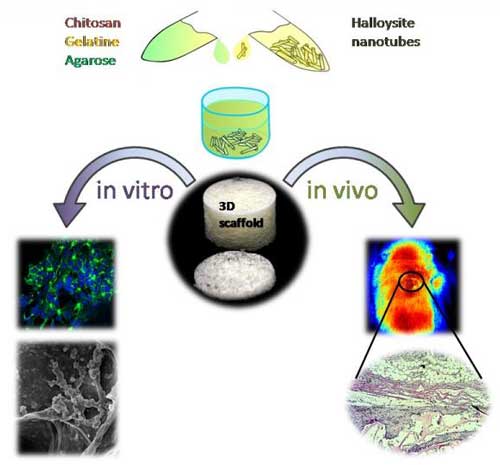
A sketch demonstrating the fabrication and in vitro and in vivo testing of novel halloysite-doped biopolymer tissue engineering scaffold. (Image: Bionanotechnology Lab, Institute of Fundamental Medicine and Biology, Kazan Federal University)
Chitosan, a natural biodegradable and chemically versatile biopolymer, has been effectively used in antibacterial, antifungal, anti-tumour and immunostimulating formulations. To overcome the disadvantages of pure chitosan scaffolds such as mechanical fragility and low biological resistance, chitosan scaffolds are typically doped with other supporting compounds which allow for mechanical strengthening, thus yielding composite biologically resistant scaffolds.
Agarose is a galactose-based backbone polysaccharide isolated from red algae, having remarkable mechanical properties which are useful in the design of tissue engineering scaffolds.
Gelatine is formed from collagen by hydrolysis (breaking the triple-helix structure into single-strand molecules) and has a number of advantages over its precursor. It is less immunogenic compared with collagen and it retains informational signal sequences promoting cell adhesion, migration, differentiation and proliferation.
The surface irregularities of the scaffold pores due to the insoluble nanosized components promote the best adhesion of the cells on scaffold materials, while the nanoparticle fillers increase the composites’ strength. Thus, researchers doped halloysite nanotubes into a chitosan-agarose-gelatine matrix to design the implantable 3D cell scaffolds.
The resulting scaffolds demonstrate the shape memory upon deformation and have the porous structure suitable for cell adhesion and proliferation which is essential for artificial tissue fabrication. Macroscopic observations have confirmed that all the samples of scaffolds exhibited the sponge-like behaviour with the shape memory and shape reconstitution after deformation both in wet and dry states.
The swelling experiments indicated that the addition of halloysite can greatly improve the hydrophilicity and wetting of composite scaffolds. The incorporation of halloysite nanotubes into the scaffolds increases the water uptake and subsequently improves the biocompatibility. The intrinsic properties of halloysite nanotubes can be used for further improving the biocompatibility of scaffolds by the loading and sustained release of different bioactive compounds. This opens the prospect for fabrication of scaffolds with defined properties for directed differentiation of cells on matrixes due to gradual release of differentiation factors.
Experiments on two types of human cancer cells (A549 and Hep3B) show that in vitro cell adhesion and proliferation on the nanocomposites occur without changes in viability and cytoskeleton formation.
Further in vivo biocompatibility and biodegradability evaluation in rats has confirmed that the scaffolds promote the formation of novel blood vessels around the implantation sites. The scaffolds show excellent resorption within six weeks after implantation in rats. Neo-vascularization observed in newly formed connective tissue placed near the scaffold allows for the complete restoration of blood flow.
The results obtained indicate that the halloysite doped scaffolds are biocompatible as demonstrated both in vitro and in vivo. In addition, they confirm the great potential of chitosan-agarose-gelatine nanocomposite porous scaffolds doped with halloysite in tissue engineering with potential for sustained nanotube drug delivery.
Source: Kazan Federal University

Read more: Clay nanotube-biopolymer composite scaffolds for tissue engineering

O piele inteligentă analogică care este auto-alimentată(An analogue smart skin that is self-powered)

O piele inteligentă auto-alimentată, ca cea recent dezvoltată de o echipă de cercetători chinezi, rezolvă fundamental această problemă. În această lucrare, oamenii de știință combină efectul triboelectric și inducția electrostatică plană și o aplică într-o structură subtilă pentru prima dată pentru a crea o piele inteligentă analogică inteligentă.

Posted: Apr 08, 2016

An analogue smart skin that is self-powered

(Nanowerk Spotlight) In order to make robots and robotic technology more human-like and more human-friendly, smart skin technology is a critical element that helps robots sense the world. These electronic or smart skins could help machines to accurately perceive the environment and better assist human owners.However, conventional smart skins – no matter if they are based on resistance, capacitance or transistors – all need a power supply. It’s kind of awkward for users to have a high-tech, state-of-the-art thin, flexible and light-weight smart skin and have to power it with a hard and heavy battery which can just work for hours.Furthermore, in conventional smart skins higher resolution always means higher energy consumption and complex circuits. These two aspects need to be carefully balanced to result in a practical device. So the obvious question is: Is it possible to achieve higher resolution and at the same time reduce energy consumption?A self-powered smart skin as the one just recently developed by a team of Chinese researchers fundamentally solves this problem. In this work, the scientists combine the triboelectric effect and planar electrostatic induction and apply it in a subtle device structure for the first time to create a self-powered analogue smart skin.Structure of analogue smart skinsStructure of analogue smart skins. (a) Schematic diagram of an analogue smart skin. (b) Optical image of the transparent, flexible, and lightweight smart skin. The smart skin with a honey bee landing on it will not deform the peony. (c) SEM image of microstructures on the PDMS film. (d) SEM image of the silver nanowire electrodes. (Reprinted with permission by American Chemical Society)Reporting their findings in ACS Nano („Self-Powered Analogue Smart Skin”), a team led by Prof. Haixia Zhang at the National Key Laboratory of Science and Technology on Micro/Nano Fabrication, Peking University, presents a self-powered analogue smart skin to detect location as well as contact velocity, based on a single-electrode contact electrification effect and planar electrostatic induction.In this paper, the team presents two significant achievements. The first is that their smart skin is intrinsically self-powered.”We use spontaneous triboelectric charges, combined with planar electrostatic induction, to sense the touch applied on the smart skin,” Zhang explains to Nanowerk. „Triboelectric charges occur in our daily life everywhere when two surfaces touch each other. And when the charged surface approaches a metal block (or electrode) it will induce the opposite charge, which is the so-called ‘electrostatic induction’ effect.”The beauty of this approach is that it makes use of the charges from triboelectric effect – which exist everywhere. Imagine a scenario, when you want to drink some coffee: you walk towards a table, and by doing so the opposite charges will be generated on the surface of shoes and ground respectively; you pick up the cup to drink, and the opposite charges will be generated on the skin of your palm and the handle of the cup; furthermore, even swallowing the coffee will generate charges on the surface of your digestive tract and the coffee.The Chinese researchers utilize these spontaneous – but often be ignored – charges to make their smart skin completely self-powered.The intensity of the electrostatic induction effect depends on the distance between the charged surface and the metal electrode. The scientists use fixed electrodes to detect the intensity of the electrostatic induction effect, allowing them to confirm the location based on the relative intensity.That way, no extra power supply is required for operating the analogue smart skin.The second achievement is that only four electrodes are necessary to achieve millimeter bi-dimensional resolution (precision) because of the utilization of analogue localizing method to sense the touch stimulation.”Compared with the previous works (see references 1-3 below), this smart skin reduces the number of electrodes remarkably,” Zhang points out. „This helps a lot to reduce the complexity of the signal processing circuit. Although using less electrodes, our smart skins achieve 1.9 mm resolution, much better than previous results.”She notes that, compared with digital smart skins which have been studied extensively, analogue smart skins still need more in-depth study.”Analogue smart skins have obviously advantages at resolution and energy consumption,” she says. „I hope our work can draw more attention to the field of analogue smart skins. Furthermore, it will contribute to the areas of artificial intelligence and portable electronics as the self-powered high-resolution sensor offers a solution for smart skin applications.”Use of smart skin on an artificial handUse of smart skin on an artificial hand. (a) Photograph of an artificial hand covered by two-dimensional analogue smart skins on the curved back of the hand and one-dimensional analogue smart skins on the middle finger. (b) Voltage output when a honey bee approaches and leaves the two-dimensional smart skin swiftly. (c,d) Voltage ratios of electrodes a-d. (e) Voltage output when the two-dimensional smart skin on the artificial hand is touched. (f) Location result of analogue smart skins. The testing point is (2.50, 2.50), and the result is (2.53, 2.50), with a slight deviation of only 0.3 mm. (Reprinted with permission by American Chemical Society) (click on image to enlarge)Going forward, the team will work on the stretchability of their smart skin (the current version is not stretchable) and on improving the resolution. According to the team, due to the theoretically infinite resolution, there still is plenty of room to improve on the current performance. Furthermore, they will try to integrate more sensing parameters as well as signal transmission in the design.Last but not the least, they will explore approaches to shield the smart skin from environmental interference, which is critical for practical applications.Zhang notes that the current device design provides opportunities for including additional sensing capabilities such as temperature, contact velocity, or gas composition.References1) Takao Someya’s Group,36 electrodes for 64 square centimeter smart skins. Kaltenbrunner, M, et al. „An ultra-lightweight design for imperceptible plastic electronics.” Nature 499.499(2013):458-63.2) Zhenan Bao‘s Group, 16 electrodes for 4 square centimeter smart skins. Lipomi, Darren J., et al. „Skin-like pressure and strain sensors based on transparent elastic films of carbon nanotubes.” Nature Nanotechnology 6.12(2011):788-792.3) Do Hwan Kim’s Group, 14 electrodes for 16 square centimeter smart skins. Kim, So Young, et al. „Highly Sensitive and Multimodal All-Carbon Skin Sensors Capable of Simultaneously Detecting Tactile and Biological Stimuli.” Advanced Materials 27.28(2015):4178-4185.By Michael is author of two books by the Royal Society of Chemistry: Nano-Society: Pushing the Boundaries of Technology and Nanotechnology: The Future is Tiny. Copyright © Nanowerk

Read more: An analogue smart skin that is self-powered

O piele inteligentă analogică care este auto-alimentată(An analogue smart skin that is self-powered )

„Pielea inteligentă analogică are în mod evident avantaje în ceea ce privește rezoluția și consumul de energie”, spune ea. „Sper ca munca noastră să atragă mai multă atenție pe domeniul pielii inteligente analogice. În plus, va contribui la zonele de inteligență artificială și electronică portabilă, deoarece senzorul de înaltă rezoluție auto-alimentat oferă o soluție pentru aplicații inteligente pentru piele

Posted: Apr 08, 2016

An analogue smart skin that is self-powered

(Nanowerk Spotlight) In order to make robots and robotic technology more human-like and more human-friendly, smart skin technology is a critical element that helps robots sense the world. These electronic or smart skins could help machines to accurately perceive the environment and better assist human owners.However, conventional smart skins – no matter if they are based on resistance, capacitance or transistors – all need a power supply. It’s kind of awkward for users to have a high-tech, state-of-the-art thin, flexible and light-weight smart skin and have to power it with a hard and heavy battery which can just work for hours.Furthermore, in conventional smart skins higher resolution always means higher energy consumption and complex circuits. These two aspects need to be carefully balanced to result in a practical device. So the obvious question is: Is it possible to achieve higher resolution and at the same time reduce energy consumption?A self-powered smart skin as the one just recently developed by a team of Chinese researchers fundamentally solves this problem. In this work, the scientists combine the triboelectric effect and planar electrostatic induction and apply it in a subtle device structure for the first time to create a self-powered analogue smart skin.Structure of analogue smart skinsStructure of analogue smart skins. (a) Schematic diagram of an analogue smart skin. (b) Optical image of the transparent, flexible, and lightweight smart skin. The smart skin with a honey bee landing on it will not deform the peony. (c) SEM image of microstructures on the PDMS film. (d) SEM image of the silver nanowire electrodes. (Reprinted with permission by American Chemical Society)Reporting their findings in ACS Nano („Self-Powered Analogue Smart Skin”), a team led by Prof. Haixia Zhang at the National Key Laboratory of Science and Technology on Micro/Nano Fabrication, Peking University, presents a self-powered analogue smart skin to detect location as well as contact velocity, based on a single-electrode contact electrification effect and planar electrostatic induction.In this paper, the team presents two significant achievements. The first is that their smart skin is intrinsically self-powered.”We use spontaneous triboelectric charges, combined with planar electrostatic induction, to sense the touch applied on the smart skin,” Zhang explains to Nanowerk. „Triboelectric charges occur in our daily life everywhere when two surfaces touch each other. And when the charged surface approaches a metal block (or electrode) it will induce the opposite charge, which is the so-called ‘electrostatic induction’ effect.”The beauty of this approach is that it makes use of the charges from triboelectric effect – which exist everywhere. Imagine a scenario, when you want to drink some coffee: you walk towards a table, and by doing so the opposite charges will be generated on the surface of shoes and ground respectively; you pick up the cup to drink, and the opposite charges will be generated on the skin of your palm and the handle of the cup; furthermore, even swallowing the coffee will generate charges on the surface of your digestive tract and the coffee.The Chinese researchers utilize these spontaneous – but often be ignored – charges to make their smart skin completely self-powered.The intensity of the electrostatic induction effect depends on the distance between the charged surface and the metal electrode. The scientists use fixed electrodes to detect the intensity of the electrostatic induction effect, allowing them to confirm the location based on the relative intensity.That way, no extra power supply is required for operating the analogue smart skin.The second achievement is that only four electrodes are necessary to achieve millimeter bi-dimensional resolution (precision) because of the utilization of analogue localizing method to sense the touch stimulation.”Compared with the previous works (see references 1-3 below), this smart skin reduces the number of electrodes remarkably,” Zhang points out. „This helps a lot to reduce the complexity of the signal processing circuit. Although using less electrodes, our smart skins achieve 1.9 mm resolution, much better than previous results.”She notes that, compared with digital smart skins which have been studied extensively, analogue smart skins still need more in-depth study.”Analogue smart skins have obviously advantages at resolution and energy consumption,” she says. „I hope our work can draw more attention to the field of analogue smart skins. Furthermore, it will contribute to the areas of artificial intelligence and portable electronics as the self-powered high-resolution sensor offers a solution for smart skin applications.”Use of smart skin on an artificial handUse of smart skin on an artificial hand. (a) Photograph of an artificial hand covered by two-dimensional analogue smart skins on the curved back of the hand and one-dimensional analogue smart skins on the middle finger. (b) Voltage output when a honey bee approaches and leaves the two-dimensional smart skin swiftly. (c,d) Voltage ratios of electrodes a-d. (e) Voltage output when the two-dimensional smart skin on the artificial hand is touched. (f) Location result of analogue smart skins. The testing point is (2.50, 2.50), and the result is (2.53, 2.50), with a slight deviation of only 0.3 mm. (Reprinted with permission by American Chemical Society) (click on image to enlarge)Going forward, the team will work on the stretchability of their smart skin (the current version is not stretchable) and on improving the resolution. According to the team, due to the theoretically infinite resolution, there still is plenty of room to improve on the current performance. Furthermore, they will try to integrate more sensing parameters as well as signal transmission in the design.Last but not the least, they will explore approaches to shield the smart skin from environmental interference, which is critical for practical applications.Zhang notes that the current device design provides opportunities for including additional sensing capabilities such as temperature, contact velocity, or gas composition.References1) Takao Someya’s Group,36 electrodes for 64 square centimeter smart skins. Kaltenbrunner, M, et al. „An ultra-lightweight design for imperceptible plastic electronics.” Nature 499.499(2013):458-63.2) Zhenan Bao‘s Group, 16 electrodes for 4 square centimeter smart skins. Lipomi, Darren J., et al. „Skin-like pressure and strain sensors based on transparent elastic films of carbon nanotubes.” Nature Nanotechnology 6.12(2011):788-792.3) Do Hwan Kim’s Group, 14 electrodes for 16 square centimeter smart skins. Kim, So Young, et al. „Highly Sensitive and Multimodal All-Carbon Skin Sensors Capable of Simultaneously Detecting Tactile and Biological Stimuli.” Advanced Materials 27.28(2015):4178-4185.By Michael is author of two books by the Royal Society of Chemistry: Nano-Society: Pushing the Boundaries of Technology and Nanotechnology: The Future is Tiny. Copyright © Nanowerk

Read more: An analogue smart skin that is self-powered
Metodele utilizate pentru crearea de textile ar putea de asemenea ajuta la fabricarea țesuturilor umane(Methods used to create textiles also could help manufacture human tissues)

Ingineria țesuturilor este un proces care folosește noi biomateriale însămânțate cu celule stem pentru a crește și înlocui țesuturile lipsă;Metblowing este o tehnică în timpul căreia sunt create materiale nonwore folosind un polimer topit pentru a crea fibre continue

Methods