Materiale ceramice cu greutate redusă un model pentru armura mai ușoară(Light-weight ceramic materials a model for lighter armor)

În timp ce diferite materiale ceramice posedă o duritate ridicată, acestea nu reușesc cu ușurință atunci când sunt separate;când este supus forțelor de tracțiune;cantitatea de tensiune pe care aceste materiale le poate rezista înainte de eșec, este o mică parte din compresia pe care o pot suporta

Stimp4

Rezistența dinamică / cvasi-statică a rezistenței la încovoiere și a proprietăților mecanice ale compozitelor din armură moale pentru corp, construite din țesături Kevlar și fluide de îngroșare prin forfecare(Dynamic/quasi-static stab-resistance and mechanical properties of soft body armour composites constructed from Kevlar fabrics and shear thickening fluids)

Fluidele de îngroșare prin frecare sunt o suspensie nouă a cărei vâscozitate poate crește odată cu creșterea vitezei de forfecare sau a tensiunii aplicate.Aceste compozite au o adaptabilitate bună atât pentru viteză joasă, cât și pentru viteze reduse, inclusiv condiții dinamice și cvasistatice,

RSC1RSC2

Noua metodă chimică ar putea revoluționa grafenul( New chemical method could revolutionize graphene)

au descoperit o noua metoda chimica care permite incorporarea grafenului intr-o gama larga de aplicatii, mentinand in acelasi timp electronica ultra-rapida;Graphene, un material ușor, subțire și flexibil, poate fi folosit pentru a spori rezistența și viteza ecranelor de afișare a computerului, a circuitelor electrice / fotonice, a celulelor solare și a diferitelor procese medicale, chimice și industriale, printre alte lucruri.

New Chemical

Cojile conchite scapă secretul în duritatea lor(Conch shells spill the secret to their toughness)

Cojile de organisme marine iau un beatin de la ipacts din cauza furtunilor și todes, țărmuri stâncoase și prădători cu dinți ascuțiți.
Materiale compozite tipărite cu structuri precis controlate și teste efectuate într-un turn care le-a permis să observe exact cum apar crăpăturile și răspândirea

Conch

Sunt sintetizate pentru prima dată sinteze lanțuri unidimensionale foarte lungi(Ultra-long, one-dimensional carbon chains are synthesised for the first time)

a fost dezvoltată o nouă cale de producere a carbinei (lanțuri de carbon infinit de lungi ale căror proprietăți mecanice depășesc cele ale diamantului și grafen) prin utilizarea nanotuburilor de carbon cu pereți dubli pentru a proteja lanțul de carbon datorită instabilității sale extreme în condiții ambientale.Conform modelelor teoretice, Carbyne are proprietăți mecanice care nu sunt comparabile cu niciun material cunoscut, deoarece depășesc chiar și rezistența mecanică și proprietățile de flexibilitate ale grafenului și diamantului.

Posted: Apr 13, 2016

Ultra-long, one-dimensional carbon chains are synthesised for the first time

(Nanowerk News) In a study, in which researchers in the UPV/EHU’s Nano-Bio Spectroscopy Group led by Ángel Rubio have participated, a new route has been developed to produce carbyne (infinitely long carbon chains whose mechanical properties surpass those of diamond and graphene) by using double-walled carbon nanotubes to protect the carbon chain due to its extreme instability in ambient conditions. The results of the study have been published in the journal Nature Materials („Confined linear carbon chains as a route to bulk carbyne”).

Elemental carbon appears in many different forms, some of which are very well-known and have been thoroughly studied: diamond, graphite, graphene, fullerenes, nanotubes and carbyne. Within this “carbon family”, carbyne (a truly one-dimensional carbon structure) is the only one that has not been synthesised until now, despite having been studied for more than 50 years. Organic chemists across the world had been trying to synthesise increasingly longer carbyne chains by using stabilizing agents; the longest chain obtained so far (achieved in 2010) was 44 carbon atoms.
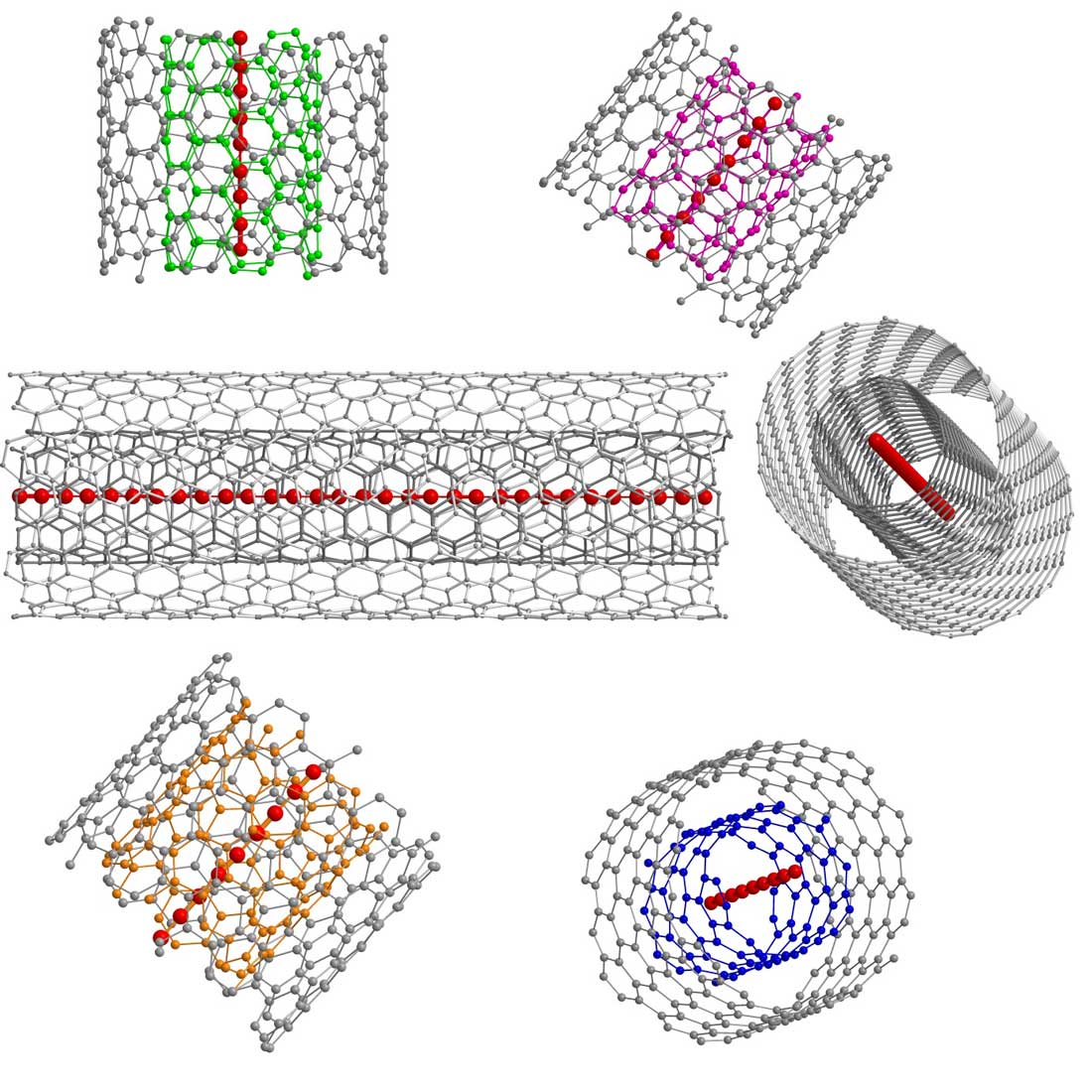
Schematic representation of confined ultra-long, linear carbon chains inside different double-walled carbon nanotubes
Schematic representation of confined ultra-long, linear carbon chains inside different double-walled carbon nanotubes (Image: Lei Shi / Faculty of Physics, University of Vienna) (click on image to enlarge)
A research group at the University of Vienna, led by Prof Thomas Pichler, has presented a new, simple means for stabilising carbon chains with a record-breaking length of over 6,400 carbon atoms. They have thus broken the previous record by more than two orders of magnitude. To do this, they used the confined space inside a double-walled carbon nanotube as a nano-reactor to make the ultra-long carbon chains grow and also to provide the chains with great stability. This stability is tremendously important for future applications.
The work carried out in collaboration with various highly prominent research groups worldwide, including the UPV/EHU’s Nano-Bio Spectroscopy research Group led by Prof Ángel Rubio, has unambiguously confirmed the existence of these chains by means of structural and optical probes.
According to the researchers, the direct experimental proof of the confined, ultra-long carbon chains, which are two orders of magnitude longer than the previously proven ones, can be seen as a promising step towards the final objective to obtain perfectly linear carbon chains.
Theoretical studies have shown that after having made these linear chains grow inside the carbon nanotube, the hybrid system could have a metallic nature due to the load transfer from the carbon nanotubes towards the chain, although both the nanotube and the chain are vacuum semi-conductors. So it is possible to control the electronic properties of this hybrid system. Therefore, this new system is not only interesting from the chemical point of view, it could also be very important in the field of nano devices.
According to theoretical models, carbyne has mechanical properties that are unmatched by any known material, as it even outperforms the mechanical resistance and flexibility properties of graphene and diamond. Furthermore, its electronic properties are pointing towards new nano-electronic applications, such as in the development of new magnetic semiconductors, high power density batteries, or in quantum spin transport electronics (spintronics). However, the researchers point out that to do this it would be necessary to extract these ultra-long, linear carbon chains from the double-walled nanotube containing them and stabilise them in some liquid environment.
Source: University of the Basque Country

Nanoparticulele asemănătoare nanoparticulelor oferă o protecție fiabilă împotriva ruginii(Flake-like nanoparticles offer reliable rust protection)

Cercetătorii de la INM au dezvoltat un tip special de nanoparticule de zinc-fosfat sub formă de fulgi. Aceste nanoparticule sunt de zece ori mai lungi decât ele sunt groase. Ca rezultat al acestei anizotropii, penetrarea moleculelor de gaze în metal este încetinită.În alte serii de teste, oamenii de știință au reușit să valideze eficiența noilor nanoparticule. Pentru a face acest lucru, ei au scufundat plăcile de oțel atât în ​​soluțiile de electroliți cu nanoparticule zinc-fosfat sferoidale, cât și cu nanoparticule de zinc-fosfat tip fulgi în fiecare caz. După doar o jumătate de zi, plăcile de oțel din electroliți cu nanoparticule sferoidale au prezentat semne de coroziune, în timp ce plăcile de oțel din electroliții cu nanoparticule de tip flaky erau încă în stare perfectă și străluceseră, chiar și după trei zile. Cercetătorii și-au creat particulele utilizând săruri de zinc disponibile în comerț, acid fosforic și acid organic ca agent de complexare. Cu cât agenți mai complexați au adăugat, cu atât nanoparticulele au devenit mai anizotrope.

Posted: Apr 13, 2016

Flake-like nanoparticles offer reliable rust protection

(Nanowerk News) Research scientists at INM developed a special type of flake-like zinc-phosphate nanoparticles. These nanoparticles are ten times as long as they are thick. As a result of this anisotropy, the penetration of gas molecules into the metal is slowed down.

Large quantities of steel are used in architecture, bridge construction and ship-building. Structures of this type are intended to be long-lasting. Furthermore, even in the course of many years, they must not lose any of their qualities regarding strength and safety. For this reason, the steel plates and girders used must have extensive and durable protection against corrosion. In particular, the steel is attacked by oxygen in the air, water vapor and salts. Nowadays, various techniques are used to prevent the corrosive substances from penetrating into the material. One common method is to create an anti-corrosion coating by applying layers of zinc-phosphate.
Now, research scientists at INM – Leibniz Institute for New Materials developed a special type of zinc-phosphate nanoparticles. In contrast to conventional, spheroidal zinc-phosphate nanoparticles, the new nanoparticles are flake-like. They are ten times as long as they are thick. As a result of this anisotropy, the penetration of gas molecules into the metal is slowed down.
The developers will be demonstrating their results and the possibilities they offer at stand B46 in hall 2 at this year’s Hanover Trade Fair as part of the leading trade show Research & Technology which takes place from 25th to 29th April.
“In first test coatings, we were able to demonstrate that the flake-type nanoparticles are deposited in layers on top of each other thus creating a wall-like structure,” explained Carsten Becker-Willinger, Head of Nanomers® at INM. “This means that the penetration of gas molecules through the protective coating is longer because they have to find their way through the ´cracks in the wall´”. The result, he said, was that the corrosion process was much slower than with coatings with spheroidal nanoparticles where the gas molecules can find their way through the protective coating to the metal much more quickly.
In further series of tests, the scientists were able to validate the effectiveness of the new nanoparticles. To do so, they immersed steel plates both in electrolyte solutions with spheroidal zinc-phosphate nanoparticles and with flake-type zinc-phosphate nanoparticles in each case. After just half a day, the steel plates in the electrolytes with spheroidal nanoparticles were showing signs of corrosion whereas the steel plates in the electrolytes with flake-type nanoparticles were still in perfect condition and shining, even after three days. The researchers created their particles using standard, commercially available zinc salts, phosphoric acid and an organic acid as a complexing agent. The more complexing agent they added, the more anisotropic the nanoparticles became.
Source: INM – Leibniz-Institut für Neue Materialien

Noile cerneluri hibride permit circuite electronice tipărite și flexibile fără sinterizare(New hybrid inks permit printed, flexible electronics without sintering)

Cercetătorii de la INM au combinat avantajele materialelor electronice organice și anorganice într-un tip nou de cerneluri hibride. Acest lucru permite ca circuitele electronice să fie aplicate pe hârtie direct de pe un stilou, de exemplu. În cele din urmă, compușii organici acționează ca nișe: dacă materialul este îndoit, ele mențin conductivitatea electrică. Într-un strat de particule de metal fără teaca de polimer, conductivitatea electrică s-ar pierde rapid atunci când materialul este îndoit „, spune omul de știință Kraus. Datorită combinației ambelor materiale, când sunt îndoite,

Posted: Apr 12, 2016

New hybrid inks permit printed, flexible electronics without sintering

(Nanowerk News) Research scientists at INM have combined the benefits of organic and inorganic electronic materials in a new type of hybrid inks. This allows electronic circuits to be applied to paper directly from a pen, for example.

The electronics of the future will be printed. Flexible circuits can be produced inexpensively on foil or paper using printing processes and permit futuristic designs with curved diodes or input elements. This requires printable electronic materials that can be printed and retain a high level of conductivity during usage in spite of their curved surfaces. Some tried and tested materials include organic, conductive polymers and nanoparticles made of conductive oxides (TCOs). Research scientists at INM – Leibniz-Institute for New Materials have now combined the benefits of organic and inorganic electronic materials in a new type of hybrid inks. This allows electronic circuits to be applied to paper directly from a pen, for example.
hybrid inks permit printed, flexible electronics without sintering
New hybrid inks permit printed, flexible electronics without sintering. (Image: INM)
The developers will be demonstrating their results and the possibilities they offer at stand B46 in hall 2 at this year’s Hanover Trade Fair as part of the leading trade show Research & Technology which takes place from 25th to 29th April.
To create their hybrid inks, the research scientists coated nanoparticles made of metals with organic, conductive polymers and suspended them in mixtures of water and alcohol. These suspensions can be applied directly on paper or foil using a pen and they dry without any further processing to form electrical circuits.
“Electrically conductive polymers are used in OLEDs, for example, which can also be manufactured on flexible substrates,” explains Tobias Kraus, Head of the research group Structure Formation at INM. “The combination of metal and nano-particles that we introduce here combines mechanical flexibility with the robustness of a metal and increases the electrical conductivity”.
The developers combine the organic polymers with gold or silver nanoparticles. The organic compounds have three functions: “On the one hand, the compounds serve as ligands, ensuring that the nanoparticles remain suspended in the liquid mixture; any agglomeration of particles would have a negative effect on the printing process. Simultaneously, the organic ligands ensure that the nanoparticles have a good arrangement when drying. Ultimately, the organic compounds act as ´hinges´: if the material is bent, they maintain the electrical conductivity. In a layer of metal particles without the polymer sheath the electrical conductivity would quickly be lost when the material is bent,” the material scientist Kraus continues. Due to the combination of both materials, when bent, the electrical conductivity is greater all in all than in a layer that is made purely of conductive polymer or a layer made purely of metal nanoparticles.
“Metal nanoparticles with ligands are already printed to form electronics today,” explains the physical chemist Kraus, adding that the shells mostly had to be removed by a sintering process because, while on the one hand they control the arrangement of the nanoparticles, on the other hand, they are not conductive. He added that this was difficult in the case of carrier materials that are sensitive to temperature such as paper or polymer films since these would be damaged during the sintering process. Kraus summarizes the results of his research, saying, “Our new hybrid inks are conductive as soon as they have dried as well as being particularly mechanically flexible and they do not require sintering”.
Source: INM – Leibniz-Institut für Neue Materialien

Modelarea numerică a comportamentului de impact al materialelor compozite noi încărcate cu particule(Numerical modeling of the impact behavior of new particulate-loaded composite materials)

Eficiența balistică și costul sunt principalele considerente în proiectarea armurilor ușoare.Așadar, dezvoltarea unui material nou care acoperă decalajul dintre materialele metalice și ceramice poate fi de interes pentru aplicațiile cu costuri reduse în care greutatea nu este o prioritate de proiectare.

Numerical