Printr-un pahar, cald: Nanomaterialele pot ajuta la eficientizarea ferestrelor

Nanofoamul care se dezvoltă – cunoscut sub numele de compozit nanocelular cu izolație termică superioară și izolare fonică – utilizează bule de gaz mai mici de 100 nanometri în diametru pentru a bloca transferul de căldură și sunet prin ferestrele de sticlă, permițând lumina vizibilă să treacă și să mențină o claritate Similar cu ferestrele normale

Posted: Jun 01, 2016

Through a glass, warmly: Nanomaterials can help make windows more efficient

(Nanowerk News) A team of researchers at the U.S. Department of Energy’s (DOE’s) Argonne National Laboratory is using nanomaterials to improve the energy efficiency of existing single-pane windows in commercial and residential buildings. The team was recently awarded a $3.1 million grant from DOE’s Advanced Research Projects Agency-Energy (ARPA-E) to develop a technology that could help achieve that goal. The nanofoam the team is developing – known as a nanocellular composite with super thermal insulation and soundproofing – uses gas bubbles less than 100 nanometers in diameter to block the transfer of heat and sound through glass windows while allowing visible light to pass through and maintain a clarity similar to normal windows.

chemical engineer Jie Li, left, and postdoctoral researcher Alina Yan create coated nanoparticles in a continuous flow reactor
Principal chemical engineer Jie Li, left, and postdoctoral researcher Alina Yan create coated nanoparticles in a continuous flow reactor. Nanoparticles are key to an ongoing effort at Argonne to create more efficient window films.
“That’s really the trick, blocking the heat and sound transfer while maintaining transparency,” said Ralph Muehleisen, principal building scientist at Argonne. “It’s fairly simple to develop a coating that insulates, but getting one that is thin and you can still see through is a substantial technical challenge.”
The nanofoam, which will be extruded into sheets about three millimeters thick, creates a thermal insulation effect by using the tiny bubbles to reduce collisions among gas molecules, thereby reducing the transfer of heat energy. When the bubbles are reduced to that scale, super thermal insulation becomes possible.
A foam with larger bubbles could perform a similar function, but those bubbles would scatter visible light, making the window hazy and less transparent. The bubbles need to be created with a size of around 100 nanometers or less, distributed properly and then sculpted within the host medium to achieve an acceptable level of clarity.. By way of comparison, a human hair is about 60,000 nanometers wide and a DNA molecule is 2-3 nanometers wide.
According to ARPA-E, single-pane windows make up 30-40 percent of windows in the United States, depending on the region. Single-pane windows conduct at least twice as much heat as double paned, so retrofitting all those windows could save consumers about $12 billion a year in energy costs.
The nanofoam team combines expertise from nanomaterial scientists, polymer scientists, chemical, process and building engineers, along with the expertise of Argonne’s Center for Nanoscale Materials, a DOE Office of Science user facility. The team also includes researchers from the University of Chicago’s Institute for Molecular Engineering, Lawrence Berkeley National Laboratory (LBNL) and Temple University’s Department of Chemistry.
“This effort really shows the power of cross-cutting scientific collaboration,” said Matt Tirrell, who is Argonne’s Deputy Laboratory Director for Science and holds a joint appointment with the University of Chicago. “By bringing together these unique skillsets and facilities, we have the ability to make substantial breakthroughs that hold the promise to make a big difference in building energy efficiency.”
The team will not be satisfied with creating laboratory versions of the materials, however. Researchers are also developing processes that can be economically scaled up to commercial production. Jie Li, a principal chemical engineer at Argonne and the principal investigator on the project, recently completed the DOE’s Lab-Corps program, which aims to accelerate the transfer of clean energy technologies from national laboratories to the marketplace.
“We know that commercial production is the key step to having a positive effect on building efficiency,” Li said. “There are billions of square feet of windows in the US. Imagine the impact of making all those windows more efficient. That’s when you really start to see benefit from your science.”
The team also includes Leah Guzowski, director of strategic programs at Argonne, Yugang Sun, formerly of Argonne and now a professor at Temple University, and Stephen Selkowitz and Charlie Curcija from the Windows and Daylighting Group at LBNL.
This nanofoam research builds upon another nanomaterial being developed at Argonne. Several members of the ARPA-E team are working on a new nanoparticle coating of vanadium dioxide, which is a phase-change material that behaves differently at different temperatures. At low temperatures, vanadium dioxide is a semiconductor that allows both near-infrared light (the portion of the solar spectrum that contains approximately half of all solar energy) and visible light to pass through. When it gets hot, however, it develops metallic properties and begins to block out near-infrared light, which helps reflect solar radiation during the summer. Current versions of vanadium dioxide do not block much solar heat gain, so the film must be very thick, which makes for a darker window that consumers are reluctant to adopt.
By using nanoparticles of vanadium dioxide, the team has created a film that can boost near-infrared blocking and is more efficient at reflecting solar radiation, all while maintaining visible transparency.
The Argonne researchers hope that by combining the nanofoam and the vanadium dioxide, they may be able to create a single-pane window that could achieve efficiencies similar to multi-pane Low-E units. Low-E windows usually have multiple coated panes of glass with inert gas suspended between them. By using only one pane of glass without the costly and complicated sealing system required by multi-paned windows, the new windows would become more affordable, allowing more widespread adoption.
Source: Argonne National Laboratory

Read more: Through a glass, warmly: Nanomaterials can help make windows more efficient

Nanoparticule pentru înlocuirea elementelor de pământuri rare în magneți permanenți

Cercetatorii au folosit un complex mixt de oleat de cobalt-cobalt intr-o abordare sintetica intr-un singur pas pentru a produce nanoparticule magnetice core-shell. Materialele rezultate au prezentat proprietăți magnetice puternice și capacități de stocare a energiei.

Posted: Jun 01, 2016

Nanoparticles to replace rare-earth elements in permanent magnets

(Nanowerk News) Technologies from wind turbines to electric vehicles rely on critical materials called rare-earth elements. These elements, though often abundant, can be difficult and increasingly costly to come by.

Now, scientists looking for alternatives have reported in ACS’ journal Chemistry of Materials („Strongly exchange coupled core|shell nanoparticles with high magnetic anisotropy: a strategy towards Rare Earth -free permanent magnets”) a new way to make nanoparticles that could replace some rare-earth materials and help ensure the continued supply of products people have come to depend on.
Rare-earth elements have unique characteristics that make them very useful. For example, the world’s strongest magnets are made with neodymium. A little too powerful for your refrigerator, these magnets are incorporated into computer disk drives, power windows and wind turbines.
But rare earths are challenging to mine and process, and prices can rise quickly in a short period of time. Given the increasing demand for rare earths, Alberto López-Ortega, Claudio Sangregorio and colleagues set out to find substitutes for use in strong magnets.
The researchers used a mixed iron-cobalt oleate complex in a one-step synthetic approach to produce magnetic core-shell nanoparticles. The resulting materials showed strong magnetic properties and energy-storing capabilities.
Their approach could signal an efficient new strategy toward replacing rare earths in permanent magnets and keeping costs stable, the researchers say.
Source: American Chemical Society

Read more: Nanoparticles to replace rare-earth elements in permanent magnets

Atomii -materiale cuantice topologice

clase de materiale complet noi, cunoscut sub numele de „materiale cuantice topologice^

Posted: May 31, 2016

Atome mit dem gewissen Twist

(Nanowerk News) Gewisse Materialien wie Metalle leiten den Strom, andere, sogenannte Isolatoren wie Glas oder Keramik nicht. Nun ist es Forschern der Universität Hamburg erstmals gelungen, die zentrale Kenngröße einer Klasse ganz neuer Materialien, der sogenannten „topologischen Quantenmaterialien“ zu vermessen. Von diesem speziellen „Twist“, einer trickreichen Verdrehung der Wege der Elektronen, hängen zum Beispiel die Leitfähigkeit und andere Eigenschaften ab.

Die Ergebnisse eröffnen ganz neue Perspektiven für die Entwicklung neuer Quantenmaterialien, auch mit potenziellen Anwendungen bei zukünftigen Quantencomputern. Sie wurden nun im Fachmagazin Science veröffentlicht („Experimental reconstruction of the Berry curvature in a Floquet Bloch band”).
Geometrie der Eigenstände zweier Bloch-Bänder
Künstlerische Darstellung der berechneten Geometrie der Eigenstände der zwei Bloch-Bänder. (Bild: UHH/Sengstock)
In üblichen Materialien müssen sich Elektronen, die für den Stromtransport verantwortlich sind, ihren Weg durch gleichmäßig verteilte Hindernisse im Festkörper bahnen. In den topologischen Quantenmaterialien können sich Teilchen dagegen nur auf gewissen, mehr oder weniger verdrehten Wegen (die einen Twist beinhalten) bewegen und verhalten sich entsprechend den Gesetzen der Quantenphysik zudem wie Teilchen und Wellen gleichzeitig.
Es gibt eine zentrale Eigenschaft, die die Topologie, also den Quanten-Twist dieser Materialien, komplett beschreiben kann: die „Berry Krümmung“, benannt nach dem englischen Physiker Michael Berry, der das Grundkonzept dazu bereits in den 1980er Jahren angelegt hat. Das Team um Prof. Dr. Klaus Sengstock und Dr. Christof Weitenberg vom Institut für Laserphysik der Universität Hamburg konnte die Berry Krümmung in einem Quantenmaterial nun erstmalig vollständig vermessen.
Die Physiker nutzten bewusst ein künstliches Quantenmaterial, das heute weltweit intensiv eingesetzt wird: atomare Wolken – sogenannte „ultrakalte Quantengase“ – in einem künstlichen Festkörper, gebildet aus Laserlicht. Nachdem die Atome, die in diesen Experimenten die Rolle von Elektronen in Festkörpern übernahmen, in das künstliche Material, das die zu untersuchende Topologie enthielt, eingebracht worden waren, konnte mithilfe weiterer Laser diese Topologie sehr präzise gemessen werden.
Dr. Weitenberg, der die Experimente betreute, betont: „Wir konnten bereits in diesen ersten Experimenten die Topologie eines künstlichen Materials bestimmen, und das ist erst der Anfang, wir alle sind sehr begeistert von den Möglichkeiten dieser neuen Methode.“ Prof. Sengstock ergänzt: „Neuartige Quantenmaterialien werden schon in naher Zukunft eine wichtige Rolle in den absehbaren Quantentechnologien spielen; Quantencomputer sind dabei besonders visionär und nur durch neue Konzepte zu verwirklichen.“ Materialien mit dem gewissen Twist können vermutlich dazu wichtige Beiträge liefern: „Es ist besonders spannend, in diesem Bereich zu forschen, da das Forschungsfeld dieser neuen Quantenmaterialien erst ganz am Anfang steht, vieles ist noch gar nicht erforscht“, so Prof. Sengstock.
Source: Universität Hamburg

Read more: Atome mit dem gewissen Twist

Materialele slabe oferă posibilități puternice pentru electronică

crisal compus din bismut combinat fie cu iod sau bromÎnlătură termen: izolatoare topologice izolatoare topologiceÎnlătură termen: Materialele conductive din punct de vedere electric Materialele conductive din punct de vedere electric

Posted: May 31, 2016

Weak materials offers strong possibilities for electronics

(Nanowerk News) New fundamental research by University of Texas at Dallas physicists may accelerate the drive toward more advanced electronics and more powerful computers.

The scientists are investigating materials called topological insulators, whose surface electrical properties are essentially the opposite of the properties inside.
“These materials are made of the same thing throughout, from the interior to the exterior,” said Dr. Fan Zhang, assistant professor of physics at UT Dallas. “But, the interior does not conduct electrons — it’s an insulator — while the electrons on the surface are free to move around. The surface is therefore a conductor, like a metal, but it is in fact more robust than a metal.”
There are two types of topological insulators: strong and weak. The difference between them is subtle and involves complex physics, but is critically important.
“If you had a cube of material that is a strong topological insulator, all six faces can conduct electrons,” Zhang said. “For the weak one, only the four sides are conducting, while the top and bottom surfaces remain insulating.”
Strong topological insulators were made experimentally shortly after they were theoretically proposed. Zhang said they are common in nature, and several dozen variations have been identified and experimentally confirmed.
On the other hand, weak topological insulators have been more elusive. Scientists have proposed various ways to construct a weak topological insulator, but because of its distinctive properties, researchers have not been able to say definitively that they have experimentally produced one.
crystals of bismuth iodide
UT Dallas scientists have made crystals of bismuth iodide and are investigating the material’s exotic electrical properties for possible use in advanced electronics.
Zhang, a theoretical physicist, has devised a new way to make a weak topological insulator, one that involves a relatively simple mix of two chemical elements: a crystal composed of bismuth combined with either iodine or bromine. He and his colleagues published the research recently in the journal Physical Review Letters („Weak Topological Insulators and Composite Weyl Semimetals: β-Bi4X4 (X=Br, I)”) and presented their work at the March meeting of the American Physical Society.
In the 1970s, German scientists grew bismuth iodides and bismuth bromides, but they didn’t understand their potential as weak topological insulators, Zhang said.
“This class of materials we are proposing is a unique platform for exploring exotic physics with fairly simple chemistry,” he said. “With further research and experimentation, our findings could lead to significant advances in technology, especially in electronics and quantum computing.”
Electrically conductive materials are the fundamental building blocks of the traditional transistors that power electronic devices including cellphones and computers. Researchers are developing new theories and experiments with innovative physics and materials to create new transistor-like technologies that run devices and make computers more powerful.
With such exotic electrical properties, topological insulators offer a potential option, Zhang said.
“Our lives have been modified over time by our understanding of the conduction of electrons and the exploitation of this physics for use in electronic devices,” he said. “We now need to revolutionize transistors. One possible substitution is a so-called topological field effect transistor, which could be made of a thin film of a weak topological insulator.”
Computers also are heading for a fundamental redesign, and those efforts might be aided by Zhang’s research.
“The fundamental computing scale is now very limited,” he said. “For many applications, like weather forecasting and information encoding and decoding, today’s computers are way too slow. However, quantum computers have been proposed that would use the principles of quantum physics to compute exponentially faster than today’s computers.
“Weak topological insulators could make quantum computing feasible.”
As a theorist, Zhang used old-fashioned pencil and paper to construct the basis of his theory about the bismuth compounds. His postdoctoral researcher Dr. Cheng-Cheng Liu, the study’s lead author and now an assistant professor at Beijing Institute of Technology, then crunched specific numbers using high-speed supercomputers at the Texas Advanced Computing Center based at UT Austin.
Zhang’s UT Dallas colleague, Dr. Bing Lv, assistant professor of physics, has made samples of bismuth iodide.
“The next step will be to characterize the material to explore the unique properties that a weak topological insulator can offer to fundamental physics and to our everyday lives,” Zhang said.
Source: University of Texas at Dallas

Read more: Weak materials offers strong possibilities for electronics

Mantis crevete inspiră următoarea generație de materiale ultra-puternice

Descoperirea structurii de heringbone rezistente la impacturi .Se foloseste la automobile, armuri,inclusiv aerospațial . Materiale compozite super-puternnice. Proiectează următoarea generație de materiale pentru o varietate de aplicații .Structură unică de heringbone în stratul exterior al clubului dactil.

Posted: May 31, 2016

Mantis shrimp inspires next generation of ultra-strong materials

(Nanowerk News) Mantis shrimp are available in the lab and can be photographed or videoed.

A video that media are free to use is here: https://www.youtube.com/watch?v=_8K3bx42jVM – The next generation of airplanes, body armor and football helmets crawled out from under a rock–literally.
Researchers at the University of California, Riverside and Purdue University are one step closer to developing super strong composite materials, thanks to the mantis shrimp, a small, multicolored marine crustacean that crushes the shells of its prey using a fist-like appendage called a dactyl club.
Their latest research, to be published in the journal Advanced Materials („A Sinusoidally Architected Helicoidal Biocomposite”), describes for the first time a unique herringbone structure, not previously reported in nature, within the appendage’s outer layer. It is this tough herringbone structure that not only protects the club during impact, but also enables the mantis shrimp to inflict incredible damage to its prey.
herringbone structure of the outer layer of the mantis shrimp dactyl club
This is the herringbone structure of the outer layer (impact region) of the mantis shrimp dactyl club. (Image: UC Riverside) (click on image to enlarge)
Mantis shrimp, also called stomatopods, come in two varieties: ‘smashers’ and ‘spearers.’ While spearers kill prey by driving a spear into soft-bodied sea creatures, smashers kill hard-shelled prey such as crabs and snails by pulverizing them with incredible speed and force. The dactyl club can reach an acceleration of 10,000g, unleashing a barrage of impacts with the speed of a .22 caliber bullet.
For the past eight years, David Kisailus, the Winston Chung Endowed Professor in Energy Innovation in UCR’s Bourns College of Engineering, and his team have been studying smashers’ dactyl clubs and using them as inspiration in their development of next generation composite materials. Their research is already being translated into real-world products by Nature Inspired Industries, a recent startup led by Kisailus that spun out from UC Riverside’s Office of Research and Economic Development.
Mantis shrimp in the lab of David Kisailus at the University of California, Riverside. Kisailus studies the structure of the fist-like club of the mantis shrimp to develop tougher and stronger materials.
In previous work, including a 2012 study published in the journal Science („The Stomatopod Dactyl Club: A Formidable Damage-Tolerant Biological Hammer”), the researchers identified several different regions of the dactyl club, including an interior region–called the periodic region–with an energy-absorbent structure that also filters out damaging shear waves, which travel through objects when they are under stress. This energy absorbing „periodic region” consists of two phases: an organic phase made of chitin–a compound found in the shells of insects and crustaceans–arranged in a helicoidal structure that resembles a spiral staircase, and an inorganic phase comprising amorphous calcium phosphate and calcium carbonate.
The current research, funded by the Air Force Office of Scientific Research under a $7.5M Multi-University Research Initiative that Kisailus leads, describes for the first time a unique herringbone structure within the dactyl club’s outer layer, called the impact region.
The impact region is a crack-resistant layer that shields the club as the mantis shrimp pummels its prey. However, unlike the periodic region, the impact region consists of crystalline calcium phosphate (the same mineral found in human bone) surrounding the organic chitin fibers. The researchers found that these heavily mineralized fibers were compacted to form a „herringbone structure” that is significantly stiffer than the structure in the periodic region. The highly ordered compacted herringbone structure is a pitch-graded sinusoidal arrangement of helicoidal chitin fibers mineralized with highly textured calcium phosphate.
This unique herringbone structure not only protects the club from failure, but also enables the mantis shrimp to inflict incredible damage to its prey by transferring more momentum upon impact.
Although the mechanism of the formation of the herringbone structure has yet to be confirmed, Kisailus speculates that the difference in stresses during the formation of the crystalline material in the impact region causes the helicoidal arrangement to buckle, which can be viewed under high power microscopy as a herringbone pattern.
Adding an additional layer of complexity, the very outer layer of the impact region is different again, offering a thin, particle-like coating around the surface of the dactyl club that acts to delocalize stress that might induce catastrophic failure within the club.
Nicholas Yaraghi, a graduate student in Kisailus’ group who led the current research, said this is the first time the unique herringbone structure has been observed in Nature.
„We knew from previous studies that the impact region allows the mantis shrimp to transfer incredible momentum to its prey while resisting fracture, but it was exciting to reveal through our research that the properties of this highly impact-resistant material are created by the novel herringbone structure,” he said.
In order to confirm their hypotheses, Kisailus and his research group teamed up with Pablo Zavattieri, Associate Professor of Civil Engineering and University Faculty Scholar at Purdue University, and his team to perform finite element analyses to understand the role of these structures. The researchers also fabricated the herringbone structure using synthetic materials and a 3D printer.
Zavattieri and his student Nicolas Guarín-Zapata built computational models that replicate the local details of the herringbone structure. These models explained that damaging stress can be more uniformly distributed, mitigating catastrophic structural failure. Compression testing of the 3D printing biomimetic composite also helped prove that the herringbone structure makes the impact region even more effective than the periodic region in redistributing stress and deflecting cracks.
„While the computational modeling results gave us compelling confirmation of the redistribution of stresses in these structures, the „wow” moment came when we tested our 3D printing samples,” Guarín-Zapata said.
Kisailus said the discovery of the highly impact-resistant herringbone structure adds new inspiration as his team designs the next generation of materials for a variety of applications, including aerospace, automotive and armor.
„The smasher mantis shrimp has evolved this exceptionally strong and impact-resistant dactyl club for one primary purpose–to be able to eat. However, the more we learn about this tiny creature and it’s multi-layered structural designs, the more we realize how much it can help us as we design better planes, cars, sports equipment and armor,” Kisailus said.
Kisailus said recent advances in 3D printing techniques and modeling are making it easier than ever to translate the mantis shrimp’s weapon into new materials.
„By using 3D printing techniques like those used by Zavattieri’s team, we can actually take what we’ve learned about the architecture of the dactyl club and manufacture new composites with traditional engineering materials like polymers and carbon fiber,” Kisailus said. In fact, he says that his team is already fabricating the second generation of composites that incorporates not only the energy-absorbing component, but the stiff outer layer inspired from the mantis. He has demonstrated this by producing a helmet with this hard coating.
Source: University of California – Riverside

Read more: Mantis shrimp inspires next generation of ultra-strong materials

Noua tehnică permite vizualizarea defectelor pe suprafața grafenului

Folosind tehnici imagistice avansate, cercetatorii au descoperit, dass die clusterele de paladiu atașați Selectiv la gemäß suprafața grafen la modele specifice, FUNCȚIE cum reactiv centrele de carbon sunt. Particulele de paladiu individuale rezolva Onto defectelor punctuale, acumulări locale de particule sunt prezente pe defecte mai mari și lanțuri scurte contur defecte liniare

Posted: May 31, 2016

New technique allows to visualize defects on the surface of graphene

(Nanowerk News) The technique, developed by researchers at the Zelinsky Institute of Organic Chemistry in a collaborative project, employs the metal palladium, which interacts with “carbon reactivity centres” found on graphene. Graphene is an incredibly strong one-atom-thick layer of carbon touted to be an excellent conductor of heat and electricity.

Several types of defects on graphene surfaces are known to increase the reactivity of its carbon atoms: i.e. their ability to form chemical bonds. If researchers can locate these defects and manipulate them, they will be able to maximize the use of graphene’s properties.
For example, locating and removing defects is important for applications that require perfectly smooth graphene.
In other applications, such as in catalysis and certain biomedical materials, some defects are actually beneficial because they allow the incorporation of additional elements, such as metals, into the graphene.
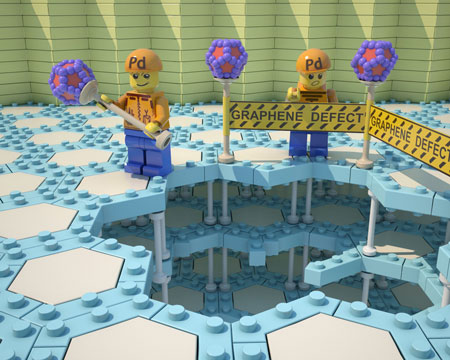
concept of imaging of carbon defect areas by palladium markers
Artistic image on the concept of imaging of carbon defect areas by palladium markers. (Graphene defects marked by Pd). (Image : Ananikov Laboratory, Zelinsky Institute of Organic Chemistry)
When the palladium complex Pd2(dba)3 is dissolved in chloroform, it forms a dark red solution under normal circumstances. But when graphene or another carbon material is added to the solution, the palladium is completely consumed. As a result, the solution turns from dark red to colourless.
Using advanced imaging techniques, the researchers found that the palladium clusters selectively attach to graphene’s surface according to specific patterns, depending on how reactive the carbon centres are. Individual palladium particles settle onto point defects, local accumulations of particles are present on larger defects, and short chains outline linear defects.
These defects are normally invisible under an electron microscope. The palladium particles act like a contrast agent, allowing the spatial imaging of the chemical reactivity, and thus the defects, of graphene layers.
“Metal mapping of carbon materials provides unique insights and reveals hidden information about fascinating properties at the molecular level,” says project leader Professor Valentine Ananikov.
The team’s findings indicate that using palladium markers, more than 2,000 surface defects, or reactivity centres, on graphene can be individually located, per square micrometre of surface area. The researchers say that the unexpected capacity of graphene to accommodate so many reactivity centres challenges scientists to re-examine their understanding of the electronic and structural properties of carbon materials.
Now that the researchers have learned how to recognise and characterise the defects, their next step is to develop a technique to control them. Some defects possess a dynamic nature and have the ability to “migrate” over graphene’s surface. If the researchers can control this migration, they will have a unique opportunity to form materials with customised properties. This is an outstanding direction for future studies, they say
Source: Zelinsky Institute of Organic Chemistry
Subscribe to a free copy of one of our daily
Nanowerk Newsletter Email Digests
with a compilation of all of the day’s news.

Read more: New technique allows to visualize defects on the surface of graphene

Ipoteza puternică a lui Ivy ar putea conduce la adezivi medicali mai buni, la armura de luptă mai puternică(Ivy’s powerful grasp could lead to better medical adhesives, stronger battle armor

Adezivul natural al iederii englezești ar putea să dețină cheia unor noi abordări pentru vindecarea rănilor, armuri puternice pentru armată și poate chiar produse cosmetice cu o putere de ședere mai bună.este interesat în special de bioadezive care ar putea ajuta la vindecarea rănilor după intervenții chirurgicale sau intervenții chirurgicale. Alții, în special militarii americani, sunt interesați de aplicațiile de acoperire a suprafețelor pentru scopuri care includ consolidarea sistemelor de armură, a spus el

Posted: May 24, 2016

Ivy’s powerful grasp could lead to better medical adhesives, stronger battle armor

(Nanowerk News) English ivy’s natural glue might hold the key to new approaches to wound healing, stronger armor for the military and maybe even cosmetics with better staying power.

New research from The Ohio State University illuminates the tiny particles responsible for ivy’s ability to latch on so tight to trees and buildings that it can withstand hurricanes and tornadoes. (Not to mention infuriate those trying to rid their homes of the vigorous green climber.)
The researchers pinpointed the spherical particles within English ivy’s adhesive and identified the primary protein within them.
„By understanding the proteins that give rise to ivy’s strength, we can give rise to approaches to engineer new bio-inspired adhesives for medical and industry products,” said Mingjun Zhang, the biomedical engineering professor who led the work.
„It’s a milestone to resolve this mystery. We now know the secret of this adhesive and the underlying molecular mechanism,” said Zhang, who focuses his work on finding answers in nature for vexing problems in medicine.
The study appears today in the journal Proceedings of the National Academy of Sciences(„Nanospherical arabinogalactan proteins are a key component of the high-strength adhesive secreted by English ivy”).
Like many scientists before him, Charles Darwin among them, Zhang found himself captivated by English ivy – the physics of it, the sheer strength of it.
„Ivy has these very tiny hairy structures that have a wonderful interaction with the surface as the plant climbs. One day I was looking at the ivy in the backyard and I was amazed at the force,” Zhang said.
„It’s very difficult to tear down, even in a natural disaster. It’s one of the strongest adhesive forces in nature.”
When he and his team took a look at the ivy’s glue with a powerful atomic-force microscope, they were able to identify a previously unknown element in its adhesive.
The tiny particles inside the glue on their laboratory slides turned out to be primarily made up of arabinogalactan proteins. And when the scientists investigated further, they discovered that the driving force behind the curing of the glue was a calcium-mediated interaction between the proteins and pectin in the gelatinous liquid that oozes from ivy as it climbs.
Zhang said particles rich in those proteins have exceptional adhesive abilities – abilities that could be used to the advantage of many, from biomedical engineers to paint makers.
Zhang, a member of Ohio State’s Davis Heart and Lung Research Institute, is particularly interested in bioadhesives that could aid in wound healing after injury or surgeries. Others, notably the U.S. military, are interested in surface-coating applications for purposes that include strengthening armor systems, he said.
Many plants are excellent climbers, but scientists have had limited information about the adhesives that enable those plants to affix themselves to walls, fences and just about anything in their way, he said.
„When climbing, ivy secretes these tiny nanoparticles which make initial surface contact. Due to their high uniformity and low viscosity, they can attach to large areas on various surfaces,” Zhang said.
After the water evaporates, a chemical bond forms, Zhang said.
„It’s really a nature-made amazing mechanism for high-strength adhesion,” he said.
The glue doesn’t just sit on the surface of the object that the ivy is clinging to, he said. It finds its way into openings invisible to the naked eye, further solidifying its bond.
To confirm what they found, Zhang and his collaborators used the nanoparticles to reconstruct a simple glue that mimics ivy adhesive. Advanced bioadhesives based on this research will take more time and research.
In addition to its strength, ivy adhesive has other properties that make it appealing to scientists looking for answers to engineering quandaries, Zhang said.
„Under moisture or high or low temperatures, it’s not easily damaged,” he said. „Ivy is very resistant to various environmental conditions, which makes the adhesive a particularly interesting candidate for the development of armor coatings.”
Ivy also is considered a pest because it can be destructive to buildings and bridges. Knowing what’s at the heart of its sticking ability could help scientists unearth approaches to resist the plant, Zhang said.
Source: Ohio State University

Lumina poate vindeca defectele în unele celule solare(

O familie de compuși cunoscuți sub numele de perovskites, care pot fi transformate în filme subțiri cu multe proprietăți electronice și optice promițătoare, a fost un subiect de cercetare fierbinte în ultimii ani. Dar, deși aceste materiale ar putea fi extrem de utile în aplicații precum celulele solare, unele limitări încă îngreunează eficiența și coerența acestora.

Posted: May 24, 2016

Light can ‘heal’ defects in some solar cells

(Nanowerk News) A family of compounds known as perovskites, which can be made into thin films with many promising electronic and optical properties, has been a hot research topic in recent years. But although these materials could potentially be highly useful in applications such as solar cells, some limitations still hamper their efficiency and consistency.

Now, a team of researchers at MIT and elsewhere say they have made significant inroads toward understanding a process for improving perovskites’ performance, by modifying the material using intense light. The new findings are being reported in the journal Nature Communications („Photo-induced halide redistribution in organic-inorganic perovskite films”), in a paper by Samuel Stranks, a researcher at MIT; Vladimir Bulovic, the Fariborz Maseeh (1990) Professor of Emerging Technology and associate dean for innovation; and eight colleagues at other institutions in the U.S. and the U.K. The work is part of a major research effort on perovskite materials being led by Stranks, within MIT’s Organic and Nanostructured Electronics Laboratory.
perovskite
A sample of the mineral perovskite is shown in the foreground, while behind it is an image the researchers used to prove the effects of intense light on a thin film of perovskite. Fluorescence imaging shows that areas that received more light became more purified, as revealed by brighter fluorescence from those regions.
Tiny defects in perovskite’s crystalline structure can hamper the conversion of light into electricity in a solar cell, but “what we’re finding is that there are some defects that can be healed under light,” says Stranks, who is a Marie Curie Fellow jointly at MIT and Cambridge University in the U.K. The tiny defects, called traps, can cause electrons to recombine with atoms before the electrons can reach a place in the crystal where their motion can be harnessed.
Under intense illumination, the researchers found that iodide ions — atoms stripped of an electron so they carry an electric charge — migrated away from the illuminated region, and in the process apparently swept away most of the defects in that region along with them.
“This is the first time this has been shown,” Stranks says, “where just under illumination, where no [electric or magnetic] field has been applied, we see this ion migration that helps to clean the film. It reduces the defect density.” While the effect had been observed before, this work is the first to show that the improvement was caused by the ions moving as a result of the illumination.
This work is focused on particular types of the material, known as organic-inorganic metal halide perovskites, which are considered promising for applications including solar cells, light-emitting diodes (LEDs), lasers, and light detectors. They excel in a property called the photoluminescence quantum efficiency, which is key to maximizing the efficiency of solar cells. But in practice, the performance of different batches of these materials, or even different spots on the same film, has been highly variable and unpredictable. The new work was aimed at figuring out what caused these discrepancies and how to reduce or eliminate them.
Stranks explains that “the ultimate aim is to make defect-free films,” and the resulting improvements in efficiency could also be useful for applications in light emission as well as light capture.
Previous work reducing defects in thin-film perovskite materials has focused on electrical or chemical treatments, but “we find we can do the same with light,” Stranks says. One advantage of that is that the same technique used to improve the material’s properties can at the same time be used as a sensitive probe to observe and better understand the behavior of these promising materials.
Another advantage of this light-based processing is it doesn’t require anything to come in physical contact with the film being treated — for example, there is no need to attach electrical contacts or to bathe the material in a chemical solution. Instead, the treatment can simply be applied by turning on the source of illumination. The process, which they call photo-induced cleaning, could be “a way forward” for the development of useful perovskite-based devices, Stranks says.
The effects of the illumination tend to diminish over time, Stranks says, so “the challenge now is to maintain the effect” long enough to make it practical. Some forms of perovskites are already “looking to be commercialized by next year,” he says, and this research “raises questions that need to be addressed, but it also shows there are ways to address” the phenomena that have been limiting this material’s performance.
“I think the paper provides valuable insight that is likely to help people make more efficient solar cells by figuring out how to reduce the number of iodine vacancies,” says Michael McGehee, a professor of materials science and engineering at Stanford University, who was not involved in this research. “I think it is fascinating that illuminating the perovskites improves their photoluminescence efficiency by enabling iodine to move around and eliminate iodine vacancies. … This research does not make solar cells better, but it does greatly increase our understanding of how these complex materials function in solar cells.”
Source: By David L. Chandler, MIT

Material cu dublă funcție, pe bază de grafen, bun pentru aeronave, medii extreme(Dual-function, graphene-based material good for aircraft, extreme environments)

dezvoltat de-icerul pe bază de grafen pentru a servi un scop dublu. Noul material încă mai topeste gheața din aripi și fire atunci când condițiile sunt prea reci. Dar dacă aerul este peste 7 grade Fahrenheit, gheața nu se va forma deloc.Filmul dur, care se formează atunci când pulverizatorul este pulverizat pe o suprafață, este realizat din nanoparticule de grafen subțire atomice care sunt conductive, astfel că materialul poate fi de asemenea încălzit cu electricitate pentru a topi gheața și zăpada în condiții mai reci.
Materialul poate fi acoperit cu spray, făcându-l potrivit pentru aplicații de mari dimensiuni, cum ar fi aeronave, linii electrice, cupole radar și nave, potrivit cercetătorilo

Posted: May 24, 2016

Dual-function, graphene-based material good for aircraft, extreme environments

(Nanowerk News) Rice University scientists have advanced their graphene-based de-icer to serve a dual purpose. The new material still melts ice from wings and wires when conditions get too cold. But if the air is above 7 degrees Fahrenheit, ice won’t form at all.

The Rice lab of chemist James Tour gave its de-icer superhydrophobic (water-repelling) capabilities that passively prevent water from freezing above 7 degrees. The tough film that forms when the de-icer is sprayed on a surface is made of atom-thin graphene nanoribbons that are conductive, so the material can also be heated with electricity to melt ice and snow in colder conditions.
The material can be spray-coated, making it suitable for large applications like aircraft, power lines, radar domes and ships, according to the researchers. The study was published this month in the American Chemical Society journal ACS Applied Materials and Interfaces („Passive Anti-icing and Active Deicing Films”).
Graphene-Based De-Icer
Rice University scientists have modified their graphene-based de-icer to resist the formation of ice well below the freezing point and added superhydrophobic capabilities. The robust film is intended for use in extreme environments as well as on aircraft, power lines and ships. (Image: Tour Group/Rice University)
„We’ve learned to make an ice-resistant material for milder conditions in which heating isn’t even necessary, but having the option is useful,” Tour said. „What we now have is a very thin, robust coating that can keep large areas free of ice and snow in a wide range of conditions.”
Tour, lead authors Tuo Wang, a Rice graduate student, and Yonghao Zheng, a Rice postdoctoral researcher, and their colleagues tested the film on glass and plastic.
Materials are superhydrophobic if they have a water-contact angle larger than 150 degrees. The term refers to the angle at which the surface of the water meets the surface of the material. The greater the beading, the higher the angle. An angle of 0 degrees is basically a puddle, while a maximum angle of 180 degrees defines a sphere just touching the surface.
The Rice films use graphene nanoribbons modified with a fluorine compound to enhance their hydrophobicity. They found that nanoribbons modified with longer perfluorinated chains resulted in films with a higher contact angle, suggesting that the films are tunable for particular conditions, Tour said.
Warming test surfaces to room temperature and cooling again had no effect on the film’s properties, he said.
The researchers discovered that below 7 degrees, water would condense within the structure’s pores, causing the surface to lose both its superhydrophobic and ice-phobic properties. At that point, applying at least 12 volts of electricity warmed them enough to retain its repellant properties.
Applying 40 volts to the film brought it to room temperature, even if the ambient temperature was 25 degrees below zero. Ice allowed to form at that temperature melted after 90 seconds of resistive heating.
The researchers found that while effective, the de-icing mode did not remove water completely, as some remained trapped in the pores between linked nanoribbon bundles. Adding a lubricant with a low melting point (minus 61 degrees F) to the film made the surface slippery, sped de-icing and saved energy.
Source: Rice University