Un cip de graphene filtrează lumina pentru a intensifica comunicațiile(A graphene chip filters light to boost communications)

au dezvoltat un microcip folosind grafen care ar putea ajuta datele de comunicații fără fir de comunicații la o rată de zece ori mai mare decât este posibil în prezent.Ei au descoperit că grafenul poate filtra radiațiile în același mod ca și ochelarii polarizați

Graphene

Spuma de metal protejează focul și căldura de două ori, la fel ca și metalul simplu(Metal Foam Protects Fire and Heat Twice as Well as Plain Metal )

cercetătorii constată că noile spume metalice compozite cu greutate ușoară sunt semnificativ mai eficiente la izolarea împotriva căldurii ridicate decât metalele convenționale de bază și aliajele din care sunt fabricate, cum ar fi oțelul

Metal

Design nou al celulelor de combustibil alimentat cu nanocristale învelite în grafen ( New fuel cell design powered by graphene-wrapped nanocrystals )

au elaborat o nouă rețetă de materiale pentru baterii pile de combustie cu hidrogen – care înconjoară nanocristalele de magneziu absorbante de hidrogen cu foi grafenice atomice subțiri – pentru a-și împinge performanțele înainte în zonele cheie.
Grafenul protejează nanocristalele de oxigen, umiditate și contaminanți, în timp ce găurile naturale mici permit moleculelor de hidrogen mai mici să treacă. Acest proces de filtrare depășește problemele comune care degradează performanța hidrurilor metalice pentru stocarea de hidrogen. Într-un vehicul alimentat cu celule de combustie pe bază de hidrogen, care utilizează aceste materiale, cunoscut sub numele de „hidrură metalică legată cu metal”, gazul hidrogen pompat într-un vehicul ar fi absorbit chimic de pulberea de nanocristalină de magneziu și ar fi asigurat în condiții de presiune scăzută .

Posted: Mar 11, 2016

New fuel cell design powered by graphene-wrapped nanocrystals

(Nanowerk News) Hydrogen is the lightest and most plentiful element on Earth and in our universe. So it shouldn’t be a big surprise that scientists are pursuing hydrogen as a clean, carbon-free, virtually limitless energy source for cars and for a range of other uses, from portable generators to telecommunications towers–with water as the only byproduct of combustion.

While there remain scientific challenges to making hydrogen-based energy sources more competitive with current automotive propulsion systems and other energy technologies, researchers at the U.S. Department of Energy’s Lawrence Berkeley National Laboratory (Berkeley Lab) have developed a new materials recipe for a battery-like hydrogen fuel cell–which surrounds hydrogen-absorbing magnesium nanocrystals with atomically thin graphene sheets–to push its performance forward in key areas.
The graphene shields the nanocrystals from oxygen and moisture and contaminants, while tiny, natural holes allow the smaller hydrogen molecules to pass through. This filtering process overcomes common problems degrading the performance of metal hydrides for hydrogen storage.
Illustration of Graphene Sheets and Magnesium Nanocrystal
Thin sheets of graphene oxide (red sheets) have natural, atomic-scale defects that allow hydrogen gas molecules to pass through while blocking larger molecules such as oxygen (O2) and water (H2O). Berkeley Lab researchers encapsulated nanoscale magnesium crystals (yellow) with graphene oxide sheets to produce a new formula for metal hydride fuel cells. (Image: Jeong Yun Kim)
These graphene-encapsulated magnesium crystals act as „sponges” for hydrogen, offering a very compact and safe way to take in and store hydrogen. The nanocrystals also permit faster fueling, and reduce the overall „tank” size.
„Among metal hydride-based materials for hydrogen storage for fuel-cell vehicle applications, our materials have good performance in terms of capacity, reversibility, kinetics and stability,” said Eun Seon Cho, a postdoctoral researcher at Berkeley Lab and lead author of a study related to the new fuel cell formula, published recently in Nature Communications („Graphene oxide/metal nanocrystal multilaminates as the atomic limit for safe and selective hydrogen storage”).
In a hydrogen fuel cell-powered vehicle using these materials, known as a „metal hydride” (hydrogen bound with a metal) fuel cell, hydrogen gas pumped into a vehicle would be chemically absorbed by the magnesium nanocrystaline powder and rendered safe at low pressures.
Jeff Urban, a Berkeley Lab staff scientist and co-author, said, „This work suggests the possibility of practical hydrogen storage and use in the future. I believe that these materials represent a generally applicable approach to stabilizing reactive materials while still harnessing their unique activity–concepts that could have wide-ranging applications for batteries, catalysis, and energetic materials.”
The research, conducted at Berkeley Lab’s Molecular Foundry and Advanced Light Source, is part of a National Lab Consortium, dubbed HyMARC (Hydrogen Materials–Advanced Research Consortium) that seeks safer and more cost-effective hydrogen storage, and Urban is Berkeley Lab’s lead scientist for that effort.
The U.S. market share for all electric-drive vehicles in 2015, including full-electric, hybrids and plug-in hybrid vehicles, was 2.87 percent, which amounts to about 500,000 electric-drive vehicles out of total vehicle sales of about 17.4 million, according to statistics reported by the Electric Drive Transportation Association, a trade association promoting electric-drive vehicles.
Hydrogen-fuel-cell vehicles haven’t yet made major in-roads in vehicle sales, though several major auto manufacturers including Toyota, Honda, and General Motors, have invested in developing hydrogen fuel-cell vehicles. Indeed, Toyota released a small-production model called the Mirai, which uses compressed-hydrogen tanks, last year in the U.S.
A potential advantage for hydrogen-fuel-cell vehicles, in addition to their reduced environmental impact over standard-fuel vehicles, is the high specific energy of hydrogen, which means that hydrogen fuel cells can potentially take up less weight than other battery systems and fuel sources while yielding more electrical energy.
A measure of the energy storage capacity per weight of hydrogen fuel cells, known as the „gravimetric energy density,” is roughly three times that of gasoline. Urban noted that this important property, if effectively used, could extend the total vehicle range of hydrogen-based transportation, and extend the time between refueling for many other applications, too.
More R&D is needed to realize higher-capacity hydrogen storage for long-range vehicle applications that exceed the performance of existing electric-vehicle batteries, Cho said, and other applications may be better suited for hydrogen fuel cells in the short term, such as stationary power sources, forklifts and airport vehicles, portable power sources like laptop battery chargers, portable lighting, water and sewage pumps and emergency services equipment.
Cho said that a roadblock to metal hydride storage has been a relatively slow rate in taking in (absorption) and giving out (desorption) hydrogen during the cycling of the units. In fuel cells, separate chemical reactions involving hydrogen and oxygen produce a flow of electrons that are channeled as electric current, creating water as a byproduct.
The tiny size of the graphene-encapsulated nanocrystals created at Berkeley Lab, which measure only about 3-4 nanometers, or billionths of a meter across, is a key in the new fuel cell materials’ fast capture and release of hydrogen, Cho said, as they have more surface area available for reactions than the same material would at larger sizes.
Another key is protecting the magnesium from exposure to air, which would render it unusable for the fuel cell, she added.
Working at The Molecular Foundry, researchers found a simple, scalable and cost-effective „one pan” technique to mix up the graphene sheets and magnesium oxide nanocrystals in the same batch. They later studied the coated nanocrystals’ structure using X-rays at Berkeley Lab’s Advanced Light Source. The X-ray studies showed how hydrogen gas pumped into the fuel cell mixture reacted with the magnesium nanocrystals to form a more stable molecule called magnesium hydride while locking out oxygen from reaching the magnesium.
„It is stable in air, which is important,” Cho said.
Next steps in the research will focus on using different types of catalysts–which can improve the speed and efficiency of chemical reactions–to further improve the fuel cell’s conversion of electrical current, and in studying whether different types of material can also improve the fuel cell’s overall capacity, Cho said.
Source: Lawrence Berkeley National Laboratory

Read more: New fuel cell design powered by graphene-wrapped nanocrystals

Scrierea nanotuburilor cu un stilou injector nano

echipa a dezvoltat un nanopen simplu pentru desenarea și plasarea nanometrică a moleculelor singulare sau multiple, cum ar fi tijele. Acest lucru este exemplificat în lucrare printr-un accent pe nanotuburile de carbon, considerat pe scară largă ca un element critic în electronica moleculară.

Posted: Mar 02, 2016

Writing nanotubes with a nano fountain pen

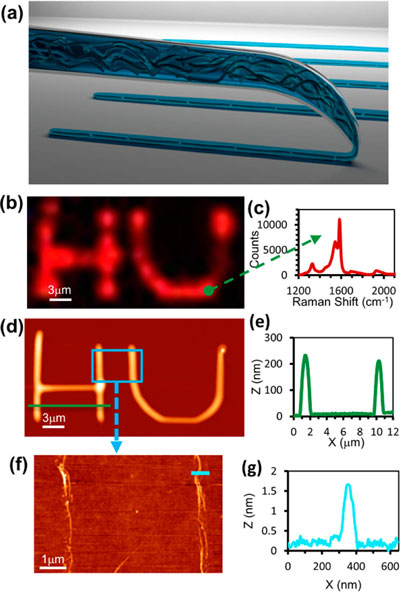
(Nanowerk Spotlight) One of the fundamental challenges in the development of nanoelectromechanical systems (NEMS) – and of nanotube- and nanowire-based devices in general – is the large-scale controlled placement of molecular sized building blocks on a substrate.The ability to effectively place at will molecules so that they can be rapidly organized into functional components is a core requirement of many nanotechnology applications, components and functional devices.In new work, an international team of researchers describes the drawing and Raman characterization procedure developed for placing single-walled carbon nanotubes (SWCNTs), proof of SWCNT alignment, optimization of the drawing parameters, and the subsequent placement in predefined lithographic structures for the demonstration of electrical conductivity.The findings have been published in the January 20, 2016 online edition of Nano Letters („Nanodrawing of Aligned Single Carbon Nanotubes with a Nanopen”).In essence, the team developed a simple nanopen for drawing and placing aligned single or multiple rod like molecules nanometrically. This is exemplified in the paper by a focus on carbon nanotubes, considered widely as a critical element in molecular electronics.Controlled direct drawing of SWCNTs on SiO2Controlled direct drawing of SWCNTs on SiO2. (a) A diagrammatic representation of the drawing process. The SWCNT alignment occurs by capillary forces in the direction of drawing. (b) Raman mapping of the written structure of the G+ band together with (c) a Raman spectrum at a point in this image. (d) AFM of the written structure before washing with (e) a line scan of a particular location. The height of the drawing is 200-250 nm, and the line width is 600-800 nm. (f) AFM of a portion of the written structure that has been washed after 4 days of drying, with (g) a line scan at a particular location. After washing only the SWCNTs remained on the substrate with the associated surfactant and solution being washed away. The height of the drawn structure is between 0.8 and 2.9 nm. (Reprinted with permission by American Chemical Society)”The basis of the methodology, which is the use of capillary forces during nanowriting of chemicals, should have general applicability in many areas such as polymer molecules, DNA where molecular placement is fundamentally and technologically of considerable import, nanoparticle manometric deposition, the deposition of metallic lines etc.,” Aaron Lewis, a professor at The Hebrew University of Jerusalem, Israel, tells Nanowerk.Thus, from the point of view of the paper, it is now feasible to write molecular components into circuit functionalities. As Mark Ratner from Northwestern commented a few years ago: „Connecting molecular nanowires in a controlled fashion to single molecules that function like circuit elements is one of the great challenges of the field (of molecular electronics).””The fundamental implications of our work is that we present a general method of chemical nanowriting that is applicable to any surface hydrophobic or hydrophilic, rough or smooth, with liquid or with gases,” Lewis points out.The team’s fountain pen nanolithography (FPN) method uses a simple glass cantilever as a nanofountain pen to draw a carbon nanotube solution directly onto a substrate with atomic force feedback.The SWCNTs are deposited and aligned by capillary forces in the drawing direction at a speed of microns per second.”FPN has overtones of the dip pen nanolithography (DPN) method but has some powerful advantages,” explains Lewis. „FPN does not have DPNs preference for hydrophilic substrates like gold and does not need to deposit linker molecules for deposition of SWCNTs as is the case in DPN. In addition, the nanopens used in FPN are optically transparent and have their drawing tip highly exposed to the optical axis for accurate placement within a device structure.”Potential application areas for FPN are molecular circuit design; mask repair at the highest of resolutions by either adding or removing with a solvent and the nanopen errors in the mask; flat panel display repair of electronic components with molecular of nanoparticle inks; placement of structured defects in photonic band gap or plasmonic optical components for guiding light in specific directions more effectively.The team is planning to demonstrate the broadened scope of this method for many different directions in science and technology.”Basically, what we have shown for carbon nanotubes now needs to be applied to other molecular systems,” says Lewis. „However, not only in terms of writing recipes for these systems on any surface but characterizing such things as the ability to write on a structure already previously drawn by the Nanopen. This among many other features is unique to this method.”By Michael is author of two books by the Royal Society of Chemistry: Nano-Society: Pushing the Boundaries of Technology and Nanotechnology: The Future is Tiny. Copyright © Nanowerk

Read more: Writing nanotubes with a nano fountain pen