La sursa de lumină de la DESY, sursa de lumină PETRA III, o echipă condusă de cercetători suedezi a produs cel mai puternic bio-material care a fost produs vreodată. Fibrele de celuloză artificiale, dar biodegradabile, sunt mai puternice decât oțelul și chiar și mătasea de păianjen, care este, de obicei, considerată cel mai puternic material bazat pe bio.
Posted: May 16, 2018
World’s strongest bio-material outperforms steel and spider silk
(Nanowerk News) At DESY’s X-ray light source PETRA III, a team led by Swedish researchers has produced the strongest bio-material that has ever been made. The artifical, but bio-degradable cellulose fibres are stronger than steel and even than dragline spider silk, which is usually considered the strongest bio-based material. The team headed by Daniel Söderberg from the KTH Royal Institute of Technology in Stockholm reports the work in the journal ACS Nano („Multiscale Control of Nanocellulose Assembly: Transferring Remarkable Nanoscale Fibril Mechanics to Macroscale Fibers”).
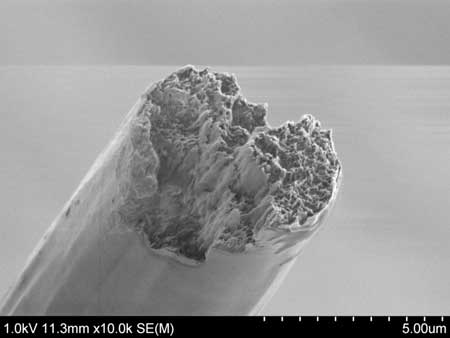
An artificial cellulose fiber made from cellulose nano fibrils seen with a scanning electron microscope. (Image: Nitesh Mittal, KTH Stockholm)
The ultrastrong material is made of cellulose nanofibres (CNF), the essential building blocks of wood and other plant life. Using a novel production method, the researchers have successfully transferred the unique mechanical properties of these nanofibres to a macroscopic, lightweight material that could be used as an eco-friendly alternative for plastic in airplanes, cars, furniture and other products. „Our new material even has potential for biomedicine since cellulose is not rejected by your body”, explains Söderberg.
The scientists started with commercially available cellulose nanofibres that are just 2 to 5 nanometres in diameter and up to 700 nanometres long. A nanometre (nm) is a millionth of a millimetre. The nanofibres were suspended in water and fed into a small channel, just one millimetre wide and milled in steel. Through two pairs of perpendicular inflows additional deionized water and water with a low pH-value entered the channel from the sides, squeezing the stream of nanofibres together and accelerating it.
This process, called hydrodynamic focussing, helped to align the nanofibres in the right direction as well as their self-organisation into a well-packed macroscopic thread. No glue or any other component is needed, the nanofibres assemble into a tight thread held together by supramolecular forces between the nanofibres, for example electrostatic and Van der Waals forces.
With the bright X-rays from PETRA III the scientists could follow and optimise the process. „The X-rays allow us to analyse the detailed structure of the thread as it forms as well as the material structure and hierarchical order in the super strong fibres,” explains co-author Stephan Roth from DESY, head of the Micro- and Nanofocus X-ray Scattering Beamline P03 where the threads were spun. „We made threads up to 15 micrometres thick and several metres in length.”
Measurements showed a tensile stiffness of 86 gigapascals (GPa) for the material and a tensile strength of 1.57 GPa. „The bio-based nanocellulose fibres fabricated here are 8 times stiffer and have strengths higher than natural dragline spider silk fibres,” says Söderberg. „If you are looking for a bio-based material, there is nothing quite like it. And it is also stronger than steel and any other metal or alloy as well as glass fibres and most other synthetic materials.”
The artificial cellulose fibres can be woven into a fabric to create materials for various applications. The researchers estimate that the production costs of the new material can compete with those of strong synthetic fabrics. „The new material can in principle be used to create bio-degradable components,” adds Roth.
The study describes a new method that mimics nature’s ability to accumulate cellulose nanofibres into almost perfect macroscale arrangements, like in wood. It opens the way for developing nanofibre material that can be used for larger structures while retaining the nanofibres’ tensile strength and ability to withstand mechanical load.
„We can now transform the super performance from the nanoscale to the macroscale,” Söderberg underlines. „This discovery is made possible by understanding and controlling the key fundamental parameters essential for perfect nanostructuring, such as particle size, interactions, alignment, diffusion, network formation and assembly.” The process can also be used to control nanoscale assembly of carbon tubes and other nano-sized fibres.
Nano-structurile bazate pe carbon cu nivele multiple de ierarhizare nu numai că pot păstra proprietăți fizice utile, cum ar fi conductivitatea electronică bună, dar pot avea și proprietăți unice. Aceste materiale pe bază de carbon 3D pot prezenta o umectabilitate îmbunătățită (pentru a facilita infiltrarea ionilor), o rezistență ridicată pe unitate de greutate și căi direcționale pentru transportul fluidelor.
Posted: May 14, 2018
Scientists discover how a pinch of salt can improve battery performance
(Nanowerk News) They found that adding salt to the inside of a supermolecular sponge and then baking it at a high temperature transformed the sponge into a carbon-based structure.
Surprisingly, the salt reacted with the sponge in special ways and turned it from a homogeneous mass to an intricate structure with fibres, struts, pillars and webs. This kind of 3D hierarchically organised carbon structure has proven very difficult to grow in a laboratory but is crucial in providing unimpeded ion transport to active sites in a battery.
Due to their intricate architecture the researchers have termed these structures ‘nano-diatoms’, and believe they could also be used in energy storage and conversion, for example as electrocatalysts for hydrogen production.
The transformation of the MOF into a nano-diatom is much like the metamorphosis of a dragon egg into a fire-born dragon when given fire treatment in Game of Thrones. (Image: Queen Mary University of London)
Like fire-born dragons in Game of Thrones
Lead author and project leader Dr Stoyan Smoukov, from Queen Mary’s School of Engineering and Materials Science, said: “This metamorphosis only happens when we heat the compounds to 800 degrees centigrade and was as unexpected as hatching fire-born dragons instead of getting baked eggs in the Game of Thrones. It is very satisfying that after the initial surprise, we have also discovered how to control the transformations with chemical composition.”
Carbon, including graphene and carbon nanotubes, is a family of the most versatile materials in nature, used in catalysis and electronics because of its conductivity and chemical and thermal stability.
3D carbon-based nanostructures with multiple levels of hierarchy not only can retain useful physical properties like good electronic conductivity but also can have unique properties. These 3D carbon-based materials can exhibit improved wettability (to facilitate ion infiltration), high strength per unit weight, and directional pathways for fluid transport.
It is, however, very challenging to make carbon-based multilevel hierarchical structures, particularly via simple chemical routes, yet these structures would be useful if such materials are to be made in large quantities for industry.
Promising applications
The supermolecular sponge used in the study is also known as a metal organic framework (MOF) material. These MOFs are attractive, molecularly designed porous materials with many promising applications such as gas storage and separation. The retention of high surface area after carbonisation – or baking at a high temperature – makes them interesting as electrode materials for batteries. However, so far carbonising MOFs has preserved the structure of the initial particles like that of a dense carbon foam. By adding salts to these MOF sponges and carbonising them, the researchers discovered a series of carbon-based materials with multiple levels of hierarchy.
Dr R Vasant Kumar, a collaborator on the study from University of Cambridge, commented: “This work pushes the use of the MOFs to a new level. The strategy for structuring carbon materials could be important not only in energy storage but also in energy conversion, and sensing.”
Lead author, Tiesheng Wang, from University of Cambridge, said: “Potentially, we could design nano-diatoms with desired structures and active sites incorporated in the carbon as there are thousands of MOFs and salts for us to select.”
combină nanodiamonds cu straturi bidimensionale de disulfură de molibden și le rupe pentru a crea un lubrifiant uscat cu auto-generare, cu o frecare foarte scăzută, care durează atâta timp încât ar putea fi aproape confundat cu pentru totdeauna. Substanța poate avea sute de aplicații industriale și poate fi utilizată practic ori de câte ori două bucăți de metal se freacă împreună în condiții uscate.
Posted: May 10, 2018
Nanodiamonds are forever
(Nanowerk News) Say goodbye to the slogan “diamonds are forever.” For industries that use dry lubricant, the up-and-coming phrase is more likely to be “broken nanodiamonds are forever.”
Researchers at the U.S. Department of Energy’s (DOE) Argonne National Laboratory are combining nanodiamonds with two-dimensional molybdenum disulfide layers and breaking them to create a self-generating, very-low-friction dry lubricant that lasts so long it could almost be confused with forever. The substance could have hundreds of industrial applications and can be used virtually wherever two pieces of metal rub together in dry conditions.
This reactive molecular dynamics simulation shows the formation of ordered onion-like Carbon (OLC) from an amorphous carbon matrix that was formed by tribochemical reaction of sulfur with nanodiamonds. The magnified view of a representative carbon-rich region is indicated (red circle), where graphitic structures nucleate and grow into well-ordered OLC. In this simulation, yellow atoms are sulfur and dark brown atoms are carbon. Scientists ran the simulation on Argonne’s Mira supercomputer under the U.S. Department of Energy’s INCITE program.
The most commonly used solid lubricants on the market today take the form of graphite paste. We use these lubricants to grease doorknobs and bike chains, among other things.
In 2015, Anirudha Sumant of the Nanoscience and Technology division and his colleagues achieved a breakthrough in solid lubrication technology by demonstrating superlubricity (near-zero friction) at engineering scale for the first time by using graphene combined with nanodiamonds. This approach was revolutionary, and since then his group has continued to further develop the technology.
Most recently, Sumant replaced the graphene in the process with molybdenum disulfide, to see how other 2-D materials would behave. He was expecting the process to resemble the one observed with graphene-nanodiamond lubricant. However, the team was surprised when Diana Berman, the lead author and Argonne post-doctoral fellow, couldn’t see nanodiamonds in the material. Instead, she found balls of onion-like carbon.
What was happening? The molybdenum disulfide was breaking up into molybdenum and sulfur and reacting with the nanodiamonds to convert them into onion-like carbon.
“We knew that the culprit must be sulfur damaging the nanodiamonds, but for us it actually helps,” Sumant said.
The Argonne team, which included Sumant, Diana Berman, Subramanian Sankaranarayanan, Badri Narayanan, Mathew Cherukara, Ali Erdemir and Alexander Zinovev, realized that sulfur diffusion was increasing the strain in the nanodiamonds, subsequently breaking them and converting them into onion-like carbon.
This was a blessing in disguise, said Sankaranarayanan, since their efforts also unlocked another secret of how other 2-D materials will interact with nanodiamonds with the same result.
The friction in this new combination is 10 times lower than that of some nonstick coatings including fluoropolymers, which means less heat and less wear and tear on parts and equipment.
“The material the lubricant is used on is going to last longer, and I don’t have to worry about liquid residue and throwing out oily rags as part of the clean-up process,” Harvey said. “We also can use it to make parts that we can’t make today, especially with metal stamping.”
Onion-like carbon, when formed, consists of several layers of spherical graphitic shells that can be used as a dry lubricant. And the process of sprinkling molybdenum disulfide and nanodiamonds together creates this form of carbon automatically, without any additional chemical application.
“It’s interesting to see that these carbon balls can sustain high contact pressure and, due to their unique nanostructure, can glide easily, creating the superlubricity,” said Ali Erdemir, Argonne Distinguished Fellow and collaborator in this study.
“We have now figured out how to generate lubricants during sliding that can last much longer than any other solid lubricants,” Sumant said.
While molybdenum disulfide is a bit more expensive than graphene, less is needed in this process.
“The amount is so small — a few drops for kilometers of sliding — that cost is not an issue,” Sumant said. The dry lubrication method is also much cleaner for use because there are no hazardous chemicals getting thrown away in this process, he added.
Dry lubricants are already common in several industries. However, they are mostly used for thin-film coatings and are prone to catastrophic failure modes. The Argonne-developed superlubricant works very differently from traditional thin-film coatings. The self-generating lubricant readjusts itself continuously, so it lasts longer.
“This really represents the next generation of solid lubricant,” Sumant said.
The potential applications include bearings and mechanical pump seals in dry applications as well as in wind turbines. The technology could also be used in the computer industry; specifically, in magnetic disc drives.
Argonne already has three patents on the superlubricity technology, with a patent pending on this breakthrough, which will soon be available for licensing.
Sumant and Erdemir co-wrote a recent review in ACS Nano („Approaches for Achieving Superlubricity in Two-Dimensional Materials”) on the most current superlubricity technologies and discoveries within the field. This guidepost article may be the first to summarize the current state of global research on superlubricity using two-dimensional materials such as graphene, hexagonal boron nitride and molybdenum disulfide.
Grafenul material are multe proprietati incredibile, dar pana in prezent a fost dificil de utilizat pe scara larga in industrie, pentru ca isi pierde proprietatile unice si se intoarce la grafitul de origine. Cercetătorul Mamoun Taher a dezvoltat o nouă formă de grafen care poate rezolva problema.
Posted: May 09, 2018
A new generation of graphene incorporates ‘separators’
(Nanowerk News) The material graphene has many incredible properties, but to date it has been difficult to use on a large scale in industry, because it loses its unique properties and goes back to its origin graphite. Researcher Mamoun Taher has developed a new form of graphene that can solve the problem.
“The challenge has been to scale up graphene’s outstanding properties from nanoscale at laboratories to macro-scale at industry without degradation,” says Mamoun Taher. He is a researcher at the Department of Chemistry at Uppsala University and CEO of start-up company Graphmatech.
Mamoun Taher
Graphene is one atom thick two-dimensional carbon material. It is flexible, 200 times stronger than steel, and has many other advantageous properties. The problem is that when it is produced on a large scale, the thin flakes have tendency to re-stick. As a result, the material loses its wonder properties and becomes more like graphite.
The new material, Aros Graphene, has been designed to prevent this by incorporating designed molecules, so called “separators”.
“The separators are designed to separate graphene flakes without degrading their properties, so we have control over the material. The process has been designed to be environmentally accepted, we use water as a solvent and no hazardous chemicals.”
Research in collaboration with companies
Mamoun Taher splits his time between research at the Ångström Laboratory and working with start-up company Graphmatech. By his side is entrepreneur Björn Lind, one of the brains behind the company Disruptive Materials and Upsalite, another material developed from research at Uppsala University.
The development takes place in close partnership with the company ABB and they also have access to ABB’s laboratories in Västerås.
Mamoun Taher made his discovery as a postdoc at Uppsala University. Originally from Syria, after he wrote a doctoral dissertation in the chemistry of interfaces at Luleå University of Technology, he came to Uppsala University. In collaboration with ABB Corporate Research Center in Västerås, he worked with graphene materials, but was struck by how much of the properties were lost when the flakes stuck together.
“I combined my previous research with my studies of graphene, and that’s how Aros Graphene was born.”
Thermal management of electronics
He contacted UU Innovation, the University´s unit for support for commercialisation of research results, and the European organisation InnoEnergy. With their support, the company took off. There are applications in electronics and telecommunication industry, where the material can be used to efficiently dissipate heat from electronics which enables more compacted designs, longer life spam and safer operation.
“We’ve seen that a thermal paste that contains Aros Graphene is 180 percent more thermally conductive than other thermal paste products on the market. In the close future where more and more data centres will be needed to store data, there is huge demand for advanced thermal management solutions.”
GraphMaTech has several other projects, for example on self-lubricating mechanical systems, 3D printing, moving electrical contacts and printed supercapacitors.
“We aren’t just developing a material, but also processes that can be used by graphene producers and other materials-related industries. We’re currently in discussions about licensing our process,” says Mamoun Taher.
a creat un alt material bidimensional, despre care cercetătorii spun că ar putea fi un schimbător de jocuri pentru generarea de combustibil solar.Hematena poate fi un fotocatalizator eficient, în special pentru împărțirea apei în hidrogen și oxigen, și ar putea servi și ca un material magnetic ultrathin pentru dispozitive pe bază de spintronă, au spus cercetătorii.Spre deosebire de carbon și forma sa 2D, grafenul, hematitul este un material non-van der Waals, adică este susținut de rețelele de lipire 3D, mai degrabă decât interacțiunile atomice van der Waals nechemice și relativ mai slabe.
Posted: May 07, 2018
Hematene joins parade of new 2D materials
(Nanowerk News) In the wake of its recent discovery of a flat form of gallium, an international team led by scientists from Rice University has created another two-dimensional material that the researchers said could be a game changer for solar fuel generation.
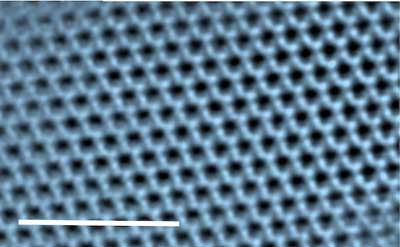
Hematene created by a Rice University-led team is the first known two-dimensional non-van der Waals material. The transmission electron image shows a single sheet of hematene. Scale bar equals 0.5 microns. (Image: Shyam Sinha and Peter van Aken/Max Planck Institute for Solid State Research, Stuttgart, Germany)
Hematene may be an efficient photocatalyst, especially for splitting water into hydrogen and oxygen, and could also serve as an ultrathin magnetic material for spintronic-based devices, the researchers said.
“2D magnetism is becoming a very exciting field with recent advances in synthesizing such materials, but the synthesis techniques are complex and the materials’ stability is limited,” Ajayan said. “Here, we have a simple, scalable method, and the hematene structure should be environmentally stable.”
Ajayan’s lab worked with researchers at the University of Houston and in India, Brazil, Germany and elsewhere to exfoliate the material from naturally occurring hematite using a combination of sonication, centrifugation and vacuum-assisted filtration.
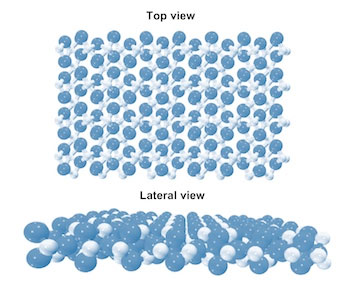
A schematic shows the atomic arrangement of iron (blue) and oxygen (white) atoms in hematene, a two-dimensional material that was exfoliated from hematite for the first time by Rice University scientists and their international partners. (Image: Cristiano Woellner and Douglas Galvao/State University of Campinas, Brazil)
Hematite was already known to have photocatalytic properties, but they are not good enough to be useful, the researchers said.
“For a material to be an efficient photocatalyst, it should absorb the visible part of sunlight, generate electrical charges and transport them to the surface of the material to carry out the desired reaction,” said Oomman Varghese, a co-author and associate professor of physics at the University of Houston.
“Hematite absorbs sunlight from ultraviolet to the yellow-orange region, but the charges produced are very short-lived. As a result, they become extinct before they reach the surface,” he said.
Hematene photocatalysis is more efficient because photons generate negative and positive charges within a few atoms of the surface, the researchers said. By pairing the new material with titanium dioxide nanotube arrays, which provide an easy pathway for electrons to leave the hematene, the scientists found they could allow more visible light to be absorbed.
The researchers also discovered that hematene’s magnetic properties differ from those of hematite. While native hematite is antiferromagnetic, tests showed that hematene is ferromagnetic, like a common magnet. In ferromagnets, atoms’ magnetic moments point in the same direction. In antiferromagnets, the moments in adjacent atoms alternate.
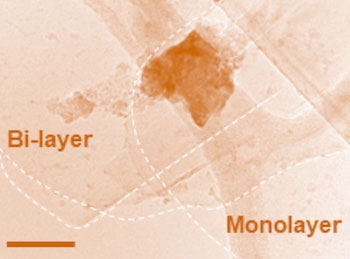
A transmission electron microscope image shows bi-layer and monolayer hematene, exfoliated from hematite, a common iron ore, by scientists at Rice University and their international partners. The material shows promise as a catalyst for advanced solar fuel generation and spintronics applications. The scale bar equals 50 nanometers. (Image: Ajayan Research Group/Rice University)
Unlike carbon and its 2D form, graphene, hematite is a non-van der Waals material, meaning it’s held together by 3D bonding networks rather than non-chemical and comparatively weaker atomic van der Waals interactions.
“Most 2D materials to date have been derived from bulk counterparts that are layered in nature and generally known as van der Waals solids,” said co-author Professor Anantharaman Malie Madom Ramaswamy Iyer of the Cochin University of Science and Technology, India. “2D materials from bulk precursors having (non-van der Waals) 3D bonding networks are rare, and in this context hematene assumes great significance.”
According to co-author Chandra Sekhar Tiwary, a former postdoctoral researcher at Rice and now an assistant professor at the Indian Institute of Technology, Gandhinagar, the collaborators are exploring other non-van der Waals materials for their 2D potential.
Cercetătorii de la Universitatea din Geneva (UNIGE) și CEA, CNRS și UGA au studiat BACOVO – un material cuantic unidimensional necunoscut publicului larg – în colaborare cu cercetătorii din centrele neutronice ILL și PSI. Ei au descoperit în acest material o nouă tranziție fazică topologică, guvernată nu de un singur tip de excitație topologică, ci de două tipuri diferite. În plus, au putut alege care dintre cele două seturi ar domina celălalt.
Posted: May 07, 2018
The apparent inner calm of quantum materials
(Nanowerk News) Transitions between different phases of matter are part of our day-to-day lives: when water freezes, for example, it passes from liquid to solid state. Some of these transitions may be of a different kind, resulting from so-called topological excitations that force all the particles to act in unison.
Researchers from the University of Geneva (UNIGE) and the CEA,CNRS and UGA have been studying BACOVO – a one-dimensional quantum material unknown to the general public – in collaboration with scientists from the neutronic centers ILL and PSI. They have discovered in this material a novel topological phase transition, governed not by a single type of topological excitation, but by two different ones. In addition, they were able to choose which of the two sets would dominate the other.
The helix structure of BACOVO: the oxygen atoms, represented in red, are organized in octahedra around the cobalt atoms, located at their center. The blue arrows represent the small moments carried by the cobalt atoms, ordered antiferromagnetically along the helical chain. (Image: CEA/CNRS/UGA)
The researchers drew on the work of the 2016 Nobel Prize for physics awarded to David Thouless, Duncan Haldane, and Michael Kosterlitz. The three physicists predicted that a set of topological excitations in a quantum material is likely to induce a phase transition. Numerous theories have been developed about these topological excitations, including the feasibility of combining two of them in a single material.
But is that a real possibility? And if so, what would happen? The teams from UNIGE and CEA, CNRS and UGA were able to provide the first experimental confirmation of the theory predicting the existence of two simultaneous sets of topological excitations and the competition between them. All in all, it is a small revolution in the mysterious world of quantum properties.
Theory and experimentation intimately linked
The researchers from CEA, CNRS, and Université Grenoble Alpes were working on a one-dimensional antiferromagnetic material with particular properties: BACOVO (BaCo2V2O8).
„We performed various experiments on BACOVO, an oxide characterised by its helical structure,” underline Béatrice Grenier, Sylvain Petit and Virginie Simonet, researchers at the CEA, CNRS and UGA. „But our experimental results evidenced a puzzling phase transition” – which is why their team called on Thierry Giamarchi, a professor in the Department of Quantum Matter Physics in UNIGE’s Faculty of Science. The Geneva physicist explains: „Based on their results, we established theoretical frameworks capable of interpreting them. These theoretical models were then tested again using new experiments so they could be validated.”
Creating the „standard model”
The aim was to understand how BACOVO’s quantum properties act, especially their topological excitations. „For this purpose, we used neutron scattering, meaning we sent a neutron beam onto the material. The neutrons behave like small magnets that interact with those of BACOVO, according to a strategy „disturb in order to reveal”, helping us to understand their properties,” says Quentin Faure, Ph-D student at the Institute for Nanoscience and Cryogenics (CEA/UGA) and Néel Institute. When the model developed at UNIGE matches the experiment, it becomes the material’s „standard model”. Professor Giamarchi enthusiastically points out: „And, in fact, the model we established with Shintaro Takayoshi predicted exactly the outcome seen in the experiment!”
A material with unexpected properties
But this experiment also led to a discovery that the scientists had not anticipated. „After settling on the „standard model” for BACOVO, we observed unexpected properties,» says Shintaro Takayoshi, researcher in the Department of Quantum Matter Physics in UNIGE’s Faculty of Science. When placed in a magnetic field, BACOVO develops a second set of topological excitations that are in competition with the first one, confirming theories from the 1970s and 1980s organised around the field opened up by the work of the Nobel scientists.
„As well as proving the existence of this confrontation between two sets of topological excitations within the same material – an unprecedented event – we were able to experimentally control which set would dominate the other”, adds the Genevan researcher. And that is a first!
What was originally a theoretical hypothesis became a verified experiment. The in-depth analysis of BACOVO undertaken by the physicists proved that two sets of topological excitations come into direct confrontation in the same material and control the state of matter, which differs according to the dominant set, yielding a quantum phase transition. Furthermore, the scientists succeeded in controlling which set prevails, meaning they could adjust BACOVO’s state of matter at will.
„These results open up a whole range of possibilities in terms of quantum physics research,” concludes Professor Giamarchi. „It’s true that we are still at the fundamental level, but it’s through this kind of discovery that we are getting closer every day to applications for the quantum properties of materials… and why not quantum computers!?”
a dezvoltat foi de carbon de înaltă rezistență, super-dură, care pot fi fabricate inexpensiv la temperaturi scăzute.
Echipa a realizat foile prin îmbinarea chimică a trombocitelor de carbon grafitic, care este similar cu grafitul găsit în plumbul moale al unui creion obișnuit. Procesul de fabricație a dus la obținerea unui material ale cărui proprietăți mecanice depășesc acelea ale compozitelor din fibră de carbon utilizate în mod curent în diferite produse comerciale.Deoarece foile noastre sunt fabricate la temperaturi scăzute, acestea sunt costuri reduse, în plus față de rezistența înaltă a foilor duritatea și rezistența la oboseală, au o conductivitate electrică ridicată și sunt capabile să protejeze împotriva radiațiilor electromagnetice
Posted: May 07, 2018
Scientists make strong, super-tough carbon sheets at low temperature
(Nanowerk News) An international research team led by scientists at Beihang University in China and The University of Texas at Dallas has developed high-strength, super-tough sheets of carbon that can be inexpensively fabricated at low temperatures.
The team made the sheets by chemically stitching together platelets of graphitic carbon, which is similar to the graphite found in the soft lead of an ordinary pencil. The fabrication process resulted in a material whose mechanical properties exceed those of carbon fiber composites that are currently used in diverse commercial products.
„These sheets might eventually replace the expensive carbon fiber composites that are used for everything from aircraft and automobile bodies to windmill blades and sports equipment,” said Dr. Ray Baughman, the Robert A. Welch Distinguished Chair in Chemistry at UT Dallas and director of the Alan G. MacDiarmid NanoTech Institute. Baughman is a corresponding author of an article describing the material published online this week in the Proceedings of the National Academy of Sciences („Sequentially bridged graphene sheets with high strength, toughness, and electrical conductivity”).
This false-color, scanning electron microscope image shows the fractured surface of a sequentially bonded graphene sheet. An international research team led by scientists at Beihang University in China and The University of Texas at Dallas developed the high-strength, super-tough sheets, which can be inexpensively fabricated at low temperatures. (Image: Beihang University)
Today’s carbon fiber composites are expensive in part because the carbon fibers are produced at extremely high temperatures, which can exceed 2,500 degrees Celsius (about 4,500 degrees Fahrenheit).
„In contrast, our process can use graphite that is cheaply dug from the ground and processed at temperatures below 45 degrees Celsius (113 degrees Fahrenheit),” said Dr. Qunfeng Cheng, professor of chemistry at Beihang University and a corresponding author. „The strengths of these sheets in all in-plane directions match that of plied carbon fiber composites, and they can absorb much higher mechanical energy before failing than carbon fiber composites.”
Graphite consists of platelets made up of stacked layers of graphene. Graphene is simply a single layer of carbon atoms, arranged in a pattern that looks like a chicken wire mesh fence, where each hexagon in the mesh is formed by six carbon atoms.
„While scientists can continuously make large sheets of graphene by high-temperature processing, and have shown these sheets to have remarkable strength, it is impractical to make thick plates of graphite by merely stacking large-area graphene sheets,” Cheng said. „One would need to stack about 150,000 graphene sheets to make a graphite sheet having about the thickness of a human hair.”
The researchers found inspiration in natural nacre, also known as mother-of-pearl, which gives some seashells their strength and toughness. Nacre is composed of parallel platelets that are bound together by thin layers of organic material, similar to the way bricks in a wall are held together by mortar.
„Instead of mechanically stacking large-area graphene sheets, we oxidize micron-size graphite platelets so that they can be dispersed in water, and then filter this dispersion to inexpensively make sheets of oriented graphene oxide,” Baughman said. „This process is akin to hand-making sheets of paper by filtering a slurry of fibers.
„At this stage, the sheets are neither strong nor tough, meaning they cannot absorb much energy before rupturing,” he said. „The trick we use is to stitch together the platelets in these sheets using sequentially infiltrated bridging agents that interconnect overlapping neighboring platelets, and convert the oxidized graphene oxide to graphene. The key to this advance is that our bridging agents separately act via formation of covalent chemical bonds and van der Waals bonds.”
Sheets that incorporated the bridging agents were 4.5 times stronger and 7.9 times tougher than agent-free sheets, said Beihang University PhD student Sijie Wan, who is a lead author of the journal article. „Unlike carbon fiber composites, no polymer matrix is needed,” he said.
„While sheets of expensive carbon fiber composites can provide a similar strength in all sheet-plane directions, the energy that they can absorb before fracture is about one-third that of our sequentially bridged graphene sheets,” Wan said. „Because our sheets are fabricated at low temperatures, they are low cost. In addition to exhibiting high sheet strength, toughness and fatigue resistance, they have high electrical conductivity and are able to shield against electromagnetic radiation. These properties make these sequentially bridged graphene sheets quite attractive for possible future applications.”
raporteaza informatii importante despre aurul nanoporos – un material cu aplicatii in crestere in mai multe domenii, incluzand dispozitive de stocare a energiei si dispozitive biomedicale – fara a intra intr-un laborator.Nanoporous aur a fost studiat de aproximativ 15 ani, dar putin este de fapt cunoscut despre caracteristicile sale fizice si limitele de tunability sale pentru aplicatii specifice, echipa scrie in rapoartele stiintifice .
Posted: May 03, 2018
Mining for nanogold with a computer
(Nanowerk News) Engineers from Texas A&M University and Virginia Tech report important new insights into nanoporous gold–a material with growing applications in several areas, including energy storage and biomedical devices–all without stepping into a lab.
Instead of conducting any additional experiments, the team used image-analysis software developed in-house to „mine” the existing literature on nanoporous gold (NPG). Specifically, the software analyzed photographs of NPG from some 150 peer-reviewed papers, quickly measuring key features of the material that the researchers then correlated with written descriptions of how the samples were prepared. One of the results? A recipe, of sorts, for how to make NPG with specific characteristics.
„We were able to back out a quantitative law that explains how you can change NPG features by changing the processing times and temperatures,” said Ian McCue, a postdoctoral researcher in the Texas A&M Department of Materials Science and Engineering. McCue is lead author of a paper on the work published in Scientific Reports („Gaining new insights into nanoporous gold by mining and analysis of published images”).
These images show some of the physical characteristics of nanoporous gold at different magnifications. (Image: Texas A&M University)
The team also identified a new parameter related to NPG that could be used to better tune the material for specific applications.
„Before our work, engineers knew of one tunable ‘knob’ for NPG. Now we have a second one that could give us even more control over the material’s properties,” said Josh Stuckner, a graduate student at Virginia Tech and co-author of the paper. Stuckner developed the software that allowed the new insights.
Other authors are Dr. Michael J. Demkowicz, associate professor in the materials science and engineering department at Texas A&M, and Dr. Mitsu Murayama, associate professor at Virginia Tech.
Nanoporous gold has been studied for some 15 years, but little is actually known about its physical characteristics and the limits of its tunability for specific applications, the team writes in Scientific Reports.
The material is a three-dimensional porous network of interweaving strands, or ligaments. Multiple ligaments, in turn, connect at points called nodes. All of these features are almost unimaginably small. Stuckner notes, for example, that some of the smaller pores would fit about three strands of DNA side by side. As a result, McCue said the overall structure is very complex and it’s been extremely difficult and time-consuming to measure features like the lengths between nodes and the diameters of ligaments. But Stuckner’s software has changed that.
„Manually it might take 20 minutes to over an hour to measure the features associated with one image,” Stuckner said. „We can do it in a minute, or even just tell the computer to measure a whole slew of images while we walk away.”
Earlier attempts to measure NPG features led to very small data sets of five or six data points. The Texas A&M/Virginia Tech team has looked at around 80 data points. That, in turn, allowed the team to create the new quantitative description of NPG features associated with different processing techniques. All that without doing any actual experiments, just clever data-mining and analysis, said McCue.
The work has also led to new publication guidelines for future researchers. Of the 2,000 papers the team originally analyzed, only 150 had useful information.
„We had to throw out a lot of data due to poor image quality or a lack of written information on how a given NPG was processed,” McCue said. „The new guidelines could prevent that, ultimately allowing better data mining not only for NPG but for other materials.”
Source: By Elizabeth Thomson, Texas A&M University
unei noi clase de catalizatori atomici unici (SAC) susținute pe nanotuburi de carbon care prezintă o reducere electrochimică remarcabilă a CO 2 la CO. % pentru clasa nouă, nanotuburile de carbon cu azot dopat de azot, cu un atom de azot (NiSA-N-CNT), se consideră a fi cea mai mare încărcare de metal pentru SAC-urile raportate până în prezent.
Atomii atomici de nichel, cobalt și fier au fost sprijiniți pe nanotuburi de carbon dopate cu azot printr-o metodă de piroliză cu un singur recipient și comparate în studiu.Noua clasă de SAC are un potențial extraordinar, cu aplicații promițătoare în domeniile electrocatalizei și catalizatorilor pentru conversia energiei, precum și a altor utilizări;au dezvoltat un nou proces de sinteză și dezvoltare a nanotuburilor de carbon dopate cu azot cu un ligand de nichel care demonstrează activitate catalitică ridicată.
Posted: May 02, 2018
New class of single atoms catalysts for carbon nanotubes exhibit outstanding electrochemical reduction of CO2 to CO
(Nanowerk News) Experiments using X-rays on two beamlines at the Australian Synchrotron have helped characterise a new class of single atom catalysts (SACs) supported on carbon nanotubes that exhibit outstanding electrochemical reduction of CO2 to CO. A weight loading of 20 wt% for the new class, nickel single atom nitrogen doped carbon nanotubes (NiSA-N-CNTs), is believed to be the highest metal loading for SACs reported to date.
Single atoms of nickel, cobalt and iron were supported on nitrogen doped carbon nanotubes via a one-pot pyrolysis method and compared in the study.
A large international collaboration, led by Prof San Ping Jiang, Deputy Director of the Fuels and Energy Technology Institute at the Curtin University of Technology and associates from the Department of Chemical Engineering, have developed a new synthesis and development process for nitrogen-doped carbon nanotubes with a nickel ligand that demonstrate high catalytic activity.
Dr Bernt Johannessen, instrument scientist on the X-ray absorption spectroscopy (XAS) beamline at the Australian Synchrotron was a co-author on the paper, which also included lead investigators from Curtin University of Technology and collaborators at the University of Western Australia, Institute of Metal Research (China), Oak Ridge National Laboratory (US), University of the Sunshine Coast, University of Queensland, Tsinghua University (China) and King Abdulaziz University (Saudi Arabia). Technical support and advice on the soft X-ray spectroscopy experiments was provided by Australian Synchrotron instrument scientist Dr Bruce Cowie.
“The whole idea behind the approach is that the smaller particles you have, the more catalytically active they are. As you go to a nanoparticle size, you see catalytic activity increase. And if you take that to the extreme, you are looking at single metal atoms anchored on a supporting substrate of carbon,” said Johannessen.
“Because surface atoms behave differently to bulk or other atoms, XAS was used to verify there were in fact single atoms and the position of those nickel atoms relative to other atoms. We were able to determine bond lengths and coordination numbers.”
The adding or subtracting single atoms from a particle opens up the possibility of tuning its properties.
The challenge has been to keep the metal atoms, which provide a strong metal support bond, from interacting with each other and aggregating because of their higher surface energy.
The investigators overcame this by developing a multistep method to synthesise atomically dispersed nickel atoms on nitrogen doped CNTs that included decomposing the precursor solution at high temperature.
The X-ray absorption near edge structure spectroscopy (XANES) measurements at the Australian Synchrotron provided supporting evidence of the electrochemical efficiency of NiSA-N-CNTs. The results suggested that the Ni-N species are the active centres for the reduction reaction of CO2 to CO. The single nickel atoms are held by coordinating nitrogen atoms in the N- doped carbon nanotube structure and this helps stabilise the structure from metal aggregation.
The NiSA-N-CNTs also demonstrated a higher turnover frequency than other nitrogen doped CNTs. The data confirmed there was no obvious aggregation or breakdown of nickel and also revealed the structural durability of the NiSA-N-CNTs as electrocatalysts.
A number of other techniques and simulations were undertaken as part of materials characterisation and to confirm the CO2 reaction reduction.
The new class of SACs has tremendous potential with promising applications in the areas of electrocatalysis and catalysts for energy conversion as well as other uses.
Proprietățile acestui nou aliaj ar putea conduce la utilizarea acestuia ca strat de contact pentru celulele solare sau pentru memoria magnetică viitoare, tranzistori de film subțire sau termoelectrice dispozitive; au găsit o modalitate de a crea echivalentul presiunii negative prin amestecarea a două materiale împreună în doar condițiile potrivite pentru a face un aliaj cu un airier și o structură cristalină complet diferită și proprietăți unice .
Posted: May 01, 2018
Scientists find a new way to make novel materials by ‘un-squeezing’
(Nanowerk News) Some materials can morph into multiple crystal structures with very different properties. For instance, squeezing a soft form of carbon produces diamond, a harder and more brilliant form of carbon. The Kurt Vonnegut novel “Cat’s Cradle” featured ice-nine, a fictional form of water with a much higher melting point than regular ice that threatened to irreversibly freeze all the water on Earth.
These materials are called polymorphs, and they’re commonly made by applying pressure, or squeezing. Scientists looking for new materials would also like to do the opposite – apply “negative pressure” to stretch a material’s crystal structure into a new configuration. In the past, this approach seemed to require negative pressures that are difficult if not impossible to achieve in the lab, plus it risked pulling the material apart.
Now researchers at the Department of Energy’s National Renewable Energy Laboratory (NREL) have found a way to create the equivalent of negative pressure by mixing two materials together under just the right conditions to make an alloy with an airier and entirely different crystal structure and unique properties.
A team led by scientists at NREL demonstrated a way to use “negative pressure” to combine two dense materials into an alloy (right) with a much lower density, as if turning a snowball back into fluffy snow. The new alloy also has much different properties than either of its parents. The spheres represent atoms of manganese (blue), selenium (red) and tellurium (gold).
X-ray measurements at DOE’s SLAC National Accelerator Laboratory confirmed that they have succeeded. Their new alloy has more space between its atoms then either of its parent materials, as if it had been stretched out. Unlike its parents, the new material is piezoelectric – able to generate an electric charge in response to applied mechanical stress. This may be important for use in sensors and actuators.
Published in Science Advances („Negative-pressure polymorphs made by heterostructural alloying”), the paper reporting their findings contains both the theoretical understanding and experimental proof of concept that show how such novel low-density materials can be made.
“Creating the negative pressure conditions in alloys required counterintuitive thinking, and maybe that’s why this has not been pointed out before,” said Andriy Zakutayev, an NREL scientist and a lead author of the new paper.
“It’s possible to apply positive pressure to the material by squeezing it, but it’s really difficult to un-squeeze the material,” he said. “Think about it this way: you can pack a snowball out of snow, but you can’t turn a dense snowball back into fluffy snow.”
Pioneering Work on Mismatched Materials
The experiment builds on pioneering work led by NREL on mixing compounds with atomic structures that didn’t match.
As surely as water flows downhill, a chemical reaction will take the path of least resistance, proceeding in a way that consumes the least energy. Mixing two materials with high-density structures takes a lot of energy; but if you could nudge the reaction in the direction of creating a low-density end product whose atoms were farther apart, it would require a lot less energy, the researchers theorized. It would be the equivalent of making a material under negative pressure.
They tested this hypothesis by mixing high-density forms of manganese selenide and manganese telluride that have different crystal structures – one resembling rock salt, the other the mineral nickeline. To combine the two, they used a technique called sputtering in which fine sprays of atoms were freed from the surfaces of both starting materials and deposited as a thin film on a hot surface, where the new alloy crystallized and grew, said SLAC associate staff scientist Laura Schelhas. She conducted X-ray measurements of the new alloy at the lab’s Stanford Synchrotron Radiation Lightsource (SSRL) with staff scientist Kevin Stone. The alloy, it turned out, had the crystal structure of yet another mineral, wurtzite.
“You can use this alloying approach to make different, never-before-seen materials with interesting properties,” Schelhas said. “For instance, this one becomes piezoelectric: When you apply a voltage across the material it actually stretches and gets bigger. And the opposite also happens: If you push on it, it produces an electric charge. These piezoelectric materials are used in a lot of places – including some airbags, where the pressure from getting hit in a collision creates a little bit of electric charge that sets the airbag off – and the material created here was entirely new.”
Aaron Holder, an NREL researcher and assistant professor at the University of Colorado Boulder, said, “The properties of this new alloy could lead to its use as a contact layer for solar cells, or for future magnetic memory, thin film transistors, or thermoelectric devices. But how we made it is even more promising: Finding new routes to synthesize materials that nature cannot make would catalyze progress towards next-generation technologies.”
O provocare majoră în domeniul științei materialelor este dezvoltarea de nanomateriale care pot replica aspecte ale acestor funcții celulare și se pot integra cu sistemele vii.dar ceea ce avem până acum este un progres interesant care demonstrează posibilitatea creării de materiale fabricate de om, care să imite o activitate complexă și dinamică a sistemelor biologice. Aceste noi nanomateriale au capacitatea de a răspunde la semnalele chimice relevante din punct de vedere biologic și oferă o interfață electronică.
Posted: Apr 30, 2018
Scientists create nanomaterials that reconfigure in response to biochemical signals
(Nanowerk News) Biological cells have the complex and miraculous ability to reconfigure and change the way they communicate with each other over time, allowing them to nimbly direct critical functions in the human body – from thinking to walking to fighting disease. A major challenge in materials science is developing nanomaterials that can replicate aspects of these cellular functions and integrate with living systems.
Formation of electronic nanowires is chemically programmed by incorporation of amino acids into self-assembling molecules. (Image: Ella Maru Studio)
„The ability to self-assemble, reconfigure and disassemble in response to chemical signals is a common trait in biological materials, but not in manmade ones” said Mohit Kumar, the paper’s lead author and a scientist with Rein Ulijn’s research group at the ASRC’s Nanoscience Initiative and Hunter College. „If you want to integrate synthetic materials into biology, a seamless interface is desirable, which requires materials that share some of the properties of living matter. Our approach will hopefully open the door to manmade materials that can interact with and repair living systems.”
To develop nanomaterials that reconfigure in response to chemical signals, researchers started with the base molecule naphthalenediimide (NDI), which is an organic semiconductor. The molecule was selectively modified on both sides by exposing it to biochemical signals in the form of simple amino acids that were added to the system. An enzyme was used to incorporate the amino acids onto the core molecule, triggering self-assembly and disassembly pathways. This process allowed the formation and degradation of nanomaterials with wire-like features capable of conducting electrical signals.
By using different amino acids, researchers were able to direct the development of nanomaterials with different properties, including a programmable nanostructure with the ability to turn electrical conduction on and off through the use of time-dependent self-assembly and disassembly.
„Like neurons in the brain, these materials exhibit a remarkable ability to remodel their electrical connections,” said Allon Hochbaum, a co-author of the paper and material scientist at the Samueli School of Engineering, University of California, Irvine (UCI). „The assembly of these molecules is encoded in their dynamic chemistry, so by simply changing the chemical inputs, we can observe insulating nanomaterials, conductive nanomaterials, or nanomaterials that dynamically switch between conducting and non-conducting states. The fact that their assembly and conductivity evolve in water makes these materials all the more compelling for bio-interfacing applications.”
Funding for the research was provided by the Air Force Office for Scientific Research and the Army Research Office. UCI researchers developed the devices for measuring the nanomaterials’ electrical conducting abilities, while ASRC researchers developed the nanomaterials. The collaborative team’s next step is to interface the new nanomaterials with actual neurons to see how the manmade and biological materials interact.
„We want to see if we can use the dynamic electro-conducting nanomaterials to effectively interface with neurons and result in their on-demand electrical firing,” said Rein Ulijn, director of the ASRC’s Nanoscience Initiative. „We’re still early in that aspect of the work, but what we have so far is an exciting breakthrough that demonstrates the possibility for creating manmade materials that mimic a complex, dynamic activity of biological systems. These new nanomaterials have the ability to respond to biologically relevant chemical signals and provide an electronic interface. In the long run, this may open up a new pathway towards developing treatments that, until now, have only been theoretical.”