Materiale precum sulfura de molibden sunt utilizate ca catalizatori în reacțiile chimice. Huang se referă la împărțirea apei, un procedeu utilizat pentru a produce hidrogen gazos și oxigen din apa lichidă, în cazul în care sulfura de molibden în mod corespunzător poate îmbunătăți procesul și reduce cantitatea de energie și costurile necesare și crește cantitatea de hidrogen produsă.
Molibdenul este un metal de tranziție, iar alți membri ai acestui grup atomic formează și molecule numite dichalcogenide. Acestea includ tungsten, niobiu, zirconiu, titan și tantal și formează straturi cu sulf și alte calcogenide cum ar fi seleniu și telur. Alte diccalcogene pot fi făcute în materiale 2-D și pot fi ajustabile pentru a-și îmbunătăți proprietățile.
Posted: Apr 19, 2018
Electrochemical tuning of single layer materials relies on defects
(Nanowerk News) Perfection is not everything, according to an international team of researchers whose 2-D materials study shows that defects can enhance a material’s physical, electrochemical, magnetic, energy and catalytic properties.
„Electronic devices, like transistors, are usually made from relatively bulky stacked layers of metal, oxides and crystalline semiconductors,” said Shengxi Huang, assistant professor of electrical engineering, Penn State. „We would like to make them with two-dimensional materials so that they can be faster, smaller and more flexible.”
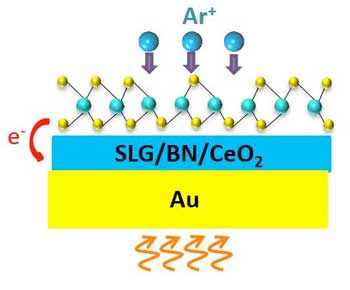
Molybdenum sulfide is a molecule made up of one molybdenum atom with two sulfur atoms attached. The molecules line up with the molybdenum in the middle and the sulfur atoms on the top and bottom when forming a 2-D, single-layer, film. These films were placed on a variety of substrates – gold, single-layer graphene, hexagonal boron nitride and cerium dioxide – and irradiated to create defects in the lattice structure.
Creating 2-D materials is not a perfect manufacturing process and defects are always present in the lattice. The researchers wanted to determine how those defects changed the physical and electrochemical properties of the molybdenum sulfide. Irradiation causes some of the molybdenum sulfide to lose a sulfur atom from the surface. Using these less-than-perfect films, the researchers could see how the materials changed using a variety of microscopies and spectroscopies.
Simulations of lattice defects allowed the researchers to manipulate the materials and produce structures that matched the experimentally defective films. They found that the materials properties results of their simulations matched their experimental results.
„We found that the sulfur defects improved the physical characteristics of the material,” said Huang. „By choosing the locations and number of defects, we should be able to tune the material’s band structure, improving its electronic capabilities.”
Experimentally, the researchers found that many more sulfur atoms are lost than molybdenum atoms, because the sulfur is on the surfaces and the molybdenum is protected in the middle. They also noted that because so many sulfur atoms leave the material, the defects caused by the absence of sulfur overwhelm any effect the absence of a molybdenum in the lattice might have.
Investigating how different substrates enhanced or did not enhance the properties of the two-dimensional material, the researchers found that „the substrates can tune the electronic energy levels in molybdenum sulfide due to charge transfer at the interface.” The material properties of the substrate also change the properties of the two-dimensional single layer. Cerium dioxide, because it is an oxide, altered the electrical properties of the material differently than the other substrates.
Smaller, faster and more flexible electronics are not the only possible outcome of tuning these 2-D materials.
„If we have the right amount of sulfur vacancies, we can enhance chemical processes like hydrogen evolution from water,” said Huang.
Materials like molybdenum sulfide are used as catalysts in chemical reactions. Huang refers to the splitting of water, a process used to create gaseous hydrogen and oxygen from liquid water where properly defective molybdenum sulfide could enhance the process and reduce the amounts of energy and costs needed and increase the amount of hydrogen produced.
Molybdenum is a transition metal and other members of this atomic group also form molecules called dichalcogenides. These include tungsten, niobium, zirconium, titanium and tantalum and they form layers with sulfur and other chalcogenides such as selenium and tellurium. Other dichalcogenides can be made into 2-D materials and may also be tunable to enhance their properties.
fabricarea grafenului de înaltă calitate, care este adaptat pentru utilizarea în membrane care filtrează o varietate de molecule, inclusiv săruri, ioni mai mari, proteine sau nanoparticule. Astfel de membrane ar trebui să fie utile pentru desalinizare, separare biologică și alte aplicații.
Posted: Apr 18, 2018
A graphene roll-out
(Nanowerk News) MIT engineers have developed a continuous manufacturing process that produces long strips of high-quality graphene.
The team’s results are the first demonstration of an industrial, scalable method for manufacturing high-quality graphene that is tailored for use in membranes that filter a variety of molecules, including salts, larger ions, proteins, or nanoparticles. Such membranes should be useful for desalination, biological separation, and other applications.
“For several years, researchers have thought of graphene as a potential route to ultrathin membranes,” says John Hart, associate professor of mechanical engineering and director of the Laboratory for Manufacturing and Productivity at MIT. “We believe this is the first study that has tailored the manufacturing of graphene toward membrane applications, which require the graphene to be seamless, cover the substrate fully, and be of high quality.”
Hart is the senior author on the paper, which appears online in the journal Applied Materials and Interfaces („A Scalable Route to Nanoporous Large-Area Atomically Thin Graphene Membranes by Roll-to-Roll Chemical Vapor Deposition and Polymer Support Casting”). The study includes first author Piran Kidambi, a former MIT postdoc who is now an assistant professor at Vanderbilt University; MIT graduate students Dhanushkodi Mariappan and Nicholas Dee; Sui Zhang of the National University of Singapore; Andrey Vyatskikh, a former student at the Skolkovo Institute of Science and Technology who is now at Caltech; and Rohit Karnik, an associate professor of mechanical engineering at MIT.
The process consists of a “roll-to-roll” system that spools out a ribbon of copper foil from one end, which is fed through a furnace. Methane and hydrogen gas are deposited onto the foil to form graphene, which then exits the furnace and is rolled up for further development. (Image: MIT) (click on image to enlarge)
Growing graphene
For many researchers, graphene is ideal for use in filtration membranes. A single sheet of graphene resembles atomically thin chicken wire and is composed of carbon atoms joined in a pattern that makes the material extremely tough and impervious to even the smallest atom, helium.
Researchers, including Karnik’s group, have developed techniques to fabricate graphene membranes and precisely riddle them with tiny holes, or nanopores, the size of which can be tailored to filter out specific molecules. For the most part, scientists synthesize graphene through a process called chemical vapor deposition, in which they first heat a sample of copper foil and then deposit onto it a combination of carbon and other gases.
Graphene-based membranes have mostly been made in small batches in the laboratory, where researchers can carefully control the material’s growth conditions. However, Hart and his colleagues believe that if graphene membranes are ever to be used commercially they will have to be produced in large quantities, at high rates, and with reliable performance.
“We know that for industrialization, it would need to be a continuous process,” Hart says. “You would never be able to make enough by making just pieces. And membranes that are used commercially need to be fairly big — some so big that you would have to send a poster-wide sheet of foil into a furnace to make a membrane.”
A factory roll-out
The researchers set out to build an end-to-end, start-to-finish manufacturing process to make membrane-quality graphene.
The team’s setup combines a roll-to-roll approach — a common industrial approach for continuous processing of thin foils — with the common graphene-fabrication technique of chemical vapor deposition, to manufacture high-quality graphene in large quantities and at a high rate. The system consists of two spools, connected by a conveyor belt that runs through a small furnace. The first spool unfurls a long strip of copper foil, less than 1 centimeter wide. When it enters the furnace, the foil is fed through first one tube and then another, in a “split-zone” design.
While the foil rolls through the first tube, it heats up to a certain ideal temperature, at which point it is ready to roll through the second tube, where the scientists pump in a specified ratio of methane and hydrogen gas, which are deposited onto the heated foil to produce graphene.
“Graphene starts forming in little islands, and then those islands grow together to form a continuous sheet,” Hart says. “By the time it’s out of the oven, the graphene should be fully covering the foil in one layer, kind of like a continuous bed of pizza.”
As the graphene exits the furnace, it’s rolled onto the second spool. The researchers found that they were able to feed the foil continuously through the system, producing high-quality graphene at a rate of 5 centimers per minute. Their longest run lasted almost four hours, during which they produced about 10 meters of continuous graphene.
“If this were in a factory, it would be running 24-7,” Hart says. “You would have big spools of foil feeding through, like a printing press.”
Custom-built roll-to-roll chemical vapor deposition (CVD) system in our laboratory at MIT, making graphene on copper foil at 1000°C.
Flexible design
Once the researchers produced graphene using their roll-to-roll method, they unwound the foil from the second spool and cut small samples out. They cast the samples with a polymer mesh, or support, using a method developed by scientists at Harvard University, and subsequently etched away the underlying copper.
“If you don’t support graphene adequately, it will just curl up on itself,” Kidambi says. “So you etch copper out from underneath and have graphene directly supported by a porous polymer — which is basically a membrane.”
The polymer covering contains holes that are larger than graphene’s pores, which Hart says act as microscopic “drumheads,” keeping the graphene sturdy and its tiny pores open.
The researchers performed diffusion tests with the graphene membranes, flowing a solution of water, salts, and other molecules across each membrane. They found that overall, the membranes were able to withstand the flow while filtering out molecules. Their performance was comparable to graphene membranes made using conventional, small-batch approaches.
The team also ran the process at different speeds, with different ratios of methane and hydrogen gas, and characterized the quality of the resulting graphene after each run. They drew up plots to show the relationship between graphene’s quality and the speed and gas ratios of the manufacturing process. Kidambi says that if other designers can build similar setups, they can use the team’s plots to identify the settings they would need to produce a certain quality of graphene.
“The system gives you a great degree of flexibility in terms of what you’d like to tune graphene for, all the way from electronic to membrane applications,” Kidambi says.
Looking forward, Hart says he would like to find ways to include polymer casting and other steps that currently are performed by hand, in the roll-to-roll system.
“In the end-to-end process, we would need to integrate more operations into the manufacturing line,” Hart says. “For now, we’ve demonstrated that this process can be scaled up, and we hope this increases confidence and interest in graphene-based membrane technologies, and provides a pathway to commercialization.”
O diminuare a sarii poate simplifica crearea de materiale bidimensionale, iar datorita oamenilor de stiinta de la Universitatea Rice, motivul devine clar.
Boris Yakobson, profesor de știință în materie de ricin, nanoengineering și chimie, a fost expertul în grup atunci când un grup de laboratoare din Singapore, China, Japonia și Taiwan au folosit sare pentru a face o „bibliotecă” de materiale 2-D care combina tranziția metale și chalcogeni.
Posted: Apr 18, 2018
Salt boosts creation of 2-D materials
(Nanowerk News) A dash of salt can simplify the creation of two-dimensional materials, and thanks to Rice University scientists, the reason is becoming clear.
Boris Yakobson, a Rice professor of materials science and nanoengineering and of chemistry, was the go-to expert when a group of labs in Singapore, China, Japan and Taiwan used salt to make a “library” of 2-D materials that combined transition metals and chalcogens.
A molecular dynamics simulation by Rice University scientists shows a layer of salt and molybdenum oxide mixing together to form molybdenum oxychloride. The atoms are oxygen (red), sodium (yellow), chlorine (green) and molybdenum (purple). (Video: Yakobson Group)
These compounds could lead to smaller and faster transistors, photovoltaics, sensors and catalysts, according to the researchers.
Through first-principle molecular dynamics simulations and accurate energy computations, Yakobson and his colleagues determined that salt reduces the temperature at which some elements interact in a chemical vapor deposition (CVD) furnace. That makes it easier to form atom-thick layers similar to graphene but with the potential to customize their chemical composition for specific layer-material and accordingly electrical, optical, catalytic and other useful properties.
The research team including Yakobson and Rice postdoctoral researcher Yu Xie and graduate student Jincheng Lei reported its results this week in Nature („A library of atomically thin metal chalcogenides”).
The team led by Zheng Liu of Nanyang Technological University in Singapore used its seasoned technique with CVD to create 47 compounds of metal chalcogenides (which contain a chalcogenand an electropositive metal). Most of the new compounds had two ingredients, but some were alloys of three, four and even five. Many of the materials had been imagined and even coveted, Yakobson said, but never made.
In the CVD process, atoms excited by temperatures — in this case between 600 and 850 degrees Celsius (1,112 and 1,562 degrees Fahrenheit) — form a gas and ultimately settle on a substrate, linking to atoms of complementary chemistry to form monolayer crystals.
Researchers already suspected salt could facilitate the process, Yakobson said. Liu came to him to request a molecular model analysis to learn why salt made it easier to melt metals with chalcogens and get them to react. That would help them learn if it might work within the broader palette of the periodic table.
“They did impressively broad work to make a lot of new materials and to characterize each of them comprehensively,” Yakobson said. “From our theoretical perspective, the novelty in this study is that we now have a better understanding of why adding plain salt lowers the melting point for these metal-oxides and especially reduces the energy barriers of the intermediates on the way to transforming them into chalcogenides.”
Rice University scientists built computer models of intermediate reactions to understand why salt lowers reaction temperatures in the synthesis of two-dimensional compounds. Above left, molybdenum oxychloride precursor molecules undergo sulfurization in which sulfur atoms replace oxygen atoms. That sets up the material to form new compounds. At right, the calculations show the charge densities of the new molecules. (Image: Yakobson Group/Rice University)
Whether in the form of common table salt (sodium chloride) or more exotic compounds like potassium iodide, salt was found to allow chemical reactions by lowering the energetic barrier that otherwise prevents molecules from interacting at anything less than ultrahigh temperatures, Yakobson said.
“I call it a ‘salt assault,’” he said. “This is important for synthesis. First, when you try to combine solid particles, no matter how small they are, they still have limited contact with each other. But if you melt them, with salt’s help, you get a lot of contact on the molecular level.
“Second, salt reduces the sublimation point, where a solid undergoes a phase transformation to gas. It means more of the material’s component molecules jump into the gas phase. That’s good for general transport and contact issues and helps the reaction overall.”
The Rice team discovered the process doesn’t facilitate the formation of the 2-D-material itself directly so much as it allows for the formation of intermediate oxychlorides. These oxychlorides then lead to the 2-D chalcogenide growth.
Detailing this process required intensive atom-by-atom simulations, Yakobson said. These took weeks of heavy-duty computations of the quantum interactions among as few as about 100 atoms – all to show just 10 picoseconds of a reaction. “We only did four of the compounds because they were so computationally expensive, and the emerging picture was clear enough,” Yakobson said.
au dezvoltat un nou material poros capabil de adsorbție selectivă a CO 2.studiul deschide noi căi de dezvoltare a materialelor ieftine și non-toxice, nu numai pentru captarea CO 2, ci și pentru alte separări de gaze. În prezent, echipa ei îmbunătățește în continuare stabilitatea la apă a noilor MOF-uri, precum și dezvoltarea unor căi sintetice generale către MOF-urile alcalino-pământoase stabile pentru o gamă largă de separări moleculare.
Posted: Apr 17, 2018
A novel, water-stable metal-organic framework for selective CO2 adsorption
(Nanowerk News) Researchers of the University of Amsterdam’s Research Priority Area Sustainable Chemistry have developed a novel porous material capable of selectively adsorbing CO2. In the journal Inorganic Chemistry Frontiers („Selective CO2 adsorption in water-stable alkaline-earth based metal-organic frameworks”) they present their design of a water-stable metal-organic framework (MOF) that according to team leader Dr Stefania Grecea can pave the way to cost-effective separation of CO2 from power plant emissions.
Climate change is correlated with increasing CO2 emissions as a result of the combustion of fossil fuels in power stations, vehicles, factories and homes. One way to keep the atmospheric CO2concentration within acceptable levels is by selectively removing it from power plant emissions. The physical adsorption of CO2 using porous materials provides an economically viable route for such CO2 capturing. It requires less energy for the regeneration of adsorbents in comparison to the currently used chemisorption methods.
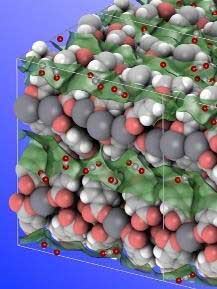
Molecular structure of the novel calcium-based MOF. Small CO2 molecules can be seen adsorbed within the channels (green transparent) of the microporous material. (Image: HIMS)
At the Research Priority Area Sustainable Chemistry of the University of Amsterdam (UvA), Dr Stefania Grecea develops synthetic strategies for making porous materials that enable efficient adsorptive separations.
In the journal Inorganic Chemistry Frontiers, Grecea and co-workers now present a water-stable metal-organic framework that selectively adsorbs CO2 from a CO2/N2 mixture. The research was performed by PhD student Yiwen Tang in collaboration with Dr David Dubbeldam of UvA’s Computational Chemistry group, Dr Simon Teat of the Lawrence Berkeley National Laboratory (USA), and Prof. Anastasios Tasiopoulos of the University of Cyprus.
Metal-organic frameworks
Metal-organic frameworks (MOFs) are crystalline microporous materials that exist of metal ions (or clusters of metal ions) linked by organic ligands. MOFs are very promising materials for gas separation since their pore surfaces can be easily functionalised to tune the interaction with various gas molecules. They also have very high surface areas which provide for optimal selectivity and capacity. Moreover, MOFs offer the right balance between high adsorption capacity, operational life time and energy requirement for regeneration.
The UvA team designed a series of MOFs using a flexible organic linker in combination with alkaline metal ions, which are abundantly available, lightweight and low-cost. They show that when the guest molecules are removed, the three-dimensional structure of these MOFs shrinks. In the case of calcium based materials, this specific behaviour results in large diffusional resistances towards N2 over CO2 molecules.
Selective and water-stable
Experimental studies performed by Yiwen Tang and theoretical calculations performed by Dr David Dubbeldam confirmed a very good CO2/N2 separation selectivity that is substantially higher than what has been reported for other MOFs. Adding to this, the specific design of the organic linker protects the calcium ions from being attacked by water molecules. Therefore, the new MOF materials also have a very high humidity stability.
According to Dr Grecea, the study opens new avenues in developing low-cost and non-toxic materials, not only for CO2capture but also for other gas separations. Currently her team is further improving the water stability of the novel MOFs as well as developing general synthetic routes towards stable alkaline-earth MOFs for a broad range of molecular separations.
„Rezistența materialului hibrid obținut se realizează suplimentar pentru că nu distrugem însuși grafenul, ci folosim defecte pre-existente și o legătură covalentă puternică cu moleculele de polimer. Acest lucru ne permite să considerăm studiul drept promițător pentru dezvoltarea de electronice subțiri și flexibile atunci când bateriile solare pot fi atașate la haine, iar atunci când sunt deformate, ele nu se vor rupe „.Grafenul trebuie integrat în structuri complexe pentru a fi utilizat cu succes. Cu toate acestea, este o provocare să facem acest lucru. Potrivit oamenilor de știință, grafena în sine este suficient de stabilă și reacționează prost cu alți compuși. Pentru a reacționa cu alte elemente, adică pentru al modifica, grafenul este, de obicei, cel puțin parțial distrus. Această modificare degradează proprietățile materialelor obținute.
Posted: Apr 17, 2018
Polymer-graphene nanocarpets to electrify smart fabrics
(Nanowerk News) Researchers from Tomsk Polytechnic University together with their international colleagues have discovered a method to modify and use the one-atom thin conductor of current and heat, graphene without destroying it. Thanks to the novel method, the researchers were able to synthesize on single-layer graphene a well-structured polymer with a strong covalent bond, which they called ‘polymer carpets’. The entire structure is highly stable; it is less prone to degradation over time that makes the study promising for the development of flexible organic electronics. Also, if a layer of molybdenum disulfide is added over the ‘nanocarpet’, the resulting structure generates current under exposure to light. The study results were published in Journal of Materials Chemistry C („Bottom-up Fabrication of Graphene-based Conductive Polymer Carpets for Optoelectronics”).
This is the scheme for obtaining a hybrid structure of ‘graphene-polymer’. (Image: Tomsk Polytechnic University) (click on image to enlarge)
Graphene is simultaneously the most durable, light and an electrically conductive carbon material. It can be used for manufacturing solar batteries, smartphone screens, thin and flexible electronics, and even in water filters since graphene films pass water molecules and stop all other compounds. Graphene should be integrated into complex structures to be used successfully. However, it is a challenge to do that. According to scientists, graphene itself is stable enough and reacts poorly with other compounds. In order to make it react with other elements, i.e. to modify it, graphene is usually at least partially destroyed. This modification degrades the properties of the materials obtained.
Professor Raul D. Rodriguez from the Research School for Chemistry & Applied Biomedical Sciences says: ‘When functionalizing graphene, you should be very careful. If you overdo it, the unique properties of graphene are lost. Therefore, we decided to follow a different path.
In graphene, there are inevitable nanodefects, for example, at the edges of graphene and wrinkles in the plane. Hydrogen atoms are often attached to such defects. It is this hydrogen that can interact with other chemicals.’
To modify graphene, the authors use a thin metal substrate on which a graphene single-layer is placed. Then graphene is covered with a solution of bromine-polystyrene molecules. The molecules interact with hydrogen and are attached to the existing defects, resulting in polyhexylthiophene (P3HT). Further exposed to light during the photocatalysis, a polymer begins to ‘grow’.
‘In the result, we obtained the samples which structure resembles ‘polymer carpets’ as we call them in the paper. Above such a ‘polymer carpet’ we place molybdenum disulfide. Due to a unique combination of materials, we obtain a ‘sandwich’ structure’ that functions like a solar battery. That is, it generates current when exposed to light. In our experiments a strong covalent bond is established between the molecules of the polymer and graphene, that is critical for the stability of the material obtained,’ notes Rodriguez.
According to the researcher, the method for graphene modification, on the one hand, enables obtaining a very sturdy compound; on the other hand, it is rather simple and cheap as affordable materials are used. The method is versatile because it makes growing very different polymers directly on graphene possible.
‘The strength of the obtained hybrid material is achieved additionally because we do not destroy graphene itself but use pre-existing defects, and a strong covalent bond to polymer molecules. This allows us to consider the study as promising for the development of thin and flexible electronics when solar batteries can be attached to clothes, and when deformed they will not break,’ the professor explains.
Au dezvoltat o tehnica care face ca un material compozit sa devina mai rigid si mai puternic la cerere atunci cand este expus la lumina ultravioleta.Acest control la cerere al comportamentului compozit ar putea să permită o varietate de noi capacități pentru proiectarea, performanța și întreținerea viitoarelor nave de rotor armatei.În laboratorul nostru de la UMD am dezvoltat nanomateriale unice de carbon și chimie, dar nu a fost până când Gardea ne-a abordat am devenit conștienți de provocarea interesantă și oportunitatea pentru materiale reconfigurabile compozite
Posted: Apr 17, 2018
Making adaptive composite materials with light-responsive chemistry
(Nanowerk News) Engineers at the U.S. Army Research Laboratory and the University of Maryland have developed a technique that causes a composite material to become stiffer and stronger on-demand when exposed to ultraviolet light.
This on-demand control of composite behavior could enable a variety of new capabilities for future Army rotorcraft design, performance and maintenance.
ARL’s Dr. Frank Gardea, a research engineer, said the focus of the research was on controlling how molecules interact with each other. He said the aim was to „have them interact in such a way that changes at a small size, or nanoscale, could lead to observed changes at a larger size or macroscale.”
Dr. Bryan Glaz, chief scientist of ARL’s Vehicle Technology Directorate said,”an important motivation for this work is the desire to engineer new structures, starting from the nanoscale, to enable advanced rotorcraft concepts that have been proposed in the past, but were infeasible due to limitations in current composites. One of the most important capabilities envisioned by these concepts is a significantly reduced maintenance burden due to compromises we make to fly at high speeds.”
The reduced scheduled maintenance of future Army aviation platforms is an important technological driver for future operating concepts.
„The enhanced mechanical properties with potentially low weight penalties, enabled by the new technique, could lead to nanocomposite based structures that would enable rotorcraft concepts that we cannot build today,” Glaz said.
Researchers show the synthetic process they use to create photo responsive reinforcing agents. A carbon nanotube, or CNT, is treated with a photo-reactive molecule called benzophenone. After exposure to ultraviolet light, the molecules bond to the surrounding polymer chain. This creates a covalent link between the nanotube and the polymer. (Image: U.S. Army Research Laboratory)
The technique consists of attaching ultraviolet light reactive molecules to reinforcing agents like carbon nanotubes. These reactive reinforcing agents are then embedded in a polymer. Upon ultraviolet light exposure, a chemical reaction occurs such that the interaction between the reinforcing agents and the polymer increases, thus making the material stiffer and stronger.
The researchers said the chemistry used here is generally applicable to a variety of reinforcement/polymer combinations thereby expanding the utility of this control method to a wide range of material systems.
„This research shows that it is possible to control the overall material property of these nanocomposites through molecular engineering at the interface between the composite components. This is not only important for fundamental science but also for the optimization of structural component response,” said Dr. Zhongjie Huang, a postdoctoral research fellow at the University of Maryland.
Army researchers conceived of this fundamental approach for the potential of „enabling new leap-ahead capabilities in support of the Future Vertical Lift Army Modernization Priority,” officials said.
„In this instance, the development of advanced structures to enable leap-ahead Army aviation capabilities not currently feasible due to limitations in mechanical properties of current materials,” Glaz said. „This is especially important for the envisioned future operating environment which will require extended periods of operation without the opportunity to return to stationary bases for maintenance.”
Some particularly attractive design options that correspond to lower mechanical loads and vibration are not currently achievable due to limitations in structural damping in hingeless blade or wing structures.
Future structures based on this work may help lead to new composites with controlled structural damping and low weight that could enable low maintenance, high speed rotorcraft concepts that are currently not feasible (e.g. soft in-plane tiltrotors).
In addition, controllable mechanical response will allow for the development of adaptive aerospace structures that could potentially accommodate mechanical loading conditions.
„The Army Research Laboratory and its partners will continue to invest in emerging and Soldier-inspired technologies that will enable more reliable, higher performing and leap-ahead capabilities that are key to the advancement of the next generation platforms used by Soldiers,” said Elias Rigas, division chief of the ARL Vehicle Applied Research Division.
Collaboration between the ARL and the University of Maryland was crucial in the development of this method.
„In our lab at UMD we have been developing unique carbon nanomaterials and chemistry but it was not until Gardea approached us did we become aware of the intriguing challenge and opportunity for reconfigurable composite materials,” said Dr. YuHuang Wang, professor of the Department of Chemistry and Biochemistry at the University of Maryland.
„Together we have achieved something that is quite remarkable.”
au dezvoltat un strat nanoscala pentru celule solare , care le permite să absoarbă aproximativ 20 de procente mai mult soare decât dispozitivele neacoperite. Acoperirea, aplicată printr-o tehnică care ar putea fi încorporată în procesul de fabricație, deschide o nouă cale de dezvoltare a celulelor solare cu costuri reduse și eficiente, cu materiale abundente, regenerabile și ecologice.
Învelișul constă din mii de margele de sticlă mici, doar aproximativ o sută din lățimea părului uman. Când lumina soarelui lovește acoperirea, undele luminoase sunt direcționate în jurul barei nanometrice, similar cu modul în care undele sonore se deplasează în jurul unui perete curbat,
Posted: Apr 13, 2018
Psst! A whispering gallery for light boosts solar cells
(Nanowerk News) Trapping light with an optical version of a whispering gallery, researchers at the National Institute of Standards and Technology (NIST) have developed a nanoscale coating for solar cells that enables them to absorb about 20 percent more sunlight than uncoated devices. The coating, applied with a technique that could be incorporated into manufacturing, opens a new path for developing low-cost, high-efficiency solar cells with abundant, renewable and environmentally friendly materials.
The coating consists of thousands of tiny glass beads, only about one-hundredth the width of a human hair. When sunlight hits the coating, the light waves are steered around the nanoscale bead, similar to the way sound waves travel around a curved wall such as the dome in St. Paul’s Cathedral in London. At such curved structures, known as acoustic whispering galleries, a person standing near one part of the wall easily hears a faint sound originating at any other part of the wall.
Illustration shows the nanoresonator coating, consisting of thousands of tiny glass beads, deposited on solar cells. The coating enhances both the absorption of sunlight and the amount of current produced by the solar cells. (Image: K. Dill, D. Ha, G. Holland/NIST)
Whispering galleries for light were developed about a decade ago, but researchers have only recently explored their use in solar-cell coatings. In the experimental set up devised by a team including Dongheon Ha of NIST and the University of Maryland’s NanoCenter, the light captured by the nanoresonator coating eventually leaks out and is absorbed by an underlying solar cell made of gallium arsenide.
Using a laser as a light source to excite individual nanoresonators in the coating, the team found that the coated solar cells absorbed, on average, 20 percent more visible light than bare cells. The measurements also revealed that the coated cells produced about 20 percent more current.
The study is the first to demonstrate the efficiency of the coatings using precision nanoscale measurements, said Ha. “Although calculations had suggested the coatings would enhance the solar cells, we could not prove this was the case until we had developed the nanoscale measurement technologies that were needed,” he noted.
The team also devised a rapid, less-costly method of applying the nanoresonator coating. Researchers had previously coated semiconductor material by dipping it in a tub of the nanoresonator solution. The dipping method takes time and coats both sides of the semiconductor even though only one side requires the treatment.
In the team’s method, droplets of the nanoresonator solution are placed on just one side of the solar cell. A wire-wound metal rod is then pulled across the cell, spreading out the solution and forming a coating made of closely packed nanoresonators. This is the first time that researchers have applied the rod method, used for more than a century to coat material in a factory setting, to a gallium arsenide solar cell.
“This is an inexpensive process and is compatible with mass production,” said Ha.
ercetatorii au creat în mod specific și a examinat panglici grafen care conțin atomi de impuritate ( Știință Avansuri , „Înlocuirea heteroatomului multiplu cu nanofibrele de grafen” ).
Aceștia au înlocuit atomii de carbon anumiți în rețeaua hexagonală cu atomi de bor și atomi de azot folosind chimia suprafeței, prin plasarea compușilor precursori organici adecvați pe o suprafață de aur. La expunerea la căldură, până la 400 ° C, panglici de grafen se formează pe suprafața aurului de la precursori, incluzând atomii de impuritate la locurile specifice.
Posted: Apr 13, 2018
Individual impurity atoms detectable in graphene
(Nanowerk News) Graphene is made of a two-dimensional layer of carbon atoms arranged in a hexagonal lattice. The strong bonds between the carbon atoms make graphene extremely stable yet flexible. It is also an excellent electrical conductor through which electricity can flow with almost no loss.
Graphene’s distinctive properties can be further expanded by incorporating impurity atoms in a process known as “doping”. The impurity atoms cause local changes of the conduction that, for example, allow graphene to be used as a tiny transistor and enable the construction of circuits.
Targeted incorporation
In a collaboration between scientists from the University of Basel and the National Institute for Material Science in Tsukuba in Japan, Kanazawa University and Kwansei Gakuin University in Japan, and Aalto University in Finland, the researchers specifically created and examined graphene ribbons containing impurity atoms (Science Advances, „Multiple heteroatom substitution to graphene nanoribbon”).
They replaced particular carbon atoms in the hexagonal lattice with boron and nitrogen atoms using surface chemistry, by placing suitable organic precursor compounds on a gold surface. Under heat exposure up to 400°C, tiny graphene ribbons formed on the gold surface from the precursors, including impurity atoms at specific sites.
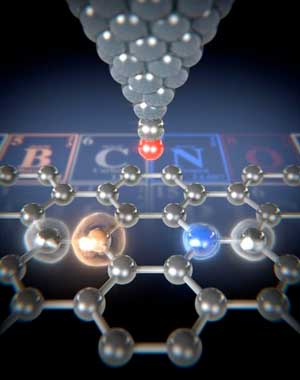
Using the atomic force microscope’s carbon monoxide functionalized tip (red/silver), the forces between the tip and the various atoms in the graphene ribbon can be measured. (Image: University of Basel, Department of Physics)
Measuring the strength of the atoms
Scientists from the team led by Professor Ernst Meyer from the Swiss Nanoscience Institute and the University of Basel’s Department of Physics examined these graphene ribbons using atomic force microscopy (AFM). They used a carbon monoxide functionalized tip and measured the tiny forces that act between the tip and the individual atoms.
This method allows even the smallest differences in forces to be detected. By looking at the different forces, the researchers were able to map and identify the different atoms. “The forces measured for nitrogen atoms are greater than for a carbon atom,” explains Dr. Shigeki Kawai, lead author of the study and former postdoc in Meyer’s team. “We measured the smallest forces for the boron atoms.” The different forces can be explained by the different proportion of repulsive forces, which is due to the different atomic radii.
Computer simulations confirmed the readings, proving that AFM technology is well-suited to conducting chemical analyses of impurity atoms in the promising two-dimensional carbon compounds.
Dacă combinați două sau trei metale împreună, veți obține un aliaj care de obicei arată și se comportă ca un metal, cu atomii săi aranjați în modele geometrice rigide.
Dar din când în când, în condițiile potrivite, veți obține ceva cu totul nou: un aliaj futurist numit sticlă metalică. Atomii materialului amorf sunt aranjați în orice fel, la fel ca atomii de sticlă dintr-o fereastră. Natura sa sticloasă o face mai puternică și mai ușoară decât cea mai bună oțel de astăzi și se ridică mai bine la coroziune și uzură.
Deși sticla metalică arată o mulțime de promisiuni ca acoperire protectoare și alternativă la oțel, doar câteva mii din milioane de combinații posibile de ingrediente au fost evaluate în ultimii 50 de ani și doar o mână a fost dezvoltată până la punctul de a deveni util.
Posted: Apr 13, 2018
Artificial intelligence accelerates discovery of metallic glass
(Nanowerk News) If you combine two or three metals together, you will get an alloy that usually looks and acts like a metal, with its atoms arranged in rigid geometric patterns.
But once in a while, under just the right conditions, you get something entirely new: a futuristic alloy called metallic glass. The amorphous material’s atoms are arranged every which way, much like the atoms of the glass in a window. Its glassy nature makes it stronger and lighter than today’s best steel, and it stands up better to corrosion and wear.
Although metallic glass shows a lot of promise as a protective coating and alternative to steel, only a few thousand of the millions of possible combinations of ingredients have been evaluated over the past 50 years, and only a handful developed to the point that they may become useful.
Now a group led by scientists at Northwestern University, the Department of Energy’s SLAC National Accelerator Laboratory and the National Institute of Standards and Technology (NIST) has reported a shortcut for discovering and improving metallic glass — and, by extension, other elusive materials — at a fraction of the time and cost.
With new approach, predictions closely match actual experimental data. (Image: SLAC)
The research group took advantage of a system at SLAC’s Stanford Synchrotron Radiation Lightsource (SSRL) that combines machine learning — a form of artificial intelligence where computer algorithms glean knowledge from enormous amounts of data — with experiments that quickly make and screen hundreds of sample materials at a time. This allowed the team to discover three new blends of ingredients that form metallic glass, and to do it 200 times faster than it could be done before.
“It typically takes a decade or two to get a material from discovery to commercial use,” said Chris Wolverton, the Jerome B. Cohen Professor of Materials Science and Engineering in Northwestern’s McCormick School of Engineering, who is an early pioneer in using computation and AI to predict new materials. “This is a big step in trying to squeeze that time down. You could start out with nothing more than a list of properties you want in a material and, using AI, quickly narrow the huge field of potential materials to a few good candidates.”
The ultimate goal, said Wolverton, who led the paper’s machine learning work, is to get to the point where a scientist can scan hundreds of sample materials, get almost immediate feedback from machine learning models and have another set of samples ready to test the next day — or even within the hour.
Over the past half century, scientists have investigated about 6,000 combinations of ingredients that form metallic glass. Added paper co-author Apurva Mehta, a staff scientist at SSRL: “We were able to make and screen 20,000 in a single year.”
Just getting started
While other groups have used machine learning to come up with predictions about where different kinds of metallic glass can be found, Mehta said, “The unique thing we have done is to rapidly verify our predictions with experimental measurements and then repeatedly cycle the results back into the next round of machine learning and experiments.”
There’s plenty of room to make the process even speedier, he added, and eventually automate it to take people out of the loop altogether so scientists can concentrate on other aspects of their work that require human intuition and creativity. “This will have an impact not just on synchrotron users, but on the whole materials science and chemistry community,” Mehta said.
The team said the method will be useful in all kinds of experiments, especially in searches for materials like metallic glass and catalysts whose performance is strongly influenced by the way they’re manufactured, and those where scientists don’t have theories to guide their search. With machine learning, no previous understanding is needed. The algorithms make connections and draw conclusions on their own, which can steer research in unexpected directions.
“One of the more exciting aspects of this is that we can make predictions so quickly and turn experiments around so rapidly that we can afford to investigate materials that don’t follow our normal rules of thumb about whether a material will form a glass or not,” said paper co-author Jason Hattrick-Simpers, a materials research engineer at NIST. “AI is going to shift the landscape of how materials science is done, and this is the first step.”
Experimenting with data
In the metallic glass study, the research team investigated thousands of alloys that each contain three cheap, nontoxic metals.
They started with a trove of materials data dating back more than 50 years, including the results of 6,000 experiments that searched for metallic glass. The team combed through the data with advanced machine learning algorithms developed by Wolverton and Logan Ward, a graduate student in Wolverton’s laboratory who served as co-first author of the paper.
Based on what the algorithms learned in this first round, the scientists crafted two sets of sample alloys using two different methods, allowing them to test how manufacturing methods affect whether an alloy morphs into a glass. An SSRL x-ray beam scanned both sets of alloys, then researchers fed the results into a database to generate new machine learning results, which were used to prepare new samples that underwent another round of scanning and machine learning.
By the experiment’s third and final round, Mehta said, the group’s success rate for finding metallic glass had increased from one out of 300 or 400 samples tested to one out of two or three samples tested. The metallic glass samples they identified represented three different combinations of ingredients, two of which had never been used to make metallic glass before.
Grafen, o latură bidimensională de atomi de carbon, a atras un interes enorm de la o bază largă a comunității de cercetare timp de mai mult de un deceniu. Granulele graphene (GNR), benzi înguste de grafen, care sunt cvasi unidimensionale, posedă caracteristici complementare față de corespondentul lor bidimensional al foilor de grafen. Pe baza calculelor teoretice, proprietățile electrice ale GNR pot fi controlate prin configurația de lățime și muchie și pot varia de la metal la semiconductori
Posted: Apr 12, 2018
Mechanism of oxidative unzipping of multiwall carbon nanotubes to graphene nanoribbons
(Nanowerk News) Graphene, a two-dimensional lattice of carbon atoms, has attracted enormous interest from a broad base of the research community for more than one decade. Graphene nanoribbons (GNRs), narrow strips of graphene, being quasi one-dimensional, possess complementary features relative to their two-dimensional counterpart of graphene sheets. Based on theoretical calculations, GNRs’ electrical properties can be controlled by the width and edge configuration and they can vary from being metallic to semiconducting.
The physical properties of the GNRs depend significantly on the size and number of layers, which in turn depend on their synthesis method.
There are three major approaches for synthesis of GNRs: cutting graphene by different lithographic techniques; bottom-up synthesis from polycyclic molecules; and unzipping of carbon nanotubes (CNTs). While the bottom-up method provides a route to precise edge control, and the lithographic method can afford GNRs with precise placement, the unzipping method has the advantage of mass-production on a large scale.
Intercalation-unzipping, oxidation, and exfoliation of carbon nanotubes. (Image: Kazan Federal University, Laboratory of Advanced Carbon Nanomaterials) (click on image to enlarge)
MWCNT unzipping methods can be classified into four major types: the reductive-intercalation-assisted approach, the oxidative unzipping, the electrochemical unzipping, and the group of methods that can be denoted as miscellaneous. The first approach is based on the well-known ability of alkali metals to intercalate graphite with expansion in the Z-axis direction.
Being applied toward MWCNTs, such lattice expansion induces extreme stress within the concentric walls, resulted in the bursting, or longitudinal opening, of the tubes. The resulting GNRs are highly conductive, but they remain multi-layered and foliated. Due to the attraction between the surfaces, they do not exfoliate to single-layer ribbons.
The oxidative approach involves treatment of MWCNTs in acidic oxidative media with the formulation almost identical to that used in production of graphene oxide (GO) from graphite by the Hummers method. The resulting product is graphene oxide nanoribbons (GONRs). Unlike GNRs obtained by the reductive-intercalation method, GONRs easily exfoliate in aqueous solution, and they can be obtained as single-layered structures.
A reaction mechanism for oxidative unzipping was proposed by Kosynkin et al (Nature, „Longitudinal Unzipping of Carbon Nanotubes to Form Graphene Nanoribbons”). Invoking the classical oxidation of the alkenes by permanganate in acids, the first step is the formation of manganate ester on a C-C bond, and the second step is the rupture of the C-C bond with formation of ketones at the newly formed edges.
This mechanism was further developed in the theoretical work by Rangel et al (The Journal of Chemical Physics, „Mechanism of Carbon Nanotubes Unzipping Into Graphene Ribbons”). The original synthesis spawned numerous studies on oxidative unzipping of MWCNTs. In many reports, the unzipping process was denoted as „chemical” as opposed to the „intercalation-exfoliation”, indicating that the permanganate-induced oxidative mechanism has been commonly accepted, and was even suggested toward unzipping SWCNTs.
The newly proposed mechanism was based on the Lab’s competences on the studies of the mechanism of GO formation of graphite that involves three consecutive steps: (a) intercalation of graphite by sulfuric acid with formation of a stage-1 H2SO4-graphite intercalation compound (GIC); (b) conversion of stage-1 H2SO4-GIC into pristine GO, and (c) exfoliation of GO to single-layer sheets upon exposure to water. Thus, under given conditions, formation of stage-1 H2SO4-GIC is unavoidable for any graphitic material. Subsequently, the mechanism of the oxidative unzipping of MWCNTs might be also intercalation-driven.
If this is correct, one should be able to stop the reaction after the first intercalation-unzipping step before the second oxidation step proceeds. If attained, this will afford unzipped but not oxidized or minimally oxidized products possessing properties similar to reductively unzipped GNRs obtained by potassium or sodium-potassium metal intercalation.
The researchers demonstrated that the mechanism of the oxidative unzipping of MWCNTs is indeed intercalation-driven. The overall unzipping process involves the same three steps as in the course of GO production from graphite by the Hummers and modified Hummers methods: intercalation, oxidation, and exfoliation. With MWCNTs, the intercalation is associated with simultaneous unzipping.
At low KMnO4/MWCNT ratios, one can obtain GNRs with characteristics similar to those produced by reductive unzipping. 0.12 wt equiv KMnO4 is the threshold ratio sufficient for almost complete unzipping, with only small amounts of covalent oxidation. Controlling the KMnO4/MWCNT ratio and time of reaction allows one to produce GNRs with the properties varying in a broad continuous range from multi-layered graphenic GNRs through single-layered GONRs.
Thus, the team answered several questions that remained open in the field of unzipping MWCNTs, such as the reason why the inner-most walls of the nanotubes remain zipped.
The intercalation-driven reaction mechanism provides a rationale for the impossibility of unzipping single-wall and few-wall CNTs, and aids in a reevaluation of the data from the oxidative unzipping process.
au sintetizat cu succes o membrana de grafen cu pori a caror marime , forma si densitatea pot fi reglate cu precizie atomica la scara nanometrica.Porii din inginerie la nano-scala în grafen se pot schimba proprietățile fundamentale ale acestui material. Pentru un început devine permeabil sau asemănător sita. Numai această schimbare, combinată cu puterea intrinsecă a grafenului și nano-subțire, indică utilizarea ulterioară ca filtru cel mai rezistent, eficient din punct de vedere energetic și selectiv pentru substanțe extrem de mici, de la gaze cu efect de seră până la sare, până la biomolecule.Simulat la DIPC și testat experimental la ICN2, rezultatul este un nou tip de grafen care prezintă proprietăți electrice asemănătoare cu cele ale siliciului,
Posted: Apr 12, 2018
One step closer to using nanoporous graphene membranes as smart filters and sensors
(Nanowerk News) Researchers at the Catalan Institute of Nanoscience and Nanotechnology (ICN2), the CiQUS research centre at the University of Santiago de Compostela (USC) and the Donostia International Physics Center (DIPC) have successfully synthesised a graphene membrane with pores whose size, shape and density can be tuned with atomic precision at the nanoscale. Led by ICREA Prof. Aitor Mugarza from the ICN2 and Prof. Diego Peña from CiQUS, their work brings us one step closer to unlocking the potential of this much lauded material in electronics, and in filtration and sensing applications.
The results have been published this week in Science („Bottom- up synthesis of multifunctional nanoporous graphene”), with ICN2 researcher Dr. César Moreno as first author. A patent for the resulting nanoporous graphene membrane has also been filed.
Engineering pores at the nanoscale in graphene can change the fundamental properties of this material. For a start it becomes permeable or sieve-like. This change alone, combined with graphene’s intrinsic strength and nano-slimness, points to its future use as the most resilient, energy-efficient and selective filter for extremely small substances, from greenhouse gases to salt, to biomolecules.
But a second, perhaps less intuitive change also takes place when the spacing between pores is similarly reduced to a few atoms. Doing so transforms the graphene from semimetal to semiconductor, opening the door for its use in electronic applications, where it could be used to replace the bulkier, more rigid silicon components used today.
However, while all of this is true in theory, producing such a material requires a precision that current fabrication methods have yet to achieve, and look unlikely to ever do so. The problem is the approach: punching holes in or otherwise manipulating a material that is just one atom thick is an incredibly fiddly task. In the work described here, the team takes a “bottom up” approach based on the principles of molecular self-assembly and 2D polymerisation, effectively growing the graphene from scratch with the nanopores already built-in.
For this approach to work, you first need a very specific precursor molecule to use as the initial building blocks, designed such that they will behave as intended when subjected to different stimuli. In this work these precursors were designed and produced by synthetic chemistry specialists at CiQUS, before being taken to the ICN2 for the abovementioned “bottom-up” assembly of nanoporous graphene. Here they were submitted to several rounds of heating at high temperatures while placed on a gold surface, which serves to catalyse the reactions by which the molecules are first polymerised, to form long, lacelike “nanoribbons”, and then bonded laterally, to create the desired 2D “nanomesh” structure complete with evenly spaced, evenly sized pores.
Simulated at the DIPC and tested experimentally at the ICN2, the result is a new kind of graphene that exhibits electrical properties akin to those of silicon which can also act as a highly-selective molecular sieve. Applied in conjunction, these two properties are predicted to allow the development of combined filter and sensor devices which will not only sort for specific molecules, but will alternatively block or monitor their passage though the nanopores using an electric field. Such electrical readings would provide additional information as to precisely what concentrations of which molecule are passing through the pores and when, something which also points to possible applications in more efficient DNA sequencing.
Indeed, the real-world applications of such a tunable, uniformly nanoporous graphene membrane are manifold. They range from pollution monitoring and mitigation, to water desalinisation, and even applications in biomedicine, where such a slim, flexible, biocompatible membrane could be used to support failing organs like the kidney, one of the body’s natural filters.