Tuner lasere pentru îmbunătățirea spectroscopiei în infraroșu (Tunable lasers to improve infrared spectroscopy )

a creat un nou laser revoluționar, cu bandă largă, reglabil, care are implicații majore pentru detectarea drogurilor și a explozivilor.
Robustul, tot laserul solid, poate fi reglat rapid pentru a emite în intervalul lungimii de undă care cuprinde regiunea critică a „amprentelor digitale” în care cele mai multe caracteristici moleculare sunt absorbite și identificate prin detectarea în infraroșu. În experimente, laserul și-a demonstrat capacitatea de a capta amprenta spectrală unică a gazelor.

Posted: Jun 09, 2016

Tunable lasers to improve infrared spectroscopy

(Nanowerk News) A new development from Northwestern Engineering’s Manijeh Razeghi could be another tool for protecting our borders.

Supported by the Department of Homeland Security, Razeghi’s lab has created a new, revolutionary, broad-band tunable infrared laser that has major implications for the detection of drugs and explosives.
The robust, all solid-state laser can be rapidly tuned to emit in the wavelength range that encompasses the critical “fingerprint” region where most molecular features are absorbed and identified through infrared sensing. In experiments, the laser has demonstrated its ability to capture the unique spectral fingerprint of gases.
“The only moving part in the entire system is the fan used to keep the laser cool,” said Manijeh Razeghi, Walter P. Murphy Professor of Electrical Engineering and Computer Science. “This is a major advantage over existing systems that require mechanical parts to achieve tuning, and we expect to demonstrate remarkable stability.”
The initial, patent-pending results have been published in the June 8 issue of Nature Scientific Reports („Monolithically, widely tunable quantum cascade lasers based on a heterogeneous active region design”). The research and development of the laser system is the culmination of more than 18 years of quantum cascade laser development work at Northwestern’s Center for Quantum Devices.
The laser has been integrated into a system that contains all of the laser driver electronics and tuning software necessary for integration into a spectroscopy system. It produces a stable, single-aperture spot less than 3 millimeters in diameter that is suitable for standoff detection and is capable of linear or random access scanning with stabilization times of less than 1 millisecond per wavelength.
Source: Northwestern University

Read more: Tunable lasers to improve infrared spectroscopy

Sticla are acum potențialul inteligent(Glass now has smart potential)

au dezvoltat o metodă de încorporare a nanoparticulelor cu emisie de lumină în sticlă, fără a-și pierde nici una dintre proprietățile lor unice – un pas major către aplicațiile de „sticlă inteligentă”, cum ar fi ecrane 3D sau senzori de radiație de la distanță

Glass

Datorită nanoparticulelor, sticla are acum potențialul inteligent(Thanks to nanoparticles, glass now has smart potential )

Aceste nanoparticule luminescente noi, denumite upconversion nanoparticles, au devenit candidati promitatori pentru o intreaga varietate de aplicatii ultra-inalte tehnologice, cum ar fi senzori biologici, imagistica biomedicala si afisaje volumetrice 3D”

Posted: Jun 07, 2016

Thanks to nanoparticles, glass now has smart potential

(Nanowerk News) Australian researchers at the University of Adelaide have developed a method for embedding light-emitting nanoparticles into glass without losing any of their unique properties – a major step towards ‘smart glass’ applications such as 3D display screens or remote radiation sensors.

This new “hybrid glass” successfully combines the properties of these special luminescent (or light-emitting) nanoparticles with the well-known aspects of glass, such as transparency and the ability to be processed into various shapes including very fine optical fibres.
The research, in collaboration with Macquarie University and University of Melbourne, has been published online in the journal Advanced Optical Materials („Upconversion Nanocrystal-Doped Glass: A New Paradigm for Photonic Materials”).
text
Schematic diagram of Ln3+ distribution in various glasses. a) glass containing Ln3+ ions (Ln3+-doped glass), b) glass containing in situ grown NCs (glass ceramics), c) glass with directly doped NCs (NCs-doped glass). The small gray dots represent the Ln3+ ions in NCs-doped glass that were formed by dissolution of NCs, which could be prevented by using NCs with a robust shell. d) Schematic of Ln3+ ion densities available in glasses, NCs in glass ceramics, and as-synthesized individual NCs. (© Wiley)
“These novel luminescent nanoparticles, called upconversion nanoparticles, have become promising candidates for a whole variety of ultra-high tech applications such as biological sensing, biomedical imaging and 3D volumetric displays,” says lead author Dr Tim Zhao, from the University of Adelaide’s School of Physical Sciences and Institute for Photonics and Advanced Sensing (IPAS).
“Integrating these nanoparticles into glass, which is usually inert, opens up exciting possibilities for new hybrid materials and devices that can take advantage of the properties of nanoparticles in ways we haven’t been able to do before. For example, neuroscientists currently use dye injected into the brain and lasers to be able to guide a glass pipette to the site they are interested in. If fluorescent nanoparticles were embedded in the glass pipettes, the unique luminescence of the hybrid glass could act like a torch to guide the pipette directly to the individual neurons of interest.”
Although this method was developed with upconversion nanoparticles, the researchers believe their new ‘direct-doping’ approach can be generalised to other nanoparticles with interesting photonic, electronic and magnetic properties. There will be many applications – depending on the properties of the nanoparticle.
“If we infuse glass with a nanoparticle that is sensitive to radiation and then draw that hybrid glass into a fibre, we could have a remote sensor suitable for nuclear facilities,” says Dr Zhao.
To date, the method used to integrate upconversion nanoparticles into glass has relied on the in-situ growth of the nanoparticles within the glass.
“We’ve seen remarkable progress in this area but the control over the nanoparticles and the glass compositions has been limited, restricting the development of many proposed applications,” says project leader Professor Heike Ebendorff-Heideprem, Deputy Director of IPAS.
“With our new direct doping method, which involves synthesizing the nanoparticles and glass separately and then combining them using the right conditions, we’ve been able to keep the nanoparticles intact and well dispersed throughout the glass. The nanoparticles remain functional and the glass transparency is still very close to its original quality. We are heading towards a whole new world of hybrid glass and devices for light-based technologies.”
Source: University of Adelaide

Read more: Thanks to nanoparticles, glass now has smart potential

Înțelegerea și prezicerea autoasamblării(Understanding and predicting self-assembly)

Materialul este o nanopapetă peptoidă. Este o structură plană de numai două molecule groase și este compusă din peptoide, care sunt polimeri sintetici strâns legați de peptidele care formează proteine.
Asamblarea automată a nanoparticulelor pentru a realiza structuri complexe de foi și altele, cum ar fi nanotuburi și solide cristaline, care pot fi personalizate în detectoare chimice incredibil de sensibile sau catalizatori de durată, pentru a numi câteva posibilități .

Posted: Jun 07, 2016

Understanding and predicting self-assembly

(Nanowerk News) To mimic complex natural proteins’ capabilities as sensors, catalysts, and more using synthetic materials that can withstand industrial conditions, scientists must first know how to finesse the building blocks they’ll use. Molecular Foundry staff worked with scientists to discover a new design rule that controls the way in which polymer building blocks adjoin to form the backbones that run the length of tiny biomimetic sheets.

Understanding the rules that govern how the nanosheets self-assemble could be used to piece together complex sheet structures and others, such as nanotubes and crystalline solids, that could be customized into incredibly sensitive chemical detectors or long-lasting catalysts, to name a few possibilities.
Scientists aspire to build nanostructures that mimic the complexity and function of nature’s proteins, but are made of durable and synthetic materials. These microscopic widgets could be customized into incredibly sensitive chemical detectors or long-lasting catalysts, to name a few possible applications.
But as with any craft that requires extreme precision, researchers must first learn how to finesse the materials they’ll use to build these structures.
A recent discovery by scientists at the Molecular Foundry is a big step in this direction (Nature, „Peptoid nanosheets exhibit a new secondary-structure motif”).
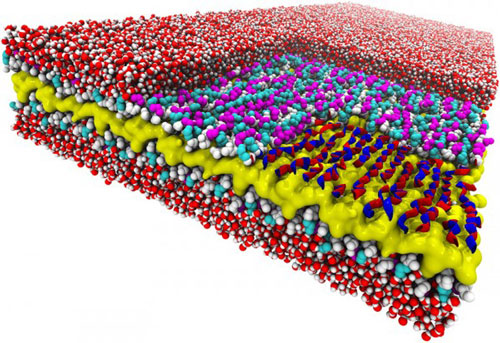
atomic-resolution simulation of a peptoid nanosheet
Snakes on a plane: This atomic-resolution simulation of a peptoid nanosheet reveals a snake-like structure never seen before. The nanosheet’s layers include a water-repelling core (yellow), peptoid backbones (white), and charged sidechains (magenta and cyan). The right corner of the nanosheet’s top layer has been “removed” to show how the backbone’s alternating rotational states give the backbones a snake-like appearance (red and blue ribbons). Surrounding water molecules are red and white.
The researchers discovered a design rule that enables a recently created material to exist. The material is a peptoid nanosheet. It’s a flat structure only two molecules thick, and it’s composed of peptoids, which are synthetic polymers closely related to protein-forming peptides.
The design rule controls the way in which polymers adjoin to form the backbones that run the length of nanosheets.
Surprisingly, these molecules link together in a counter-rotating pattern not seen in nature. This pattern allows the backbones to remain linear and untwisted, a trait that makes peptoid nanosheets larger and flatter than any biological structure.
The Molecular Foundry scientists say this never-before-seen design rule could be used to piece together complex nanosheet structures and other peptoid assemblies such as nanotubes and crystalline solids.
What’s more, they discovered it by combining computer simulations at National Energy Research Scientific Computing Center, another DOE user facility located at Berkeley Lab, with x-ray scattering and imaging methods to determine, for the first time, the atomic-resolution structure of peptoid nanosheets.
Source: Department of Energy, Office of Science

Read more: Understanding and predicting self-assembly

1.3 milioane dolari DARPA subvenție pentru a fondului de cercetare grafene detector de infraroșu ( $1.3 million DARPA grant to fund graphene infrared detector research )

Camerele portabile cu infraroșu care pot vedea lungimi de undă invizibile de lumină au fost utilizate de mult timp de către organele de drept, soldați, pompieri și alții pentru a vedea în întuneric sau pentru a localiza oamenii prin căldura corporală pe care o emită. Dar imaginile neclare pe care aceste dispozitive le produc nu sunt câteodată mai mult decât bloburi colorate indistincte.
Detectoarele cu infraroșu mai puternice care produc imagini mai detaliate – cele utilizate în mod obișnuit de către NASA și agențiile de apărare – sunt mari, costisitoare și pot funcționa doar la temperaturi extrem de scăzute.

Posted: Jun 07, 2016

$1.3 million DARPA grant to fund graphene infrared detector research

(Nanowerk News) The Defense Advanced Research Projects Agency has awarded a $1.3 million grant to a team led by University of Central Florida researcher Debashis Chanda to fund the development of a next-generation infrared detector that could be used in fields as varied as night vision, meteorology and space exploration.

„We are working on a novel infrared detection and imaging technology. The detection mechanism is very different than what is being used now,” said Chanda, an assistant professor with joint appointments to UCF’s NanoScience Technology Center and College of Optics & Photonics.
Dr. Debashis Chanda, University of Central Florida
The work caught the attention of DARPA, which made news recently with fanciful technology like a crewless Navy drone ship, workhorse robots to lug soldiers’ heavy gear, and the XS-1 space plane. DARPA is funding the UCF team’s research for the 3½ years.
Portable infrared cameras that can see invisible wavelengths of light have long been used by law enforcement, soldiers, firefighters and others to see in the dark or locate people by the body heat they emit. But the blurry images those devices produce are sometimes nothing more than indistinct colored blobs.
More powerful infrared detectors that produce more detailed images – ones typically used by NASA and defense agencies – are large, expensive and can only function at ultra-low temperatures.
„The biggest problem is that most infrared detectors need cryogenic cooling, and in most cases you can’t carry a big cooling tank with you,” Chanda said. „That is a big barrier.”
Chanda and associate professor Michael Leuenberger of the NTC and UCF’s Department of Physics, are working on an entirely new type of detector that relies on a seemingly magic material. The team plans to use a substance known as graphene, that is so thin – just one atomic layer thick – it is a two-dimensional material.
Chanda envisions an infrared detector that is small, portable, doesn’t need to be cooled and produces high-resolution images. Unlike current technologies, which can detect only one band of light, the next-gen detector would be tunable and able to see a range of bands.
„We came up with the idea that one can make graphene to strongly absorb light in the infrared domain and we showed that we can also tune the response electronically,” Chanda said. „If you can take an infrared image in different spectral bands, you can extract much more information.”
The team intends to collaborate with defense majors such as Northrop Grumman, Lockheed Martin and St. Johns Optical Systems for integration and packaging.
Source: University of Central Florida

Read more: $1.3 million DARPA grant to fund graphene infrared detector research

Protejarea impotriva contaminantilor de virsta(Protecting Against Doomsday Contaminants)

Sunt create noi instrumente pentru cele mai grave scenarii de apă potabilă: contaminare chimică, biologică, radiologică și nucleară (CBRN);materialul se poate răspândi în apă rapid și cu precădere înainte de detectarea problemei;Setul de senzori CBRN disponibili, care pot fi utilizați pentru detectarea amenințărilor de contaminare a calității apei potabile în sistemul de distribuție, este foarte limitat

0 (42)

Pe ferma din Africa (On the farm in Africa)

Brățările au atras atenția cercetătorilor din întreaga lume;pentru a evalua benzile de utilizat în monitorizarea expunerilor chimice legate de exploatații agricole și lucrători;ele oferă doar o înregistrare a expunerii cumulative a unei persoane în timp

On the farm

Echipa construiește primul laser cu cascadă cuantică pe siliciu(Team builds first quantum cascade laser on silicon)

au construit primul laser cu cascadă cuantică pe siliciu. Progresul poate avea aplicații care se întind de la spectroscopia de legături chimice și de detectarea gazelor, până la astronomia și comunicațiile spațiului liber.construirea acestor dispozitive fotonice cu siliciu pentru lungimi de undă mai lungi în mijlocul infraroșiei, pentru o gamă de aplicații de detectare și detectare, cum ar fi spectroscopia de legături chimice, senzația de gaz, astronomia, senzorizarea oceanografică, imagistica termică, spațiul liber de comunicații.

Posted: Apr 20, 2016

Team builds first quantum cascade laser on silicon

(Nanowerk News) A team of researchers from across the country, led by Alexander Spott, University of California, Santa Barbara, USA, have built the first quantum cascade laser on silicon. The advance may have applications that span from chemical bond spectroscopy and gas sensing, to astronomy and free-space communications.

Quantum Cascade Lasers Integrated above Silicon Waveguide
3-D artistic depiction of multiple Quantum Cascade Lasers integrated above silicon waveguides. (Image: Alexander Spott)
Integrating lasers directly on silicon chips is challenging, but it is much more efficient and compact than coupling external laser light to the chips. The indirect bandgap of silicon makes it difficult to build a laser out of silicon, but diode lasers can be built with III-V materials such as InP or GaAs. By directly bonding an III-V layer on top of the silicon wafer and then using the III-V layers to generate gain for the laser, this same group has integrated a multiple quantum well laser on silicon that operates at 2 µm. Limitations in diode lasers prevent going to longer wavelengths where there are many more applications, so the group turned their attention to using quantum cascade lasers instead.
Building a quantum cascade laser on silicon was a challenging task made more difficult by the fact that silicon dioxide becomes heavily absorptive at longer wavelengths in the mid-infrared.
„This meant that not only did we have to build a different type of laser on silicon, we had to build a different silicon waveguide too,” Spott explained. „We built a type of waveguide called a SONOI waveguide [silicon-on-nitride-on-insulator], which uses a layer of silicon nitride [SiN] underneath the silicon waveguide, rather than just SiO2.”
The breakthrough could lead to several applications, Spott explained. Traditionally, silicon photonic devices operate at near-infrared wavelengths, with applications in data transmission and telecommunications. However, there is emerging research interest in building these silicon photonic devices for longer mid-infrared wavelengths, for a range of sensing and detection applications, such as chemical bond spectroscopy, gas sensing, astronomy, oceanographic sensing, thermal imaging, explosive detection, and free-space communications.
The next step for the team is to improve the heat dissipation to improve the performance of these QCLs and to allow them to make continuous-wave QCLs on silicon. „We generally hope to improve the design to get higher powers and efficiency,” Spott said. „This brings us closer to building fully integrated mid-infrared devices on a silicon chip, such as spectrometers or gas sensors. Silicon is inexpensive, the fabrication can be scaled up to significantly reduce the cost of individual chips, and many small devices can be built on the same silicon chip for example multiple different types of sensors operating at different mid-infrared wavelengths.”
About the Presentation
The presentation „Quantum Cascade Laser on Silicon at 4.8 µm,” by Alexander Spott, Jon Peters, Michael Davenport, Eric Stanton, Charles Merritt, William Bewley, Igor Vurgaftman, Jerry Meyer, Jeremy Kirch, Luke Mawst, Dan Botez, John Bowers, will take place from 14:00 – 16:00, Thursday, 09 June 2016, San Jose Convention Center, San Jose, California, USA.
Source: The Optical Society

Inovațiile LGS au acordat un contract de forță aeriană de 11,2 milioane USD pentru a dezvolta senzor chimic la distanță(LGS Innovations Awarded $11.2M Air Force Contract to Develop Remote Chemical Sensor )

Sistem bazat pe laser pentru a ajuta la detectarea armelor chimice, a explozivilor, a narcoticelor și multe altele

LGS

Inovațiile LGS au acordat contractul privind Forțele Aeriene pentru a dezvolta senzor chimic la distanță(LGS Innovations Awarded Air Force Contract to Develop remote Chemical sensor )

Sistem de laser pentru detectia armelor chimice, explozibile , narcotice ,etc

Mark 24