Nanoantenna arrays putere o nouă generație de senzori bazați pe fluorescență(Nanoantenna arrays power a new generation of fluorescence-based sensors)

au proiectat si testat o serie de matrice nanoantenna plasmonica care ar putea duce la dezvoltarea unei noi generatii de senzori de fluorescenta ultrasensibili si cu costuri reduse care ar putea să fie utilizat pentru a monitoriza calitatea apei.care dezvoltă senzori de fluorescență cuantificați, care vor ajuta la identificarea bacteriilor în câteva minute, nu în câteva zile.

Posted: Oct 16, 2017

Nanoantenna arrays power a new generation of fluorescence-based sensors

(Nanowerk News) Researchers from the Universities of Bristol and Bedfordshire, in collaboration with multinational company ABB, have designed and tested a series of plasmonic nanoantenna arrays that could lead to the development of a new generation of ultrasensitive and low-cost fluorescence sensors that could be used to monitor water quality.

The arrays, designed and tested by Dr Neciah Dorh during his PhD at the University of Bristol, are made from aluminium nanorods fabricated using electron beam lithography by commercial partner Kelvin Nanotechnologies. The nanorods, 50nm wide and 158nm long, are designed to resonantly enhance fluorescence emission from a range of contaminants in water such as diesel or tryptophan.
Nanoantenna Array
SEM images of nanoantenna array and in the inset a magnified view of the array elements. (Image: University of Bristol)
The work, published in Applied Optics („Nanoantenna arrays combining enhancement and beam control for fluorescence-based sensing applications”), shows a six-fold increase in measured fluorescence emission from a dye. The research also shows that by correctly designing the array element spacing, strongly directional fluorescent emission can be obtained which would allow for highly integrated multi-wavelength sensors to be designed.
The work was carried out in Professor Martin Cryan’s research group, which is part of the Photonics Research group in the Department of Electrical and Electronic Engineering.
The project was a collaboration with Dr Andrei Sarua from the School of Physics at Bristol and Dr Tahmina Ajmal from the University of Bedfordshire, who had previously worked on the Aquatest project at Bristol.
Together they developed a prototype low-cost, LED based sensor system, which they plan to develop further into a hand-held field deployable system for performing water quality monitoring.
Martin Cryan, Professor of Applied Electromagnetics and Photonics in the Department of Electrical and Electronic Engineering at the University of Bristol and co-author on the paper, said: „The nanoantenna arrays, which can be fabricated by lower cost production techniques such as nanoimprint lithography, can bring significant sensitivity enhancement so that laboratory quality measurements could be carried out in the field. This would allow for deployment of remote wireless sensor networks for early warning of pollution or continuous monitoring of water quality in sensitive environments.”
Dr Dorh, now a Fellow within Bristol’s QTEC programme, has co-founded a start-up, FluoretiQ, developing quantum enhanced fluorescence sensors which will help identify bacteria within minutes rather than days.
Professor Cryan’s group is developing systems that could combine the power of nanoantennas with quantum enhanced sensors to produce yet further sensitivity enhancements.
Source: University of Bristol

Stratul de electrozi preparat din carbon activ (din frunze de ceai) îmbunătățește performanța celulelor de combustibil cu 33%(Electrode layer prepared from activated carbon (from tea leaves) enhances fuel cell performance by 33%)

Celulele de combustibil sunt considerate tehnologii energetice promițătoare ale viitorului, deoarece ele ajută la producerea de energie durabilă prin utilizarea de hidrocarburi ca și combustibili, cum ar fi metanolul, etanolul, acetona etc. prin mecanismul simplu de reacție de reducere a oxidării. Prin urmare, găsesc utilizarea lor în încărcătoare laptop, aplicații militare, în cazul în care accesul la energie electrică este dificil.Acest cadru utilizat în combinație cu negrul de fum convențional din stratul de difuzie a gazului catodic, a demonstrat că îmbunătățește performanța celulelor de combustibil cu 33% în condițiile de funcționare a celulelor de combustie cu metanol.

Posted: Oct 03, 2017

Electrode layer prepared from activated carbon (from tea leaves) enhances fuel cell performance by 33%

(Nanowerk Spotlight) Fuel cells are considered as promising energy technology of the future, as they aid in production of sustainable energy using hydrocarbons as fuels, such as methanol, ethanol, acetone etc by simple oxidation-reduction reaction mechanism. Hence find their use in laptop chargers, military applications, where the access to electricity is difficult.
However the wider spectrum of commercial perspective of methanol systems is greatly hindered by the mass transport phenomenon occurring in the electrode area of a fuel cell.
In a fuel cell, methanol undergoes oxidation on anode side, liberating protons and electrons. Electrons travel through external circuit and protons travel through membrane and reach the cathode side. On the cathode side, air undergoes reduction on cathode side, utilizing electrons and protons from anode reaction to form water.
This water, where the rate of formation is high at high current density regions covers the catalyst sites and prevents the incoming the air stream from further accession. This phenomenon – called ‘flooding’ – limits the operation of fuel cells at high current density regions. This is mitigated by optimising pore characteristics of carbon materials used in the gas diffusion layer of membrane electrode assembly (MEA) of a fuel cell.
MEA of a fuel cell consists of gas diffusion layer, catalyst layer and the membrane, all sandwiched together, with each layer playing a prominent role. The gas diffusion layer aids in effective reactant transport, catalyst layer in oxidation/reduction reaction and the membrane layer in transport of protons from anode to the cathode.
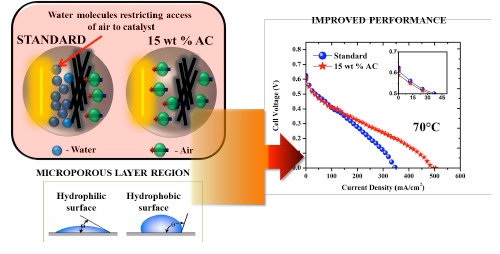
Schematic illustration of impact of using activated carbon (AC) in the gas diffusion layer comparable to standard (STD) MEA
Figure 1: Schematic illustration of impact of using activated carbon (AC) in the gas diffusion layer comparable to standard (STD) MEA. (Image: University of Manchester)
The mass transport limitation is addressed by working on the pore structure of carbon materials. Several carbon blacks: Vulcan XC-72, Ketjen Black, Acetylene Black Asbury 850, Denka Black and Mogul L are used widely. In addition to the performance limitation, the precursor for these carbon materials comes from the treatment of hydrocarbons at high temperature and pressure conditions.
In this work, reported in Electrochimica Acta („Enhanced performance based on a hybrid cathode backing layer using a biomass derived activated carbon framework for methanol fuel cells”), Manchester University chemical engineering researchers Prabhuraj Balakrishnan and Stuart M. Holmes prepared an activated carbon framework from tea leaves, obtained from the Black sea region of Tukey (from Ankara University) collaborators.
This framework used in combination with conventional carbon black in the cathode gas diffusion layer, has shown to improve the fuel cell performance by 33% in methanol fuel cell operating conditions.
More specifically, the cell performance underwent drastic changes in the mass transport region of the fuel cell polarization curve (Figure 1), comparable to the standard MEA. This is attributed to the pore structure (75.69% of mesopores and 24.31% of micropores) of this framework aiding in enhanced water removal, as a result more air molecules react with the platinum catalyst sites finally improving the fuel cell performance.
On increasing the composition of this activated carbon framework in the gas diffusion layer, the performance declined due to the poor electrical conductivity of the carbon. This shows that if the electrical conductivity of this activated carbon framework could be improved, this would decrease the reliance on conventional carbon blacks which currently suffers from source material (hydrocarbon) availability in addition to improving performance.
Provided by The University of Manchester as a Nanowerk exclusive

Comutare de mare viteză pentru comutatoare și senzori electromecanici ultra-rapizi ( High-speed switching for ultrafast electromechanical switches and sensors )

Piezoelectromecanismele piezoMEMS sunt dispozitive miniaturizate care prezintă piezoelectricitate, adică apariția unei încărcături electrice sub tensiune mecanică aplicată. Aceste dispozitive au multe aplicații diverse în mașinile de recoltat energie, micropumpuri, senzori, capete de imprimantă cu jet de cerneală, întrerupătoare și așa mai departe. În materialele polarizate (feroelectrice) permanent, comutarea domeniului fero-elastic afectează în mod semnificativ proprietățile piezoelectrice, iar acest comportament poate fi exploatat pentru aplicațiile piezoMEMS.

Read more: Piezoelectromecanismele piezoMEMS sunt dispozitive miniaturizate care prezintă piezoelectricitate, adică apariția unei încărcături electrice sub tensiune mecanică aplicată. Aceste dispozitive au multe aplicații diverse în mașinile de recoltat energie, micropumpuri, senzori, capete de imprimantă cu jet de cerneală, întrerupătoare și așa mai departe. În materialele polarizate (feroelectrice) permanent, comutarea domeniului fero-elastic afectează în mod semnificativ proprietățile piezoelectrice, iar acest comportament poate fi exploatat pentru aplicațiile piezoMEMS.

Comutarea de mare viteză observată în aceste experimente a fost limitată de echipamentele electrice actuale, dar este mai rapidă decât cea raportată în studiile anterioare. Mai mult, această comutare de mare viteză de 90 ° este reversibilă și poate fi utilizată pentru a spori răspunsul piezoelectric în dispozitivele piezoMEMS cu câteva zeci de nanosecunde. Prin urmare, această constatare are o importanță considerabilă pentru dezvoltarea continuă a comutatoarelor și senzorilor electromecanici ultra-rapizi.

Posted: Aug 29, 2017

High-speed switching for ultrafast electromechanical switches and sensors

(Nanowerk News) Unlike the slow ferroelastic domain switching expected for ceramics, high-speed sub-microsecond ferroelastic domain switching and simultaneous lattice deformation are directly observed for the Pb(Zr0.4Ti0.6)O3 thin films. This exciting finding („In-situ observation of ultrafast 90° domain switching under application of an electric field in (100)/(001)-oriented tetragonal epitaxial Pb(Zr0.4Ti0.6)O3 thin films”) paves the way for high-frequency ultrafast electromechanical switches and sensors.

Piezo micro electro mechanical systems (piezoMEMS) are miniaturized devices exhibiting piezoelectricity, i.e., the appearance of an electric charge under applied mechanical stress. These devices have many diverse applications in energy harvesters, micropumps, sensors, inkjet printer heads, switches, and so on. In permanently polarized (ferroelectric) materials, ferroelastic domain switching affects the piezoelectric properties significantly, and this behavior can be exploited for piezoMEMS applications.
Pb(Zr1-xTix)O3 (PZT) thin films have excellent piezoelectric and ferroelectric properties; therefore, they are potential candidates for MEMS applications. Under an applied electric field, both lattice elongation and 90° ferroelastic domain switching are observed in tetragonal PZT thin films. In particular, non-180° ferroelastic domain switching has important implications for the future realization of high-performance piezoMEMS devices.
However, before the recent investigation, the speed of this 90° domain switching was unknown. In addition, the relationship between the speeds of the lattice deformation and ferroelastic domain switching had not been determined. To investigate these speeds, the research team led by Hiroshi Funakubo examined the switching behavior of Pb(Zr0.4Ti0.6)O3 thin films under applied rectangular electric field pulses.
To observe the changes in the lattice and the domain structure, time-resolved in situ synchrotron X-ray diffraction was carried out in synchronization with a high-speed pulse generator. These observations were performed at the BL13XU beamline at the SPring-8 synchrotron radiation facility. The electric field pulses were applied to the PZT thin films through Pt top electrodes, which were fabricated on top of the films.
Investigation of the diffraction peaks in the PZT thin films revealed elongation of the surface normal c-axis lattice parameter of the c-domain with a simultaneous decrease in the surface normal a-axis lattice parameter of the a-domain under the applied electric field. The intensities of the diffraction peaks also changed under the electric field. These observations provided direct evidence of 90° domain switching.
Responses of PZT Thin Film Properties to Applied Electric Field
The (a-f) capacitance, strain, tilting angle, intensity, difference capacitance, and volume fraction of the c domain were measured as functions of time, respectively. The elastic deformation and ferroelastic domain switching were completed within 40 ns. (© NPG) (click on image to enlarge)
To determine the switching speed, the lattice elongation and domain switching behaviors were plotted as functions of time (Figure). These plots revealed that these processes were completed within 40 ns and occurred simultaneously in response to the applied electric field. The switching behavior was also shown to be perfectly repeatable.
The high-speed switching observed in these experiments was limited by the present electrical equipment, but is faster than that reported in previous studies. Further, this high-speed 90° switching is reversible and can be used to enhance the piezoelectric response in piezoMEMS devices by several tens of nanoseconds. Therefore, this finding is of considerable importance for the ongoing development of ultrafast electromechanical switches and sensors.
Source: Tokyo Institute of Technology

Read more: High-speed switching for ultrafast electromechanical switches and sensors
München Re & In-Q-Tel a selectat Metabiota pentru a obține o perspectivă mai profundă asupra riscului epidemiei și pregătirii globale pentru bolile infecțioase(Munich Re& In-Q-Tel Select Metabiota to Gain Deeper Insights into Epidemic Risk and Global Preparedness for Infectious Diseases)

Cu o platformă intuitivă, bazată pe cloud, Metabiota furnizează administratorilor de risc și subscriptorilor cu o perspectivă fără precedent asupra modului în care se propagă bolile și le ajută să cuantifice riscul reprezentat de epidemii

Stimp20

Silk ar putea îmbunătăți sensibilitatea, flexibilitatea senzorilor de corp care pot fi purtați ( Silk could improve sensitivity, flexibility of wearable body sensors )

Pe baza rezultatelor preliminare, Zhang dorește să exploreze modalități de a crea un set integrat de senzori auto-susținători care să fie alimentați de nano-generatori. Ea sugerează, de asemenea, că senzorii de mătase ai echipei sale ar putea fi folosiți pentru a construi roboți mai reali care să poată simți atingerea, temperatura sau umiditatea și pot chiar distinge între vocile diferitelor persoane.

Posted: Aug 21, 2017

Silk could improve sensitivity, flexibility of wearable body sensors

(Nanowerk News) From smart socks to workout clothes that measure exertion, wearable body sensors are becoming the latest „must-have” technology. Now scientists report they are on the cusp of using silk, one of the world’s most coveted fabrics, to develop a more sensitive and flexible generation of these multi-purpose devices that monitor a slew of body functions in real time.

The researchers are presenting their work today at the 254th National Meeting & Exposition of the American Chemical Society (ACS).
„There is a whole world of possibilities for silk sensors at the moment. Silk is the ideal material for fabricating sensors that are worn on the body,” Yingying Zhang, Ph.D., says. „One possibility we foresee is for them to be used as an integrated wireless system that would allow doctors to more easily monitor patients remotely so that they can respond to their medical needs more rapidly than ever before.”
flexible body sensor made from silk
Silk could soon be used to produce more sensitive and flexible body sensors like this one. (Image: Yingying Zhang)
Body sensors, which are usually made with semiconductors, have shown great potential for monitoring human health. But they have limitations. For instance, strain sensors, which measure changes in force, cannot be highly sensitive and highly stretchable at the same time. Silk, a natural material that is stronger than steel and more flexible than nylon, could overcome these problems. The fiber is also lightweight and biocompatible. However, silk doesn’t conduct electricity very well. To address this challenge, Zhang and colleagues at Tsinghua University in China sought to find a way to boost the conductivity of silk so it could be successfully used in body-sensing devices.
The researchers decided to try two different strategies. In one approach, they treated the silk in an inert gas environment with temperatures ranging from 1,112 degrees to 5,432 degrees Fahrenheit. As a result, the silk became infused with N-doped carbon with some graphitized particles, which is electrically conductive. Using this technique, the scientists have developed strain sensors, pressure sensors and a dual-mode sensor capable of measuring temperature and pressure simultaneously.
In the other approach, the team fed either graphene or carbon nanotubes to silkworms. Some of these nanoparticles were naturally incorporated into the silk produced by the worms. So far, this method hasn’t produced electrically conductive fibers, but the researchers are still experimenting with this technique and are hopeful they can make it work.
Based on the preliminary results, Zhang wants to explore ways to create an integrated set of silk-based, self-sustaining sensors that would be powered by nano-generators. She also suggests that her team’s silk sensors might be used to build more realistic robots that can sense touch, temperature or humidity and can even distinguish between different people’s voices.
Source: American Chemical Society

Read more: Silk could improve sensitivity, flexibility of wearable body sensors