Disputa privind originea răspunsului foto terahertz în grafen are ca rezultat o remiză(The dispute about the origins of terahertz photoresponse in graphene results in a draw)

Aceste experimente vor ajuta la alegerea celui mai bun design pentru detectoarele terahertzi și ne vor aduce mai aproape de detectarea la distanță a substanțelor periculoase, diagnosticarea sigură medicală și comunicațiile wireless de mare viteză.

Posted: Apr 24, 2018

The dispute about the origins of terahertz photoresponse in graphene results in a draw

(Nanowerk News) Physicists at Moscow Institute of Physics and Technology (MIPT) and their British and Russian colleagues revealed the mechanisms leading to photocurrent in graphene under terahertz radiation. The paper published in Applied Physics Letters („Dual origin of room temperature sub-terahertz photoresponse in graphene field effect transistors”) not only puts a period to a long-lasting debate about the origins of direct current in graphene illuminated by high-frequency radiation but also sets the stage for the development of high-sensitivity terahertz detectors. Such detectors are highly demanded in medical diagnostics, wireless communications and security systems.

Photoresponse in graphene
Photoresponse in graphene. (Image: MIPT)
In 2005 MIPT alumni Andre Geim and Konstantin Novoselov experimentally studied the behavior of electrons in graphene, a flat honeycomb lattice of carbon atoms. They found that electrons in graphene respond to electromagnetic radiation with an energy of quantum, whereas the common semiconductors have an energy threshold below which the material does not respond to light at all. However, the direction of electron motion in graphene exposed to radiation has long remained a point of controversy, as there is a plenty of factors pulling it in different directions. The controversy was especially stark in the case of the photocurrent caused by terahertz radiation.
What sets terahertz radiation apart is its unique set of properties. As an example, it easily passes through many dielectrics without ionizing them: this is of particular value to medical diagnostic or security systems. A terahertz camera can „see” the weapons concealed under a person’s clothes, and a medical scanner can detect skin diseases at early stages by the spectral lines („fingerprints”) of characteristic biomolecules in the terahertz range. Finally, raising the carrier frequency of Wi-Fi devices from several to hundreds of gigahertz (into the sub-terahertz range) will proportionally increase the bandwidth. But all these applications need a sensitive and low-noise terahertz detector which is simple in fabrication.
Wiring diagram of a Graphene-based Terahertz Detector
Wiring diagram of a graphene-based terahertz detector: terahertz radiation hits the antenna connected to the left (source) and top (gate) terminals of a transistor. This generates direct photocurrent (or a constant voltage, depending on the measurement setup) between the left and right terminals, which is a measure of radiation intensity. (Image: MIPT)
A terahertz detector designed by researchers at MIPT, MSPU and the University of Manchester (the place where graphene was first discovered) is a graphene sheet (colored green in figures 1 and 2) sandwiched between dielectric layers of boron nitride and electrically coupled to a terahertz antenna–a metal spiral about a millimeter in size. As radiation impinges on the antenna, it rocks electrons on one side of the graphene sheet, while the resulting direct current is measured on the other side. It is the „packing” of graphene into boron nitride that enables record-high electric characteristics, giving the detector a sensitivity that is a cut above the earlier designs. However, the main result of the research is not a better-performing instrument; it is the insight into the physical phenomena responsible for the photocurrent.
There are three main effects leading to the electric current flowing in graphene exposed to terahertz radiation. The first one, the photothermoelectric effect, is due to the temperature difference between the antenna terminal and the sensing terminal. This sends electrons from the hot terminal to the cold one, like air rising up from a warm radiator up to cold ceiling. The second effect is the rectification of current at the terminals: it turns out that the edges of graphene let through only the high-frequency signal of a certain polarity. The third and most interesting effect is called plasma wave rectification. We can think of the antenna terminal as stirring up „waves in the electronic sea” of the graphene strip, while the sensing terminal registers the average current associated with these waves.
Operating Area of the Terahertz Detector
The operating area of the terahertz detector: the green strip is graphene, gold tracks lead to the antenna and a sensing ammeter. The scale bar is 6 microns. (Image: MIPT)
„Earlier attempts to explain the photocurrent in such detectors used only one of these mechanisms and excluded all the others,” says Dmitry Svintsov, head of the Laboratory of 2d Materials’ Optoelectronics at MIPT. „In reality, all three of them are at play, and our study found which effect dominates at which conditions. Thermoelectric effects dominate at low temperatures, while plasmonic rectification prevails at high temperatures and in longer-channel instruments. And the main thing is that we figured out how to make a detector in which the different photoresponse mechanisms will not cancel each other, but rather reinforce each other”
These experiments will help choose the best design for terahertz detectors and bring us closer to remote detection of dangerous substances, safe medical diagnostics, and high-speed wireless communications.
Source: Moscow Institute of Physics and Technology

Graphene origami ca structură plasmonică reglabilă mecanic pentru detectarea în infraroșu(Graphene origami as a mechanically tunable plasmonic structure for infrared detection)

s-au dezvoltat cu succes un filtru infrarosu acordabile facut din grafen, ceea ce ar permite un soldat să schimbe frecvența unui filtru, pur și simplu prin deformarea mecanică controlată a filtrului (de exemplu, grafen origami), și nu de înlocuind substanța cu ochelarii utilizați pentru a filtra un anumit spectru de culori.Cercetarea este finanțată de Biroul de Cercetări Științifice al Forțelor Aeriene, care este interesat de senzori care nu numai că sunt sensibili la diferite lungimi de undă IR, dar și controlabile și reglabile mecanic.

Posted: Apr 24, 2018

Graphene origami as a mechanically tunable plasmonic structure for infrared detection

(Nanowerk News) Soldiers often need to see through smoke, fog, dust or any other airborne obscurant and detect the presence of toxins or other chemicals in the field or on the front lines. To identify those chemicals, they use infrared (IR) sensors and spectroscopy, which allow a specific color of light to shine at a particular frequency corresponding to each chemical. Identifying each chemical will require a soldier to coat the goggle with a unique filter, enabling the chemical signature to come through at a specific frequency (i.e., a specific color).

Researchers at the University of Illinois, however, have successfully developed a tunable infrared filter made from graphene, which would allow a soldier to change the frequency of a filter simply by controlled mechanical deformation of the filter (i.e., graphene origami), and not by replacing the substance on the goggles used to filter a particular spectrum of colors.
The research is funded by the Air Force Office of Scientific Research, which is interested in sensors that are not only sensitive to different IR wavelengths, but also mechanically controllable and tunable. The results are published in Light: Science & Applications („Mechanically Reconfigurable Architectured Graphene for Tunable Plasmonic Resonances”).
Origami Graphene
Mechanically tunable light absorption wavelength with wrinkled graphene structures. A schematic illustration of the uniaxially wrinkled graphene structure (left panel) showing a reversible mechanical change of the wrinkled structure. Optical absorption spectra (right panel) for the wrinkled graphene structures with various aspect ratio of wrinkle height (h) to wavelength (λc). (Image: University of Illinois College of Engineering) (click on image to enlarge)
This application is another in a series of discoveries of „wonder material” graphene by SungWoo Nam, an Assistant Professor of Mechanical Science and Engineering at the University of Illinois at Urbana-Champaign.
„Typically when you place graphene on a substrate, it is extremely transparent and absorbs only about three percent of light,” Nam noted. „At certain angles, you can see it. We use this versatility to make other structures like flexible and transparent sensors out of graphene.”
Because it’s one-atom thin, graphene is normally used while flat. Nam’s research team asked a question: what would happen if through origami (paper-folding art), you wrinkled the graphene? Could you change the properties of graphene by altering its topography?
According to Nam, scientists haven’t tried this idea before with other conventional materials because they are brittle and not able to be bent without breaking. What’s unique about graphene is that it is not only thin, but it is resilient, meaning it doesn’t break easily when it is bent.
„Let’s say we create graphene wrinkles by mechanical deformation,” Nam said. „If you get a certain dimension, is there going be any changes in the way the light is going to be absorbed by the graphene? We wanted to link the dimensions of the wrinkled graphene to its optical absorption.”
Nam’s team discovered that indeed, wrinkled graphene absorbs light differently depending on the structure and dimensions through plasmonic resonances, thus producing different colors. In addition, unlike paper, which can’t easily be flattened after folding or crumpling, graphene can be re-stretched to become flat and wrinkle free again. Not only that but the amount of light absorption can be altered by a factor of approximately 10.
„By changing the shape, you can absorb the light of a different frequency by controlling plasmonic resonance conditions,” Pilgyu Kang, the first author of the paper and now an Assistant Professor at Mechanical Engineering Department at George Mason University, stated. „And by mechanically controlling the height and wavelength of the graphene wrinkles, I can excite different surface plasmons and thus absorb different frequency. At the end of the day, you get a tunable filter.”
By choosing graphene as a filter for infrared goggles, the user can turn a knob to mechanically stretch and compress the graphene. That allows for a change of the light wavelength being absorbed. So as an example of its application, a solider can thus easily tune the graphene filter to a desired wavelength to match the type of chemical he/she is looking for.
„In a conventional filter, once you make the filter, you are done,” Nam concluded. „No matter the size, there is one unique light wavelength. With graphene, depending on how much you stretch and release, you can communicate in different light wavelengths.”
Source: University of Illinois College of Engineering

Nanoengineeringul de beton cu grafen reduce drastic amprenta de carbon(Nanoengineering concrete with graphene drastically reduces carbon footprint)

Un nou beton mai ecologic, mai puternic și mai durabil, care este realizat cu ajutorul grafenului, ar putea revoluționa industria construcțiilor.

Posted: Apr 23, 2018

Nanoengineering concrete with graphene drastically reduces carbon footprint

(Nanowerk News) A new greener, stronger and more durable concrete that is made using graphene could revolutionise the construction industry.

Experts from the University of Exeter have developed a pioneering new technique that uses nanoengineering technology to incorporate graphene into traditional concrete production.
The new composite material, which is more than twice as strong and four times more water resistant than existing concretes, can be used directly by the construction industry on building sites. All of the concrete samples tested are according to British and European standards for construction.
Crucially, the new graphene-reinforced concentre material also drastically reduced the carbon footprint of conventional concrete production methods, making it more sustainable and environmentally friendly.
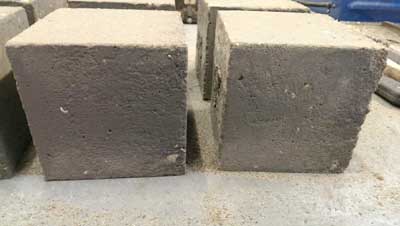
concrete blocks
The new concrete developed using graphene by experts from the University of Exeter (Image: Dimitar Dimov / University of Exeter)
The research team insist the new technique could pave the way for other nanomaterials to be incorporated into concrete, and so further modernise the construction industry worldwide.
The research is published in the journal Advanced Functional Materials („Ultrahigh Performance nanoengineered Graphene-Concrete Composites for Multifunctional Applications”).
Professor Monica Craciun, co-author of the paper and from Exeter’s engineering department, said: „Our cities face a growing pressure from global challenges on pollution, sustainable urbanization and resilience to catastrophic natural events, amongst others.
„This new composite material is an absolute game-changer in terms of reinforcing traditional concrete to meets these needs. Not only is it stronger and more durable, but it is also more resistant to water, making it uniquely suitable for construction in areas which require maintenance work and are difficult to be accessed .
„Yet perhaps more importantly, by including graphene we can reduce the amount of materials required to make concrete by around 50 per cent – leading to a significant reduction of 446kg/tonne of the carbon emissions.
„This unprecedented range of functionalities and properties uncovered are an important step in encouraging a more sustainable, environmentally-friendly construction industry worldwide.”
Previous work on using nanotechnology has concentrated on modifying existing components of cement, one of the main elements of concrete production.
In the innovative new study, the research team has created a new technique that centres on suspending atomically thin graphene in water with high yield and no defects, low cost and compatible with modern, large scale manufacturing requirements.
Dimitar Dimov, the lead author and also from the University of Exeter added: „This ground-breaking research is important as it can be applied to large-scale manufacturing and construction. The industry has to be modernised by incorporating not only off-site manufacturing, but innovative new materials as well.
„Finding greener ways to build is a crucial step forward in reducing carbon emissions around the world and so help protect our environment as much as possible. It is the first step, but a crucial step in the right direction to make a more sustainable construction industry for the future.”
Source: University of Exeter

O piele falsă mai bună, inspirată de plante(A better fake leather, inspired by plants)

au folosit anterior o textură nano-inginerie bazată pe frunzele fuzzy pentru a elabora sticlă auto-curățată și o plasă care separă petrolul de apă.Pentru a testa auto-curățarea, cercetătorii au pulverizat praf de carbură de siliciu negru pe piele și au măsurat cantitatea de pulbere care ar putea fi spălată de o singură picătură de apă. Pe piele sintetică netratată, apa spăla aproximativ 10% din pulbere, în timp ce pe pielea tratată, 90% din ea a fost spălată.

Posted: Apr 23, 2018

A better fake leather, inspired by plants

(Nanowerk News) If you’ve ever stained your favorite leather-look jacket or had to peel your bare legs from a sticky vinyl car seat in the summer, the solution to your woes just might be found on the surface of a lotus leaf.

Researchers at The Ohio State University have previously used a nano-engineered texture based on the fuzzy leaves to devise self-cleaning glass and a mesh that separates oil from water.
Now, in the journal Colloids and Surfaces A („Fabrication of bioinspired superliquiphobic synthetic leather with self-cleaning and low adhesion”), they report that they found a way to adapt the same nature-inspired coating to plastic-based synthetic leather. Both water and oil roll off the coating, which keeps the leather-like surface from getting sticky up to temperatures of 70 degrees Celsius (158 degrees Fahrenheit).
The coating could make for cleaner, less sticky furniture, automotive interiors, clothing, shoes and handbags—any products for which people use synthetic leather, said Bharat Bhushan, Ohio Eminent Scholar and Howard D. Winbigler Professor of mechanical engineering at Ohio State.
a drop of oil on an untreated piece of synthetic leather (top, left to right) and a piece of treated synthetic leather (bottom, left to right)
In these images, researchers place a drop of oil on an untreated piece of synthetic leather (top, left to right) and a piece of treated synthetic leather (bottom, left to right). After treatment, the oil rolls off. (Image: Ohio State University)
“Genuine leather has been an important material since the beginning of human history,” Bhushan said. “Today, the market for synthetic leather is growing because it’s less expensive and easier to work with. To our knowledge, this is the first time anyone has managed to fabricate synthetic leather that is not just water resistant, but super-liquiphobic—it repels both water and oil-based liquids.”
Synthetic leather is made from fabric coated with plastic, usually polyurethane (PU) or polyvinyl chloride (PVC). Both PVC and PU can be molded into flat sheets with grooves that give it a leather-like texture. Like genuine leather, synthetic leather is somewhat permeable to liquids. Unlike genuine leather, it gets sticky at high temperatures because heat softens the plastic surface.
Bhushan specializes in biomimetics, the science of creating materials and processes that mimic nature. Much of his work has been inspired by lotus leaves, whose bumpy surfaces naturally repel water.
As in their previous experiments creating water- and oil-repellant surfaces, the researchers tried to create a bumpy texture by spraying a coating of silica nano-particles on the surface of the synthetic leather.
But Bhushan and doctoral student Dev Gurera quickly discovered that the plasticizers in the synthetic leather—that is, the chemicals that give plastic its plasticity—prevented the nano-particles from sticking, especially inside the leather-look grooves. So they cleaned the surface with an ultraviolet light treatment commonly used in computer chip manufacturing.
The result: The nano-particles stuck to the cleaned synthetic leather, creating a bumpy surface. Then the researchers sealed the nano-particles with a silicone resin. The coating was mostly transparent, so the leather-like texture was still visible.
Bhushan and Gurera coated samples of PU and PVC and tested them for water and oil repellency and self-cleaning properties, as well as durability and heat resistance.
They squeezed droplets of oil and water onto the synthetic leather and tested how much the surface would have to be tilted for the droplet to roll off. Water rolled off with a tilt of 2 degrees and oil with a tilt of 4 degrees. Any tilt below 10 degrees is considered super-liquiphobic.
To see how wear affected the coating, the researchers scratched a groove into the surface by dragging a small sapphire bead back and forth over it 100 times. The tilt angle required to get droplets to roll off the scratched surface increased to 7 degrees—still super-liquiphobic—but only when the droplet rolled across (that is, perpendicular to the direction of) the worn-in groove.
When the leather was placed so that the droplet would have to roll inside the worn groove, the required angle for the droplet to roll off increased to 44 degrees. That sounds pretty bad, but it’s still better than the untreated PU and PVC surfaces, which remained coated with water or oil even when they were tilted to 90 degrees.
To test self-cleaning, the researchers sprayed black silicon carbide powder on the leather and measured how much of the powder could be washed away by a single water droplet. On untreated synthetic leather, the water washed away about 10 percent of the powder, while on the treated leather, 90 percent of it was washed away.
And the stickiness? The hottest temperature reported inside a closed car sitting in the sunlight is around 80 degrees Celsius (176 degrees Fahrenheit). At that temperature, the researchers said, the coating can’t maintain its integrity, because the PU or PVC beneath it begins to flow like an extremely viscous fluid. The coating did remain un-sticky up to 70 degrees Celsius (158 degrees Fahrenheit), so it could keep your legs from sticking to a car seat on most hot days.
It won’t prevent a very hot seat from burning you, however—so watch out. At least your favorite “leather” jacket will look and feel the same.
Source: Ohio State University

Lucrările de vopsire transformă pereții în senzori, suprafață interactivă (cu video)

Cercetătorii au descoperit că ar putea utiliza vopsea conductoare pentru a crea electrozi pe suprafața unui perete, permițându-i să acționeze atât ca un touchpad pentru a urmări atingerea utilizatorilor, cât și ca un senzor electromagnetic pentru detectarea și urmărirea dispozitivelor și aparatelor electrice.

Posted: Apr 23, 2018

Paint job transforms walls into sensors, interactive surface (w/video)

(Nanowerk News) Walls are what they are – big, dull dividers. With a few applications of conductive paint and some electronics, however, walls can become smart infrastructure that sense human touch, and detect things like gestures and when appliances are used.

Researchers at Carnegie Mellon University and Disney Research found that they could transform dumb walls into smart walls at relatively low cost – about $20 per square meter –using simple tools and techniques, such as a paint roller.
These new capabilities might enable users to place or move light switches or other controls anywhere on a wall that’s most convenient, or to control videogames by using gestures. By monitoring activity in the room, this system could adjust light levels when a TV is turned on or alert a user in another location when a laundry machine or electric kettle turns off.
„Walls are usually the largest surface area in a room, yet we don’t make much use of them other than to separate spaces, and perhaps hold up pictures and shelves,” said Chris Harrison, assistant professor in CMU’s Human-Computer Interaction Institute (HCII). „As the internet of things and ubiquitous computing become reality, it is tempting to think that walls can become active parts of our living and work environments.”
Yang Zhang, a Ph.D. student in the HCII, will present a research paper („Wall++: Room-Scale Interactive and Context-Aware Sensing”) on this sensing approach, called Wall++, at CHI 2018, the Conference on Human Factors in Computing Systems, April 21-26 in Montreal.
The team presents Wall++, a low-cost sensing approach that allows walls to become a smart infrastructure. Instead of merely separating spaces, walls can now enhance rooms with sensing and interactivity. Our wall treatment and sensing hardware can track users’ touch and gestures, as well as estimate body pose if they are close. By capturing airborne electromagnetic noise, we can also detect what appliances are active and where they are located.
The researchers found that they could use conductive paint to create electrodes across the surface of a wall, enabling it to act both as a touchpad to track users’ touch and an electromagnetic sensor to detect and track electrical devices and appliances.
„Walls are large, so we knew that whatever technique we invented for smart walls would have to be low cost,” Zhang said. He and his colleagues thus dispensed with expensive paints, such as those containing silver, and picked a water-based paint containing nickel.
They also wanted to make it easy to apply the special coating with simple tools and without special skills. Using painter’s tape, they found they could create a cross-hatched pattern on a wall to create a grid of diamonds, which testing showed was the most effective electrode pattern. After applying two coats of conductive paint with a roller, they removed the tape and connected the electrodes. They then finished the wall with a top coat of standard latex paint to improve durability and hide the electrodes.
The electrode wall can operate in two modes – capacitive sensing and electromagnetic (EM) sensing. In capacitive sensing, the wall functions like any other capacitive touchpad: when a person touches the wall, the touch distorts the wall’s electrostatic field at that point. In EM sensing mode, the electrode can detect the distinctive electromagnetic signatures of electrical or electronic devices, enabling the system to identify the devices and their locations.
Similarly, if a person is wearing a device that emits an EM signature, the system can track the location of that person, Zhang said.
Wall++ hasn’t been optimized for energy consumption, Zhang said, but he estimated the wall-sized electrodes consume about as much power as a standard touch screen.
Source: Carnegie Mellon University

Oamenii de știință propun noi argumente pentru verificarea proprietăților izolatoarelor topologice

Izolații topologici sunt materiale noi care au fost studiate de mai multe grupuri de cercetare din întreaga lume pentru mai mult de zece ani. Principalul avantaj al acestor materiale este prezența (în anumite condiții de simetrie) a stărilor disipante la limita eșantionului, în timp ce materialul în vrac păstrează proprietățile unui izolator. Având în vedere aceste proprietăți, se speră că izolatoarele topologice pot fi utilizate în sistemele avansate de comunicații și procesare a informațiilor, precum și în calculul cuantic.
Multe proprietăți ale izolatoarelor topologice au fost bine descrise teoretic, unele dintre ele fiind verificate experimental. Proprietățile de bază care necesită încă o verificare cuprinzătoare includ forma curbei de disipare a energiei a stărilor de margine într-un izolator topologic, în funcție de componentele lor quasimoment.

Posted: Apr 20, 2018

Scientists propose new arguments for checking the properties of topological insulators

(Nanowerk News) Topological insulators are new materials that have been studied by many research groups around the world for more than ten years. The main advantage of such materials is the presence (under certain symmetry conditions) of dissipationless states at the sample boundary, while the bulk material retains the properties of an insulator. In view of these properties, it is hoped that topological insulators can be used in advanced communications and information processing systems, as well as in quantum computing.

Many properties of topological insulators have by now been well described theoretically, some of them have been verified experimentally. The basic properties that still require comprehensive verification include the shape of the energy dissipation curve of the edge states in a topological insulator, depending on their quasimomentum components.
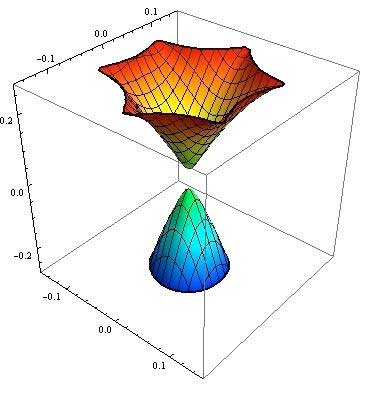
The law described by this curve underlies most of the observable and applied properties of the material, therefore it is very important to know its details. If, for example, we make a plot of the dissipation law for the electrons on the surface of the Bi2Te3 class compounds, it will resemble a flower with intricately shaped petals. The shape of the petals will contain information about the symmetry of the dissipation law, which directly affects the physical properties of the electron gas.
Researchers at the UNN Faculty of Physics have long been engaged in the study of topological insulators. Recently, work has been completed on the impact of the dissipation law symmetry for electrons on the Bi2Te3 surface on the observed properties of this material. According to Associate Professor of the Department of Theoretical Physics Denis Khomitsky, researchers were able to show that the shape of the „petals” of the dissipation curve, or rather their symmetry, is a reflection of specific and measurable regularities.
Spectrum of Hamiltonian (1) in zero external fields
Spectrum of Hamiltonian (1) in zero external fields. (Image: Lobachevsky University)
These regularities include the appearance of new peaks in the absorption spectrum of electromagnetic radiation with different polarization, as well as qualitative differences in the dynamics of the wave packet that are manifested when hexagonal distortion or corrugation of the spectrum is taken into account.
„With the results obtained, we will be able to estimate in our future optical and transport experiments the real contribution of this corrugation, that is, to describe more accurately the details of the „petal” shape of the dissipation law”, Denis Khomitsky notes.
The authors of the article published in the April issue of Journal of Experimental and Theoretical Physics hope that a better understanding of this law will contribute to accelerating the development of practically useful applications and devices based on this class of materials.
Source: Lobachevsky University

Grafenul modifică proprietățile elastice în funcție de forța aplicată(Graphene changes elastic properties depending on applied force)

vor prezenta proprietăți speciale” , Note Kachorovskii.
Faptul că grafenul se poate întinde în mod normal sau anormal în funcție de forța aplicată în perspectivă va ajuta, de exemplu, la crearea de senzori de sunet hipersensibili.
„Undele sonore întind membrana grafenului și, în funcție de gradul de întindere, grafenul modifică semnificativ rezistența electrică.” Calculele arată că sensibilitatea unui astfel de detector poate fi gigantică, în plus, viteza sonoră este semnificativ mai mare decât în ​​materialele „normale”. Valoarea altor constante elastice, de exemplu modulul lui Young, ramane acelasi. De aceea, atunci cand grafenul devine intins la starea de auxetic, sunetul se raspandeste foarte repede, ceea ce ne permite sa cream senzori ultra-rapizi care pot detecta schimbare foarte rapidă a oscilațiilor

Posted: Apr 19, 2018

Graphene changes elastic properties depending on applied force

(Nanowerk News) A group of scientists, including specialists from Landau Institute for Theoretical Physics (ITF), described a universal characteristic, in which many unique graphene properties are „hidden”. It turned out that abnormal graphene behavior can be fully characterised by Poisson ratio, which determines material capability to shrink or extend in transverse dimension. Moreover,scientists found key factors that can influence this characteristic. The results are published in Physical Review B („Stress-controlled Poisson ratio of a crystalline membrane: Application to graphene”).

Folded elements of auxetic materials straighten out, increasing its transverse dimension under stretching
a) Folded elements of auxetic materials straighten out, increasing its transverse dimension under stretching. b) Products made of any materials, folded according to the rules of the miura-ori: a folding system, which makes it possible to straighten the construction in one movement, also possess auxetic properties. c) Sneakers sole made up of overlapping triangles behaves like an auxetic under pressure. (Image: Article authors)
Graphene is a two-dimensional sheet consisting of one layer of carbon atoms. Due to its unusual properties, today graphene is considered one of the most promising materials for new non-silicon elastic electronics. One of the most interesting things about graphene is the relation between its unique elastic and electrical properties. For instance, graphene shows extremely high mobility of electric charges, which can change drastically under elastic stress. Physicists tried to find a universal physical characteristic fully reflecting this unusual behaviour. This would make it possible to use graphene more effectively, as well as create new materials with required exotic properties. However, until recently researchers could not find any such parameter.
The key to understanding this question lied in the unusual behavior of graphene under stretching. Most common materials shrink in transverse direction while stretching: a rubber band is a typical example. However, about a hundred years ago, the German physicist Voldemar Voight discovered that pyrite crystals, on the contrary, extend under stretching. Such materials were called auxetics, and in the late 1970s scientists obtained first artificial auxetic. The secret of such materials comes from their unusual geometry. Although in a relaxed state auxetic structural elements are folded, when stretching is applied they unfold and grow in size.
Auxetics have a number of unusual features that will help improve existing technologies and create new ones. „Conventional materials expand when heated and this impairs their original properties through various mechanical stresses and disturbances. Auxetics can, on the contrary, shrink. So there is an idea to create combined materials with zero expansion ratio using auxetics. As the temperature rises, the conventional compound of such materials will tend to expand, but auxetic compound will compensate for this,” comments Valentin Kachorovskii, a leading researcher at The Ioffe Institute and ITF.
The feature determining material capability to shrink or extend in transverse dimension under tension is called the Poisson ratio. In auxetics it is negative, in ordinary materials – positive. „Scientists were long interested in graphene Poisson ratio,” says Kachorovskii. „For a long time we thought that it was equal to the universal negative value -?. However, a number of recent numerical calculations showed that graphene Poisson ratio could be both positive and negative. At first glance, results of various calculations contradict each other completely.”
Direct experimental verification of this parameter is difficult. Graphene is hard to obtain in isolation: it is usually „grown” on various substrates, and their characteristics mask the true value of graphene Poisson ratio. What is more, samples of isolated graphene are so small that it is practically impossible to attach brackets for controlled stretching. At the same time, researchers and engineers who develop new carbon-based technologies need to know exactly whether graphene is auxetic or not.
Authors of the new work managed to „reconcile” contradictory results of previous calculations and find parameters that exactly determine the Poisson ratio of graphene. Physicists found out that it is a variable value depending on tensile force applied. „With a very large force, graphene behaves like a normal material, demonstrating positive Poisson ratio. However, when the applied force decreases, we find ourselves in an area where graphene exhibits typically auxetic properties,” notes Kachorovskii.
Scientists explained this unusual link between Poisson ratio and stretching. On popular images graphene is shown as a two-dimensional sheet of carbon atoms, usually flat. However, in reality so-called bending waves run along this „sheet”. They tend to turn graphene from a flat state into a crumpled state. „This is called a crumpling transition,” Kachorovskii explains.
„For a long time the theory of membranes predicted that due to this phenomenon two-dimensional crystals such as graphene could not exist in principle. They would always strive to shrink into a ball. As we see, this assumption was a mistake since along the surface of graphene ordinary compression-extension waves run along with bending ones. Nonlinear interaction between two wave types does not allow the membrane to shrink into a ball. Even though, the dimension of such crystals does not actually equal to two. Due to crumpling transition, it is in an intermediate state between two and three dimensions.”
Membrane striving to curl due to ordinary compression-extension waves competes with the effect of smoothing transverse waves due to an external applied force. This results in a changing sign of Poisson ratio. In other words, if the external force is high, the abnormal auxetic properties are suppressed and Poisson ratio is positive. As the scientists showed, the unusual properties of graphene are based on that slightly crumpled resting state.
„In folds of transverse bending waves additional energy is stored, which accounts for graphene abnormal elasticity and other unusual properties. For example, when heated graphene begins to shrink in the longitudinal direction, since the entire extension goes to transverse folds,” continues Kachorovskii. „And universal characteristic which determines exactly graphene behavior is Poisson ratio. With its help, you can describe and predict a large number of properties of graphene and other materials.”
What is more, current work contains explanation why previous studies of the Poisson ratio of graphene had contradictory results. „We derived an analytically complete system of equations for the elastic balance of graphene sheet. It turns out that there are two modes of behavior for graphene membrane. In the usual one, all the properties of graphene are determined by standard formulas and Poisson ratio is positive. At the same time, for samples larger than so-called Ginzburg length, an abnormal elasticity regime is realized, leading to negative Poisson ratio”, adds Kachorovskii. For graphene, Ginzburg’s length ranges from 40 to 70 angstroms. The size of samples used in practice is certainly greater, therefore it is possible to see the most unusual auxetic behavior.
The explanation of this phenomenon is also connected with waves of different types, which interact with each other in a very complicated manner. „Ginzburg length characterizes the scale at which these interactions can no longer be neglected as they begin to abnormally shift the material. For example, such large-scale interaction does not allow two-dimensional crystals to shrink into a ball”, explains Kachorovskii. Different substances have different Ginzburg lengths and knowing them is extremely important for the development of new materials.
„Often people create new materials without calculating Ginzburg length and then they try to find something unusual in their properties. But our work shows that if Ginzburg length is as large as 1 kilometer, for example, regular sized samples will not show any special properties”, Kachorovskii notes.
The fact that graphene can stretch normally or abnormally depending on the applied force in perspective will help create hypersensitive sound sensors, for example.
„Sound waves stretch graphene membrane, and depending on the degree of stretching graphene noticeably changes the electrical resistance. Calculations show that sensitivity of such detector can be gigantic. In addition, in auxetics the sound velocity is noticeably higher than in „normal” materials. The value of other elastic constants, for example, the Young’s modulus remains the same. Therefore, when graphene becomes stretched to the state of auxetic, the sound in it spreads very quickly. This allows us to create ultra-fast sensors which can detect a very rapid change of oscillations”, summarizes Kachorovskii.
Source: AKSON Russian Science Communication Association

Mătase fluorescentă de culoare roșie poate ucide bacteriile dăunătoare ca remediu biologic și ecologic(Far-red fluorescent silk can kill harmful bacteria as biomedical and environmental remedy)

Un material hibrid de mătase atacă bacteriile atunci când este iluminat de o lumină verde, datorită cercetătorilor de proteină fluorescenți de departe roșii transferați la machiajul lor genetic.Materialul complet natural ar fi mai sigur decât mijloacele convenționale fotocatalitic sau activat cu lumină pentru a ucide agenții patogeni daunatori, cum ar fi bacteriile, care utilizează semiconductori potențial biohazard și necesită lumină ultravioletă care provoacă cancer pentru activare.Tehnologia de procesare a mătăsii fluorescente (mKate2) poate fi aplicată dezvoltării de bandaje inteligente pentru vindecarea rănilor pe pielea umană
O alternativă de mătase proiectată de Universitatea Purdue și Institutul Național de Cercetări Agricole coreene ar folosi biomateriale plasmonice asemănătoare biomaterialelor și lumină vizibilă, care, de asemenea, ajută la vindecarea rănilor și la reabilitarea mediului, inclusiv purificarea aerului și a apei.

Posted: Apr 19, 2018

Far-red fluorescent silk can kill harmful bacteria as biomedical and environmental remedy

(Nanowerk News) A silk hybrid material attacks bacteria when illuminated by a green light, thanks to a far-red fluorescent protein researchers transferred to its genetic makeup.

The all-natural material would be safer than conventional photocatalytic, or light-activated, means to kill harmful pathogens such as bacteria, which use potentially biohazardous semiconductors and require cancer-causing ultraviolet light for activation.
A silk alternative engineered by Purdue University and the Korean National Institute of Agricultural Research would instead use plasmonic photocatalyst-like biomaterials and visible light, which also aid in wound healing and environmental remediation including air and water purification. Their findings published in Advanced Science („Green-light-activated photoreaction via genetic hybridization of far-red fluorescent protein and silk”).
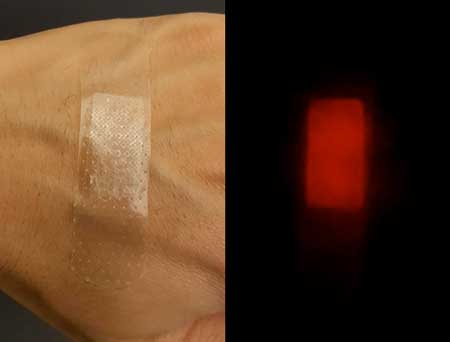
Silk Hybrid Bandage
The processing technology of fluorescent (mKate2) silk can be applied to developing smart medical bandages for wound healing on the human skin. (Image: Jung Woo Leem, Purdue University)
„Silk is an ancient and well-known biomaterial,” said Young Kim, Purdue associate professor of biomedical engineering. „It doesn’t have any issues with the human body. And the nice thing about green light is that it’s not harmful – the color corresponds to the strongest intensity of the solar spectrum.”
To combine the benefits of silk and green light, researchers inserted the gene for „mKate2,” a far-red fluorescent protein, into a silk host. Shining a green light on the resulting hybrid generates reactive oxygen species (ROS), which are effective radicals for breaking down organic contaminants and attacking the membrane and DNA of pathogens.
When E. coli on the fluorescent silk were illuminated by a weak green light for 60 minutes, the bacteria’s survival rate dropped to 45 percent.
The researchers found that the hybrid could be processed into a solution, film, bandage and fabric. „We’ve basically added fluorescence to silk to facilitate disinfection or decontamination using just visible light,” said Jung Woo Leem, a visiting scholar in Purdue’s school of biomedical engineering.
Kim’s team believes that green-light activated red fluorescent silk could be both more efficient and scalable than other plasmonic photocatalysts, in which metal nanoparticles hybridized from semiconductor materials also use visible light but could still pose negative environmental consequences.
„The silk photocatalysts would be easier and safer to produce than plasmonic ones since silkworms, rather than industrial facilities, provide the host for ROS-generating materials. It’s a completely new green manufacturing of nanomaterials,” Kim said.
Because ambient white light also includes green light, the researchers anticipate that the silk hybrid material should typically have a strong enough light source to generate ROS as long as a green light controls ROS generation.
Kim’s team plans to take advantage of silk’s biocompatibility with the human body both inside and out. „We’re thinking about some implantable and injectable wound healing materials that dissolve over time in the body. Then we wouldn’t need to do additional surgery to take it out,” Kim said.
Source: Purdue University