Dezvoltarea de materiale avansate de grafen pentru industrie(Developing advanced graphene materials for industry)

Centrul de Cercetare al ARC pentru Transformarea Industriei prin Graphene va dezvolta produse de înaltă valoare și soluții inovatoare pentru diverse industrii precum agricultura, mineritul, construcțiile, tehnologiile medicale și apărarea.Grafenul este un singur strat de atomi de carbon care deține proprietăți de material de neegalat – este cel mai subțire, cel mai puternic, cel mai ușor material cunoscut, cu cea mai mare suprafață și cele mai bune proprietăți de conductivitate electrică și termică din orice alt material, rezistent la apă și netoxic, cu unele proprietăți anti-bacteriene

Posted: Dec 08, 2017

Developing advanced graphene materials for industry

(Nanowerk News) Research and development around new applications and industries based on the advanced material graphene is the focus of a new Graphene Research Hub being launched at the University of Adelaide today.

The ARC Research Hub for Graphene Enabled Industry Transformation will develop high-value products and innovative solutions for industries as diverse as agriculture, mining, construction, medical technologies and defence.
The Research Hub is supporting commercialisation of graphene research in a partnership between universities and industry partners. It is funded by the Australian Government through the Australian Research Council’s Industrial Transformation Research Hubs scheme with a $2.6 million grant, with industry partners contributing over $3 million.
Graphene is produced from graphite which is mined from the ground. South Australia has the largest deposit of high quality of graphite in Australia, at 200 million tonnes. Graphene has unique properties and is so thin that one gram of graphene can cover the size of a football oval.
“Graphene is a single layer of carbon atoms that holds unrivalled material properties – it’s the thinnest, strongest, lightest material known, with the greatest surface area, and the best electrical and thermal conductivity properties of any other material, as well as being flexible, water repellent and non-toxic with some anti-bacterial properties,” says Professor Dusan Losic, Director of the ARC Research Hub for Graphene Enabled Industry Transformation, which is based in the University of Adelaide’s School of Chemical Engineering.
“It has the potential for new disruptive technology that will change our lives and create new industries, the same as silicon did 60 years ago.”
The research group in Adelaide are already working on a new generation of fire retardant products, construction materials, advanced protective coatings for defence and industrial applications including slow-release fertilisers; and new electrical devices and super-batteries.
“The aim is that our research will transform industry and support Australian businesses to embrace cutting-edge innovation and technologies that deliver high-value returns and build new industries,” Professor Losic says. “We have a vision of South Australia becoming the ‘Graphene Valley’ of Australia.”
The University of Adelaide will lead the new ARC Research Hub with collaborators at Monash University, University of Melbourne and University of South Australia. The commercial partners are Archer Exploration Limited, Ziltek Pty Ltd, Qingdao Huagao Graphene Technology Corporation Limited, First Graphene Limited, and Cleanfuture Energy Australia Pty Ltd.
The Hub also has a training component with a cohort of postgraduate students and postdoctoral researchers.
Source: University of Adelaide

Celulele solare cu o schimbare cuantică(Solar cells with a quantum shift)

Echipa a investigat un feroelectric organic cu o polarizare cuantică puternică pentru a-și explora capabilitățile de schimbare-curent. Compus din inele aromatice aromatice tetrathiafulvalene (TTF) și p-cloranil (CA), acest complex trece printr-o separare instantanee a încărcăturii când este răcită la aproximativ -200 de grade Celsius și este deosebit de sensibilă la lumina soarelui.

Posted: Dec 08, 2017

Solar cells with a quantum shift

(Nanowerk News) A much quicker, less wasteful way to extract current from solar cells that uses a quantum-mechanical process has been demonstrated by RIKEN researchers (Nature Communications, „Shift current photovoltaic effect in a ferroelectric charge-transfer complex”).

When sunlight strikes a typical solar panel, it creates pairs of electrons and positively charged holes. Normally, an electric field is used to separate these charges and produce electrical power, but this approach requires charges that have high mobilities and lifetimes, which makes it hard to develop new photovoltaic materials.
An alternative approach for extracting current from solar cells involves exploiting the symmetry of the repeating structural units that make up crystals. Certain semiconductors lack ‘inversion’ symmetry—meaning that if their atoms are flipped about the center of the repeating unit, a different atomic arrangement will be produced.
For such semiconductors, light-induced transitions of charges to excited states become unbalanced, which creates a ‘shift current’ along a specific crystal direction. This shift current propagates rapidly and with less energy loss than a current generated by applying an electric field. But shift currents usually generate insufficient photovoltaic power for practical uses.
Now, Masao Nakamura from the RIKEN Center for Emergent Matter Science and colleagues have overcome this shortcoming by using ferroelectric organic molecules that spontaneously separate their positive and negative charges. Because ferroelectric materials naturally disrupt inversion symmetry, they have potentially large shift currents—particularly when charge separation occurs due to quantum-mechanical differences in the covalent bonds holding a crystal together.
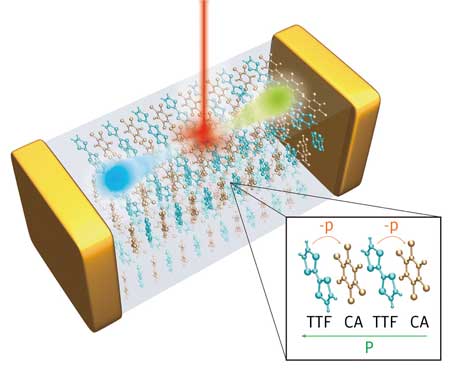
The team investigated an organic ferroelectric with strong quantum polarization to explore its shift-current capabilities. Composed of alternately stacked tetrathiafulvalene (TTF) and p-chloranil (CA) aromatic rings (Fig. 1), this complex undergoes instantaneous charge separation when cooled to around -200 degrees Celsius and is particularly sensitive to sunlight.
An organic charge-transfer complex can generate dissipation-free solar power thanks to quantum-based polarization effects
Figure 1: An organic charge-transfer complex can generate dissipation-free solar power thanks to quantum-based polarization effects. (Image: RIKEN Center for Emergent Matter Science)
“Most ferroelectric materials need light with energy in the ultraviolet region to excite carriers over a large band gap,” says Nakamura. “With TTF–CA, the band gap is narrow and responds to visible and infrared light, which is really important for applications like solar cells.”
When the researchers measured the photovoltaic properties of the organic complex, they were taken aback by the amount of shift current generated—nearly ten times higher than comparable oxide ferroelectrics. The quantum-based charge transfer dramatically improved solar output power and allowed the current to travel as far as 200 micrometers before dissipating.
Because the shift-current effects in TTF–CA are so sizeable, Nakamura expects that it could be used as a platform to implement this photoelectric conversion in next-generation devices. “We’ll be looking at other ferroelectrics to try for room-temperature operation,” he says. “And we think we can improve extraction efficiency by employing thin-film device structures.”
Source: RIKEN

Nanoscienții dezvoltă noi materiale cu pori controlabile(Nanoscientists develop new material with controllable pores)

oamenii de știință descriu sintetizarea unui material nou din copolimerii de sticlă, o moleculă gigantică cu arhitectură specială. Aceste molecule au peri care emană dintr-o coloană vertebrală cu blocuri de capăt. Echipa de cercetare a prezis ca aceasta combinatie unica de componente reactive intr-o singura molecula ar forma un material puternic cu pori controlabile.

Posted: Dec 06, 2017

Nanoscientists develop new material with controllable pores

(Nanowerk News) What do your skin, the clothes you wear, and the soil you stand on have in common? They are all porous substances. Like a sponge, their surfaces are covered with tiny holes that allow liquids and gasses to pass through. Porous materials are widespread throughout our world, and those with nanoscale pores—called mesoporous materials—make up everything from chemical catalyst supports to gas storage chambers and separation membranes.

To date, scientists have struggled to fabricate strong mesoporous materials; however, they have successfully developed “microporous” materials. These materials have even smaller pores, measuring less than two nanometers. Scientists construct these incredibly tiny materials using the “molecular framework” concept, where small, rigid molecules are interconnected to generate a continuous structure. While a lack of suitable building blocks in the mesoporous regime (two to 50 nanometers) has prevented scientists from developing strong mesoporous materials, a research team at the University at Buffalo (UB) has now solved this problem.
“Once you get to a certain size, most molecules become too flexible and aren’t strong enough to maintain a material’s pore framework,” said Dmytro Nykypanchuk, a scientist at the Center for Functional Nanomaterials (CFN)—a U.S. Department of Energy Office of Science User Facility located at Brookhaven National Laboratory. “This has led the scientists at UB to develop an entirely new approach to the synthesis of mesoporous materials.”
special architecture of bottlebrush copolymers
This image depicts the special architecture of bottlebrush copolymers (top left), which have bristles that emanate from a backbone with end blocks. By interconnecting these molecules, scientists fabricated a mesoporous material (right).
In a paper published in ACS Nano („Mesoporous Polymer Frameworks from End-Reactive Bottlebrush Copolymers”), the scientists describe synthesizing a new material from bottlebrush copolymers, a giant molecule with special architecture. These molecules have bristles that emanate from a backbone with end blocks. The research team predicted this unique combination of reactive components in a single molecule would form a strong material with controllable pores. Specifically, the side chains could serve as extra rigid interconnectors, while the reactive end blocks could help multiple bottlebrush molecules bind together.
“Bottlebrush copolymers provide a unique platform for fabricating mesoporous materials,” said Javid Rzayev, the lead researcher of the project and a chemistry professor at UB. “By manipulating their molecular architecture, we can control the molecular rigidity and the directionality of intermolecular interactions. This has allowed us to develop a mesoporous material with molecularly tunable parameters.”
To confirm their results, the UB research team analyzed the new material’s structure at the National Synchrotron Light Source II (NSLS-II), also a DOE Office of Science User Facility. Using a technique called small angle x-ray scattering, the team directed the bright x-rays from beamline 11-BM—a beamline built in a partnership between NSLS-II and CFN—to observe how light bounces off the atoms within the material. The study revealed the new material was far different than those produced by traditional methods. Because each pore was constructed by several macromolecules, the newly developed material had a much larger number of pores per volume, while the pores exhibited uniform dimensions and maintained their rigidity. Most importantly, the scientists could control the pores by manipulating the structure of the bottlebrush copolymers.
“Because the pores are defined by molecular architecture, scientists have far more control over the pore size and the properties of these materials than they did before,” Nykypanchuk said.
With a sturdy and controllable framework to work off, scientists can now research ways to improve mesoporous materials, such as altering the nature of the pores to make them catalytically active.
Source: Brookhaven National Laboratory

Grâul devine impresionat din nanotuburi purificate(Wheat gets boost from purified nanotubes)

Nanotuburile de carbon purificate cu un singur perete dispersate în apă au promovat o creștere mai mare a plantelor (centru) decât controlul fără nanomateriale (stânga) după opt zile;dacă nanotuburile cu pereți unici se combină cu poluanți organici, cum ar fi pesticidele, substanțele chimice industriale sau solvenții din mediu, aceștia pot concentra și imobiliza toxinele și pot spori absorbția acestora de către plante.

Posted: Dec 06, 2017

Wheat gets boost from purified nanotubes

(Nanowerk News) The introduction of purified carbon nanotubes appears to have a beneficial effect on the early growth of wheatgrass, according to Rice University scientists. But in the presence of contaminants, those same nanotubes could do great harm.

The Rice lab of chemist Andrew Barron grew wheatgrass in a hydroponic garden to test the potential toxicity of nanoparticles on the plant. To their surprise, they found one type of particle dispersed in water helped the plant grow bigger and faster.
They suspect the results spring from nanotubes’ natural hydrophobic (water-avoiding) nature that in one experiment apparently facilitated the plants’ enhanced uptake of water.
The research appears in the Royal Society of Chemistry journal Environmental Science: Nano(„Effect of raw and purified carbon nanotubes and iron oxide nanoparticles on the growth of wheatgrass prepared from the cotyledons of common wheat (triticum aestivum)”).
Purified single-walled carbon nanotubes dispersed in water promoted greater plant growth
Purified single-walled carbon nanotubes dispersed in water promoted greater plant growth (center) than the nanomaterial-free control (left) after eight days of an experiment at Rice University. Feeding plants tetrahydrofuran with the nanotubes (right) produced the opposite effect, stunting plant growth. (Image: Pavan Raja/Rice University)
The lab mounted the small-scale study with the knowledge that the industrial production of nanotubes will inevitably lead to their wider dispersal in the environment. The study cited rapid growth in the market for nanoparticles in drugs, cosmetic, fabrics, water filters and military weapons, with thousands of tons produced annually.
Despite their widespread use, Barron said few researchers have looked at the impact of environmental nanoparticles – whether natural or man-made – on plant growth.
The researchers planted wheatgrass seeds in multiple replicates in cotton wool and fed them with dispersions that contained raw single-walled or multi-walled nanotubes, purified single-walled nanotubes or iron oxide nanoparticles that mimicked leftover catalyst often attached to nanotubes. The solutions were either water or tetrahydrofuran (THF), an industrial solvent. Some of the seeds were fed pure water or THF as a control.
After eight days, the plantings showed that purified single-walled nanotubes in water enhanced the germination rate and shoot growth of wheatgrass, which grew an average of 13 percent larger than plants in plain water. Raw single- and multi-walled nanotubes and particles in either solution had little effect on the plants’ growth, they found.
However, purified single-walled nanotubes in THF retarded plant development by 45 percent compared to single-walled nanotubes in water, suggesting the nanotubes act as a carrier for the toxic substance.
The concern, Barron said, is that if single-walled nanotubes combine with organic pollutants like pesticides, industrial chemicals or solvents in the environment, they may concentrate and immobilize the toxins and enhance their uptake by plants.
Nothing seen in the limited study indicated whether carbon nanotubes in the environment, and potentially in plants, will rise up the food chain and be harmful to humans, he said.
On the other hand, the researchers said it may be worth looking at whether hydrophobic substrates that mimic the positive effects observed in single-walled nanotubes could be used for high-efficiency channeling of water to seeds.
„Our work confirms the importance of thinking of nanomaterials as part of a system rather in isolation,” Barron said. „It is the combination with other compounds that is important to understand.”
Source: Rice University

The world’s smallest Mona Lisa(The world’s smallest Mona Lisa)

profesor asistent de bioinginerie la Caltech, au dezvoltat o metoda ieftina prin care ADN-ul origami se auto-asambleaza in mese mari, cu modele personalizabile in intregime, creand un fel de panza care poate afisa orice imagine;Folosind acest instrument software online și tehnici automate de manipulare a lichidelor, mai multe alte modele au fost proiectate și asamblate din fire de ADN, incluzând un portret de viață al unei bacterii și un portret de dimensiuni bacteriene al unui cocoș.;fabricarea materialelor avansate sau studierea interacțiunilor dintre substanțe chimice sau biomolecule”

Posted: Dec 06, 2017

The world’s smallest Mona Lisa

(Nanowerk News) In 2006, Caltech’s Paul Rothemund (BS ’94) – now research professor of bioengineering, computing and mathematical sciences, and computation and neural systems – developed a method to fold a long strand of DNA into a prescribed shape. The technique, dubbed DNA origami, enabled scientists to create self-assembling DNA structures that could carry any specified pattern, such as a 100-nanometer-wide smiley face.

DNA origami revolutionized the field of nanotechnology, opening up possibilities of building tiny molecular devices or „smart” programmable materials. However, some of these applications require much larger DNA origami structures.
Now, scientists in the laboratory of Lulu Qian, assistant professor of bioengineering at Caltech, have developed an inexpensive method by which DNA origami self-assembles into large arrays with entirely customizable patterns, creating a sort of canvas that can display any image. To demonstrate this, the team created the world’s smallest recreation of Leonardo da Vinci’s Mona Lisa – out of DNA.
DNA rendering of the Mona Lisa viewed with atomic force microscopy
DNA rendering of the Mona Lisa viewed with atomic force microscopy. (Image: Qian laboratory)
The work is described in a paper appearing in the December 7 issue of the journal Nature(„Fractal assembly of micrometre-scale DNA origami arrays with arbitrary patterns”).
While DNA is perhaps best known for encoding the genetic information of living things, the molecule is also an excellent chemical building block. A single-stranded DNA molecule is composed of smaller molecules called nucleotides–abbreviated A, T, C, and G–arranged in a string, or sequence. The nucleotides in a single-stranded DNA molecule can bond with those of another single strand to form double-stranded DNA, but the nucleotides bind only in very specific ways: an A nucleotide with a T or a C nucleotide with a G. These strict base-pairing „rules” make it possible to design DNA origami.
To make a single square of DNA origami, one just needs a long single strand of DNA and many shorter single strands–called staples–designed to bind to multiple designated places on the long strand. When the short staples and the long strand are combined in a test tube, the staples pull regions of the long strand together, causing it to fold over itself into the desired shape. A large DNA canvas is assembled out of many smaller square origami tiles, like putting together a puzzle. Molecules can be selectively attached to the staples in order to create a raised pattern that can be seen using atomic force microscopy.
The Caltech team developed software that can take an image such as the Mona Lisa, divide it up into small square sections, and determine the DNA sequences needed to make up those squares. Next, their challenge was to get those sections to self-assemble into a superstructure that recreates the Mona Lisa.
„We could make each tile with unique edge staples so that they could only bind to certain other tiles and self-assemble into a unique position in the superstructure,” explains Grigory Tikhomirov, senior postdoctoral scholar and the paper’s lead author, „but then we would have to have hundreds of unique edges, which would be not only very difficult to design but also extremely expensive to synthesize. We wanted to only use a small number of different edge staples but still get all the tiles in the right places.”
The key to doing this was to assemble the tiles in stages, like assembling small regions of a puzzle and then assembling those to make larger regions before finally putting the larger regions together to make the completed puzzle. Each mini puzzle utilizes the same four edges, but because these puzzles are assembled separately, there is no risk, for example, of a corner tile attaching in the wrong corner. The team has called the method „fractal assembly” because the same set of assembly rules is applied at different scales.
„Once we have synthesized each individual tile, we place each one into its own test tube for a total of 64 tubes,” says Philip Petersen, a graduate student and co-first author on the paper. „We know exactly which tiles are in which tubes, so we know how to combine them to assemble the final product. First, we combine the contents of four particular tubes together until we get 16 two-by-two squares. Then those are combined in a certain way to get four tubes each with a four-by-four square. And then the final four tubes are combined to create one large, eight-by-eight square composed of 64 tiles. We design the edges of each tile so that we know exactly how they will combine.”
The Qian team’s final structure was 64 times larger than the original DNA origami structure designed by Rothemund in 2006. Remarkably, thanks to the recycling of the same edge interactions, the number of different DNA strands required for the assembly of this DNA superstructure was about the same as for Rothemund’s original origami. This should make the new method similarly affordable, according to Qian.
„The hierarchical nature of our approach allows using only a small and constant set of unique building blocks, in this case DNA strands with unique sequences, to build structures with increasing sizes and, in principle, an unlimited number of different paintings,” says Tikhomirov. „This economical approach of building more with less is similar to how our bodies are built. All our cells have the same genome and are built using the same set of building blocks, such as amino acids, carbohydrates, and lipids. However, via varying gene expression, each cell uses the same building blocks to build different machinery, for example, muscle cells and cells in the retina.”
The team also created software to enable scientists everywhere to create DNA nanostructures using fractal assembly.
„To make our technique readily accessible to other researchers who are interested in exploring applications using micrometer-scale flat DNA nanostructures, we developed an online software tool that converts the user’s desired image to DNA strands and wet-lab protocols,” says Qian. „The protocol can be directly read by a liquid-handling robot to automatically mix the DNA strands together. The DNA nanostructure can be assembled effortlessly.”
Using this online software tool and automatic liquid-handling techniques, several other patterns were designed and assembled from DNA strands, including a life-sized portrait of a bacterium and a bacterium-sized portrait of a rooster.
„Other researchers have previously worked on attaching diverse molecules such as polymers, proteins, and nanoparticles to much smaller DNA canvases for the purpose of building electronic circuits with tiny features, fabricating advanced materials, or studying the interactions between chemicals or biomolecules,” says Petersen. „Our work gives them an even larger canvas to draw upon.”
Source: California Institute of Technology

In-q-Tel trimestrial: Ce sunt consumabilele?(In-q-Tel Quarterly: What Are Wearables?)

Articolele de îmbrăcăminte sunt dispozitive de senzor care pur și simplu sunt purtate pe corpul fizic.Poziția senzorului pe corp este vitală pentru a înregistra o reprezentare precisă a mișcărilor corpului, în timp ce abordarea celor mai importante semne vitale, incluzând moartea fizică reală

0 (16)

Monitorizarea stării fizice și a contra-terorismului(Physical Status Monitoring and Counter-terrorism)

CST sau echipele de asistență civilă sunt unități complet echipate și echipate, al căror rol este de a sprijini autoritățile de stat și locale în caz de incidente chimice / biologice / nucleare.Stofa sensibilă a fost o cămașă de întârziere cu întârziere la flacără, cu senzori de țesătură încorporați

0 (13)

4 Cerințe de proiectare electronică ale soldatului integrat în sistem(4 Electronic Design Requirements Of the System-Integrated Soldier)

Detectarea și localizarea semnalelor ascunse și a interferențelor în operațiile militare;progresele înregistrate în domeniul optic pentru câmpul de luptă al secolului XXI;Dezvoltarea de antene purtabile pentru aplicații militare

0 (9)

Catalizatorul de hidrogen superior crește doar în acest fel(Superior hydrogen catalyst just grows that way)

solicitat un brevet comun pentru procesul de tipărire prin pulverizare, care utilizează disulfură de molibden ieftină. Suprafața mărită a „frunzei” se creează de trei ori mai multe puncte de contact catalitic ca și alte structuri de disulfură de molibden, iar noua creație poate suporta temperaturi mai ridicate decât platina, fără sinterizarea și învelirea celulei.
Lucrarea ( Materiale avansate , „MoS 2 deformate structural pentru stabilitate electrochimică, rezistentă la temperatură și reacție de evoluție a hidrogenului foarte eficient” ) face parte dintr-un efort de a propulsa mai ieftin autovehicule pe bază de hidrogen, de dorit deoarece emit apă mai degrabă decât monoxid de carbon dioxid de carbon.

Posted: Dec 05, 2017

Superior hydrogen catalyst just grows that way

(Nanowerk News) Replacing your everyday gas guzzler with a hydrogen fueled car could drastically reduce your carbon footprint. So why don’t we all make the switch?

One of reasons we don’t is the expensive platinum catalyst required to operate hydrogen fuel cells efficiently.
Research led by Sandia National Laboratories and the University of California, Merced aim at bringing down the cost of hydrogen fuel cells by using a dirt-cheap compound to create an uneven surface that resembles a plant’s leaves. The additional area helps catalyze hydrogen almost as efficiently as platinum.
a 'flowering' hydrogen catalyst
These inorganic ‘flowers,’ color added, were created by Sandia National Laboratories researcher Stanley Chou and University of California, Merced colleague Vincent Tung in a spray-printing process that uses molybdenum disulfide to create a ‘flowering’ hydrogen catalyst far cheaper than platinum and reasonably close in efficiency. (Image: Sandia National Laboratories)
Lead researchers Stanley Chou, a Sandia materials scientist, and UC Merced’s Vincent Tung have applied for a joint patent for the spray-printing process, which uses inexpensive molybdenum disulfide. The increased surface area of the rippling „leaf” creates three times as many catalytic contact points as other molybdenum disulfide structures, and the new creation can handle higher temperatures than platinum without sintering and gumming up the cell.
The work (Advanced Materials, „Structurally Deformed MoS2 for Electrochemically Stable, Thermally Resistant, and Highly Efficient Hydrogen Evolution Reaction”) is part of an effort to more cheaply power hydrogen-fueled cars, desirable because they emit water rather than carbon monoxide or carbon dioxide.

Nature as an ally

The production method uses nature as an ally rather than a hindrance, Chou said. „In traditional thinking, forces such as gravity, viscosity and surface tension must be overcome to achieve the manufactured shapes you desire. We thought, instead of thinking these forces as limitations, why not use them to do something useful? So, we did.”
Tung said the method uses natural processes to produce materials for extremely inexpensive fuel cell terminals to liberate hydrogen. „The printing process also allows for continued deposition, with the ability to scale for industry,” he said.
The team mixed molybdenum disulfide with water and used the printing process to expel micron-size droplets into an enclosed area about 2 feet high. As they dropped, the droplets first separated into nanoscopic subunits. These dried further as they fell, their shrinking volume producing an uneven 3-D surface much like the leaves of plants, with tiny ridges, hills, canals, caves and tunnels. Landing on a substrate and on each other, the „leaves” were still moist enough to bond as though attached at critical points by tiny droplets of glue. Thus, the nanostructures did not lose their individuality but instead, by maintaining their identities, created tiny tunnels within and between them that permitted extraordinary access for atoms of hydrogen to seek their freedom from chemical bonds.
The inspiration for creating a bio-inspired 3-D form arose from studying the cuticle folding process, a mechanism used by plants for controlling diffusion and permeability on leaf surfaces, Chou said.
„We see our catalyst as an inorganic material acting like a plant. The nanostructures, like leaves, are varied in shape, with tiny rises and falls,” he said. „The structures take in an external material to produce hydrogen rather than oxygen, and one day may be powered by sunlight.” Right now, very low-voltage electricity does the job.
Doubts about the strength of structure formed in such a serendipitous manner, Tung recounted, were settled when a 170-pound student unwittingly trod upon one of the first molybdenum disulfide-catalyst creations when it accidentally fell to the floor. A few hundred nanometers thick, it rested upon a centimeter-square carbon substrate but was otherwise unprotected. Elecromicroscopic investigation showed the tiny structure to be undamaged. The „leaves” also have proved to be long lasting, continuing to produce hydrogen for six months.
Source: Sandia National Laboratories