
Ram Fences în lupta împotriva terorismului(Ram Fences in Combat Against Terrorism)
Atacurile cu vehicule teroriste în diferite orașe din întreaga lume în ultimii ani au subliniat necesitatea urgentă în dezvoltarea sistemelor de apărare
Atacurile cu vehicule teroriste în diferite orașe din întreaga lume în ultimii ani au subliniat necesitatea urgentă în dezvoltarea sistemelor de apărare
Un material compozit nanostructurat dezvoltat la UC Santa Cruz a arătat o performanță impresionantă ca un catalizator pentru despicarea electrochimică a apei pentru a produce hidrogen. Un catalizator eficient și ieftin este esențial pentru realizarea promisiunii de hidrogen ca un combustibil curat și ecologic.
| Posted: Jan 17, 2018 | |
New nanocatalyst for hydrogen production(Nanowerk News) A nanostructured composite material developed at UC Santa Cruz has shown impressive performance as a catalyst for the electrochemical splitting of water to produce hydrogen. An efficient, low-cost catalyst is essential for realizing the promise of hydrogen as a clean, environmentally friendly fuel. |
|
| Researchers led by Shaowei Chen, professor of chemistry and biochemistry at UC Santa Cruz, have been investigating the use of carbon-based nanostructured materials as catalysts for the reaction that generates hydrogen from water. | |
| In one recent study, they obtained good results by incorporating ruthenium ions into a sheet-like nanostructure composed of carbon nitride. Performance was further improved by combining the ruthenium-doped carbon nitride with graphene, a sheet-like form of carbon, to form a layered composite. | |
| „The bonding chemistry of ruthenium with nitrogen in these nanostructured materials plays a key role in the high catalytic performance,” Chen said. „We also showed that the stability of the catalyst is very good.” | |
The Front Cover shows the production of hydrogen gas when electrons and protons meet on ruthenium ion-complexed graphitic carbon nitride nanosheets supported on graphene surface. The image is based on an ancient Chinese legend of Niulang and Zhinü. Niulang was a human cowherd and Zhinü was a fairy from heaven. They fell in love with each other. Yet their love was banned by the fairy’s queen, who forcefully separated them by the Silver River. The lovers were only able to see each other once a year, on the 7th day of the 7th lunar month, with the help of a flock of magpies that formed a bridge.The new findings were published in ChemSusChem(„Ruthenium Ion-Complexed Graphitic Carbon Nitride Nanosheets Supported on Reduced Graphene Oxide as High-Performance Catalysts for Electrochemical Hydrogen Evolution”) and is featured on the cover of the January 10 issue. First author Yi Peng, a graduate student in Chen’s lab, led the study and designed the cover image. Hydrogen has long been attractive as a clean and renewable fuel. A hydrogen fuel cell powering an electric vehicle, for example, emits only water vapor. Currently, however, hydrogen production still depends heavily on fossil fuels (mostly using steam to extract it from natural gas). Finding a low-cost, efficient way to extract hydrogen from water through electrolysis would be a major breakthrough. Electricity from renewable sources such as solar and wind power, which can be intermittent and unreliable, could then be easily stored and distributed as hydrogen fuel. Currently, the most efficient catalysts for the electrochemical reaction that generates hydrogen from water are based on platinum, which is scarce and expensive. Carbon-based materials have shown promise, but their performance has not come close to that of platinum-based catalysts. In the new composite material developed by Chen’s lab, the ruthenium ions embedded in the carbon nitride nanosheets change the distribution of electrons in the matrix, creating more active sites for the binding of protons to generate hydrogen. Adding graphene to the structure further enhances the redistribution of electrons. „The graphene forms a sandwich structure with the carbon nitride nanosheets and results in further redistribution of electrons. This gives us greater proton reduction efficiencies,” Chen said. |
|
| The electrocatalytic performance of the composite was comparable to that of commercial platinum catalysts, the authors reported. Chen noted, however, that researchers still have a long way to go to achieve cheap and efficient hydrogen production. |
Noul material a fost testat legat de plasa de rechin din Golful Watson din Sydney, arătând că nanomaterialele erau eficiente pentru a rezista la biofoluarea într-un mediu marin.Suprafețele antifoulare sunt deformabile și transparente, ceea ce face ca aplicarea lor să fie ideală pentru camerele și senzorii subacvatici. a dezvoltat straturi de acoperire nanostructurate care au proprietati antivegetative fara a folosi componente toxice.
| Posted: Jan 17, 2018 | |
Wrinkled nanocoatings could save billions in shipping and aquaculture(Nanowerk News) A team of chemistry researchers from the University of Sydney Nano Institute has developed nanostructured surface coatings that have anti-fouling properties without using any toxic components. |
|
| Biofouling – the build-up of damaging biological material – is a huge economic issue, costing the aquaculture and shipping industries billions of dollars a year in maintenance and extra fuel usage. It is estimated that the increased drag on ship hulls due to biofouling costs the shipping industry in Australia $320 million a year. | |
| Since the banning of the toxic anti-fouling agent tributyltin, the need for new non-toxic methods to stop marine biofouling has been pressing. | |
| Leader of the research team, Associate Professor Chiara Neto, said: “We are keen to understand how these surfaces work and also push the boundaries of their application, especially for energy efficiency. Slippery coatings are expected to be drag-reducing, which means that objects, such as ships, could move through water with much less energy required.” | |
 |
|
| The Nepenthes pitcher plant traps a lubricating layer in the structure of its peristome. The nanowrinkles developed by the team function in the same way, trapping a lubricating layer that stops the adhesion of bacteria and other marine organisms, and could have drag-reducing properties. (click on image to enlarge) | |
| The new materials were tested tied to shark netting in Sydney’s Watson Bay, showing that the nanomaterials were efficient at resisting biofouling in a marine environment. | |
| The research has been published in ACS Applied Materials & Interfaces („Marine Antifouling Behavior of Lubricant-Infused Nanowrinkled Polymeric Surfaces”). | |
| The new coating uses ‘nanowrinkles’ inspired by the carnivorous Nepenthes pitcher plant. The plant traps a layer of water on the tiny structures around the rim of its opening. This creates a slippery layer causing insects to aquaplane on the surface, before they slip into the pitcher where they are digested. | |
| Nanostructures utilise materials engineered at the scale of billionths of a metre – 100,000 times smaller than the width of a human hair. Associate Professor Neto’s group at Sydney Nano is developing nanoscale materials for future development in industry. | |
| Biofouling can occur on any surface that is wet for a long period of time, for example aquaculture nets, marine sensors and cameras, and ship hulls. The slippery surface developed by the Neto group stops the initial adhesion of bacteria, inhibiting the formation of a biofilm from which larger marine fouling organisms can grow. | |
| The interdisciplinary University of Sydney team included biofouling expert Professor Truis Smith-Palmer of St Francis Xavier University in Nova Scotia, Canada, who was on sabbatical visit to the Neto group for a year, partially funded by the Faculty of Science scheme for visiting women. | |
| In the lab, the slippery surfaces resisted almost all fouling from a common species of marine bacteria, while control Teflon samples without the lubricating layer were completely fouled. Not satisfied with testing the surfaces under highly controlled lab conditions with only one type of bacteria the team also tested the surfaces in the ocean, with the help of marine biologist Professor Ross Coleman. | |
| Test surfaces were attached to swimming nets at Watsons Bay baths in Sydney Harbour for a period of seven weeks. In the much harsher marine environment, the slippery surfaces were still very efficient at resisting fouling. | |
| The antifouling coatings are mouldable and transparent, making their application ideal for underwater cameras and sensors. |
| Source: University of Sydney |
Aliajele MXene sunt o clasă foarte recent descoperită de materiale 2D, care ar putea consta în oricare dintre milioane de aranjamente posibile ale metalelor de tranziție (precum molibden sau titan), carbon și azot. Aceste caracteristici se reflectă în denumirea „MXene” – „M” reprezintă atomi de metal, „X” reprezintă carbon și azot, în timp ce sufixul „ene” semnalează structura atomică 2D a materialelor.
| Posted: Jan 16, 2018 | |
Clever simulation scheme helps identify the most promising compositions of 2D materials(Nanowerk News) A high-throughput scan of possible compositions for a new class of materials known as MXenes gives researchers invaluable direction for picking the best candidate from the millions of possible material recipes (ACS Nano, „High-throughput survey of ordering configurations in MXene alloys across compositions and temperatures”). The simulation study by researchers from the A*STAR Institute of High Performance Computing is a significant advancement in the field of MXenes, which have exciting potential in next-generation energy storage applications. |
|
| Two-dimensional (2D) materials are a relatively new class of materials that display a wide range of unusual properties associated with their ability to constrain the movement of electrons and energy in a 2D plane. The MXene alloys are a very recently discovered class of 2D materials, which could conceivably consist of any of millions of possible arrangements of transition metals (like molybdenum or titanium), carbon and nitrogen. These characteristics are reflected in the name ‘MXene’ — the ‘M’ represents metal atoms, the ‘X’ denotes carbon and nitrogen, while the ‘ene’ suffix signals the materials’ 2D atomic structure. | |
| “Since MXenes are new, there’s still much to be learned about their structure and properties,” says Teck Leong Tan from A*STAR. “As MXene alloys are formed by mixing different types of transition elements at different compositions, the alloying possibilities in MXenes are huge. So we developed a high-throughput computational method to predict the probable structures and stable phases of different MXene alloys across all compositional ranges and temperatures.” | |
| Although there are many possible MXene alloy compositions, most will not be stable. The challenge faced by material scientists has been how to efficiently sweep through the huge number of alloy configurations to identify those with the lowest formation energy and hence highest stability. Conventional ‘first principles’ calculation approaches are too computationally intensive for such a scan to be feasible. | |
| “Our approach uses what’s called a cluster expansion method to ‘learn’ the effective interactions between atoms, thus enabling quick evaluation of the formation energies of millions of MXene alloy structures,” says Tan. | |
| The scan, conducted in collaboration with Drexel University in the US, revealed that molybdenum-based MXenes mixed with vanadium, tantalum, niobium or titanium, appear to form the most stable ordered structures. Titanium however tends to form stable ‘asymmetric’ ordered structures that were previously not considered viable. | |
| “Our scan allows us to predict the structures of MXene alloys that are yet to be fabricated and estimate the likelihood of their fabrication from a thermodynamics viewpoint. And for known MXene alloys, our predicted structures are consistent with experimental results.” |
| Source: A*STAR |
a prezentat un nou tip de adezivi subacvatici care sunt mai rezistenți decât clemele biologice naturale pe care mielurile le folosesc în mod normal pentru a adera la roci, creaturi de mare.Acest adeziv care blochează hidrogelul poate fi folosit ca un adeziv umed robust și versatil pentru o gamă largă de aplicații care necesită o aderență stabilă și puternică în diverse condiții umede
| Posted: Jan 16, 2018 | |
New insights into underwater adhesives(Nanowerk News) A Korean research team, affiliated with Ulsan National Institute of Science and Technology (UNIST) has presented a new type of underwater adhesives that are tougher than the natural biological glues that mussels normally use to adhere to rocks, ships, and larger sea critters. This has attracted much attention as a technology that surpass the limits of conventional chemical-based adhesives that significantly lose adhesion capability when exposed to moisture or when reused. |
|
| This breakthrough has been led by Professor Hoon-Eui Jeong in the School of Mechanical Aerospace and Nuclear Engineering and his research team at UNIST. The findings of this study has been selected as the front cover of the December 2017 issue of ACS Macro Letters („Flexible and Shape-Reconfigurable Hydrogel Interlocking Adhesives for High Adhesion in Wet Environments Based on Anisotropic Swelling of Hydrogel Microstructures”). Besides, it has been featured as an ACS Editor’s Choice article. | |
 |
|
| Photograph of the fabricated flexible interlocking adhesive (left) and a SEM image (center) of the PEGDMA microhook arrays of the adhesive. Shown on right is the conceptual illustration of the reversible interlocking of the PEGDMA microhook arrays via the hydration-induced shape reconfiguration of the array for high adhesion under wet conditions. (Image: UNIST) | |
| Wet adhesives are substances that are applied to the joining surfaces in the fluid state. According to the research team, stable adhesion between surfaces under wet conditions is highly desirable for many practical applications, particularly in the bioengineering and medical fields, where most surfaces are wet. However, limitations in complicated surface treatment and expensive protocols restrain the extensive use of these natural protein adhesives. Furthermore, they are typically permanent adhesives, and therefore, have limitations for application as a reversible and reusable adhesive. | |
| Professor Jeong solved such issues using the simple hydrogel microstructures alone. In the study, the research team presented a wet-responsive, shape-reconfigurable, and flexible hydrogel adhesives that exhibit strong adhesion under wet environments based on reversible interlocking between reconfigurable microhook arrays. | |
| The microhooks of the adhesive were designed to exhibit a unique structural configuration with protruding heads. The adhesion between the interlocked microhook arrays is greatly enhanced under wet conditions because of the hydration-triggered shape reconfiguration of the hydrogel microstructures. Furthermore, this water-responsive shape change was reversible and the microstructure can recover its original shape and size upon water removal by drying. | |
| „These adhesives take the form of thin flexible films with bioinspired mushroom-shaped micropillars uniformly spread on the surface of microstructure,” says Hyun-Ha Park in the Ph.D. program of Mechanical Engineering, the first author of the study. „When the interlocked arrays are exposed to water, a notable volume expansion of a corresponding shape transformation of the hydrogel microhooks occurred by the swelling of the hydrogel, resulting in significantly increased wet adhesion both in the shear and normal directions.” | |
| The research team notes, „In contrast to other wet binding systems, the current interlocking mechanism does not involve any complicated surface treatment or chemical moieties, thus allowing for a simple yet efficient route to strong and reversible wet adhesion in a cost-effective manner.” | |
| „The surface of the conventional chemical adhesives softens or dissolves when exposed to moisture or water, which can lead to a significant decrease in adhesive bond strength or loss of adhesion over time,” says Professor Jeong. „In contrast to other wet binding systems, the current interlocking mechanism does not involve any complicated surface treatment or chemical moieties, thus allowing for a simple yet efficient route to strong and reversible wet adhesion in a cost-effective manner.” | |
| „This wet-responsive and reversible hydrogel interlocking adhesive can serve as a robust and versatile wet adhesive for a broad range of applications which require stable and strong adhesion under diverse wet conditions,” Professor Jeong adds. |
| Source: Ulsan National Institute of Science and Technology |
Efectul durității particulelor asupra comportamentului de penetrare a țesăturilor intercalate cu particule uscate și suspensii concentrate de lichide particulare
au o modalitate de a crea cadrul structural pentru creșterea țesutului viu folosind un off-the- -Shelf 3-D imprimanta.Dacă sunt necesare două țesuturi diferite – mușchi și tendon -, imprimanta 3-D poate schimba modelul firelor astfel încât tranziția să fie fără egal cu celulele corespunzătoare, rezultând o înlocuire a țesutului în două părți.
In prezent, cercetatorii lucreaza la tesuturi care sunt putin mai putin de 1 inch cuburi, dar chiar si asta ar putea avea ceva utilitate.
Ligamentul cruciat anterior, sau ACL, este de aproximativ 2 la 3 centimetri lungime si 1 centimetru lata, a spus Fattahi.
Utilizând electrospinning la câmpul apropiat, cercetătorii au realizat mai întâi fire în mod excepțional subțiri în gama de microni și nanometri. Apoi au arătat că pot crește celulele pe aceste fibre și, în cele din urmă, au depus fibre modelate într-un gel de colagen încărcat cu celule.
| Posted: Jan 15, 2018 | |
3D printed microfibers could provide structure for artificially grown body part(Nanowerk News) Much as a frame provides structural support for a house and the chassis provides strength and shape for a car, a team of Penn State engineers believe they have a way to create the structural framework for growing living tissue using an off-the-shelf 3-D printer. |
|
| „We are trying to make stem-cell-loaded hydrogels reinforced with fibers like the rebar in cement,” said Justin L. Brown, associate professor of biomedical engineering. „If we can lend some structure to the gel, we can grow living cells in defined patterns and eventually the fibers will dissolve and go away.” | |
 |
|
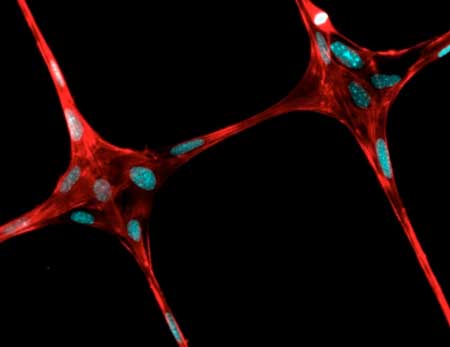
| This figure displays the cells grown on polymeric fibers created by 3-D near field electrospinning. (Image: Justin Brown / Penn State) | |
| The researchers’ report in a recent issue of the Journal of Advanced Healthcare Materials(„Electrospinning: 3D Near-Field Electrospinning of Biomaterial Microfibers with Potential for Blended Microfiber-Cell-Loaded Gel Composite Structures”) that their aim is to create a novel, low-cost and efficient method to fabricate high-resolution and repeatable 3-D polymer fiber patterns on nonconductive materials for tissue engineering with available hobbyist-grade 3-D printers. The method they use is a combination of 3-D printing and electrospinning, a method that uses electric charge to spin nanometer threads from either a polymer melt or solution. | |
| Currently nearly all complex transplant tissues, from hearts and kidneys to tendons, come from living or dead donors. The researchers are looking for a way to grow replacement tissues reliably using inexpensive methods. The combination of 3-D printing and electrospinning to produce a scaffold for tissue engineering might also enable production of combined muscles and tendons, or tendons and cartilage, for example. | |
| „The overarching idea is that if we could multiplex electrospinning with a collagen gel and bioprinting, we could build large and complex tissue interfaces, such as bone to cartilage,” said Pouria Fattahi, doctoral student in bioengineering. „Others have created these combination tissues using a microextrusion bioprinter.” | |
| These current strategies create the different tissues separately and then combine them using some type of adhesive or connector. However, in the body, tissues such as cartilage and bone, and tendons and muscles, grow seamlessly together. | |
| The researchers’ apparatus uses the electrospinner to replace the extruder nozzle on the 3-D printer. The printer can deposit a precise pattern of fibers in three dimensions to form a scaffold in a hydrogel on which cells can grow. Once the tissue has grown sufficiently, the scaffolding can be dissolved, leaving only a structured tissue appropriate for use. | |
| If two different tissues — muscle and tendon — are needed, the 3-D printer can alter the pattern of threads in such a way that the transition could be seamless with the appropriate cells, resulting in a naturally formed, two-part tissue replacement. | |
| Currently, the researchers are working on tissues that are a little less than 1 inch cubes, but even that might have some utility. | |
| „The anterior cruciate ligament, or ACL, is only about 2 to 3 centimeters (.8 to 1 inch) long and 1 centimeter (.8 inches) wide,” said Fattahi. | |
| Using near-field electrospinning, the researchers first produced exceptionally thin threads in the micron and nanometer range. They next showed that they could grow cells on these fibers and finally, deposited patterned fibers into a collagen gel loaded with cells. |
| Source: By A’ndrea Elyse Messer, Penn State Materials Research Institute | |
Țesături transparente vizibile și opace pentru infraroșu care poate fi purtată pentru gestionarea termică personală .Țesături transparente vizibile și opace cu infraroșu care asigură o răcire pasivă prin transmiterea radiațiilor termice emise de corpul uman direct în mediul înconjurător.Tehnicile personale de răcire controlează la nivel local temperatura unei persoane.
inginerii NASA au reinventat roata intr-o forma care ar putea cuceri o zi pe Marte;Construirea de vehicule și, mai special, a roților și a anvelopelor care vor face față provocării nu este o sarcină ușoară, așa că NASA a experimentat multe materiale diferite de-a lungul anilor
Prezentare generală a reconstrucției imaginii profunde. Valorile pixelilor imaginii de intrare sunt optimizate astfel încât caracteristicile DNN ale imaginii sunt similare cu cele decodificate din activitatea fMRI
După ce am acoperit CES timp de 10 ani, nimic pe care l-am văzut la show nu mă așteaptă ca viitorul ca tehnologia de încărcare fără fir a lui Ossia