Graphena albă face ceramică multifuncțională(White graphene makes ceramics multifunctional)

profesor asistent de inginerie civilă și de mediu, a sugerat că încorporarea foilor superioare de nitrurați de bor (hBN) între straturile de silicat de calciu ar face un cristal dublu interesant cu proprietăți multifuncționale. Acestea ar putea fi potrivite pentru construcții și materiale refractare și aplicații în industria nucleară, petrol și gaz, industria aerospațială și alte domenii care necesită compozite de înaltă performanță.Graphenul alb de culoare albă (stratul de mijloc), combinat cu silicat de calciu, creează un ceramică multifuncțională cu rezistență ridicată și duritate

Posted: Jan 11, 2018

White graphene makes ceramics multifunctional

(Nanowerk News) A little hBN in ceramics could give them outstanding properties, according to a Rice University scientist.

Rouzbeh Shahsavari, an assistant professor of civil and environmental engineering, suggested the incorporation of ultrathin hexagonal boron nitride (hBN) sheets between layers of calcium-silicates would make an interesting bilayer crystal with multifunctional properties. These could be suitable for construction and refractory materials and applications in the nuclear industry, oil and gas, aerospace and other areas that require high-performance composites.
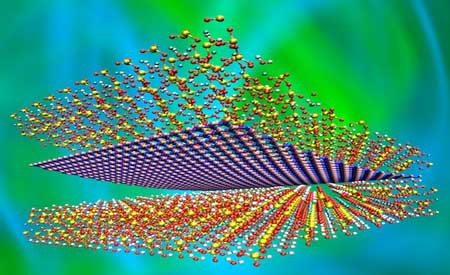
Bilayer white graphene (middle layer) combined with calcium-silicate creates a multifunctional ceramic
Bilayer white graphene (middle layer) combined with calcium-silicate creates a multifunctional ceramic with high strength and toughness, according to a Rice University lab. The material may be suitable for construction and refractory materials and applications in the nuclear industry, oil and gas, aerospace and other areas that require high-performance composites. (Image: Rouzbeh Shahsavari)
Combining the materials would make a ceramic that’s not only tough and durable but resistant to heat and radiation. By Shahsavari’s calculations, calcium-silicates with inserted layers of two-dimensional hBN could be hardened enough to serve as shielding in nuclear applications like power plants.
The research appears in the American Chemical Society journal ACS Applied Materials and Interfaces („Intercalated Hexagonal Boron Nitride/Silicates as Bi-layer Multifunctional Ceramics”).
Two-dimensional hBN is nicknamed white graphene and looks like graphene from above, with linked hexagons forming an ultrathin plane. But hBN differs from graphene as it consists of alternating boron and nitrogen, rather than carbon, atoms.
“This work shows the possibility of material reinforcement at the smallest possible dimension, the basal plane of ceramics,” Shahsavari said. “This results in a bilayer crystal where hBN is an integral part of the system as opposed to conventional reinforcing fillers that are loosely connected to the host material.
“Our high-level study shows energetic stability and significant property enhancement owing to the covalent bonding, charge transfer and orbital mixing between hBN and calcium silicates,” he said.
The form of ceramic the lab studied, known as tobermorite, tends to self-assemble in layers of calcium and oxygen held together by silicate chains as it dries into hardened cement. Shahsavari’s molecular-scale study showed that hBN mixes well with tobermorite, slips into the spaces between the layers as the boron and oxygen atoms bind and buckles the flat hBN sheets.
This accordion-like buckling is due to the chemical affinity and charge transfer between the boron atoms and tobermorite that stabilizes the composite and gives it high strength and toughness, properties that usually trade off against each other in engineered materials, Shahsavari said. The explanation appears to be a two-phase mechanism that takes place when the hBN layers are subjected to strain or stress.
Shahsavari’s models of horizontally stacked tobermorite and tobermorite-hBN showed the composite was three times stronger and about 25 percent stiffer than the plain material. Computational analysis showed why: While the silicate chains in tobermorite failed when forced to rotate along their axes, the hBN sheets relieved the stress by first unbuckling and then stiffening.
When compressed, plain tobermorite displayed a low yield strength (or elastic modulus) of about 10 gigapascals (GPa) with a yield strain (the point at which a material deforms) of 7 percent. The composite displayed yield strength of 25 GPa and strain up to 20 percent.
“A major drawback of ceramics is that they are brittle and shatter upon high stress or strain,” Shahsavari said. “Our strategy overcomes this limitation, providing enhanced ductility and toughness while improving strength properties.
“As a bonus, the thermal and radiation tolerance of the system also increases, rendering multifunctional properties,” he said. “These features are all important to prevent deterioration of ceramics and increase their lifetime, thereby saving energy and maintenance costs.”
When the material was tested from other angles, differences between the pure tobermorite and the composite were less pronounced, but on average, hBN improved significantly the material’s properties.
“Compared with one-dimensional fillers such as conventional fibers or carbon nanotubes, 2-D materials like hBN are two-sided, so they have twice the surface area per unit mass,” Shahsavari said. “This is perfect for reinforcement and adhesion to the surrounding matrix.”
He said other 2-D materials like molybdenum disulfide, niobium diselenide and layered double hydroxide may also be suitable for the bottom-up design of high-performance ceramics and other multifunctional composite materials.
Source: By Mike Williams, Rice University

Cercetătorii realizează un senzor ultra-sensibil de temperatură(Researchers engineer ultra-sensitive temperature sensor)

Poate un „termometru” să fie format dintr-o peliculă subțire sau mic (particule micrometrice sau nanometrice), să funcționeze în timp real și într-o regiune foarte bine definită, cu o rezoluție spațială variind de la un centimetru până la un micrometru capabil să măsoare temperaturi cu sensibilitate excepțională într-o bandă largă între 80 kelvin (minus 193 ° C) și 750 kelvin (476 ° C)? Raspunsul este da.Ca o peliculă subțire, materialul poate fi la fel de mic ca centimetri pătrați sau poate ajunge la câțiva metri pătrați pentru a fi utilizat ca strat de acoperire pe componentele vehiculelor terestre, al aeronavelor sau al transformatoarelor de rețea. Ca particule micrometrice sau nanometrice, acestea pot fi dispersate într-un mediu lichid, în timp ce rămân solide.

Posted: Jan 11, 2018

Researchers engineer ultra-sensitive temperature sensor

(Nanowerk News) Can a „thermometer” consist of a thin film or tiny (micrometer or even nanometer scale) particles, operate in real time and in very well-defined regions with a spatial resolution ranging from a centimeter to a micrometer, and be capable of measuring temperatures with exceptional sensitivity in a wide band between 80 kelvin (minus 193°C) and 750 kelvin (476°C)? The answer is yes.

The device, created in the laboratory by researchers at the University of São Paulo (USP) and the University of Campinas (UNICAMP) in São Paulo State, Brazil, is described in an article in Scientific Reports („A suitable (wide-range + linear) temperature sensor based on Tm3+ ions”). Basically, it is a temperature sensor with practically no effect at all on the temperature of the object.
ultra-sensitive temperature sensor
Material developed in Brazil measures temperatures in the range of 80-750 kelvin and could be used in manufacturing and biological processes. (click on image to enlarge)
„Because the device is optical, information on the temperature of the object of interest can be obtained without direct physical contact between them,” Zanatta said. „It suffices to project a laser beam onto the sensor and observe how it responds. By measuring the wavelength of the light emitted by the sensor using a detector, the temperature of the object can be determined with great precision,” said Antonio Ricardo Zanatta, an investigator at the USP’s São Carlos Physics Institute and one of project’s researchers.
When excited by a laser pulse, the sensor – which consists of a system made of titanium dioxide (TiO2) doped with thulium ions (Tm3+) – emits light at wavelengths that vary depending on the temperature of the environment. A very precise measurement of the wavelength is used to determine this temperature.
The wavelength varies approximately 2 picometers (2×10-12 m) per degree of temperature. Spectroscopy can be used to detect this tiny wavelength variation.
„Variation in the wavelength of the emitted light is absolutely linear between 80 and 750 kelvin, and the device remains integral and stable throughout this temperature range,” Zanatta said.
Besides from Zanatta, the project also had contributions from UNICAMP’s Gleb Wataghin Physics Institute investigators Fernando Alvarez and Diego Scoca. The research is supported by the Sao Paulo Research Foundation – FAPESP through the Thematic Project „Research and development of nanostructured materials for electronic and surface physics applications”, with Alvarez as principal investigator.
A patent application form commercial production has been filed with support from UNICAMP’s incubator, the Inova UNICAMP.

Technologic application

Applications of the sensor range from the identification of hotspots in electronic equipment to the detection of viral or bacterial infection in specific regions of an organism. „Because it’s capable of measuring a very broad spectrum of temperatures, it can be used in manufacturing – where temperatures sometimes reach very high levels – as well as biological processes, which are highly sensitive to the slightest temperature variations,” said Alvarez.
„At this stage,” Zanatta points, „we’ve arranged the material in the form of a thin film. Theoretically, this can be used as a coating for any surface, be it flat or curved, smooth or rough.” He says that the material can also be presented as microparticles or nanoparticles.
Although this technological development does not yet exist, in principle, it would be possible to encapsulate the laser emitter, temperature sensor and wavelength detector with a radio communicator inside a small pill.
Swallowed with a little water, the pill would send back temperature data while moving along the digestive tract until its ejection from the organism at the opposite extremity: a futuristic scenario, but not too distant from the science available now.
„A very simple application, which could rapidly be made feasible, would entail coating a plastic substrate with the sensor and fixing it to a patient’s skin. It’s important to note that titanium dioxide is abundant, easy to obtain, and biocompatible, i.e., non-toxic. It’s already used in many medical prosthetic devices,” Alvarez said.
As a thin film, the material can be as small as a few square centimeters or reach several square meters for use as a surface coating on components of land vehicles, aircraft or power grid transformers. As micrometric or nanometric particles, it can be dispersed in a liquid medium while remaining solid.

Challenges and the next steps

The need for a dedicated detector is a limiting factor at the present stage, in terms of both the cost and portability of the device.
„The associated instrumentation is costly today, given the need for a laser and a detector,” Zanatta said. „We believe, however, that as technology advances, it will be possible to fabricate an integrated device with a semiconductor laser, temperature sensor and detector. And the cost can be considerably reduced when we go from laboratory to industrial scale.”
Source: By José Tadeu Arantes, Fundação de Amparo à Pesquisa do Estado de São Paulo

O stare cuantică rară realizată într-un material nou(A rare quantum state realized in a new material)

O stare cuantică exotică numită Dirac semimetal a fost realizat într – un roman Sr material magnetic 1-y Mn 1-z Sb 2 ( Nature Materials , „A magnetic topologic semimetal Sr 1-y Mn 1 z Sb 2 (y , z <0,1) " ). Acest material prezintă o combinație neobișnuită de două comportamente electronice distincte. Un comportament este persistența unei stări asemănătoare cu un magnet de bar cu rotiri care sunt paralele între ele. Celălalt se referă la electroni cu o masă efectivă aproape de zero care se deplasează aproape de viteza luminii.

Posted: Jan 10, 2018

A rare quantum state realized in a new material

(Nanowerk News) An exotic quantum state called a Dirac semimetal was realized in a novel magnetic material Sr1-yMn1-zSb2 (Nature Materials, „A magnetic topological semimetal Sr1-yMn1-zSb2 (y, z < 0.1)”). This material features an unusual combination of two distinct electronic behaviors.

One behavior is the persistence of a state similar to a bar magnet with spins that are parallel to each other. The other relates to electrons with an effective mass near zero that travel close to the speed of light.
The artwork depicts the magnetic and electronic states of a magnetic topological semimetal
The artwork depicts the magnetic and electronic states of the newly discovered magnetic topological semimetal (Sr1-yMn1-zSb2); its unusual and robust electronic behavior enables the flow of electrical current with little resistance. The violet spheres are strontium (Sr), blue is antimony (Sb), and purple is manganese (Mn). Arrows represent the alignment of magnetic moments. The two gold cones touching at a point (called Dirac point) represent the energy and momentum states of conducting electrons. (Image: Oak Ridge National Laboratory)
The Dirac semimetal belongs to a class of materials called topological semimetals. These materials offer great promise. They could be the basis for ultra-powerful computers. Essentially, the semimetal could create a new paradigm for highly efficient and robust computational platforms. Semimetals could let such computers and other quantum devices work in warmer settings, climbing further from absolute zero.
A 3-D analog of graphene (a 2-D material) is a Dirac semimetal. Dirac semimetals have exceedingly high charge carrier mobility, creating little to no resistance to current flow, and large magnetoresistance that could be used for high-density, low-power data storage.
A team led by Tulane University, Louisiana Consortium for Neutron Scattering at Louisiana State University, and others discovered a new magnetic semimetal Sr1-yMn1-zSb2 (y, z<0.1) with nearly massless quantum particles (electrons in this case) that follow the rules of relativistic quantum mechanics.
Neutron scattering experiments revealed an unusual combination of ferromagnetic and antiferromagnetic states in the material that vary as a function of temperature. In general, materials exhibit either ferromagnetism or antiferromagnetism, not both in the same material at a given condition.
The observed persistence of a ferromagnetic component in the antiferromagnetic state at low temperatures is the signature for the breaking of the time-reversal symmetry (that is, running backward does not return to its starting conditions).
The combination of unusual electronic behaviors in this new material offers a rare opportunity to investigate the interplay between relativistic quantum states and spontaneous breaking of symmetry associated with time. These materials offer great promise for highly efficient quantum devices and quantum computers.
Source: U.S. Department of Energy, Office of Science

Senzor de gaz controlat atomic(Atomically controlled gas sensing)

Baza pentru detectarea gazului precum și alte aplicații ale oxidului de staniu este reducebilitatea oxidului, care îi permite să elibereze ușor și reversibil oxigenul în prezența reactanților cum ar fi monoxidul de carbon sau hidrocarburile și pentru a facilita adsorbția moleculelor cum ar fi oxigenul . Modificările în conductivitatea electrică a acestui semiconductor care rezultă din aceste procese de suprafață reprezintă baza caracteristicilor de detectare a gazului. Din acest motiv, a fost mult timp un obiectiv al cercetării fundamentale pentru a caracteriza proprietățile structurale, fizice și chimice ale suprafețelor de oxid de staniu.

Posted: Jan 10, 2018

Atomically controlled gas sensing

(Nanowerk News) An international team of scientists, including those from the LCN at UCL, have solved the stucture of a gas sensing surface of tin dioxide, opening the way to advanced device design (Physical Review Letters, „Structure of the SnO2(110)-(4×1) Surface”).

The basis for the gas sensing as well other applications of tin oxide is the reducibility of the oxide, which allows it to readily and reversibly release oxygen in the presence of reactants such as carbon monoxide or hydrocarbons, and to facilitate adsorption of molecules such as oxygen. The changes in electrical conductivity of this semiconductor resulting from these surface processes are the basis for the material’s gas-sensing characteristics. Because of this, it has long been a goal of fundamental research to characterise the structural, physical, and chemical properties of tin oxide surfaces.
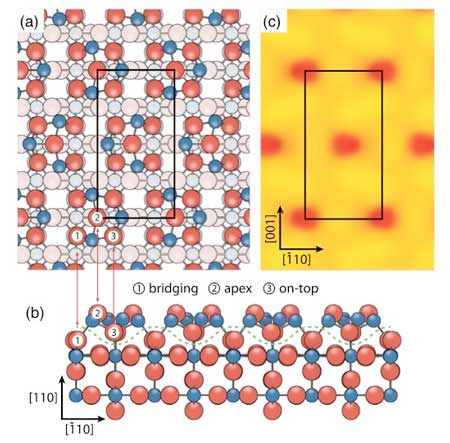
The structure of the tin dioxide surface determined in this work along with a simulation of the scanning tunnelling microscope image
The structure of the tin dioxide surface determined in this work along with a simulation of the scanning tunnelling microscope image. (Image: London Centre for Nanotechnology)
The (110) plane of tin oxide, the mineral cassiterite, is the most stable under ambient conditions and therefore will be the most abundant termination of the gas sensor. This is the surface that the team investigated with a number of experimental and theoretical techniques, including those available at the Diamond Light Source at Harwell Laboratory.
The lead author of the work, Lindsay Merte, comments “the tin oxide (4 × 1) termination is one of a handful of gas sensor related surfaces to have its quantitative structure determined. It can now serve as a useful model for fundamental studies of tin oxide surface chemistry and a basis for further studies that should help resolve the complex behavior of the surface under different conditions”
Considering the importance of tin oxide surface electrical conductivity in gas-sensing applications, it is a natural question whether upon formation of the (4 × 1) termination the surface becomes metallic. To address this, we have evaluated the electronic properties of the upper layers in our structure. This shows that the surface remains semiconducting, which is a necessary requirement for gas sensing.
Source: London Centre for Nanotechnology

Graphene spumă poate acționa ca un dispozitiv eficient de captură și conversie termică solare(Graphene foam can act as efficient solar thermal capture and conversion device)

După cum sa raportat în ACS Nano ( „Convertor de energie solară autonomă bazat pe grafenie pentru purificarea și purificarea apei” ), materialul de 3D-grafit (3DG) încrucișat cu polimeri 3D poate fi utilizat direct într-un mod ușor și scalabil ca o apă curată generator cu eficiență ridicată în lumina soarelui normală și chiar mai slabă (până la 0.25 soare).
Noul material 3DG are o rată specifică de producție a apei extrem de ridicată de 2,6 kg h -1 m -2 g -1 și 87% eficiență energetică sub 1 radiație solară a soareluiMai mult, diferit de alte materiale de desalinizare, acest nou material ușor și elastic este, de asemenea, foarte portabil pentru punctul de utilizare și ar fi ideal atât pentru aplicații personale, cât și industriale.
„Acest material de carbon usor de folosit ar putea oferi multe posibilitati pentru recoltarea energiei solare cu un randament ridicat”, concluzioneaza autorii.

Posted: Jan 10, 2018

Graphene foam can act as efficient solar thermal capture and conversion device

(Nanowerk News) Researchers have demonstrated that a simple sheet of standalone graphene foam can act as efficient solar thermal capture and conversion device.

As reported in ACS Nano („Graphene-Based Standalone Solar Energy Converter for Water Desalination and Purification”), the 3D cross-linked polymer-like graphene material (3DG) material can be used directly in an easy and scalable manner as a clean water generator with high efficiency under normal and even weaker sunlight (down to 0.25 sun).
The new 3DG material has an extremely high specific water production rate of 2.6 kg h-1 m-2 g-1and 87% energy efficiency under 1 sun solar radiation.
Solar thermal performance of the 3D graphene material
Solar thermal performance of the 3D graphene material. (a) Absorption spectrum of 3DG. It shows a blackbody-like property with ~97% absorption across 200-2500 nm. Left part of the inset is the SEM image showing its porous morphology. Such morphology benefits from efficient light absorption through the multiscattering effect and water transportation through the interconnected pores. Right part of the inset is the contact angle showing it is superhydrophilic. (b) Left is the evaporation mass of water with/without 3DG under 1 kW m-2 solar irradiation and the case without light; the middle is the schematic illustration of 3DG for the vapor generation and the temperature distribution (cross section); the right part is the IR image of vertical and side view under 1 kW m-2. The sample is smaller than the water/air interface to show that such a material can effectively prevent the heat conduction surrounding water. (c) Specific water production rate (water production rate/weight of 3DG) compared with some highest performing bulk converters reported in literature. (d) Solar thermal efficiency of the evaporation process by the 3DG under a range of optical concentrations. Error bars represent standard deviation for the same repeated measurements. (e) Performance of the 3DG with different water quantities under 10 kW m-2. The device was in the same diameter but different heights of water at 32 mm (red), 22 mm (green), and 12 mm (blue). (f) Reusability of 3DG under 1 and 10 kW m-2 solar irradiation for 20 cycles with a NaCl solution, mimicking the seawater. Each cycle was tested for 2 h. (© American Chemical Society) (click on image to enlarge)
The researchers point out that the high efficiency is achieved due to the combination of multiple properties simultaneously exhibited by this as-prepared bulk 3D crosslinked honeycomb graphene material, including its intrinsic blackbody-like high absorption, extremely low thermal loss to environment, hydrophilicity, and automatic water transportation to the absorber by capillary force through the microchannels present in the structure.
With these results, an efficient and scalable desalination (4 orders of salinity decrement) and sewage treatment device was demonstrated. A model for this converter has been used to understand the high efficiency and mechanism.
Furthermore, different from other desalination materials, this novel lightweight and elastic material is also highly portable for point of use and would be ideal for both personal and industrial application.
„This easy-to-use carbon material could provide many possibilities for high efficient solar energy harvesting,” the authors conclude.
By Michael is author of two books by the Royal Society of Chemistry: Nano-Society: Pushing the Boundaries of Technology and Nanotechnology: The Future is Tiny.

Armata chineză se pregătește să câștige al treilea război mondial (WWIII) cu tehnologii „emergente și exponențiale”: Cyberwarfare, război electronic, arme hipersonice, inteligență artificială (AI), computere cuantice, avioane stealth, UAS / UAV / Arme, Roboți / Roboți și alte „noi tehnologii”

PLA a testat o gamă largă de arme anti-satelit, inclusiv vehicule convenționale de ucidere kinetică, arme energetice direcționate, capabilități de blocare și de spargere și „sateliți ucigași” concepuți pentru a dezactiva sau distruge alți sateliți pe orbită.

Ei și-au extins capacitățile de război electronic, testează capacitățile lor de a bloca radar și comunicațiile și sistemele de spoof GPS. China a dezvoltat, de asemenea, unele dintre cele mai sofisticate capabilități cibernetice ofensive din lume.

Chinese Military Preparing to Win World War III (WWIII) with ‘Emerging and Exponential’ Technologies: Cyberwarfare, Electronic Warfare, Hypersonic Weapons, Artificial Intelligence (AI), Quantum Computing, Stealth Aircraft, UAS/UAV/Drone Aircraft Tech, Anti-Satellite Weapons, Robots/Robotics, and other ‘New Technologies’…It’s All on the Table!

DefenseReview (DR) has been following Chinese and Russian military technology capabilities and advancements for quite some time now, so we weren’t surprised to read about the Chinese PLA’s (People’s Liberation Army) drive to dominate the United States of America militarily and to win World War III (WWIII), should it happen, and their pursuit of every single advanced military warfare technology to do it. According to Breitbart News, Center for Strategic and International Studies (CSIS) is really sounding the alarm on this one. “China sees offensive cyber capabilities, anti-satellite weapons, electronic warfare tools, hypersonic weapons, artificial intelligence [AI], and quantum [computing] technologies as key to enabling the PLA [People’s Liberation Army] to win wars in future, high-tech conditions and offset the advantages of the U.S. military, and has made significant strides in all of these areas,” says CSIS deputy director William Carter. He also warned that “We may have more and better aircraft carriers, tanks, and missiles than the PLA, but without access to data and connectivity many of these systems are ineffective or even inoperable,” and that China considers US military satellites to be our “Achilles heel”.

You can read all about it in CSIS’ Statement Before the House Armed Services Committee Subcommittee on Emerging Threats and Capabilities “Chinese Advances in Emerging Technologies and their Implications for U.S. National Security”, or watch the video of the hearing for which it was prepared. The Congressional hearing video is titled China’s Pursuit of Emerging and Exponential Technologies.
To sum it all up, Carter says that the Chinese have “developed a national strategic plan—in fact, many of them—to overtake us in the race to dominate these new technologies, and are rapidly closing the gap in innovation, deployment, and militarization of these new systems with the U.S.” Carter identifies the “new technologies” referenced in the title of this article as ““artificial intelligence and robotics, miniaturization and ubiquitous connectivity, and quantum computing.” Carter warns, “We may have more and better aircraft carriers, tanks, and missiles than the PLA, but without access to data and connectivity many of these systems are ineffective or even inoperable.”

Regarding the Chinese military anti-satellite wafare technology threat, Carter had this to say:

The PLA has tested a range of anti-satellite weapons, including conventional ground-based kinetic kill vehicles, directed energy weapons, jamming and spoofing capabilities, and “kill-satellites” designed to disable or destroy other satellites on orbit.

They have expanded their electronic warfare capabilities, testing their capabilities to jam radar and communications and spoof GPS systems. China has also developed some of the most sophisticated offensive cyber capabilities in the world.
Perhaps most concerning to DR is China’s combined AI (artificial intelligence) and quantum computingpush, since those two capabilities/technologies are potentially reall game changers/paradigm shifters. “In particular, China sees artificial intelligence (AI) and quantum as foundational to both economic and military competitiveness in the long term, and has become not just a copycat or adopter of these technologies, but an innovator in its own right,” says Carter. Carter also discussed China’s combined military and civilian economic power-enhancing approach. Carter says that “China’s strategy is not just to exploit the weaknesses in our military technology but to develop their own innovative, dynamic high technology sector to dominate the next generation of civilian and military technologies, particularly AI,” and adds that “They seek to leverage both commercial and military innovation in ways that complement each other and build both military and economic power.”

DR finds the idea of China’s potential surpassing of US military quantum-computing focus and advancement to be particularly alarming, since quantum computing and AI can be used to enhance the capabilities of EVERY other military technology and system. It’s absolutely crucial that the US military stay ahead of the Chinese and Russian militaries’ on these combined technological fronts, if we want to be able to effectively and successfully fight either country individually, or a combined Sino-Russian military force in a WWIII-level scenario, or in smaller, limited conflicts.

As Defense Review’s written before, our focus should be on being able to defeat a combined Sino-Russian military threat, not just being able to defeat them individually. We must ASSUME and EXPECT that they’ll team up against us in a future nation-state war, and act and prepare accordingly, militarily and economically. This is our opinion, and we think we’re right about this.

Of course, as we’ve also written, we have to do this without creating a Skynet-type AI robotic Armageddon scenario, a la Terminator. It’s gonna’ be a tough balance.

Armata chineză se pregătește să câștige al treilea război mondial cu tehnologii „emergente și exponențiale”: Cyberwarfare, război electronic, arme hipersonice, inteligență artificială (AI), computere cuantice, avioane stealth, UAS / UAV / / Robotica și alte „noi tehnologii” … E totul pe masă!(Chinese Military Preparing to Win World War III with ‘Emerging and Exponential’ Technologies:Cyberwarfare, Electronic Warfare, Hypersonic Weapons, Artificial Intelligence(AI), Quantum Computing, Stealth Aircraft, UAS/UAV/Drone Aircraft Tech, Anti-Satellite Weapons, Robots/Robotics, and other’ New Technologies’… It’s All on the Table)

DR a urmărit capacitățile și progresele tehnologiei militare chineze și rusești de ceva timp acum, așa că nu am fost surprinși să citim despre modul în care Chinezii PLA au încercat să domine armata americană și să câștige al treilea război mondial,

Chinese MilitaryChinese 1

Echipamente periculoase in interiorul scolilor FBI-urilor( Inside the FBI’s Hazardous Devices School)

În cazul în care tehnicile națiunii de bombe invata instrumentele comerțului;Amenințarea cu bombă la un mall din Alabama a fost întâmpinată de tehnicieni robusti de rachetă din țara înarmată cu echipament de raze X, tehnologie de robot și cea mai recentă informație despre dispozitivele explozive impresionate

Inside