Materialul nostru super-adsorbant are proprietăți unice”, explică Alezi. Două realizări descoperite cu noul MOF (Cr-soc-MOF-1) sunt stabilitatea sa în apă, spre deosebire de multe MOF foarte poroase și porii interni de capacitate mare care pot adsorbi de două ori greutatea MOF ca apă ( vezi imaginea). O altă trăsătură vitală este reversibilitatea ușoară a absorbției apei. Apa adsorbită atunci când nivelurile de umiditate sunt ridicate pot fi eliberate imediat când umiditatea scade. Acest lucru oferă un material ideal pentru controlul umidității în spații restrânse.Acest material nou este un singur produs al angajamentului pe termen lung al lui Eddaoudi de a explora capacitățile MF. „Din cele mai bune cunoștințe, noul nostru MOF de absorbție a apei depășește toate MOF existente în ceea ce privește capacitatea, reversibilitatea și performanța ciclică”, spune Eddaoudi.
Posted: Feb 05, 2018
Super-adsorbent MOF to control humidity
(Nanowerk News) Humidity control is a vital aspect of air conditioning, but high energy requirements make conventional methods expensive and environmentally damaging. Researchers at KAUST have developed a metal-organic framework (MOF) that, within its range of applications, could control humidity in an eco-friendly and cost-effective way (Chem, „Reticular chemistry in action: A hydrolytically stable MOF capturing twice its weight in adsorbed water”).
The crystal structure of the super-adsorbent Cr-soc-MOF-1, hosting twice its weight as adsorbed water within its extensive network of micropores. The framework is represented in green, red and grey, and water molecules are represented with blue spheres. (Image: Mohamed Eddaoudi)
MOFs encompass metal centers or clusters held in a porous framework by organic linker groups. The key to designing a MOF with specific properties is the ability to control the size and chemical structure of the pores by varying the metal and organic parts within each framework.
Dalal Alezi works in Mohamed Eddaoudi’s research group at KAUST where a wide range of MOFs are being developed for gas separation, purification and chemical catalysis. This work is part of her doctoral research.
„Our super-adsorbent material has unique properties,” explains Alezi. Two breakthrough achievements with the new water-adsorbing MOF (Cr-soc-MOF-1) are its stability in water, unlike many highly porous MOFs, and its high-capacity internal pores that can adsorb twice the weight of the MOF as water (see image). Another vital feature is the easy reversibility of the water uptake. The water adsorbed when humidity levels are high can readily be released when the humidity falls. This yields an ideal material for controlling humidity in restricted spaces.
„Regulating escalating humidity levels, especially indoors and in confined environments, such as aircraft cabins and air-conditioned buildings, is a critical challenge,” says Youssef Belmabkhout, a senior research scientist in Eddaoudi’s group. He adds: „The conventional systems consume large amounts of energy, require intricate design and excessive cost.”
This new material is just one product of Eddaoudi’s long-term commitment to exploring the capabilities of MOFs. „To the best of our knowledge our new water-adsorbing MOF outperforms all existing MOFs in terms of capacity, reversibility and cyclic performance,” says Eddaoudi. The easy reversibility will be crucial for commercial applications. The team have already maintained the exceptional water uptake and release through more than 100 adsorption-desorption cycles.
Eddaoudi also emphasizes that water-adsorbing MOFs are ready to provide effective solutions to challenges other than regulating humidity, such as tackling water scarcity and environmental sustainability in energy-efficient ways. Possibilities include harvesting drinkable water from air and use in water desalination and purification.
The researchers are now working to scale up their water-adsorbing materials in order to demonstrate commercial potential and move into real-world applications.
Source: King Abdullah University of Science and Technology
au descoperit o modalitate eficienta de a face panouri solare combinate si dispozitive de emisie de lumina. Mai degrabă decât folosind blocuri de materiale pervoskit hibride, au stratificat mai multe foi subțiri unul peste altul ( Stiinta , „extrem de eficient de disociere a excitonilor interne prin stări de margine în perovskiti 2D stratificate“ și Știință , „Pornesc perovskit Photoresponse“ ).
În acest nou model stratificat, au descoperit importante „stări de margine a stratului”. În aceste stări, energia este foarte conservată. Când este excitat de lumină sau de alte surse, materialul produce energie care nu se disipează instantaneu și poate fi utilizată pentru a încărca bateriile sau pentru a face alte lucrări. Aceasta înseamnă că creează un transportator de lungă durată, gratuit, care poate fi recoltat și manipulat.Hibridele perovskite reprezintă o nouă clasă de materiale cu costuri reduse care pot capta și emite lumină. Acest material poate fi sintetizat în mai multe forme: structuri 3-D în vrac, foi de cristal 2-D și tije 1-D. În particular, compușii stratificați pot fi creați prin stivuirea foilor de cristal 2-D cu straturi organice subțiri între ele.
În comparație cu variantele 3-D în vrac, aceste foi de perovskite sunt stabile intrinsec și reglabile pe scară largă. Prin urmare, aceste foi subțiri pot avea aplicații largi într-o varietate de tehnologii.
In this new layered pattern, they discovered important “layer-edge states.” In these states, energy is highly conserved. When excited by light or other sources, the material produces energy that doesn’t instantly dissipate and can be used to charge batteries or do other work. That is, it creates long-lived, free charge carriers that can be harvested and manipulated.
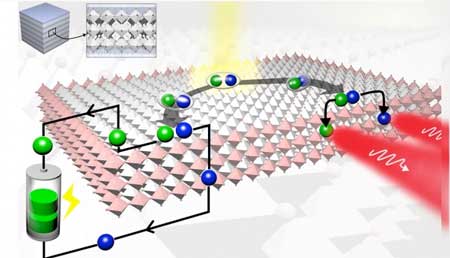
An artistic rendering shows the dissociation of electron-hole pairs (excitons) to free carriers at crystal edges resulting in efficient solar energy (>12 percent) and light emission (>30 percent). Dissociated carriers captured and located at the edges have lower energy and last longer. (Image: Jean-Christophe Blancon, Los Alamos National Laboratory)
Compared to blocks of material, layered sheets of perovskites offer a host of benefits. The sheets are more chemically stable, more environmentally friendly, and more tunable to fit the needs of new applications or experiments. Discovery of edge states opens new avenues for designing and fabricating efficient electronic devices which collect and emit light. These devices include low-cost solar cells, LEDs, laser diodes, and detectors.
Hybrid perovskites are a new class of low-cost materials that can capture and emit light. This material can be synthesized in several forms: bulk 3-D structures, 2-D crystal sheets, and 1-D rods. In particular, layered compounds can be created by stacking 2-D crystal sheets with thin organic layers in between.
Compared to bulk 3-D variations, these sheets of perovskites are intrinsically stable and widely tunable. Therefore, these thin sheets may have broad applications in a variety of technologies.
In this study, scientists from CINT as well as international collaborators describe a strategy to layer sheets of 2-D perovskites to drastically enhance the material’s optoelectronic properties. They found that in materials with three or more layers, charged particles (electrons and holes) become trapped at low-energy states near the edge of the crystal layers.
These carriers exhibit a 5-fold increase in their lifetime and do not lose energy to heat, resulting in tremendous improvements in efficiency for light-capturing devices.
On the flip side, devices that emit light are also tremendously more effective because trapped carriers can recombine very efficiently.
These results address a long-standing problem not just for the perovskite family but also for a large group of materials. Often, the edges and surface states of materials can degrade the optoelectronic properties.
Now, the structure of these materials can be chemically designed and engineered to achieve efficient flow of charge and energy leading to high-efficiency optoelectronic devices.
Source: U.S. Department of Energy, Office of Science
O caracteristică cheie a acestui compus este că se comportă ca un izolator la temperatura camerei, dar ca un conductor la temperaturi de peste 68 ° C. Acest comportament, cunoscut și sub numele de tranziția izolatoarelor metalice, este studiat într-un proiect ambițios al UE Orizont 2020 numit Switch Phase-Change. EPFL a fost aleasă pentru a coordona proiectul în urma unui proces de selecție provocator.
Posted: Feb 05, 2018
Vanadium dioxyde: A revolutionary material for tomorrow’s electronics
(Nanowerk News) First came the switch. Then the transistor. Now another innovation stands to revolutionize the way we control the flow of electrons through a circuit: vanadium dioxide (VO2). A key characteristic of this compound is that it behaves as an insulator at room temperature but as a conductor at temperatures above 68°C. This behavior – also known as metal-insulator transition – is being studied in an ambitious EU Horizon 2020 project called Phase-Change Switch. EPFL was chosen to coordinate the project following a challenging selection process.
This is a Vanadium Dioxide chip developed at EPFL’s NANOLAB. (Image: Jamani Caillet, EPFL)
The project will last until 2020 and has been granted €3.9 million of EU funding. Due to the array of high-potential applications that could come out of this new technology, the project has attracted two major companies – Thales of France and the Swiss branch of IBM Research – as well as other universities, including Max-Planck-Gesellschaft in Germany and Cambridge University in the UK. Gesellschaft für Angewandte Mikro- und Optoelektronik (AMO GmbH), a spin-off of Aachen University in Germany, is also taking part in the research.
Scientists have long known about the electronic properties of VO2 but haven’t been able to explain them until know. It turns out that its atomic structure changes as the temperature rises, transitioning from a crystalline structure at room temperature to a metallic one at temperatures above 68°C. And this transition happens in less than a nanosecond – a real advantage for electronics applications.
„VO2 is also sensitive to other factors that could cause it to change phases, such as by injecting electrical power, optically, or by applying a THz radiation pulse,” says Adrian Ionescu, the EPFL professor who heads the school’s Nanoelectronic Devices Laboratory (Nanolab) and also serves as the Phase-Change Switch project coordinator.
The challenge: reaching higher temperatures
However, unlocking the full potential of VO2 has always been tricky because its transition temperature of 68°C is too low for modern electronic devices, where circuits must be able to run flawlessly at 100°C.
But two EPFL researchers – Ionescu from the School of Engineering (STI) and Andreas Schüler from the School of Architecture, Civil and Environmental Engineering (ENAC) – may have found a solution to this problem, according to their joint research published in Applied Physics Letters in July 2017. They found that adding germanium to VO2 film can lift the material’s phase change temperature to over 100°C.
For the first time ever, scientists were able to make ultra-compact, modulable frequency filters. Their technology also uses VO2 and phase-change switches, and is particularly effective in the frequency range crucial for space communication systems (the Ka band, with programmable frequency modulation between 28.2 and 35 GHz).
Neuromorphic processors and autonomous vehicles
These promising discoveries are likely to spur further research into applications for VO2 in ultra-low-power electronic devices. In addition to space communications, other fields could include neuromorphic computing and high-frequency radars for self-driving cars.
Indiferent dacă lauda a venit de la compania în sine sau de la site-uri externe de raportare cu privire la aparatul de fotografiat, a fost greu de a evita superlative și interesul deosebit pentru această cameră nou-veni
Agenția de cercetare a redus valoarea minimă a comenzii înainte de termenul limită de propunere;Există o mulțime de oameni inteligenți la DARPA care lucrează la o mulțime de tehnologii interesante și avansate
Rezultatele lor sugerează o platformă versatilă atât pentru manipularea fluidelor, cât și pentru cele ușoare, atât la nivel micro, cât și la nivel macroscopic. Aplicațiile potențiale pot fi găsite în microfluidica digitală, dispozitive biomedicale, jaluzele virtuale, suprafețe de camuflaj și rețele de micromirror. cercetătorii săi au fost capabili să proiecteze, să caracterizeze și să analizeze o gamă largă de funcții, cum ar fi umectarea reglabilă, manipularea picăturilor, transmisia optică tunabilă și colorarea structurală, prin încorporarea unei game largi de scale – siliciu gol, și cântare fotonice de cristal – în configurații atât în plan, cât și în afara planului.
Posted: Feb 02, 2018
Researchers develop new surface design inspired by snake skin
(Nanowerk News) Assistant Professor Seok Kim and graduate students Zining Yang and Jun Kyu Park have developed a design construct inspired in part by the surface of butterflies and snakes, where flexible skins are fully covered by rigid, discrete scales.
Seok Kim Lab develops new surface design inspired by snake skin. (Image: University of Illinois Department of Mechanical Science and Engineering)
Their new surface design features rigid scales assembled into soft, ferromagnetic micropillars on a flexible substrate in a predesigned manner by transfer printing-based deterministic assembly. The nanostructured silicon scales on the magnetically responsive elastomer micropillar array enables fluid and light manipulation. The functional properties of the surface are dictated by the scales’ patterns, while the micropillar array is magnetically actuated with large-range, instantaneous, and reversible deformation.
Kim and his researchers were able to design, characterize, and analyze a wide range of functions, such as tunable wetting, droplet manipulation, tunable optical transmission, and structural coloration, by incorporating a wide range of scales–bare silicon, black silicon, and photonic crystal scales–in both in-plane and out-of-plane configurations.
Magnetically response materials like soft elastomers loaded with magnetic particles, are desirable for their real-time manipulation of fluid, light, solid particles, and living cells – thanks to their instantaneous structural tenability under a magnetic field. However, due to the fabrication process, most existing surfaces of this kind are limited in their functional ability.
Compared with common responsive surface with simple design (the magnetic micropillar array), the surface developed in our work not only has enhanced performance in directional liquid spreading and optical transmission tuning, but also enables novel functions such as droplet manipulation and dynamic structural coloration,” said Yang, PhD candidate and first author of the study.
Their results suggest a versatile platform for both fluid and light manipulations at both the micro and macroscale. Potential applications can be found in digital microfluidics, biomedical devices, virtual blinds, camouflage surfaces, and micromirror arrays. Further work could also result in more biomimetic functionalities such as robotic locomotion, swimming, self-cleaning, and solid object manipulation. Their design could also be integrated with active devices such as solar cells, light emitting diodes, and lasers as scales to form novel flexible optoelectronics.
Kim is a leading scientist in advanced transfer printing and transfer printing-based microassembly.
Source: University of Illinois College of Engineering
De-a lungul anilor înainte și după inventarea armelor nucleare și a cursei către semi-pace care vine cu distrugere asigurată reciproc, națiunile au creat tehnologii incredibile, toate în numele războiului.
Dezvoltarea rapidă a sistemelor electronice flexibile și portabile dă naștere unei game incitante de aplicații, de la ceasuri inteligente și ecrane flexibile – cum ar fi telefoane inteligente, tablete și televizoare – la țesături inteligente, sticlă inteligentă, plasturi transdermali, senzori , și altele
Posted: Feb 01, 2018
Engineers develop flexible lithium battery for wearable electronics
(Nanowerk News) The rapid development of flexible and wearable electronics is giving rise to an exciting range of applications, from smart watches and flexible displays—such as smart phones, tablets, and TV—to smart fabrics, smart glass, transdermal patches, sensors, and more. With this rise, demand has increased for high-performance flexible batteries. Up to now, however, researchers have had difficulty obtaining both good flexibility and high energy density concurrently in lithium-ion batteries.
A team led by Yuan Yang, assistant professor of materials science and engineering in the department of applied physics and mathematics at Columbia Engineering, has developed a prototype that addresses this challenge: a Li-ion battery shaped like the human spine that allows remarkable flexibility, high energy density, and stable voltage no matter how it is flexed or twisted. The study is published today in Advanced Materials („Bio-inspired, spine-like flexible rechargeable lithium-ion batteries with high energy density”).
Schematic of the structure and the fabrication process of Yang’s spine-like battery. (a) Schematic illustration of bio-inspired design, the vertebrae correspond to thick stacks of electrodes and soft marrow corresponds to unwound part that interconnects all the stacks. (b) The process to fabricate the spine-like battery, multilayers of electrodes were first cut into designed shape, then strips extending out were wound around the backbone to form spine-like structure. (Image: Yuan Yang/Columbia Engineering) (click on image to enlarge)
“The energy density of our prototype is one of the highest reported so far,” says Yang. “We’ve developed a simple and scalable approach to fabricate a flexible spine-like lithium ion battery that has excellent electrochemical and mechanical properties. Our design is a very promising candidate as the first-generation, flexible, commercial lithium-ion battery. We are now optimizing the design and improving its performance.”
Yang, whose group explores the composition and structure of battery materials to realize high performance, was inspired by the suppleness of the spine while doing sit-ups in the gym. The human spine is highly flexible and distortable as well as mechanically robust, as it contains soft marrow components that interconnect hard vertebra parts. Yang used the spine model to design a battery with a similar structure. His prototype has a thick, rigid segment that stores energy by winding the electrodes (“vertebrae”) around a thin, flexible part (“marrow”) that connects the vertebra-like stacks of electrodes together. His design provides excellent flexibility for the whole battery.
“As the volume of the rigid electrode part is significantly larger than the flexible interconnection, the energy density of such a flexible battery can be greater than 85 percent of a battery in standard commercial packaging,” Yang explains. “Because of the high proportion of the active materials in the whole structure, our spine-like battery shows very high energy density¾higher than any other reports we are aware of. The battery also successfully survived a harsh dynamic mechanical load test because of our rational bio-inspired design.”
Video demonstrating flexibility of Yang’s lithium-ion battery powering a smart watch, in flat, flexed, and twisted configurations.
Yang’s team cut the conventional anode/separator/cathode /separator stacks into long strips with multiple “branches” extending out 90 degrees from the “backbone.” Then they wrapped each branch around the backbone to form thick stacks for storing energy, like vertebrae in a spine. With this integrated design, the battery’s energy density is limited only by the longitudinal percentage of vertebra-like stacks compared to the whole length of the device, which can easily reach over 90 percent.
The battery shows stable capacity upon cycling, as well as a stable voltage profile no matter how it is flexed or twisted. After cycling, the team disassembled the battery to examine the morphology change of electrode materials. They found that the positive electrode was intact with no obvious cracking or peeling from the aluminum foil, confirming the mechanical stability of their design.
To further illustrate the flexibility of their design, the researchers continuously flexed or twisted the battery during discharge, finding that neither bending nor twisting interrupted the voltage curve. Even when the cell was continuously flexed and twisted during the whole discharge, the voltage profile remained. The battery in the flexed state was also cycled at higher current densities, and the capacity retention was quite high (84 percent at 3C, the charge in 1/3 of an hour). The battery also survived a continuous dynamic mechanical load test, rarely reported in earlier studies.
“Our spine-like design is much more mechanically robust than are conventional designs,” Yang says. “We anticipate that our bio-inspired, scalable method to fabricate flexible Li-ion batteries could greatly advance the commercialization of flexible devices.”
carburile metalice de tranziție, cunoscute sub numele de MXenes, ar putea fi folosite pentru recoltarea energiei de frecare pierdute, de exemplu, din contracțiile musculare în timpul tipăririi sau mersului pe jos.MXenes, descoperit în 2011, cuprinde una dintre cele mai mari familii de materiale bidimensionale. Acestea au o conductivitate electrică ridicată și capacitatea de absorbție a electronilor în contact cu polimerii și alte materiale. Această combinație neobișnuită de proprietăți face MXenes util ca componente pentru nanogeneratoarele triboelectrice (TENG), care transformă mișcările musculare în energie electrică. Studiul sugerează că aceste materiale avansate ar putea fi încorporate în telefoane mobile, dispozitive electronice portabile, dispozitive portabile și laptop-uri, ceea ce le va face în cele din urmă să se autodeclamă.
Posted: Feb 01, 2018
New MXene materials could capture wasted frictional energy from smartphones
(Nanowerk News) Imagine that every time you tapped out a message on your smartphone, it would create electric power instead of sapping your phone’s battery. That scenario could one day be a reality, according to a researcher at Missouri University of Science and Technology.
Writing in the February 2018 issue of the journal Nano Energy („Metallic MXenes: A New Family of Materials for Flexible Triboelectric Nanogenerators”), Dr. Vadym Mochalin, associate professor of chemistry at Missouri S&T, describes how a new family of two-dimensional transition metal carbides, known as MXenes, could be used to harvest wasted frictional energy, for example, from muscle contractions during typing or walking.
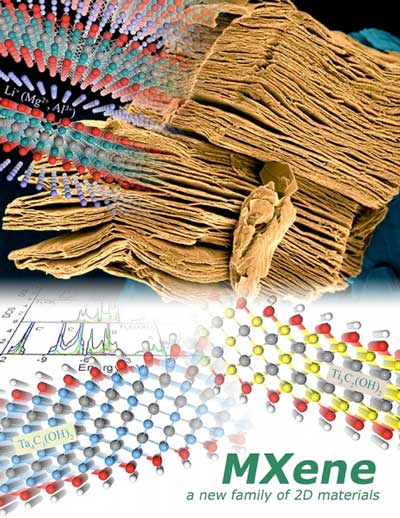
Artistic representation of scanning electron microphotograph of Ti3C2 MXene flake, superimposed with atomistic models of several MXenes and electronic density of states calculated using these models. (Image: Vadym Mochalin)
MXenes, discovered in 2011, comprise one of the largest families of two-dimensional materials. They possess high electrical conductivity and the ability to uptake electrons when in contact with polymers and other materials. This unusual combination of properties makes MXenes useful as components for triboelectric nanogenerators (TENG), which turn muscle movements into electric power. The research suggests these advanced materials could be incorporated into mobile phones, handheld electronics, wearable devices and laptops, ultimately making them self-powering.
“Exploring new chemistries and fundamental physical properties of MXenes for applications in energy storage, biology and medicine, electronics, composites, sensors and water purification is a hot area in the two-dimensional materials field,” says Mochalin.
The paper was written in collaboration with research groups from Drexel and Clemson universities.
Another study from Mochalin and his collaborators, “Saturable Absorption in 2D Ti3C2 MXene Thin Films for Passive Photonic Diodes,” was published in Advanced Materials („Saturable Absorption in 2D Ti3C2 MXene Thin Films for Passive Photonic Diodes”). This research shows how the non-linear optical properties of MXene – fullerene layered structures enable light rectification, a process similar to electrical current rectification which has been in use in electronics for decades. When compared to other two-dimensional materials, such as graphene, MXene is superior in its mechanical stability, conductivity and light radiation damage resistance, the researchers write.
A technique developed by Mochalin’s research group to deposit the nearly transparent and conductive MXene films on glass and other substrates may be used to fabricate passive saturable absorbers for generation of nanosecond pulses of high energy and peak power with solid-state bulk lasers. The high-energy ultrafast laser pulses are beneficial for processing materials where thermal influence must be minimized, for example, in drilling and cutting metals, delicate semiconductor wafers, polymeric stents, glasses, and other materials. These MXene films — only tens of nanometers in thickness — are also ideal for a wide range of applications in photonics, photovoltaics, flexible electronics, environment- and photo-sensitive sensors, and many others.
“MXenes are relatively young but already have captured a great deal of attention from scientists,” Mochalin says. “As we explore new synthetic routes to MXenes and study their fundamental physical and chemical properties, as well as their vibrational properties using Raman spectroscopy and neutron scattering, we become more and more excited about the future of MXenes. Why? Because we realize how much this family of materials has yet to offer to help us meet important societal challenges — from energy to healthcare — and to revolutionize our everyday lives.”
Working with international scholars, Mochalin’s research group at Missouri S&T leads the studies on the synthesis, characterization, computational modeling, and development of novel nanomaterials, like MXenes and nanodiamonds, for energy storage systems, composites, and biomedical applications. Mochalin involves Missouri S&T chemistry students in research — from highly-motivated undergraduates, to post-doctoral researchers. He has obtained six patents for discoveries in the fields of nanodiamonds, biodegradable composite materials, and energy storage.
Source: Missouri University of Science and Technology
MXene este unul dintre cei mai sensibili senzori de gaze raportate vreodată. Această cercetare este semnificativă, deoarece extinde gama de detectare a gazelor comune, permițându-ne să detectăm concentrații foarte scăzute pe care nu am reușit să le detectăm înainte”, a spus Yury Gogotsi, Distinsa Universitate si profesor Bach in Drexel’s College of Engineering, care a fost un autor al studiului, Drexel. Sensibilitatea ridicată a dispozitivului poate fi utilizată pentru detectarea gazelor toxice sau a poluanților găsiți în mediul nostru. „
Posted: Feb 01, 2018
A higher(er)-definition nose
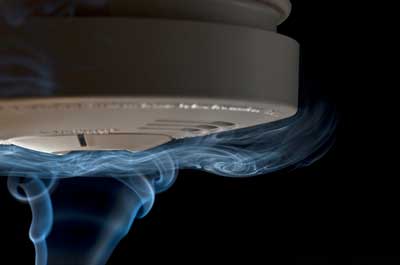
(Nanowerk News) Sensors that sniff out chemicals in the air to warn us about everything from fires to carbon monoxide to drunk drivers to explosive devices hidden in luggage have improved so much that they can even detect diseases on a person’s breath. Researchers from Drexel University and the Korea Advanced Institute of Science and Technology have made a discovery that could make our best „chemical noses” even more sensitive.
In research, recently published in the American Chemical Society journal ACS Nano („Metallic Ti3C2Tx MXene Gas Sensors with Ultrahigh Signal-to-Noise Ratio”), the team describes how a two-dimensional, metallic material called MXene can be used as a highly sensitive detector of gaseous chemicals. The paper suggests that MXene can pick up chemicals, such as ammonia and acetone, which are indicators of ulcers and diabetes, in much lower traces than sensors currently being used in medical diagnostics.
Researchers have discovered that a two-dimensional, metallic material called MXene, which was developed at Drexel, can be used to improve sensors that detect chemicals in the air. (Image: Drexel University)
„MXene is one of the most sensitive gas sensors ever reported. This research is significant because it expands the range for detection of common gases allowing us to detect very low concentrations that we were not able to detect before,” said Yury Gogotsi, PhD, Distinguished University and Bach Professor in Drexel’s College of Engineering, who was a lead Drexel author of the study. „The high sensitivity of the device may be used for detecting toxic gases or pollutants found in our environment.”
Gogotsi’s Nanomaterials Research Group, from Drexel’s Department of Materials Science and Engineering, teamed with Hee-Tae Jung, PhD, a professor at KAIST in Daejeon, South Korea to explore the gas-sensing properties of titanium carbide MXene. The key to its excellent scent-sleuthing capabilities is that MXene is both highly conductive and undergoes a measurable change of electrical conductivity in the presence of the chemical it’s designed to detect – and only when that particular chemical is present.
This discernment is called „signal-to-noise” ratio in the world of chemical sensors and it is used to rank the quality of sensors – picking up more signal and less noise is the goal. The ones in use today – mostly in medical settings to detect chemicals like acetone, ethanol and propanol, or in breathalyzers to detect alcohol – have a signal-to-noise ratio between 3-10, MXene’s is between 170 and 350, depending on the chemical.
„If the material can respond to gases by giving a strong signal, while simultaneously being conductive and achieving low electrical noise, the sensor can detect gases at very low concentrations because the signal-to-noise ratio is high – this is clearly the case with MXene,” Gogotsi said. „MXene can detect gases in the 50-100 parts per billion ranges, which is below the concentration necessary for current sensors to detect diabetes and a number of other health conditions.”
This level of sensitivity could be extremely important for detection of disease. In addition to ulcers and diabetes, breath analysis is currently being developed for early diagnosis of multiple types of cancer, cirrhosis, multiple sclerosis and kidney disease. If the chemical indicators for these diseases can be spotted in lower concentrations they are more likely to be diagnosed and treated at earlier stages.
MXene’s advantage over conventional sensor materials lies in its porous structure and chemical composition. The material is good at both allowing gas molecules to move across its surface and snagging, or adsorbing, certain ones that are chemically attracted to it, showing good selectivity.
Gogotsi’s team has been exploring MXenes since the material’s discovery at Drexel in 2011. The group has been able to create and study more than two dozen different chemical compositions for the material, which means they could be used to create sensors for a very wide variety of gasses.
In the future, Gogotsi suggests, MXene sensors could play an important role in environmental monitoring, energy harvesting and storage, as well as health care.
„The next step to advance this research will be to develop sensor sensitivity to different types of gases and improve the detection selectivity between different gases,” Gogotsi said. „We can also imagine personal sensors that will be in our smart phones or fitness trackers, monitoring body functions and the environment while we work, sleep or exercise, accessible with a tap of a finger. Improving the detection sensitivity with new materials is the first step toward making these devices a reality.”