Un simplu material artificial poate influența proprietățile luminii vizibile(A simple artificial material can influence the properties of visible light)

Materiale fabricate artificial, numite metamateriale, pot fi utilizate pentru manipularea luminii pentru o serie de aplicații, dar necesită deseori structuri tridimensionale complicate cu caracteristici de câteva zeci de nanometri. Acum, cercetătorii A * STAR au construit o „metasurface” mai simplă, bidimensională, pentru manipularea luminii de transmisie de ultimă generație ( metaforele dielectrice de înaltă transmisie cu 2 controlul fazei la lungimi de undă vizibile „).Principalul dezavantaj al abordărilor anterioare la astfel de componente optice a fost fracțiunea redusă a luminii transmise. Structura creată de echipă a atins o transmisie de vârf de aproape 90%. „Cele mai multe abordări anterioare se bazează pe nanoparticule plasmonice, care au pierderi puternice în spectrul vizibil și de obicei au doar un răspuns rezonant electric”, explică Yu. „Particulele de siliciu pe care le folosim pot avea rezonante atât electrice, cât și magnetice.” Cercetătorii au eliminat aproape atât pierderile, cât și reflexia optică din metastru.

Posted: Jan 20, 2016

A simple artificial material can influence the properties of visible light

(Nanowerk News) Artificially engineered materials called metamaterials can be used to manipulate light for a range of applications, but often require complicated three-dimensional structures with features as small as a few tens of nanometers. Now, A*STAR researchers have constructed a simpler, two-dimensional ‘metasurface’ for state-of-the-art high-transmission light manipulation („High-transmission dielectric metasurface with 2 phase control at visible wavelengths”).

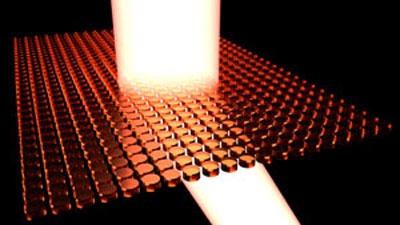
Visualization of the metasurface — a square array of silicon cylinders — manipulating the phase of visible light
Visualization of the metasurface — a square array of silicon cylinders — manipulating the phase of visible light. (Image: A*STAR Data Storage Institute)
A metamaterial is a periodic array of subwavelength-sized elements that interact with an electromagnetic wave’s electric or magnetic component, or both. Each element can be engineered to create a material with optical properties beyond those found in naturally occurring substances. Metasurfaces harness the same idea but are only two-dimensional, and so easier to create.
Yefeng Yu and his co-workers from A*STAR’s Data Storage Institute have created a metasurface that can alter a property of light known as phase (see image). Light can be thought of as a wave with successive peaks and troughs. Moving this wave, to delay or hasten the peaks and troughs, is known as a phase shift. The metasurface designed and created by Yu and the team is capable of complete control over the phase of visible light. By creating certain phase shift distributions it is possible to focus light or even create on-demand holographic images.
The team’s metasurface comprised a square array of silicon disks. Each was 130 nanometers tall with a center-to-center separation of 360 nanometers. Light striking the surface of the structure passed through to the other side, but was deflected by approximately ten degrees. The phase change imparted to the transmitted light by the metasurface was dependent on the radius of the silicon disks. The team showed that varying the radii between 120 and 155 nanometers could produce any desired phase shift.
The main drawback of previous approaches to such optical components has been the low fraction of light transmitted. The structure created by the team reached a peak transmission of almost 90 per cent. “Most previous approaches are based on plasmonic nanoparticles, which have strong losses in the visible spectrum and typically have only an electric resonant response,” explains Yu. “The silicon particles we use can have both electric and magnetic resonances.” The researchers have nearly eliminated both losses and optical reflection from their metasurface.
“To make metasurfaces interesting for practical applications it is important to tune them and dynamically control the phase of incoming light,” says Yu. “This is something our group is now working on.”
Source: A*STAR

Cristalele care pot fi transformate pot permite noi cipuri de memorie(Switchable crystals could enable new memory chips)

au dezvoltat un material subțire, a cărui fază și proprietăți electrice pot fi schimbate între metale și semiconductoare pur și simplu prin aplicarea unei mici tensiuni. Materialul rămâne apoi în noul său configurație, până când este deconectat de o altă tensiune. el deschide calea pentru aplicarea acestor materiale atat in dispozitive electrochimice in stare solida pentru conversia eficienta a stocarii de energie sau oxigen, cat si in aplicatii posibile intr-un nou tip de dispozitive de memorie „.

Posted: Jan 20, 2016

Switchable crystals could enable new memory chips

(Nanowerk News) Two MIT researchers have developed a thin-film material whose phase and electrical properties can be switched between metallic and semiconducting simply by applying a small voltage. The material then stays in its new configuration until switched back by another voltage. The discovery could pave the way for a new kind of “nonvolatile” computer memory chip that retains information when the power is switched off, and for energy conversion and catalytic applications.

The findings, reported in the journal Nano Letters in a paper („Voltage-Controlled Topotactic Phase Transition in Thin-Film SrCoOx Monitored by In Situ X-ray Diffraction”) by MIT materials science graduate student Qiyang Lu and associate professor Bilge Yildiz, involve a thin-film material called a strontium cobaltite, or SrCoOx.
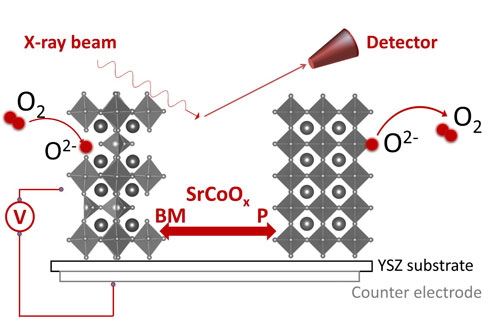
This diagram shows how an electrical voltage can be used to modify the oxygen concentration, and therefore the phase and structure, of strontium cobaltites
This diagram shows how an electrical voltage can be used to modify the oxygen concentration, and therefore the phase and structure, of strontium cobaltites. Pumping oxygen in and out transforms the material from the brownmillerite form (left) to the perovskite form (right). (Courtesy of the researchers)
Usually, Yildiz says, the structural phase of a material is controlled by its composition, temperature, and pressure. “Here for the first time,” she says, “we demonstrate that electrical bias can induce a phase transition in the material. And in fact we achieved this by changing the oxygen content in SrCoOx.”
“It has two different structures that depend on how many oxygen atoms per unit cell it contains, and these two structures have quite different properties,” Lu explains.
One of these configurations of the molecular structure is called perovskite, and the other is called brownmillerite. When more oxygen is present, it forms the tightly-enclosed, cage-like crystal structure of perovskite, whereas a lower concentration of oxygen produces the more open structure of brownmillerite.
The two forms have very different chemical, electrical, magnetic, and physical properties, and Lu and Yildiz found that the material can be flipped between the two forms with the application of a very tiny amount of voltage — just 30 millivolts (0.03 volts). And, once changed, the new configuration remains stable until it is flipped back by a second application of voltage.
Strontium cobaltites are just one example of a class of materials known as transition metal oxides, which is considered promising for a variety of applications including electrodes in fuel cells, membranes that allow oxygen to pass through for gas separation, and electronic devices such as memristors — a form of nonvolatile, ultrafast, and energy-efficient memory device. The ability to trigger such a phase change through the use of just a tiny voltage could open up many uses for these materials, the researchers say.
Previous work with strontium cobaltites relied on changes in the oxygen concentration in the surrounding gas atmosphere to control which of the two forms the material would take, but that is inherently a much slower and more difficult process to control, Lu says. “So our idea was, don’t change the atmosphere, just apply a voltage.”
“Voltage modifies the effective oxygen pressure that the material faces,” Yildiz adds. To make that possible, the researchers deposited a very thin film of the material (the brownmillerite phase) onto a substrate, for which they used yttrium-stabilized zirconia.
In that setup, applying a voltage drives oxygen atoms into the material. Applying the opposite voltage has the reverse effect. To observe and demonstrate that the material did indeed go through this phase transition when the voltage was applied, the team used a technique called in-situ X-ray diffraction at MIT’s Center for Materials Science and Engineering.
The basic principle of switching this material between the two phases by altering the gas pressure and temperature in the environment was developed within the last year by scientists at Oak Ridge National Laboratory. “While interesting, this is not a practical means for controlling device properties in use,” says Yildiz. With their current work, the MIT researchers have enabled the control of the phase and electrical properties of this class of materials in a practical way, by applying an electrical charge.
In addition to memory devices, the material could ultimately find applications in fuel cells and electrodes for lithium ion batteries, Lu says.
“Our work has fundamental contributions by introducing electrical bias as a way to control the phase of an active material, and by laying the basic scientific groundwork for such novel energy and information processing devices,” Yildiz adds.
In ongoing research, the team is working to better understand the electronic properties of the material in its different structures, and to extend this approach to other oxides of interest for memory and energy applications, in collaboration with MIT professor Harry Tuller.
José Santiso, the nanomaterials growth division leader at the Catalan Institute of Nanoscience and Nanotechnology in Barcelona, Spain, who was not involved in this research, calls it “a very significant contribution” to the study of this interesting class of materials, and says “it paves the way for the application of these materials both in solid state electrochemical devices for the efficient conversion of energy or oxygen storage, as well as in possible applications in a new kind of memory devices.”
Source: By David L. Chandler, MIT

Electrolitul celulelor de combustie dezvoltat pentru a oferi o energie mai curată și mai eficientă(Fuel cell electrolyte developed to offer cleaner, more efficient energy)

Un nou material electrolit subțire, care ajută celulele de combustie cu oxizi solizi să funcționeze mai eficient și mai ieftin decât cele compuse din materiale convenționale și care are aplicații potențiale pentru sursele de energie portabile, a fost dezvoltat la Universitatea din Cambridge.
Aceste materiale noi oferă posibilitatea fie de a îmbunătăți în mod semnificativ eficiența sistemelor actuale de celule de combustibil la temperaturi ridicate, fie de a atinge aceleași niveluri de performanță la temperaturi mult mai scăzute. Oricare dintre aceste abordări ar putea permite consumul de combustibil și consumul de deșeuri mult mai redus.

Posted: Jan 20, 2016

Fuel cell electrolyte developed to offer cleaner, more efficient energy

(Nanowerk News) A new thin-film electrolyte material that helps solid oxide fuel cells operate more efficiently and cheaply than those composed of conventional materials, and has potential applications for portable power sources, has been developed at the University of Cambridge.

These new materials offer the possibility of either significantly improving the efficiency of current high-temperature fuel cell systems, or achieving the same performance levels at much lower temperatures. Either of these approaches could enable much lower fuel consumption and waste energy. The material was co-invented by Professor Judith Driscoll of the Department of Materials Science and Metallurgy and her colleague Dr Shinbuhm Lee, with support from collaborators at Imperial College and at three different labs in the US.
Solid oxide fuel cells are comprised of a negative electrode (cathode) and positive electrode (anode), with an electrolyte material sandwiched between them. The electrolyte transports oxygen ions from the cathode to the anode, generating an electric charge. Compared to conventional batteries, fuel cells have the potential to run indefinitely, if supplied by a source of fuel such as hydrogen or a hydrocarbon, and a source of oxygen.
By using thin-film electrolyte layers, micro solid oxide fuel cells offer a concentrated energy source, with potential applications in portable power sources for electronic consumer or medical devices, or those that need uninterruptable power supplies such as those used by the military or in recreational vehicles.
“With low power requirements and low levels of polluting emissions, these fuel cells offer an environmentally attractive solution for many power source applications,” said Dr Charlanne Ward of Cambridge Enterprise, the University’s commercialisation arm, which is managing the patent that was filed in the US. “This opportunity has the potential to revolutionise the power supply problem of portable electronics, by improving both the energy available from the power source and safety, compared with today’s battery solutions.”
In addition to providing significantly improved conductivity, the new electrolyte material offers:
  • minimal heat loss and short circuiting due to low electronic conductivity
  • minimal cracking under heat cycling stress due to small feature size in the construction
  • high density, reducing the risk of fuel leaks
  • simple fabrication using standard epitaxial growth and self-assembly techniques
“The ability to precisely engineer and tune highly crystalline materials at the nanoscale is absolutely key for next-generation power generation and storage of many different kinds,” said Driscoll. “Our new methods and understanding have allowed us to exploit the very special properties of nanomaterials in a practical and stable thin-film configuration, resulting in a much improved oxygen ion conducting material.”
In October, a paper on the enhancement of oxygen ion conductivity in oxides was published in Nature Communications („Strongly enhanced oxygen ion transport through samarium-doped CeO2 nanopillars in nanocomposite films”). It is this enhancement that improves efficiency and enables low-temperature operation of fuel cells. As a result of the reported advantages, the novel electrolyte material can also potentially be used in the fabrication of improved electrochemical gas sensors and oxygen separation membranes (to extract oxygen molecules from the air). The inventors have also published two other papers showing the enhanced ionic conduction in different materials systems, one in Nano Letters („Ionic Conductivity Increased by Two Orders of Magnitude in Micrometer-Thick Vertical Yttria-Stabilized ZrO2 Nanocomposite Films”) and one in Advanced Functional Materials („Strain Tuning and Strong Enhancement of Ionic Conductivity in SrZrO3–RE2O3 (RE = Sm, Eu, Gd, Dy, and Er) Nanocomposite Films”).
Source: University of Cambridge

Programul de transformare a substanțelor chimice mortale în murdăria inofensivă se află în plină desfășurare(Program for Transforming Deadly Chemicals into Harmless Dirt Gets Underway)

două contracte de dezvoltare a prototipurilor unui sistem de eliminare capabil să transforme substanțele chimice periculoase într-o cantitate sigură, cum ar fi solul inofensiv, utilizarea unor consumabile minime și crearea de deșeuri nepericuloase.

47 sept

Cercetătorii fac plăci mai subțiri care pot fi luate de mână(Researchers make thinnest plates that can be picked up by hand)

Oamenii de știință și inginerii se angajează într-o cursă globală pentru a face noi materiale care să fie cât mai subțiri, mai ușoare și mai puternice;Ca folie agățată, materialele comparabile subțiri se curvesc imediat pe ele și se blochează în forme deformate dacă nu sunt așezate pe un cadru sau susținute de un alt material

103 sept

Ursul de mare provoacă idei noi pentru materiale ușoare(Sea urchin spurs new ideas for lightweight materials)

pentru a dezvolta materiale care reduc tragerea în apă;pentru a dezvolta materiale care reduc tragerea în apă, și deci nu.
au gasit acum un model pentru materiale puternice si usoare, scufundandu-se sub suprafata marii, pentru a investiga un varsator de mare de ursina cunoscut sub numele de urchin in inima

stimp20