
Acum puteți căuta material nuclear fără a fi observat(Now You Can Search for Nuclear Material Without Being Noticed)
Cercetatorii au dezvoltat si testat detectoare eficiente dar mici.
Cercetatorii au dezvoltat si testat detectoare eficiente dar mici.
Poate un „termometru” să fie format dintr-o peliculă subțire sau mic (particule micrometrice sau nanometrice), să funcționeze în timp real și într-o regiune foarte bine definită, cu o rezoluție spațială variind de la un centimetru până la un micrometru capabil să măsoare temperaturi cu sensibilitate excepțională într-o bandă largă între 80 kelvin (minus 193 ° C) și 750 kelvin (476 ° C)? Raspunsul este da.Ca o peliculă subțire, materialul poate fi la fel de mic ca centimetri pătrați sau poate ajunge la câțiva metri pătrați pentru a fi utilizat ca strat de acoperire pe componentele vehiculelor terestre, al aeronavelor sau al transformatoarelor de rețea. Ca particule micrometrice sau nanometrice, acestea pot fi dispersate într-un mediu lichid, în timp ce rămân solide.
| Posted: Jan 11, 2018 | |
Researchers engineer ultra-sensitive temperature sensor(Nanowerk News) Can a „thermometer” consist of a thin film or tiny (micrometer or even nanometer scale) particles, operate in real time and in very well-defined regions with a spatial resolution ranging from a centimeter to a micrometer, and be capable of measuring temperatures with exceptional sensitivity in a wide band between 80 kelvin (minus 193°C) and 750 kelvin (476°C)? The answer is yes. |
|
| The device, created in the laboratory by researchers at the University of São Paulo (USP) and the University of Campinas (UNICAMP) in São Paulo State, Brazil, is described in an article in Scientific Reports („A suitable (wide-range + linear) temperature sensor based on Tm3+ ions”). Basically, it is a temperature sensor with practically no effect at all on the temperature of the object. | |
 |
|
| Material developed in Brazil measures temperatures in the range of 80-750 kelvin and could be used in manufacturing and biological processes. (click on image to enlarge) | |
| „Because the device is optical, information on the temperature of the object of interest can be obtained without direct physical contact between them,” Zanatta said. „It suffices to project a laser beam onto the sensor and observe how it responds. By measuring the wavelength of the light emitted by the sensor using a detector, the temperature of the object can be determined with great precision,” said Antonio Ricardo Zanatta, an investigator at the USP’s São Carlos Physics Institute and one of project’s researchers. | |
| When excited by a laser pulse, the sensor – which consists of a system made of titanium dioxide (TiO2) doped with thulium ions (Tm3+) – emits light at wavelengths that vary depending on the temperature of the environment. A very precise measurement of the wavelength is used to determine this temperature. | |
| The wavelength varies approximately 2 picometers (2×10-12 m) per degree of temperature. Spectroscopy can be used to detect this tiny wavelength variation. | |
| „Variation in the wavelength of the emitted light is absolutely linear between 80 and 750 kelvin, and the device remains integral and stable throughout this temperature range,” Zanatta said. | |
| Besides from Zanatta, the project also had contributions from UNICAMP’s Gleb Wataghin Physics Institute investigators Fernando Alvarez and Diego Scoca. The research is supported by the Sao Paulo Research Foundation – FAPESP through the Thematic Project „Research and development of nanostructured materials for electronic and surface physics applications”, with Alvarez as principal investigator. | |
| A patent application form commercial production has been filed with support from UNICAMP’s incubator, the Inova UNICAMP. | |
Technologic application |
|
| Applications of the sensor range from the identification of hotspots in electronic equipment to the detection of viral or bacterial infection in specific regions of an organism. „Because it’s capable of measuring a very broad spectrum of temperatures, it can be used in manufacturing – where temperatures sometimes reach very high levels – as well as biological processes, which are highly sensitive to the slightest temperature variations,” said Alvarez. | |
| „At this stage,” Zanatta points, „we’ve arranged the material in the form of a thin film. Theoretically, this can be used as a coating for any surface, be it flat or curved, smooth or rough.” He says that the material can also be presented as microparticles or nanoparticles. | |
| Although this technological development does not yet exist, in principle, it would be possible to encapsulate the laser emitter, temperature sensor and wavelength detector with a radio communicator inside a small pill. | |
| Swallowed with a little water, the pill would send back temperature data while moving along the digestive tract until its ejection from the organism at the opposite extremity: a futuristic scenario, but not too distant from the science available now. | |
| „A very simple application, which could rapidly be made feasible, would entail coating a plastic substrate with the sensor and fixing it to a patient’s skin. It’s important to note that titanium dioxide is abundant, easy to obtain, and biocompatible, i.e., non-toxic. It’s already used in many medical prosthetic devices,” Alvarez said. | |
| As a thin film, the material can be as small as a few square centimeters or reach several square meters for use as a surface coating on components of land vehicles, aircraft or power grid transformers. As micrometric or nanometric particles, it can be dispersed in a liquid medium while remaining solid. | |
Challenges and the next steps |
|
| The need for a dedicated detector is a limiting factor at the present stage, in terms of both the cost and portability of the device. | |
| „The associated instrumentation is costly today, given the need for a laser and a detector,” Zanatta said. „We believe, however, that as technology advances, it will be possible to fabricate an integrated device with a semiconductor laser, temperature sensor and detector. And the cost can be considerably reduced when we go from laboratory to industrial scale.” |
| Source: By José Tadeu Arantes, Fundação de Amparo à Pesquisa do Estado de São Paulo | |
Baza pentru detectarea gazului precum și alte aplicații ale oxidului de staniu este reducebilitatea oxidului, care îi permite să elibereze ușor și reversibil oxigenul în prezența reactanților cum ar fi monoxidul de carbon sau hidrocarburile și pentru a facilita adsorbția moleculelor cum ar fi oxigenul . Modificările în conductivitatea electrică a acestui semiconductor care rezultă din aceste procese de suprafață reprezintă baza caracteristicilor de detectare a gazului. Din acest motiv, a fost mult timp un obiectiv al cercetării fundamentale pentru a caracteriza proprietățile structurale, fizice și chimice ale suprafețelor de oxid de staniu.
| Posted: Jan 10, 2018 | |
Atomically controlled gas sensing(Nanowerk News) An international team of scientists, including those from the LCN at UCL, have solved the stucture of a gas sensing surface of tin dioxide, opening the way to advanced device design (Physical Review Letters, „Structure of the SnO2(110)-(4×1) Surface”). |
|
| The basis for the gas sensing as well other applications of tin oxide is the reducibility of the oxide, which allows it to readily and reversibly release oxygen in the presence of reactants such as carbon monoxide or hydrocarbons, and to facilitate adsorption of molecules such as oxygen. The changes in electrical conductivity of this semiconductor resulting from these surface processes are the basis for the material’s gas-sensing characteristics. Because of this, it has long been a goal of fundamental research to characterise the structural, physical, and chemical properties of tin oxide surfaces. | |
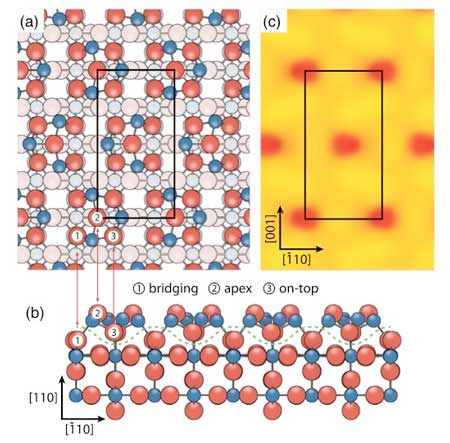 |
|
| The structure of the tin dioxide surface determined in this work along with a simulation of the scanning tunnelling microscope image. (Image: London Centre for Nanotechnology) | |
| The (110) plane of tin oxide, the mineral cassiterite, is the most stable under ambient conditions and therefore will be the most abundant termination of the gas sensor. This is the surface that the team investigated with a number of experimental and theoretical techniques, including those available at the Diamond Light Source at Harwell Laboratory. | |
| The lead author of the work, Lindsay Merte, comments “the tin oxide (4 × 1) termination is one of a handful of gas sensor related surfaces to have its quantitative structure determined. It can now serve as a useful model for fundamental studies of tin oxide surface chemistry and a basis for further studies that should help resolve the complex behavior of the surface under different conditions” | |
| Considering the importance of tin oxide surface electrical conductivity in gas-sensing applications, it is a natural question whether upon formation of the (4 × 1) termination the surface becomes metallic. To address this, we have evaluated the electronic properties of the upper layers in our structure. This shows that the surface remains semiconducting, which is a necessary requirement for gas sensing. |
| Source: London Centre for Nanotechnology |
Senzorii cu un dispozitiv de identificare RFID se află în centrul IOT. Această nouă dezvoltare poate oferi diverse aplicații, cum ar fi monitorizarea wireless fără fir fără baterii, pentru procesele de fabricație care sunt sensibile la umiditate, siguranță alimentară, asistență medicală și deșeuri nucleare.
| Posted: Jan 08, 2018 | |
Graphene sensors embedded into RFIDs for wireless humidity sensing(Nanowerk News) Researchers at The University of Manchester have devised graphene sensors embedded into RFIDs, which have the potential to revolutionise the Internet of Things (IoT). |
|
| By layering graphene-oxide (a derivative of graphene) over graphene to create a flexible heterostructure the team have developed humidity sensors for remote sensing with the ability to connect to any wireless network. | |
| Graphene was the world’s first two-dimensional material isolated in 2004 at The University of Manchester, it is stronger than steel, lightweight, flexible and more conductive than copper. | |
| Since then a whole family of other 2D materials have been discovered and continues to grow. | |
| Using graphene and other 2D materials, scientists can layer these materials, similar to stacking bricks of Lego in a precisely chosen sequence known as van der Waals heterostructures to create high-performance structures tailored to a specific purpose. | |
| As reported in Scientific Reports („Graphene Oxide Dielectric Permittivity at GHz and Its Applications for Wireless Humidity Sensing”), the groundbreaking nature of this development is that such sensors can be printed layer-by-layer for scalable and mass production at very low cost. The device also requires no battery source as it harvests power from the receiver. | |
| Sensors with a RFID enabler are at the heart of the IoT. This new development can provide various applications such as battery-free smart wireless monitoring for manufacturing processes that are sensitive to moisture, food safety, healthcare and nuclear waste. | |
| The developed technique has the potential to simplify how the information is gathered through its wireless system, nor is it is limited to a particular wireless network and has the ability to be compatible with networks including WiFi and 5G. | |
| Dr Zhirun Hu who led the work said: The excitement does not end with this new application here, but leads to the future possibilities of integrations of this technique with other 2D materials to open up a new horizon of wireless sensing applications. | |
| Professor Sir Kostya Novoselov, who won the Nobel Prize in Physics and coordinated the project, added: It is the first example of the printable technology where several 2D materials come together to create a functional device immediately suitable for industrial applications. The Internet of Things is the fast growing segment of technology, and I’m sure that 2D materials will play an important role there. |
| Source: University of Manchester |
Acestea ar putea fi folosite și în sistemele de apărare și securitate care utilizează magnetometre cuantice îmbunătățite, dispozitive care măsoară modificările câmpurilor magnetice pentru identificarea și urmărirea țintă.
| Posted: Dec 19, 2017 | |
Quantum trick blocks background ‘chatter’ in sensing devices(Nanowerk News) A University of Sydney team has solved a common problem in quantum sensing devices, which are used in biomedical imaging and have defence applications. |
|
| Industrial sensors are everywhere in our technology and in order to function successfully they must be able to identify tiny signals from a cluttered background. | |
| For most humans this is simple. Walk into a crowded room and you can pick out a single voice while ignoring everyone else. That trick isn’t so easy for industrial sensors – and the challenge gets even harder for super-sensitive quantum devices. | |
| Now, a team led by Professor Michael J. Biercuk from the University of Sydney, in collaboration with Dartmouth College and Johns Hopkins Applied Physics Laboratory in the US, has developed quantum control techniques enabling a new generation of ultra-sensitive sensors that can identify tiny signals while rejecting background noise down to theoretical limits. | |
 |
|
| An ion trap in Professor Michael J. Biercuk’s laboratory in the Sydney Nanoscience Hub. (Image: University of Sydney) | |
| „By applying the right quantum controls to a qubit-based sensor, we can adjust its response in a way that guarantees the best possible exclusion of the background clutter – that is, the other voices in the room,” said Professor Biercuk, a chief investigator at the ARC Centre of Excellence for Engineered Quantum Systems. | |
| While devices themselves have improved, the measurement protocols used to capture and interpret the signals have lagged behind. Quantum sensors therefore often return fuzzy results, which complicates interpretation of the data through a phenomenon known as „spectral leakage” – a bit like being distracted by the wrong voices in the room. | |
| The University of Sydney research, published on Tuesday in Nature Communications („Application of optimal band-limited control protocols to quantum noise sensing”), demonstrates control protocols that will help take advantage of improved sensor hardware. | |
| The experiments, using trapped atomic ions, have reduced spectral leakage by many orders of magnitude over conventional methods. Professor Biercuk said in certain circumstances, the methods they have developed are up to 100 million times better at excluding this background. | |
 |
|
| Six ytterbium atoms in an ion trap in Professor Michael J. Biercuk’s laboratory at the Sydney Nanoscience Hub. (Image: University of Sydney) | |
| Quantum sensors take advantage of the very thing that makes building quantum computers so difficult. Quantum bits, or qubits, are the building blocks of quantum computers but they are highly prone to losing their quantum properties due to interference from the environment. This challenge can be turned on its head and used to build sensors that are much more responsive to the environment than classical technologies. | |
| Professor Biercuk said the new protocols could have applications in medicine, such as imaging inside living cells using nanodiamonds. They could also be used in defence and security systems that use quantum-enhanced magnetometers, devices that measure changes in magnetic fields for target identification and tracking. | |
| He said: „Our approach is relevant to nearly any quantum sensing application and can also be applied to quantum computing as it provides a way help identify sources of hardware error. This is a major advance in how we operate quantum sensors.” | |
| Professor Biercuk has recently launched a venture-capital-backed spin-off from the work being done at the University of Sydney. Q-Ctrl aims to be the trusted provider of quantum control solutions for all new quantum technologies. |
| Source: University of Sydney |
prin crearea de capcane moleculare prin modificarea chimică a materialelor din cadrul metalelor-organice (MOF). Punctele de legare („cârlige” chimice) sunt adăugate la acest material foarte poros, cu suprafață mare. Locurile de legare au azot reactiv care se poate lega de iodurile organice. Capcana a avut o capacitate ridicată de iodură de metil – de peste trei ori mai mare decât adsorbantul industrial folosit în prezent în condiții identice.
| Posted: Dec 14, 2017 | |
Molecular mousetraps capture more nuclear waste(Nanowerk News) At nuclear power plants and legacy waste sites, a particularly difficult-to-capture hazard is radioactive organic iodides. These compounds are made of hydrocarbons and iodine. In this work, scientists modified cage-like molecules called metal-organic frameworks (MOF). They added small “hooks” inside the cages. The modified MOFs were more than three times more effective at capturing radioactive organic iodides than the leading materials used by the U.S. nuclear fuel industry. Also, these traps were recyclable, unlike other adsorbents (Nature Communications, „Capture of organic iodides from nuclear waste by metal-organic framework-based molecular traps”). |
|
 |
|
| Chemically modified metal-organic frameworks (MOF) are over three times more effective at capturing radioactive iodine compounds than current industrial methods. The schematic shows the design and function of this recyclable MOF trap. First, a porous and robust MOF (yellow rods and purple balls) is modified by attaching a functional chemical “hook” (y-shaped gray molecule) inside its porous structure. The modified MOF has a high capacity for radioactive organic iodides (green) because the iodine binds strongly with the chemical “hook.” The original MOF starting material can be recovered by acid (red) washing and reused multiple times, unlike other adsorbents. (Image: Jing Li, Rutgers University) | |
| The modified MOF has a high capture capacity, stability, recyclability, and low cost. It holds promise for effective capture of a difficult byproduct from nuclear reactors. Further, this study revealed that through chemical modification, MOFs could be tuned to capture specific molecules. Molecular tuning of MOFs has potential, broad impact in the chemical industry. | |
| Since the 1980s, research has focused on containment of radioactive iodine, associated with nuclear energy and legacy environmental sites, because it is long-lived and can be incorporated into the human body, where it is linked with cancer. Radioactive organic iodide is particularly difficult to capture and sequester and thus tends to more easily leak into the environment. | |
| Effective capture of radioactive organic iodides (such as methyl iodide) remains a significant challenge due to the drawbacks of currently used adsorbents. These drawbacks include low uptake capacity, high cost, and non-recyclability. | |
| This work demonstrates a general approach to address this challenge by creating molecular traps through chemical modification of metal-organic framework (MOF) materials. Binding sites (chemical “hooks”) are added to this highly porous, high surface area material. The binding sites have reactive nitrogen that can bind to the organic iodides. The trap exhibited a high methyl iodide capacity—over three times higher than the currently used industrial adsorbent under identical conditions. | |
| Also, these new MOFs advantageously serve as good adsorbents at lower temperatures. Furthermore, the MOF adsorbent can be recycled multiple times without loss of capacity, unlike other known industrial adsorbents. The team investigated the capture mechanism by experimental and theoretical methods. | |
| Their work verified that binding is occurring at the “hook” sites in the MOF. Due to its chemical and thermal stability, high capture efficiency, and low cost, the new MOF adsorbent demonstrates promise for industrial radioactive organic iodine capture from nuclear energy or treatment of legacy environmental clean-up sites. |
| Source: Department of Energy, Office of Science |
a dezvoltat o membrană ultra-subțire de diamant care poate măsura numărul de protoni într-o doză de radiație cu o precizie aproape perfectă. Detectorul se atașează la un microbeam cu particule încărcate și permite transmiterea radiației într-o zonă mai mică de 2 micrometri
| Posted: Dec 13, 2017 | |
New ultra-thin diamond membrane Is a radiobiologist’s best friend(Nanowerk News) Depending on the dose and the target, radiation can cause incredible damage to healthy cells or it can be used to treat cancer and other diseases. To understand how cells respond to different doses of radiation, scientists need to direct precise amounts of energy to specific areas of the cell. Measuring dosage can be challenging, however, especially when working with low-energy protons. |
|
| A collaboration of researchers from the Université de Bordeaux, Centre National de la Recherche Scientifique and CEA-LIST has developed an ultra-thin diamond membrane that can measure the number of protons in a dose of radiation with almost perfect accuracy. The detector attaches to a charged-particle microbeam and enables the delivery of radiation to an area less than 2 micrometers wide. The study, published this week in Applied Physics Letters, („Cell micro-irradiation with MeV protons counted by an ultra-thin diamond membrane”), represents a valuable technological advance for radiation biology. | |
 |
|
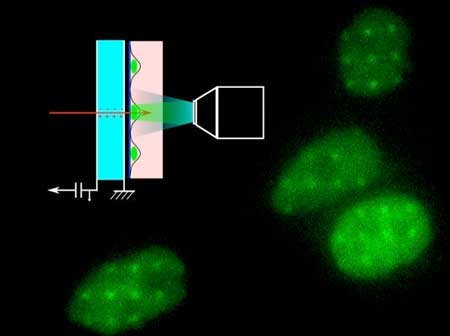
| The ultra-thin diamond membrane detects individual protons as they pass through, allowing researchers to irradiate micron-sized areas on living cells for radiobiology experiments. (Image: Philippe Barberet) | |
| Previous experiments had already established that diamond membranes can detect and quantify protons, but until the current study, no one had developed the technology for biological investigations. | |
| “The device is completely compatible with living cells in their liquid environment,” said Philippe Barberet, a biophysicist at the Université de Bordeaux. “It will allow us to irradiate different kinds of cells and organisms using single protons, which is not so easy to do using low-energy accelerators.” | |
| To test the effectiveness of the diamond membranes when irradiating live cells, the group used a cell line engineered to express a DNA repair protein called XRCC1, tagged with green fluorescent protein (GFP). When DNA damage occurs in these cells, the GFP lights up at the site of the repairs. | |
| “XRCC1 is involved in DNA repair pathways and it’s one of the first proteins recruited,” said Barberet. “You irradiate and you immediately see an effect.” They delivered 100 protons spaced 5 micrometers apart to the cells. The resulting pattern of green irradiation spots confirmed that the beam inflicted damage in circles measuring less than 2 microns across. | |
| The diamond membranes could become a valuable tool for increasing precision in radiation biology research. The researchers note, however, that their utility is limited to groups who have access to proton beams from particle accelerators. |
| Source: American Institute of Physics |
Articolele de îmbrăcăminte sunt dispozitive de senzor care pur și simplu sunt purtate pe corpul fizic.Poziția senzorului pe corp este vitală pentru a înregistra o reprezentare precisă a mișcărilor corpului, în timp ce abordarea celor mai importante semne vitale, incluzând moartea fizică reală
Constatările ar putea conduce la dezvoltarea unui detector de raze T, deoarece nu a fost încă proiectat un astfel de detector convențional.
Hosono adaugă: „Chiar acum, materialul nostru este bun la detectarea unei radiații terahertz puternice. Provocarea va fi cum să ajustăm sensibilitatea.”
Grupul său a raportat, de asemenea, că anionii de oxigen pot fi înlocuiți cu anioni de aur sau hidrogen în cuști. Folosind aceste anioni diferiți, este posibil să se dezvolte detectoare care emite lumină colorată în viitor
| Posted: Nov 29, 2017 | |
Harnessing the rattling motion of oxygen ions to convert T-rays to visible light(Nanowerk News) Scientists have successfully visualized terahertz radiation, popularly known as T-rays, using a crystal called mayenite (Ca12Al14O33). Their method cleverly utilizes the rattling motion caused by the vibration of oxygen ions inside the cage-like structures of the crystal. |
|
| In recent years, there has been growing interest in developing practical devices based on terahertz technology. With wavelengths longer than infrared light, T-rays are considered safer than conventional imaging systems. They are already used, for example, at airport security checkpoints, and are starting to be used more widely in areas such as medical screening, food inspection and analysis of artworks. The visualization of terahertz light itself, however, has so far proved challenging. | |
| Now, Hideo Hosono of Materials Research Center for Element Strategy, Tokyo Tech and co-workers in Japan, Ukraine and the US have devised a simple approach to convert T-rays to bright, visible light. Their findings have been published in ACS Nano („Rattling of Oxygen Ions in a Sub-Nanometer-Sized Cage Converts Terahertz Radiation to Visible Light”). | |
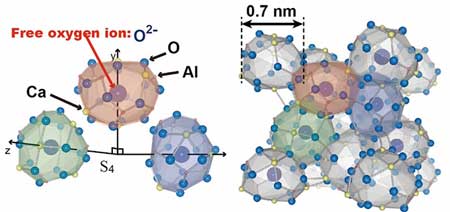
| First, the study involved beaming T-rays onto the mayenite crystal using a gyrotron1. This led to the vibration of oxygen anions2, which collide with the inside walls of the cages within the crystal. Each cage has an inner diameter of 0.4 nanometers and an outer diameter of 0.7 nanometers (see Figure 1). | |
 |
|
| Fig. 1: A schematic representation of the nanoscale cages. The oxygen anions randomly occupy one sixth of the cages. | |
| „The rattling of oxygen ions within the cages promotes upward energy conversion,” Hosono explains. „Strong and frequent collisions of the oxygen ions induce electron transfer to neighboring empty cages. The excitation of the oxygen ions is key to the emission of visible light.” | |
| Spectroscopy measurements confirmed that the visible light originated from vibrations caused by the free-moving oxygen anions. The researchers took care to rule out the possibility of other sources such as black body radiation and surface polarization as reasons behind the production of visible light. | |
| The study is an example of strategic research on functional materials under the Element Strategy initiative supported by Japan’s Ministry of Education, Culture, Sports, Science and Technology (MEXT) and the Japan Science and Technology Agency (JST). | |
| „The crystal in our study is just composed of calcium, aluminium and oxygen, all of which are in the top five of the most abundant elements,” says Hosono. „So, it’s one of the most inexpensive materials, at around 15 cents per kilogram.” | |
 |
|
| Fig. 2: A photograph of the emission of visible light at a terahertz radiation level of 0.21 and output power of 50 W. | |
| Despite its simplicity, Hosono says that the crystal has many exciting properties due to its nanostructure. Drawing on 20 years of research, his group has already succeeded in demonstrating that the material has excellent catalytic properties for ammonia synthesis and superconductivity. | |
| Best known for his pioneering work on iron-based superconductors, Hosono says that the current study marks a new research direction. „Our group has been concentrating on the cultivation of new functionalities using abundant elements, but it’s the first time for me to focus on ionic motion — this is completely new,” he says. | |
| The findings could lead to the development of a T-ray detector, as no such conventional detector has yet been designed. | |
| Hosono adds: „Right now, our material is good at detecting strong terahertz radiation. The challenge will be how to adjust the sensitivity.” | |
| His group has also reported that the oxygen anions can be substituted with gold or hydrogen anions inside the cages. By making use of these different anions, it may be possible to develop detectors that emit different-colored light in future. |
| Source: Tokyo Institute of Technology |
DARPA evaluează faptul că senzorii de inteligență tradiționali ai armatei nu sunt întotdeauna optimi pentru sarcinile care au devenit din ce în ce mai complexe și provocatoare.Plantele sunt foarte atinse de mediile lor și manifestă în mod natural răspunsuri fiziologice la stimuli de bază cum ar fi lumina și temperatura, dar, de asemenea, în unele cazuri la atingere, chimicale, dăunători și agenți patogeni
Posibilitatea unui atac chimic într-un centru urban central a accelerat eforturile Departamentului pentru Securitate Internă al SUA de a dezvolta mai multe platforme de alertă de securitate