Vizualizarea bilelor de fotbal moleculare(Visualization of molecular soccer balls)

Pentru a optimiza performanța Li + @ C 60 în aplicații precum fotovoltaice și dispozitive de comutare, este important să înțelegeți bine proprietățile sale electronice. O colaborare internationala de cercetare condus de Universitatea din Tsukuba extins recent cunoștințe de Li + @C 60 de gestionare a imaginii unice Li + @C 60 de molecule prin scanarea microscopie tunelare. Scanarea microscopiei de tuneluri poate realiza imagini cu rezoluție la nivel molecular și oferă informații despre structura electronică a moleculelor unice. Fullerenele sunt compuse din 60 de atomi de carbon îmbinate în inele hexagonale pentru a forma o sferă care seamănă puternic cu o minge de fotbal. Fullerenes sunt de mare interes pentru oamenii de stiinta de materiale, deoarece proprietatile lor electronice interesante le fac atractive pentru utilizarea in electronica avansata si nanotehnologie.

Posted: May 09, 2018

Visualization of molecular soccer balls

(Nanowerk News) Fullerenes are composed of 60 carbon atoms joined together in hexagonal rings to form a sphere that strongly resembles a soccer ball. Fullerenes are of great interest to materials scientists because their interesting electronic properties make them attractive for use in advanced electronics and nanotechnology.

The electronic properties of fullerene can be modified by doping with other elements without altering its soccer ball-like shape. In particular, salts of lithium ion-doped fullerene, which is denoted as Li+@C60, have been synthesized in high yield and the structure of Li+@C60 has been determined. Li+@C60 salts have been used in solar cells and molecular switches with promising results.
To optimize the performance of Li+@C60 in applications such as photovoltaics and switching devices, it is important to thoroughly understand its electronic properties. An international research collaboration led by the University of Tsukuba recently expanded knowledge of Li+@C60by managing to image single Li+@C60 molecules by scanning tunneling microscopy. Scanning tunneling microscopy can image materials with molecular-level resolution and provide information about the electronic structure of single molecules.
Calculated geometry and charges of Li+C60[PF6-] salt
Calculated geometry and charges of Li+@C60[PF6–]salt. (Image: University of Tsukuba)
The results were published in the journal Carbon („Electronic structure of Li+@C60: Photoelectron spectroscopy of the Li+@C60[PF6–] salt and STM of the single Li+@C60 molecules on Cu(111)”).
„We fabricated a thin-film sample suitable for scanning tunneling microscopy by vacuum evaporation of a Li+@C60 salt on a copper substrate,” study co-author Seiji Sakai explains. „Our subsequent microscopy examination revealed that although some lithium ions escaped during the evaporation process, the sample did contain some Li+@C60 molecules on the copper substrate.”
The microscopy images revealed a mixture of Li+@C60 and undoped fullerene molecules on the copper surface. Both types of molecules were similarly oriented but displayed different heights and electronic structure, allowing them to be differentiated. The team lent further weight to their experimental findings by conducting density functional theory calculations to generate simulated scanning tunneling microscopy images. The experimentally measured and simulated microscopy images agreed well overall.
„Our study provides confirmation of the electronic structure of lithium-doped fullerene,” lead author Yoichi Yamada says. „Such knowledge will aid our ability to modulate the electronic structure of fullerenes to optimize their performance in optoelectronic and switching devices.”
The imaging and electronic structure confirmation of Li+@C60 represent important paving stones on the road to advanced applications of organic materials because they should aid our ability to control the carrier injection and transport properties of fullerenes.
Source: University of Tsukuba

Plasma din plastic micșorat mărește durata de viață a bateriei cu litiu-sulf(Microwaved plastic increases lithium-sulfur battery life span)

Cercetătorii au înmuiat o pungă de plastic în solvent conținând sulf și au pus-o într-un cuptor cu microunde pentru a oferi ieftin creșterea rapidă a temperaturii necesare pentru transformarea în polietilenă de joasă densitate. Căldura a promovat sulfonarea și carbonizarea plasticului și a indus o densitate mai mare de pori pentru capturarea polisulfurii. Plasticul de polietilenă de joasă densitate ar putea fi transformat într-o schelă de carbon pentru a împărți jumătățile de litiu și sulf ale unei celule de monede pentru baterii.reciclarea plasticului LDPE în schelă de carbon sulfurat prin sulfonare promovată de microunde” ), arată că plasarea unui plastic înmuiat în sulf într-un cuptor cu microunde , inclusiv pungi de plastic transparente, transformă materialul în substanța ideală pentru a crește durata de viață a bateriilor viitoare la mai mult de 200 de cicluri de încărcare-descărcare.reciclarea plasticului LDPE în schelă de carbon sulfurat prin sulfonare promovată de microunde” ), arată că plasarea unui plastic înmuiat în sulf într-un cuptor cu microunde , inclusiv pungi de plastic transparente, transformă materialul în substanța ideală pentru a crește durata de viață a bateriilor viitoare la mai mult de 200 de cicluri de încărcare-descărcare.

Posted: May 09, 2018

Microwaved plastic increases lithium-sulfur battery life span

(Nanowerk News) Purdue engineers have figured out a way to tackle plastic landfills while also improving batteries – by putting ink-free plastic soaked in sulfur-containing solvent into a microwave, and then into batteries as a carbon scaffold.

Lithium-sulfur batteries have been hailed as the next generation of batteries to replace the current lithium ion variety. Lithium-sulfur batteries are cheaper and more energy-dense than lithium ions, which would be important characteristics in everything from electric vehicles to laptops.
But the knock on lithium-sulfur batteries to this point is that they don’t last as long, being usable for about 100 charging cycles.
Purdue researchers have found a way to increase the life span in a process that has the added bonus of being a convenient way to recycle plastic. Their process, which was recently published in ACS Applied Materials and Interfaces („Toward High-Performance Lithium–Sulfur Batteries: Upcycling of LDPE Plastic into Sulfonated Carbon Scaffold via Microwave-Promoted Sulfonation”), shows that putting sulfur-soaked plastic in a microwave, including transparent plastic bags, transforms the material into the ideal substance for increasing the life span of the forthcoming batteries to more than 200 charging-discharging cycles.
Watch a YouTube video explaining this.
“No matter how many times you recycle plastic, that plastic stays on the earth,” said Vilas Pol, associate professor in Purdue’s School of Chemical Engineering. “We’ve been thinking of ways to get rid of it for a long time, and this is a way to at least add value.”
The need to reduce landfills runs parallel to making lithium-sulfur batteries good enough for commercial use.
“Because lithium-sulfur batteries are getting more popular, we want to get a longer life sucked out of them,” Pol said.
Low-density polyethylene plastic, which is used for packaging and comprises a big portion of plastic waste, helps address a long-standing issue with lithium-sulfur batteries – a phenomenon called the polysulfide shuttling effect that limits how long a battery can last between charges.
Lithium-sulfur batteries, as their name suggests, have a lithium and a sulfur. When a current is applied, lithium ions migrate to the sulfur and a chemical reaction takes place to produce lithium sulfide. The byproduct of this reaction, polysulfide, tend to cross back over to the lithium side and prevent the migration of lithium ions to sulfur. This decreases the charge capacity of a battery as well as life span.
“The easiest way to block polysulfide is to place a physical barrier between lithium and sulfur,” said Patrick Kim, a Purdue postdoc research associate in chemical engineering.
Previous studies had attempted making this barrier out of biomass, such as banana peels and pistachio shells, because the pores in biomass-derived carbon had the potential to catch polysulfide.
“Every material has its own benefit, but biomass is good to keep and can be used for other purposes,” Pol said. “Waste plastic is really valueless and burdensome material.”
Instead, researchers thought of how plastic might be incorporated into a carbon scaffold to suppress polysulfide shuttling in a battery. Past research had shown that low-density polyethylene plastic yields carbon when combined with sulfonated groups.
The researchers soaked a plastic bag into sulfur-containing solvent and put it in a microwave to cheaply provide the quick boost in temperature needed for transformation into low-density polyethylene. The heat promoted the sulfonation and carbonization of the plastic and induced a higher density of pores for catching polysulfide. The low-density polyethylene plastic could then be made into a carbon scaffold to divide the lithium and sulfur halves of a battery coin cell.
“The plastic-derived carbon from this process includes a sulfonate group with a negative charge, which is also what polysulfide has,” Kim said. Sulfonated low-density polyethylene made into a carbon scaffold, therefore, suppressed polysulfide by having a similar chemical structure.
“This is the first step for improving the capacity retention of the battery,” Pol said. “The next step is fabricating a bigger-sized battery utilizing this concept.”
Source: Purdue University

Chimistii dezvolta o metoda imbunatatita pentru a crea fotosinteza artificiala(Chemists develop improved method to create artificial photosynthesis)

Ei au depus straturi de oxid de zinc pe un amestec de sticlă și nanosfere polimerice. Odata ce structura a fost completa, cercetatorii ar putea dizolva polimerul, lăsând o rețea de sfere de sticlă acoperite cu oxid de zinc și pori goi. Această structură conține toate elementele necesare pentru a acționa ca un fotoanod, partea unei frunze artificiale care utilizează lumina pentru a transforma apa în oxigen și energie.Cercetătorii au testat materialul în curs de brevetare, folosind un dispozitiv numit potențiostat pentru a măsura cantitatea de energie generată sub formă de curent.

Posted: May 07, 2018

Chemists develop improved method to create artificial photosynthesis

(Nanowerk News) A team of chemistry and chemical engineering researchers at the University of Arkansas has developed a method of creating materials for artificial photosynthesis that is more efficient and cost-effective than current methods (Advanced Functional Materials, „Enhanced Photoelectrochemical Energy Conversion in Ultrathin Film Photoanodes with Hierarchically Tailorable Mesoscale Structure”).

glass and polymer nanospheres covered with a thin layer of zinc oxide
Researchers covered glass and polymer nanospheres with a thin layer of zinc oxide (left). After the polymer spheres were dissolved (right), they had a material that could act as a photoanode. (Image: Robert Coridan)
Plants use photosynthesis to convert sunlight into chemical energy, which they store in the form of sugars or fatty acids. A device known as an artificial leaf mimics this natural process, providing a reliable, economical and sustainable source of storable chemical fuels, such as hydrogen.
Artificial photosynthesis has an advantage over traditional photovoltaics, which produce electricity only when the sun is shining. An artificial leaf stores the energy from sunlight as chemical bonds which can be used to generate power at any time, matching the advantage of that coal and natural gas have over photovoltaics.
Currently, materials for artificial photosynthesis devices are expensive to produce because they must integrate all of the components that carry out the necessary light absorption, chemical catalysis, and other processes, and each of these components must be assembled on the nanoscale.
“Typical nanostructured materials for these applications use the same expensive and energy-consuming fabrication methods that are used to build microprocessors,” explained Robert Coridan, assistant professor of chemistry and biochemistry. Coridan worked with Mya Norman, an instructor in chemistry and biochemistry; Walker Perez, who recently earned a bachelor’s degree in chemical engineering; and Chandler Kline, an undergraduate chemical engineering student.
This research team used a method called atomic layer deposition to build nanostructures one atomic layer at a time. They deposited layers of zinc oxide onto a mixture of glass and polymer nanospheres. Once the structure was complete, the researchers could dissolve the polymer, leaving a network of zinc oxide-coated glass spheres and hollow pores. This structure contains all the elements necessary to act as a photoanode, the part of an artificial leaf that uses light to turn water into oxygen and energy.
Coridan explained that a similar process could be used to create a photocathode, the part of an artificial leaf that takes the protons and electrons created by the photoanode and recombines them to form hydrogen, which can be stored and used as fuel.
The researchers tested their patent-pending material by using a device called a potentiostat to measure the amount of energy it generated in the form of current.
Source: University of Arkansas

Membranele polimerice proiectate ar putea fi o nouă opțiune pentru tratarea apei(Engineered polymer membranes could be new option for water treatment)

Membranele de polimer, care acționează ca un filtru pentru desalinizarea și îndepărtarea selectivă a contaminanților din diferite surse de apă, au ajutat la tratarea apei, însă selectivitatea lor rămâne o provocare semnificativă în ceea ce privește filtrarea proprietăților chimice – un potențial risc pentru mediu și sănătatea umană.

Posted: May 04, 2018

Engineered polymer membranes could be new option for water treatment

(Nanowerk News) The world’s freshwater resources are in short supply. According to the United Nations, water scarcity affects an estimated 1.9 billion people and 2.1 billion people live with drinking water services that are not safely managed. The critical point of water scarcity has led scientists to look for new and efficient ways to make the most of nontraditional sources, including sea water, brackish water and wastewater.

Polymer membranes, which act as a filter to desalinate and selectively remove contaminants from various water sources, have aided water treatment, but their selectivity remains a significant challenge when it comes to filtering chemical properties — a potential risk to the environment and human health.
Chemical and biomolecular engineers at the University of Notre Dame and Purdue University studied self-assembled block polymer membranes, which allow for both customizable and uniform pore sizes, as a platform for water treatment systems. The study, published in Clean Water („Fit-for-purpose block polymer membranes molecularly engineered for water treatment”), determined the platform has the potential to advance water treatment technologies.
“Most state-of-the-art membranes for water treatment are designed to let water pass through while filtering contaminants,” said William Phillip, associate professor in the Department of Chemical and Biomolecular Engineering at Notre Dame. “This approach limits the ability to remove or recover dissolved species based on their chemical identity. The exciting thing about self-assembled block polymer membranes is that you can engineer the nanostructure and pore wall chemistry of the membrane through the design of the block polymer molecules. This capability has the potential to open up a variety of new separation mechanisms that can isolate species based on chemical identity, which in turn could help to enable decentralized reuse of wastewater.”
Phillip and the research team focused on block polymer membranes because of their well-defined nanostructures and functionality. They were able to molecularly engineer the chemical properties of the polymer to create large areas of high-performance membrane, reduce pore size and design multifunctional pore wall chemistries for solute-specific separation. The membranes could essentially be customized depending on the water source and treatment needed.
Membranes that are more selective and more resilient to certain exposures such as chlorine or boric acid and less prone to collecting unwanted properties — or fouling — than current state-of-the-art options could improve treatment in a number of ways. They could reduce the number of filtration passes required for irrigation, control concentrations of chlorine into the system to help forestall effects of biofouling and reduce chemical demands for membrane cleaning — reducing operating costs and environmental impact.
The global applications are significant when considering those populations without suitable drinking water and limited resources.
Transitioning the technology from the laboratory setting to practice presents its own set of challenges that will need to be addressed in the coming years. However, the researchers are hopeful the transition can be made since several of the techniques used to generate self-assembled block polymers are consistent with current membrane fabrication practices.
Source: By Jessica Sieff, University of Notre Dame

Imprimare inteligentă: filme generatoare de energie și sticlă luminescente(Smart printing: power generating films and luminescent glass)

cernelurile cu jet de cerneală dezvoltate de cercetători la Fraunhofer IAP pot fi imprimate pe substraturi solide, precum și pe folii flexibile. De fapt, celulele solare și ecranele ecologice pot fi produse rapid și eficient din punct de vedere al costurilor.Materiale cuantice pentru industria afișelor
În plus față de OLED-urile, oamenii de știință din cadrul IAP studiază, de asemenea, QLED-uri bazate pe puncte cuantice de fosfură de indiu. Ele nu conțin cadmiu toxic folosit în mod convențional. Rezultatele până în prezent sunt esențiale pentru industrie. QLED bazate pe fosfură de indium se recuperează treptat pe avantajele de performanță ale sistemelor pe bază de cadmiu în multe domenii. În ceea ce privește luminanța, ele depășesc deja QLED-urile bazate pe cadmiu.

Posted: Apr 11, 2018

Smart printing: power generating films and luminescent glass

(Nanowerk News) They turn light into electricity or vice versa: the inkjet inks developed by researchers at the Fraunhofer IAP can be printed on solid substrates as well as on flexible foils. In effect, solar cells and organic displays can be produced fast and cost-effectively.

Together with research partners, the Fraunhofer scientists have developed methods to print organic photovoltaic elements for use in architecture and for the textile industry on film. With a solar module as façade element and a power-generating jacket, they present the potential of their work at the fair.
manufacturing of flexible photovoltaic elements
Flexible photovoltaic elements, manufactured on Fraunhofer IAP`s own pilot plant. (Image: Fraunhofer IAP)

Printed displays rolled up?

Also for displays, printing processes are utilized at the Fraunhofer IAP. Using specially developed inks from organic light sources and quantum dots, the researchers print, for example, organic light-emitting diodes (OLEDs) and quantum dot-based LEDs (QLEDs). The displays can also be printed on different materials. Printing on film makes them flexible to some degree.
„Until we can flexibly roll up our televisions, we still have a little research to do”, explains Dr. Armin Wedel, head of the research division Functional Polymer Systems at the Fraunhofer IAP. „Although there are already curved and even scrollable displays, they still have to be rolled up on rigid rolls with a defined diameter,” says the OLED specialist.

ESJET printing for high-resolution OLEDs

New perspectives for the production of printed displays result from the use of ESJET printing (electrostatic printing). The scientists at the Fraunhofer IAP are working on this procedure together with twelve other partners within the project Hi-Response, which is funded by the European Union.
The ESJET printing process allows the use of a wider range of inks, as even very viscous inks can be processed. The drop-on-demand system also makes it possible to set the thickness of the printed layer very precisely. The printed structures can be as small as 1 micron. In the future, the printing of high-resolution, active-matrix-driven OLEDs should be possible.

Quantum materials for the display industry

In addition to OLEDs, the IAP scientists are also researching QLEDs based on indium phosphide quantum dots. They are free of conventionally used toxic cadmium. The results so far are groundbreaking for the industry. Indium phosphide-based QLEDs are gradually catching up on the performance advantage of cadmium-based systems in many areas. Regarding luminance, they are already outperforming cadmium-based QLEDs.
Dr. André Geßner presents the research results in his presentation:
Concept For Full Color QD-Displays. Thursday, April 12, 10.00 to 10.20 a.m.; Estrel Convention Center, Berlin; Room II
Source: Fraunhofer-Institut für Angewandte Polymerforschung

Nanoembrama inspirată din punct de vedere biologic purifică fumul de gaze cu efect de seră din cărbune(Biologically inspired nanomembrane purges coal-fired smoke of greenhouse gases)

O membrană inspirată din punct de vedere biologic, destinată să curățe aproape complet dioxidul de carbon de fumul de la centralele pe bază de cărbune, a fost dezvoltată de oamenii de știință de la Sandia National Laboratories și de la Universitatea din New Mexico.
Lucrările brevetate, raportate recent în Nature Communications ( „Membrana lichidă enzimatică ultra-subțire pentru separarea și captarea CO2 2 ” ), au companii interesate de energie și energie care ar dori să reducă în mod semnificativ și ieftin emisiile de dioxid de carbon, una dintre cele mai răspândite gaze cu efect de seră și pentru a explora alte posibile utilizări ale invenției.

Posted: Apr 11, 2018

Biologically inspired nanomembrane purges coal-fired smoke of greenhouse gases

(Nanowerk News) A biologically inspired membrane intended to cleanse carbon dioxide almost completely from the smoke of coal-fired power plants has been developed by scientists at Sandia National Laboratories and the University of New Mexico.

The patented work, reported recently in Nature Communications („Ultra-thin enzymatic liquid membrane for CO22 separation and capture”), has interested power and energy companies that would like to significantly and inexpensively reduce emissions of carbon dioxide, one of the most widespread greenhouse gases, and explore other possible uses of the invention.
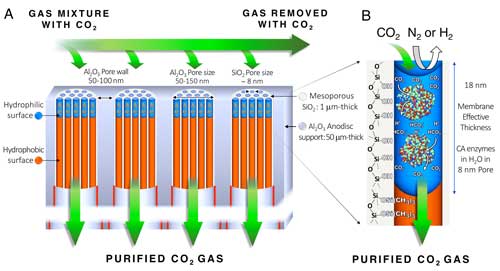
Enzymatic liquid membrane design and mechanism of carbon dioxide capture and separation
Enzymatic liquid membrane design and mechanism of carbon dioxide capture and separation. The Sandia/University of New Mexico membrane is fabricated by formation of 8-nanometer diameter mesopores. Using atomic layer deposition and oxygen plasma processing, the silica mesopores are engineered to be hydrophobic except for an 18-nm-deep region at the pore surface which is hydrophilic. Through capillary condensation, carbonic anhydrase enzymes and water spontaneously fill the hydrophilic mesopores to form an array of stabilized enzymes with an effective concentration greater than 10 times of that achievable in solution. These catalyze the capture and dissolution of carbon dioxide at the upstream surface and the regeneration of carbon dioxide at the downstream surface. The high enzyme concentration and short diffusion path maximizes capture efficiency and flux. (Image: Sandia National Laboratories) (click on image to enlarge)
The memzyme meets the Department of Energy’s standards by capturing 90 percent of power plant carbon dioxide production at a relatively low cost of $40 per ton.
Researchers term the membrane a „memzyme” because it acts like a filter but is near-saturated with an enzyme, carbonic anhydrase, developed by living cells over millions of years to help rid themselves of carbon dioxide efficiently and rapidly.
„To date, stripping carbon dioxide from smoke has been prohibitively expensive using the thick, solid, polymer membranes currently available,” says Jeff Brinker, a Sandia fellow, University of New Mexico regents’ professor and the paper’s lead author.
„Our inexpensive method follows nature’s lead in our use of a water-based membrane only 18 nanometers thick that incorporates natural enzymes to capture 90 percent of carbon dioxide released. This is almost 70 percent better than current commercial methods, and it’s done at a fraction of the cost.”
Coal power plants are one of the United States’ largest energy producers, but they have been criticized by some for sending more carbon dioxide into the atmosphere than any other form of electrical power generation. Still, coal burning in China, India and other countries means that U.S. abstinence alone is not likely to solve the world’s climate problems. But, says Brinker, „maybe technology will.”
The device’s formation begins with a drying process called evaporation-induced self-assembly, first developed at Sandia by Brinker 20 years ago and a field of study in its own right.
The procedure creates a close-packed array of silica nanopores designed to accommodate the carbonic anhydrase enzyme and keep it stable. This is done in several steps. First, the array, which may be 100 nanometers long, is treated with a technique called atomic layer deposition to make the nanopore surface water-averse or hydrophobic. This is followed by an oxygen plasma treatment that overlays the water-averse surface to make the nanopores water-loving or hydrophilic, but only to a depth of 18 nanometers. A solution of the enzyme and water spontaneously fill up and are stabilized within the water-loving portion of the nanopores. This creates membranes of water 18 nanometers thick, with a carbonic anhydrase concentration 10 times greater than aqueous solutions made to date.
The solution, at home in its water-loving sleeve, is stable. But because of the enzyme’s ability to rapidly and selectively dissolve carbon dioxide, the catalytic membrane has the capability to capture the overwhelming majority of carbon dioxide molecules that brush up against it from a rising cloud of coal smoke. The hooked molecules then pass rapidly through the membranes, driven solely by a naturally occurring pressure gradient caused by the large number of carbon dioxide molecules on one side of the membrane and their comparative absence on the other. The chemical process turns the gas briefly into carbonic acid and then bicarbonate before exiting immediately downstream as carbon dioxide gas. The gas can be harvested with 99 percent purity – so pure that it could be used by oil companies for resource extraction. Other molecules pass by the membrane’s surface undisturbed. The enzyme is reusable, and because the water serves as a medium rather than an actor, does not need replacement.
The nanopores dry out over long periods of time due to evaporation. This will be checked by water vapor rising from lower water baths already installed in power plants to reduce sulfur emissions. And, enzymes damaged from use over time can easily be replaced.
Says Brinker, „The very high concentration of carbonic anhydrase, along with the thinness of the water channel, result in very high carbon dioxide flux through the membrane. The greater the carbonic anhydrase concentration, the greater the flux. The thinner the membrane, the greater the flux.”
The membrane’s arrangement in a generating station’s flue would be like that of a catalytic converter in a car, suggests Brinker. The membranes would sit on the inner surface of a tube arranged like a honeycomb. The flue gas would flow through the membrane-embedded tube, with a carbon dioxide-free gas stream on the outside of the tubes. Varying the tube length and diameter would optimize the carbon dioxide extraction process.
„Energy companies and oil and gas utilities have expressed interest in optimizing the gas filters for specific conditions,” says Susan Rempe, Sandia researcher and co-author, who suggested and developed the idea of inserting carbonic anhydrase into the water solution to improve the speed by which carbon dioxide could be taken up and released from the membrane. „The enzyme can catalyze the dissolution of a million carbon dioxide molecules per second, vastly improving the speed of the process. With optimization by industry, the memzyme could make electricity production cheap and green,” she says.
The separation process could increase the amount of fuel obtained by enhanced oil recovery using carbon dioxide injected into existing reservoirs.
A slightly different enzyme, used in the same process, can convert methane – an even more potent greenhouse gas – to the more soluble methanol for removal, she says.
Prior cleansing by industrial scrubbers means that the rising smoke will be clean enough not to significantly impair membrane efficiency, says University of New Mexico professor and paper co-author Ying-Bing Jiang, who originated and developed the idea of using watery membranes based on the human body’s processes to separate out carbon dioxide. The membranes have operated efficiently in laboratory settings for months.
The procedure also could sequester carbon dioxide on a spacecraft, the authors mention, because the membranes operate at ambient temperatures and are driven solely by chemical gradients.
Source: Sandia National Laboratory

Piroliza deșeurilor de polistiren în prezența cărbunelui activ în încălzire convențională și cu microunde utilizând termocuplu modificat(Pyrolysis of polystyrene waste in the presence of activated carbon in conventional and microwave heating using modified thermocouple)

Procesul de piroliză a fost experimentat utilizând două tipuri de surse de încălzire, și anume convenționale și microunde. Deșeul de plastic din polistiren (PS) a fost utilizat ca materie primă într-un reactor discontinuu atât pentru piroliza convențională (piroliză lentă), cât și pentru piroliza în microunde. Sa studiat efectul raportului dintre carbonul activ și polistiren asupra (i) randamentului de ulei, gaz și reziduuri (ii) temperatura de reacție (iii) timpul de reacție. Calitatea uleiului din piroliza polistirenului a fost evaluată pentru posibila aplicabilitate în producția de combustibil. Puterea cu microunde de 450 W și raportul polimer cu cărbune activ de 10: 1, a condus la cel mai mare randament al uleiului de 93,04% în greutate cu o valoare de încălzire mai mare de 45 MJ kg -1și o viscozitate cinematică de 2,7 cSt. Încălzirea cu microunde în comparație cu metoda de încălzire convențională prezintă o temperatură de reacție și un timp de 330 ° C în 5,5 minute, în timp ce în sistemul de încălzire convențional a fost de 418 ° C în 60 de minute

Pyrolysis of polystyrene waste in the presence of activated carbon in conventional and microwave heating using modified thermocouple

Highlights

•

PSW was rapidly processed in microwave pyrolysis.

Temperature measurement using modified chromel-alumel thermocouple.

A reaction temperature of 330 °C in 5.5 min.

Viscosity of the oil was 2.7 cSt.

Abstract

Pyrolysis process was experimented using two types of heating source, namely conventional and microwave. Polystyrene (PS) plastic waste was used as feedstock in a batch reactor for both the conventional (slow pyrolysis) and microwave pyrolysis. The effect of activated carbon to polystyrene ratio on (i) yield of oil, gas and residues (ii) reaction temperature (iii) reaction time were studied. Quality of oil from pyrolysis of polystyrene were assessed for the possible applicability in fuel production. Microwave power of 450 W and polymer to activated carbon ratio of 10:1, resulted in the highest oil yield of 93.04 wt.% with a higher heating value of 45 MJ kg−1 and a kinematic viscosity of 2.7 cSt. Microwave heating when compared to conventional heating method, exhibits a reaction temperature and time of 330 °C in 5.5 min, whereas in conventional heating system it was 418 °C in 60 min. The gas chromatography-mass spectrometry analysis of liquid oil from microwave pyrolysis predominantly yields alkenes of 8.44 wt.%, α-methyl styrene 0.96 wt.%, condensed ring aromatics 23.21 wt.% and benzene derivatives 26.77 wt.% when the polystyrene to activated carbon ratio was 10:1. Significant factor of using microwave heating is the amount of energy converted (kWh) is lesser than conventional heating.

Keywords

Microwave
Pyrolysis
Polystyrene
Activated carbon

Recycling process for expanded polystyrene wastes(Procesul de reciclare a deșeurilor de polistiren expandat)

Se dezvăluie un proces de reciclare ecologic pentru deșeurile din polistiren expandat (EPS), utilizând procesul de dizolvare și procesul de extracție CO 2 supercritică . Procesul de reciclare poate permite condensarea unui polistiren expandat (EPS) prin dizolvarea EPS într-un solvent și unul sau mai mulți aditivi, obținându-se astfel o soluție de polistiren expandat (EPS). Procesul de reciclare poate permite în continuare purificarea soluției EPS folosind cel puțin un procedeu de filtrare și un proces de separare pentru a obține o soluție de polistiren expandat purificat (EPS). Mai mult, procesul de reciclare poate permite extragerea polistirenului din solvent în soluția de polistiren expandat purificat (EPS) folosind un CO 2 supercriticmetoda de extracție pentru obținerea unui polistiren reciclat. Procesul de reciclare permite reducerea semnificativă a volumului EPS, economisind astfel costurile logistice, precum și facilitarea creșterii cantității, calității și purității polistirenului reciclat.

Reciclare polistiren

Filtrele noi ar putea permite producătorilor să efectueze separări chimice foarte selective(New filters could enable manufacturers to perform highly selective chemical separation)

Membranele se bazează pe polimeri care se auto-asamblează, formează nanostructuri și expun funcționalități chimice care le permit să îndeplinească sarcini care nu sunt așteptate de la membrane. Ei elimină nu numai bacteriile, ci și metalele grele, reacționează la stimuli și separă moleculele mici de structura chimică. În ansamblu, obiectivul este de a dezvolta membrane care să contribuie la generarea mai eficientă a apei curate și mai sigure și la separarea substanțelor chimice cu consum redus de energie.

Posted: Jan 23, 2018

New filters could enable manufacturers to perform highly selective chemical separation

(Nanowerk News) A team of chemical and biological engineers has developed highly selective membrane filters that could enable manufacturers to separate and purify chemicals in ways that are currently impossible, allowing them to potentially use less energy and cut carbon emissions, according to findings published in print today in the journal ACS Nano („Selective Transport through Membranes with Charged Nanochannels Formed by Scalable Self-Assembly of Random Copolymer Micelles”).

Tufts University scientists said the sophisticated membranes can separate organic compounds not only by size–as small as a molecule–but also by their electrostatic charge, meaning manufacturers could sort compounds by both size and type. The membranes use a simple, scalable process in which a specialty polymer is dissolved in a solvent and coated onto a porous support. The polymer self-assembles to create approximately 1 nanometer size channels that mimic biological systems, such as ion channels, which control the passage of compounds through cell membranes with great effectiveness.
Membrane structure
Membrane structure; the top layer (pink) shows selective layer morphology containing packed micelles. The spaces between the micelles form membrane nanopores with size of 1-3 nanometer. (Image: Ilin Sadeghi, study co-author and Tufts University Ph.D. candidate)
Corresponding-author Ayse Asatekin, Ph.D., a chemical and biological engineering professor in the Tufts School of Engineering, said the team’s discovery responds to industry-wide calls for the development of more efficient solutions for separating chemicals, which accounts for 10 to 15 percent of global energy use, according to a report in Nature.
„Our study is promising because it is the first demonstration of a new way of making these selective membranes that are so important for chemical manufacturing,” she said. „Designing very selective membranes that can perform these complex separations could really boost energy efficiency and greatly reduce manufacturing waste.”
The newly designed membranes can:
  • Allow neutral compounds to pass through 250 times faster than charged compounds of similar size;
  • When charged and uncharged compounds are mixed, prevent the charged compound from passing through at all–its passage is averted because the neutral compound gets into the channels first and prevents the charge compound from entering; and
  • Provide the ability to separate charged and uncharged compounds in various filtration systems.
Asatekin noted that the charge-based separation is enhanced when the solution contains a mixture of solutes, which indicates that the membrane structure successfully mimics how biological systems such as ion channels operate. This discovery has led the researchers to believe that this approach can be used to address other separations, and bring about selectivities above and beyond what can be attained using conventional membranes.
„This means we could potentially make filters that are capable of separations that cannot be achieved currently. Filters today usually are limited to separating big from small, and we want to be able to separate compounds that are the same size but different,” Asatekin said.
Asatekin noted some potential applications for this project include the purification of antibiotics, amino acids, antioxidants and other small molecule biologic compounds, and the separation of ionic liquids from sugar in biorefinery facilities. However, she said she believes this general approach may potentially be adapted further to different separations with further research.
Asatekin serves as the principal investigator of the Smart Polymers, Membranes, and Separations Laboratory at Tufts. The lab aims to develop the next generation of membranes by designing them from molecules up. The membranes rely on polymers that self-assemble, form nanostructures, and expose chemical functionalities that enable them to perform tasks normally not expected from membranes. They remove not only bacteria but also heavy metals, react to stimuli, and separate small molecules by chemical structure. Overall, the goal is to develop membranes that will help generate clean, safe water more efficiently and separate chemicals with lower energy use.
Source: Tufts University

Caracterizarea noului material compozit bazat pe foile de palmier date și deșeurile din polistiren expandat(

Testele de caracterizare termică a LPC au arătat și o conductivitate termică medie cuprinsă între 0,11 și 0,16 W / m · K. LPC poate fi utilizat în domeniul construcțiilor de construcții ca o bună izolare termică, precum și o componentă structurală în structurile sandwich. Mai mult, materialul LPC este obținut din deșeuri și poate fi reciclat în întregime la sfârșitul duratei sale de utilizare.

https://doi.org/10.1016/j.conbuildmat.2017.12.197

Caracterizarea noului material compozit bazat pe foile de palmier date și deșeurile din polistiren expandat

În scopul protecției mediului și valorificării resurselor vegetale, se efectuează un studiu experimental privind un material inovativ din lemn-plastic compozit (WPC) bazat pe date Palm și polistiren expandat, EPS, deșeuri. Data de deșeuri de folii de palmier sunt folosite ca armături, iar deșeurile EPS dizolvate în benzină sunt utilizate ca matrice. S-au considerat mai multe combinații de mărimi de întărire (0,1-0,315 mm, 0,315-0,5 mm și 0,5-1 mm) și raporturi de greutate fibră-matrice (70, 75 și 80% în greutate) pentru a investiga proprietățile compozitului de foițe-polistiren (LPC). În acest studiu s-au efectuat caracterizări fizice, mecanice, termice și morfologice pentru a determina: densitatea în vrac, modulul de flexiune, tensiunea maximă și conductivitatea termică a LPC. Prin urmare, măsurarea densității Pycnometer, testul de îndoire în trei puncte s-a efectuat și s-a folosit metoda sursă de căldură plană tranzitorie (hotdisc). Mai mult, o caracterizare prin microscopie electronică de scanare (SEM) a fost realizată pentru a observa legătura fibrelor / matricei. LPC a demonstrat o bună stare de adeziune a interfeței matrice-fibră și a unor proprietăți mecanice acceptabile, cu un modul de flexiune și un efort maxim care poate atinge 0,78 GPa și respectiv 2,84 MPa. LPC are o densitate cuprinsă între 542 și 824 kg / m3 care sunt comparabile cu cele ale materialelor obișnuite, cum ar fi lemnul tare și moale, MDF și alte tipuri de pulbere de sticlă WPC găsite în literatură. Testele de caracterizare termică a LPC au arătat și o conductivitate termică medie cuprinsă între 0,11 și 0,16 W / m · K. LPC poate fi utilizat în domeniul construcțiilor de construcții ca o bună izolare termică, precum și o componentă structurală în structurile sandwich. Mai mult, materialul LPC este obținut din deșeuri și poate fi reciclat în întregime la sfârșitul duratei sale de utilizare.

Sticla cu opacitate comutativă ar putea îmbunătăți celulele solare și LED-urile(Glass with switchable opacity could improve solar cells and LEDs)

au creat sticlă care permite o cantitate mare de lumină în timp ce apare tulbure. Aceasta este prima dată când sticla a fost făcută cu un nivel ridicat de opacitate și de transmisie a luminii în același timp, o combinație de proprietăți care ar putea contribui la creșterea performanței celulelor solare și a LEDurilor.

Posted: Dec 11, 2017

Glass with switchable opacity could improve solar cells and LEDs

(Nanowerk News) Using nanoscale grass-like structures, researchers at the University of Pittsburgh, Pennsylvania have created glass that lets through a large amount of light while appearing hazy. This is the first time that glass has been made with such high levels of haze and light transmittance at the same time, a combination of properties that could help boost the performance of solar cells and LEDs.

The glass exhibits another remarkable quality: It can be switched from hazy to clear by applying water. This could make it useful for creating smart windows that change haze or opacity to control the privacy of a room or to block glare from sunlight.
„Switchable glass available today is quite expensive because it uses transparent conducting layers to apply a voltage across the entire glass,” said Paul W. Leu of the University of Pittsburgh’s Swanson School of Engineering, leader of the research team. „Our glass would be potentially less expensive to make because its opacity can be switched in a matter of seconds by simply applying or removing liquid.”
The top image shows that text can be read through normal flat glass, while the glass etched with nanostructure scatters light, making the glass appear opaque
Researchers created a new type of glass that is etched with nanograss structures. The top image shows that text can be read through normal flat glass, while the glass etched with nanostructure scatters light, making the glass appear opaque. This glass could help boost the performance of solar cells and LEDs. (Image: Sajad Haghanifar, University of Pittsburgh)
In Optica („Ultrahigh Transparency, Ultrahigh Haze Nanograss Glass with Fluid-Induced Switchable Haze”), The Optical Society’s journal for high impact research, the researchers describe their new nanograss-based glass, which achieves a record 95 percent light transmittance and a similarly high degree of haze at the same time. The researchers experimented with glass etched with nanograss structures from 0.8 to 8.5 microns in height with „blades” each measuring a few hundred nanometers in diameter.
The discovery of switchability was one of serendipity. „I was cleaning the new nanograss glass when I discovered that cleaning it with water made the glass become clear,” said project lead, graduate student Sajad Haghanifar. While the discovery was incidental, it can be easily explained. „The water goes between the extremely hydrophilic nanostructures, making the nanograss glass act like a flat substrate. Because water has a very similar index of refraction to the glass, the light goes straight through it. When the water is removed, the light hits the scattering nanostructures, making the glass appear hazy.”

Using nanograss to improve solar cells

Leu’s group developed the new glass to improve the ability of solar cells to capture light and turn it into power. Nanostructure patterns can prevent light from reflecting off the solar cell’s surface. These structures also scatter the light that enters the glass, helping more of the light reach the semiconductor material within the solar cell, where it is converted into power.
The new glass uses a unique pattern of nanostructures that looks much like grass. Because the structures are taller than previously-used nanostructures, they increase the likelihood that light will be scattered. Although glass with the nanostructures appears opaque, tests showed that most of the scattered light makes its way through the glass.
The fact that the glass is highly hazy and exhibits high transmittance could also make it useful for LEDs, which work in a way that is essentially the opposite of a solar cell, by using electricity that enters a semiconductor to produce light that is then emitted from the device. The new glass could potentially increase the amount of light that makes it from the semiconductor into the surroundings.
New glass etched with nanograss structures can be switched from hazy to clear by applying water
New glass etched with nanograss structures can be switched from hazy to clear by applying water. As shown here, removing the water from the glass makes it appear hazy again. This switchable glass could offer a simple and inexpensive way to make smart windows that change between clear and opaque. (Image: Sajad Haghanifar, University of Pittsburgh)

Finding the right ‘grass’ height

The researchers found that shorter nanograss improved the antireflection properties of the glass while longer nanograss tended to increase the haze. Glass with 4.5-micron-high nanograss showed a nice balance of 95.6 percent transmittance and 96.2 percent haze for light with a 550-nanometer wavelength (yellow light, a component of sunlight).
Although more work is needed to estimate the exact cost of manufacturing the new glass, the researchers predict that their glass will be inexpensive because it is easy to make. The nanostructures are etched into the glass using a process known as reactive ion etching, a scalable and straightforward method commonly used to make printed circuit boards.
To turn the glass into a smart window that switches from hazy to clear, it would require placing a piece of traditional glass over the nanograss glass. Pumps could be used to flow liquid into the space between the two glasses, and a fan or pump could be used to remove the water. The researchers also showed that in addition to water, applying acetone and toluene can also switch the glass from hazy to clear.
„We are now conducting durability tests on the new nanograss glass and are evaluating its self-cleaning properties,” said Haghanifar. „Self-cleaning glass is very useful because it prevents the need for robotic or manual removal of dust and debris that would reduce the efficiency of solar panels, whether the panels are on your house or on a Mars rover.”
Source: The Optical Society