Determinarea simultană a DTPA, EDTA și NTA prin spectrometrie vizibilă UV și HPLC(Simultaneous determination of DTPA, EDTA, and NTA by UV-visible spectrometry and HPLC )

Spectrofotometria vizibilă UV și cromatografia lichidă de înaltă performanță au fost utilizate pentru analiza simultană a agenților de chelatizare a acidului dietilenetriamin pentaacetic, a acidului etilen-diamină tetraacetic și a acidului nitrilotriacetic, ca chelați metalici în detergenții de spălare a apei,

Stimp31

Separarea metanului și a CO2 va deveni mai eficientă(Separating methane and CO2 will become more efficient)

Cercetătorii de la KU Leuven (Universitatea din Leuven), Belgia, au dezvoltat o nouă membrană care face procesul de separare mult mai eficient ( Energy & Environmental Science , „Membrană selectivă de separare a gazelor cu ajutorul structurilor organice metalice amorficate in situ” ).
Aceasta conferă noii membrane cea mai mare selectivitate raportată vreodată, prevenind în același timp plastificarea atunci când concentrația de CO 2 este ridicată. „Dacă începe cu un 50/50 de CO 2 / amestec de metan, această membrană vă oferă 164 de ori mai mult CO 2 decât metan după permeabilitatea prin membrana“ , explica Dr. Lik Hong Wee. „Acestea sunt cele mai bune rezultate înregistrate vreodată în literatura științifică.”

Posted: Oct 18, 2017

Separating methane and CO2 will become more efficient

(Nanowerk News) To make natural gas and biogas suitable for use, the methane has to be separated from the CO2. This involves the use of membranes: filters that stop the methane and let the CO2 pass through. Researchers at KU Leuven (University of Leuven), Belgium, have developed a new membrane that makes the separation process much more effective (Energy & Environmental Science, „Highly selective gas separation membrane using in situ amorphised metal–organic frameworks”).

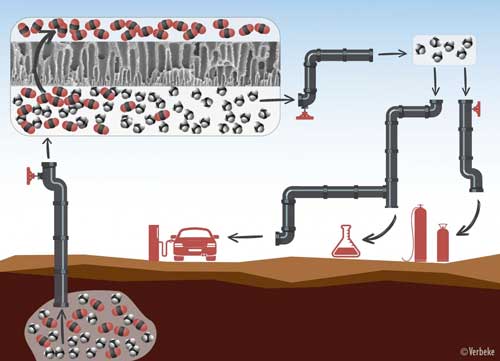
When it comes to extracting natural gas or producing biogas, it’s all about the methane. But methane is never found in its pure form. Natural gas, for instance, always contains quite a bit of carbon dioxide (the greenhouse gas CO2), sometimes up to 50 percent. To purify the methane – or, in other words, remove the CO2 – the industry often uses membranes. These membranes function as molecular sieves that separate the methane and the CO2. The methane can then be used as a source of energy for heating, for the production of chemicals, or as fuel, while the CO2can be reused as a building block for renewable fuels and chemicals.
New Membrane Makes Separation of Methane and C02 More Efficient
Natural gas or biogas always needs to be purified before use. First, the methane molecules (in black and white) are separated from the CO2 molecules (in red and black) by means of membranes with tiny pores through which only the CO2 can pass. After the purification process, the methane can be used as fuel, for heating, or for the production of chemicals. (Image: KU Leuven – Verbeke)
Existing membranes still need to be improved for effective CO2 separations, says Professor Ivo Vankelecom from the KU Leuven Faculty of Bioscience Engineering. „An effective membrane only allows the CO2 to pass through, and as much of it as possible. The commercially available membranes come with a trade-off between selectivity and permeability: they are either highly selective or highly permeable. Another important problem is the fact that the membranes plasticise if the gas mixture contains too much CO2. This makes them less efficient: almost everything can pass through them, so that the separation of methane and CO2 fails.”
The best available membranes consist of a polymeric matrix with a filler in it, for instance a metal-organic framework (MOF). This MOF filler has nanoscale pores. The new study has shown that the characteristics of such a membrane improve significantly with a heat treatment above 160 degrees Celsius during the production process. „You get more crosslinks in the polymeric matrix: the net densifies, so to speak, and that in itself already improves the membrane performance, because it can no longer plasticise. At these temperatures, the structure of the MOF – the filler – changes, and it becomes more selective. Finally, the high-temperature treatment also improves polymer-filler adhesion: the gas mixture can no longer escape through little holes at the filler-polymer interface.”
This gives the new membrane the highest selectivity ever reported, while preventing plasticisation when the concentration of CO2 is high. „If you start off with a 50/50 CO2/methane mixture, this membrane gives you 164 times more CO2 than methane after permeation through the membrane,” Dr Lik Hong Wee explains. „These are the best results ever reported in scientific literature.”
Source: KU Leuven

Cercetătorii dezvoltă un generator solar termoelectric purtător(Researchers develop wearable solar thermoelectric generator)

a introdus un nou sistem avansat de recoltare a energiei, capabil să genereze electricitate pur și simplu atașat la haine, ferestre și pereți exteriori o clădire ( Nano Energy , „Generator termoelectric purtător solar, condus de o diferență de temperatură fără precedent” ).
Acest nou dispozitiv se bazează pe o diferență de temperatură între părțile calde și cele reci. Diferența de temperatură poate fi mărită cu până la 20,9 ° C, care este mult mai mare decât diferențele de temperatură tipice de 1,5 până la 4,1 ° C ale generatoarelor termoelectrice purtate de căldură. Echipa de cercetare se așteaptă ca generatorul lor termoelectric purtător solar să propună o modalitate promițătoare de a îmbunătăți în continuare eficiența prin creșterea diferenței de temperatură.

Posted: Sep 26, 2017

Researchers develop wearable solar thermoelectric generator

(Nanowerk News) A recent study, led by Professor Kyoung Jin Choi in the School of Materials Science and Engineering at UNIST has introduced a new advanced energy harvesting system, capable of generating electricity by simply being attached to clothes, windows, and outer walls of a building (Nano Energy, „Wearable solar thermoelectric generator driven by unprecedentedly high temperature difference”).

This new device is based on a temperature difference between the hot and cold sides. The temperature difference can be increased as high as 20.9°C, which is much higher than the typical temperature differences of 1.5 to 4.1°C of wearable thermoelectric generators driven by body heat. The research team expects that their wearable solar thermoelectric generator proposes a promising way to further improve the efficiency by raising the temperature difference.
thermoelectric ink printed in lines and shapes
This is a photograph of the TE ink printed in various shapes with curves and straight lines. (Image: UNIST)
Energy harvesting is a diverse field encompassing many technologies, which involve a process that captures small amounts of energy that would otherwise be lost as heat, light, sound, vibration, or movement. A thermoelectric generator (TEGs) refers to a device that converts waste heat energy, such as solar energy, geothermal energy, and body heat into additional electrical power.
There has been a great increase in the study of wearable thermoelectric (TE) generators using the temperature difference between the body heat and surrounding environment. However, one of the main drawbacks of wearable TEG techniques driven by body heat was that such temperature difference is only 1-4 °C and this has hindered further commercialization.
The research team solved this low temperature difference faced by conventional wearable TEGs by introducing a local solar absorber on a PI substrate. The solar absorber is a five-period Ti/MgF2 superlattice, in which the structure and thickness of each layer was designed for optimal absorption of sunlight. This has increased the temperature difference as high as 20.9°C, which is the highest value of all wearable TEGs reported to date.
„Through this study, we have secured a temperature difference with the ten-fold increase from the conventional wearable solar thermoelectric generators,” says Yeon Soo Jung in the Graduate School of Materials Science and Engineering at UNIST. „Since the output of a TE generator is proportional to the square root of the temperature difference, one can significantly increase the output with the help of this technology.”
In this study, Professor Choi and his team designed a noble wearable solar thermoelectric generator (W-STEG) by integrating flexible BiTe-based TE legs and sub-micron thick solar absorbers on a polymide (PI) substrate. The TE legs were prepared by dispenser printing with an ink consisting of mechanically alloyed BiTe-based powders and an Sb2Te3-based sintering additive dispersed in glycerol. They report that a W-STEG comprising 10 pairs of p-n legs has an open-circuit voltage of 55.15 mV and an output power of 4.44 µW when exposed to sunlight.
„Our new werable STEG is expected to be useful in various applications, such as in self-powered wearable electronic devices,” says Professor Choi. „It will also serve as a catalyst to further improve the future wearable electronic technology market.”
Source: Ulsan National Institute of Science and Technology

Nanopore filtru poate fi un meci pentru fracking de apă(Nanopore filter may be a match for fracking water)

Un nou filtru superhidrofil sa dovedit a fi capabil sa indeparteze mai mult de 90% din hidrocarburi, precum si toate bacteriile si particulele din apa contaminata produsa prin operatiuni de fracturare hidraulica (fracking) la sisturi de petrol si gaze,

Posted: Sep 25, 2017

Nanopore filter may be a match for fracking water

(Nanowerk News) A new superhydrophilic filter has proven able to remove greater than 90 per cent of hydrocarbons, as well as all bacteria and particulates from contaminated water produced by hydraulic fracturing (fracking) operations at shale oil and gas wells, according to researchers at the Energy Safety Research Institute at Swansea University in collaboration with researchers at Rice University.

The work by Prof Andrew R Barron and his colleagues turns a ceramic membrane with microscale pores into a superhydrophilic filter that „essentially eliminates” the common problem of fouling.
The researchers determined one pass through the membrane should clean contaminated water enough for reuse at a well, significantly cutting the amount that has to be stored or transported.
The work is reported in Nature’s open-access Scientific Reports („Superhydrophilic Functionalization of Microfiltration Ceramic Membranes Enables Separation of Hydrocarbons from Frac and Produced Water”).
The filters keep emulsified hydrocarbons from passing through the material’s ionically charged pores, which are about one-fifth of a micron wide, small enough that other contaminants cannot pass through. The charge attracts a thin layer of water that adheres to the entire surface of the filter to repel globules of oil and other hydrocarbons and keep it from clogging.
A hydraulically fractured well uses more than 5 million gallons of water on average, of which only 10 to 15 per cent is recovered during the flow back stage, Barron said.
„This makes it very important to be able to re-use this water”
Not every type of filter reliably removes every type of contaminant, he said.
Solubilized hydrocarbon molecules slip right through micro filters designed to remove bacteria. Natural organic matter, like sugars from guar gum used to make fracking fluids more viscous, require ultra- or nanofiltration, but those foul easily, especially from hydrocarbons that emulsify into globules. A multistage filter that could remove all the contaminants isn’t practical due to cost and the energy it would consume.
Frac water and produced waters represent a significant challenge on a technical level. If you use a membrane with pores small enough to separate they foul, and this renders the membrane useless. In our case, the superhydrophilic treatment results in an increased flux (flow) of water through the membrane as well as inhibiting any hydrophobic material – such as oil – from passing through. The difference in solubility of the contaminants thus works to allow for separation of molecules that should in theory pass through the membrane.
Barron and his colleagues used cysteic acid to modify the surface of an alumina-based ceramic membrane, making it superhydrophilic, or extremely attracted to water. The superhydrophilic surface has a contact angle of 5 degrees.
The acid covered not only the surface but also the inside of the pores, and that kept particulates from sticking to them and fouling the filter.
In tests with fracking flow back or produced water that contained guar gum, the alumna membrane showed a slow initial decrease in flux – a measure of the flow of mass through a material – but it stabilized for the duration of lab tests. Untreated membranes showed a dramatic decrease within 18 hours.
The researchers theorized the initial decrease in flow through the ceramics was due to purging of air from the pores, after which the superhydrophilic pores trapped the thin layer of water that prevented fouling.
„This membrane doesn’t foul, so it lasts,” Barron said. „It requires lower operating pressures, so you need a smaller pump that consumes less electricity. And that’s all better for the environment.”
„Fracking has proved highly controversial in the UK in part as a result of the pollution generated from produced waters”, co-author Darren Oatley-Radcliffe, an associate professor, at Swansea University, said, „However, with this new super-hydrophilic membrane we can clean up this waste produced water to a very high standard and recycle all of the materials, significantly improving the environmental performance of the fracking process.”
Source: Swansea University

Bateți căldura cu ajutorul filmelor cu nanoparticule(Beating the heat with nanoparticle films)

Nanoparticulele termocromice trec de la infraroșu transparent la reflector infraroșu atunci când se încălzesc, ceea ce va ajuta la menținerea clădirilor de birouri, a locuințelor și chiar a mașinilor răcoroase.Nanoparticule tunabile și reflexive.O echipă de cercetători, a petrecut câțiva ani încercând să dezvolte filme polimerice ușor de aplicat cu nanoparticule termochromice.

Beating

Evaluarea performanței unui material compozit bazat pe hârtie Kraft și o rășină formată cu deșeuri polistiren expandate

reciclarea deșeurilor din polistiren expandat (EPS), pentru a contribui la reducerea acumulării excesive a acestui material în depozitele de deșeuri sanitare din Mexic.

Evaluarea performanței unui material compozit bazat pe hârtie Kraft și o rășină formată cu deșeuri polistiren expandate: Un studiu de caz din Mexic

  • M. Jimenez-Francisco
  • J. A. Caamal-Canche
  • J. G. Carrillo 
  • Ricardo H. Cruz-Estrada

Abstract

Lucrarea de față propune reciclarea deșeurilor din polistiren expandat (EPS), pentru a contribui la reducerea acumulării excesive a acestui material în depozitele de deșeuri sanitare din Mexic. Procesul de recuperare a EPS este propus folosind un biosolvent (Lemon limonene-LL) pentru a prepara o soluție polimerică (EPS-LL), iar evaluarea sa ulterioară ca o acoperire pe o hârtie Kraft lignocelulozică de 200 g / m 2și o porozitate Gurley de 15-30 seg / 100 ml. Sa testat efectul diferitelor concentrații de rășină și straturile de acoperire cu rășină asupra rezistenței la compresiune și a rezistenței la tracțiune, precum și rezistența hârtiei tratate la absorbția apei. Rezultatele au arătat că straturile de acoperire au crescut treptat rezistența mecanică a hârtiei Kraft, atât la întindere, cât și la compresiune, dar numai până la o anumită greutate de rășină aplicată. Referitor la absorptiveness apei, hârtia tratată a arătat o reducere semnificativă a absorbției de apă, de la 230 g / m 2 , cu un strat de rășină până la 23 g / m 2cu trei straturi de rășină. Rezultatele demonstrează potențialul reciclării EPS pentru obținerea unui material compozit cu caracteristici hidrofobe bune și rezistență mecanică. Acest studiu are, de asemenea, intenția de a oferi o valoare adăugată a acestui polimer reciclat, mai degrabă decât de a continua obiceiul actual de ao elimina în depozitele de deșeuri sanitare.

/link.springer.com/article/10.1007/s10924-017-1073-7

Fezabilitatea structurală a panourilor de perete de tip sandwich pe bază de polistiren expandat (EPS)(

Se demonstrează că utilizarea acestui beton din spumă împreună cu plăcile din fibre de ciment generează un panou de perete ușor, care poate fi utilizat foarte eficient pentru pereții portanți ai caselor cu un singur nivel și a pereților neîncărcați ai clădirilor cu mai multe etaje

https://doi.org/10.1016/j.conbuildmat.2017.02.027

Într-un context global în care nevoia de locuințe de calitate crește, cu un nivel de trai mai ridicat și o populație în creștere, exploatarea excesivă a resurselor naturale ca materiale de construcție devine o problemă gravă. În acest context, transformarea materialelor reziduale ne-biodegradabile în produse de construcții de calitate ar fi extrem de utilă. În această cercetare, utilizarea polistirenului expandat mecanic reciclat ca 50% din EPS total utilizat într-un panou din beton spumos compozit a fost evaluată experimental. Rezultatele programului experimental au fost interpretate cu privire la diverse comportamente structurale utile în comprimare și flexiune. Se demonstrează că utilizarea acestui beton din spumă împreună cu plăcile din fibre de ciment generează un panou de perete ușor, care poate fi utilizat foarte eficient pentru pereții portanți ai caselor cu un singur nivel și a pereților neîncărcați ai clădirilor cu mai multe etaje. Aceste panouri ușoare pot permite o construcție rapidă, reducând în același timp greutatea totală a clădirii./science/article/pii/S0950061817302106

Utilizarea deșeurilor de polistiren pentru panoul de perete pentru a produce materiale de construcție verde

dezvoltarea materialelor ușoare de perete și promovarea materialelor verzi de construcție prin utilizarea deșeurilor din polistiren. Lucrarea prezintă studiul privind dezvoltarea panoului de perete din polistiren prin metoda precompactată. În această cercetare, polistirenul sfărâmat a fost amestecat cu ciment Portland și apă în diverse anumite proporții. Atunci când amestecul a fost amestecat deja în mod corespunzător, acesta a fost turnat în matrița de oțel de 30×80 cm. Amestecul din matriță a fost supus stresului de compactizare de până la 2 MPa, care reduce grosimea amestecului în aproximativ 1 cm. Panoul de polistiren a fost păstrat în zona umedă pentru întărire timp de aproximativ 28 de zile.Utilizarea deșeurilor de polistiren pentru panoul de perete pentru a produce materiale de construcție verde ☆
Link – uri Autor Deschideți panoul de acoperire Suprapto Siswosukarto un Ashar Saputra un I. Gede Yohan Kafrain b
Afișați mai multe
https://doi.org/10.1016/j.proeng.2017.01.406 Obțineți drepturi și conținut
Sub Creative Commons licență
Abstract
Structura peretelui care separă zonele de pardoseală contribuie semnificativ la greutatea clădirii care a pus-o într-un risc mai mare pentru evenimentul cutremur. Folosirea materialelor de perete mai ușoare este mai de dorit pentru a reduce riscul potențial de deteriorare datorat tratării cutremurelor. Această dezvoltare a panoului de pereți din polistiren este un efort de realizare a două obiective, și anume dezvoltarea materialelor ușoare de perete și promovarea materialelor verzi de construcție prin utilizarea deșeurilor din polistiren. Lucrarea prezintă studiul privind dezvoltarea panoului de perete din polistiren prin metoda precompactată. În această cercetare, polistirenul sfărâmat a fost amestecat cu ciment Portland și apă în diverse anumite proporții. Atunci când amestecul a fost amestecat deja în mod corespunzător, acesta a fost turnat în matrița de oțel de 30×80 cm. Amestecul din matriță a fost supus stresului de compactizare de până la 2 MPa, care reduce grosimea amestecului în aproximativ 1 cm. Panoul de polistiren a fost păstrat în zona umedă pentru întărire timp de aproximativ 28 de zile. Au fost 12 exemplare de panouri de perete realizate în acest scop. Rezultatul testului arată că la același efort de compactare, conținutul mai mare de ciment produce beton polistiren mai puternic. Rezistența medie la compresiune a specimenelor cu 250 kg / m 3 și 300 kg / m 3 conținut de ciment sunt de 4,9 MPa și 5,3 MPa, respectiv, și pentru rezistența la încovoiere sunt de 2,4 MPa și 3,3 MPa, respectiv. Rezultatul arată că rezistența la compresiune a matricei de beton și a panoului de rezistență la încovoiere este semnificativ mai mare. Cu toate acestea, la o încărcare repetată de aproximativ 10% din încărcătura maximă, panourile prezintă o scădere a rigidității în fiecare ciclu de sarcină, ceea ce sugerează capacitatea scăzută de tracțiune a matricei de beton. Aceste rezultate indică utilizarea potențială a panoului de perete din polistiren pentru scopurile materialelor de construcție, cu o atenție sporită la îmbunătățirea caracteristicilor de tracțiune ale matricei de beton.