Pigmentul produs de ciuperci arată promisiunea ca material semiconductor(Fungi-produced pigment shows promise as semiconductor material)

reprezintă prima utilizare a unui material produs de ciuperci într-un dispozitiv electric subțire.Cercetatorii de la Universitatea de Stat din Oregon se uita la un pigment organic durabil, folosit de om in lucrari de arta de sute de ani, ca o posibilitate promitatoare ca material semiconductor.
Constatările sugerează că ar putea deveni o alternativă durabilă, ieftină și ușor fabricată la siliciu în aplicații electronice sau optoelectronice, unde nu sunt necesare capacitățile de înaltă performanță ale siliciului.
Optoelectronica este o tehnologie care lucrează cu utilizarea combinată a luminii și electronicii, cum ar fi celulele solare, iar pigmentul studiat este xylindein.

Posted: Jun 05, 2018

Fungi-produced pigment shows promise as semiconductor material

(Nanowerk News) Researchers at Oregon State University are looking at a highly durable organic pigment, used by humans in artwork for hundreds of years, as a promising possibility as a semiconductor material.

Findings suggest it could become a sustainable, low-cost, easily fabricated alternative to silicon in electronic or optoelectronic applications where the high-performance capabilities of silicon aren’t required.
Optoelectronics is technology working with the combined use of light and electronics, such as solar cells, and the pigment being studied is xylindein.
Chlorociboria Aeruginascens fungus on a tree log
Chlorociboria Aeruginascens fungus on a tree log. (Image: Oregon State University)
„Xylindein is pretty, but can it also be useful? How much can we squeeze out of it?” said Oregon State University physicist Oksana Ostroverkhova. „It functions as an electronic material but not a great one, but there’s optimism we can make it better.”
Xylindien is secreted by two wood-eating fungi in the Chlorociboria genus. Any wood that’s infected by the fungi is stained a blue-green color, and artisans have prized xylindein-affected wood for centuries.
The pigment is so stable that decorative products made half a millennium ago still exhibit its distinctive hue. It holds up against prolonged exposure to heat, ultraviolet light and electrical stress.
„If we can learn the secret for why those fungi-produced pigments are so stable, we could solve a problem that exists with organic electronics,” Ostroverkhova said. „Also, many organic electronic materials are too expensive to produce, so we’re looking to do something inexpensively in an ecologically friendly way that’s good for the economy.”
With current fabrication techniques, xylindein tends to form non-uniform films with a porous, irregular, „rocky” structure.
„There’s a lot of performance variation,” she said. „You can tinker with it in the lab, but you can’t really make a technologically relevant device out of it on a large scale. But we found a way to make it more easily processed and to get a decent film quality.”
Ostroverkhova and collaborators in OSU’s colleges of Science and Forestry blended xylindein with a transparent, non-conductive polymer, poly(methyl methacrylate), abbreviated to PMMA and sometimes known as acrylic glass. They drop-cast solutions both of pristine xylindein and a xlyindein-PMMA blend onto electrodes on a glass substrate for testing.
They found the non-conducting polymer greatly improved the film structure without a detrimental effect on xylindein’s electrical properties. And the blended films actually showed better photosensitivity.
„Exactly why that happened, and its potential value in solar cells, is something we’ll be investigating in future research,” Ostroverkhova said. „We’ll also look into replacing the polymer with a natural product – something sustainable made from cellulose. We could grow the pigment from the cellulose and be able to make a device that’s all ready to go.
„Xylindein will never beat silicon, but for many applications, it doesn’t need to beat silicon,” she said. „It could work well for depositing onto large, flexible substrates, like for making wearable electronics.”
This research, whose findings were recently published in MRS Advances („Fungi-Derived Pigments for Sustainable Organic (Opto)Electronics”), represents the first use of a fungus-produced material in a thin-film electrical device.
„And there are a lot more of the materials,” Ostroverkhova said. „This is just first one we’ve explored. It could be the beginning of a whole new class of organic electronic materials.”
Source: Oregon State University

Ultrascurt puls laser creat de nanoparticule de aur(Ultrafast laser pulse created by golden nanoparticles)

Pulsul generat de laserul cu matrice nanoparticule este atât de rapid încât nu există camere electronice convenționale care să-și poată capta dinamica. Cercetatorii au folosit un alt laser ca o „camera”, facand fotografii foarte rapide ale laserului mic. Metoda se numește spectroscopie sonda pompă.

Posted: May 02, 2018

Ultrafast laser pulse created by golden nanoparticles

(Nanowerk News) A new study shows that organic dye material combined with metallic nanostructures can provide ultrafast lasing dynamics with short and rapidly appearing laser pulses (Nano Letters, „Ultrafast Pulse Generation in an Organic Nanoparticle-Array Laser”).

‘We wanted to find out how fast we can turn our laser device on and off. Generating laser pulses quickly can be very useful in information processing and can improve the response of some optoelectronic devices,’ explains postdoctoral researcher Konstantinos Daskalakis at Aalto University.
The samples used in the experiments are made out of gold nanoparticles placed on glass and immersed in an organic, light-emitting material. The nanoparticles are arranged very close to each other in a square array. Electric fields localised around the particles result in high field strengths that speed up the molecular dynamics in the organic dye.
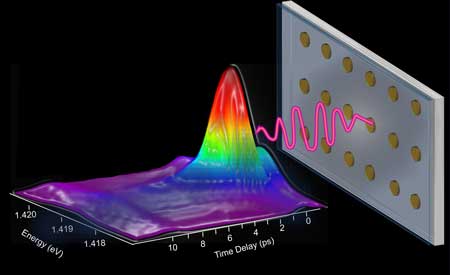
Illustration of the nanoparticle-array laser generating one-trillionth-of-a-second-long laser pulses
Illustration of the nanoparticle-array laser generating one-trillionth-of-a-second-long laser pulses. (Image: Konstantinos Daskalakis)
The electromagnetic fields and the conducting gold particles interact both with each other and the organic dye to generate a directional laser pulse that is ultrafast, one trillionth of a second long.
Generating a laser of this kind is promising for all-optical switching and sensing and will potentially improve the speed of optical telecommunications and performance of devices that use light to process information, such as cameras and transistors.
Very small nanolasers do not usually provide clearly directional beams. Arranging nanoparticles in an array considerably improves directionality. Such lasers have already been created in several laboratories in the world, but their potential for ultrafast pulses has not been proven before the experiments conducted at Aalto University.
Measuring the properties of the pulses is very demanding because of their tremendous speed.
‘The key achievement here is that we have succeeded in experimentally demonstrating that the laser pulses are indeed ultrafast. The lasing occurs in optical modes that are hybrids of light and the motion of electrons in metal. These modes are called surface lattice resonances,’ explains Academy Professor Päivi Törmä.
The laser light is first squeezed by the metallic nanoparticles into sub-wavelength dimensions, and then it escapes from the surface lattice resonance modes as a picosecond-fast, concentrated laser pulse.
‘These kinds of metal nanoparticle array lasers are excellent for generating pulsed laser radiation with a high modulation speed,’ says doctoral student Aaro Väkeväinen.
The pulse generated from the nanoparticle-array laser is so fast that there are no conventional electronic cameras that can capture its dynamics. The researchers used another laser as a “camera”, taking very fast pictures of the tiny laser. The method is called pump-probe spectroscopy.
Source: Aalto University

La testele pe teren, dispozitivul recoltează apă din aerul deșert(In field tests, device harvests water from desert air)

Sistemul, bazat pe materiale relativ noi de suprafață, numit cadre metalice organice (MOF), poate extrage apă potabilă chiar și din cel mai uscat aer de deșert, spun cercetătorii, cu o umiditate relativă de până la 10 procente. Metodele actuale de extragere a apei din aer necesită niveluri mult mai ridicate – 100% umiditate pentru metodele de recoltare a ceții și peste 50% pentru sistemele de refrigerare bazate pe rouă, care necesită și cantități mari de energie pentru răcire. Astfel, noul sistem ar putea umple eventual o nevoie nesatisfăcută de apă chiar și în regiunile cele mai uscate din lume.
Făcând un dispozitiv de testare pe un acoperiș la Universitatea Arizona de Stat din Tempe, Wang spune că echipa „a fost testată pe teren într-un loc reprezentativ pentru aceste zone aride și a arătat că putem recolta apa, chiar și în zonele de aburi subteroar

Posted: Mar 22, 2018

In field tests, device harvests water from desert air

(Nanowerk News) It seems like getting something for nothing, but you really can get drinkable water right out of the driest of desert air.

Even in the most arid places on Earth, there is some moisture in the air, and a practical way to extract that moisture could be a key to survival in such bone-dry locations. Now, researchers at MIT have proved that such an extraction system can work.
The new device, based on a concept the team first proposed last year, has now been field-tested in the very dry air of Tempe, Arizona, confirming the potential of the new method, though much work remains to scale up the process, the researchers say.
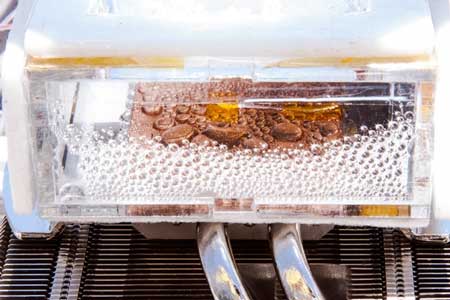
device that is able to extract moisture from very dry air
Researchers at MIT have developed a new device that is able to extract moisture from very dry air. (Image: MIT)
The new work is reported today in the journal Nature Communications („Adsorption-based atmospheric water harvesting device for arid climates”) and includes some significant improvements over the initial concept that was described last year in a paper in Science, says Evelyn Wang, the Gail E. Kendall Professor in the Department of Mechanical Engineering, who was the senior author of both papers. MIT postdoc Sameer Rao and former graduate student Hyunho Kim SM ’14, PhD ’18 were the lead authors of the latest paper, along with four others at MIT and the University of California at Berkeley.
Last year’s paper drew a great deal of attention, Wang says. “It got a lot of hype, and some criticism,” she says. Now, “all of the questions that were raised from last time were explicitly demonstrated in this paper. We’ve validated those points.”
The system, based on relatively new high-surface-area materials called metal-organic frameworks (MOFs), can extract potable water from even the driest of desert air, the researchers say, with relative humidities as low as 10 percent. Current methods for extracting water from air require much higher levels – 100 percent humidity for fog-harvesting methods, and above 50 percent for dew-harvesting refrigeration-based systems, which also require large amounts of energy for cooling. So the new system could potentially fill an unmet need for water even in the world’s driest regions.
By running a test device on a rooftop at Arizona State University in Tempe, Wang says, the team “was field-testing in a place that’s representative of these arid areas, and showed that we can actually harvest the water, even in subzero dewpoints.”
The test device was powered solely by sunlight, and although it was a small proof-of-concept device, if scaled up its output would be equivalent to more than a quarter-liter of water per day per kilogram of MOF, the researchers say. With an optimal material choice, output can be as high as three times that of the current version, says Kim. Unlike any of the existing methods for extracting water from air at very low humidities, “with this approach, you actually can do it, even under these extreme conditions,” Wang says.
Not only does this system work at lower humidities than dew harvesting does, says Rao, but those systems require pumps and compressors that can wear out, whereas “this has no moving parts. It can be operated in a completely passive manner, in places with low humidity but large amounts of sunlight.”
Whereas the team had previously described the possibility of running the system passively, Rao says, “now we have demonstrated that this is indeed possible.” The current version can only operate over a single night-and-day cycle with sunlight, Kim says, but “continous operation is also possible by utilizing abundant low-grade heat sources such as biomass and waste heat.”
The next step, Wang says, is to work on scaling up the system and boosting its efficiency. “We hope to have a system that’s able to produce liters of water.” These small, initial test systems were only designed to produce a few milliliters, to prove the concept worked in real-world conditions, but she says “we want to see water pouring out!” The idea would be to produce units sufficient to supply water for individual households.
The team tested the water produced by the system and found no traces of impurities. Mass-spectrometer testing showed “there’s nothing from the MOF that leaches into the water,” Wang says. “It shows the material is indeed very stable, and we can get high-quality water.”
„This technology is fantastic, because of the practical demonstration of an air-cooled water harvesting system based on MOFs operating in a real desert climate,” says Yang Yang, a professor of materials science and engineering at the University of California at Los Angeles, who was not involved in this work.
“This provides a new approach to solving the problem of water scarcity in arid climates,” Yang says. “This technology, if one can further increase its production capacity, can have a real impact in areas where water is scarce, such as southern California.”
Source: By David L. Chandler, MIT

Suprafețe rapide(Speedy surfaces)

Utilizarea potențială a suprafețelor care sunt super-lichide-respingătoare, de la textile de protecție și autocurățare, ochelari și ferestre pentru dispozitive medicale și membrane de schimb gazos. Aplicațiile de acoperiri rezistentă la lichide depind nu numai de proprietățile lor de umectare, ci și de transparența, robustețea și costul și viteza de fabricație. Pe lângă faptul că este superperceptiv împotriva lichidelor, această nouă acoperire prezintă o transparență ridicată și rezistă la impactul asupra uleiurilor și picăturilor de apă cu viteză mare.Deoarece timpul de expunere al substratului la flacără este extrem de scurt, pot fi acoperite chiar materiale foarte inflamabile cum ar fi hârtia și lemnul.

Posted: Mar 15, 2018

Speedy surfaces

(Nanowerk News) Researchers from the Max Planck Institute for Polymer Research in Mainz, Germany, and the Tampere University of Technology, Finland, have found a new way of applying a structured coating for liquid repellency (Advanced Materials, „Ultrafast Processing of Hierarchical Nanotexture for a Transparent Superamphiphobic Coating with Extremely Low Roll-Off Angle and High Impalement Pressure”).

By using liquid flame spray, the method is extremely fast. Not only water but also oil drops do not adhere to these surfaces but remain spherical and bounce or roll off easily.
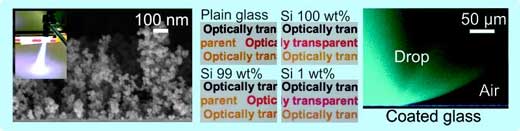
Coating by liquid flame spray
FLTR: Coating by liquid flame spray; surface SEM ; letters on paper below liquid repellent coating; confocal microscopy image of water drop resting on coating on glass. (© Wiley)
Potential applications of surfaces that are super liquid-repellent range from protective and self-cleaning textiles, goggles and windows for medical devices and gas exchange membranes. Applications of liquid-repellent coatings depend not only on their wetting properties, but also on their transparency, robustness, and fabrication cost and speed. Besides of being super-repellent against liquids, this new coating shows high transparency and withstands impacting high-velocity oil and water drops.
These extraordinary properties are based on a specific structure of the coating composed of nanometer-sized silicon dioxide–titanium dioxide particles. The method can be scaled up to coat large surface areas. Liquid flame spray is already used in industry to color glass and produce optical fibers. As the exposure time of the substrate to the flame is extremely short, even highly flammable materials like paper and wood can be coated.
The researchers have combined this fast and scalable processing method with the extraordinary liquid-repellent properties. They also discussed the criteria the coating needs to fulfill to achieve the superior liquid repellency. They described in detail how they managed to tune the coating morphology to meet these criteria. Their strategy can be widely applied to produce coatings composed of different materials because liquid flame spray can be used to synthesize a broad range of oxides, metal nanoparticles, and their mixtures.
Source: Max Planck Institute for Polymer Research

Cadrele metalice-organice reduc consumul de energie al produselor petrochimice(Metal-organic frameworks cut energy consumption of petrochemicals)

) În industria chimică și petrochimică, separarea moleculelor într-un mod eficient din punct de vedere energetic este una dintre cele mai importante provocări. În ansamblu, procesele de separare reprezintă aproximativ 40% din energia consumată în industria petrochimică, iar reducerea acestora poate contribui la soluționarea emisiilor de carbon antropice.
Unul dintre cele mai importante produse din industria petrochimică este propilena, care este utilizată pe scară largă în fibre, spumă, materiale plastice etc. Propilena purificatoare necesită aproape întotdeauna separarea acesteia de propan. În prezent, acest lucru se face prin distilare criogenică, unde cele două gaze sunt lichefiate prin răcire la temperaturi sub zero. Acest lucru conferă procesului de separare propilen-propan o amprentă foarte mare de energie.
O soluție este utilizarea „cadrelor metalice-organice” (MOF). Acestea sunt polimeri cristalini porosi, realizați din noduri metalice care sunt legate între ele prin liganzi organici. Porii din structura lor moleculară permit MF să capteze moleculele atât de eficient încât sunt acum candidați primari în cercetarea privind captarea carbonului.

Posted: Mar 15, 2018

Metal-organic frameworks cut energy consumption of petrochemicals

(Nanowerk News) In the chemical and the petrochemical industries, separating molecules in an energy-efficient way is one of the most important challenges. Overall, the separation processes account for around 40% of the energy consumed in the petrochemical industry, and reducing this can help addressing anthropogenic carbon emissions.

One of the most important products in the petrochemical industry is propylene, which is widely used in fibers, foams, plastics etc. Purifying propylene almost always requires separating it from propane. Currently this is done by cryogenic distillation, where the two gases are liquefied by being cooled to sub-zero temperatures. This gives the propylene-propane separation process a very large energy footprint.
A solution is to use „metal-organic frameworks” (MOF’s). These are porous, crystalline polymers made of metal nodes that are linked together by organic ligands. The pores in their molecular structure allow MOFs to capture molecules so efficiently that they are now prime candidates in carbon-capture research.
Ultrathin MOF Membrane on Commercial Polymer Support
This is an ultrathin MOF membrane on commercial polymer support. (Image: K.V. Agrawal/EPFL)
In terms of separating molecules, MOF-based membranes are among the highest performers, and can carry out the propylene-propane separation at ambient temperature. One MOF called ZIF-8 (zeolitic imidazolium frameworks-8), allows propylene to diffuse through its pores 125 times more efficiently than propane at 30oC, offering high selectivity without the need for sub-zero temperatures.
„The main challenge with this approach is to synthesize high-quality, ultrathin, MOF films on commercial porous substrates without complicated substrate modifications,” says Professor Kumar Varoon Agrawal at EPFL. „Such high-quality films have fewer defects and are necessary for obtaining the highest possible separation selectivity.”
His lab at EPFL Sion has now developed a straightforward MOF crystallization approach called „electrophoretic nuclei assembly for crystallization of highly-intergrown thin-films” (ENACT) (Advanced Functional Materials, „Electrophoretic Nuclei Assembly for Crystallization of High-Performance Membranes on Unmodified Supports”).
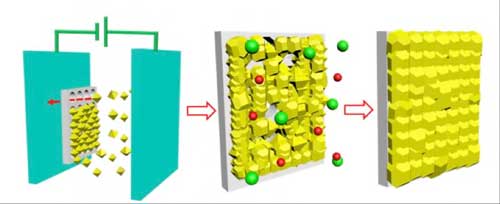
Electrophoretic Nuclei Assembly for Energy-efficient Separation Membrane
This is an electrophoretic nuclei assembly for energy-efficient separation membrane. (Image: K.V. Agrawal/EPFL)
The ENACT method allows simple regulation of the heterogeneous nucleation on unmodified (as-obtained) porous and nonporous substrates. This in turn facilitates the synthesis of ultrathin, highly intergrown polycrystalline MOF films.
The lab used the ENACT method to synthesize 500-nm-thick MOF membranes. When they tested them, the membranes yielded one of the best separation performances in propylene/propane separation recorded to date. The ultrathin film yielded large propylene permeance (flux normalized with pressure difference), which will help reduce the membrane area needed for industrial applications.
The group concludes that the versatile, straightforward ENACT method can be extended to a wide-range of nanoporous crystals.
Source: Ecole Polytechnique Fédérale de Lausanne

Materiale avansate Morgan, compozite și sisteme de apărare pentru a închide Coventry Factory-coausing masive Layoffs(Morgan Advanced Materials, Composites&Defense Systems to Close its Coventry Factory-Coausing Massive Layoffs)

Compania care produce vehicule blindate specializate și armuri de corp pentru Ministerul Apărării intenționează să închidă fabrica din Coventry.Au început consultări cu lucrătorii din fabrica Foleshill Road despre disponibilizări

Morgan