Designul de circuit nou promovează generatoarele termoelectrice care pot fi purtate(Novel circuit design boosts wearable thermoelectric generators)

cercetatorii au demonstrat ca generatoarele termoelectrice care pot recupera energia din caldura corporala pot fi folosite pentru a alimenta biosenzori simpli pentru masurarea frecventei cardiace, a respiratiei sau a altor factori.”Comunitatea electronică a făcut progrese extraordinare în înțelegerea proprietăților electronice și optice ale materialelor pe bază de polimeri. Construim aceste cunoștințe pentru a înțelege transportul termic și termoelectric în aceste polimeri pentru a permite noi funcționalități ale dispozitivului. ”
Printre celelalte perspective ale materialelor dezvoltate se numără dispozitive de răcire localizate care inversează procesul, folosind electricitatea pentru a transfera energia termică dintr-o parte a unui dispozitiv în altul. Răcirea doar a unor părți ale corpului ar putea oferi percepția confortului fără costul aerului condiționat mare.

Posted: Oct 09, 2017

Novel circuit design boosts wearable thermoelectric generators

(Nanowerk News) Using flexible conducting polymers and novel circuitry patterns printed on paper, researchers have demonstrated proof-of-concept wearable thermoelectric generators that can harvest energy from body heat to power simple biosensors for measuring heart rate, respiration or other factors.

Because of their symmetrical fractal wiring patterns, the devices can be cut to the size needed to provide the voltage and power requirements for specific applications. The modular generators could be inkjet printed on flexible substrates, including fabric, and manufactured using inexpensive roll-to-roll techniques.
“The attraction of thermoelectric generators is that there is heat all around us,” said Akanksha Menon, a Ph.D. student in the Woodruff School of Mechanical Engineering at the Georgia Institute of Technology. “If we can harness a little bit of that heat and turn it into electricity inexpensively, there is great value. We are working on how to produce electricity with heat from the body.”
The research was reported in the Journal of Applied Physics („Interconnect patterns for printed organic thermoelectric devices with large fill factors”)
Electrical conductivity is measured for a thermoelectric polymer film
Electrical conductivity is measured for a thermoelectric polymer film in the laboratory of Shannon Yee at the Georgia Institute of Technology. (Image: Georgia Tech)
Thermoelectric generators, which convert thermal energy directly into electricity, have been available for decades, but standard designs use inflexible inorganic materials that are too toxic for use in wearable devices. Power output depends on the temperature differential that can be created between two sides of the generators, which makes depending on body heat challenging. Getting enough thermal energy from a small contact area on the skin increases the challenge, and internal resistance in the device ultimately limits the power output.
To overcome that, Menon and collaborators in the laboratory of Assistant Professor Shannon Yee designed a device with thousands of dots composed of alternating p-type and n-type polymers in a closely-packed layout. Their pattern converts more heat per unit area due to large packing densities enabled by inkjet printers. By placing the polymer dots closer together, the interconnect length decreases, which in turn lowers the total resistance and results in a higher power output from the device.
“Instead of connecting the polymer dots with a traditional serpentine wiring pattern, we are using wiring patterns based on space filling curves, such as the Hilbert pattern – a continuous space-filling curve,” said Kiarash Gordiz, a co-author who worked on the project while he was a Ph.D. student at Georgia Tech. “The advantage here is that Hilbert patterns allow for surface conformation and self-localization, which provides a more uniform temperature across the device.”
The new circuit design also has another benefit: its fractally symmetric design allows the modules to be cut along boundaries between symmetric areas to provide exactly the voltage and power needed for a specific application. That eliminates the need for power converters that add complexity and take power away from the system.
“This is valuable in the context of wearables, where you want as few components as possible,” said Menon. “We think this could be a really interesting way to expand the use of thermoelectrics for wearable devices.”
So far, the devices have been printed on ordinary paper, but the researchers have begun exploring the use of fabrics. Both paper and fabric are flexible, but the fabric could be easily integrated into clothing.
“We want to integrate our device into the commercial textiles that people wear every day,” said Menon. “People would feel comfortable wearing these fabrics, but they would be able to power something with just the heat from their bodies.”
With the novel design, the researchers expect to get enough electricity to power small sensors, in the range of microwatts to milliwatts. That would be enough for simple heart rate sensors, but not more complex devices like fitness trackers or smartphones. The generators might also be useful to supplement batteries, allowing devices to operate for longer periods of time.
Among the challenges ahead are protecting the generators from moisture and determining just how close they should be to the skin to transfer thermal energy – while remaining comfortable for wearers.
The researchers use commercially-available p-type materials, and are working with chemists at Georgia Tech to develop better n-type polymers for future generations of devices that can operate with small temperature differentials at room temperatures. Body heat produces differentials as small as five degrees, compared to a hundred degrees for generators used as part of piping and steam lines.
“One future benefit of this class of polymer material is the potential for a low-cost and abundant thermoelectric material that would have an inherently low thermal conductivity,” said Yee, who directs the lab as part of the Woodruff School of Mechanical Engineering. “The organic electronics community has made tremendous advances in understanding electronic and optical properties of polymer-based materials. We are building upon that knowledge to understand thermal and thermoelectric transport in these polymers to enable new device functionality.”
Among the other prospects for the materials being developed are localized cooling devices that reverse the process, using electricity to move thermal energy from one side of a device to another. Cooling just parts of the body could provide the perception of comfort without the cost of large-space air conditioning, Yee said.
Source: Georgia Institute of Technology

Nanoparticule care leagă rănile împreună(Nanoparticles that stick wounds together)

tencuială la răni interne.
Acum există un adeziv de țesut inovator, al cărui scop este de a ajuta la închiderea optimă a rănilor în zonele în care acestea sunt dificil de localizat sau accesate și pentru a evita hemoragii difuze și care pun viața în pericol. Ideea unui adeziv de țesut nu este nouă: clemele convenționale constau în principal din fibrină, o proteină produsă de organism, care joacă un rol esențial în coagularea sângelui. Fibrina nu este numai foarte scumpă, dar poate declanșa și răspunsuri imune, care de multe ori duc la complicații grave.

Posted: Oct 09, 2017

Nanoparticles that stick wounds together

(Nanowerk News) In spite of medical advances, wound-related complications arising after operations can still be life-threatening. In order to avoid these complications in the future, a new nanoparticle-based tissue glue has been developed by researchers at Empa.

There are internal and external areas of the body where it is difficult to apply stitches. Although medical science has made considerable progress in recent decades, complications still arise, especially after operations. In some cases, these are fatal. Particularly with internal wounds, there is a risk of haemorrhage, which is difficult to treat because it is not easy to stitch or apply a plaster to internal wounds.
Now there is an innovative tissue glue, the purpose of which is to help to close wounds optimally in areas where they are difficult to locate or access, and to avoid diffuse and often life-threatening haemorrhages. The idea of a tissue glue is not new: conventional glues consist primarily of fibrin, a protein produced by the body which plays a key role in clotting the blood. Fibrin is not only very expensive, but can also trigger immune responses, which frequently result in serious complications.
Pig intestines were used for testing the new nanoparticle-based tissue glue
Pig intestines were used for testing the new nanoparticle-based tissue glue. (Image: Empa)

An adhesive that also heals

As described recently in the specialist literature, it has now been discovered that nanoparticles have an adhesive property, known as „nano-bridging”. In the study in question, researchers used silica (silicon dioxide) and iron oxide nanoparticles to stick pieces of tissue together. Under Inge Herrmann’s leadership, researchers at Empa used this innovative principle to develop a tissue glue to be used in the future for various operations and complaints. They created nanoparticles from various material combinations, with a view to making the glue bioactive.
And they succeeded. A combination of glue and bioglass makes the blood clot more quickly at the location of the wound. Depending on the combination of the elements silicon, calcium, sodium and phosphorus, bioglass has various different properties. If the ideal combination is achieved, this will open up completely new treatment possibilities. Depending on the formula, for example, bioglass may form effective bonds with bones or soft tissue. The researchers also ensured that none of the materials used is harmful to health.

First study of potential surgical use is published

Doctors helped the Empa research team to develop the tissue glue. For example, they expressed their wish to use the glue for intestinal tears. If the intestinal wall is damaged, tissue-damaging substances may leak out – so a glue of this kind would be ideal.
In their study (Nanoscale, „Developing a tissue glue by engineering the adhesive and hemostatic properties of metal oxide nanoparticles”), the Empa researchers aimed to fulfil the doctors’ wish. Martin Matter, a doctoral candidate in Herrmann’s team and lead author of the study, used pig intestines to test the new glue. He investigated its capacity to glue the intestines together in the Empa textile laboratory in St. Gallen, by using a machine that usually tests the tear strength of materials. The first findings were extremely promising. So promising, in fact, that this line of research is still being pursued. Herrmann is convinced that there are further exciting possibilities for the glue if it is given additional properties.
Source: By Cornelia Zogg,Empa

Noul aerogel de argint nanofire de argint este un avantaj pentru industria energetică și electronică(New ultralight silver nanowire aerogel is boon for energy and electronics industries)

Spumele metalice (sau metalele poroase) reprezintă o nouă clasă de materiale cu proprietăți unice, inclusiv o suprafață ușoară, suprafață mare, conductivitate electrică ridicată și conductivitate termică scăzută. Cercetătorii Laboratorului Național Lawrence Livermore (LLNL) au creat un nou aerogel de ultrasunete de nanoparticule de argint, care ar putea duce la avansarea celulelor de combustie, a stocării energiei, a dispozitivelor medicale și a electronicii.

Posted: Oct 06, 2017

New ultralight silver nanowire aerogel is boon for energy and electronics industries

(Nanowerk News) Metal foams (or porous metals) represent a new class of materials with unique properties including lightweight, high surface area, high electrical conductivity and low thermal conductivity. Lawrence Livermore National Laboratory (LLNL) researchers have created a new ultralight silver nanowire aerogel that could lead to advances in fuel cells, energy storage, medical devices and electronics.

It is so light that it could lay on a fragile rosebud without the flower wilting.
ultralight silver nanowire aerogel on rosebud
A new ultralight silver nanowire aerogel developed by Lawrence Livermore National Laboratory scientist is so light that it could lay on a fragile rosebud without the flower wilting. (Image: LLNL)
But conventional methods of creating these foams require demanding manufacturing conditions including high temperature, high pressure and/or strict oxygen exclusion. In some cases, they are not scalable for mass production. Using nanowires as building blocks, the fabrication of silver aerogels doesn’t have these limitations. In addition, the new silver aerogels have tunable densities, controlled pore structures, improved electrical conductivity and mechanical properties, making it attractive for practical applications.
„The high porosity and excellent mechanical/electrical properties of these silver nanowire aerogels may lead to enhanced device performance and open up new possibilities in fuel cells, energy storage, medical devices, catalysis and sensors,” said Fang Qian, lead author of the paper in the most recent online edition of Nano Letters („Ultralight Conductive Silver Nanowire Aerogels”), which also will be featured as the journal cover in the December issue.
A scanning electron microscope image of a typical silver aerogel
A scanning electron microscope image of a typical silver aerogel. (Image: LLNL)
The new method for fabricating these ultralight, conductive silver aerogels utilizes assemblies of LLNL-made silver nanowires, which can result in low-density monoliths (4.8 mg/cc) that can conform to various geometries. Silver nanowire building blocks were prepared by polyol synthesis and purified by selective precipitation. Silver aerogels were produced by freeze-casting nanowire aqueous suspensions followed by thermal sintering to weld the nanowire junctions.
„We are able to make these ultra-lightweight silver aerogels because the quality of our silver nanowires is extremely high,” said Yong Han, principal investigator of the project. „The custom feedstock synthesis capabilities we have at the Lab allow us to create such materials with demanding specifications for diverse application.”
Source: Lawrence Livermore National Laboratory

Nanomaterialul nou poate extrage combustibil hidrogen din apa de mare(New nanomaterial can extract hydrogen fuel from seawater)

nou nanomaterial hibrid care utilizează energia solară și îl folosește pentru a genera hidrogen din apa de mare mai ieftin și mai eficient decât materialele curente.
Descoperirea ar putea duce într-o zi la o nouă sursă de carburant curat, ar ușura cererea de combustibili fosili și va stimula economia din Florida, unde soarele și apa de mare sunt abundente.producerea unui combustibil chimic din energia solară este o soluție mai bună decât producerea energiei electrice din panourile solare, a spus el. Această energie electrică trebuie utilizată sau stocată în baterii care se degradează, în timp ce gazul hidrogen este ușor de depozitat și transportat.

Posted: Oct 04, 2017

New nanomaterial can extract hydrogen fuel from seawater

(Nanowerk News) It’s possible to produce hydrogen to power fuel cells by extracting the gas from seawater, but the electricity required to do it makes the process costly. UCF researcher Yang Yang has come up with a new hybrid nanomaterial that harnesses solar energy and uses it to generate hydrogen from seawater more cheaply and efficiently than current materials.

The breakthrough could someday lead to a new source of the clean-burning fuel, ease demand for fossil fuels and boost the economy of Florida, where sunshine and seawater are abundant.
Yang, an assistant professor with joint appointments in the University of Central Florida’s NanoScience Technology Center and the Department of Materials Science and Engineering, has been working on solar hydrogen splitting for nearly 10 years.
It’s done using a photocatalyst – a material that spurs a chemical reaction using energy from light. When he began his research, Yang focused on using solar energy to extract hydrogen from purified water. It’s a much more difficulty task with seawater; the photocatalysts needed aren’t durable enough to handle its biomass and corrosive salt.
hybrid nanomaterial photocatalyst that's able to generate solar energy and extract hydrogen gas from seawater
Artist’s conceptualization of the hybrid nanomaterial photocatalyst that’s able to generate solar energy and extract hydrogen gas from seawater. (Image: University of Central Florida)
As reported in the journal Energy & Environmental Science („MoS2/TiO2 Heterostructures as Nonmetal Plasmonic Photocatalysts for Highly Efficient Hydrogen Evolution”), Yang and his research team have developed a new catalyst that’s able to not only harvest a much broader spectrum of light than other materials, but also stand up to the harsh conditions found in seawater.
„We’ve opened a new window to splitting real water, not just purified water in a lab,” Yang said. „This really works well in seawater.”
Yang developed a method of fabricating a photocatalyst composed of a hybrid material. Tiny nanocavities were chemically etched onto the surface of an ultrathin film of titanium dioxide, the most common photocatalyst. Those nanocavity indentations were coated with nanoflakes of molybdenum disulfide, a two-dimensional material with the thickness of a single atom.
Typical catalysts are able to convert only a limited bandwidth of light to energy. With its new material, Yang’s team is able to significantly boost the bandwidth of light that can be harvested. By controlling the density of sulfur vacancy within the nanoflakes, they can produce energy from ultraviolet-visible to near-infrared light wavelengths, making it at least twice as efficient as current photocatalysts.
„We can absorb much more solar energy from the light than the conventional material,” Yang said. „Eventually, if it is commercialized, it would be good for Florida’s economy. We have a lot of seawater around Florida and a lot of really good sunshine.”
In many situations, producing a chemical fuel from solar energy is a better solution than producing electricity from solar panels, he said. That electricity must be used or stored in batteries, which degrade, while hydrogen gas is easily stored and transported.
Fabricating the catalyst is relatively easy and inexpensive. Yang’s team is continuing its research by focusing on the best way to scale up the fabrication, and further improve its performance so it’s possible to split hydrogen from wastewater.
Source: University of Central Florida

Metoda nouă pentru regenerarea țesuturilor, inspirată de natură(New method for tissue regeneration, inspired by nature)

au gasit o modalitate de imitare a procesului nostru natural de vindecare a organismului, folosind particule nanometrice derivate din celule numite vezicule, pentru a repara tesutul deteriorat.Această soluție nouă oferă toate avantajele terapiilor bazate pe celule, dar fără a utiliza celule viabile, prin valorificarea capacității regenerative a particulelor de dimensiuni nanofilice numite vezicule extracelulare care sunt generate în mod natural în timpul formării osoase.

Posted: Oct 03, 2017

New method for tissue regeneration, inspired by nature

(Nanowerk News) Scientists have found a way of mimicking our body’s natural healing process, using cell derived nano-sized particles called vesicles, to repair damaged tissue.

The paper, published in Scientific Reports („Annexin-enriched osteoblast-derived vesicles act as an extracellular site of mineral nucleation within developing stem cell cultures”), describes a new approach to bone regeneration; stimulating cells to produce vesicles which can then be delivered to facilitate tissue regeneration.
The research team, led by the University of Birmingham, believe that the findings mark the first step in a new direction for tissue regeneration with the potential to help repair bone, teeth and cartilage.
Fracture numbers are expected to double by 2020, putting tremendous strain on healthcare-systems worldwide. Osteoporosis-fragility fractures alone represent a cost of £1.5 billion to the NHS, and for individuals it can have a detrimental impact on quality of life.
Current approaches have significant limitations; autologous grafts cannot meet demand and cause patient morbidity, allogeneic bone lacks bioactive factors, and growth factor-based approaches (e.g. BMP-2) may have serious side-effects and high costs.
Consequently, there is a considerable need to devise new methods for the generation of large volumes of bone without associated patient morbidity.
In recent years, attention has been focused on cell-based approaches. However, translation is frequently prevented by insurmountable regulatory, ethical and economic issues.
This novel solution delivers all the advantages of cell-based therapies but without using viable cells, by harnessing the regenerative capacity of nano-sized particles called extracellular vesicles that are naturally generated during bone formation.
Excitingly, the team have shown in-vitro that if extracellular vesicles are applied in combination with a simple phosphate the therapy outperforms the current gold standard, BMP-2.
Dr Sophie Cox, from the School of Chemical Engineering at the University of Birmingham, explained, „Though we can never fully mimic the complexity of vesicles produced by cells in nature, this work describes a new pathway harnessing natural developmental processes to facilitate hard tissue repair.”
Dr Owen Davies, EPSRC E-TERM Landscape Fellow at the University of Birmingham and Loughborough University, added, „It is early days, but the potential is there for this to transform the way we approach tissue repair. We’re now looking to produce these therapeutically valuable particles at scale and also examine their capacity to regenerate other tissues.”

Stratul de electrozi preparat din carbon activ (din frunze de ceai) îmbunătățește performanța celulelor de combustibil cu 33%(Electrode layer prepared from activated carbon (from tea leaves) enhances fuel cell performance by 33%)

Celulele de combustibil sunt considerate tehnologii energetice promițătoare ale viitorului, deoarece ele ajută la producerea de energie durabilă prin utilizarea de hidrocarburi ca și combustibili, cum ar fi metanolul, etanolul, acetona etc. prin mecanismul simplu de reacție de reducere a oxidării. Prin urmare, găsesc utilizarea lor în încărcătoare laptop, aplicații militare, în cazul în care accesul la energie electrică este dificil.Acest cadru utilizat în combinație cu negrul de fum convențional din stratul de difuzie a gazului catodic, a demonstrat că îmbunătățește performanța celulelor de combustibil cu 33% în condițiile de funcționare a celulelor de combustie cu metanol.

Posted: Oct 03, 2017

Electrode layer prepared from activated carbon (from tea leaves) enhances fuel cell performance by 33%

(Nanowerk Spotlight) Fuel cells are considered as promising energy technology of the future, as they aid in production of sustainable energy using hydrocarbons as fuels, such as methanol, ethanol, acetone etc by simple oxidation-reduction reaction mechanism. Hence find their use in laptop chargers, military applications, where the access to electricity is difficult.
However the wider spectrum of commercial perspective of methanol systems is greatly hindered by the mass transport phenomenon occurring in the electrode area of a fuel cell.
In a fuel cell, methanol undergoes oxidation on anode side, liberating protons and electrons. Electrons travel through external circuit and protons travel through membrane and reach the cathode side. On the cathode side, air undergoes reduction on cathode side, utilizing electrons and protons from anode reaction to form water.
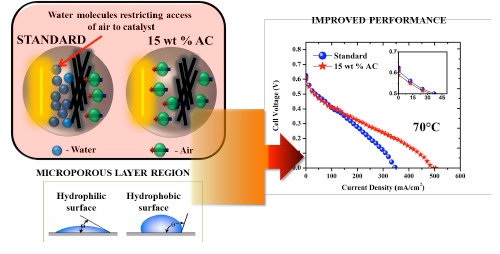
This water, where the rate of formation is high at high current density regions covers the catalyst sites and prevents the incoming the air stream from further accession. This phenomenon – called ‘flooding’ – limits the operation of fuel cells at high current density regions. This is mitigated by optimising pore characteristics of carbon materials used in the gas diffusion layer of membrane electrode assembly (MEA) of a fuel cell.
MEA of a fuel cell consists of gas diffusion layer, catalyst layer and the membrane, all sandwiched together, with each layer playing a prominent role. The gas diffusion layer aids in effective reactant transport, catalyst layer in oxidation/reduction reaction and the membrane layer in transport of protons from anode to the cathode.
Schematic illustration of impact of using activated carbon (AC) in the gas diffusion layer comparable to standard (STD) MEA
Figure 1: Schematic illustration of impact of using activated carbon (AC) in the gas diffusion layer comparable to standard (STD) MEA. (Image: University of Manchester)
The mass transport limitation is addressed by working on the pore structure of carbon materials. Several carbon blacks: Vulcan XC-72, Ketjen Black, Acetylene Black Asbury 850, Denka Black and Mogul L are used widely. In addition to the performance limitation, the precursor for these carbon materials comes from the treatment of hydrocarbons at high temperature and pressure conditions.
In this work, reported in Electrochimica Acta („Enhanced performance based on a hybrid cathode backing layer using a biomass derived activated carbon framework for methanol fuel cells”), Manchester University chemical engineering researchers Prabhuraj Balakrishnan and Stuart M. Holmes prepared an activated carbon framework from tea leaves, obtained from the Black sea region of Tukey (from Ankara University) collaborators.
This framework used in combination with conventional carbon black in the cathode gas diffusion layer, has shown to improve the fuel cell performance by 33% in methanol fuel cell operating conditions.
More specifically, the cell performance underwent drastic changes in the mass transport region of the fuel cell polarization curve (Figure 1), comparable to the standard MEA. This is attributed to the pore structure (75.69% of mesopores and 24.31% of micropores) of this framework aiding in enhanced water removal, as a result more air molecules react with the platinum catalyst sites finally improving the fuel cell performance.
On increasing the composition of this activated carbon framework in the gas diffusion layer, the performance declined due to the poor electrical conductivity of the carbon. This shows that if the electrical conductivity of this activated carbon framework could be improved, this would decrease the reliance on conventional carbon blacks which currently suffers from source material (hydrocarbon) availability in addition to improving performance.
Provided by The University of Manchester as a Nanowerk exclusive

Nanocoatingul face posibilă fabricarea de materiale textile încălzite electric(Nanocoating makes electrically heated textiles possible)

oamenii de știință descriu modul în care utilizează o metodă de depunere a vaporilor pentru tesatura nano-strat pentru a crea sewable, materialul weavable, încălzit electric. Mânușa demonstrativă pe care au făcut-o poate menține degetele în picioare timp de până la opt ore. Mănușa cu trei straturi, cu un strat acoperit de polimerul conductor poli (3,4-etilendioxitiofen), cunoscut și ca PEDOT, este alimentat de o baterie cu buton de greutate de 1,8 grame. Un ban cântărește puțin sub 2,27 grame.Într-un test al capacității țesăturii de a rezista la crăpare, înfundare sau alte schimbări atunci când au fost încălzite, au generat o temperatură de 28 grade C (82,4 F), cu o conexiune la o baterie de 4,5 V și o temperatură de 45 grade C (113 F) -V pentru o oră și nu a găsit „modificări dramatice ale morfologiei”, ceea ce indică faptul că materialul de bumbac acoperit cu PEDOT a fost robust și suficient de stabil pentru a-și menține performanța „când este folosit ca element de încălzire.

Posted: Sep 29, 2017

Nanocoating makes electrically heated textiles possible

(Nanowerk News) Commuters, skiers, crossing guards and others who endure frozen fingers in cold weather may look forward to future relief as manufacturers are poised to take advantage of a new technique for creating electrically heated cloth developed by materials scientist Trisha Andrew and colleagues at the University of Massachusetts Amherst. They have made gloves that keep fingers as warm as the palm of the hand.

In a new paper in Applied Materials & Interfaces („Transforming Commercial Textiles and Threads into Sewable and Weavable Electric Heaters”), the scientists describe how they use a vapor deposition method for nano-coating fabric to create sewable, weavable, electrically heated material. The demonstration glove they made can keep fingers toasty for up to eight hours. The three-layered glove, with one layer coated by the conducting polymer poly(3,4-ethylenedioxytiophene), also known as PEDOT, are powered by a button battery weighing 1.8 grams. A dime weighs just under 2.27 grams.
Nano-coated, Battery Powered Warm Gloves
A three-layered glove developed by materials chemist Trisha Andrew has one layer coated by the conducting polymer PEDOT and is powered by a button battery weighing 1.8 grams. (Image: UMass Amherst)
The authors point out, „Lightweight, breathable and body-conformable electrical heaters have the potential to change traditional approaches to personal thermal management, medical heat therapy, joint pain relief and athletic rehabilitation.”
Andrew says, „We took a pair of cotton gloves and coated the fingers to allow a small amount of current to pass through, so they heat up. It’s regular old-fashioned cotton cloth. We chose to make a pair of gloves because the fingers require a high curvature that allows us to show that our material is really flexible. The glove is powered by a small coin battery and they run on nano-amps of current, not enough to pass current through your skin or to hurt you. Our coating works even when it’s completely dunked in water, it will not shock you, and our layered construction means the conductive cloth does not come into contact with your skin.”
She adds, „We hope to have this reach consumers as a real product in the next few years. Maybe it will be two years to a prototype, and five years to the consumer. I think this is the most consumer-ready device we have. It’s ready to take to the next phase.”
Until recently, textile scientists have not used vapor deposition because of technical difficulties and high cost of scaling up from the laboratory. But recently, manufacturers are finding that the technology can be scaled up while remaining cost-effective, the researchers say. Using the vapor deposition method described in their paper, Andrew and colleagues also coated threads of a thick cotton yarn commonly used for sweaters. It performed well and offers another avenue for creating heated clothing, the authors state.
Andrew says, „One thing that motivated us to make this product is that we could get the flexibility, the nice soft feel, while at the same time it’s heated but not making you sweaty. A common thing we hear from commuters is that in the winter, they would love to have warmer fingers.” In their laboratory tests, her research team reports, four fingers of the test glove warmed to the same temperature as the palm, and „the wearer could feel the heat transferred from the fabric heaters to her fingers a few seconds after the voltage was applied.”
Andrew and chemistry postdoctoral researcher Lushuai Zhang, with chemical engineering graduate student Morgan Baima, conducted several tests to assure that their gloves could stand up to hours of use, laundering, rips, repairs and overnight charging. Andrew notes, „Right now we use an off-the-shelf battery that lasts for eight hours, but you would need a rechargeable to make these more practical.”
Further, „If you are skiing and rip your glove, you can repair it just by sewing it back together with plain thread.”
They arranged for biocompatibility testing at an independent lab where mouse connective tissue cells were exposed to PEDOT-coated samples and responses compared to positive and negative controls. They report that their PEDOT-coated materials are safe for contact with human skin without causing adverse reactions to the chemicals used.
They also addressed questions of heat, moisture and skin contact stability to prevent the wearer from experiencing any electric shock from a wet conducting element. Andrew says, „Chemically, what we use to surround the conductive cloth looks like polystyrene, the stuff used to make packing peanuts. It completely surrounds the conducting material so the electrical conductor is never exposed.”
Experimenting with different variables in the vapor nano-coating process, they found that adjusting temperature and chamber pressure were important in achieving optimal surface coverage of the cloth. In a test of the fabric’s ability to resist cracking, creasing or other changes when heated, they generated a temperature of 28 degrees C (82.4 F) with connection to a 4.5-V battery and 45 degrees C (113 F) connected to a 6-V battery for an hour, and found „no dramatic morphology changes,” indicating that the PEDOT-coated cotton textile was rugged and stable enough to maintain its performance” when used as a heating element.
Source: University of Massachusetts at Amherst

Senzor de hidrogen ultra-rapid și ultra-sensibil pentru nanofire(Ultra-fast and ultra-sensitive nanowire hydrogen sensor)

O echipă KAIST a realizat un senzor de hidrogen ultra rapid care poate detecta nivelurile de gaze de hidrogen sub 1% în mai puțin de șapte secunde. De asemenea, senzorul poate detecta sute de părți la un milion de niveluri de hidrogen gazos în 60 de secunde la temperatura camerei ( materiale și interfețe aplicate ACS , „Nanowires compozit Pd-Ag compozit pentru răspuns rapid și senzori de hidrogen transparent” ).Profesorul Kim se așteaptă ca senzorul ultra-rapid de hidrogen să poată fi util pentru prevenirea accidentelor de explozie provocate de scurgeri de hidrogen gazos. În plus, se așteaptă ca alte gaze nocive din aer să poată fi detectate cu precizie prin nano-filtrare eficientă prin utilizarea unei varietăți de straturi MOF.

Posted: Sep 29, 2017

Ultra-fast and ultra-sensitive nanowire hydrogen sensor

(Nanowerk News) A KAIST team made an ultra-fast hydrogen sensor that can detect hydrogen gas levels under 1% in less than seven seconds. The sensor also can detect hundreds of parts per million levels of hydrogen gas within 60 seconds at room temperature (ACS Applied Materials and Interfaces, „Hollow Pd-Ag Composite Nanowires for Fast Responding and Transparent Hydrogen Sensors „).

A research group under Professor Il-Doo Kim in the Department of Materials Science and Engineering at KAIST, in collaboration with Professor Reginald M. Penner of the University of California-Irvine, has developed an ultra-fast hydrogen gas detection system based on a palladium (Pd) nanowire array coated with a metal-organic framework (MOF).
text
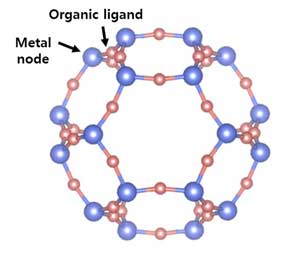
Schematic illustration of a metal-organic framework (MOF). The MOF, consisting of metal ions and organic ligands, is a highly porous material with a ultrahigh surface area. The various structures of MOFs can be synthesized depending on the kinds of metal ions and organic ligands. (Image: KAIST)
Hydrogen has been regarded as an eco-friendly next-generation energy source. However, it is a flammable gas that can explode even with a small spark. For safety, the lower explosion limit for hydrogen gas is 4 vol% so sensors should be able to detect the colorless and odorless hydrogen molecule quickly.
The importance of sensors capable of rapidly detecting colorless and odorless hydrogen gas has been emphasized in recent guidelines issued by the U.S. Department of Energy. According to the guidelines, hydrogen sensors should detect 1 vol% of hydrogen in air in less than 60 seconds for adequate response and recovery times.
Ultra-fast and ultra-sensitive nanowire hydrogen sensor
Representative image of this paper published in ACS Nano on Sept. 26.
To overcome the limitations of Pd-based hydrogen sensors, the research team introduced a MOF layer on top of a Pd nanowire array. Lithographically patterned Pd nanowires were simply overcoated with a Zn-based zeolite imidazole framework (ZIF-8) layer composed of Zn ions and organic ligands. ZIF-8 film is easily coated on Pd nanowires by simple dipping (for 2-6 hours) in a methanol solution including Zn (NO3)2·6H2O and 2-methylimidazole.
As synthesized ZIF-8 is a highly porous material composed of a number of micro-pores of 0.34 nm and 1.16 nm, hydrogen gas with a kinetic diameter of 0.289 nm can easily penetrate inside the ZIF-8 membrane, while large molecules (>0.34 nm) are effectively screened by the MOF filter.
Thus, the ZIF-8 filter on the Pd nanowires allows the predominant penetration of hydrogen molecules, leading to the acceleration of Pd-based H2 sensors with a 20-fold faster recovery and response speed compared to pristine Pd nanowires at room temperature.
Images of Pd nanowire array-based hydrogen sensors, scanning electron microscopy image of a Pd nanowire covered by a metal-organic framework layer, and the hydrogen sensing properties of the sensors
Images of Pd nanowire array-based hydrogen sensors, scanning electron microscopy image of a Pd nanowire covered by a metal-organic framework layer, and the hydrogen sensing properties of the sensors. (Image: KAIST)
Professor Kim expects that the ultra-fast hydrogen sensor can be useful for the prevention of explosion accidents caused by the leakage of hydrogen gas. In addition, he expects that other harmful gases in the air can be accurately detected through effective nano-filtration by using of a variety of MOF layers.
Source: The Korea Advanced Institute of Science and Technology (KAIST)

Progresele înregistrate în procesul de obținere a foilor de nanotuburi de carbon în masă(Progress achieved towards mass producing carbon nanotube sheets)

CNT-urile sunt foi de carbon care au fost laminate în tuburi, măsurând 100.000 de ori mai mici decât diametrul părului uman. Proprietățile lor electrice, chimice, termice și mecanice excepționale le fac un material ideal pentru nenumărate aplicații, inclusiv pentru stocarea energiei, cipuri de calculator și senzori. Potențialul revoluționar al CNT-urilor în ingineria materialelor se reflectă în creșterea prognozată a valorii de piață, care se așteaptă să ajungă la 8,7 miliarde de dolari până în 2022, potrivit analistilor de piață Markets and Markets. Buckypaper este o foaie subțire din nanotuburi de carbon agregate.

Posted: Sep 27, 2017

Progress achieved towards mass producing carbon nanotube sheets

(Nanowerk News) Researchers at the Masdar Institute have recently announced a breakthrough approach to producing carbon nanotube (CNT) sheets, known as ‘buckypaper,’ through a scalable, low-cost and simple technique. The novel fabrication method could help bring game-changing buckypaper applications a step closer towards cost-effective commercialization.

“Being able to produce buckypaper in a scalable way like this has not been demonstrated before. This new technique could boost the development of market-ready applications, including high-power lithium-ion batteries and low-cost vanadium-redox-flow batteries,” said Dr. Rahmat Susantyoko, postdoctoral researcher from the Mechanical Engineering Department.
Dr. Susantyoko was first author of a paper that describes the new technique, called Surface-Engineered Tape-Cast (SETC), which was published last month in the Journal of Materials Chemistry A („A surface-engineered tape-casting fabrication technique toward the commercialisation of freestanding carbon nanotube sheets”).
Buckypaper
Buckypaper
CNTs are sheets of carbon that have been rolled into tubes, measuring 100,000 times smaller than the diameter of human hair. Their exceptional electrical, chemical, thermal and mechanical properties make them an ideal material for countless applications, including in energy storage, computer chips, and sensors. The revolutionary potential of CNTs in materials engineering is reflected by the projected growth of its market value, which is expected to reach US$8.7 billion by 2022, according to market analysts Markets and Markets. Buckypaper is a thin sheet made of aggregated carbon nanotubes.
Despite the technical potential of buckypaper, a critical problem continues to hinder its development for CNT applications. The difficulty of converting CNTs from their original fine, dust-like powdery state, to a solid, thin film of grouped CNTs remains a key challenge.
CNTs in buckypaper form are much easier for engineers to manipulate. In their macroscopic manifestation, CNTs can be processed and developed into useful materials for a broader range of applications. While many innovative buckypaper-based applications have been developed in recent years, they failed to achieve broad commercialization because they lacked a scalable and cost-effective buckypaper fabrication process.
“Common buckypaper fabrication methods used today are membrane filtration and chemical vapor deposition. However both methods have severe limitations, with membrane filtration restricting the size of the produced buckypaper to the size of the membrane and apparatus used, and chemical vapor deposition being exceedingly expensive,” Dr. Susantyoko explained.
Addressing the need for a low-cost, scalable fabrication method, Masdar Institute’s SETC technique offers a novel solution that leverages tape-casting – a method traditionally used to coat a CNT film over a substrate – that overcomes the current technological limitations that have prevented low-cost, scalable buckypaper fabrication till now.
“Our technique utilizes tape-casting with a special type of substrate, which we engineered in the lab, that allows us to easily peel off the buckypaper from the supporting substrate, resulting in a free-standing buckypaper film,” Dr. Susantyoko said.
Identifying the ideal substrate that would allow the buckypaper to easily peel off was the biggest challenge. Through investigation, the team discovered that buckypaper sticks to smooth and randomly-patterned rough surfaces, but separates from a special kind of surface that has a rough structure composed of micro-sized pyramids.
“We realized that the surface morphology of substrate and dissimilarity in surface energy of CNT–substrate play important roles in affecting the ability to easily peel off the CNT film,” Dr. Susantyoko added. He explained that the unique morphology and high surface area created by the micro-pyramids enabled the easy separation of the CNT sheet.
To demonstrate the effectiveness of their SETC buckypaper fabrication technique, the team used it to produce a buckypaper-based cathode for a high-power lithium-ion battery. Now, the team is enhancing their SETC method to produce an even higher-powered cathode, which is intended to be used for space applications.
By providing materials scientists with a scalable, low-cost and simple method to fabricate CNT sheets, Masdar Institute researchers are helping to bring the game-changing CNT innovations being developed in labs across the world to the market.