Pe calea către roboți moleculari(On the path toward molecular robots)

au creat cu succes un compus chimic sau o ansamblu cristalin, care repetă în mod autonom flipping sub lumină albastră .Echipa a făcut cristale compuse dintr-un compus organic, numit azobenzen, utilizat în mod obișnuit în fabricarea vopselelor, și acidul oleic, care se găsește în ulei de gătit. Moleculele azobenzenului au două forme diferite, structurale: cis și trans. Se convertesc repetat de la o formă la alta sub dreapta albastră.

Posted: Jul 06, 2016

On the path toward molecular robots

(Nanowerk News) Researchers are working on mimicking cellular systems to develop molecular motors that can move or even deliver drugs to target tissues. Engineering such motors may ultimately lead to molecular robots that can execute more complex tasks. To this end, researchers must find ways to convert motion at the molecular level to motion at the macroscopic level. They also must find ways to cause chemical reactions to repeat autonomously and continuously.

Yoshiyuki Kageyama, Sadamu Takeda and colleagues at Hokkaido University’s Department of Chemistry have successfully created a chemical compound, or a crystalline assembly, which autonomously repeated flipping under blue light (Angewandte Chemie International Edition, „Dissipative and Autonomous Square-Wave Self-Oscillation of a Macroscopic Hybrid Self-Assembly under Continuous Light Irradiation”).
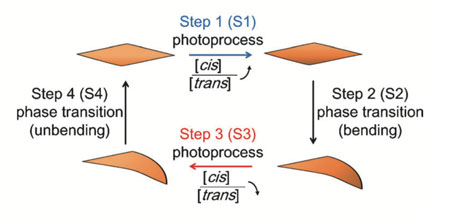
Schematic illustration of each step of a self-oscillatory motion
Schematic illustration of each step of the self-oscillatory motion.
The team made crystals composed of an organic compound, called azobenzene, commonly used in dye manufacturing, and oleic acid, commonly found in cooking oil. Azobenzene molecules take two structurally different forms: cis and trans. They repetitively convert from one form to the other under blue right. The scientists tested if this would influence the structure of the azobenzene-oleic acid crystal, which contained unequal amounts of cis- and trans-azobenzene.
By applying blue light to the crystals in solution, the team observed, under a microscope, an oscillatory bending-unbending motion of the thin crystals, suggesting the existence of two stable structures, bent or unbent, depending on the cis/trans ratio. The frequency of the motion increased when the light intensity was increased. Some crystal complexes even exhibited ‘swimming-like’ motions in the water.
Previously reported light-responsive materials have been limited in their ability to deform. The properties of the compounds in the Hokkaido University-developed crystals, however, allowed for a two-step switching mechanism, resulting in regular repetitive oscillations.
Source: Hokkaido University

Read more: On the path toward molecular robots
IARPA pentru a găzdui Zilele propunerilor pentru evaluarea individuală a programelor pentru senzori(IARPA to Host Proposers Day For Individual Evaluation Sensor Tool Program)

programe senzori ;IARPA se așteaptă ca programul să aibă loc în două etape, care vor implica testarea unui set de senzori pe voluntari

Stimpex 13

O privire apropiată asupra nanomaterialelor ultra-subțiri pentru uz industrial (A close up look at ultra-thin nanomaterials for industrial use )

Nanomaterialele bidimensionale (2D) constau din straturi ultra-subțiri, care pot fi la fel de subțiri ca un singur atom. Natura ultra-subțire a nanomaterialelor 2D le conferă proprietăți speciale, cum ar fi rapoartele de suprafață ridicate și proprietățile termice și electronice excepționale. Acest lucru a pus în evidență aplicații în domeniul electronicii moderne, al stocării și al recoltării energiei.

Postat: Jul 05, 2016

O privire apropiată asupra nanomaterialelor ultra-subțiri pentru uz industrial

( Nanowerk News ) Avansurile în nanomateriale țin promisiunea unor produse noi, mai bune și mai competitive. Proiectul 2DInterFOX finanțat de UE caută noi perspective asupra comportamentului lor – rezultatele ar putea ajuta producătorii să dezvolte noi produse electronice și legate de consumul de energie, potențiali care să le stimuleze competitivitatea.

nanomateriale
În timp ce potențialul nanomaterialelor și nanotehnologiilor este bine documentat, traducerea științei celor foarte mici în succesul comercial a fost un proces dificil.
Nanomaterialele bidimensionale (2D) constau din straturi ultra-subțiri, care pot fi la fel de subțiri ca un singur atom. Natura ultra-subțire a nanomaterialelor 2D le conferă proprietăți speciale, cum ar fi rapoartele de suprafață ridicate și proprietățile termice și electronice excepționale. Acest lucru a pus în evidență aplicații în domeniul electronicii moderne, al stocării și al recoltării energiei.
Spre deosebire de materialele tradiționale în vrac, există mai mulți atomi pe suprafața unui material 2D decât în ​​mijlocul acestuia. Atomii de suprafață acționează diferit față de atomii din interiorul unui material, deci atunci când există mai mulți atomi de suprafață decât atomii din interiorul lor, modul în care se comportă afectează modul în care se comportă un material.
Cu toate acestea, multe sunt încă necunoscute despre materialele 2D la nivel atomic și, în special, despre interacțiunea materialelor 2D cu alte nanomateriale.
2DInterFOX va încerca să ofere răspunsuri cu privire la interacțiunile dintre nanomaterialele 2D și materialele non-metalice de oxid 2D care sunt utilizate în industria electronică și în domeniul energetic. Aceste informații ar putea ajuta industria să mărească integrarea nanomaterialelor 2D cu alte tipuri de nanostructuri. O asemenea descoperire ar putea fi utilizată în aplicații electronice flexibile, transparente, cu costuri reduse sau în sectorul energetic.
2DInterFOX propune utilizarea tehnicilor de scanare electronică prin microscopie electronică (STEM), prin care se transmite un fascicul de electroni printr-o mostră ultra-subțire, pentru a crea o imagine a structurii eșantionului la nivel atomic și pentru a afla mai multe despre interacțiunile chimice și electronice ale Materialele 2D cu nanostructuri de oxid de metal.
Sursa: Comisia Europeană

Read more: A close up look at ultra-thin nanomaterials for industrial use

Materialul plastic nou începe să oscileze în mod spontan în lumina soarelui (New plastic material begins to oscillate spontaneously in sunlight )

Provocarea a fost găsirea unui material care se comportă în acest fel în lumină vizibilă, de preferință lumina solară neprelucrată.au reușit acum să producă un strat de polimer subțire care conține molecule sensibile la lumină (azo-coloranți).Una dintre principalele posibilități de utilizare a materialului este ca suprafață autocurătoare.

Posted: Jul 05, 2016

New plastic material begins to oscillate spontaneously in sunlight

(Nanowerk News) Materials that move all by themselves under the influence of light – this phenomenon has been known for a number of years. However, since the source tends to be ultraviolet light, the required intensity can damage the material. The challenge was to find a material that behaves in this way in visible light, preferably unprocessed sunlight.

The researchers from Eindhoven and Berlin have now succeeded in producing a thin polymer layer containing light-sensitive molecules (azo-dyes). Lying in sunlight, the thin film begins to oscillate spontaneously and irregularly (Nature Communications, „A chaotic self-oscillating sunlight-driven polymer actuator”).
Plastic Begins to Oscillate Spontaneously
Why the plastic begins to oscillate spontaneously is something that the researchers cannot yet quite explain. (Image: Eindhoven University of Technology)
Combination of factors
Why the plastic does this is something that the researchers cannot yet quite explain. „It seems to be a combination of factors,” suggests TU/e researcher Michael Debije. „The light-sensitive molecules bend and stretch under the influence of visible light. Since these molecules are bound within the polymer network of crystal, this results in the material oscillating as if cramped. Of course, there’s more to it than that – this is what we are investigating now.”
Self-cleaning
One of the main possibilities for using the material is as a self-cleaning surface. „A surface that vibrates in the sun makes it difficult for sand and dust to stick to it,” Debije says. Fellow researcher, Dick Broer, thinks that self-cleaning solar panels in the desert where there are no water supplies could be an option. But the researchers believe there is a whole range of other possible applications.
„We have just discovered the effect; we expect that this will attract attention from many researchers from whom we will be hearing a lot over the coming period,” Debije says.
Source: Eindhoven University of Technology

Read more: New plastic material begins to oscillate spontaneously in sunlight

Trioul integrat de nanomateriale 2D deblochează aplicațiile electronice grafen (Integrated trio of 2D nanomaterials unlocks graphene electronics applications )

Conductibilitatea termică extrem de ridicată a grafenului este un avantaj suplimentar în structura dispozitivului prin facilitarea eliminării căldurii. Proprietățile unice de conducție termică ale grafenului au fost descoperite experimental și explicate teoretic în 2008

Posted: Jul 05, 2016

Integrated trio of 2D nanomaterials unlocks graphene electronics applications

(Nanowerk News) Graphene has emerged as one of the most promising two-dimensional crystals, but the future of electronics may include two other nanomaterials, according to a new study by researchers at the University of California, Riverside and the University of Georgia.

In research published Monday (July 4) in the journal Nature Nanotechnology („A charge-density-wave oscillator based on an integrated tantalum disulfide–boron nitride–graphene device operating at room temperature”), the researchers described the integration of three very different two-dimensional (2D) materials to yield a simple, compact, and fast voltage-controlled oscillator (VCO) device. A VCO is an electronic oscillator whose oscillation frequency is controlled by a voltage input.
integrated Tantalum Sulfide—Boron Nitride—Graphene Oscillator
A schematic of the integrated Tantalum Sulfide—Boron Nitride—Graphene Oscillator developed at UCR, which is the first useful device that exploits the potential of charge-density waves to modulate an electrical current through a 2D material.
The paper describes the development of the first useful device that exploits the potential of charge-density waves to modulate an electrical current through a 2D material. The new technology could become an ultralow power alternative to conventional silicon-based devices, which are used in thousands of applications from computers to clocks to radios. The thin, flexible nature of the device would make it ideal for use in wearable technologies.
Graphene, a single layer of carbon atoms that exhibits exceptional electrical and thermal conductivities, shows promise as a successor to silicon-based transistors. However, its application has been limited by its inability to function as a semiconductor, which is critical for the ‘on–off’ switching operations performed by electronic components.
To overcome this shortfall, the researchers turned to another 2D nanomaterial, Tantalum Sulfide (TaS2). They showed that voltage-induced changes in the atomic structure of the ‘1T prototype’ of TaS2 enable it to function as an electrical switch at room temperature—a requirement for practical applications.
“There are many charge-density wave materials that have interesting electrical switching properties. However, most of them reveal these properties at very low temperature only. The particular polytype of TaS2 that we used can have abrupt changes in resistance above room temperature. That made a crucial difference,” said Alexander Balandin, UC presidential chair professor of electrical and computer engineering in UCR’s Bourns College of Engineering, who led the research team.
To protect the TaS2 from environmental damage, the researchers coated it with another 2D material, hexagonal boron nitrate, to prevent oxidation. By pairing the boron nitride-capped TaS2 with graphene, the team constructed a three-layer VCO that could pave the way for post-silicon electronics. In the proposed design, graphene functions as an integrated tunable load resistor, which enables precise voltage control of the current and VCO frequency. The prototype UCR devices operated at MHz frequency used in radios, and the extremely fast physical processes that define the device functionality allow for the operation frequency to increase all the way to THz.
Balandin said the integrated system is the first example of a functional voltage-controlled oscillator device comprising 2D materials that operates at room temperature. “It is difficult to compete with silicon, which has been used and improved for the past 50 years. However, we believe our device shows a unique integration of three very different 2D materials, which utilizes the intrinsic properties of each of these materials. The device can potentially become a low-power alternative to conventional silicon technologies in many different applications,” Balandin said.
The electronic function of graphene envisioned in the proposed 2D device overcomes the problem associated with the absence of the energy band gap, which so far prevented graphene’s use as the transistor channel material. The extremely high thermal conductivity of graphene comes as an additional benefit in the device structure, by facilitating heat removal. The unique heat conduction properties of graphene were experimentally discovered and theoretically explained in 2008 by Balandin’s group at UCR. The Materials Research Society recognized this groundbreaking achievement by awarding Balandin the MRS Medal in 2013.
The Balandin group also demonstrated the first integrated graphene heat spreaders for high-power transistors and light-emitting diodes. “In those applications, graphene was used exclusively as heat conducting material. Its thermal conductivity was the main property. In the present device, we utilize both electrical and thermal conductivity of graphene,” Balandin added.
Source: University of California, Riverside

Read more: Integrated trio of 2D nanomaterials unlocks graphene electronics applications

Tehnologia Nanocoating îmbunătățește teflonul(Nanocoating technology improves Teflon)

a inventat stratul compozit de nanoparticule PTFE în așteptare.stratul de acoperire va fi testat ca lubrifiant în rulmenții cu bile pentru motoarele electrice care sunt spălate frecvent cu soluții de curățare caustică. Produsul SurfTec este de așteptat să mărească durata de viață a rulmenților cu bile cu 50% comparativ cu rulmenții lubrifiați cu grăsime.

Posted: Jul 05, 2016

Nanocoating technology improves Teflon

(Nanowerk News) The National Science Foundation has awarded $225,000 to start-up company SurfTec LLC to commercialize its patent-pending technology invented at the University of Arkansas.SurfTec, a U of A-affiliated company at the Arkansas Research and Technology Park, will use the grant to investigate the feasibility of a novel approach that significantly improves wear resistance of polytetrafluoroethylene coatings.Samuel Beckford (left) and Min ZouSurfTec co-founders Samuel Beckford (left) and Min Zou discuss their research in the Nano Mechanics and Tribology Laboratory at the University of Arkansas.Polytetrafluoroethylene (PTFE) is better known by its trademarked brand name: Teflon. SurfTec will show that its nano-coating technology – a thinner and more durable version of Teflon – will reduce friction and wear in manufacturing equipment, according to company co-founder Samuel Beckford.Beckford, as a graduate student at the U of A, invented the patent-pending PTFE nanoparticle composite coating with SurfTec co-founder Min Zou, professor of mechanical engineering.Initially, the coating will be tested as a lubricant in ball bearings for electric motors that are frequently washed with caustic cleaning solutions. SurfTec’s product is expected to increase the wear-life of ball bearings by 50 percent compared to grease-lubricated bearings.“Our research has shown that PTFE nanoparticle composite coatings have exceptionally low friction and durability,” Beckford said. “Historically, the use of Teflon in bearings has been limited due to a poor wear life and low adhesion to bearing components. Our thin, low-friction nanoparticle coating eliminates these weaknesses.”Beckford, who earned a doctorate in microelectronics-photonics from the U of A, has worked with Zou for the past six years on research related to the proposed coating technology. They have conducted the research in Zou’s Nano Mechanics and Tribology Laboratory in the College of Engineering.The Phase I grant came through NSF’s Small Business Innovation Research Program, which allows federal agencies to stimulate technological innovation in the private sector by strengthening small businesses that meet federal research and development needs. The program also is intended to increase the commercial application of federall

Read more: Nanocoating technology improves Teflon